

What do you think?

Pozaziemskie oceany. Poszukiwanie życia w głębinach kosmosu
Być może nie ma we wszechświecie nikogo poza nami. Być może powstanie życia jest trudne, a samo życie – rzadkie. A może odległe planety, księżyce i gwiazdy tętnią życiem, którego wciąż jeszcze nie odkryliśmy?
Pod skorupami niewielkich, pokrytych lodem księżyców Jowisza i Saturna znajdują się ogromne oceany, istniejące prawdopodobnie równie długo jak nasza planeta. Czy kryją w sobie jakieś formy życia? Z tej książki dowiemy się, jak nauka poszukuje odpowiedzi na to ekscytujące pytanie.
Kevin Peter Hand, jeden z czołowych naukowców NASA, prowadzi pionierskie badania, które zawiodły go w najróżniejsze zakątki naszego globu. W tej pasjonującej opowieści łączy wiedzę z zakresu planetologii i biologii, aby wyjaśnić, skąd wiemy, że na Europie, Tytanie czy Enceladusie istnieją oceany, i jak zbadać panujące tam warunki.
Odkrycia, które na nas czekają, mogą doprowadzić do rewolucji w sposobie pojmowania naszego miejsca we wszechświecie. Czy rzeczywiście jesteśmy tak wyjątkowi? A może Ziemia jest tylko jedną z wielu żyjących planet orbitujących wokół całkiem przeciętnej gwiazdy?
Pod skorupami niewielkich, pokrytych lodem księżyców Jowisza i Saturna znajdują się ogromne oceany, istniejące prawdopodobnie równie długo jak nasza planeta. Czy kryją w sobie jakieś formy życia? Z tej książki dowiemy się, jak nauka poszukuje odpowiedzi na to ekscytujące pytanie.
Kevin Peter Hand, jeden z czołowych naukowców NASA, prowadzi pionierskie badania, które zawiodły go w najróżniejsze zakątki naszego globu. W tej pasjonującej opowieści łączy wiedzę z zakresu planetologii i biologii, aby wyjaśnić, skąd wiemy, że na Europie, Tytanie czy Enceladusie istnieją oceany, i jak zbadać panujące tam warunki.
Odkrycia, które na nas czekają, mogą doprowadzić do rewolucji w sposobie pojmowania naszego miejsca we wszechświecie. Czy rzeczywiście jesteśmy tak wyjątkowi? A może Ziemia jest tylko jedną z wielu żyjących planet orbitujących wokół całkiem przeciętnej gwiazdy?
374 pages, Paperback
First published April 7, 2020
Ratings & Reviews
Friends & Following
Create a free account to discover what your friends think of this book!
Community Reviews
Displaying 1 - 30 of 165 reviews

July 21, 2020
I’ve always maintained a bit of an interest in space exploration, and over the past couple of decades I’ve read with some amazement of the discovery of subsurface oceans of water in some of the bodies of the outer Solar System. This book provides a comprehensive overview of these discoveries.
To begin with, the author explains how scientists came to discover the existence of the oceans. Suffice to say it’s not simply a matter of looking through a telescope. Right throughout the book though, the author explains the relevant physics, maths, chemistry and biology in ways that are very clear to the layman.
The book concentrates on Europa, Enceladus and Titan, where the existence of oceans has been established beyond doubt. There’s a fairly heavy emphasis on Europa, which the author sees as the most likely world to harbour life. In one chapter he does a brief tour of Ganymede, Callisto, Triton and Pluto, which are also worlds that are very likely to have subsurface oceans.
After discussing the science of the alien oceans, the author moves onto speculate not just whether these worlds have life, but what sort of life they may have. He admits that this section of the book is pure conjecture but adds that it’s something that is fun to ponder. I think this part of the book has to be read in that spirit, as it is indeed very speculative. It then finishes strongly, with a description of what the next steps might be in investigating the ocean worlds. There are likely to be two missions to orbit Jupiter’s icy moons in the late 2020s (one from NASA and one from the European Space Agency), and he hopes that a landing on Europa might be achieved by the mid-2040s.
It’s not part of the book, but my own feeling is that if we do find more than one world with life within a single planetary system, then it’s reasonably safe to assume that microbial life at least will have arisen in vast numbers of other worlds within our galaxy.
I listened to the audio version of this book, which maybe wasn’t the best choice as it’s the sort of the book I would like to refer back to, and it’s less easy to do that with audio. The author narrates his own book, and whilst he doesn’t do a bad job, I didn’t think he was as good as a trained narrator.
If like me you have an interest in the subject, you will find this to be absolutely fascinating.
To begin with, the author explains how scientists came to discover the existence of the oceans. Suffice to say it’s not simply a matter of looking through a telescope. Right throughout the book though, the author explains the relevant physics, maths, chemistry and biology in ways that are very clear to the layman.
The book concentrates on Europa, Enceladus and Titan, where the existence of oceans has been established beyond doubt. There’s a fairly heavy emphasis on Europa, which the author sees as the most likely world to harbour life. In one chapter he does a brief tour of Ganymede, Callisto, Triton and Pluto, which are also worlds that are very likely to have subsurface oceans.
After discussing the science of the alien oceans, the author moves onto speculate not just whether these worlds have life, but what sort of life they may have. He admits that this section of the book is pure conjecture but adds that it’s something that is fun to ponder. I think this part of the book has to be read in that spirit, as it is indeed very speculative. It then finishes strongly, with a description of what the next steps might be in investigating the ocean worlds. There are likely to be two missions to orbit Jupiter’s icy moons in the late 2020s (one from NASA and one from the European Space Agency), and he hopes that a landing on Europa might be achieved by the mid-2040s.
It’s not part of the book, but my own feeling is that if we do find more than one world with life within a single planetary system, then it’s reasonably safe to assume that microbial life at least will have arisen in vast numbers of other worlds within our galaxy.
I listened to the audio version of this book, which maybe wasn’t the best choice as it’s the sort of the book I would like to refer back to, and it’s less easy to do that with audio. The author narrates his own book, and whilst he doesn’t do a bad job, I didn’t think he was as good as a trained narrator.
If like me you have an interest in the subject, you will find this to be absolutely fascinating.

March 14, 2021
Mars used to be the great hope for life in our solar system because it was known Mars had water. Now we know there's no water anymore and the focus has shifted to some of the moons in our solar system.
I was surprised and fascinated to learn that over two hundred moons have been discovered that orbit the other planets, and there are thought to be more. Mercury and Venus, closest to the sun, have none and we've got the one. The other planets and Pluto, whatever it is, all have multiple moons. Jupiter has eighty that have been confirmed and Saturn over fifty -- each likely has many more. Uranus has 27 confirmed moons, Neptune 14 and Pluto, whatever it is, is known to have five; all are believed to have more.
For those of you who, like me, didn't know, how cool, right? Amazing! But I didn't learn this from the book. I learned it and a lot more from searching, streaming and from websites. Some of the information in this review comes from a documentary and a few YouTube videos I watched and supplemental reading on the internet -- after finishing this poorly-written and disorganized book.
To be fair, the subject is not solar system exploration in general so the number of moons isn't relevant, but in this book about moons which contains less interesting extraneous information, I would have liked these few facts to be included. The writing ruined the book for me. At best this book served as an amuse bouche that turned my usual appetite for anything space into intense hunger.
Hand writes about only those moons and Pluto that are known to have the possibility of life. It's a hard subject to write about because there are many tantalizing questions without answers. Since most of the search for life is based on conjecture, the book is full of "may" and "could," "potentially" and other qualifiers. In Hand's hands this gets tedious; a better writer would have handled it better by making it clear at the outset rather than repeating them repeatedly.
There are believed to be three conditions essential for life in our solar system and in the beginning Hand writes:
"to understand the sweet spot for habitability and why some of these ice-covered moons might reside in that sweet spot...we begin with the classic story of Goldilocks."
Get it? Three conditions: Goldilocks. The fairytale metaphor comes off as foolish.* And Goldilocks doesn't just have a cameo; she's mentioned throughout, to the end. It's meant to make this crucial point which needs no fairytale character:
"Life needs three things: liquid water, the elements to build life, and the energy to sustain life."
[*I have been corrected by Jenna in the comments section. The Goldlilocks Zone is actually a standard scientific term for the three conditions necessary for life to arise in our solar system. Because the author never makes that clear and for other reasons, I wish Jenna had written this book.]
So: the moons that are already known to have ice crusts are of great interest, as is Pluto, whatever it is. Also promising is Jupiter's Io, which is made of volcanos. On earth the elements to build came from hydrothermal vents located at the bottom of the ocean. Ice crusts could have oceans beneath, and though Hand never says anything this simply, just think about rivers and lakes freezing with flowing water below. Where there is water, thermal vents or other sorts of formations to introduce elements and bacteria to mix with them, there is a good chance there's life there.
Hand never makes clear whether this is the general consensus of all scientists in the field; certainly many believe that but he writes as if everyone does and I wanted clarification on that. And other things, such as this:
"The density change in water across the liquid–solid boundary (at the pressure of Earth’s surface) goes from 0.9999 grams per cubic centimeter (g/cm3) of liquid water at 0 °C, to 0.9167 g/cm3 once it freezes at 0 °C. That is about a 9% change in density! Curiously, water has an even higher density at 4 °C than at 0 °C in the liquid phase. At 4 °C water is 1.0000 g/cm3."
I'm not gifted in math or science and he never explained what it means. I had no idea and that was frustrating. Fortunately a GR friend who had read the book and who understands these matters commented on my highlight: "It's a fancy way of saying water takes up 9% more space as ice than it does as a liquid." Thank you for translating that for this mortal's mind.
In explaining how water is made of oxygen and hydrogen atoms whose electrons hook up (I think that's what he's explaining) he uses a long section in which he's got the atoms and electrons riding a Ferris wheel. They ride the Ferris wheel ad nauseum, which came close to inducing nausea in me. I wrote a note on the highlight that says: "All these words he used and I don't even know what the point is..." And I still don't. There's also this, and more like it:
"The angle between the hydrogen branches of the pyramid (i.e., linking H-O-H) is 104.5 degrees (Figure 2.1c). The electrons distributed on the other side of the molecule also form an angle of 104.5 degrees, with the oxygen atom at the vertex."
Over the course of two chapters he uses the analogy of a baby and babysitter (safe to say nonscientific terms?) and within them is this:
"...the total would look something like: 0.66mara2 + 0.66mbrb2 + 0.66mcrc2 +.…, where the subscripts a, b, and c refer to the different layers. With the exception of the outermost layer, the radii of the inner shells must be smaller than the total radius, R. For example, rb might be half the full radius, which would mean rb = R/2. If we now plug in R/2 for rb in the expression above, we see that ½ becomes ¼ after it’s squared; and then it divides into 0.66, and the new term is 0.16mbR."
Forgive but I can't resist including two more examples from among the silly and distracting: Humpty Dumpty being thrown off the Empire State Building and an octopus holding a hammer.
There's a lot of riveting information in Alien Oceans because the subject is inherently riveting. Some of it is written clearly. Hand includes some history of exploration and some information about projects underway or soon to take off that will gather much more detailed information. Based on what is known now, Jupiter's Europa and Saturn's Enceladus are most likely to have some sort of life.
The European Space Agency's Jupiter's Icy Moons Explorer, aka JUICE, spacecraft leaves next year to explore Europa and two other moons of Jupiter. It will enter Jupiter's orbit in 2030. As I write it's exactly a month since Perseverance landed on Mars. The rock samples it's collecting as I write will arrive on earth a year after JUICE gets to Jupiter. There's a NASA spacecraft headed for Saturn's Titan and plans being finalized to send one to Enceladus, which is the best hope of some scientists. Big things are happening in space exploration, beautiful ones.
Some of the information in the last two paragraphs came from the book but some came from other sources; I can't be sure which is which because now I know there's a lot of information available about the search for life. This is a topic I'm fascinated by but hadn't read much about. Two of my GR friends enjoyed Alien Oceans and there are other good reviews. This was not my book but, given the right conditions, it may be yours.
I was surprised and fascinated to learn that over two hundred moons have been discovered that orbit the other planets, and there are thought to be more. Mercury and Venus, closest to the sun, have none and we've got the one. The other planets and Pluto, whatever it is, all have multiple moons. Jupiter has eighty that have been confirmed and Saturn over fifty -- each likely has many more. Uranus has 27 confirmed moons, Neptune 14 and Pluto, whatever it is, is known to have five; all are believed to have more.
For those of you who, like me, didn't know, how cool, right? Amazing! But I didn't learn this from the book. I learned it and a lot more from searching, streaming and from websites. Some of the information in this review comes from a documentary and a few YouTube videos I watched and supplemental reading on the internet -- after finishing this poorly-written and disorganized book.
To be fair, the subject is not solar system exploration in general so the number of moons isn't relevant, but in this book about moons which contains less interesting extraneous information, I would have liked these few facts to be included. The writing ruined the book for me. At best this book served as an amuse bouche that turned my usual appetite for anything space into intense hunger.
Hand writes about only those moons and Pluto that are known to have the possibility of life. It's a hard subject to write about because there are many tantalizing questions without answers. Since most of the search for life is based on conjecture, the book is full of "may" and "could," "potentially" and other qualifiers. In Hand's hands this gets tedious; a better writer would have handled it better by making it clear at the outset rather than repeating them repeatedly.
There are believed to be three conditions essential for life in our solar system and in the beginning Hand writes:
"to understand the sweet spot for habitability and why some of these ice-covered moons might reside in that sweet spot...we begin with the classic story of Goldilocks."
Get it? Three conditions: Goldilocks. The fairytale metaphor comes off as foolish.* And Goldilocks doesn't just have a cameo; she's mentioned throughout, to the end. It's meant to make this crucial point which needs no fairytale character:
"Life needs three things: liquid water, the elements to build life, and the energy to sustain life."
[*I have been corrected by Jenna in the comments section. The Goldlilocks Zone is actually a standard scientific term for the three conditions necessary for life to arise in our solar system. Because the author never makes that clear and for other reasons, I wish Jenna had written this book.]
So: the moons that are already known to have ice crusts are of great interest, as is Pluto, whatever it is. Also promising is Jupiter's Io, which is made of volcanos. On earth the elements to build came from hydrothermal vents located at the bottom of the ocean. Ice crusts could have oceans beneath, and though Hand never says anything this simply, just think about rivers and lakes freezing with flowing water below. Where there is water, thermal vents or other sorts of formations to introduce elements and bacteria to mix with them, there is a good chance there's life there.
Hand never makes clear whether this is the general consensus of all scientists in the field; certainly many believe that but he writes as if everyone does and I wanted clarification on that. And other things, such as this:
"The density change in water across the liquid–solid boundary (at the pressure of Earth’s surface) goes from 0.9999 grams per cubic centimeter (g/cm3) of liquid water at 0 °C, to 0.9167 g/cm3 once it freezes at 0 °C. That is about a 9% change in density! Curiously, water has an even higher density at 4 °C than at 0 °C in the liquid phase. At 4 °C water is 1.0000 g/cm3."
I'm not gifted in math or science and he never explained what it means. I had no idea and that was frustrating. Fortunately a GR friend who had read the book and who understands these matters commented on my highlight: "It's a fancy way of saying water takes up 9% more space as ice than it does as a liquid." Thank you for translating that for this mortal's mind.
In explaining how water is made of oxygen and hydrogen atoms whose electrons hook up (I think that's what he's explaining) he uses a long section in which he's got the atoms and electrons riding a Ferris wheel. They ride the Ferris wheel ad nauseum, which came close to inducing nausea in me. I wrote a note on the highlight that says: "All these words he used and I don't even know what the point is..." And I still don't. There's also this, and more like it:
"The angle between the hydrogen branches of the pyramid (i.e., linking H-O-H) is 104.5 degrees (Figure 2.1c). The electrons distributed on the other side of the molecule also form an angle of 104.5 degrees, with the oxygen atom at the vertex."
Over the course of two chapters he uses the analogy of a baby and babysitter (safe to say nonscientific terms?) and within them is this:
"...the total would look something like: 0.66mara2 + 0.66mbrb2 + 0.66mcrc2 +.…, where the subscripts a, b, and c refer to the different layers. With the exception of the outermost layer, the radii of the inner shells must be smaller than the total radius, R. For example, rb might be half the full radius, which would mean rb = R/2. If we now plug in R/2 for rb in the expression above, we see that ½ becomes ¼ after it’s squared; and then it divides into 0.66, and the new term is 0.16mbR."
Forgive but I can't resist including two more examples from among the silly and distracting: Humpty Dumpty being thrown off the Empire State Building and an octopus holding a hammer.
There's a lot of riveting information in Alien Oceans because the subject is inherently riveting. Some of it is written clearly. Hand includes some history of exploration and some information about projects underway or soon to take off that will gather much more detailed information. Based on what is known now, Jupiter's Europa and Saturn's Enceladus are most likely to have some sort of life.
The European Space Agency's Jupiter's Icy Moons Explorer, aka JUICE, spacecraft leaves next year to explore Europa and two other moons of Jupiter. It will enter Jupiter's orbit in 2030. As I write it's exactly a month since Perseverance landed on Mars. The rock samples it's collecting as I write will arrive on earth a year after JUICE gets to Jupiter. There's a NASA spacecraft headed for Saturn's Titan and plans being finalized to send one to Enceladus, which is the best hope of some scientists. Big things are happening in space exploration, beautiful ones.
Some of the information in the last two paragraphs came from the book but some came from other sources; I can't be sure which is which because now I know there's a lot of information available about the search for life. This is a topic I'm fascinated by but hadn't read much about. Two of my GR friends enjoyed Alien Oceans and there are other good reviews. This was not my book but, given the right conditions, it may be yours.

November 2, 2020
This is a really interesting look at the state of astrobiology at the time of its writing, and like the science itself, has a sometimes frustrating mix of brilliant hard science with wild speculation.
The science on how we know that the outer planet's moons have seas is fascinating reading, and varies between extremely direct (flying the Cassini probe through the water plumes from Saturn's moon Enceladus) to the more speculative where the evidence isn't quite as strong (the outer moons of Jupiter for instance).
Likewise the discussion of alternate biochemistry is also interesting, if a bit more speculative. At least it gives some likely alternatives.
Where it all comes a bit unstuck for me is some much wilder speculation later in the book about actual icy moon ecosystems and life forms. It just doesn't really fit with the harder science in most of the rest of the book.
Still, I think the first two thirds is good enough reason to read this.
The science on how we know that the outer planet's moons have seas is fascinating reading, and varies between extremely direct (flying the Cassini probe through the water plumes from Saturn's moon Enceladus) to the more speculative where the evidence isn't quite as strong (the outer moons of Jupiter for instance).
Likewise the discussion of alternate biochemistry is also interesting, if a bit more speculative. At least it gives some likely alternatives.
Where it all comes a bit unstuck for me is some much wilder speculation later in the book about actual icy moon ecosystems and life forms. It just doesn't really fit with the harder science in most of the rest of the book.
Still, I think the first two thirds is good enough reason to read this.

August 18, 2020
Having just read The Sirens of Mars by another JPL alum, I feel for Kevin Hand. Exploration of Mars has gotten the lion's share of funding at NASA in the last twenty-five years, so when Hand wants to cite data in reference to his thoughts on the possibilities of life on the watery (icy) moons of the outer Solar System, the data is both old and scant. That said, what we do know is intriguing, and it would seem that NASA would gladly mount interesting missions to Europa, one of Jupiter's more promising moons, and to other Jovian moons if Congress would appropriate funds. It seems unlikely though, that the focus on Mars will end soon, especially since Mars is so much easier to reach; Jupiter is, on average, eight times further from Earth than Mars, so getting to the vicinity of Europa is just harder.
It will be quite some time before we know even a fraction as much about the ice moons as we do about Mars, but in the meantime, Hand's book is a good primer on the possibilities for life there.
It will be quite some time before we know even a fraction as much about the ice moons as we do about Mars, but in the meantime, Hand's book is a good primer on the possibilities for life there.

September 8, 2025
Книга містера Генда чудово працює разом із книгою «Усі ці світи ваші» Джона Вілліса і є чудовим продовженням, для тих, кому інформації було не достатньо. Там де Джон дає короткий зміст, Генд тему пояснює розлогіше, додаючи нових конотацій. Майже в усіх аспектах його книга ліпша. Починаючи з описом придатних для життя планет, завершуючи поясненням стосовно складнощів зародження життя на цих планетах. І це не просто спам академічних даних, але збіса цікава оповідь з непоганими порівняннями.

April 9, 2021
“ To turn a classic phrase on its head, failure has to be an option when you are trying to do new things and push the frontier. Fail early and often, and learn from your failures. Kivelson and her team were quick studies in the art of failure. Not long after they failed, they won. It turns out that the mission to Jupiter included two components: the orbiter and a probe. The probe would dive into Jupiter’s atmosphere and send back a small, but very useful, dataset as it plummeted into Jupiter. ”
Brilliantly written. I half-read this and half-listened to the audiobook. Usually it's easy for me to get distracted when it comes to non-fiction books because non-fiction books have the tendency to be so repetitive and monotonous in tone (esp. general non-fiction books). I read/listened to it in morning right after I wake up. I think this is definitely a morning book, and not a pre-bed book, but you do you.
I must confess that I found the first chapter slightly confusing because before reading this, I knew nothing about the existence of these 'alien oceans'. But the writer explains so well that it's almost impossible to not understand. I don't know if not knowing anything before reading this is an advantage? Because I found it all so fresh/new and exciting.
Also, knowing now that the surface of 'Europa' is super salty, well - this makes me more excited to read and learn more about halophytic plants. Yes, I do believe that halophytic plants will become more and more important in the very near future (if they aren't already). They literally recycle human shit, what more can
one ask for?
And no, there is no astrobotany in this book, but it's still very good. Also, the book ends with a hopeful note about a lonely robot(s) waiting to detect any form of 'life'. Too cute, I like.
Brilliantly written. I half-read this and half-listened to the audiobook. Usually it's easy for me to get distracted when it comes to non-fiction books because non-fiction books have the tendency to be so repetitive and monotonous in tone (esp. general non-fiction books). I read/listened to it in morning right after I wake up. I think this is definitely a morning book, and not a pre-bed book, but you do you.
I must confess that I found the first chapter slightly confusing because before reading this, I knew nothing about the existence of these 'alien oceans'. But the writer explains so well that it's almost impossible to not understand. I don't know if not knowing anything before reading this is an advantage? Because I found it all so fresh/new and exciting.
Also, knowing now that the surface of 'Europa' is super salty, well - this makes me more excited to read and learn more about halophytic plants. Yes, I do believe that halophytic plants will become more and more important in the very near future (if they aren't already). They literally recycle human shit, what more can
one ask for?
And no, there is no astrobotany in this book, but it's still very good. Also, the book ends with a hopeful note about a lonely robot(s) waiting to detect any form of 'life'. Too cute, I like.

March 30, 2024
4☆
Якщо хочете дізнатись щось нове - вам сюди. Читав завжди дозовано і зранку на свіжака, бо інфа вся цікава. Багато біології, хімії, води :) А ще про Сонячну систему з ймовірними океанами на Європі, Сатурні, Енцеладі, Іо, Титані. Пізнавально, як не крути, мозок не вскипав :)
Рекомендую!
Якщо хочете дізнатись щось нове - вам сюди. Читав завжди дозовано і зранку на свіжака, бо інфа вся цікава. Багато біології, хімії, води :) А ще про Сонячну систему з ймовірними океанами на Європі, Сатурні, Енцеладі, Іо, Титані. Пізнавально, як не крути, мозок не вскипав :)
Рекомендую!

May 12, 2022
A conservative and logical look at the possibility of life in our solar system.

September 13, 2020
"Alien Oceans" begins with director James Cameron and a crew being plunged in a submersible deep into the ocean, toward the seafloor. No, he is not being banished for bringing the world "Avatar," or even worse, threatening the world with numerous "Avatar" sequels. He was down there doing research for another movie (from "The Abyss" to "Titanic," it's safe to say Mr. Cameron is some kind of aquaphile). Kevin Peter Hand, the author of "Alien Oceans," was down there with Cameron, but for other reasons. His interests lays in the heavens, among the stars, or, to be more precise, among the icy moons of our solar system.
"Alien Oceans" is a very informative, somewhat entertaining exploration of what we know about oceans on other planets, and what scientifically grounded speculation exists about how we might learn more, and what that might mean for us as a species, if it fact we do make contact with other forms of life. It's written by an expert but pitched to the general reader (If I understand a scientific concept, it has been sufficiently dumbed down).
The book is definitely worth your time, if you're interested in space exploration and the potential for the more plausible types of life we're likely to find out there, if indeed any exist. My only complaint is that the focus on organic and molecular composition is not balanced by much of a look at exobiology. I understand that the book is a respectable foray by a pedigreed specialist, but a bit more wonder did creep into the text from time to time, and I wish the author had indulged this tendency, and spent a tad less bit time with the Periodic Table and the medium through which creatures might swim, and spent a little more time with the potential creatures themselves. Those from hard science backgrounds are likely to feel the opposite way, and will be grateful for the chemistry-centric focus of the book. Recommended, in any case. With photos, drawings, some charts, and models.
"Alien Oceans" is a very informative, somewhat entertaining exploration of what we know about oceans on other planets, and what scientifically grounded speculation exists about how we might learn more, and what that might mean for us as a species, if it fact we do make contact with other forms of life. It's written by an expert but pitched to the general reader (If I understand a scientific concept, it has been sufficiently dumbed down).
The book is definitely worth your time, if you're interested in space exploration and the potential for the more plausible types of life we're likely to find out there, if indeed any exist. My only complaint is that the focus on organic and molecular composition is not balanced by much of a look at exobiology. I understand that the book is a respectable foray by a pedigreed specialist, but a bit more wonder did creep into the text from time to time, and I wish the author had indulged this tendency, and spent a tad less bit time with the Periodic Table and the medium through which creatures might swim, and spent a little more time with the potential creatures themselves. Those from hard science backgrounds are likely to feel the opposite way, and will be grateful for the chemistry-centric focus of the book. Recommended, in any case. With photos, drawings, some charts, and models.

August 14, 2024
absolutely fabulous. dr. hand is a great and engaging narrator, and kudos to him on doing the audiobook. not every professor can (i love you professor cline). there are truly cathedrals everywhere for those with eyes to see and hand absolutely sees them from the possibility of alien microbial life in the stars to the way life has evolved here on earth and could elsewhere. docked a star, absurdly, for his supposition that if there was life in the oceans of europa they wouldn't know about the stars bc of the ice shell. thats like saying we don't know about the crust because we didn't dig down. bro be serious lmfao.

February 21, 2021
Good book. If you enjoyed the scientific parts of Extraterrestrial by Avi Loeb I would highly recommend this book. But I would maybe worn off against it if you’re not into more chemical and biological discussions of extraterrestrial life and it’s possibilities.
That being said it handles the chemical bit quite well and quite entertaining leave if you are up for a challenge.
That being said it handles the chemical bit quite well and quite entertaining leave if you are up for a challenge.

July 28, 2021
Accessible and terribly fascinating, Alien Oceans makes a convincing case for why you would want to explore the moons in our solar system in the search for extraterrestrial life. See my full review at https://inquisitivebiologist.com/2021...

Read
November 5, 2024доволі спекулятивний поп-сай and it’s a good thing!
спочатку автор робить екскурс в історію космічних відкриттів, пояснює принцип роботи спектрометра і розповідає яким чином вчені ще до прольотів вояджерів Сонячною системою зʼясували котрі з супутників Юпітера та Сатурна вкриті водяним льодом. тобто, дає науковий базис для подальших розгонів, а потім майже одразу починається: “на Європі під товстелезним шаром криги є нормальний такий океан у 80-170 км завтовшки 😱, котрий не замерзає because of reasons, а тому скоріш за все місцеве життя, за умови що воно існує, буде мати ехолокацію та може навіть електрорецепцію. норм? ну тоді давайте ще поміркуємо як могли б еволюціонувати ці гіпотетичні інопланетяни в жорстких умовах океану із незрозумілим хімічним складом, до того ж дбайливо вкритого крижаною ковдрою, через яку не пробивається ніяке сонячне світло”. бляха, просто обожнюю таке лайно.
чим ближче до фіналу — тим вища щільність спекуляцій. в якийсь момент починає здаватись наче я читаю щось із Мічіо Каку, але без відчуття ніби зі мною розмовляють як із дитиною. наприклад, Кевін Пітер Генд розповідає, що йому страшно кортить побачити результати дослідів програми «Європа Кліппер» (вивчення атмосфери супутника), але ще більше — дожити до висадки на поверхню Європи якоїсь роботизованої паскуди, котра повільно пробурить лід, пролізе в той клятий океан поза межами Землі та сфоткає якого-небудь космічного кальмара, якщо він таки існує, але з Трампом і його урізаннями бюджетів НАСА — хз чи це станеться за його життя (книжка писалась у 2019 році). курва, навіть тут Донні нагидив.
отже, якщо вам подобається наукова фантастика за наголос на слові “наукова”, то цей стовідсотково задротський контент був створений спеціально для вас. і той, як же круто, що подібні речі стали зʼявлятись українською.
спочатку автор робить екскурс в історію космічних відкриттів, пояснює принцип роботи спектрометра і розповідає яким чином вчені ще до прольотів вояджерів Сонячною системою зʼясували котрі з супутників Юпітера та Сатурна вкриті водяним льодом. тобто, дає науковий базис для подальших розгонів, а потім майже одразу починається: “на Європі під товстелезним шаром криги є нормальний такий океан у 80-170 км завтовшки 😱, котрий не замерзає because of reasons, а тому скоріш за все місцеве життя, за умови що воно існує, буде мати ехолокацію та може навіть електрорецепцію. норм? ну тоді давайте ще поміркуємо як могли б еволюціонувати ці гіпотетичні інопланетяни в жорстких умовах океану із незрозумілим хімічним складом, до того ж дбайливо вкритого крижаною ковдрою, через яку не пробивається ніяке сонячне світло”. бляха, просто обожнюю таке лайно.
чим ближче до фіналу — тим вища щільність спекуляцій. в якийсь момент починає здаватись наче я читаю щось із Мічіо Каку, але без відчуття ніби зі мною розмовляють як із дитиною. наприклад, Кевін Пітер Генд розповідає, що йому страшно кортить побачити результати дослідів програми «Європа Кліппер» (вивчення атмосфери супутника), але ще більше — дожити до висадки на поверхню Європи якоїсь роботизованої паскуди, котра повільно пробурить лід, пролізе в той клятий океан поза межами Землі та сфоткає якого-небудь космічного кальмара, якщо він таки існує, але з Трампом і його урізаннями бюджетів НАСА — хз чи це станеться за його життя (книжка писалась у 2019 році). курва, навіть тут Донні нагидив.
отже, якщо вам подобається наукова фантастика за наголос на слові “наукова”, то цей стовідсотково задротський контент був створений спеціально для вас. і той, як же круто, що подібні речі стали зʼявлятись українською.

June 6, 2020
Most people who have a passing interest in astronomy and astrobiology are well aware that the most likely candidates to sustain recognizable life in our own solar system are the moons of the gas giant planets. These unique little worlds unto themselves have a staggering array of composition and environment. Some are obviously barren bits of rock, others like Io offer the largest amount of volcanic activity in the solar system, and others are bizarre ice worlds which likely contain their own oceans deep underneath this massive protective layer.
In the work, Kevin Peter hand makes the case for the most likely contenders among these aforementioned stellar bodies for the conditions necessary and conducive to life to be two moons of Saturn: Enceladus and Titan; and Jupiter's Europa. Beginning with his background in the study of our own oceans on Earth, Hand lays out the history of development leading to our ability to understand the necessary oceanic conditions for life, the recent history of hydrothermal vents, and the exploration of our solar system already conducted in the area of Saturn and Jupiter's moons. This was all fascinating new history to me and he certainly makes a fine argument for his list, though I would also include Ganymede on the short list...however this is hardly my profession so I will of course yield to the expert.
Anyway, the concluding two sections summarize what we know of the origins of life on our own planet and the future steps we need to take to adequately understand the moon worlds he has so deftly described. If you are already up on the literature as pertains to Earth's early life forms, you likely don't need to read much of section 3, however I would certainly recommend the final section especially given the rate of development we are currently seeing from the partnering of NASA with private companies such as SpaceX. He frames the discussion quite interestingly in that our own study of Earth's oceans has piggybacked on, in most cases, outdated military equipment that was not the most efficient mechanism possible, but got the job done. Also, given how frequently NASA's budget is used as a political football, seeking funding and advancement outside of this government agency is a pressing necessity. Anyway, this book certainly delivers on its promise and you will certainly leave it with a great awareness of the worlds possible on Europa, Enceladus, and Titan.
In the work, Kevin Peter hand makes the case for the most likely contenders among these aforementioned stellar bodies for the conditions necessary and conducive to life to be two moons of Saturn: Enceladus and Titan; and Jupiter's Europa. Beginning with his background in the study of our own oceans on Earth, Hand lays out the history of development leading to our ability to understand the necessary oceanic conditions for life, the recent history of hydrothermal vents, and the exploration of our solar system already conducted in the area of Saturn and Jupiter's moons. This was all fascinating new history to me and he certainly makes a fine argument for his list, though I would also include Ganymede on the short list...however this is hardly my profession so I will of course yield to the expert.
Anyway, the concluding two sections summarize what we know of the origins of life on our own planet and the future steps we need to take to adequately understand the moon worlds he has so deftly described. If you are already up on the literature as pertains to Earth's early life forms, you likely don't need to read much of section 3, however I would certainly recommend the final section especially given the rate of development we are currently seeing from the partnering of NASA with private companies such as SpaceX. He frames the discussion quite interestingly in that our own study of Earth's oceans has piggybacked on, in most cases, outdated military equipment that was not the most efficient mechanism possible, but got the job done. Also, given how frequently NASA's budget is used as a political football, seeking funding and advancement outside of this government agency is a pressing necessity. Anyway, this book certainly delivers on its promise and you will certainly leave it with a great awareness of the worlds possible on Europa, Enceladus, and Titan.

May 23, 2020
Astrobiologists now agree that the best immediate hope for finding life “elsewhere” is not on a planet orbiting a distant star, but in the watery interiors of moons orbiting the giant planets of our Solar System, Jupiter and Saturn. They used to think that water (which seems to be essential for life as we know it) could only exist in the “Goldilocks Zone” around the Sun, where warmth comes from the Sun itself; but they now realise that these moons can be kept hot inside by tidal forces, stretching and squeezing them as the move through the gravitational field of their planetary parents. Kevin Hand’s book is partly about the discoveries made by spaceprobes that have visited these moons, partly about the origin of life, and partly an adventure story, because in pursuit of the origin of life he has been on deep dives to the bottom of the ocean on Earth to observe the strange creatures which live there.
This is a pretty heady mixture, and pretty well put together. But I only give it four stars because there are a few “ouch” moments. The worst is when Hand says "The elements in the Sun are the same as the elements found here on Earth,” without explaining that this is what people thought roughly a hundred years ago, but was disproved by one of my astronomical heroes, Cecilia Payne, in the 1920s. We also get a rather dodgy story about his encounters with airport security, which if true cast him in a very bad light. Did he really deliberately try to set off the metal detectors?
On the science side, it would have been good to have some discussion of the latest thinking about the origin of our kind of life (eukaryotic life), which is much more interesting than the out of date version he provides. And at a trivial level it is only Americans these days who use degrees Fahrenheit without even giving a conversion to the units used by everyone else!
But the main message of the book is compelling and makes it well worth reading:
If our solar system is any guide, ocean worlds may provide ten to a hundred times the volume of liquid water found on worlds like Earth, with oceans on their surfaces. What might this mean for the emergence of intelligent life throughout our solar system and beyond?
This is a pretty heady mixture, and pretty well put together. But I only give it four stars because there are a few “ouch” moments. The worst is when Hand says "The elements in the Sun are the same as the elements found here on Earth,” without explaining that this is what people thought roughly a hundred years ago, but was disproved by one of my astronomical heroes, Cecilia Payne, in the 1920s. We also get a rather dodgy story about his encounters with airport security, which if true cast him in a very bad light. Did he really deliberately try to set off the metal detectors?
On the science side, it would have been good to have some discussion of the latest thinking about the origin of our kind of life (eukaryotic life), which is much more interesting than the out of date version he provides. And at a trivial level it is only Americans these days who use degrees Fahrenheit without even giving a conversion to the units used by everyone else!
But the main message of the book is compelling and makes it well worth reading:
If our solar system is any guide, ocean worlds may provide ten to a hundred times the volume of liquid water found on worlds like Earth, with oceans on their surfaces. What might this mean for the emergence of intelligent life throughout our solar system and beyond?

August 23, 2024
"We were stuck on the bottom. Batteries were running low. Our air was running out. We had no way to communicate to the other submersible or to the team on the boat some 10,000 feet above us. We were nestled in the metal sphere of our tiny submersible, perched on some rocks at the bottom of the Atlantic Ocean..."
Despite its catchy title and being excited to see where the author would take the book, I ultimately put it down ~midway through, which is something I rarely do...
Author Kevin Peter Hand is an astrobiologist and planetary scientist at JPL. He is also the founder of Cosmos Education and was its president until 2007.
Kevin Peter Hand :
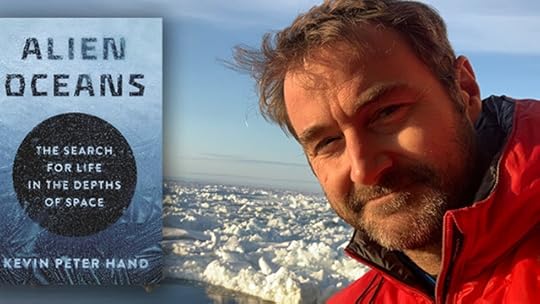
I recently decided to pull the plug on books that I am not enjoying instead of just trudging through. I was not prepared to spend any more time on this one.
While the book contains a ton of interesting data and other factual info, the writing here bored me to tears. Now, fault me all you will for being a finicky reader, but I need my books to be decently engaging and readable. Say whatever you want, but just don't bore me...
Science books - broadly speaking - can be delineated into two broad-based categories. The first sees the author rattle off factoid after factoid in a never-ending torrent of obscure minutia, often losing the reader completely. The second makes the science accessible to even the layperson, and keeps the book interesting enough that the reader will likely retain much of its information long after they put it down. Sadly, this book was an example of the former and not the latter...
******************
I'm sorry to say that this one just did not resonate with me. The author has no doubt done some great work in this field, and I'm sure many people will get great value from the book. Sadly, I was not among them, and my ratings need to reflect my level of enjoyment.
1.5 stars.
Despite its catchy title and being excited to see where the author would take the book, I ultimately put it down ~midway through, which is something I rarely do...
Author Kevin Peter Hand is an astrobiologist and planetary scientist at JPL. He is also the founder of Cosmos Education and was its president until 2007.
Kevin Peter Hand :
I recently decided to pull the plug on books that I am not enjoying instead of just trudging through. I was not prepared to spend any more time on this one.
While the book contains a ton of interesting data and other factual info, the writing here bored me to tears. Now, fault me all you will for being a finicky reader, but I need my books to be decently engaging and readable. Say whatever you want, but just don't bore me...
Science books - broadly speaking - can be delineated into two broad-based categories. The first sees the author rattle off factoid after factoid in a never-ending torrent of obscure minutia, often losing the reader completely. The second makes the science accessible to even the layperson, and keeps the book interesting enough that the reader will likely retain much of its information long after they put it down. Sadly, this book was an example of the former and not the latter...
******************
I'm sorry to say that this one just did not resonate with me. The author has no doubt done some great work in this field, and I'm sure many people will get great value from the book. Sadly, I was not among them, and my ratings need to reflect my level of enjoyment.
1.5 stars.

March 19, 2026
I'm just not in an intellectual mood right now (I say this while reading a book on dinosaurs 🦖.) it's an interesting book though!!

December 10, 2020
Wow, this was actually better than I anticipated! So although the title may hint to a fantasy book, it's really about places in our solar system that may have suitable conditions for life to emerge. Not exactly "Green Martians" type of life, but at least some microbial.
The book starts off about diving deep down into our own oceans here on planet Earth and then draws parallels to the somewhat similar conditions found in our solar system. It concentrates mostly on moons such as Europa, Enceladus and Titan, but since the author (who was also the narrator) is a huge fan of the topic himself, worked with NASA for years etc, his writing style is captivating and thought-provoking. Clearly he's been practicing well by giving public speeches on the topic :D
As I have a 9 year old cosmos enthusiast growing at home, the issues discussed here in this book weren't foreign to me. We've watched many a documentary about what the scientists have managed to find out about these moons thus far, which missions have been sent to investigate the relevant areas in our solar system etc.
I personally liked a lot the latter half of his book, where he rather philosophized about the possible scenarios how life could have developed there, which might be it's so to say intelligence level and so forth. Also, it was heart-warming to see a quote from a fantasy book =)
The book starts off about diving deep down into our own oceans here on planet Earth and then draws parallels to the somewhat similar conditions found in our solar system. It concentrates mostly on moons such as Europa, Enceladus and Titan, but since the author (who was also the narrator) is a huge fan of the topic himself, worked with NASA for years etc, his writing style is captivating and thought-provoking. Clearly he's been practicing well by giving public speeches on the topic :D
As I have a 9 year old cosmos enthusiast growing at home, the issues discussed here in this book weren't foreign to me. We've watched many a documentary about what the scientists have managed to find out about these moons thus far, which missions have been sent to investigate the relevant areas in our solar system etc.
I personally liked a lot the latter half of his book, where he rather philosophized about the possible scenarios how life could have developed there, which might be it's so to say intelligence level and so forth. Also, it was heart-warming to see a quote from a fantasy book =)

June 19, 2025
Ta książka czekała na mnie prawie trzy lata (a może to ja czekałem na nią?). Czy było warto? Oczywiście, że tak. Rozległy temat ujęty w przyswajany i satysfakcjonujący sposób.

January 31, 2021
Need to re-read it to get all of these beautiful scientific details.

March 28, 2022
Who would have thought, until very recently, that the best places to look for life elsewhere in our solar system, might not be Mars at all, but the frozen moons orbiting Jupiter and Saturn?
In the last couple of decades, scientists looking for life elsewhere have absorbed a radical shift of perspective. Our one known case of life in the universe biased our speculations about what kind of environment was conducive to the origin and development of life. After all, we live on the surface of a temperate world, with a robust cycle of rainfall, large bodies of surface water, and an evaporation cycle. Our initial thinking about life elsewhere led us to look for the same types of worlds.
But explorations and analyses of the other bodies in our solar system have led to a far more common and promising environment. Planetary moons with underground oceans are abundant in our own solar system and seem to offer the characteristics under which life could well develop.
Kevin Peter Hand is a JPL scientist with skills as a science writer. As a lead on solar system probe missions, he is in a great position to tell this story.
Hand’s focus in his JPL work is Europa, but there may be subsurface oceans on a number of moons of the outer planets. The most promising so far are Europa, Enceladus, and Titan, orbiting Jupiter and Saturn.
What makes these moons promising for life? The discoveries of subsurface oceans on moons so far from the sun were surprises. We hadn’t understood the presence and effects of tidal forces between large planets and their moons.
The differences in gravitational forces from those massive planets on the near and far sides of their moons, coupled with the moons’ elliptical orbits, produce tidal frictions within the moons’ interiors. Those frictions are sufficient to heat the moons’ interiors enough to maintain water in a liquid state below their surfaces, even while the surfaces themselves are frozen solid.
The result is a layering of hard, frozen surface crust covering a liquid subsurface ocean, and then at least in some of the moons, a rocky layer beneath the ocean that allows for passage of materials, such as carbon, from the rocky layer into the liquid ocean.
That rock/ocean interface is crucial, according to our current understanding of how life may originate. Water itself is a great solvent and medium for the chemical reactions that support life, but it requires materials, “building blocks,” for living things. The bare minimum required goes by the acronym CHNOPS, for carbon, hydrogen, nitrogen, oxygen, potassium, and sulfur. Components not present in the water itself, or not separable from water except through other chemical reactions, require a source. Hence the importance of the rock interface.
As little as we really do understand the origin of life on Earth, we know it includes at least those essential components, plus, as Hand characterizes them, an architecture and builders — some sort of structural plan that can be replicated from instance to instance and some processing mechanism to enact the plan and construct living things from it. For Earth life, those roles are taken by DNA and RNA.
Energy is also required for those chemical reactions. We don’t actually know, again, how life originated on Earth, but scientists hypothesize either an origin within surface water, with the sun as the energy source, or deep within the ocean, around hydrothermal vents where the sun cannot reach but where heat within the planet’s interior provides the needed energy.
Just as we hadn’t until recently understood the role that tidal heating could play in otherwise frozen moons, we hadn’t either understood the importance of those deep, hydrothermal vents on our own planet — vents that may be duplicated on those same distant moons.
We have no idea if there are hydrothermal vents within those moons, much less that biological processes are going at their mouths, as happens at the bottom of our own ocean. We only know that the conditions we know of for such things are present.
Hand takes us step by step through the speculations and discoveries, beginning with the discoveries of the subsurface oceans of Europa, Enceladus, and Titan, going into some detail about the roles of spectroscopy, gravitational measurements, and magnetic field detection and measurement.
In the cases of Europa and Enceladus, scientists rely on instrumented probes, like the Galileo and Cassini missions as well as the more recent Juno mission, performing flybys.
Titan is a special case altogether, given that it not only appears to have a subsurface ocean but a (to us) bizarre surface environment with its own evaporation cycle, bodies of surface liquid, and rainfall, but primarily methane, not water. And Titan has been probed and imaged upclose with the Huygens lander.
Hand doesn’t neglect other moons and bodies that may have subsurface oceans, including Ganymede, Callisto, Triton, and even Pluto.
From there, he moves on to speculations about life, what it requires, how it might originate, and finally what special characteristics subsurface ocean life might have as compared with life on Earth. Things get very speculative there, in an already very speculative field, but, hey, that’s where the fun is and where the leading edge takes us.
Finally, Hand talks about the future of exploration. The realities of funding are like a cloud over all the enthusiasm for future probes to analyze the moons from orbit, landers to examine their surfaces and probe their interiors, and missions to melt or drill through the frozen surfaces and explore the oceans themselves with submersibles. Some of those missions are funded and in development, through NASA and international partnerships.
I think Hand’s book fills a sparse niche in (semi)popular writing on life beyond Earth. There’s a lot written about the search for intelligent life and techno-signals, about detection and study of planets in the traditional “habitable” zones of stars, and even about the chemistry of life. But not much that focuses on the possibilities of life specifically in subsurface ocean worlds. That’s what got me to read the book in the first place.
The style and level of the book give away that Hand is a scientist first, and a “popularizer” second. He does go into some of the technical details, especially in chapters on the detection of oceans and analysis of their characteristics, although you won’t need a math or geology degree to follow him. I’d put him on the more technical end of the “popular” spectrum (yes, I hate that word!).
And if you’re interested in following future missions, like the Europa Clipper mission or the European Space Agency’s JUICE mission, this serves as a great primer. Those missions are funded and in development. They won’t be launching next year, or the year after that, and we won’t be able to hold our breath until we get their results, but for now, all this stuff is just a lot of fun.
In the last couple of decades, scientists looking for life elsewhere have absorbed a radical shift of perspective. Our one known case of life in the universe biased our speculations about what kind of environment was conducive to the origin and development of life. After all, we live on the surface of a temperate world, with a robust cycle of rainfall, large bodies of surface water, and an evaporation cycle. Our initial thinking about life elsewhere led us to look for the same types of worlds.
But explorations and analyses of the other bodies in our solar system have led to a far more common and promising environment. Planetary moons with underground oceans are abundant in our own solar system and seem to offer the characteristics under which life could well develop.
Kevin Peter Hand is a JPL scientist with skills as a science writer. As a lead on solar system probe missions, he is in a great position to tell this story.
Hand’s focus in his JPL work is Europa, but there may be subsurface oceans on a number of moons of the outer planets. The most promising so far are Europa, Enceladus, and Titan, orbiting Jupiter and Saturn.
What makes these moons promising for life? The discoveries of subsurface oceans on moons so far from the sun were surprises. We hadn’t understood the presence and effects of tidal forces between large planets and their moons.
The differences in gravitational forces from those massive planets on the near and far sides of their moons, coupled with the moons’ elliptical orbits, produce tidal frictions within the moons’ interiors. Those frictions are sufficient to heat the moons’ interiors enough to maintain water in a liquid state below their surfaces, even while the surfaces themselves are frozen solid.
The result is a layering of hard, frozen surface crust covering a liquid subsurface ocean, and then at least in some of the moons, a rocky layer beneath the ocean that allows for passage of materials, such as carbon, from the rocky layer into the liquid ocean.
That rock/ocean interface is crucial, according to our current understanding of how life may originate. Water itself is a great solvent and medium for the chemical reactions that support life, but it requires materials, “building blocks,” for living things. The bare minimum required goes by the acronym CHNOPS, for carbon, hydrogen, nitrogen, oxygen, potassium, and sulfur. Components not present in the water itself, or not separable from water except through other chemical reactions, require a source. Hence the importance of the rock interface.
As little as we really do understand the origin of life on Earth, we know it includes at least those essential components, plus, as Hand characterizes them, an architecture and builders — some sort of structural plan that can be replicated from instance to instance and some processing mechanism to enact the plan and construct living things from it. For Earth life, those roles are taken by DNA and RNA.
Energy is also required for those chemical reactions. We don’t actually know, again, how life originated on Earth, but scientists hypothesize either an origin within surface water, with the sun as the energy source, or deep within the ocean, around hydrothermal vents where the sun cannot reach but where heat within the planet’s interior provides the needed energy.
Just as we hadn’t until recently understood the role that tidal heating could play in otherwise frozen moons, we hadn’t either understood the importance of those deep, hydrothermal vents on our own planet — vents that may be duplicated on those same distant moons.
We have no idea if there are hydrothermal vents within those moons, much less that biological processes are going at their mouths, as happens at the bottom of our own ocean. We only know that the conditions we know of for such things are present.
Hand takes us step by step through the speculations and discoveries, beginning with the discoveries of the subsurface oceans of Europa, Enceladus, and Titan, going into some detail about the roles of spectroscopy, gravitational measurements, and magnetic field detection and measurement.
In the cases of Europa and Enceladus, scientists rely on instrumented probes, like the Galileo and Cassini missions as well as the more recent Juno mission, performing flybys.
Titan is a special case altogether, given that it not only appears to have a subsurface ocean but a (to us) bizarre surface environment with its own evaporation cycle, bodies of surface liquid, and rainfall, but primarily methane, not water. And Titan has been probed and imaged upclose with the Huygens lander.
Hand doesn’t neglect other moons and bodies that may have subsurface oceans, including Ganymede, Callisto, Triton, and even Pluto.
From there, he moves on to speculations about life, what it requires, how it might originate, and finally what special characteristics subsurface ocean life might have as compared with life on Earth. Things get very speculative there, in an already very speculative field, but, hey, that’s where the fun is and where the leading edge takes us.
Finally, Hand talks about the future of exploration. The realities of funding are like a cloud over all the enthusiasm for future probes to analyze the moons from orbit, landers to examine their surfaces and probe their interiors, and missions to melt or drill through the frozen surfaces and explore the oceans themselves with submersibles. Some of those missions are funded and in development, through NASA and international partnerships.
I think Hand’s book fills a sparse niche in (semi)popular writing on life beyond Earth. There’s a lot written about the search for intelligent life and techno-signals, about detection and study of planets in the traditional “habitable” zones of stars, and even about the chemistry of life. But not much that focuses on the possibilities of life specifically in subsurface ocean worlds. That’s what got me to read the book in the first place.
The style and level of the book give away that Hand is a scientist first, and a “popularizer” second. He does go into some of the technical details, especially in chapters on the detection of oceans and analysis of their characteristics, although you won’t need a math or geology degree to follow him. I’d put him on the more technical end of the “popular” spectrum (yes, I hate that word!).
And if you’re interested in following future missions, like the Europa Clipper mission or the European Space Agency’s JUICE mission, this serves as a great primer. Those missions are funded and in development. They won’t be launching next year, or the year after that, and we won’t be able to hold our breath until we get their results, but for now, all this stuff is just a lot of fun.

Read
October 6, 2023I have to re-read this as a physical or ebook, as I missed out on a lot of the (interesting) science elements by listening to it via audiobook. It is well read, I just do not have the sharp concentration needed to grasp every detail when listening to an audiobook.
Besides that, I truly enjoyed it, except for the last quarter when the author falls for the idea that human evolution is linear (it is NOT) and that life needs technology and innovation (etc) to be "intelligent". This notion is long outdated and very damaging to not only our connection to other cultures and other lifeforms on our own planet, but would also limit our understanding of life in space.
Still, this book was fascinating. I am looking forward to my re-read to understand more.
Besides that, I truly enjoyed it, except for the last quarter when the author falls for the idea that human evolution is linear (it is NOT) and that life needs technology and innovation (etc) to be "intelligent". This notion is long outdated and very damaging to not only our connection to other cultures and other lifeforms on our own planet, but would also limit our understanding of life in space.
Still, this book was fascinating. I am looking forward to my re-read to understand more.

January 24, 2022
I’d recommend this popularized science book to anyone with some interest in biology, chemistry, space science or exploration. It may be that there’s 20 times more ocean water in the outer solar system than on Earth, and perhaps exomoons with oceans, heated by tidal forces, are more common than rocky planets that are at just the right distance from their Sun for water to stay liquid.

February 9, 2024
Якісний нон-фікшн, що розглядає не лише існуючі дані про освоєння космосу, але й різні дуже цікаві гіпотези. Багато розділів присвячено астробіології.
Сумно, звісно, що на перспективні дослідження коштів постійно не вистачає, на відміну від військових бюджетів(
Сумно, звісно, що на перспективні дослідження коштів постійно не вистачає, на відміну від військових бюджетів(
August 26, 2024
Думав, ставити 4 чи 5, урешті-решт випадковим чином обрав 5.
Для мене це була перша наук-поп книга Бородатого Тамарина. Перша частина, що стосувалася саме космічних тіл, видалася мені найцікавішою, але це, мабуть, мої особисті преференції на цей момент. Частина про загальну біологію життя сподобалася трохи менше, можливо через те, що читав уночі та був достатньо втомлений, можливо через те, що здалася трохи неповною та в деяких моментах надто неглибоко описовою. Розвиток думки про те, який життя могло би мати вигляд в океанах інших планет та які органи чуття та технології йому могли би бути доступні, були трохи надто спекулятивні, але тим не менш цікаві. Остання частина про майбутні дослідження та про те, як улаштовано систему фінансування, була досить цікавою для розуміння, як працює ця галузь (не забуваймо, що НАСА досі любить руZZкіх і продовжує співпрацю з ними).
На жаль, переклад і редактура в певних місцях вийшли трохи вище за середні. Наприклад, К’юріосіті, написане, з апострофом, тоді як Оппорт’юніті з м’яким знаком було досить незрозуміло. Але передача японського 八文字 (hachimoji) як гачімодзі ще дивніша. Якщо те, що японське h передали як г, хоча наче жодна система транслітерації так не робить, ще можна зрозуміти (і я навіть підтримаю), то чому в одному випадку вжито нормальну систему, а в іншому — полівановку, незрозуміло (хоча й те краще за хатімодзі з Вікіпедії). Окрім того невеликі одруки в інших місцях, плутанина в алфавітному покажчику, де деякі з однаковими прізвищами або переплутані, або злиті в одне, деякі посилання ведуть не на ті сторінки (а Юнона взагалі вказана двічі на 27, хоча її знайшов лише на 26), транслітерація деяких прізвищ відрізняється в тексті й покажчику не мають аж надто гарного вигляду. Але важливо, що такі книжки з’являються та видавництву можна лише подякувати за роботу та сподіватися, що у процесі певні хиби виправляться.
П.С. Кольоровий розворот із Європою досі чарівний.
Для мене це була перша наук-поп книга Бородатого Тамарина. Перша частина, що стосувалася саме космічних тіл, видалася мені найцікавішою, але це, мабуть, мої особисті преференції на цей момент. Частина про загальну біологію життя сподобалася трохи менше, можливо через те, що читав уночі та був достатньо втомлений, можливо через те, що здалася трохи неповною та в деяких моментах надто неглибоко описовою. Розвиток думки про те, який життя могло би мати вигляд в океанах інших планет та які органи чуття та технології йому могли би бути доступні, були трохи надто спекулятивні, але тим не менш цікаві. Остання частина про майбутні дослідження та про те, як улаштовано систему фінансування, була досить цікавою для розуміння, як працює ця галузь (не забуваймо, що НАСА досі любить руZZкіх і продовжує співпрацю з ними).
На жаль, переклад і редактура в певних місцях вийшли трохи вище за середні. Наприклад, К’юріосіті, написане, з апострофом, тоді як Оппорт’юніті з м’яким знаком було досить незрозуміло. Але передача японського 八文字 (hachimoji) як гачімодзі ще дивніша. Якщо те, що японське h передали як г, хоча наче жодна система транслітерації так не робить, ще можна зрозуміти (і я навіть підтримаю), то чому в одному випадку вжито нормальну систему, а в іншому — полівановку, незрозуміло (хоча й те краще за хатімодзі з Вікіпедії). Окрім того невеликі одруки в інших місцях, плутанина в алфавітному покажчику, де деякі з однаковими прізвищами або переплутані, або злиті в одне, деякі посилання ведуть не на ті сторінки (а Юнона взагалі вказана двічі на 27, хоча її знайшов лише на 26), транслітерація деяких прізвищ відрізняється в тексті й покажчику не мають аж надто гарного вигляду. Але важливо, що такі книжки з’являються та видавництву можна лише подякувати за роботу та сподіватися, що у процесі певні хиби виправляться.
П.С. Кольоровий розворот із Європою досі чарівний.

December 20, 2025
Astronomy, Physics, Geology, Chemistry, Biology and Imaginative Possibilities
Before reading this book, I understood the search for life on other worlds as being the search for earth-like planets orbiting another star within the “Goldilocks zone” of that star. But it turns out that the search for life is not limited to worlds 20 lightyears (or more) away from Earth.
Instead, it turns out that some of the moons of Jupiter, Saturn and Neptune (and even dwarf planet Pluto’s moon) may also have the conditions necessary to support life. But what are the necessary conditions to support life? How can we determine which moons may have those life-supporting conditions? Do we have the means to confirm that such life-supporting conditions actually exist on those outer planets’ moons? And if we do have such means, do we also have the means to detect if any life has actually taken ahold on any of those moons? Knowing the multitude of questions to ask and then figuring out how to answer those questions is the subject of this book.
This is clearly a science-oriented book – and not just one specific branch of science. The author’s explanations touched on several science subjects, including astronomy, physics, geology, chemistry and biology. These explanations are written clearly enough and simply enough that the average I-like-science person will understand, appreciate and maybe even be wowed by what this author has written.
The last couple chapters got more speculative as the author imagined what kind of weird forms of life might evolve under those not-the-earth conditions. To me, that just showed the author’s love of the subject he is writing about.
Bottom line: Impressive science, written by someone able to clearly explain science to the non-scientists (and to be quite interesting to the reader as well).
Before reading this book, I understood the search for life on other worlds as being the search for earth-like planets orbiting another star within the “Goldilocks zone” of that star. But it turns out that the search for life is not limited to worlds 20 lightyears (or more) away from Earth.
Instead, it turns out that some of the moons of Jupiter, Saturn and Neptune (and even dwarf planet Pluto’s moon) may also have the conditions necessary to support life. But what are the necessary conditions to support life? How can we determine which moons may have those life-supporting conditions? Do we have the means to confirm that such life-supporting conditions actually exist on those outer planets’ moons? And if we do have such means, do we also have the means to detect if any life has actually taken ahold on any of those moons? Knowing the multitude of questions to ask and then figuring out how to answer those questions is the subject of this book.
This is clearly a science-oriented book – and not just one specific branch of science. The author’s explanations touched on several science subjects, including astronomy, physics, geology, chemistry and biology. These explanations are written clearly enough and simply enough that the average I-like-science person will understand, appreciate and maybe even be wowed by what this author has written.
The last couple chapters got more speculative as the author imagined what kind of weird forms of life might evolve under those not-the-earth conditions. To me, that just showed the author’s love of the subject he is writing about.
Bottom line: Impressive science, written by someone able to clearly explain science to the non-scientists (and to be quite interesting to the reader as well).

May 3, 2026
I picked up Alien Ocean after attending a talk titled "Worlds Unknown", which sparked my curiosity about life beyond Earth not in the cinematic sense of intelligent aliens, but in the more boring and more plausible form of microbial life. This book turned out to be a perfect continuation of that curiosity.
Kevin Hand begins close to home, with the exploration of deep-sea hydrothermal vents on Earth, environments so extreme that they reshape our understanding and imagination of where life can exist. From there, the narrative expands outward, drawing a compelling connection between these alien-like ecosystems in our own oceans and the possibility of oceans beyond Earth. The focus on icy moons such as Europa, Enceladus, and Titan is particularly fascinating, as these worlds emerge as some of the most promising candidates for harboring extraterrestrial life.
What I appreciated most was how the book builds its scientific case from first principles - walking through the physics, chemistry, and biology needed to even define what “life” might look like elsewhere. The explanations of techniques used to detect it - studying magnetospheres, gravitational anomalies, and spectroscopy - are detailed yet approachable. The discussion on biomarkers, and how we might infer life indirectly through chemical signatures and spectroscopy from afar, was especially fascinating.
Perhaps the most humbling takeaway is how little we still know about our own planet as we xplore outer space. The deep oceans of Earth remain less explored than some distant moons, and the technical challenges of probing both environments are laid out with clarity and respect for their complexity.
Kevin Hand begins close to home, with the exploration of deep-sea hydrothermal vents on Earth, environments so extreme that they reshape our understanding and imagination of where life can exist. From there, the narrative expands outward, drawing a compelling connection between these alien-like ecosystems in our own oceans and the possibility of oceans beyond Earth. The focus on icy moons such as Europa, Enceladus, and Titan is particularly fascinating, as these worlds emerge as some of the most promising candidates for harboring extraterrestrial life.
What I appreciated most was how the book builds its scientific case from first principles - walking through the physics, chemistry, and biology needed to even define what “life” might look like elsewhere. The explanations of techniques used to detect it - studying magnetospheres, gravitational anomalies, and spectroscopy - are detailed yet approachable. The discussion on biomarkers, and how we might infer life indirectly through chemical signatures and spectroscopy from afar, was especially fascinating.
Perhaps the most humbling takeaway is how little we still know about our own planet as we xplore outer space. The deep oceans of Earth remain less explored than some distant moons, and the technical challenges of probing both environments are laid out with clarity and respect for their complexity.

May 12, 2026
I liked this book, scientific and plain in all the right ways, but I found I had to pay attention haha if I tuned out I would miss a good chunk of something being explained.
The book talks about our celestial neighbors and the likely origins of life found in water. It slowly becomes a small history lesson on human evolution and more than one hypothesis about how alien life could evolve in a water world.
The book ends on a hopeful note for the continuation of science.
“Gravity a measure of the shape of space. The shape of space is determined by mass as an object travels through space , its path or trajectory is determined by the shape of space.”
“We want to know if they are habitable as a first step towards knowing whether or not they're inhabited , we need to know not only where to look , but also what we're looking for and how to recognize it.”
“Finding kindred spirits with whom to share the big picture, makes it all worth while.”
The book talks about our celestial neighbors and the likely origins of life found in water. It slowly becomes a small history lesson on human evolution and more than one hypothesis about how alien life could evolve in a water world.
The book ends on a hopeful note for the continuation of science.
“Gravity a measure of the shape of space. The shape of space is determined by mass as an object travels through space , its path or trajectory is determined by the shape of space.”
“We want to know if they are habitable as a first step towards knowing whether or not they're inhabited , we need to know not only where to look , but also what we're looking for and how to recognize it.”
“Finding kindred spirits with whom to share the big picture, makes it all worth while.”

April 4, 2021
Interesting book. I haven't had chemistry since I was in high school, so I appreciated the step-by-step walks through sections containing a lot of chemistry, and I enjoyed the analysis of the various oceanic worlds' compositions and what life could look like there. The discussions of upcoming NASA missions was very illuminating, and I wish there had been more because I'm always curious as to how those proposal processes work. Hand tried to be conversational in the book, and at times, the tone of the writing veered towards "teaching eight-year-olds about Europa and Titan at a planetarium," which is my only negative comment; there are other science writers who hit a better balance for explaining things to nonspecialists in a way that is less awkward.

November 25, 2025
This book really excited my astrobiological senses, going over the history of the search for life as well as potential future projects. It went over the chemistries of different planets and moons which was fascinating. The best part was when the author allowed himself to speculate on life on other worlds, I think about the potential fish underneath the ice sheets of Jupiter's moons being kept warm by centrifugal forces of the moon spinning around Jupiter, where the gravity distortion is just enough to keep parts of the moon above freezing despite being so far from the sun. It is a dense read, but a fun one!
Displaying 1 - 30 of 165 reviews