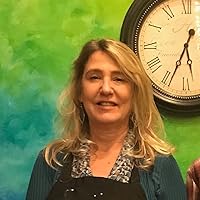
Sharon Maas was born in Georgetown, Guyana in 1951, and a sense of adventure has followed her around the world. In 1971 she spent a year backpacking around South America, followed by a few months with pioneering friends in the Guyana rainforest, followed by an overland trip to India, followed by a year in a Hindu Ashram.
She settled in Germany where she married, studied, worked, and raised children.
Officially retired, she continues to write from her new home in Ireland.
Her first novel was published by HarperCollins in 1999, followed by two more in 2001 and 2002. At present, she has 10 published works with the digital publisher Bookouture.
She has one self-published work, a retelling of the magnificent Indian epic Mahabharata: a project of love that took her over 30 years to "get right", written under the pen name S. Aruna.
Set during World War II in German-occupied France, The Violin Maker's Daugther follows the story of Sarah Mayer, a Jewish girl fleeing the Nazis with the help of Rolf, a German soldier deserter. I really liked the premise of this book but I wasn't very impressed by the execution of it.
I didn't really connect with Sarah and found her character very two-dimensional. She was an extremely sheltered girl and very naive- I was surprised she wasn't captured by the Germans two seconds after leaving home. Rolf was kind of better but not by much. He had so much potential but instead, he served as Sarah's bland love interest. I really wanted more development on Monique because she left so much be explained but alas, no.
The historical background was well-researched but I found the plot not very believable and wasn't very engaged in it. I felt like a spectator watching everything unfold from afar instead of sitting on the edge of my seat wanting answers ASAP.
Overall, not a terrible book but could've been better developed.
*Thank you to NetGalley and Bookouture for providing a free ARC
Many thanks to #NetGalley and Bookouture for sending me an advance copy of The Violin Maker’s Daughter by Sharon Maas to read. What follows is my honest review.
The first thing that drew me to this book was the wonderful cover art which caught my attention and let me know that the book was set in the time of World War 2 - a time I am always fascinated to read about.
The story begins in Colmar, a city in the north-eastern region of France located in what was known as Alsace, a region which was sometimes a part of France and sometimes a part of Germany. Many residents could speak both languages. In November of 1940 it has once again been taken over by the Germans, but this time they are the Nazi’s and life is about to change drastically for local violin maker Josef and his family. They have never been practicing Jews and in fact Josef’s wife is not a Jew. When the Jewish citizens of Colmar are forced to register as such, Josef chooses not to register, hoping that they have safely blended into their surroundings and that those few who know will keep their secret. Life is harder though as no one has money to spend on high quality musical instruments. Josef has been warned that he should try and move his family away, but it is a hard and scary decision to make and so they do nothing.
One year later, their secret gets out and it becomes clear that Josef and his wife must make the difficult choice to send their children away starting with their eldest daughter Sarah, who at 17, is a violin maker in her own right. Sarah is still a teenager though, and in many respects so sheltered from what is going on in the world that she seems younger than her actual age. She fights against the decision and refuses to pack until it is brought home to her that time is running out and that she must go. Her journey will be a long one, fraught with danger and many difficulties along the way. The first challenge comes as Sarah, her chaperone and her guide are attempting to cross through an area where it is known German soldiers are likely to be around. An accident to her chaperone makes it so that Sarah must continue on alone with her guide. Sadly, they do not take enough care and are accosted by German soldiers, leading to a scene of great violence that alters the whole trajectory of Sarah’s life.
Sarah has been taught that there are no good Germans at all. They are all Nazi’s, and now she is forced to depend on one for her life. As a young and rather immature girl, she longs for someone to love her a care for her and is very dependant on others to fill her emotional needs. This leads to some extreme problems throughout her journey to safety. By the end of the book Sarah has matured somewhat even to the point where she has become involved with the Resistance. There is a surprise twist which I will not divulge.
I really enjoyed the basic story line of the book but there were a few things I struggled with. The author chose to write the story in the present tense at times and I always find this distracting. I also felt that the immaturity that Sarah showed was perhaps a little extreme – especially after some of the things that she experienced. She couldn’t seem to take the need for security seriously which led to problems which had some dire consequences. I found it hard to believe that she wouldn’t have learned discretion way earlier on. Having said that, if you like historical fiction set in WW2 you will likely enjoy this book. It definitely shows the hardships of war both for the Jewish people and the Germans who are forced to fight on the side of evil even when they would prefer not to.
If only I could give this book 100 stars rather than 5! This book captivated me right from the start. This book is epic, a mesmerizing book of strength through unimaginable losses. A forbidden love but will it be enough to overcome the pressure around them? Heartbreaking and beautifully written this gripping tale of bravery and standing up for what you believe in despite the odds being against you. One of the best and most memorable historical books I've ever read! Expected publication: July 19th 2019 by Bookouture.
I was given a complimentary copy of this book. Thank you. All opinions expressed are my own. Check out this and all my reviews on my blog. https://cnnamongirl.wixsite.com/website
Sharon Maas has become one of my favorite authors this summer! The first book I read, "The Soldier's Girl", was excellent in a way that was unexpected. Both of these books about WWII and the French Resistance in the area of Alsace (which it seems has changed hands between Germany and France, etc. many different times over the centuries!) have quite a lot of the same characters who occur in both books during the same time frame. However, I wouldn't call it a series or even say you have to read The Soldier's Girl before this one. The "unexpectedness" I'm referring to is how you can think it's another comfortable read about those "carrying on bravely" during the circumstances of the war. Only to be shocked by the true brutality that those who lived under German Occupation experienced. Those who like this WWII homefront genre and the people who were left behind in most of the European and Eastern European homefront will definitely not be disappointed in Sharon Mass' novels
“The Violin Maker’s Daughter” is a beautiful story of resistance and survival. It drew me in from the very first page. The setting of Alsace and the violin maker’s shop, in particular, was atmospheric and so vivid, I felt instantly immersed into a family’s world on the verge of collapse. Having lived virtually undetected among the Aryanized population, the Mayers could never fathom that one day they would have to make one of the most difficult decisions a family can make - to separate so that at least some of them have a chance for survival.
I couldn’t help but feel for Sarah - a young girl who has to grow up much too soon in a war-ravaged world. Ralf Sommer, a German deserter, also won me over right away: not everyone would risk not only their freedom but life itself in order to do the right thing, but for Ralf, his good conscience is above all and just for that he earned my utmost respect. Despite Sarah being a central protagonist, Ralf was a wonderfully complex character, and I thoroughly enjoyed following the evolution of their relationship.
If you enjoy well-researched stories of the French Resistance, you definitely need to read this book. It’s a story of brave men and women who sacrificed everything they had in the name of freedom, and such stories of ultimate self-sacrifice and heroism must never be forgotten. Highly recommended to all fans of the genre!
The story takes place in Alsace, in the Vosges. I lived in Germany for 3 years, and many of the towns/villages that the author is referring to were located 45 minutes to 1 hour’s drive from where I lived. I liked that I was familiar with the area but I struggled to find anything that I liked about this book. The only intriguing parts that kept me reading it was the location. The story was, however, a total “dud” for me. Hence the two stars.
I love reading WWII historical novels with strong, fearless female characters. Regardless of how sheltered someone’s life is or how old the person is, in times of war, you mature and you mature quickly. Not so with the central character. Sarah, was so maddingly immature for a 17 year old. She constantly put herself and close ones into danger. To suddenly have her as a spy? Give me a break! I was so angry with this stupid girl! The author kept rephrasing the same guidance over and over again, in different ways such that I began to feel like a child!
To me, this book might have more of an appeal to a “YA” audience.
Povestea a fost interesantă, așa cum sunt toate cărțile despre cel de-al doilea RM și Holocaust dar… niciodată în viața mea de cititor nu am dat peste un personaj mai enervant decât eroina acestei cărți, Sarah!! Citeam și mă luau toți nervii, mă întrebam “cât de idioată e fata asta?” Este un personaj teribil de imatur și enervant: o evreică trimisă de acasă de părinți, evident pe căi clandestine și tot ce face este să se smiorcăie și să trăncănească în stânga și in dreapta că este evreică și Ralf dezertor! Când atâtea persoane își riscă pielea pentru ea.. Detestabil personaj, care nu a reușit să se reabiliteze fața mea nici în ultima parte a cărții, când se maturizează brusc 🙄 și nu înțeleg de ce autoarea încerca o disculpare a personajului: “sunt așa imatura” spunea ea, iar ceilalți “nu este așa Sarah, de fapt ești foarte matură, dar ești prea sinceră..” pe bune?! Asta m-a enervat teribil. De altfel, e o lectură ușurică, plăcută.
Sharon Maas never disappoints! She is one of my favourite authors and with this wonderful, harrowing, heart breaking tale of courage and love in the face of unimaginable danger, she has cemented her place as one of the best historical fiction writes of today, right up there with Antony Doerr and Kristin Hannah. I SO loved this beautiful story, Sarah's coming of age in a time of turmoil was so stunningly realised. For me, it made the war come alive, the suffering and angst of ordinary people, both Jews and Germans, their bravery in the face of adversity so vividly brought to life thanks to the author's magical writing. I would very highly recommend this book and give it ten stars if I could. If you're going to read one war book this year which marks the 75th anniversary of D-day, make it this one!
Thanks to NetGalley, Bookouture and Sharon Maas for my digital copy of her new book: The Violin Maker's Daughter. Josef Mayer is a skilled violin maker he decided to keep his Jewish ancestry a secret, he lives a quiet life with his wife Leah and five daughters in Colmar. His plan is to evade attention by keeping their heads down, live a quiet life and during this troubled time it's impossible to a keep secret. One day two German soldiers arrive at his shop and inform him that he needs to provide documents to prove his family is of Aryan ancestry or his family will be deported.
He makes the choice to quickly get false identity papers for his eldest daughter Sarah the plan is for her to leave and once they have new papers her two teenage sisters will follow her two weeks later and then her parents and the youngest sister will join them. Sarah and her sisters have been kept at home for the past two years by their parents after the towns Jewish residents had been marched out of town and deported. Sarah reluctantly leaves her family and the plan is for the whole family to all to make their way to safety in Switzerland and be reunited.
Sarah is only 17, she has lived a sheltered life, she isn't prepared at all for the big wide world and even with a chaperone, guide and a network of safe houses the chances of her traveling across the French countryside and making it to safety are rather slim. Of course nothing goes as planned and she finds herself traveling through the mountains to Poitiers with a German soldier called Ralf and not her guide. All German men under the age of 35 are conscripted into the army, Ralf had no choice but to join the army, by chance he saves Sarah who's being attacked by another German soldier and he becomes a deserter.
At times you want to shake Sarah, she is very childish, eventually she understands how much danger she's in, as she and Ralf make their way to safety she does grow up and due to her sisters being delayed she needs to find a job. Sarah is bilingual and she finds work as a Nanny part of her job is to teach a French families children German and Ralf decides to join the French resistance. I enjoyed the second half of the book much more than the start, Sarah is not as annoying but she's still very childish, she learns the hard way to not trust anyone and most of all to keep her mouth shut! I found The Violin Maker's Daughter to be light, quick, easy book to read, I did enjoy parts of the story and I gave the book three stars. I shared my review on Goodreads, Twitter, NetGalley, Kobo, Australian Amazon and my blog. https://karrenreadsbooks.blogspot.com/
Here is another WWII historical fiction that I continue to be drawn to. This is a heartbreaking story, yet again, of a family being torn apart during the occupation of Nazis.
Through much of the book we see Sarah acting like an over protected child. Well, she is only a child and she was over protected by her parents who loved her very much. Parents that thought that they were going to go on and live an ordinary life until the unspeakable happens.
I liked the book and I do recommend it to anyone who has an interest in WWII.
Many thanks to Netgalley and Bookoture for this advanced readers copy. This book released July 2019.
I love Alsace and I was eager to hear more about the region after reading the author's previous book. The area was touched on a few times and I remembered several places after visiting there.
I found Sarah to be a really irritating and childish nearly to the point of giving up the book! I stuck with it and towards the end of the book she improved.
I found this one lacking in comparison with the previous book.
Can’t Get Enough Historical Fiction… So for the past eight months or so, I’ve been on a bit of a historical fiction kick. Basically every other novel I would check out from my local public library—was historical fiction. Much of it had been based in, Stalin’s Soviet Union. Often the in the ‘40s. But I wanted to enjoy a story from another part of Europe in that era.
Hence when I was given the opportunity to read an advance copy of, Sharon Maas’s newest historical fiction novel—The Violin Maker’s Daughter—I jumped at the chance to be the bee that did the review. It was very exciting getting the early copy, and checking out a new author (to me). Maas, has penned over ten other novels before this one. Her previous being, The Soldier’s Girl, another WWII historical fiction piece.
I couldn’t wait to have at this novel. Even with my crazy busy work schedule, I found time to read it. No matter if it was in bed before going to sleep after an insane shift. Multi-tasking while taking care of personal business. I was thrilled to read this. And I really couldn’t stop. It was almost an addiction.
But, some of that was because I was hoping for more drama and suspense. Which often wasn’t the case. At times the characters and story line development seemed rather rushed. Now I’m not knocking this novel, I did think it was enjoyable enough. Still, there was a great deal I found myself in the end wishing it had more of.
Premise As for the main character, Sarah, she is a great protagonist. While her family’s name sounded christian, she is actually a Jewish teen from Alasce. Her father is a violin maker, and she is his apprentice. When the German’s annexed the formerly French region and forced it into German culture. The family made adjustments to blend in and not stand out to the occupiers. However they predictably are ratted out to the Nazis and forced to produce evidence of their Aryan ancestry or else.
The family plans to escape in groups. Sending their oldest, Sarah, off first. She is rather sheltered and immature. So this story quickly is a “coming of age” type of story. As the novel progresses, you still see Sarah’s struggle to grow up fast enough for sometime. But she does so more as the story moves along.
Early on in her passage to safety from the Germans, Sarah and her escort are caught in the forest by two German soldiers. I won’t give you any spoilers, but this is how she first meets (and we’re introduced) to her love interest of, Ralf (or is it Karl?). Their journey into Paris as two different types of fugitives from the Nazis (Ralf, is not Jewish), and then their desire to be together again is the real driving force to this story line.
Eventually the story probably spends it’s largest amount of time, where Sarah becomes the live-in nanny for a wealthy family of French “collaborateurs”. There we see a relationship between the sister of the parents, Monique, and Sarah. There was no character I had more of a love hate relationship with in this story than, Monique. In the end, it felt rather predictable how it ends between the two. Whilst the maid was painfully underused in this section of the story.
Ultimately, towards the end—Sarah becomes a very strong hero. And finally has grown up, whilst still rather young. But this too seems to be very rushed and lacking in more details of development.
I understand this also might not be the doing of the author. As it can be difficult to convince a publisher to print an extremely long novel—unless you have made a small fortune as a New York Times best seller. Sadly in this industry, very few are given this sort of creative freedom. And even some of those abuse that privilege and give us novels with 150 pages of needless details that could have been cut. So it is a fine line.
Worth A Read So I don’t want to sound like I’m dumping on this novel. It’s not bad at all—it also was not the greatest historical fiction novel. I found it to be good enough to finish in a timely manner. But leaving me wishing it was so much more. The cover proclaims it’s an, “Absolutely heartbreaking World War 2 historical fiction”. But I didn’t find myself that moved to be heartbroken. I never once cried reading this.
And that was what I was hoping for from what the previews had given me. I wanted to be moved that I would cry (my membership to the, Macho Mens Club of America, has just been revoked). But I’m not an emotionless droid of a man. I read another historical fiction novel earlier this year, that made me cry several times. Once to the point I ugly cried for probably five minutes. That novel also had more details and development, and I think it would have behooved this novel to have that. The premise of this novel ought to be heartbreaking, it’s the second World War and Jewish people are major characters. But I never found myself teary eyed.
Still, I did have points where I could not put this down. Perhaps the section where, Sarah and Ralf are on the run, gives the best suspense in the novel. Which does move the pace along quickly. The book is good enough that I did add the author’s previous historical fiction to my “want to read list” on Goodreads. And if you’re a fan of this type of story, I do recommend giving, The Violin Maker’s Daughter, a read.
I think it’s fair to say this was a three out of five star book. And it will be on-sale starting, July 19th, 2019. You can get it on paperback or on Kindle.
Here, we’re transported to Alsace-Lorraine, as Sarah, the eldest daughter of the Mayer family, takes a dangerous journey through France to escape persecution as a Jew.
This does have the feel of a gripping adventure story, as Sarah and Ralf (the runaway German soldier she falls in with) negotiate their way from Alsace-Lorraine to France and safety. Along the way, they meet with Resistance fighters, learn how to pass undetected past checkpoints and blockades and turn their hands to spying and survival.
I was definitely a fan of Ralf: he had just the right combination of regret, kindness and a determination to put things right to endear him to the reader. Sarah… a little less so. Unfortunately, Maas writes her as a naive and selfish girl which (although probably very true to life) does make you want to scream at the page a bit every time she puts them both in danger. In wartime France, you’d hope she’d grow up a little quicker!
Despite that, the sheer number of twists and turns and the super-speedy plot kept me reading right until the bittersweet end. If you enjoy your spy thrillers with a dash of romance and naivety, this is for you!
Josef Mayer is the violin maker in Colmar, France. As Germany's takeover of France nears, Josef makes arrangements with the French Resistance for his five daughters to be escorted to Switzerland. His eldest daughter Sarah will leave first, despite her own resistance for not wanting to leave her home and family, as the severity of what was to come to France couldn't be realized. Sarah's papers are all ready, stating she's a German from Colmar, France with no yellow star stamped on the paper. Josef is an agnostic Jew and his wife Leah is a converted Jew, although the family are not practicing Jews, to the Nazis, they are still Jews. The children don't understand why plans are being made for them all to eventually flee Colmar and quick plans are made with a nearby Neighbor, Yves to hook the family up with the resistance to get them all to safety - first Sarah, then her sister's to follow, and eventually her parents. That was the plan, but during war, plans can change in a moment's notice.
Sarah is picked up in the middle of the night and taken to first stop - the winery where Rebecca who's in charge of an old farmhouse, prepares the routes and missions with Eric to guide runaway Jews through the mountains from this underground safehouse pitstop along the way of Sarah's journey. But when Rebecca falls and twists her ankle, early into the journey, the three must turn back as she cannot walk, and Eric and Sarah help to carry her back to the safehouse. New plans are made as Rebecca is housebound and will now await the next two sisters to come to the safehouse while she heals and Eric and Sarah set out again.
Eric and Sarah encounter two young German soldiers in the forest. One of them apparently relishes his job to kill Jews and the other, Raif Sommer, stood in mortification as he watched the struggle between Eric and the other soldier as Eric tried to protect Sarah and foil his attempt to rape Sarah, until Eric was shot in the leg. In this stunning commotion, Raif shoots and kills the other soldier and becomes a deserter and helps carry injured Eric with Sarah's help, back to the safehouse once again. We soon learn, once Sarah and Eric and a German soldier return, that Raif was drafted in a war he wanted no part of as he was supposed to be studying in university to be a doctor. And now with Rebecca and Eric out of commission, the plans have changed. Raif is given civilian clothes from Rebecca's son's wardrobe and he will lead Sarah once again on the journey.
Before leaving, Rebecca has a chat with Raif, informing him how Sarah is young and naive and has no experience with relationships, warning him not to start any romance business. They set out for the journey to Metz, only Sarah will take a train and Raif will have to walk for three days because he has no papers. Those three days of traveling Sarah realizes she has feelings stirring for Raif who has been kind and chivalrous to her and has ultimately saved her and Eric's life. Once they meet up again and have made it to the next farmer's safehouse, they are to wait with the resistance members until Raif's new papers are made for them to carry on together - only the safehouse is ambushed one night with mass murder going on upstairs. Once again, Sarah's life is spared by Raif's quick thinking, as they were sleeping in their respective rooms in the basement when the kerfuffle began and Raif grabs Sarah and squashes them both into a bathroom hole with a secret crawlspace as they await the Nazis to finish inspecting the basement and leave. Later Raif walks around outside to make sure the coast is clear and with the help of a neighbor who saw the whole invasion, they are directed to the next safehouse where they will then get on a train to Paris where they will connect to the next town, Poitiers.
The train ride is nerve-racking as gestapo go around checking for papers and Raif - now Karl, and Sarah sit separately as not to attract undue attention. Sarah's weakness is learning to keep her mouth shut as she loves to talk and still doesn't grasp the peril of her journey. Great tension as we follow Sarah on the multiple journeys, almost squirming with hope she doesn't make any mistakes.
They stop at a cafe and watch Jews being berated and ultimately beaten by Nazis. Sarah wants to shout out at them and Raif shuts her up by kissing her, and so the romance begins. Although Sarah is confused after because Raif backs off. He is also attracted to Sarah, but tries to honor his promise to Rebecca, not to tangle up Sarah's young heart when she is dealing with so much more.
When they finally arrive at the last safehouse in Poitiers, a town south of Paris, the two must be separated. Raif has joined the French Resistance, and Sarah who speaks fluent French and German is sent to apply for a job as a nanny who is to teach the four young children, German, and give them violin lessons at the Limoin residence where this upper class French family have become collaborators with the Nazis. Sarah rests comfortably there as she pines away for Raif/Karl awaiting message from him so they can meet up. In the meantime, Madam Limoin's boisterous and socialite younger sister, Monique, befriends Sarah and gets a little too close for comfort, especially when Monique snoops and finds a letter Sarah stupidly, left on her bed. Sarah gets a message from her safehouse keeper, Regine, in Poitiers, and she's told to get moving before she is discovered by the Limoins.
At that point, Sarah decides not to continue her journey to now Spain, but to also join the resistance. Her mission is to gather intelligence by traveling to Germany to visit various train stations to learn which towns in France the troops were being sent to next. Sarah also takes the opportunity to spread fake news to anyone she makes small talk with, in hopes they will spread her rumors that the allies have landed in some small towns in France and are killing the Germans. This mission offers great tension taking us all the way to the end of the book with a nice twist surprise ending I didn't see coming.
This book was a fantastic read, well written, lots of suspense to keep the pages turning, a bit of romance, and, love, endurance, sadness and triumph. If you enjoy stories about courage and survival, espionage, mixed in with love, hatred and redemption during the perilous WWII era, you will love this book!
I received a free ARC from NetGalley in exchange for an unbiased review.
The Violin Maker's Daughter has a protagonist, Sarah, who is sheltered and immature. Her family, her parents and four younger sisters, live in the Alsace region of France which has been annexed by the Germans. The family is of non-practicing Jewish heritage and they initially ignore the call for all Jews to register and then be deported. Eventually, however, the father decides that they can no longer rely on the sympathy and understanding of friends and neighbors; they must evacuate to a safer place.
Of course by now such an evacuation involves a much more involved and dangerous journey. As the oldest, Sarah at seventeen must depart alone to make the journey to safety with a series of underground contacts. Numerous times Sarah endangers herself and those helping her by her impetuous and childish behavior. Repeatedly warned, Sarah progresses through the underground system while falling in love with a German deserter who had saved her life. The suddenness of her love appears almost like infatuation since she is so inexperienced and childish. Her emotional outbursts and sudden honesty about her heritage to just about anyone who will listen makes her a rather unrealistic and unappealing character.
I was really disappointed by this book. Reading about the brave deeds of the civilian population during the wars is important to me, because so few of those people are left to tell of their heroism.This book had a lot going for it, plotwise, until it veered off into explanations of the heroine's childish behavior, which should have caused numerous deaths, but didn't, by some miracle. In spite of this, the hero, who showed a bit of backbone and responsibility, stayed in love with her. I found little in terms of action in this book. Usually I am overwhelmed by the bravery described, and totally in awe of what ordinary people can become in times of need. Not in this case.
In trying to tell of the heroism and the child so painfully growing up, I feel the tale lost out on both counts. I found myself skipping pages at a time, several times, something that I have not done for decades.
This book certainly does not rate alongside such books as Leon Uris's Mila 18.
I’m sorry so sorry to give a low rating but this book was unbearable! The lead character was ridiculously immature, stupid and continued saying and doing foolish, dangerous, idiotic things. She constantly put herself and others in danger. It got more ridiculous as the story went on. It had some interesting places that made me want to stay reading to find out the outcome but I was ready to stop reading many times. Then for Miss Sarah to suddenly change into a remarkable spy was even more ridiculous! I’m very sorry to say this, but it was a waste of time reading this ridiculous story. I voraciously read WWII fiction and nonfiction and I’m concerned I have more books to read than years I have left to live! I must choose wisely which book to read and not waste time with the duds. This book was severely lacking! I was so angry at this stupid girl!
This was a book I should have abandoned but since I rarely do that, I did complete it. It did not really work for me. I wasn't fully engaged and kept finding myself skimming a lot. Sarah Mayer, 17, oldest daughter in her Jewish family was was sent off with a Resistance chaperone, the first step in her family's escape from Nazi occupied Alsace, France. In a muddled series of events she winds up traveling with a German deserter who she falls for despite the danger they are in. The character Ralf is not much older but a bit more mature than Sarah who is childish, foolish and reckless with their safety. It took SO long for her character to grow up! I found the story to be unrealistic and Sarah over dramatic and naive in both her thoughts and her actions. The book was wordy and repetitive and the dialogue many times was silly and frustratingly drawn out. The story was not terrible but I have read much better WWII historical fiction.
I feel like I should write two separate reviews for “The Violin Makers’ Daughter” for two different categories of reader.
If you like an easy-to-ready, flowery prose, chicken soup for the soul story of a plucky heroine who overcomes the odds (including her tendency to always do what she should not) and lives more or less happily ever afterwards, you’ll probably enjoy the novel.
If, on the other hand, you’re looking for literary fiction with complex characters, a plot that shines light on the big questions in life and prose that engages without getting in the way of the story, you should probably look elsewhere.
To be fair, the depiction of the historical setting of the novel – WW2 in France during the Nazi occupation and Germany near the end of the war – feels authentic. But the novel chooses the path of a feel good story rather than a literary journey. As the saying goes, it is what it is, and it isn’t what I was hoping for.
The story of the WWII plight of a non-practicing Jewish luthier apprentice who must flee her home in France during the German invasion. This was a page-turner as I anxiously waited to see what happened to young Sarah Mayer as she matured from an innocent and sheltered young woman to a revolutionary. However, the writing lacks polish as the plot moves along impatiently and without depth. Many scenes felt contrived, shallow, and predictable. It feels as if this story, with so much potential to be a best seller and even a blockbuster on screen, was rushed to the press.
Thank you Bookouture Publishing for the opportunity to read and review this advanced copy.
Disappointing! An intriguing premise, but I found the central character, Sarah, immature and naive for her age of 16 to 18. I realise she was emerging from a sheltered home life but really. Anne Frank, at the age of 13, was more aware. To me this would be an appealing "Young Adult" version of historical fiction.
Sarah, her parents and her four sisters live in Colmar in the Alsace region – one that ping-ponged between French and German rule for much of World War II. Non-practicing Jews, with a Christian mother, the family doesn’t have the onus of “Juden” on their papers: in fact, only a few of their most trusted friends even know that her father is Jewish. Their surname of Mayer is very Germanic, and the girls all had names more French than Jewish, leaving them reasonably ‘safe’ in a wholly unsafe place. To add to their protection, Sarah’s father, a violin maker, was certain to keep his daughters close and indoors, not mixing about with others or being seen in the streets often, particularly since the annexation. Instead, Sarah’s days were spent learning the craft of the luthier from her father, playing music, and helping with her younger sisters.
But the time has come and Colmar is no longer safe for the family. Arrangements are made for them to leave in stages, in secret. Sarah is to go first – and, while she protests and fights the inevitable, off she goes with hopes to meet up with her family in a few weeks. Naïve, spoilt and more than a bit in the midst of a typical teenaged strop, Sarah is led and guided by her emotions and how she feels of the moment. At only 17, and sheltered for most of her life, she’s not prepared for the constraint or changes in the world that she will see, and only longs for comfort from those she encounters. This Sarah is very age appropriate and it is easy to see just how unsettling and what an upheaval the situation is for her…moods swinging from abject homesickness to feeling ‘old enough’ to know her own mind, much information and advice is ignored, although she does ‘hear it’ – it will take some growth and understanding of the actual dangers before much would sink in.
From the start, Sarah’s choices and emotions are tested, and when she finally listens to Raif, a German soldier that has deserted, she’s starting to grow up – even as she is developing ideas about their relationship and the ‘future’ for them. But, he’s listened and knows the ways of the world, and leaves to join the French Resistance, with information that they can use in their mission to stop the Germans. Sarah is brought into a collaborateur’s household as a governess/nanny, hiding her Jewish roots and her actual name, and finds a ‘friend’ in the sister of the woman she works for. Sarah is still so immature and trusting – desperate for friends, so she is often indiscreet – which leads to Raif and his cell of fighters being captured: headlines say they were ‘tried and executed” – but with her secrets out – flight is her only option. Armed with nothing but her anger and her ability to ‘appear’ as a gentile, with her fluency in both French and German, she’s joined the fight – and travels into Germany to gather information.
What Maas has done is created a character in Sarah who is both lovable and eminently frustrating – but grows and learns with each new experience, fueled with her worry for her family, grief with the loss of Raif, and the horrors she sees around her. From learning to use her new found confidence in her own beauty, strangely enough fueled by her collaborateur ‘friend’, she’s shed the girlish things and found purpose , and with the war’s end, answers about family and people she met along the way. Gripping, emotional and wholly engaging, this is a story unlike others I’ve read before – with moments of actual history mixed in with a main character ‘inspired by’ an actual woman, and tactics used during the war.
I received an eArc copy of the title from the publisher via NetGalley for purpose of honest review. I was not compensated for this review: all conclusions are my own responsibility.
This is the first and new author I am reading today is called “The Violin maker’s daughter” by Sharon Maas. I must say thoroughly enjoyed reading because the writing is beautifully written. It was very well connected, flowing and engaging where draw me into the first few pages that grip attention. I wish it wasn’t a long novel. Sharon did a great job researching the darkest history of France, a town of Alsace, where the country becomes part of Germany. The book, the characters are fiction but it is inspired by the true story of Marthe Cohn (Hoffnung) a Jewish girl, (Sarah, in the story) raised by a large family where they had to flee Metz at the start of the war. They moved to Poitiers. Marthe wrote a book called “Behind enemy lines”. Her mother Regine helped many Jewish people escaping, rehome, move into safety places in south of France. Marthe’s fiancée Jacques was in the resistance movement, he was arrested and executed. In the story, some places, the names have been changed. Freiburg was actually bombed during autumn of 1944 and Colmar was the last town to be liberated in France. It was very heart wrenching, a bravery, love, sacrifice and betrayal. The story is about forbidden love and family. Sarah, the eldest daughter of a violin maker, Josef must let her go to freedom and she believes her family would then follow her, she escapes from there via to Paris to Poitiers. She went through the mountains with one of the resistance men and she finds herself in terrible danger and meets Ralf, a German deserter, who risks his own life to save her. As a result, what happened to her family? What happened to Ralf? Did they survive or not? You can decide.
Any story which has a WWII background whether it is from any country involved in the war is poignant and very emotional. This one is no different.
Even when the Nazis walk into Colmar Josef a secular Jew believes he will be safe. He produces beautiful violins for a living and thinks that it is all a question of too much hype. When the actual situation dawns on him it is very late, and he has to think of a way to get his children away. He succeeds with his eldest sent at the age of 17 from an extremely protected background to one where subterfuge and lies becomes a way of life.
Sarah's painful and difficult journey across France from being a Jew to being a German from Alsace with a change of name and personality to match her goal is Poitiers. It is not smooth the journey and meeting Ralf who saves her from rape, and then becomes a deserter from the German army is not going to help matters at all. Germans are the enemy and having Ralf as a protector is not helping at all.
Love and loyalty, a lot of sacrifice and plenty of betrayal make this a wonderful story for lovers of historical fiction.
If you like reading about WW2 history, drama, romance etc.. this is the book for you! I randomly fell upon this book while searching for books to read on my kindle and I'm so glad I did.
This was an unbelievable story of strength, courage, love, heartbreak, friendships and bousts of happiness in the midst of a war that tore through France and Germany.
Sarah, was seperated from her family in the beginning as a mission to escape her home and seek refuge where possible. She is of Jewish faith. Her family was separated, with Sarah being the eldest child and the first to leave. On her journey she must tell no one of her faith as it is a German lead war. (Her father is a Violin Maker, hence the title and this story is hers primarily).
Along her journey she meets alliances who are on the same path with her. She makes true friends, finds true love and ultimately learns what its like to be 18 years old, strong and on your own. Amidst betrayal she finds herself alone again hoping to make a change in the face of war and praying for an ending. All this time not knowing the faith of her parents, her love or what lies ahead for her.
It's a beautifully told story of tragedy, love and interestingly enough, a happy ending!
This entire review has been hidden because of spoilers.
Sharon Maas takes us back to the town of Colmar in the Alsace region of France which has now been annexed and is in total control of the Germans during World War Two. This was the setting for her previous novel The Soldier's Girl and it was great two to see one or two characters from that book make a reappearance in this new book The Violin Maker's Daughter although be it on a more secondary level. It is 1943 and the Mayer family - father Josef, mother Leah and their five daughters Sarah, Amelie, Therese, Mannion and the youngest Sofie have been living the quietest life possible. They try to stay under the radar away from the eyes of the Germans who occupy the town and who have transformed the way of live for the residents of Colmar.
Colmar has undergone radical changes with street names being changed, people forced to speak German and even having their own names changed to more suitable German names. Any Jewish residents were rounded up and taken away from the town but as the Mayer family are not practising Jews but rather Jewish in heritage Josef did not sign any forms. Instead the family kept a very low profile trying to get by with very little as Josef's shop where he makes instruments needless to say is not very much in demand during the war years. But everything is about to change, someone has exposed their heritage and the time has come for some big decisions.
Jews were seen as polluting German society and if the Mayer family could not prove their German heritage within five days they would be taken away and brought to the camps where so many have gone but never been heard from since. It is decided with help from the French resistance that the family will flee Colmar in the hopes of eventually reaching their Uncle in America. Sarah aged 17 is to go first with two sisters following and then the parents with the remaining two daughters. It is a perilous journey which many have undertaken before them but the family cannot hope to stay in Colmar without retribution for failing to produce the correct documentation. Sarah is more than reluctant to leave her family behind and she rallies against her parents wishes. But she is given no option and soon she finds herself traversing the mountains of the region in order to make her way to Poitiers where eventually all the family members will meet up to continue their onward journey.
Right from the outset Sarah is a character who is very difficult to warm to and the more I read through the first half of the book the more she really frustrated me. I began to think maybe this was the way she was meant to be written and that the reader is being urged to feel this way because it's only as we move into the later half of the book that I began to feel any admiration for her and her eventual transformation she underwent was one which was worthwhile and certainly validated everything that she had gone through. Sarah is so naive and innocent and she doesn't realise, as she is taken to various hideouts and brought through forests and areas swarming with German troops, that really so many people are putting their lives in danger just to get her and her family to safety. Hundreds of people did this throughout the war because they felt the injustice being meted out to Jewish people and wanted to do something to help.
Sarah is like the spoilt child who wants everything her way. It took her an awfully long time to realise the bigger picture and to understand that she was but one small cog in a bigger wheel operating throughout France in order to bring about the downfall of the megalomaniac that was Hitler. She really needed to grow up but she wasn't very world wise instead she was immature, childish, rebellious, moody, reckless and silly. She never stopped to think instead rushing headlong into situations that would put herself and those helping her in grave danger. She had been protected and cosseted all her life and she was just so impulsive and emotional when really she needed to reign things in and become aware that she needed to be on her guard at all times and work with people not against them.
She really did have a steep learning curve ahead of her and as time was of the essence she needed to man up so to speak pretty quickly or else she had no hope of reaching her intended destination as planned. There were was more than one occasion where I wanted to give her a good shake and say come on you are being so careless in both your actions and words. Despite being told to be wary and careful, time and time again she throws caution to the wind because she was too ruled by her heart. She just didn't have the stamina or even the cop on to be able to lie convincingly when the need arose and I could sense that other characters felt the same way about her. She had a long journey ahead of her and although her transformation is subtle at first gaining that sense of maturity and know how her character does begin to materialise. She slowly starts to understand that I have power and I can use it to my advantage and it's then that I finally began to get her as a character and my admiration for the courage,tenacity and determination that she develops began to grow.
Through an unsettling and horrific event more or less at the beginning stages of her journey Sarah finds herself travelling through France with Ralf who has deserted from the German army and if he is caught there will be devastating consequences. He has agreed with the French resistance to bring Sarah on the next stages of her journey and both travel under assumed identities with danger lurking at every corner. Again here is where I felt Sarah to be so innocent, too trusting and believing and her inexperience showed. Ralf was trying to do the job he had agreed to do and I do think his intentions of accompanying Sarah were genuine but she just literally fell deeply in love with him overnight and then she couldn't understand why he wasn't reciprocating these feelings. It was like this was her first time outside the cocoon of her family and her first real meeting with a man and spending time in such close proximity that she felt she had to more or less fall head over heels in love with him instantaneously.
Don't get me wrong I knew there was going to be some romance in this story but the way it occurred so quickly just highlighted how innocent Sarah truly was for a good half of this book. It was only in parts three and four that I felt things on the romantic front took on a more even footing and I could see that it did become genuine and that there would be many trying times ahead for both Ralf and Sarah and for many different reasons. Lack of experience, lust and infatuation may have been initial factors for Sarah developing feelings so quickly but these factors were slowly pushed aside and once she grew up a bit things felt more natural, legitimate and honest. Although I will say with regard to the letter writing it did show Sarah still didn't always think to do the right thing, even I could see how thoughtless she was being.
The Violin Maker's Daughter took a long time to get going. Honestly I found the first half a bit of a slog to get through and I questioned would I reach a turning point where I just desperately wanted to keep turning the pages where I would be so eager to find out what was going to happen? Thankfully that point did occur and I thought from the time when Sarah arrives in Poitiers onwards was undoubtedly the strongest part of the book and from that point on I loved the book. It was so worthwhile to keep persisting with the first half as I thought then everything took on a new dimension, a real sense of urgency,of wanting to get things done. Yes Sarah might have felt she was in limbo, in a waiting period but this was a period that needed to happen for her so she could grow and mature and garner the strength and know how in order to peruse with her next step.
Finally the changes that Sarah needed to make began to occur and my opinion of her totally changed. I thought the final part of the book was brilliant as she really steps outside of her comfort zone and becomes the woman she was destined to be. Although I will say the last two chapters felt too rushed with tying up of loose ends occurring within every sentence which is a shame given how much research obviously went into the story and how much time had been spent setting up and developing all the different plot lines.
The Violin Maker's Daughter was a bit of a mixed bag for me with the later half far outweighing the first but I am definitely glad I did read this book and I look forward to seeing will Sharon Maas stay writing about World War Two in France or will she take us to another country set during the same time period to get a different perspective on the war?
With so many stories being set in the traumatic WWII era, all based on fact – whether the author chooses to rely heavily or loosely on these facts depending on each individual book – The Violin Maker’s Daughter has many unique qualities.
Sharon Maas has chosen to begin her book in the Alsace region of France, an area not often chosen as a starting point for books of this ilk, which are mostly set in more well-recognised areas of Europe. Alsace was a small area that in 1940 was annexed to become part of Germany. Josef Mayer and his family reside in the town of Colmar in Alsace. Josef is a violin-maker, married to a non-Jewish wife and together they have five daughters. Although Josef himself is Jewish, the family are not practicing Jews, so he feels that their quiet, unassuming lives will carry on as before, despite all the changes being implemented by the Nazi’s who have taken over their town.
And for about a year, this is what happens. Numerous friends warn Josef to get his family to safety as soon as possible but he ignores all the warnings and the warning signs. Until one day, he and his violin shop also fall victim to the violence of Nazi soldiers, and he’s given just a few days to prove that his family are ‘pure Aryan’, or else! Suddenly he realises that he has left it too late, and it’s now impossible for the family to escape together. With assistance, he will first need to send his first-born daughter, Sarah, to safety.
The story of Sarah’s journey to freedom is fraught with danger. If you’re expecting a story of heroics, bravery and overcoming all odds, like most other war escape stories, then be prepared for the unexpected … this is not one of those! Sarah is a naive, over-protected, 17-year-old, who’s unwilling to leave her home and family and who does so under quite some protest. Her behaviour throughout her unpredictable journey is similar to that of a temperamental 4-year-old who isn’t getting her way. She never quite seems to comprehend the danger that she’s in. But this is one of those unique aspects I mentioned at the beginning of this review – we’re so used to reading of young, brave heroes; people who overcame all odds. Surely there must have been many others who behaved just like Sarah did; like the young, unworldly teenagers that they were? No, they don’t get stories written about them. They’re not the stand-out warriors that people want to read about, but they’re the ones who are oh, so real and I felt that as annoying as Sarah was at times, she was just that: very real.
I feel that Maas has picked up on subtle themes that most authors don’t make use of. The one I spoke about above, about not everyone being a brave young hero, and the main one being the fact that Josef and his family are non-observant. It is often a (mis) perception that all Jews at the time were practicing, observant Jews when this certainly wasn’t the case. In actual fact, Josef is the only member of his family who is Jewish. In the Jewish faith, religion is passed down through the mother – so the fact that their mother isn’t Jewish, means that none of Josef’s daughter’s is actually Jewish. However, this was irrelevant to the Nazi’s. The fact that their father was Jewish meant that they were ‘half-Jewish’ and more importantly ‘non-Aryan’.
So while this isn’t one of those ‘wow’ war stories that we’re so used to reading, it remains a very good, rather different read about a different side of the war that we don’t usually get to read. A story about someone who did end up fighting back, in her own way, once she discovered how to. And just because it doesn’t come about in the way we’re expecting, that doesn’t mean her story shouldn’t be heard.
With so many books out about the war, this one has a different perspective of escape to safety, the efforts of the underground resistance, and the unlikely companionship between a Jewish girl and a German soldier. I am not finished with it yet, since I read it on my Amazon fire only when I am traveling but lingering over it is an appropriate way to be immersed in the journey.