A “vivid and breathless” (Billboard) oral history of emo’s takeover from 1999 to 2008, featuring My Chemical Romance, Fall Out Boy, Paramore, Panic! At the Disco, Taking Back Sunday, Jimmy Eat World, Dashboard Confessional. If Meet Me in the Bathroom traced New York City's early 2000’s rock scene, Where Are Your Boys Tonight? gives the inside story of the turn-of-the-millennium emo subculture that became bigger than anyone thought possible. There was Pete Wentz, the Fall Out Boy leader who launched a litany of scene-stealing bands and preposterous side-hustles, and Gerard Way, the wizard behind My Chemical Romance and The Black Parade . Panic! At the Disco and Paramore emerged soon after—a pair of intrepid outsiders who got massive playing by their own rules. As they ascended, MySpace took over the internet and the age of influencers dawned, with emo its choice aesthetic. Music journalist Chris Payne experienced emo's mainstream takeover from sweaty crowds and mosh pits growing up in New Jersey. In Where Are Your Boys Tonight? he offers an authoritative, impassioned, and occasionally absurd account told through interviews with more than 150 people, from the scene's biggest bands, producers, and managers to the teenage fans who helped redefine American music culture.
where are your boys tonight? we’re all queer and kissing each other on the lips now probably
in a surprise twist, a nonfic book turns out to be my biggest cry of the year.
this year has been an age of reclamation. learning to openly love the things i used to get made fun of for loving. the parts kept neatly under wraps. no longer being ashamed about things i am so proud to love.
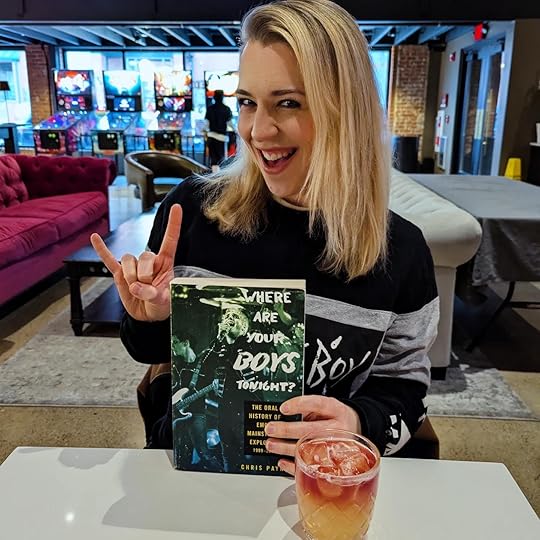
feels dramatic to say that emo music raised me but it’s threaded through my life. my formative years were spent in mosh pits, sweaty in the front row, hands in the air, black around my eyes, metal against my chest, going so hard the barricades broke.
dozens of wristbands, “angels fart too” written by pete wentz, hugging patrick stump. m&gs with panic!, my chemical romance touring again, gerard way & the umbrella academy. the first online friends i ever made (i like your shoelaces).
the first minute of this novel immediately felt like taking all of that back. a chronicle of some of the best times of my life & people i still love—william beckett, gabe saporta, ryan ross, adam siska (sisky business!). it talks about snakes on a plane, my favorite shitty movie.
the thing about being in your early teens & loving these bands is that you can’t fathom aging. it’s terrifying. it’s devastating. how do i live without them?
but we all grow up. now i’m 26 & looking back from the other side. the bands i loved who never thought they’d make it past their twenties are well & happy. they’re okay & so am i. growing not just in the literal sense but from “you saved my life” to “i saved myself”.
pete wentz used to lie under a blanket & think “this is what it’s like to be dead”. this year he said “i don’t lie under a fucking blanket & think about dying anymore”. there’s no better way to sum it up.
I had such a blast reading this book. So many of these bands played a huge part in my youth, but I didn’t know all that much about the behind the scenes stories at the time. Middle school me in 2003 wasn’t spending a lot of time researching bands online. If you have an affinity for emo bands from the 1999-2008 era then you should definitely check this book out. It’s interesting getting to hear all the different stories from the people who were directly involved.
The book provides a fascinating look at how the scene went from DIY bands and shows in small venues to blowing up into the mainstream and being heavily featured on MTV and big chart successes. The interview subjects provide so much information about how the bands influenced one another, different drama from the time, and reflections on hardships. So many of these stories were things I hadn’t heard before. But even when it was something I’d already heard before it was still interesting to read again. Especially since these are interviews done from a modern perspective rather than reading a quote from 2005 in 2023.
Some topics that are brought up that I was hoping to get a bit more time spent on were how mainstream media, older rock bands, and rock critics looked down on emo music which led those bands to not associate with the emo title back in the day, misogyny within the scene, and homophobia aimed towards emo. Those things definitely do get discussed, but I kept wanting to dive deeper. Also, I’m personally not really a fan of the oral history format. But I can look past it and still get sucked into a book when I’m invested in the topic. However sometimes I did find myself getting confused or wishing that the book was written as a more traditional nonfiction book. I really loved the introduction and conclusion that were written in the author’s own words.
But overall I had a great time with Where Are Your Boys Tonight? There were so many bands and songs that I hadn’t listened to in such a long time that I found myself looking up again. It was an amazing trip down memory lane as well as a look into stories and behind the scenes information that I hadn’t heard before. I definitely recommend this book if you’re a fan of this era of emo music.
Thank you to the publisher for providing an advance copy via NetGalley in exchange for an honest review.
An undeniably impressive feat of research undone by glossing over the core of misogyny and sexual violence that made the scene rot from within. The book does address the problem - and the allegations against Jesse Lacey - but it doesn’t dive into it, and it really needs to. Can you fit everything into a book? Of course not. But I don’t think we needed five pages on the photo shoot for Through Being Cool - or the admittedly entertaining vignette about Cartel and the reality show - when you could’ve used that space to explore the allegations against Lacey. (It doesn’t even mention the allegations against Chris Conley.) Lacey feels like the scene’s Altamont moment, where it became clear that the dream was dead. I kept reading the book, waiting for a serious discussion of what he did - using that as a jumping off point to discuss the problem more broadly - and it just never came.
Yes, this book does a lot of things well - it’s funny, and it has a great sense of storytelling, and a nice narrative arc. But by failing to go into enough depth on this issue, it feels weightless and inconsequential. Overall, the book lacks perspective in the same way that Alternative Press did at the time: it has a number of different viewpoints to be sure, but it doesn’t really examine them in a critical way like the best oral histories do - e.g., Live from New York. It never transcends its scene boosterism, coming across as a particularly well researched infomercial a la Victory Records.
The book’s priorities seem to line up with the priorities of the people featured in the book, and that’s a problem from a journalistic perspective. Maybe the allegations against Lacey were not the most important thing to the people interviewed in the book, but they are certainly one of the most important things about the story.
An incomplete nostalgia artifact at best, an irresponsible book-length AltPress cover story at worst.
Where Are Your Boys Tonight?, or, That Wasn't a Scene, It Was a Goddamn Arms Race
4.5 stars rounded up bc the overall scope is excellent. It's a solid chronicle of the rise and fall of early 2000s music, with so many bands I remember hearing about-- I didn't listen to Jack's Mannequin or Hawthorne Heights or New Found Glory or Taking Back Sunday, but I had plenty of friends who loved all of them-- and the bands whose music got me through high school, that truly made the scene explode. It was also fascinating to read about it from insiders' perspectives, people who were active in the Jersey and Long Island local music scenes for a long time, and were able to see so many of these bands coming up and breaking through from the very beginning.
I was honestly surprised they didn't really touch on Green Day at all, not least of which because they came from the California punk scene (and the first part of the book really lays out how emo/pop punk ascended from more hardcore punk), but especially because, as someone whose high school career spanned 2003-2007 when all of this really exploded, American Idiot was such a game-changer of an album for so many of us; for me, the Big Three were Green Day, Fall Out Boy, and My Chemical Romance. Panic! made it a foursome, but they came later.
He basically said, “Yo, you need to meet Wentz.” And I was like, “I don’t fucking like that dude.”
This was a wild ride. I will admit that I don’t read a lot of non-fiction in this vein, so I don’t know how normal this format is, but Where Are Your Boys Tonight? is an oral history that mixes together dozens of different interviews to create one “narrative” that traces the emo genre from the ‘90s to around 2008. I was pretty young around this time and did not follow celebrities or musicians at all, so it was both nostalgic and very, very interesting to find out what was going down with all these bands while I was listening to Sugar We’re Going Down on youtube 2000 times.
I would be so interested to read more about how this book got made, because it seems like such a massive undertaking and I cannot imagine the work that went into weaving all these interviews together. Overall, I thought this format worked well, and once I got into the rhythm of the book I didn’t have too hard of a time following things. There were some moments where it almost felt like the wrong people were being interviewed. But at the same time, I understand that not everyone is going to have the time (or desire) to be part of a project like this, so given that I think the author did the best they could creating a cohesive story.
I was also pleasantly surprised that many of the people being interviewed for this book talked openly about the racism, misogyny and homophobia that was pervasive in the scene during this time. I honestly wish it had been discussed in more depth, but as it is this book is almost 500 pages and each of those subjects could easily be its own book. I was a bit surprised that both the author and several of the interviewees in the book openly acknowledged Jesse Lacey’s sexual assault allegations, but didn’t mention anything about…anyone else. There might be legal reasoning behind this, but it did strike me as odd.
Thanks to the publisher for a copy of this book in exchange for an honest review!
Like catching up with an old friend. All of these bands are so deeply ingrained in my DNA, I truly wouldn't be who I am today if I hadn't spent so much of my life loving them. This book brought back so many memories of waking up early every Wednesday in the summer time to watch Warped Wednesdays on Fuse, sitting in my room waiting for the music video for A Little Less Sixteen Candles... to drop on MTV, loading up my precious AOL Dial Up to get on Myspace, and going to my first ever concert when I was 11 years old, My Chemical Romance on The Black Parade tour and being convinced that Frank looked right at me.
I immediately made a Spotify playlist that I've been further damaging my hearing with and remembering how much I love every single one of these bands.
(Also... Fat Mike from NOFX bullying Underoath so hard that they almost broke up... incredible. I fully remember that Warped year being heavily documented on Fuse.)
a 4.5 rounded up -- I would've loved a longer epilogue from Payne talking about his experiences/feelings of the scene as a whole, but also understand that he refrained from doing so to let his interviews (over 300 hours!) speak for themselves.
A lovely nostalgic book! What a treat to read some of my favorite bands' origin stories directly from the source. I didn't think I could love gabe saporta and geoff rickly more but wow what wonderful dudes in the scene? To come of age during this magical time online was such a treat, and as mentioned in the book, is something that can never really happen again, you simply had to be there. Some things that cracked me up: pete wentz being some tough dude in the scene? taking back sunday being considered 'more dark' than brand new? mikey way being described as mr. burns when talking to girls LMAO. patrick stump in his humility believing everyone could sing like him.
i think the book also succeeds in reflecting on insular the scene was--how male dominated and how white it was. Right from the jump Payne says in the introduction how he's going to attempt to "depict where and how brand new drove the narrative of the 2000s emo boom, without glorifying Lacey himself... I truly hope I captured it in a way that feels accurate to the era, and bring no further pain to those Lacey hurt." And yes, many people highlight the rampant misogyny and sexism in the scene (kudos to Payne for including female and bipoc members of the scene for these parts) it seems like brand new/lacey is the only example brought up in this way, which was a frustrating missed opportunity. Satirical headlines like these don't pop up because of just one band yknow? Another reviewer pointed this out and wondered if it was due to legal issues and I can't help but wonder the same.
Yes the oral history format takes some getting used to but it's doable! I think because of the large amount of people in this book it can get overwhelming, especially if you're going into this blind/only know a couple of names. But Payne includes a cast of characters for each part of the book and you can coast reading without knowing them all. For a more traditional non-fiction take on this subject I'd recommend Dan Ozzi's Sellout which dovetails perfectly with this book. Excited for more books to come out examining this special time in music history.
As a former MySpace scene queen, this was so nostalgic. It was exciting in every page to see the people and the photos. It really was a throwback and a genuinely enjoyable read.
I was going to have this review just be something stupid like “great final read of pride month” or “yes indeed the boys are probably kissing each other” because who doesn’t love a witty goodreads review
But instead I’m over here crying like an absolute baby because this book came at the perfect time and I just love this music so much. I’ve been a fan of most of these bands for the majority of my life and it feels so strange to overlap with this time while not because I was quite literally 2 in 2005. I wish I could have seen it as an adult. Obviously since that can’t happen though I’ll take this. This book was complete fan service and so incredibly put together. There are so many interviews! And they’re strung together so well! Chris Payne deserves the absolute best from this.
i think the issue with books like this (i had the same problem with meet me in the bathroom) is its lack of any kind of critical authorial intent/direction. chris payne organized these interviews, sure, but a lot of them are sort of factually smudged without any real follow-up or explanation or context. that's an issue inherent to the form - of course people are going to hype up themselves and their own scene, especially when so much time has passed since a lot of these things happened. they get mythologized! i get that! but i think it's sort of irresponsible reporting, especially re: jesse lacey and the sexual assault/mistreatment of women that definitely ran rampant, which should obviously be discussed honestly and with as much integrity as possible, not glossed over like it was (aside from the prologue) in this book. also, just on a more general note, the shit about the northshore scene kept making me laugh. you absolutely cannot get from wilmette to a show in chicago in 15 minutes. nice try tho
I cannot possibly rate this. Not only for proximity or reasons involving nostalgia (this makes up so much of my childhood and musical DNA), but for this book's worth as an unintentional historical document for rendering the shift in culture and musicians in America in ways that are surely unintentional but no less valuable.
I read this back-to-back with Meet Me In the Bathroom. Having been born in the mid 90s, I obviously missed the boat on that movement and this surge of emo music was more my speed. In the case of Taking Back Sunday and Brand New, it was happening in my backyard (though I was too young and sheltered to attend most shows. It may as well have taken place on the moon). Lined up one after the other, one develops not only a better chronology of how music and The Scene evolved but also, in a tragic sort of way, how a lot of musicianship seemed to *devolve*.
I don't want to come off as championing NYC and throwing a middle finger to anywhere else (I can't even claim NYC), one thing becomes extremely clear when listening to the parties involved in both the NYC rock movement at the turn of the century and many of the emo bands of the early-mid 2000's: Though they share lots of drunken antics and navel-gazing, the NYC rockers are students of their craft and think deeply about culture and art. *So much* of the emo bands and fans (that I align myself with taste-wise and culturally) come off as, frankly, immature and hard-headed. The NYC rockers discuss influence across genres and mediums, they use terms like "cottage industry" and had a deeper understanding of their own medium. A good percentage of this book can be summed up as immature tribalism for not like other bands because "fuck those guys".
My Chemical Romance and Fall Out Boy, the two main characters of this book, are different. Gerard has always been emo's bon vivant and if music didn't work out, he probably would have been a comics legend instead of merely a well-regarded with several series under his belt. MCR had passion and musicianship, showmanship, direction. So much of the genre got by only on that first virtue (and once again, this is probably my favorite genre of music during its halcyon days). Suggest anything along the lines of a decline in culture or ability in artists today and you will be (somewhat) rightfully pelted with advocates (and shameless self promoters) who have their finger on the pulse of good shit. But reading this book back to back with MMITB illustrates a downward slope in nuance, proficiency, and seriousness that is difficult to ignore.
Emo's brief flirtation with the mainstream is endlessly fascinating. It calls into question discussions of high vs low art, the commodification and sausage-making in the music industry, aesthetics, sincerity in art-- and more. Most of these are beyond the scope of this book, and that's a shame. I wish the people interviewed were a bit more articulate and interested less in the adventure and nitty-gritty of the rise to fame and more about the implications and how emo functioned in the overall culture of America. What does it say that emo is almost exclusively made up of adolescents, making it a movement almost entirely driven by "kids"? How can we measure the lasting footprint of emo (which can be a lot or a little depending on your POV) on contemporary America? What are the causes, and what does it say that emo is nowhere to be seen in mainstream music today? It would be wrong to say none of these are addressed, but Where Are Your Boys Tonight only dips beneath the surface of what I've been convinced is an important development.
Emo's appeal to me as a teen was the big sound-- one of the few things out there that really captured the raging seas inside. It validated the overdramatic narration and framing of my own life. It was ugly, and I was ugly. Today, I appreciate emo in a completely different way. Our irony-poisoned society makes a mockery of this sort of vulnerability. Emo was the genre of the glass cannon-- it only knew how to take big swings and if it whiffed, so be it. Now, big swings aren't economically viable and punished culturally. It took bravery to write and sound like this back in the 2000s, and it still does today. But the texture of that bravery has shifted.
Too much emo and pop punk is still treading misogynistic tween waters. We've lost something essential when it comes to musicianship as well. Even as someone resisting boomerisms when it comes to new music, but so much of new emo sounds the same to me. It's regurgitating what was already the more digestible parts of emo. Many of my favorite bands come from the wave firmly after this wave of emo and even get mentioned at the end (Tigers Jaw and Algernon Cadwallader, hell yeah, and furthermore, lets go) but part of the reason why I'm so disenfranchised with newer emo is because it is holding back. It's not all their fault, but we're the poorer for it.
I don't want this to come off as someone who didn't enjoy my time with this book. It was fun to take a trip down memory lane. Fall Out Boy's rise in particular makes me recontextualize how I understood the genre at the time and the way I view it in hindsight now (sidebar: The idea that Folie A Deux was seen as such a failure drives me insane. 99% of the bands in this book don't have an album as good as Folie A Deux). It makes My Chemical Romance and Fall Out Boy all the more precious, because they were great, truly great, in all the ways that matter most.
An irreplaceable look at how emo touched the mainstream, if only for a moment-- and why it's so difficult (but not impossible) to imagine it happening again.
Quick side thoughts:
* The story about Bayside is utterly devastating and finding out that it happened in (or close to) Casper, WY makes me want to [REDACTED] * Had no clue how many of these bands were deeply, deeply Christian. Makes a lot of sense in hindsight. * I really liked Panic! at the Disco when they hit the scene but if I was a little older (and known how insanely young they were) I'd probably have felt differently for silly reasons lol. Also, Pretty. Odd. is a transformative album. * No-win situation with the whole Brand New stuff. You don't want to lionize them or absolve them for what they did but it also got a little much the way basically everything had to be framed as "and they suck as people, too!". * I don't remember Cartel living in the bubble at all but that's probably the funniest thing in the entire book * It's a shame how little Gerard is in the book. His presence is really missing. And MMITB proved you can have it both ways building up the myth of a character like Julian Casablancas and then hear the man speak. Gerard is probably super busy but his POV is noticeably absent. * The part about how hardcore bands would just have a microphone for people to make public statements-- we need to bury this idea so nobody will ever try it again. I'm so dead serious. * Pete Wentz and Jay Z were really actually tight, huh? Lil Wayne too but that's less surprising. * I'm so sorry to my Long Island forefathers for not putting Patchogue-Medford on the map. We look so bad. We're like the only towns on this stupid island that got no love. * Nobody likes new Panic! Come on. We don't believe you. * Haven't thought about Foxy Shazam in YEARS. What a pull lol. * Chris Gethard. * I went to Warped Tour one time and my friend got concussed and taken away in an ambulance and I never saw them again to this day. Nassau Collesium is beyond cursed. Salt the earth. * Max Bemis... history should be kinder to you than they ultimately will be. * Hysterical to think of how much physical cash was on those Warped Tour busses. If there were any justice in this world that premise would be the backdrop of at least two R-Rated comedies and one made-for-TV-special * My Chemical Romance is the best band in the world.
DNF, page 331. So ... this is a great nostalgia trip. Just seeing the names of some of these bands I used to listen to 20 years ago was enough to make me almost squeal aloud. And there were parts of the book that I enjoyed. But I struggled a lot with the format.
This book is an oral history, meaning that it's made up entirely of quotes from other people. The author begins each section with a "cast of characters" explaining how each person he interviewed is relevant to the scene (i.e., this person was the frontman for such-and-such band or the producer for such-and-such bands, stuff like that). And that was just insufficient for me. You read all these quotes saying stuff like "We got in the van and toured along the coast," and you're trying to figure out who "we" is, so you have to flip back to the cast of characters, and then two pages later is another quote using the word "we" but this time it's a different person talking about a different band.
And the worst part is that I don't care equally about all of these bands. For instance, when I looked at the first section, I was excited to see someone from Newfound Glory and someone from Gaslight Anthem in the cast of characters. But when I started reading, the bulk of the text was about bands I wasn't even familiar with, like Racetraitor and Thursday. And I guess there was some feud between Taking Back Sunday and Brand New, and there was a lot of text to devoted to all that, which I didn't care about.
In a nutshell, my problem with this book was that I really wanted to be able to skip around and read about the bands that I actually grew up with and liked. But the way this book was structured made it very hard to do that. The last section seems to be mainly about Fallout Boy, My Chemical Romance, and Panic! at the Disco, and since I'm not really a fan of any of those bands, I gave up trying to skip around looking for Chris Carrabba's and Andrew McMahon's names and just decided to call it a day.
This book was everything I was hoping for and more. I’ve always loved books about music and how different artists came up so this was SO up my alley. I’ll be thinking about it for a long time and am so happy to have some Fall Out Boy and Paramore back in my Spotify rotation. 🩷🩷🩷🩷🩷🩷
content/trigger warnings; mentions/discussions of bullying, abuse, racism, antisemitism, sexual assault/rape, drug abuse, anxiety, panic attacks, suicide, 9/11, terrorism, death, bipolar, hospitalization, ableism, queerphobia, illness, injury, addiction, depression, sexism, misogyny, grief/loss,
while i was definitely more into this genre or a lot of these bands when i was younger (i only actively still listen to like...three of them), learning about how they got started, the role myspace (ugh simpler times) had in building their careers, and just the whole behind the scenes of it all, even for bands i’ve never listened to (though definitely more interested in the bits about panic at the disco, paramore, hey monday, my chemical romance, fall out boy, taking back sunday, jimmy eat world, etc.), is fascinating. i love a good oral music history (and am forever confused by people choosing to read oral histories and then criticizing the format....don’t read oral histories then??).
i love the bit about how some suits went up to dashboard confessional being like “you’re the top illegally downloaded artist, you need to make a psa against downloading” and they were just like “shit that’s awesome! hope they keep downloading! those are the kids at our shows, so you making less money because of it isn’t my problem” because like....legend behavior.
and eminem starting up a conversation with chris from dashboard confessional and talking about the band and rattling off songs and asking about future projects and then being like “you got a sister, what’s her name” and signing a napkin for her....also legend behavior.
and because loving brendon urie is part of my personality....given the recent hate towards him, all that brendon vs ryan fan feuding about how brendon isn’t talented (can’t sing, write, play, anything) and panic was only good/successful because of ryan and his lyrics which is why the early albums are the “fan favorites” and the last few panic albums “suck,” it’s really refreshing and nice to see the appreciation for brendon in this book. the acknowledgement of his ridiculously good vocals, his ability to play any instrument put in front of him, him being a natural born performer, being a good down to earth dude, and his key role in panic’s success. it goes to show that unlike what bitter randos on twitter would like you to believe, panic’s success wasn’t just because of ryan. (it’s cool to like the early albums better, but i promise you don’t have to be so nasty and pretentious about it. also, there’s plenty appreciation for ryan’s genius in the book, too.)
and i love the way they talk about how unorthodox every single thing panic did was. like, “oh let’s record all these instruments on the track that i can’t play live at once, and let’s overlap the vocals in a way that’s impossible to perform live” we love the chaotic energy. and with their first album they sold out immediately and everyone was amazed but “someone in the band was like ‘oh we sold this many records? is that good?’” lmao hearing about how green they were is wild.
notes: i wish some topics got more of a deeper dive (racism, misogyny, mental illness) and some bands got more attention (hey monday!!!!!!), and there’s a fine line between acknowledging the role mental illness can play in the way we feel/think and therefore create, and romanticizing mental illness, and i feel like that line is almost always crossed.
Where Are Your Boys Tonight? was better than I expected. Even though I'm not a big fan of "oral" narrative styles, I thoroughly enjoyed reading this book. As a huge fan of this era of music, I was able to learn a lot about the different bands that I grew up with and love(d). This book was written (more like transcribed/composed?) for the fans. Non-fans would probably get very little from reading this.
The very first few chapters were less interesting to me because I did not listen to most of the ultra underground bands that started the scene, but other than that, all the other chapters focused on bands that I had listened to (e.g., Dashboard Confessionals, Brand New, Something Corprate, Jack's Mannequin, Taking Back Sunday, Gym Class Heros, Fall Out Boy, My Chemical Romance, Panic! At The Disco, Cobra Starship, Paramour etc.). The later chapters were particularly interesting and insightful. Overall, as a reader you really got a sense of the people and the times from the myriad interviews.
The one bad thing about the oral format of the book is that I constantly had to go back to the beginning of the sections to re-familiarize myself with all the people. It took some time to remember who everyone was and what they did (and I still feel like I didn't remember everyone). For the most part I tried to just go with the flow of the interviews and get lost in the documentary style of the book.
I rounded my review up for the pure scope and detail of the book. I highly reccomend it to other fans of the era.
P.S. Fall Out Boy is my ultimate favorite from this era, they are still one of my all time favorite bands. Also, Grand Theft Autumn/Where is Your Boy is my favorite song of theirs, so it was neat to see the title of the book be a nod to that song.
I don't think I was fully prepared for what an 'oral history' entails, and ultimately think I will be avoiding them unless the topic is really compelling to me. I thought 'Emo's Mainstream Explosion' would be, but I was left craving some good old fashioned narrative writing after 300 pages of interviews and conversations.
None of my complaints about the book are any fault of Chris Payne's and I think he did a fabulous job assembling the heavy hitters of the emo scene. There are plenty of delightful and nostalgic anecdotes in this book, and an overall enjoyable read for any former or current emo kid 3
(Chris Carrabba) "They just said me. Wait, I think we won this." Avril was sitting right in front of me. I remember her turning around to clap when they announced my name, which I thought was nice.
(Geoff Rickly) After Fall Out Boy had the hit with "Sugar, We're Goin Down," they were headlining Roseland Ballroom in New York--this very prestigious , three-thousand-cap club. I was in the balcony with Jay-Z, and Beyonce was there. And dude, she knew every fucking word to every song Fall Out Boy played. I could not get over it. I could not. I was like, "What the fuck, she knows Fall Out Boy?" Now I'm like, "Of course she did. Those songs are pop classics." It just didn't compute to me that these worlds were crossing.
The most fascinating, heartfelt look at the scene I’ve ever had the joy of reading. This thing reads like a conversation among some of your closest friends about the people whose music you screamed until your lungs gave out.
Bands I spent countless hours listening to describe the rise (and sometimes fall) of their careers with such frank openness it was sometimes hard to read. They don’t hold back and it was amazing to see.
This is the college textbook for Emo 101 and I loved every single minute of it.
Feels incredibly right to be fifteen pages from finishing this book while waiting for my flight home from seeing MCR play all of The Black Parade at Emo Nostalgia Fest 2024. What a generous, loving, hope-filled, sadder, giving, wiser In-Defense-of-the-Genre narrative.
I was once at a friend’s tattoo appointment where the tattoo artist said “distract her — the best distraction is always good gossip about people you don’t know.” On the one hand, this was absolutely that: insider gossip about who felt what, who feuded with whom, who was kissing, who felt the scene was selling out, who embraced the fact that teenaged female fans are every bit as worthwhile and worthy of respect as older guys in their late 20s. (Cue my reading aloud to all my friends this weekend the part about the scene idolizing the positive masculinity of Hot Water Music.) On the other hand, I can’t divorce my enjoyment of this book from living and breathing it with everything I had when these bands were ascending and imploding and exhaling into the air we breathed together, the shouted choruses at the club shows that showcased the “integrity” that the scene presumed was missing from arena shows.
All I know is that on Saturday I was inside the fence when MCR played and thousands and thousands sang along, and on Sunday I was hanging around outside with everyone else who couldn’t afford two days’ worth of tickets, glimpsing the screen from the main stage and still singing with as much heart and love, and this book gets at the intimacy and the earnestness and the collapse between those strata, there being no divide between those experiences. Feels appropriate that as soon as we take off, I’m about to read the epilogue, “We’ll Carry On.” I loved this, and I appreciate from the bottom of my heart that it clearly came from a place of love; so many photos and ticket stubs were credited as “from the author’s collection.” Thank you.
Like three weeks ago, Chappell Roan played this music festival two blocks from our house and suddenly 30,000 ppl showed up for a non-headliner in a random street block designed to fit 5,000. Then, like 2 days later, the NYTimes wrote a full article about her booking a tour and then blowing up and trying to deal. Anyways, this book felt like that progression but for 100 bands over 10 years and they all faded 9 months later except the ones that adapt. I’ve always wondered why so many people tried to shed the ‘emo’ label after it got them big, but the biggest takeaway is that ‘emo’ was just the only scene they felt comfortable in and then they were 17 yo musicians with money and carte Blanche, no wonder they dispersed into so many genres and worlds rather than getting pigeonholed in their teens. Anyways, hoping to continue my streak of being in the top .05% of fall out boy listeners on Spotify again this year and LOVED learning more of their story, but enjoyed learning about the Long Island/NJ scenes in the 1990s more than any other part.
My brother and I were pretty deep in the emo scene of the early 2000s, though I’m not sure we would have described it that way. Emo was a derogatory term at the time, not a genre. We’d probably say that we liked post punk, power pop, pop punk, etc etc. Reading this book brought back all the joy and adrenaline of being 16, finding new bands to love and and going to shows. It also reminded me of why I found a sense of home in the scene to begin with. If you were an emo kid or emo-adjacent kid back then, this will be an extremely fun book for you.
Extra for the .01% of people this is relevant to, if anyone ever reads this:
I so enjoyed reading the history of the movement. I was aware of the fact that Long Island and NJ were hotbeds of the scene because we always seemed to be driving there for shows, but reading an actual history (it started in this VFW hall, that club that was willing to do all-ages shows etc) was like coming up off the ground and seeing my own reality from a 30k foot view.
The book also does a great job of capturing the excitement of discovering a new band or listening to a band’s career-making album for the first time. The reactions to an emerging My Chemical Romance were a favorite point of mine. The band started as a bunch of drunk, smelly comic book fans in too-small leather jackets but something was there! Quotes from their contemporaries in other bands: “I noticed them immediately - they were like a scrappy AFI without all the histrionics” “who was this evil pop-punk band??” “I loved that they were totally camp but also dead serious” etc etc. I was like, yes!! This was my exact reaction the first time I saw them, opening for a more established band that they seemed to have eclipsed in the days since booking. They were campy, dirty, weird, and theatrical and I couldn’t get enough. Years later I’d be a little embarrassed that I had loved them so much and this brought back all the novelty and fun of it. So validating, haha.
And of course, the drama. Loved getting the insider info on the TBS/Brand New feud, the friendships formed and lost as bands gained success or faltered, got sober (Gerard from MCR) or got lost in substances (Burt from The Used.) I also appreciated that the book acknowledged the allegations against Jesse Lacey and described Brand New’s influence without glorifying him. Actually it seemed like a great opportunity for all the other guys in the industry to dunk on Jesse, which was like emo reality TV for me and I ate it up.
As an adult I sometimes listen to my favorites from that time and I’m struck by how misogynistic and violent they can be. These were a bunch of emotionally immature guys in their early 20s tanking their romantic relationships and one-upping other with extreme lyrics. I was a bookish girl, drawn to counter-culture but also an absolute rule-follower. I wanted to date a nice guy who I could talk about my feelings with. Where was my place in it when so much of it was problematic?
The book helped me sort that out! Well… I loved the way emo guys made light of gender norms. I didn’t want to live in a world where bro culture dictated the social order. I still don’t. The girl jeans, eyeliner, and nail polish were the era’s version of Harry Styles showing up at an awards show in a dress. Some of the bands were misogynistic but many of the fans were just thoughtful guys who didn’t know how to throw a football and felt ok about it. I also didn’t drink at a time when most of my peers did, and emo has roots in the straightedge scene. I liked that I could align my choice not to drink with a culture and a movement when some of my peers dismissed it as childishness. I could be like, “I’m not two years behind you in life, I have chosen to be this way for a reason!” (Of course, the actual hardcore straightedge scene is rife with problems of its own.) Most of all I loved the feeling of making a pilgrimage to a show, bonding with friends-of-friends on a 4 hour drive to Asbury Park NJ, the adrenaline when the band comes on and the floor shakes with your favorite song, talking to some girl in the bathroom about her At The Drive In t-shirt, etc. It was just so much fun. We were sober, sweaty, hoarse kids having the best time ever.
It ended for me in 2006 when I graduated from high school and went abroad for a gap year, quickly realizing that my band tees and studded belts might be alienating for my host family and others trying to get to know me through my imperfect Spanish. I dutifully put on pearls for sorority rush at my southern state university, but I carried a tote bag embroidered with tiny skulls as a beacon to any other former emo girls lurking in the houses. “If you’re out there, I’d like to be your sister.”
The back half of the book was new to me since I had fallen out of the scene by then, but it was fun to read and find out what happened to everyone. Obvious statement, but Fall Out Boy really blew up!
I’m listening to all my emo this week! Wish this book had been longer, haha. If you weren’t an emo it might be unintelligible but it’s worth a try! If you were an emo, get ready for all the flashbacks :)
This was such an enjoyable read 🥹 Reading this felt like that “how it feels to listen to a podcast” meme except the people on the poster were the bands that shaped my adolescence.
10 out of 10. Out of 5? Still 10. This was pretty much the perfect book for me.
This was truly a behind-the-scenes look at everything that went on in the emo/pop-punk scene during my formative years. I love that this is presented in a real oral history format, with pieces of interviews with SO many people interspersed with one another to give multiple perspectives on each event and phase. Sometimes books like this set high expectations and read just like a really long magazine article synthesized to make the author's point, but this felt more like a retrospective documentary. So many of the artists and other involved in the scene really opened up and this was at times funny, at times informative, and at times eye-opening.
Would recommend to anyone who listened to music from this genre and era. If you didn't, you might not get as much out of it - I would recommend at least familiarizing yourself with some of the key players first. I fully intend on purchasing and rereading some day. <3
Thanks to NetGalley/Edelweiss for this eARC in exchange for my honest review. More grateful than ever!
Where Are Your Boys Tonight? is an oral history of the rise of the emo niche of alternative rock from the late 90s to 2008. It was a really cool glimpse behind the scenes of the creation of music I screamed at the top of my lungs as a teenager. This book also made a great companion for emo trivia night 🖤
I had so much fun reading this book and would recommend it to anyone who was remotely into the scene. Still don’t understand all the hype about Fall Out Boy though. Them?