

What do you think?

Animal Man (1988-1995)
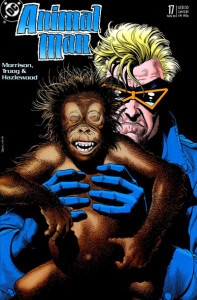
Animal Man, Vol. 2: Origin of the Species
Written by Grant Morrison; Art by Chas Truog, Tom Grummett, Doug Hazlewood, Steve Montano, and Mark McKenna; Cover by Brian Bolland The second collection of Grant Morrison's groundbreaking run on ANIMAL MAN reprints issues #10-17, plus the 19-page story from SECRET ORIGINS #39, this volume shows Animal Man moving more and more deeply into the cause of animal rights. But something else is going on beyond his burgeoning radicalism. Strange visions of aliens, people disappearing into strange pencil-like drawings, and hints of a terrible Crisis lurk around the edges of reality. For more information, see the feature article.
224 pages, Paperback
Published July 1, 2002
About the author
Grant Morrison
1,812 books4,674 followersGrant Morrison has been working with DC Comics for twenty five years, after beginning his American comics career with acclaimed runs on ANIMAL MAN and DOOM PATROL. Since then he has written such best-selling series as JLA, BATMAN and New X-Men, as well as such creator-owned works as THE INVISIBLES, SEAGUY, THE FILTH, WE3 and JOE THE BARBARIAN. In addition to expanding the DC Universe through titles ranging from the Eisner Award-winning SEVEN SOLDIERS and ALL-STAR SUPERMAN to the reality-shattering epic of FINAL CRISIS, he has also reinvented the worlds of the Dark Knight Detective in BATMAN AND ROBIN and BATMAN, INCORPORATED and the Man of Steel in The New 52 ACTION COMICS.
In his secret identity, Morrison is a "counterculture" spokesperson, a musician, an award-winning playwright and a chaos magician. He is also the author of the New York Times bestseller Supergods, a groundbreaking psycho-historic mapping of the superhero as a cultural organism. He divides his time between their homes in Los Angeles and Scotland.
In his secret identity, Morrison is a "counterculture" spokesperson, a musician, an award-winning playwright and a chaos magician. He is also the author of the New York Times bestseller Supergods, a groundbreaking psycho-historic mapping of the superhero as a cultural organism. He divides his time between their homes in Los Angeles and Scotland.
Ratings & Reviews
Friends & Following
Create a free account to discover what your friends think of this book!
Community Reviews
Displaying 1 - 30 of 122 reviews

December 22, 2021
Grant Morrison lays on the couch of his therapist, Dr. Philip K. Dick, and they discuss, among other things, Morrison's writing for the Animal Man series.
GM: Are you really a psychiatrist?
PKD: That’s what the certificate on the wall says.
GM: Yeah, I’m looking at it and under your name is typed “insert name here” and I think it’s from Miskatonic University?
PKD: Go Squids! But let’s talk about you …
GM: Em, OK, but that bright pink light is making me uncomfortable.
PKD: Animal Man, tell me about your writing that series.
GM: Well, it was the late 80s, Buddy Baker / Animal Man had been a little used DC character from the 60s, appearing in some issues of Strange Adventures. He can borrow the powers of nearby animals for a few minutes. So if there are birds around, he can fly; if there is a strong bull close to him he can attain great physical strength.
PKD: You wrote him to be a vegetarian and an animal rights activist, as well as a very humanistic drawing of a superhero.
GM: Buddy was kind of a B-lister, he was in awe of Superman when they met, he tried out and got on the Justice League of Europe, but he was still not completely at ease with his powers and was relatively untested as a hero. Also, Buddy is very approachable, and people can relate to him, he’s married with small children, they have a house and pay bills and struggle some.
PKD: Volume 2, Origin of the Species, collects issues #10-17 and a nineteen-page story from Secret Origins. Seems like in this second batch, after you had re-introduced the character, you went in a different direction.
GM: Yes, I had Buddy go to South Africa, still under Apartheid at the time, I wanted this Animal Man to be aware of social issues and to be active in environmental and ecological issues.
PKD: Eco-terrorism?
GM: You a cop now? And I wanted people to think about consequences of actions – on both sides of that issue.
PKD: And aliens?
GM: Well, sure, you gotta have aliens.
PKD: Do you feel like Buddy can relate to the animals?
GM: Somewhat, but I wanted to emphasize that animals think differently than we do, a completely alien thought process. Buddy wants to understand and his exploration of his powers and how he relates to animals was a theme in the series.
PKD: You do a little breaking of the fourth wall.
GM: That’s fun right? And I’m not over the top like Marvel and Deadpool, a wink a nod works best, Trevanian style.
PKD: Were you influenced at all by Mike Baron with his Badger series?
GM: Let’s just say there are some similarities between Badger and Buddy when it comes to animal rights / empathy.
PKD: What about your mother?
GM: My mother? Let me tell you about my mother …
GM: Are you really a psychiatrist?
PKD: That’s what the certificate on the wall says.
GM: Yeah, I’m looking at it and under your name is typed “insert name here” and I think it’s from Miskatonic University?
PKD: Go Squids! But let’s talk about you …
GM: Em, OK, but that bright pink light is making me uncomfortable.
PKD: Animal Man, tell me about your writing that series.
GM: Well, it was the late 80s, Buddy Baker / Animal Man had been a little used DC character from the 60s, appearing in some issues of Strange Adventures. He can borrow the powers of nearby animals for a few minutes. So if there are birds around, he can fly; if there is a strong bull close to him he can attain great physical strength.
PKD: You wrote him to be a vegetarian and an animal rights activist, as well as a very humanistic drawing of a superhero.
GM: Buddy was kind of a B-lister, he was in awe of Superman when they met, he tried out and got on the Justice League of Europe, but he was still not completely at ease with his powers and was relatively untested as a hero. Also, Buddy is very approachable, and people can relate to him, he’s married with small children, they have a house and pay bills and struggle some.
PKD: Volume 2, Origin of the Species, collects issues #10-17 and a nineteen-page story from Secret Origins. Seems like in this second batch, after you had re-introduced the character, you went in a different direction.
GM: Yes, I had Buddy go to South Africa, still under Apartheid at the time, I wanted this Animal Man to be aware of social issues and to be active in environmental and ecological issues.
PKD: Eco-terrorism?
GM: You a cop now? And I wanted people to think about consequences of actions – on both sides of that issue.
PKD: And aliens?
GM: Well, sure, you gotta have aliens.
PKD: Do you feel like Buddy can relate to the animals?
GM: Somewhat, but I wanted to emphasize that animals think differently than we do, a completely alien thought process. Buddy wants to understand and his exploration of his powers and how he relates to animals was a theme in the series.
PKD: You do a little breaking of the fourth wall.
GM: That’s fun right? And I’m not over the top like Marvel and Deadpool, a wink a nod works best, Trevanian style.
PKD: Were you influenced at all by Mike Baron with his Badger series?
GM: Let’s just say there are some similarities between Badger and Buddy when it comes to animal rights / empathy.
PKD: What about your mother?
GM: My mother? Let me tell you about my mother …

August 15, 2017
Grant Morrison’s second Animal Man book doesn’t improve on the lacklustre first volume being equally dull. There’s no overarching storyline to this series, it’s just a collection of random, uninteresting adventures Buddy Baker goes on.
Besides continuing to explore his powers and pursuing his animal rights activism, some aliens are watching him for reasons, he has team-ups with obscure heroines Vixen and Dolphin, there’s a new B’Wana Beast, and he fights some villainous cheeseball called Time Commander. Bo-ring!
There’s some imaginative uses of his powers with Buddy adopting the ability to multiply from bacteria within someone’s body as well as utilising sonic blasts from pistol shrimps. And you can see the meta-angle Morrison is working with the aliens and their manipulation of Animal Man’s origin that he would perfect in other books later in his career.
But the stories themselves aren’t at all compelling and the commentary on animal rights and South African politics is simplistic. The art is dated and unremarkable and - this isn’t a criticism of artist Chas Truog - Animal Man’s costume only reminded me how unoriginal Dan Jurgens’ creation, Booster Gold, is given how similar they look.
I was hoping this title would’ve found its feet in the second book but Animal Man, Volume 2: Origin of the Species was just as directionless and unengaging as the first. Grant Morrison is one of my favourite comics writers but I’m finding his Animal Man run to be disappointingly overrated.
Besides continuing to explore his powers and pursuing his animal rights activism, some aliens are watching him for reasons, he has team-ups with obscure heroines Vixen and Dolphin, there’s a new B’Wana Beast, and he fights some villainous cheeseball called Time Commander. Bo-ring!
There’s some imaginative uses of his powers with Buddy adopting the ability to multiply from bacteria within someone’s body as well as utilising sonic blasts from pistol shrimps. And you can see the meta-angle Morrison is working with the aliens and their manipulation of Animal Man’s origin that he would perfect in other books later in his career.
But the stories themselves aren’t at all compelling and the commentary on animal rights and South African politics is simplistic. The art is dated and unremarkable and - this isn’t a criticism of artist Chas Truog - Animal Man’s costume only reminded me how unoriginal Dan Jurgens’ creation, Booster Gold, is given how similar they look.
I was hoping this title would’ve found its feet in the second book but Animal Man, Volume 2: Origin of the Species was just as directionless and unengaging as the first. Grant Morrison is one of my favourite comics writers but I’m finding his Animal Man run to be disappointingly overrated.

December 5, 2020
If I'm going to be honest, some of the issues in this volume are just okay. Not great, just hmmm.
On the other hand, a few story tidbits are just plain awesome and speak loud and clear about what Animal Man COULD be. I mean, seriously, he's not just about animals. He regrew an arm in the first volume by taking on the power of an earthworm. In this one, he took on the powers of bacteria. That was particularly WILD. And let's not forget his origin/origin/origin story and what it all means about continuum stuff. :)
This guy is truly NOT what he seems. Or he is, but he's not really him, is he? My mind is going wild trying to figure it out. I love this stuff. The goofy vegetarian thing might just crack open a bit of reality and let something through, yet. :)
Bacteria! Woah.
On the other hand, a few story tidbits are just plain awesome and speak loud and clear about what Animal Man COULD be. I mean, seriously, he's not just about animals. He regrew an arm in the first volume by taking on the power of an earthworm. In this one, he took on the powers of bacteria. That was particularly WILD. And let's not forget his origin/origin/origin story and what it all means about continuum stuff. :)
This guy is truly NOT what he seems. Or he is, but he's not really him, is he? My mind is going wild trying to figure it out. I love this stuff. The goofy vegetarian thing might just crack open a bit of reality and let something through, yet. :)
Bacteria! Woah.

February 13, 2012
I did like the first volume of Morrison's Animal Man, but volume two blows it out of the water. I've expressed before my normal mix of annoyance and admiration that Morrison usually leaves me with, but this time it really does come together.
Much of the book is taken up with Buddy's political activism, mostly expressed through animal rights causes. (There's an issue dealing with apartheid, too.) Maybe in some other books, with some other heroes, this would feel belabored, false to what the book is trying to do. Not here. Of course a guy who absorbs abilities from nearby animals and calls himself Animal Man is going to be a vegetarian and animal rights activist. And at no point does Morrison make Buddy unbelievably preachy, as opposed to realistically passionate.
Obviously, there's something else building, which I have of course heard of before. At this point, it's hard to go into Animal Man without knowing that Morrison was going to have Buddy lean on the fourth wall until it fell over. But it's a more gradual build up than I'd been expecting, and there are really only a few hints scattered through that telegraphs where this is going. (The Psycho Pirate being afraid to sleep, because he might be written out of continuity if he does, and the aliens responsible for Buddy's powers consciously rewriting his reality and referencing a "crisis" that altered reality. That sort of thing.) I started reading this out of curiosity, and now I can't wait to see where this is headed.
But I wouldn't care as much if I didn't like Buddy, and his family. They don't show up quite as much here as I remember them doing in the previous volume, but they do make an impression. The issue where they're haunted by an echo of the pre-Crisis Buddy is particularly affecting.
As a sidenote, I'd already read #49, the second to last issue in this volume. It was collected as part of 52: The Companion. It's a great issue, and reading it was one of the things that convinced me it was time that I finally read Morrison's Animal Man. So I guess that collection did something good after all.
Much of the book is taken up with Buddy's political activism, mostly expressed through animal rights causes. (There's an issue dealing with apartheid, too.) Maybe in some other books, with some other heroes, this would feel belabored, false to what the book is trying to do. Not here. Of course a guy who absorbs abilities from nearby animals and calls himself Animal Man is going to be a vegetarian and animal rights activist. And at no point does Morrison make Buddy unbelievably preachy, as opposed to realistically passionate.
Obviously, there's something else building, which I have of course heard of before. At this point, it's hard to go into Animal Man without knowing that Morrison was going to have Buddy lean on the fourth wall until it fell over. But it's a more gradual build up than I'd been expecting, and there are really only a few hints scattered through that telegraphs where this is going. (The Psycho Pirate being afraid to sleep, because he might be written out of continuity if he does, and the aliens responsible for Buddy's powers consciously rewriting his reality and referencing a "crisis" that altered reality. That sort of thing.) I started reading this out of curiosity, and now I can't wait to see where this is headed.
But I wouldn't care as much if I didn't like Buddy, and his family. They don't show up quite as much here as I remember them doing in the previous volume, but they do make an impression. The issue where they're haunted by an echo of the pre-Crisis Buddy is particularly affecting.
As a sidenote, I'd already read #49, the second to last issue in this volume. It was collected as part of 52: The Companion. It's a great issue, and reading it was one of the things that convinced me it was time that I finally read Morrison's Animal Man. So I guess that collection did something good after all.

July 21, 2019
I think I had read half of this current book when I stopped buying these Animal Man stories because they were published in Brazil inside a small pocket thing called "formatinho" that contained several of the DC character's monthly American comics and I may have stopped buying it or seems more likely that it had been canceled. These issues were diminished versions of the original ones and the coloring was made here using local colorists who would spend less ink and time and thus making cheaper to buy their rights.
Grant Morrison's revamp of Animal Man is definitely as groundbreaking as Miracleman in terms of its pungency and inventiveness. What Morrison does is to amalgamate the ideas from P.K Dick about the nature of reality to a crazy metastory of a revitalized secondary superhero. I think I am going to be criticized to say that Alan Moore's Supreme was in a way a decent rip off of these stories if Alan Moore had ever cared to read them. At least, Moore should have said that "Grant, my boy, you did so well with this. I am very proud".
In the end, all these years I spend saying Morrison was not worthy were simple blah blah of a fanboy who thought to know better but could be blamed on his age but now at my current age, all I can say is if I ever said Morrison was not a great author, I might have been unfair and delusional.
Apologizes Mr. Morrison.
Grant Morrison's revamp of Animal Man is definitely as groundbreaking as Miracleman in terms of its pungency and inventiveness. What Morrison does is to amalgamate the ideas from P.K Dick about the nature of reality to a crazy metastory of a revitalized secondary superhero. I think I am going to be criticized to say that Alan Moore's Supreme was in a way a decent rip off of these stories if Alan Moore had ever cared to read them. At least, Moore should have said that "Grant, my boy, you did so well with this. I am very proud".
In the end, all these years I spend saying Morrison was not worthy were simple blah blah of a fanboy who thought to know better but could be blamed on his age but now at my current age, all I can say is if I ever said Morrison was not a great author, I might have been unfair and delusional.
Apologizes Mr. Morrison.

February 5, 2017
Leave it to Morrison to take a D-list character and make the reader care about him. Certainly more 'meta' than volume 1, this book is a quick read that manages to touch on hot-button issues such as animal rights, environmentalism, and (the no-longer-current) apartheid, without being preachy or boring. And what about those mullets, eh? I'm curious about where all this is going, and am looking forward to volume 3.

November 7, 2023
Grant Morrison le da una vuelta al origen del personaje para revestirlo de algo más que el espíritu chorra original, regresa a un adversario que tuvo en los primeros números para darle un mayor bagaje, ahonda en las connotaciones meta de la historia... Nada que no hubiera hecho Alan Moore años antes mejor, pero con un espíritu lúdico muy disfrutable.

January 31, 2017
The first volume of this was pretty easy to follow for something written by Grant Morrison. This volume is a bit more weirder and more Morrisony. It's not quite as weird as Doom Patrol, but there's some individual stories that feel like they should fit together but they don't. Got a feeling the third volume is going to be even weirder....

October 8, 2024
A very frustrating transitional volume.
Morrison lays the foundations for a long-running plot - maybe even 2 - and intersperses them with a few loners. And the volume ends with no vision of the endgame- or maybe I’m just stupid, that's also a possibility.
So it's interesting and intriguing. Buddy is as likeable as ever and Morrison continues to develop his ideas like vegetarianism or animal rights without being heavy-handed and one-sided.
But it's frustrating.
But it's interesting and intriguing enough to make me want to know where Morrison wants to go, despite the very weak artistic part.
Morrison lays the foundations for a long-running plot - maybe even 2 - and intersperses them with a few loners. And the volume ends with no vision of the endgame- or maybe I’m just stupid, that's also a possibility.
So it's interesting and intriguing. Buddy is as likeable as ever and Morrison continues to develop his ideas like vegetarianism or animal rights without being heavy-handed and one-sided.
But it's frustrating.
But it's interesting and intriguing enough to make me want to know where Morrison wants to go, despite the very weak artistic part.

November 17, 2007
So I reread this yesterday and I'm looking through it again today and I'm already having the same feeling of "did I read this? What is it exactly?" Like, sometimes I record things on GR just to prove to myself that I have indeed read relatively unmemorable books.
In this volume, the BIG IDEA behind Animal Man -- in narrative terms, the evolution of his character into a being that is able to understand the nature of his reality as a comic book character -- begins to take shape. But it's sort of a cheat, because the first thing that happens to let us know that THIS IS WHAT THE BOOK IS ABOUT WHOOAAA is that aliens show up whose job it is, apparently, to mend holes in reality. In doing so, they suggest an awareness of the fact that Animal Man, as a character, has been revised several times -- but they also sort of try to explain this away as Twilight Zone-esque sci fi, in which the nature of Animal Man's existence is a threat to the narrative reality as a whole (that is, if Animal Man's backstory isn't ironed out, the whole of the DC universe will disintegrate), while AT THE SAME TIME we are given vignettes of Grant Morrison, the writer, walking around discussing how Animal Man is just a comic he's working on.
The sloppiness here is that on the one hand, Morrison is trying to write a metatextual story about a character who realizes his existence is meaningless and solely in the hands of a real-world writer, AND Morrison is trying to give the 'fracturing' of said character's existence a larger weight within the scope of its narrative. Like, once we accept that Animal Man is a character in a story, then it doesn't really follow that the storyworld is actually under any kind of threat. Investing in either interpretation negates the other. The two things don't really fit together -- and yeah, like, I get that they fit together, all right? It's just kind of dumb.
On the other hand, when Animal Man suddenly realizes, for example, that he spent two issues in Africa and he doesn't remember how he got back to the States, that does make sense as an demonstration of how tenuous it would be to live as a fictional character who only exists in scenes and snippets. But -- again -- it also feels like a half-assed acknowledgment of sloppy writing. It just feels like Morrison is showing us how totally insecure he is about his own skill, and so much of Morrison's body of work is hung up on these kinds of insecurities (usually in the form of gross overcompensation) that the fact that all Animal Man has got going for it, as a series, is one novel idea that's also kinda sloppy is just sort of aggravating.
At a certain point, it's easy to just throw up your hands as a reader and say, "Well look! Morrision was still an early writer! He was cranking out two important books (this and Doom Patrol) and his career had hardly started yet! Plus you're looking at this with the hindset of almost 30 years in which metatextual superhero stories are now pretty much the norm!"
And I guess this is true, okay? But man, we are still living in Grant Morrison's world, and look -- I love a lot of his comics, but he is so concerned that we know Grant Morrison is a genius, it's the undercurrent to his entire body of work, pay attention to me PLEASE and fucking christ I get so tired of it. I know Morrison didn't invent the concept of being a narcissistic writer, but I feel like not only has he perfected it, he's also normalized it, made it into a selling point. He's embraced the concept of branding oneself without apology, without critique, and this has always been the toxic underbelly to his catalog. Even Madonna is willing to call herself the Material Girl -- she's willing to play with the tension of celebrity. Morrison just revels in it, wants us to indulge his god complex and to forgive him for being a fucking hack, and it's lazy, and I am pretty sure the place where you can first see this laziness take shape is in fucking Animal Man.
In this volume, the BIG IDEA behind Animal Man -- in narrative terms, the evolution of his character into a being that is able to understand the nature of his reality as a comic book character -- begins to take shape. But it's sort of a cheat, because the first thing that happens to let us know that THIS IS WHAT THE BOOK IS ABOUT WHOOAAA is that aliens show up whose job it is, apparently, to mend holes in reality. In doing so, they suggest an awareness of the fact that Animal Man, as a character, has been revised several times -- but they also sort of try to explain this away as Twilight Zone-esque sci fi, in which the nature of Animal Man's existence is a threat to the narrative reality as a whole (that is, if Animal Man's backstory isn't ironed out, the whole of the DC universe will disintegrate), while AT THE SAME TIME we are given vignettes of Grant Morrison, the writer, walking around discussing how Animal Man is just a comic he's working on.
The sloppiness here is that on the one hand, Morrison is trying to write a metatextual story about a character who realizes his existence is meaningless and solely in the hands of a real-world writer, AND Morrison is trying to give the 'fracturing' of said character's existence a larger weight within the scope of its narrative. Like, once we accept that Animal Man is a character in a story, then it doesn't really follow that the storyworld is actually under any kind of threat. Investing in either interpretation negates the other. The two things don't really fit together -- and yeah, like, I get that they fit together, all right? It's just kind of dumb.
On the other hand, when Animal Man suddenly realizes, for example, that he spent two issues in Africa and he doesn't remember how he got back to the States, that does make sense as an demonstration of how tenuous it would be to live as a fictional character who only exists in scenes and snippets. But -- again -- it also feels like a half-assed acknowledgment of sloppy writing. It just feels like Morrison is showing us how totally insecure he is about his own skill, and so much of Morrison's body of work is hung up on these kinds of insecurities (usually in the form of gross overcompensation) that the fact that all Animal Man has got going for it, as a series, is one novel idea that's also kinda sloppy is just sort of aggravating.
At a certain point, it's easy to just throw up your hands as a reader and say, "Well look! Morrision was still an early writer! He was cranking out two important books (this and Doom Patrol) and his career had hardly started yet! Plus you're looking at this with the hindset of almost 30 years in which metatextual superhero stories are now pretty much the norm!"
And I guess this is true, okay? But man, we are still living in Grant Morrison's world, and look -- I love a lot of his comics, but he is so concerned that we know Grant Morrison is a genius, it's the undercurrent to his entire body of work, pay attention to me PLEASE and fucking christ I get so tired of it. I know Morrison didn't invent the concept of being a narcissistic writer, but I feel like not only has he perfected it, he's also normalized it, made it into a selling point. He's embraced the concept of branding oneself without apology, without critique, and this has always been the toxic underbelly to his catalog. Even Madonna is willing to call herself the Material Girl -- she's willing to play with the tension of celebrity. Morrison just revels in it, wants us to indulge his god complex and to forgive him for being a fucking hack, and it's lazy, and I am pretty sure the place where you can first see this laziness take shape is in fucking Animal Man.

April 1, 2025
This series is known for its superhero deconstruction and metafictional storytelling, which is also evident in this volume. There are plenty of stories that deal with social commentaries like racism and animal cruelty. however, the overall execution of some of the stories felt average at best, and while the artwork is not bad, it does feel somewhat dated.

February 22, 2019
This was alright...why was this a Vertigo book? I prefer the New 52 Animal Man. This was just okay..

August 11, 2026
En esta parte Morrison empieza a coger velocidad y a ser cada vez más difícil de seguir, si uno no presta mucha atención. Y si no sabes qué fue el evento de Crisis en las Tierras infinitas, más difícil es aún. Uno de los temas favoritos de Morrison es precisamente qué es la realidad.

May 29, 2020
Animal Man decides he doesn't really want to be a 'superhero' he wants to be someone who saves animals, so he... basically becomes an ecoterrorist? Sort of? Oh and there are aliens rewriting DNA so that Animal Man doesn't unravel the universe and the like. But in-between you have Animal Man beating up poachers before finally being asked "okay is this actually going to solve anything?"

January 1, 2013
Interesting concepts Morrison plays with here of having the original incarnation of Animal Man run into his modern version, and how the 2 co-existing is destroying reality. That story very cool, some of the others, not so much. Still, one great idea is worth sifting through a few ho-hum ones.

August 7, 2015
Not as good as volume 1, but still pretty cool and fun read.

October 5, 2018
Whenever I read the synopsis of this book, it got me salivating. Unfortunately, it is not very easy to find, but my master bookhunter wife got hold of a copy and I started with big expectations...and got very disappointed. Maybe it has nothing to do with its contents; I think that my mind had enough of 80s/90s Vertigo deconstructivist stuff and cannot take any more. Another thing is I kinda wrote a story of myself in my mind over years about a superhero who becomes aware of its own fictional existence and it did not fit with the tale (This is what happens generally when you overhype yourself). This was maybe the last significant work from that era that I haven't read I suppose; I think I won't touch the rest. Occupational deformation: Bacteria are not animals; tell this to the writer Buddy!

May 8, 2022
Zenith kind of predates Animal Man, but there’s a real sense that the more outré moments of the latter seem to have arrived in parallel with the same moments of Animal Man. It’s fascinating seeing an obsession with past heroes, with the nature of fiction and the past and a desire to stretch the form of the superhero story are running in parallel to each other here. It’s also even more interesting to see Morrison slowly blossom as a writer. His writing would get more baroque and dense, but the kernel of what makes him such a fascinating writer is definitely here already and slowly but surely unfolding in these pages
April 27, 2019
Tohle není superhrdinský komiks jako každý jíný.. Morrison se hodně zaměřuje na Buddyho rodinný život a řeší jestli by měl vůbec být superhrdina.. Než jeden dlouhej story arc je tady více kratších příběhů na jeden sešit (kromě prvních pár sešitů v africe). Kresba je docela slabá, ale na svojí dobu dobrý. Líbí se mi focus na práva zvířat a ekologický problémy, sešit s delfínama je skvělej.

March 27, 2021
La mezcla entre el debate de los derechos animales y la metaficción es increíble. Todo aquel al que le gusten los cómics más allá de las peleas debe leerse esta serie. Estoy impaciente por empezar el tercero.

July 2, 2020
The first volume was better. Furthermore, the best part of this volume was already collected in the repackaged deluxe edition.

December 30, 2021
Apartheid, más metanarrativa, reboots, más apartheid, escenas de crueldad animal terribles, escenas de crueldad humana terribles, ecoterrorismo y la sombra de una amenaza que rompe cualquier estructura de ficción con un Morrison que brilla y juega todo el tiempo, desbordado de magia y juventud.

July 1, 2019
Just as good as the first book, with a few real gems. The middle volume of Animal Man is mostly focused on Buddy’s activism, and includes several hints for what’s to come in the final nine issues. As always, the storytelling is strong and Morrison’s love of DC history and comics in general remains a pleasure.
Aliens/Hamed Ali (10-12). If you know anything about Morrison’s Animal Man, it’s all the fourth wall breaking. There were suggestions in the first volume, but this is where the story gets explicitly meta. First, the aliens who gave Buddy his powers directly reference Crisis on Infinite Earths and the two versions of Animal Man. Then, Psycho Pirate worries he’ll get written out of continuity, something that actually happens to a character in issue 12. It’s all fascinating stuff, foreshadowing even more meta antics.
Hour of the Beast (13). What a great issue. Buddy and B’wana Beast meet in South Africa to select the Beast’s successor, encountering horrible racism at the end of Apartheid. I love how Morrison incorporates mythology and fantasy into the story. It’s well-written, urgent, and a high point of his run.
Spooks (14). Probably the weakest issue here. It’s very clearly set-up, what with Highwater’s side story. I do like that we spend time with the Buddy’s family, though. It could definitely be argued that Morrison uses Animal Man solely to voice his options on social issues and comics, but I really like Buddy and his family, and care about them as much as I enjoy Morrison’s commentary.
The Devil and the Deep Blue Sea (15). Buddy teams up with Dane of the Sea Devils and Dolphin to stop people from killing dolphins for sport. Once again, Buddy’s activism takes center stage. I don’t think what Morrison says here about poaching is particularly groundbreaking, but making Buddy an animal rights activist is such an interesting direction for a superhero.
The Clockwork Crimes of the Time Commander (16). Morrison loves the DC universe, especially the Silver Age, and that reverence shines through in this issue. The Time Commander wreaks havoc in Paris, so Buddy plus Elongated Man, Metamorpho, and Rocket Red work to stop him. Aside from being a fun, throwback romp, there’s some surprisingly deep stuff here about heroes and villains. We also get some nice moments with Buddy and Ellen.
Consequences (17). This feels like the major turning point of the series. Here, questions are raised about the effects of Buddy’s animal rights activism and role as a superhero. It seems like these questions are ones Morrison has wrestled with himself. If it wasn’t clear by now, Animal Man is a multi-layered look at superheroics that goes beyond punching - it’s actually about something.
Aliens/Hamed Ali (10-12). If you know anything about Morrison’s Animal Man, it’s all the fourth wall breaking. There were suggestions in the first volume, but this is where the story gets explicitly meta. First, the aliens who gave Buddy his powers directly reference Crisis on Infinite Earths and the two versions of Animal Man. Then, Psycho Pirate worries he’ll get written out of continuity, something that actually happens to a character in issue 12. It’s all fascinating stuff, foreshadowing even more meta antics.
Hour of the Beast (13). What a great issue. Buddy and B’wana Beast meet in South Africa to select the Beast’s successor, encountering horrible racism at the end of Apartheid. I love how Morrison incorporates mythology and fantasy into the story. It’s well-written, urgent, and a high point of his run.
Spooks (14). Probably the weakest issue here. It’s very clearly set-up, what with Highwater’s side story. I do like that we spend time with the Buddy’s family, though. It could definitely be argued that Morrison uses Animal Man solely to voice his options on social issues and comics, but I really like Buddy and his family, and care about them as much as I enjoy Morrison’s commentary.
The Devil and the Deep Blue Sea (15). Buddy teams up with Dane of the Sea Devils and Dolphin to stop people from killing dolphins for sport. Once again, Buddy’s activism takes center stage. I don’t think what Morrison says here about poaching is particularly groundbreaking, but making Buddy an animal rights activist is such an interesting direction for a superhero.
The Clockwork Crimes of the Time Commander (16). Morrison loves the DC universe, especially the Silver Age, and that reverence shines through in this issue. The Time Commander wreaks havoc in Paris, so Buddy plus Elongated Man, Metamorpho, and Rocket Red work to stop him. Aside from being a fun, throwback romp, there’s some surprisingly deep stuff here about heroes and villains. We also get some nice moments with Buddy and Ellen.
Consequences (17). This feels like the major turning point of the series. Here, questions are raised about the effects of Buddy’s animal rights activism and role as a superhero. It seems like these questions are ones Morrison has wrestled with himself. If it wasn’t clear by now, Animal Man is a multi-layered look at superheroics that goes beyond punching - it’s actually about something.

April 26, 2014
I’ll confess this is about where the series starts to get a little… existential. Here’s where we get into the whole “aliens gave me powers” story for Buddy, and Morrison starts making hints that the fourth wall is not really a concern to him anymore. On that note, this trade was the reason I started buying Morrison’s Animal Man. This is the one where Vixen shows up.
Say what you want about Morrison (and trust me, I do) the man has an excellent grip on the Baker family, and he’s one of the few writers I felt caught Vixen’s personality well. He’s really good at creating complex, flawed individuals and putting them in scenarios so far out of their comfort zone the reader is left worried that this time… this time they’re not gonna get the happy ending.
The artwork continues to meet the level of quality I expect from my comics (I’m really picky about faces in particular) and the team isn’t afraid to take it to some pretty dark places. Yes it gets a little preachy at times, but since they’re tackling issues like animal rights I didn’t find it out of place.
Not as fun as the first installment, Origin of the Species was grittier without tossing away the tender centre that one expects from Buddy Baker. If you like a little Morrison oddness and a decent story, definitely pick this one up.
Say what you want about Morrison (and trust me, I do) the man has an excellent grip on the Baker family, and he’s one of the few writers I felt caught Vixen’s personality well. He’s really good at creating complex, flawed individuals and putting them in scenarios so far out of their comfort zone the reader is left worried that this time… this time they’re not gonna get the happy ending.
The artwork continues to meet the level of quality I expect from my comics (I’m really picky about faces in particular) and the team isn’t afraid to take it to some pretty dark places. Yes it gets a little preachy at times, but since they’re tackling issues like animal rights I didn’t find it out of place.
Not as fun as the first installment, Origin of the Species was grittier without tossing away the tender centre that one expects from Buddy Baker. If you like a little Morrison oddness and a decent story, definitely pick this one up.

February 4, 2014
I didn't like this as much as the first volume, but it's still worth reading.
I know that a lot of DC continuity got re-written post-Crisis, but it normally happened off-panel, i.e. we were just given the new history as a fait accompli. This comic is unusual by showing the update in progress, so it reminded me of what Alan Moore did with Supreme. Self-insertion is generally a warning sign (e.g. in fanfic), and it's a bad habit that Clive Cussler picked up in his later novels. However, inserting his minions into the story was quite clever.
As for the animal rights side of it, I'm glad that this comic is aiming for a balanced view. The issue of the Faroese Grind is actually quite topical; I saw people talking about it on Facebook a couple of weeks ago, even though these issues were published over 20 years ago. Animal testing is a tricky area, and anyone who wants to ban it should be aware of the Nuremberg Code. That particularly applies if they want to bring up Nazi Germany in the discussion, like Buddy did in this story.
I know that a lot of DC continuity got re-written post-Crisis, but it normally happened off-panel, i.e. we were just given the new history as a fait accompli. This comic is unusual by showing the update in progress, so it reminded me of what Alan Moore did with Supreme. Self-insertion is generally a warning sign (e.g. in fanfic), and it's a bad habit that Clive Cussler picked up in his later novels. However, inserting his minions into the story was quite clever.
As for the animal rights side of it, I'm glad that this comic is aiming for a balanced view. The issue of the Faroese Grind is actually quite topical; I saw people talking about it on Facebook a couple of weeks ago, even though these issues were published over 20 years ago. Animal testing is a tricky area, and anyone who wants to ban it should be aware of the Nuremberg Code. That particularly applies if they want to bring up Nazi Germany in the discussion, like Buddy did in this story.

April 24, 2015
I've been enjoying these old, eighties style Animal Man graphic novels. Campy, serious, funny, bizarre. Love the Baker's eighties living room. I think I grew up with that furniture.
There are so many things going on. I'm pretty confused but there's enough of a cohesive story line that I can follow along well enough. There were origin stories about the aliens, stories about Africa, about dolphin killing, about animal test subjects. Moments where Buddy says "I can't do this anymore. I can't be Animal Man!"
Hopefully, on to the next one (if I can find a copy).
One interesting thing to note: When the Bakers are in Paris having a crazy adventure with the Time Commander, on a bathroom stall we see some graffiti - "quis custodiet ipsos custodes?" I don't know much French, but I assumed it was "who will watch the watchmen?". I looked it up and that is what it says. Watchmen predates these issues of Animal Man, so. . . .
There are so many things going on. I'm pretty confused but there's enough of a cohesive story line that I can follow along well enough. There were origin stories about the aliens, stories about Africa, about dolphin killing, about animal test subjects. Moments where Buddy says "I can't do this anymore. I can't be Animal Man!"
Hopefully, on to the next one (if I can find a copy).
One interesting thing to note: When the Bakers are in Paris having a crazy adventure with the Time Commander, on a bathroom stall we see some graffiti - "quis custodiet ipsos custodes?" I don't know much French, but I assumed it was "who will watch the watchmen?". I looked it up and that is what it says. Watchmen predates these issues of Animal Man, so. . . .
January 27, 2014
Starting to get darker and a little more intriguing. I really like the way that Grant Morrison sort of, kind of breaks the fourth wall but at the same time keeps it within the confines of the story and its own characters. It's really strange, as per typical Grant Morrison writing, but it is highly enjoyable. I particularly enjoyed the Dolphin issue, because it reminded me so much of the documentary The Cove. Basically, Morrison was onto certain social and moral issues in the 90's that weren't even highlighted until almost 10 years into the following century, and he did it using a comic book character that uses the strengths of animals around him for power. How about that, importance of comic books? I'm starting to understand the significance of Grant Morrison's run on Animal Man, as well as seeing why it is held as one of the legendary runs by comic authors.

September 11, 2015
Morrison's plots start paying off and building on each other. A more consistent volume than the Volume One, where Coyote Gospel particularly stood out but the other stories felt rushed. The political commentary in the context of South Africa is interesting, the plots involving the overlay of the original Animal Man with his more modern 1980s counter-part and the alien intervention to fix the problem is also particularly interesting. Animal Man's concerns for animal rights causes becomes more pronounced as does his involvement with more fringe elements of that moment, but this plot line did not feel as fleshed out as one would hope. This comic is still strong now, and one can feel Morrison start to really strain the forth wall a bit. It is nice that DC finally released the entire DC mature/Vertigo run of pre-New 52 Animal Man.

March 3, 2012
More philosophical play from Grant Morrison. This volume definitely shows a marked interest in political activism: anti-animal testing, anti-whaling, vegetarianism, and even anti-superhero violence. In one story, images of violence being committed against dolphins prefigure with stunning accuracy the documentary footage captured in The Cove.
Most interesting to me, however were the storylines involving a mysterious "red man" who challenges the very foundations of reality for the characters he interacts with.
I'll definitely be continuing on with volume 3 of Morrison's Animal Man series. More than the first volume, this one was written for the meta-narrative-ly inclined and I can only imagine he goes further down that path as he develops these characters.
Most interesting to me, however were the storylines involving a mysterious "red man" who challenges the very foundations of reality for the characters he interacts with.
I'll definitely be continuing on with volume 3 of Morrison's Animal Man series. More than the first volume, this one was written for the meta-narrative-ly inclined and I can only imagine he goes further down that path as he develops these characters.

October 25, 2016
The middle of Grant Morrison's Animal Run is very much a middle, as it does a lot of ominous foreshadowing with regards to the metafictional narrative, starting with a lot of cheeky post-Crisis continuity commentary (which is very Morrison) and ending with what appears to be Chekhov's Hightower finally going off. But he also brings back various characters from the first volume, to my surprise, and tells individual tales of Animal Man-as-superhero. Buddy Baker is gung ho for animal rights, and this allows Morrison to get in some animal rights talk. Throughout all his adventures, though, we see there are larger forces working against him, and now it's time to find out what the fuck is going on.
Displaying 1 - 30 of 122 reviews