Peter Ackroyd turns his gaze to the colours of London in this fascinating and visually engaging work, exploring how the city's many hues have come to shape its history and identity.
Think of the colours of London and what do you imagine? The reds of open-top buses, phone boxes and terracotta bricks? The grey smog of Victorian industry, Portland stone and pigeons in Trafalgar square? Or the gradations of yellows, violets and blues that shimmer on the Thames at sunset – reflecting the incandescent light of a city that never truly goes dark. We associate green with royal parks and the District Line; gold with royal carriages, the Golden Lane Estate, and the tops of monuments and cathedrals.
The colours of London have inspired artists (Van Gogh, Turner, Monet), designers (Harry Beck) and social reformers (Charles Booth). Colour is everywhere in the city, and each one holds myriad links to the city's past. And for all the colours still surrounding us today, many are long lost, hidden only in diaries, artworks and in the monochromatic shades of black-and-white photography.
In Colours of London, Peter Ackroyd examines the city's fascinating relationship with colour, alongside specially commissioned colourised photographs from Dynamichrome, which bring a lost London back to life.
London has been the main character in Ackroyd's work ever since his first novel, and he has won countless prizes in both fiction and non-fiction for his truly remarkable body of work. Here, he channels a lifetime of knowledge of the great city, writing with clarity and passion about the hues and shades which have shaped London's journey thorugh history into the present day.
A truly invaluable book for lovers of art, history, photography or urban geography, this beautifully illustrated title tells a rich and fascinating story of the history of this great and ever-changing city.
Peter Ackroyd CBE is an English novelist and biographer with a particular interest in the history and culture of London.
Peter Ackroyd's mother worked in the personnel department of an engineering firm, his father having left the family home when Ackroyd was a baby. He was reading newspapers by the age of 5 and, at 9, wrote a play about Guy Fawkes. Reputedly, he first realized he was gay at the age of 7.
Ackroyd was educated at St. Benedict's, Ealing and at Clare College, Cambridge, from which he graduated with a double first in English. In 1972, he was a Mellon Fellow at Yale University in the United States. The result of this fellowship was Ackroyd's Notes for a New Culture, written when he was only 22 and eventually published in 1976. The title, a playful echo of T. S. Eliot's Notes Towards the Definition of Culture (1948), was an early indication of Ackroyd's penchant for creatively exploring and reexamining the works of other London-based writers.
Ackroyd's literary career began with poetry, including such works as London Lickpenny (1973) and The Diversions of Purley (1987). He later moved into fiction and has become an acclaimed author, winning the 1998 James Tait Black Memorial Prize for the biography Thomas More and being shortlisted for the Booker Prize in 1987.
Ackroyd worked at The Spectator magazine between 1973 and 1977 and became joint managing editor in 1978. In 1982 he published The Great Fire of London, his first novel. This novel deals with one of Ackroyd's great heroes, Charles Dickens, and is a reworking of Little Dorrit. The novel set the stage for the long sequence of novels Ackroyd has produced since, all of which deal in some way with the complex interaction of time and space, and what Ackroyd calls "the spirit of place". It is also the first in a sequence of novels of London, through which he traces the changing, but curiously consistent nature of the city. Often this theme is explored through the city's artists, and especially its writers.
Ackroyd has always shown a great interest in the city of London, and one of his best known works, London: The Biography, is an extensive and thorough discussion of London through the ages.
His fascination with London literary and artistic figures is also displayed in the sequence of biographies he has produced of Ezra Pound (1980), T. S. Eliot (1984), Charles Dickens (1990), William Blake (1995), Thomas More (1998), Chaucer (2004), William Shakespeare (2005), and J. M. W. Turner. The city itself stands astride all these works, as it does in the fiction.
From 2003 to 2005, Ackroyd wrote a six-book non-fiction series (Voyages Through Time), intended for readers as young as eight. This was his first work for children. The critically acclaimed series is an extensive narrative of key periods in world history.
Early in his career, Ackroyd was nominated a Fellow of the Royal Society of Literature in 1984 and, as well as producing fiction, biography and other literary works, is also a regular radio and television broadcaster and book critic.
In the New Year's honours list of 2003, Ackroyd was awarded the CBE.
The Publisher Says: Celebrated novelist, biographer, and critic Peter Ackroyd paints a vivid picture of one of the world's greatest cities in this brilliant and original work, exploring how the city's many hues have come to shape its history and identity.
Think of the colors of London and what do you imagine? The reds of open-top buses and terracotta bricks? The grey smog of Victorian industry, Portland stone, and pigeons in Trafalgar square? Or the gradations of yellows, violets, and blues that shimmer on the Thames at sunset—reflecting the incandescent light of a city that never truly goes dark. We associate green with royal parks and the District Line; gold with royal carriages, the Golden Lane Estate, and the tops of monuments and cathedrals.
Colors of London shows us that color is everywhere in the city, and each one holds myriad links to its past. The colors of London have inspired artists (Whistler, Van Gogh, Turner, Monet), designers (Harry Beck) and social reformers (Charles Booth). And from the city’s first origins, Ackroyd shows how color is always to be found at the heart of London’s history, from the blazing reds of the Great Fire of London to the blackouts of the Blitz to the bold colors of royal celebrations and vibrant street life.
This beautifully written book examines the city's fascinating relationship with color, alongside specially commissioned colorized photographs from Dynamichrome, which bring a lost London back to life.
London has been the main character in Ackroyd's work ever since his first novel, and he has won countless prizes in both fiction and non-fiction for his truly remarkable body of work. Here, he channels a lifetime of knowledge of the great city, writing with clarity and passion about the hues and shades which have shaped London's journey through history into the present day.
A truly invaluable book for lovers of art, history, photography, or urban geography, this beautifully illustrated title tells a rich and fascinating story of the history of this great and ever-changing city.
I RECEIVED A DRC FROM THE PUBLISHER VIA EDELWEISS+. THANK YOU.
My Review: Gifting the Anglophile on your list is always a doddle, right? "Something about England!" the generous, but innocent, gifter thinks. "This will be a snap!"
*cue hollow laughter at callow ignorance*
What part of England...north, south, west, Kent? What time in English history...Thatcher's 1980s, Victoria's imperial experiment, William the Bastard's conquering hordes of French-speaking Vikings? England England or Britain...Britain as a whole, the constituent parts? I know it's not going to soothe your frazzled last nerve enough to make the idea of a cocktail unnecessary...but there aren't a lot of people who read seriously who haven't heard of, and probably read something by, Peter Ackroyd. He's a cultural monadnock. While one might not adore his prose, or even want to read about his relentlessly centered-on-London stories, it's a whole different kettle of fresh-from-the-Thames eels to think of reading his spear-sharp and sword-long prose about London...accompanied by these startlingly colorized vintage photos of London's past. The firm Dynamichrome makes this its business, and let me tell you that they are clearly destined to be leaders in a revolution for instead of the hitherto prevalent against the colorizing trend. These are images of London from all periods in its history. They're as beautiful as photos of London get. They're also enhanced by the careful and painstaking additions of colors commensurate with the time in history as well as the time of day that they reveal.
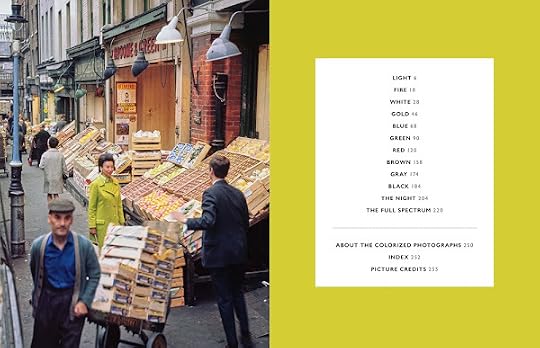
The book's organizing principle is seen in the Table of Contents on the recto above presented. Ackroyd's essays, which I suggest is the best way to present and think of these nominal chapters, riff on the colors, the affects, the gestalt of the visual impact of London. The publishers then chose vintage images and Dynamichrome brought their intense, archivally trained eyes to bear on enlivening them with colors appropriate to and emblematic of the times. Bloody gorgeous, mate.
London's suitability for gifting your Anglophile without getting the weak smile and the slide from a slack, uninterested hand that we all dread is nonpareil. It's been the focus of immense amounts of attention in the moments of history as well as scholarship about that history, so it is readily scannable. It is a major player in the world's economic life, and its social norms have both set and influenced the social norms of many, many countries with past and present ties to it. London isn't England (me, I prefer York, or Chester) but it is called "the Capital" for a reason. It is the head of the government, the home of the economy's engine-controlling bodies, the monarchy's most famous symbols reside there...London is part of the mental furniture of the world's mind. It's a simple task to find illustrations for a book about London, and an even easier one to gloss over the role of color in Humankind's experience of its world. We are fortunate to have photographic evidence of the reality of London's nineteenth-century past on forward. Beginning just slightly earlier, we have color illustrations of life in London from the eighteenth century. Printing technology has improved and improved in the centuries since Gutenberg married woodblock image-making to moveable type in 1454. That's been a key development in history's accelerating climb into prosperity from subsistence levels to reliable surpluses to wretched excess. Knowledge and ideas are easily transmissible when they're on paper.
They're also ephemeral, and subject to manipulation; they're also incomplete and misleading. But they're less likely to vanish without a trace as, for example, the cure for scurvy did in the sixteenth century when French captain Jacques Cartier heard from Native Americans that his men's scurvy would vanish if he made them drink spruce-needle tisane. It did...but he didn't do much to make it known, and it got lost in archives. Much as that has impacted our view of scurvy's history, the lack of color in vintage photos has made our vision of the past flat and one-dimensional.
We've always lived in a world of color. Nature's colors, but also mankind's. Rescue your Anglophile's imagination from the curse of flat black-and-white thinking with this book. It's vivid, and in its vividness lies its power to inform and to build on our knowledge of one of the world's most important cities: It was always modern, it was always intense, it was always brightly and intensely modern. Celebrate that this Yule gifting season.
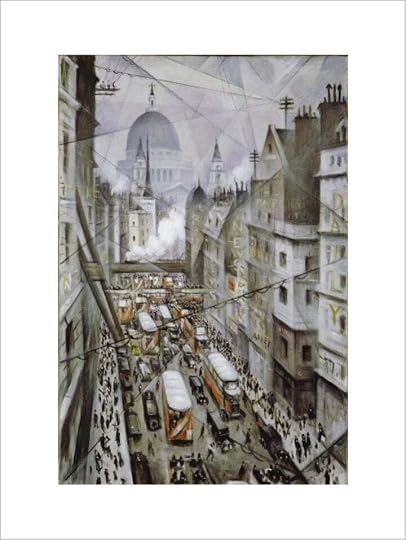
Essentially a collection of paintings, colourised old photographs, advertising posters (mostly for transport like the underground) and postcards interspersed with Ackroyd’s text. It’s divided into colours (red, blue, black etc) and also light, fire, night and the full spectrum. He quotes authors, poets, artists as well as delving into some history. Really for me it was the art and the photographs (mostly street scenes) that made it a pleasure to read. Favourite paintings Monet’s ‘Houses of Parliament’ 1904, Turner’s ‘The Burning of the Houses of Lords and Commons’ 1834 and ‘The Nerves of the World’ c.1930 by C.R.w.Nevinson. A photograph of StPauls cathedral in 1940 during a bombardment by German planes is made incredibly dramatic after colourisation. There also interesting bits of history and things I didn’t know, like the familiar facade of Buckingham Palace was only added in 1913. There’s a great photo of the palace showing the previous facade and before the Queen Victoria memorial was built. While there is some focus on royalty (particularly in the gold section!) there’s also lots about ordinary people and the poorer areas of the city.
I am grateful to NetGalley for providing an advance copy of this book in exchange for my honest review.
Pater Ackroyd’s latest book is about London, comprising some 250 pages of text and images. The images are a mix of photographs, paintings, posters and other graphics from the mid 19th Century to the late 20th Century. The text is generally related to and indeed sometimes inspired by the images. In a nice touch the Author discusses changes to London over the years since the historical events discussed, right up until the present day.
The book is divided into chapters, many with titles related to colour. Green, Blue, Red, Gold and so on. Other titles are more indirectly related, for example Light, Fire, Night.
The text is related to the images, which cover a selection of London’s history including culture, politics, architecture, sport, commerce and in general London as a city, over a period of some 150 years. Each chapter uses the title and a few images as a starting point for the Author’s observations, interpretations and story-telling, on a related or somewhat colour-inspired topic. In addition to the Author’s writing, he also provides contemporaneous thoughts and descriptions. These are often from newspapers, books, artists, politicians, royalty and other public figures. For example, we get to read extracts from Queen Victoria’s diary. Given her long reign, QV and her legacy crops up in several chapters. While the topics and events are generally well known, the Author somehow manages to add even more richness and depth from his interpretations, observations and opinions. And of course the images greatly assist in conveying his thoughts. His insights, knowledge and views of London’s place in the world are another aspect that makes this book such a fascinating read.
The graphics greatly complement the text, in particular ‘colourised’ photographs, which form a major part of the book. The Author also includes a note on the technique of colourised photography; a detailed and time consuming process which provides an interpretation of what a colour image may have resembled. The results are convincing and sit nicely besides the Author’s descriptions and storytelling.
Also of great interest are the paintings of London by well-known artists, such as Monet, Turner and Whistler. Their work and thoughts recurs throughout the book. As well as lengthy discussions on one or two major topics in each chapter (for example, the Great Exhibition, the Olympics, both World Wars, the Swinging Sixties), the Author takes us on many smaller detours to discuss other important and interesting events albeit smaller in an historical sense. Some have a tenuous relationship to the chapter colour or description, nevertheless, the events, stories and images in each chapter seem to sit naturally alongside each other.
The book does not intend to be a fully integrated or comprehensive story of London. The Author has covered this in his previous writings. What we are presented with in this book are somewhat related chapters, each telling a couple of London stories, with illustrations, loosely related to colour or some other aspect of visual imagery. I find the book a success, capturing all the major events and issues since the mid 19th century, showing these event in colour images, providing context & meaning and mentioning changes over the years. I think anyone who has an interest in the history of London and indeed the London of today, will enjoy this book. For those fortunate enough to live in or visit London, I think the sights, sounds and views will be more meaningful, rewarding and interesting having read this book.
I wish the author and publishers all the very best with this book.
I don't think there'll ever be a coffee-table book on London I don't like. :D It's really true--I love just about all the ones I've read to date, and this is no exception!
It brilliantly combines all my favorite things into one resource, including art, history, paraphernalia (Antique postcards! Historic Olympics posters/ads!), literature, and more. This is exactly why I loved my European Studies degree program in college--it didn't lean too heavily on any one thing, instead dabbling just enough across a variety of topics to hold my interest.
And coming at the topic from the examination of color--genius. I'm reminded of a favorite quote from a favorite movie, _The Lake House_: "...the light in Barcelona is quite different from the light in Tokyo. And, the light in Tokyo is different from that in Prague. A truly great structure, one that is meant to stand the tests of time never disregards its environment. A serious architect takes that into account. He knows that if he wants presence, he must consult with nature. He must be captivated by the light. Always the light. Always." Ackroyd does a brilliant job at this himself in _Colors of London: A History_. It makes my heart happy (and also makes me want to buy a plane ticket).
Of course, not everything about London is sunshine and daises, fun and games. We do see the challenges and hardships represented here, just as much as the city's glories--as we should. (And oh, reading about Queen Elizabeth's coronation just weeks after her passing... #feels) Even the weather comes up; inevitable, just like one cannot talk about the Pacific Northwest without talking about rain--or mist (ask me how I know :D). And yet, I felt at home in that section--not just because it was covered under my favorite color, blue, but because the PNW and England share many a common weather; the two are not so different there.
Thoughtful, engaging, informative, well-organized and -presented--this read would be at home on any traveler (armchair or in-person), photographer, or historian's bookcase.
I received an eARC of the book from the publisher via NetGalley. All opinions are my own.
As interesting and erudite as this might get, it really seemed a most unusual concept on which to hang a whole book. A love letter to England’s capital, it seemed to suggest a uniqueness about London’s colours that never applies anywhere else – that London is alone in having a light that changes whether you’re looking north or south, or whether the sun is in the east or west. London then is unique in having a neon smudge above it at night – try flying over India, where any metropolis has a smudge of glowing gunk reaching from the ground to space.
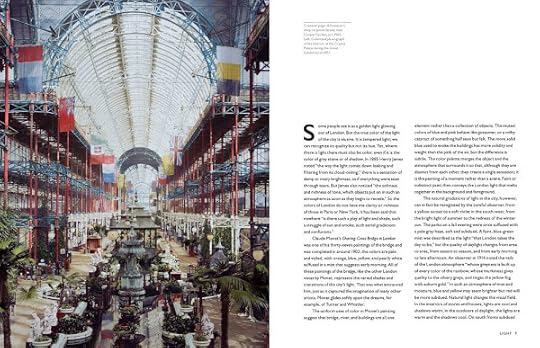
Anyway, the prologue uses colorised imagery to bring back the rich tones of the original Crystal Palace, to show London has always had colour, even if our monotone history takes it away. We’re then led to believe one of the primary colours of London is flame red – yet seeing as we’ve mentioned Monet and Turner already, wasn’t it suggested that a lot of the sky colours they used was because of a volcano, thousands of miles away? White is here, and leads to short precis of the first two London Olympics (the Olympic flag being mostly white), the Pearly Kings and Queens, and, er, the Windrush affair.
This then is a hook upon which to hang a lot of erudite history, from the Mods and Rockers to the thing between the Great Exhibition and the Festival of Britain, whereby we gained Wembley and not too much else, all things considered. The whiteness of Buck House is 'fake', for it got too brown to be savoury enough and needed repointing in Portland stone. The Thames is of an indeterminate colour, we read, before the book ends with the cop-out that the true colours of the capital are all of them, at once. All in all this was a pleasant pastime that never struck me as essential, even with the author's knowledge and spread of subjects. I was left with no sense of wanting to urge it upon anyone, nor of waving a red flag about it in alert of a failure – it was just there in the middle of the whole spectrum.
Part coffee table book for London lovers, part raconteur source for tidbits that Ackroyd never fit into his other books on London and English history, the author bases his observations on the experience of the city around colors (and light and dark and night and the full spectrum), and hits the target for fans of his books. It's a series of impressions, and the photos are very engaging, especially if you are fairly familiar with London itself. We get stories that tie into those colors (the concept isn't really pedantic, as they are jumping off points for larger discussions and other colors within the chapters) and sometimes they read like outtakes to his recent books on the history of England and biographies of London. It's a very pleasant read and is probably a wonderful way to spend a weekend meditating on your next travel to the UK. Many of the photos are "colorized" but they seem very natural and high quality, bringing to life Londoners and London streets from the last 150+ years. If these are interests of yours, or you are an Ackroyd fan, this does not disappoint. Personally, I loved it and had to struggle not to dive back in. I certainly recommend it to all Anglophiles.
Colors of London: A History, by Peter Ackroyd, offers an engaging history of London through colors. This is both a tribute to the city's beauty and a way to engage with an urban area with a different perspective.
I think this is one of those books that will speak to each reader in very different ways. I have only been to London a few times so as Ackroyd launched into some of his examinations through color, I did relate some of it to memories. But because of my limited experience in the city, I was even more taken with the many references, textual and through images, to works of art and literature. His writing gave these passages an added resonance.
I came to think of these chapters, each devoted to a different hue, as a kind of stroll through history paying attention to specific qualities. The next chapter was another stroll but with different qualities under examination. This is quite an enjoyable read as well as an attractive book to simply look through. Combined, it makes for a wonderful experience.
Reviewed from a copy made available by the publisher via NetGalley.
I have read Ackroyd’s takes on both The Canterbury Tales and King Arthur so was intrigued to see what he would have to say about London. As it turns out, not surprisingly, Ackroyd has a good deal to say. Within these pages are history and nostalgia, along with photos and other visuals that cove many years. The whole is organized by color palettes; these include Light, Fire, White, God, Blue, Green, Red, Brown, Gray, Black, The Night, and finally, The Full Spectrum.
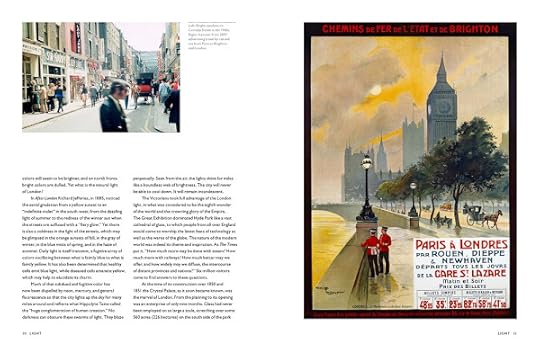
Ackroyd notes that London is a city of light and shade, perhaps not so vibrant as Paris or New York…and yet, what a place it is. It is surely a city with a palette. Enjoy looking at the many photos or read along too and learn a lot about this renowned British metropolis. I especially enjoyed the period posters that were in many sections.
Many thanks to NetGalley and Quarto Publishing Group for this title. All opinions are my own.
Colors of London is a fascinating collection of images (art and photographs) interlaced with segments of the city's history that allows the reader to travel in time and view London through different lenses. Ackroyd's portrait of London is honest, centered on the humans who coloured the city, and very alive.
I have a particular appreciation for the section on Fire, how vivid a picture Ackroyd created with their selection of texts and images.
Thank you NetGalley and White Lion Publishing for this ARC. I would recommend getting a physical copy of this book as the pictures often spread upon two pages, but my reader app allowed me to display it as such.
I received digital access to this book through Netgalley in return for an honest review.
I enjoyed the pictures and how the author grouped them into different categories. Going into this I though it was just going to be a collection of the author's photography works, however he painted a interesting view of the city, its history, and its colours.
I would suggest that anyone interested in reading buy a physical copy as the digital format frustratingly cropped the photos strangely and some descriptor were unclear as I wasnt sure which photo was right and which was left.
A fascinating and eclectic history of London told through colorized photographs, maps, and other historical documents/images organized by a broad theme of color. It was very interesting reading about mostly 20th century history and covered a wide variety of topics, from politics to fashion. The colorized pictures were really neat to see and made for an impactful glimpse into history. This would be a great pick for anyone interested in photography, the modern era, or the timeless city of London.
Many thanks to the publisher and NetGalley for the opportunity to read and review!
Full of striking photos and artwork, these pages of history truly show the colors of London throughout the years. And it’s an utterly gorgeous book.
Very visually pleasing, and well laid out, the accompanying talks about color and light and the history snippets really turn this into a highly enjoyable coffee table book, one as enjoyable to read through as to look at.
Temporary PDF kindly provided by Frances Lincoln / Quarto Publishing Group - White Lion and NetGalley. Opinions shared are my own.
Colours of London was an interesting collection of photographs and art woven with history. It leads the reader on a journey through time, viewing London through different periods.
As an anglophile, I devoured this book, it really is so visually pleasing. Anyone captivated by London or anyone wishing to visit London, should take a look at this book.
I received a copy of this from NetGalley in exchange for my honest review.
This is a fascinating read, enabling the reader to look at London through a completely different lens.
The illustrations/photographs are superb, looking at London through the decades. My particular favourite was a colourised picture of the Great Exhibitiion, of which I have read a great deal about but which I have never been able to visualise in such a way before.
Thank you to Peter Ackroyd, Frances Lincoln and NetGalley for the advance reader copy. All opinions are my own.
This is a hard book to review in that it's a format that doesn't have a ready explanation. The author has tried to explain the story of London based on the colors of the buildings and monuments in an area.
My feelings is that it's a very long travel brochure that isn't trying to sell you anything.
really well researched book with many illustrations. Painting and photography featured and would look good in any actual book, I read the kindle version. The chapters are all divided into colours with some amazing scenery shots all set in London both day & night. I especially loved the 60/70's images which brought back memories of the time. Thank you #NetGalley for the e-book to review.
It's a nicely put together curiosity. Ackroyd is an expert on London and uses the motif of colour to write a series of slightly rambling essays on London, linked to various colours. The photographs and illustrations are very nicely done. However, it's less than the sum of its parts. His London book is a superior offering.
I really enjoyed this book. Each chapter was a different colour and we went through various elements of London linked to that colour. For red - buses, gold - the coronation carriage. For each London characteristic mentioned there was a short history with relevant photos.
This would be a fab coffee table book if you have an interest in London.
A wonderul picture book, combined ith the storytelling of Peter Ackroyd. This is a book to read in a slow, leisurely tempo, enjoying both the photographs as well as the writing.
This book helped me get a good idea of what London looked like from the Victorian era through the mid-1900s with its numerous old black and white photographs that have been colorized, other art and detailed historical accounts. Never having been to London, this is someplace I've always wanted to visit. Many of my ancestors lived in this area and I couldn't help but wonder if any of them are in one of the photos in this book.
Overall, Colors of London is an interesting book that I enjoyed looking through.
Note: Having had some quality issues specific to the ebook, it would be a much better experience to read a physical copy of this book.
I was sent a digital ARC of this book from its publisher via Netgalley (thank you for this) and these are my honest thoughts.