Jump to ratings and reviews
Rate this book

Breathless: The Scientific Race to Defeat a Deadly Virus

Rate this book
National Book Award finalist Breathless tells the story of the worldwide scientific race to decipher the coronavirus SARS-CoV-2, trace its source, and make possible the vaccines to fight the Covid-19 pandemic— a “l uminous, passionate account of the defining crisis of our time.” ( The New York Times ).

Breathless is a “gripping” ( The Atlantic ) but “clear-eyed analysis” ( Time ) of SARs-CoV-2 and its fierce journey through the human population, as seen by the scientists who study its origin, its ever-changing nature, and its capacity to kill us. David Quammen expertly shows how strange new viruses emerge from animals into humans as we disrupt wild ecosystems and how those viruses adapt to their human hosts, sometimes causing global catastrophe. He explains why this coronavirus will probably be a “forever virus,” destined to circulate among humans and bedevil us endlessly, in one variant form or another. As scientists labor to catch it, comprehend it, and control it, with their high-tech tools and methods, the virus finds ways of escape.

Based on interviews with nearly one hundred scientists, including leading virologists in China and around the world, Quammen explains
-Infectious disease experts saw this pandemic coming
-Some scientists, for more than two decades, warned that “the next big one” would be caused by a changeable new virus—very possibly a coronavirus—but such warnings were ignored for political or economic reasons
-The precise origins of this virus may not be known for years, but some clues are compelling, and some suppositions can be dismissed
-And much more

Written by “one of our finest explainers of the natural world for decades” ( Chicago Tribune ), This “compelling and terrifying” ( The New York Times ) account is an unparalleled look inside the frantic international race to understand and control SARS-CoV-2—and what it might mean for the next potential global health crisis.

416 pages, Hardcover

First published October 4, 2022

402 people are currently reading
4491 people want to read

About the author

David Quammen

61 books1,883 followers
David Quammen (born February 1948) is an award-winning science, nature and travel writer whose work has appeared in publications such as National Geographic, Outside, Harper's, Rolling Stone, and The New York Times Book Review; he has also written fiction. He wrote a column called "Natural Acts" for Outside magazine for fifteen years. Quammen lives in Bozeman, Montana.

Ratings & Reviews

What do you think?
Rate this book

Friends & Following

Create a free account to discover what your friends think of this book!

Community Reviews

5 stars
818 (39%)
4 stars
888 (43%)
3 stars
301 (14%)
2 stars
45 (2%)
1 star
7 (<1%)
Displaying 1 - 30 of 302 reviews
Profile Image for Olive Fellows (abookolive).
799 reviews6,392 followers
November 3, 2022
In true David Quammen fashion, this is thorough and fascinating. But be forewarned, it's heavy on the science.

Click here to hear more of my thoughts on this book over on my Booktube channel, abookolive!

abookolive
Profile Image for Tony.
1,030 reviews1,912 followers
December 3, 2022
I have been a fan of David Quammen for over 25 years, dating back to when I first read Song of the Dodo. He takes us to fascinating places, and explains wondrous, sometimes difficult subjects intelligently and coherently. Beyond that, he's just a superb writer. Funny at times. Now, he can be smarmy, but it would be hypocritical for me to criticize anyone for that.

Anyhow, I saw this book, published just a month ago, and ordered it immediately, not so much because of the subject, but because Quammen would be writing about the subject. And, in the main, Quammen did not disappoint. He took a difficult subject - coronaviruses - and made it not just understandable (mostly, anyhow) but also entertaining, even riveting. And there were the trademark Quammen one-liners: It is hard to grow viruses from bat feces. Who knew?

But a few things gnawed at me as I read this. For one, smarmy doesn't always wear well. Like when he wrote about a cruise ship that had to be quarantined: It's safe to assume that no one was dancing now.

For another, he seemed to let his politics intrude. Maybe I'm reading too much into what he wrote, but he seems to be annoyed at America generally, capitalists more specifically, and Donald Trump to a loathsome degree. (Disclaimer: I loathe Donald Trump perhaps even more than Quammen does.)

The reason I read books instead of watching the television news is that I can't stand mere headlines, or punchlines. Let me read and see if I can be convinced. Quammen does a commendable job of explaining the science, but he turns to ipse dixit when delving into politics or personalities. America was woefully unprepared, Quammen writes. Okay. Which country was better prepared? Maybe there was one or more, but Quammen didn't tell me. He acknowledges that the vaccines, which finally contained things, were the result of pure capitalism. Sine qua non. But why didn't the capitalists give the vaccines for free to African countries? Yes, it makes abundant scientific sense to do so. But it kind of misses the point of capitalism, or as Quammen puts it: the conundrum of intellectual property rights versus public health. And, let's be clear, the government couldn't have made the vaccines.* Should the United States have made the vaccines available to African countries? Quammen makes a compelling scientific case. But at what cost? And why single out America?

Quammen wasn't entirely negative. In fact he could gush, especially when writing about Tony Fauci. Tony Fauci has so much steel in his spine and antifreeze in his veins. Quammen quotes a Zoom "dialogue" he has with Fauci. I put "dialogue" in quotes because Quammen's contribution to the conversation was a series of Mm hms to keep Fauci talking. And Fauci does a nice job of explaining how natural selection favors the coronavirus. He does. Or, as Quammen writes in the continuing "Dialogue": "Yeah," I said admiringly.

The point of the book, though, is to consider the origin of SARS-CoV-2, aka COVID-19. You may have heard there's some controversy. There are those that think the virus was a spillover from wild animals to humans, specifically in the Huanan Seafood Wholesale Market. Others look to the Wuhan lab that was doing gain of function research on viruses, suspecting a leak into the neighborhood.

Quammen begins by telling of a Chinese scientist who wrote a paper suggestive of a laboratory leak. Three weeks later, the paper was withdrawn. Quammen gets right to the point: did the scientist jump to his retraction, or was he pushed? Meaning, coerced by the Chinese government. And perhaps he wants to talk about that more. He doesn't. Instead, he shows his political hand again: The way you find yourself inclined to interpret this opaque event, gentle reader, probably reflects a predisposition you already hold toward the question of the virus's origin. Meaning, if you think laboratory leak, you're probably a Trump-y, or at least are willing to listen to Rand Paul, an opthalmologist, Quammen reminds, not a virologist like Tony Fauci.

Whoa! Hey gentle author. I plunked down money for your book. Don't patronize me. I ain't got no predisposition. And, reading that sentence, aren't you the one with the predisposition?

Quammen clearly comes down on the side of animal spillover. And he makes a compelling case. I tend to agree. But here's the thing, with a SPOILER ALERT: the scientists are fairly split on the two possible origins. And Quammen doesn't disparage the scientists that disagree with him. Indeed, he offers respect for their opinion and insists they are friends. So I guess they don't have predispositions.

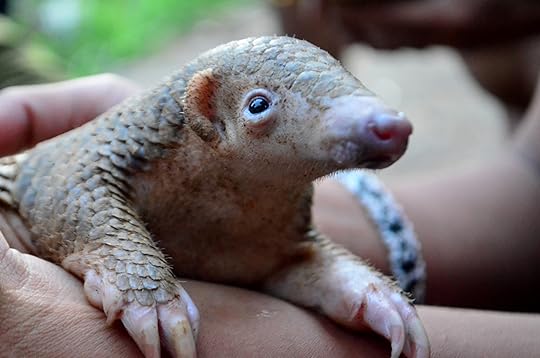
Let me end on a high note, maybe. Early on, Quammen suggests that the virus might have spilled over from bats to humans, but through the intermediate host of the pangolin. I had never heard of the pangolin before. Here she is:


The pangolins have no teeth and are essentially defenseless. And cute too, right? Anyhow, it turns out pangolins are probably not the proximate cause.
__________
*Compare the efforts of COVAX, an effort by WHO to get vaccines to third world countries. Somalia. for example, got vaccines from COVAX, but not syringes. Other countries who bought vaccines from COVAX never received them. Officials of that organization were unreachable. Nevertheless, WHO's director was appalled by the inaction of the United States.
Profile Image for Michael Perkins.
Author 6 books470 followers
October 30, 2022
I read this author's book "Spillover" and a concise biography of Darwin. I'm again enjoying the author's fluid writing style. It's a detective story.

In his books, the author explains how the virosphere is expanding. The destruction of the Amazon alone has released all sorts of pathogens into the atmosphere. There will be a race for science to keep up, and those who do nothing will be more vulnerable than ever.

=======

"I asked epidemiologist, Ali Khan, about COVID-19. What went so disastrously wrong? Where was the public health preparedness that he had overseen at the CDC? Why were most countries—and especially the U.S.—so unready? Was it a lack of scientific information, or a lack of money?....

....This is about lack of imagination,” Khan said. And, of course, imagination is informed by history"

======

From the final section of the book....

Nobody knows everything about this virus, and our efforts to comprehend it have only begun. As lengthy as the dreary months and years of the COVID-19 pandemic—the pandemic so far—may have felt to us, the time is early. We’ve scarcely started the effort of adapting ourselves and our societies for its next challenges and later stages. This virus is going to be with us forever. It will be in humans—always somewhere—and it will be in some of the animals that surround us.

The rule “Never say never” is a sensible one, but no expert can tell us right now how SARS-CoV-2 might ever be eradicated. We haven’t eradicated polio, despite decades of effort. We haven’t eradicated measles. And those viruses have nowhere to hide except within humans. This virus has many more options. We might clear it from every human on Earth (not likely) and it will still be there in the white-tailed deer of Iowa, the stray mink on the landscape of Denmark. It will continue to change. It will adapt to our adaptations. The latest variant as I write this, Omicron, seems a dramatic example of that.

Omicron will continue to change. It will adapt to our adaptations. What made Omicron alarming was the presence of fifty-three mutations, fifty-three differences from the baseline Wuhan genome, most of them in the spike protein, causing more than thirty amino acid changes to the spike, half of those within the receptor-binding domain.

=====

Sad story of 30 year old who got long Covid...

I went to a large event and didn't wear a mask
because I was vaccinated and boosted. Because I
live in Minneapolis, where I can qenerally trust
that my neighbors are also vaccinated and
boosted. Because masks aren't mandated.
Because people told me "breakthrough
cases aren't that bad"

=======

The current numbers (10/2022) show that very few have got their booster shots (updated bivalent targeted at omicron) and have dropped other safeguards, such as masks. Just 4 percent of Americans at last count. Everyone I know who got Covid got it after they let down their guard. People can have fun with their conspiracy theories, I'm opting to pay attention to the science and protect my family.

======

new review of book....

https://www.oprahdaily.com/entertainm...

=====

This just published. I'm not a conspiracy theorist, but "Breathless" (without an agenda) shows how China was blocking attempts to find out what was going on from the beginning, at every turn. This article is basically the same story and comes to the same conclusions as "Breathless."

https://www.propublica.org/article/se...
Profile Image for Sharon Orlopp.
Author 1 book1,137 followers
October 12, 2025
Breathless: The Scientific Race to Defeat a Deadly Virus is David Quammen's seventeenth book. He interviewed almost 100 scientists as part of his thorough research for this book. I have read many books about the COVID pandemic. This book shared information about research done on snakes and pangolins regarding whether they contributed to the virus. Pangolins are interesting looking animals that reside in Asia and Australia. They have scales that look like dragons or dinosaurs. Their meat and scales are highly desirable which has resulted in pangolins being the most illegally trafficked mammal in the world.

All of us have heard about the possibility of bats for being carriers of COVID, but this was the first time I heard about the research done on snakes and pangolins.

Quammen also shares the different strategies Korea and the US took when the first case of COVID was discovered in each country. There was only a one-day difference in the two cases, but Korea immediately reacted and knew the potential spread and seriousness.

I listened to Breathless: The Scientific Race to Defeat a Deadly Virus on audiobook and also have the hard copy book. It is a very scientific book, but Quammen does a great job making it relatively easy for laypeople to read and understand.

The books about pandemics that I have rated 4 or 5 stars and recommend include:

* What Really Happened in Wuhan: The Cover-Ups, the Conspiracies and the Classified Research

* How to Prevent the Next Pandemic

* The Premonition: A Pandemic Story

* The Great Influenza: The Story of the Deadliest Pandemic in History

* Ten Lessons for a Post-Pandemic World

* Moonshot: Inside Pfizer's Nine-Month Race to Make the Impossible Possible

* The Plague Year: America in the Time of Covid
Profile Image for Clif Hostetler.
1,280 reviews1,033 followers
January 10, 2023
This book. provides an in depth review of recent history that we have all lived through—the pandemic. I follow the news, thus this book is a review of a story with which I already have some familiarity. But I decided I could benefit from a re-exposure of these recent happenings to clarify my memories of how, when, and why things happened the way they did.

As with most books written for a popular audience about medical and technical subjects, this book contains short bibliographic descriptions of many different scientists and physicians as their actions and activities are told. The author also occasionally goes out of his way to provide metaphors to explain certain concepts. One in particular that I thought was almost too much was a multi-paged allegorical tale about the leopards of Mumbai to explain "gain of function" experiments. I think some readers will remember the story, but still not understand the point that the author was trying to make.

The occurrence of COVID-19 may have been unexpected to many people, but it wasn't to specialists in the field who have been tracking the occurrences of novel viruses. The book begins with a review of some of the recent viruses that had potential to turn into a pandemics, but with luck and care was avoided. Some examples mentioned included HIV/AIDS, Ebola, Marburg virus, MERS, and 2003 SARS.

We are very fortunate that we were able to go one hundred years (1918 flu to 2019 COVID) without a true pandemic. The scientific community greatly enhanced their abilities to identify and track new novel viruses during those years. The following excerpt discusses one reason the pandemic didn't occur in 2003 when the first version of SARS showed. up:
"We dodged a bullet on SARS," Don Burke told me. ... If the virus had been just a little more transmissible generally, among all patients and situations, he said, "It could have been a huge problem." But that SARS-CoV virus had one feature, or the absence of a feature, standing between it and a global nightmare in 2003. "Which was, for the most part, asymptomatic people didn't transmit until they were sick. So you had time." You could identify cases, trace contacts and quarantine. It could be stopped, for those reasons, and it was. If the virus had been a little different, "highly transmissible, with more variable disease manifestation, harder to figure out who were silent carriers, then we may never have been able to contain SARS." (p. 47)
If COVID-19 had occurred in 2003 the resulting toll would have been worse. Scientists were able to track genomes in 2003, but not as quickly and easily as they do now. Also, I don't think the mRNA vaccine technology was sufficiently advanced in 2003 to create a vaccine as quickly as was done in 2021.

The current pandemic isn't exactly over. The following link has news of the most recent COVID variant: (from Time Magazine, by Jamie Ducharme, January 3, 2023 1:07 PM EST)
Profile Image for Ben.
969 reviews118 followers
November 10, 2022
Among the many general-interest Covid books out there, Quammen successfully finds his own area. However, scientific research on Covid and its origins is broad enough that the book tends to be shallow and sometimes incoherent. The motivations of the research, and therefore of Quammen's discussions, aren't always spelled out. The book's timeliness also makes it inconclusive; there are still too many loose threads. The books on Covid vaccine development and deployment, written by active participants, have narrower focuses and much more rewarding conclusions.
Profile Image for Britta Böhler.
Author 8 books2,026 followers
December 7, 2022
Very technical and detailed about all the virus-variants. I expected a book about the development of the vaccine which is not discussed at all, only mentioned in passing but that was obviously my misinterpretation of the title.
Still worth reading.
Profile Image for Harjot.
3 reviews
September 10, 2022
I've always been a big fan of Quammen's work. I've found him to be eminently readable and interesting. He has a penchant for explaining complicated topics - like virology - in a way that makes it easily understandable.

Very pleased to say that Breathless continues in this tradition. He has delivered a compelling story in an exceptionally even-handed sort of way. Tough to do when this is such a highly political topic in 2022.

I would recommend this to anyone interested in the topic.
Profile Image for Come Musica.
2,058 reviews627 followers
November 23, 2022
"I virus respiratori sono più semplici, il che non vuol dire semplici in senso assoluto. Il numero di riproduzione può cambiare nel corso del tempo, col mutare delle circostanze in cui il virus o la popolazione ospite si trova. Una mutazione nel virus accresce la trasmissione? In tal caso il valore di R0 sale. Un messaggio del governo raccomanda il distanziamento sociale e i cittadini lo rispettano? La trasmissione viene interrotta, ostacolata, ridotta e R0 si abbassa. Questa mutevolezza è importante per capire cosa sia e cosa non sia l’immunità di gregge, se e quando arriva."

Il virus che toglie il respiro, ecco cos'è il virus Sars-Cov-2.
Con una chiarezza espositiva, David Quammen analizza le fonti e prova a rispondere a tanti quesiti che
hanno messo in crisi tanti di noi, in tutti questi mesi: è davvero fuoriuscito dal laboratorio? Oppure è frutto di uno spillover, di un salto di specie dagli animali all'uomo? E perché muta così in fretta? E i vaccini, su quali principi sono stati fatti?

In questo saggio, ricco di riferimenti bibliografici e di fonti scientifiche, David Quammen ci introduce nel mondo del Sars-Cov-2.

“Che lezioni bisogna trarne? In primo luogo, se possiedi un computer e sei capace di digitare qualche parola in un motore di ricerca, puoi trovare una dovizia di informazioni strane, una profusione di indizi accattivanti, una vasta gamma di scenari sorprendenti sul Sars-CoV-2 e sulla sua provenienza, alcune coincidenze singolari e un sacco di stronzate pseudoscientifiche. In secondo luogo, la nostra conoscenza di questo nuovo virus è ancora provvisoria, e si allarga giorno per giorno come un fiore di Rafflesia che si schiude in un filmato in time-lapse. Perciò è importante applicare gli strumenti di base del pensiero critico - come l’obiettività, l’attenta verifica delle fonti, l’umiltà di fronte all’incertezza e la parsimonia – a ciò che sentiamo e leggiamo, alle persone di cui decidiamo di fidarci e a quello che pensiamo di sapere.”

Come ha più detto l'autore nei suoi interventi che ha tenuto a partire dal 2020, questa pandemia si sarebbe potuta evitare con la prevenzione. Tanti gli errori compiuti da parte dei politici dei Paesi senza memoria, di quei Paesi cioè che non avevano avuto a che fare con epidemie come la Mers o il virus HiV.
In virus circolava già alla fine del 2019 e prendeva le misure per essere sempre più adattabile dal punto di vista trasmissivo, mentre l'uomo era ancora ignaro della sua esistenza. Dal momento in cui gli infettivologi hanno identificato la sequenza genomica, il virus si era già ampiamente diffuso e la pandemia era scoppiata.

Non è un saggio solo per addetti ai lavori: Quammen è bravissimo a divulgare la scienza, in modo chiaro e accessibile anche a chi non la mastica.

Ci libereremo dal Sars-Cov-2? Ci saranno altre pandemie? Come le fronteggeremo? E dov'è la verità?
"Altri non avranno avuto bisogno di romanzi per imparare la stessa lezione: la realtà a tutto tondo può essere còlta solo sommando prospettive disparate. Il discernimento della verità - – o meglio della «verità», perché è una parola troppo imperiosa e sospetta – deriva dall’ascolto di molte voci. Prendiamo l’esempio della nostra pandemia. Abbiamo bisogno di ascoltare molte voci, e abbiamo bisogno di aiutarci l’un l’altro a capire. Forse questa è la versione umana dell’epistasi positiva.
Una cosa è quasi certa, credo, in mezzo al turbinio delle nostre incertezze. Il Covid-19 non sarà l’ultima pandemia che vedremo nel ventunesimo secolo. Probabilmente non sarà la peggiore. Ci sono molti altri leopardi nei dintorni di Mumbai. E ci sono molti altri virus spaventosi nel luogo d’origine del Sars-CoV-2, qualunque esso sia.”


Il 24 novembre 2022, David Quammen sarà a Roma: non vedo l'ora di assistere alla presentazione.

L'intervista
https://www.rainews.it/tgr/piemonte/v...
Profile Image for Graeme Newell.
464 reviews238 followers
November 28, 2025
I’ve always considered myself a bookworm when it comes to narratives that blend science with human interest topics. Having read some of Quammen's previous works, I had high hopes for "Breathless.” Quammen has this knack for explaining labyrinthine scientific topics in a way that even those without a Ph.D. can understand. And in "Breathless,” he stays true to his talent.

David Quammen, without a doubt, did a commendable job in making the science accessible. He did a fine job of navigating the complexities of disease control. He plainly explained the myriad processes involved in drug creation. He guided me through the intricate scientific maneuvers required to combat a pandemic. In all these respects, Quammen was an astute guide.

But still, I feel as though Quammen really missed the mark on this book. This was just a dull read. To give some perspective, I recently finished Walter Isaacson's "The Code Breakers", which delves into similar territory. Isaacson's offering was filled with pathos - a pulsating drama that underscored the urgency, the sheer humanity of the race against time to find a cure. A literal race against death, where every moment counted. It was in this juxtaposition that the starkness of Quammen’s approach in "Breathless" became apparent. “Breathless” was just a long dry slog of facts.

The pandemic wasn’t just a scientific anomaly. It was a humanitarian crisis, a real-life thriller, a global call to arms for the best brains in science, medicine, and logistics. Yet, the pages of "Breathless" felt more like I was going through a textbook or a lengthy research paper. It was as though Quammen consciously decided to bypass the very heartbeat of this global catastrophe – the human stories, the raw emotions, the fear, the hope, the tireless nights, the race against the clock.

While I appreciate the depth of information and the intricate details he provided about the science and the logistics, I can't help but feel a bit cheated out of the drama. And it's not about sensationalism. It’s about capturing the essence of a world under siege and the warriors on the frontline - all lacking in "Breathless".

If you’re seeking a comprehensive, almost academic deep-dive into the science behind the pandemic and the search for a cure, "Breathless" delivers with precision. But if, like me, you were hoping for a narrative that combined the facts with the fervor of this worldwide crisis, it might leave you wanting. Quammen remains a master in explaining complex science, but in this instance, the soulful stories that could've accompanied the science were conspicuously absent.
Profile Image for Filippe.
15 reviews60 followers
October 20, 2022
Quammen is writing about what he knows best here, and it shows. Clear-eyed and engaging, concerned (and telling us, in no uncertain terms, we should be concerned too) but never fearmongering, neither pandering to conspiracy theories nor discounting plausible but controversial viewpoints. His access to high-level sources, most of whom sound like personal friends ("...journalists are not supposed to have friends. But authors, working a wider arc of history, character, and narrative, are allowed"), is peerless, but there is never any unnecessary namedropping; everyone in this book is here for a reason, and that reason is nearly always to inform the reader.

Two minor quibbles: an overreliance on metaphors that don't always land well (reaching its chapter-length peak in "The Leopards of Mumbai") and an insistent waving away of more complicated terminology, usually with asides along the lines of "I won't bother you with...". This is clearly meant to keep the book short and avoid overburdening the reader with technical minutiae—Quammen goes deep on surprisingly complicated points when they are essential to advancing the narrative or understanding some more salient controversies—but I eventually found myself feeling that some of these were odd choices, worthy at least of a sidebar, footnote, or other gloss. Neither detracts from what is by a mile the best book on the pandemic to date, a pandemic that as I write in late October 2022 is still raging despite our constant attempts—most necessary, some misguided—at normalcy.

If you are a pandemic pessimist, this book will push you toward acceptance; if you are an optimist, it will leave you more sanguine about our future preparedness for the next, inevitable, outbreak. Towards the end, Quammen states: "This virus is going to be with us forever." By now you will have realized these are not the words of a doomsayer who tried and failed to ride the plague out at home, but rather a factual statement, told matter-of-factly. You will find yourself not agreeing, because it is not a matter of opinion, but rather understanding that it is the truth, and why it is so.

No mean feat in 400 pages.
Profile Image for Caitlin.
337 reviews1 follower
March 14, 2023
**4.5 stars rounded up
Spillover, also by this author, remains one of my favorite nerdy books of all time, and over the years, I have bought it or passed it along to interested parties. Pandemics and viruses have always fascinated me even before I was forced to really live through this most recent one. In that book, he had argued it was just a matter of time before another pandemic.

And then it arrived. In this one, he presents the story of science surrounding the pandemic. He has a fantastic dry wit which I appreciate. He uses science with a deft touch but still tells a great story while interviewing tons of virologists and public health experts from around the globe. It’s not definitive (science never is), but it’s competent summation of current data and hypotheses.
726 reviews25 followers
July 15, 2022
Quammen has written one of the better books on our global pandemic, highlighting the history, genesis, and science of the current deadly virus with no conclusions (how can there be), no finger pointing and no sensationalism. The author writes on a variety of subjects; nature, travel, science (perhaps closet to his heart) and is skilled in each.
Breathless is not mere reportage or narrative nonfiction but somewhere in between that is equally engaging and accessible.
Profile Image for Laura.
802 reviews46 followers
November 30, 2023
“Infectious diseases are so globalized (...) A disease anywhere is a disease everywhere.”
Well researched, detailed, and funny, "Breathless" is a great summary on the current knowledge (not misinformation) regarding COVID-19 viral origins. Spoiler alert: we do not yet know, and the author does present arguments in favor of multiple theories, including a lab-origin one. However, the strongest data support a natural spillover hypothesis--and this is where I (and the author apparently) continue to stand. Yes, lab accidents have happened before, but close inspection of the earliest patients, the time of year, the existing data on bat viruses--all point a big fat finger at the natural spillover hypothesis. What I loved about the book is that the author was not afraid of uncertainty. He also tackled complicated science topics with great examples and analogies. I learned a lot from this book, despite my own background in biology. I had no idea for e.g. about the viruses as leftover DNA from parasitic cells hypothesis, even though I knew about Mimiviruses (I had assumed they were further proof of the "viruses first" hypothesis). Quammen did his best to also lighten to mood--and several of his jokes had me laughing out loud. Like when he was discussing the suitability of the trusted dewormer Ivermectin as an anti-viral drug: "That’s because it’s an important and trusted tool among veterinarians and livestock producers for treatment against lice, mites, and parasitic worms. Then again, the claw hammer is an important and trusted tool among carpenters, but it’s not recommended for use in dentistry."

Finally, the book ends with a chilling warning that COVID-19 is not only here with us for the rest of human species' existence, but is very likely only the second big pandemic of the 21st century, and very possibly not the worst. Only by increasing our knowledge of wild viruses and looking at actual data can we hope to prevent a worse case scenario in the near future. I worry the next big pandemic will hit us in about 10 years. I won't be as young anymore. My body won't be able to fight it as well. And I worry, society won't be better equipped (biologically and mentally) either. I worry that societal and political obsession of the less probable (based on current data) hypothesis of an engineered lab leak is only a means to refuse to accept that another zoonotic virus will emerge and colonize us in the future. We cannot hope this scenario away. After all: "Evolution will happen. That’s not a variable, it’s a constant."
Profile Image for Betsy.
637 reviews234 followers
February 17, 2023
[17 Feb 2023]
This book is interesting, but limited. It's a rather detailed history of the search by the world's scientists for the virus that causes Covid-19, and especially for the source of the virus. It does not discuss the development of vaccines or treatments, or the politics that so inhibited our ability to cope with the pandemic.

Still, it's interesting, and well written. Quammen covers all the controversies, explaining how they arose and how they've been settled. He introduces us to scores (hundreds?) of the scientists who worked on this matter, and of course, it's impossible to remember many of the names.

It's fairly short and easy to read. The author does pretty well explaining some of the virology and genomics involved, though of course, there was lots that I didn't understand. But it's definitely worth reading. This book does a much better job of explaining the origins than any media I've seen.
Profile Image for Erin (roostercalls).
325 reviews
October 5, 2022
It’s a real high-wire act to write a book about coronavirus that is thrilling to read but not exploitative of the tensions & tragedies of the past 2.75 years.

Quammen threads the needle beautifully here, filling in the gap between what was known about SARS-CoV-2 & what made it to media headlines by foregrounding scientists: their personal experiences & discoveries; the grind of inter-group communications & global collaboration; their tireless work for public health measures & a vaccine, all while facing the same existential threats the rest of us were.

Not gonna pretend he doesn’t also sneak in a little genetics 101, & tidbits of the epidemiology that formed the basis for his 2012 hit SPILLOVER (a book about zoonotic crossover that predicted the 2020 pandemic).

But those science lessons are interwoven with this engaging narrative of how the novel coronavirus was detected, sequenced, & battled, and with such vivid prose, that you’ll barely notice your medicine going down.

Quammen is a genius at stripping back the flash to reveal the substance beneath, & at making that substance more fascinating, more consumable, than 10,000 eye-catching headlines. Read this book because the science & policy matter, sure; but really read it because above all it’s a human story—the tale behind the tale that we were all a part of, every last one.

I’ve never been in the business of awards prediction but it’s hard to see how BREATHLESS won’t win some. It’s urgent, relevant, & written with tremendous respect, passion, & journalistic acumen. Out today. Massive gratitude @simonandschuster #partner for the galley.
Profile Image for Ivana.
454 reviews
January 27, 2023
The most harrowing aspect of this book is what comes next. But I’ll get to that in a second.
This is truly a masterpiece of scientific reporting. It feels surreal reading this odyssey of a pandemic we lived (and still live) through.

It’s only after reading this book that I understand how misinformed, confused, and ignorant (scientifically speaking) many of us are in the face of this pandemic. Recalling all the news coverage, newspaper articles, I now see just what a Gordian knot this pandemic is. Today, there remain more questions than answers about 1) where the virus came from, and 2) how it entered the human population.

The origins of SARS-CoV2 remain confusingly elusive, and while there are plausible hypotheses, none has conclusively been proven. So much for being so certain it came from the Wuhan wet market. Or that it came from the lab. While the former is more likely than the latter, neither has been conclusively proven. We can thank global politics for that lack of data and, to a large extent, the sinophobic western politicians.

The concept of herd immunity that so many of us vied for (most notably by using hashtags #flattenthecurve on social media) is also misinforming. The science casts a pall of doubt on this concept as the 21st century global movement of people make it almost impossible to achieve herd immunity (a concept dating to early 20th century) with certain viruses that have so well adapted to thriving in humans, with their ability to mutate at such an alarming rate and adapt to invading our cells. It is mind-blowingly fascinating.

The take home message is this: this pandemic is not the last one of this century and is not the worst we’ll witness. Unknown number of corona viruses lurk in nature, from bats to civets to raccoon dogs to mink to camels to….who knows? Even more alarmingly, we remain unprepared and our political systems, as we’ve all seen, are our Achilles heel in responding to the pandemic of tomorrow.

The most tragic backdrop of this story (for me) is the fact that illegal and legal trading in wild animals (for food, fur, or disproven “medicinal” purposes) continues and will continue. Millions of wild animals are slaughtered, tortured, and sold in awful conditions. We, the “humans”, encroach into wilderness areas, coming into contact with wild animals increasingly, and this will only worsen as the global human population continues to grow. Our cruelty toward other living beings knows no bounds it seems.

And lastly, evolution by natural selection is a subject that is beyond fascinating and awe-inspiring. Looking at these viruses from an evolutionary molecular biology perspective, one comes to appreciate these mechanisms that have been honed by millennia of evolution, adaptation, and natural selection. I don’t think we will ever fully understand the many intricacies of how all of life really works.

Absolutely fascinating read and couldn’t recommend it more.
Profile Image for RJ.
112 reviews11 followers
December 22, 2022
The line that leaped out at me the most in this book was on page 282, where Quammen, writing about the furor of opinions on Covid origins in the early stages of the pandemic, says "Most of that noise was made by amateurs and pundits who had swotted up a bit of virology for the occasion (I'm an amateur in this field too, but early in 2021 I decided to keep quiet for a while and listen.)"

This book is very clearly the product of that listening, and that makes it feel very different from the rambunctious, agenda-driven shouting match that has characterized debates about Covid in the popular press and society more broadly. Quammen's sense of time is more expansive, both in terms of the timeline for producing this book, and also in terms of understanding how zoonotic viruses operate. A great perspective on the evolutionary drivers of pandemics, a thorough exploration of the science, and a deft touch when dealing with the policy and politics, along with the usual wit and humor when introducing complex scientific topics, make this a pleasure to read. Even if you're utterly exhausted with the pandemic, this is a worthwhile read.
Profile Image for Jeremy Anderberg.
565 reviews70 followers
December 6, 2022
My initial, instinctual rating for this book was a 3. What bumps it up to a 4 are two things: 1) there are some absolutely brilliant lines and takeaways between the dense science and 2) it's obvious that Quammen did a *ridiculous* amount of research in a small period of time to get this book published. It's an important work of history and it's a guarantee that you can trust whatever is coming from Quammen's pen. It's a spectacular book, if often inaccessible, on the science and early history of the COVID-19 pandemic.
Profile Image for Matt Heavner.
1,135 reviews15 followers
December 10, 2022
The first half seemed like an apologia for WIV. The book got better, so I was tempted to give a a three star. Then the brief description of the intelligence community evaluation was so ignorant that it undermined all credibility. I was ready to overlook the "some may say I have a bias because some of these people are my friends, but I have lots of friends" defensiveness (and lack of defense against bias). I also was going to overlook the "I'm so smug and make a swipe against American football and make a nerd-joke about an oblate spheroid" as a huge failure in science communication. And the "if you haven't had a computer open in three years" - as if any reader of this would fit that?!?! This was a comprehensive and sometimes interesting look at COVID - but I gained a lot more insight from "Wuhan Diaries" than this book. And this wasn't a great bit of science communication. Perhaps being locked up for the pandemic affected this book writing effort.
Profile Image for Nguyen Minh.
3 reviews2 followers
January 27, 2024
For an "enthusiastic amateur" like myself, the book clarified a lot about the confusing quest to find answers for a very complex problem of a novel virus. This to me really highlights the importance of scientific communication, as well as patience towards differing opinions. After all, since "nobody knows everything," the only way is to share your pieces of the puzzle to uncover at least a fuller truth.
Profile Image for Dea.
642 reviews1 follower
November 4, 2022
Very informative, even if most of the answers were of the 'we do not know for sure' variety. It was also nice to have an overview of events once a bit of time had passed. When you are in the middle of it all it is hard to decide which discoveries are important and which are noise, and if any of them, when put together, make a coherent picture.

As long as you have a basic understanding of science, this book should not pose much a challenge.
Profile Image for Anne-Marie Archer.
126 reviews72 followers
dnf
September 9, 2025
DNF. David Quammen's books are usually pretty interesting, but this one is a bit tedious for me. It goes into such minutiae about every little development during the pandemic that it feels really slow. Rather than reading all this play-by-play, including dialogues and emails and so on, I would rather read a more summarized version.
Profile Image for The Atlantic.
338 reviews1,651 followers
Read
November 21, 2022
"In many ways [Breathless] is a culmination of the kind of books that Quammen has been producing for decades. It’s also a clear break from them: a science story that refused to stay at a safe distance, that has almost all the wonder and joy leached out of it, and that we all lived through and many of us would just as soon forget." — Joshua Sokol

https://www.theatlantic.com/books/arc...
Profile Image for NellyBells.
124 reviews
November 1, 2022
Quammen is the gold standard. I've read at least 5 of his books. Other books I would give 5 stars. This is let no person be unnamed and there are a lot of people to honor.
Profile Image for Angus McKeogh.
1,376 reviews82 followers
October 15, 2024
If you want the real story of COVID instead of piecing together your own personal narrative off of Facebook or through anecdotal secondhand sources, then read this book, just as good as his virus book from a decade ago called Spillover.
Profile Image for Francesco.
Author 4 books86 followers
November 8, 2022
Mentre infuriava il caos e il panico della pandemia da Covid-19, tutto il mondo è corso ad intervistare David Quammen, il 74enne divulgatore scientifico statunitense capace di cogliere il fenomeno dello spillover, il salto di un virus dal regno animale all’uomo. Ecco perché l’uscita del suo nuovo saggio, Senza respiro (in libreria con Adelphi, tr. Milena Z. Ciccimarra, pp.526 €26) è un vero evento editoriale, in attesa del suo tour italiano.
Con la consueta lucidità e una prosa minuziosamente documentata, David Quammen racconta il contagio e la corsa ai vaccini - fra negazionisti e varianti multiple - come una partita a scacchi. In Senza respiro, racconta la storia dei contagi globali per poi volgere l’attenzione al futuro, narrando la sfida per sconfiggere i patogeni – «gli angeli neri dell’evoluzione» - mettendoci in guardia per le minacce ancora in agguato. Eravamo impreparati ma in futuro dovremo essere pronti.
Displaying 1 - 30 of 302 reviews

Can't find what you're looking for?

Get help and learn more about the design.