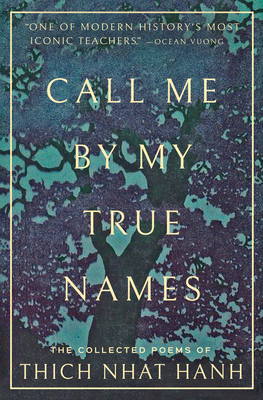
Call Me By My True Names is a collection of Hanh's poetry over the past forty years, reflecting his intimate experience of war and deep contemplation of hunger, desolation, destruction, materialism, and fear. Commentaries on each poem by the author.
Thích Nhất Hạnh was a Vietnamese Buddhist monk, teacher, author, poet and peace activist who then lived in southwest France where he was in exile for many years. Born Nguyễn Xuân Bảo, Thích Nhất Hạnh joined a Zen (Vietnamese: Thiền) monastery at the age of 16, and studied Buddhism as a novitiate. Upon his ordination as a monk in 1949, he assumed the Dharma name Thích Nhất Hạnh. Thích is an honorary family name used by all Vietnamese monks and nuns, meaning that they are part of the Shakya (Shakyamuni Buddha) clan. He was often considered the most influential living figure in the lineage of Lâm Tế (Vietnamese Rinzai) Thiền, and perhaps also in Zen Buddhism as a whole.
These poems, written by Thich Nhat Hanh, are divided up into two sections in this collection: Historical Dimension (written primarily during the '60s, during the war in Vietnam) and Ultimate Dimension (written primarily during the early '70s through the early '90s).
The poems in Historical Dimension are sometimes wonderful, sometimes controversial, sometimes spiritual, sometimes banal.
Thich Nhat Hanh goes from telling the reader:
Humans are not our enemies—even those called “Vietcong.”
to judging First World citizens in the 1960s for their lack of involvement in his country's crisis:
You used the grain that could have fed my brother to produce your steak, and your pile of steaks is now so high that it hides the sun.
There are moments when we are all good people, moments when we are all callous people, and moments when the downtrodden people are clearly superior to the affluent people.
Some of the messages are so stunning:
This body is not you. You are life without boundaries. You have never been born, you will never die. We have always been glad together and will always be.
Some of the messages are so terribly confusing. . . Sometimes I found myself fully in the grasp of his fervor, other moments I was like. . . Wait, hold on a damn minute! You wrote these poems about your suffering countrymen, pointed your finger all around the world at who wasn't being helpful, but you wrote them from the countryside of France??
The poems in Ultimate Dimension are generally more Buddhist in nature. Again, some are uplifting, some are didactic in nature, and some are a little. . . egotistical?? There was an uncomfortable (for me) amount of name-dropping and self-promotion that I found odd, coming from a famous Buddhist writer.
Sigh.
I can't quite tackle this work as a lit teacher, a writer or an American woman. The poetry is too complicated in its overall intention. The potential for controversy here is so great, I will end this with one of his poems that I believe has universal appeal. I mean, aren't we all interested in good news??
They don't publish the good news. The good news is published by us. We have a special edition every moment, and we need you to read it. The good news is that you are alive and the linden tree is still there, standing firm in the harsh Winter. . . They only print what is wrong. . .
Listen! You have ears that can hear it. Bow your head. Listen to it. Leave behind the world of sorrow and preoccupation and get free. The latest good news is that you can do it.
Thich Nhat Hanh's poetry is known for its haunting, lyrical quality. There can be no better way of conveying a sense of this than by reproducing the title poem here. Very highly recommended.
Please Call Me by My True Names
Don't say that I will depart tomorrow -- even today I am still arriving.
Look deeply: every second I am arriving to be a bud on a Spring branch, to be a tiny bird, with still-fragile wings, learning to sing in my new nest, to be a caterpillar in the heart of a flower, to be a jewel hiding itself in a stone.
I still arrive, in order to laugh and to cry, to fear and to hope.
The rhythm of my heart is the birth and death of all that is alive.
I am the mayfly metamorphosing on the surface of the river. And I am the bird that swoops down to swallow the mayfly.
I am the frog swimming happily in the clear water of a pond. And I am the grass-snake that silently feeds itself on the frog.
I am the child in Uganda, all skin and bones, my legs as thin as bamboo sticks. And I am the arms merchant, selling deadly weapons to Uganda.
I am the twelve-year-old girl, refugee on a small boat, who throws herself into the ocean after being raped by a sea pirate. And I am the pirate, my heart not yet capable of seeing and loving.
I am a member of the Politburo, with plenty of power in my hands. And I am the man who has to pay his "debt of blood" to my people dying slowly in a forced-labor camp.
My joy is like Spring, so warm it makes flowers bloom all over the Earth. My pain is like a river of tears, so vast it fills the four oceans.
Please call me by my true names, so I can hear all my cries and my laughter at once, so I can see that my joy and pain are one.
Please call me by my true names, so I can wake up, and so the door of my heart can be left open, the door of compassion.
-Call Me By My True Names: The Collected Poems of Thich Nhat Hanh
This is a mostly older collection of poems, and I think what came across most of all is how much suffering Thay experienced, because he put himself in places with those who suffered. Many of the poems just bring that quality of presence and grounded compassion as his response to those situations. It’s not frilly, and it is often gloomy, but you hear his heart. I felt a tender sense of missing him as I read them, even though so many of his poems are about how even after death we are together.
I kept a few for my collection and I think my favorite is Our True Heritage. The one that most broke me open, especially in light of this week’s headlines, is Recommendation. Those are worth looking up.
Poems by the great Thich Nhat Hanh over his long 95 year life. He died in Hue Vietnam. He writes about everything- love, death, intervening, rebirth, nature. Sometimes there are little stories at the end of the poems about where and why they were written. Such an amazing collection of poems to have access to and comfort from! I loved many of the poems. Here is a piece of one: Armfuls of Poetry Drops of Sunshine …
Poetry is back to haunt the old hills and prairies. Yet the poor thatched hut remains on the river shore, waiting. Spring carries poetry in its drizzle. The fire sparkles poetry in its orange flame. Sunshine stored in the heart of the fragrant wood, warm smoke leading poetry back to the pages of an unofficial history book.
There were some really haunting poems in the first half, esp coupled with the notes section after some of them. The second half got a bit too didactic for me, I feel like maybe a lot of it would work better in prose.
favorites: for warmth, night prayer, structure of suchness, those that have not exploded, let me give back to our motherland, the lonely watchtower, the fruit of awareness is ripe, the boat people, the fisherman and the fish, armfuls of poetry
I let these poems wash over me before bed each night. It's hard to fathom how one person could suffer so much and still manage to bring such beauty to the world.
I was introduced to this book through an interview of environmentalist icon Joanna Macy on the podcast series of Thich Nhat Hanh's Plum Village Buddhist community called "The Way Out Is In." Macy read from this book and chose the poem by the same name, "Please Call Me By My True Names." Her reading was powerful, as is the poem itself, and stuck with me until I finally bought the book.
I read the book slowly each day following my practice with a Plum Village affiliated Sangha and found it a good companion to mindful sitting and walking in Thich Nhat Hanh's (i.e. "Thay's") tradition. I would highly recommend it to anyone Interested in continuing Thay or seeing deeper into his life and thinking. However, I am glad I first read his early journals in the book "Fragrant Palm Leaves," through which I learned much about Thay's life as a young monk and activist during the Vietnam war. Those early years had much influence on the rest of Thay's life and also the poetry in this book, especially the first part of the book which contains poems about the Historical Dimension.* Having read both books I can see just how amazing Thay was to turn out like he did after living through so much death, destruction, war, loss and banishment from his homeland.
*Historical dimension - in Plum Village Buddhism there are two dimensions, the Historical where we experience every day life, and the Ultimate Dimension of freedom, peace and joy also known as Nirvana. These two dimensions are not separate but present in every moment of life.
can be skipped. i prefer TNH's philosophical works among his teachings. something by "the master instructs thee" tone in poetry just doesn't resonate with me.
for me, the poetry collected by Czeslaw Milosz in "A Book of Luminous Things" has a similar set of messages with more nuance and wisdom
As a truly compassionate man, Thich Nhat Hanh acts as bridge between the realm of art and the realm of self. In truth, barriers dissolve and the reader is left to contemplate that essence, that substance we might point to when our gaze turns inward.
What is that tenderness, that resiliency, that churning, that sorrow? It dwells in all of us. And so his poems, which are poems, call us back to each other. There is fierce love in these poems. And, against all odds, there is a real attempt to heal and to make whole.
Poetry rarely looks so striking-- so strikingly like prayer. Usually the poet rages or rallies against the Other in order to create. Thick Nhat Hanh opens his poetry to all that would harm, diminish, even squelch who and what he loves, and he takes these elements into the poetry and into himself to show us our world.
The suffering that he exposes is the suffering of the poet, and the poet "is" us.
I’m glad I read this book — I almost had to, as a lover of poetry and a reader of Thich Nhat Hanh's for almost 30 years — but I wouldn’t recommend this book to anyone. The poetry is too often didactic, hard to grasp, or just sort of weird. And for the poems that impart Buddhist teachings, their messages are much better told in prose form in other books.
I quite enjoyed two aspects, though. One is that some of these poems were written before he became quite so famous (when MLK nominated for the Nobel Peace Prize in 1966, I think) so the peek into his earlier writings was fun. And the best part were his explanations of many of the poems. I'd read one and think "Well, that was kind of a misfire" and he'd note how it'd inspired someone to immolate themselves in opposition to the government or forced his exile or inspired a popular folk song, or some such story that meant I clearly hadn't understood the depth of its message.
While I found a few poems quite moving and memorable such as "Condemnation" and "Earth Touching," the sheer number of poems that I couldn't connect with means that I can’t go higher than three stars.
Condemnation Listen to this: yesterday six Vietcong came through my village, and because of this, the village was bombed. Every soul was killed. When I returned to the village the next day, there was nothing but clouds of dust — the pagoda without roof or altar, only the foundations of houses, the bamboo thickets burned away.
Here in the presence of the undisturbed stars, in the invisible presence of all people still alive on Earth,, let me raise my voice to denounce this dreadful war, this murder of brothers by brothers!
Whoever is listening, be my witness: I cannot accept this war. I never could, I never will. I must say this a thousand times before I am killed.
I am like the bird who dies for the sake of its mate, dripping blood from its broken beak and crying out, "Beware! Turn around and face your real enemies — ambition, violence, hatred, and greed."
Humans are not our enemies — even those called "Vietcong." If we kill our brothers and sisters, what will we have left? With whom then shall we live?
And then here is part of the note at the bottom of the poem: This antiwar poem was written in 1964 and printed in the Buddhist Weekly Hai Trieu Am (The Sound of the Rising Tide), circulation 50,000. I earned the title "antiwar poet" and was denounced as a pro-communist propagandist.
This collection had a bit of everything. There's three sections. The first one is poems about the Vietnam war, the second is short stories, the third is more poems but with a more positive outlook. It took me a bit to get through the war section because it was quite tragic. Its unfortunate they had to go through such things.
I mostly enjoy Thich Nhat Hanh's insights but there was one or two that I can't get behind. Funny enough its the one from the title. The poem about the pirate who raped a girl during the war rubbed me the wrong way because it was about not hating people who did terrible things because it was thanks to circumstances. Instead we should call them by their true name and understand that it was the life they had that put them on this path. That man is not our enemy and we're all the same. In any other situation I might agree, but there is no circumstance I will ever forgive rapists so I will be overlooking that poem. I guess I can agree that the quality of life should be improved so that no one thinks this is an ok thing to do.
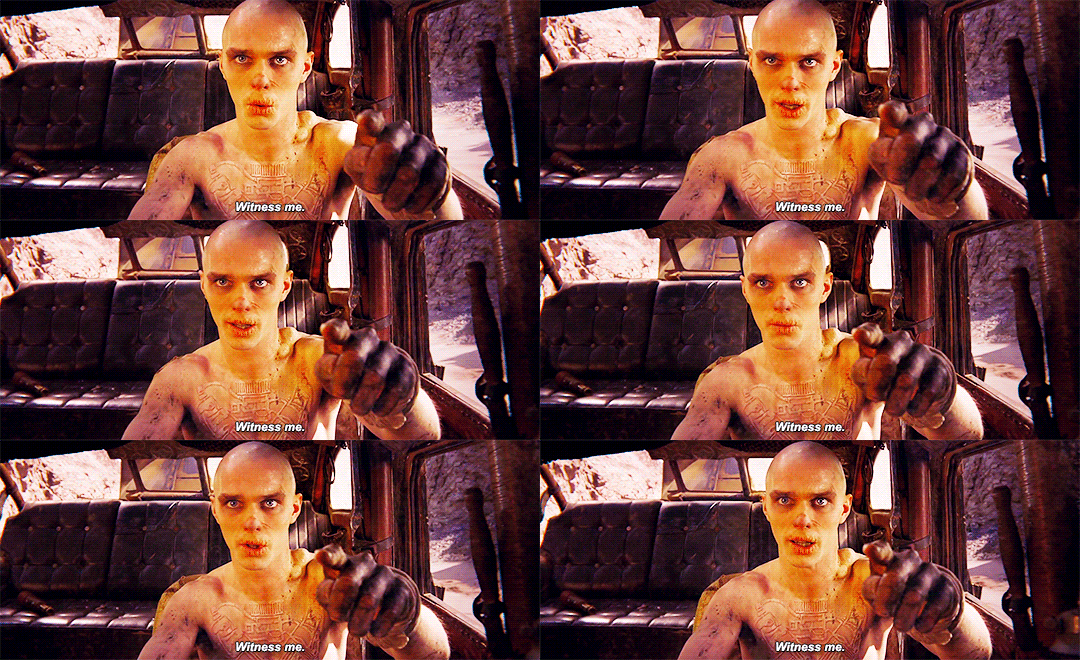
I liked the end section for having softer outlooks on life. Some were very wholesome. I Will Say I Want I It All reminded me of Mad Max lol. It was absolutely not supposed to be funny but the phrasing took me off guard.
One night, I will come and set fire to his shelter, the small cottage on the hill. My fire will destroy everything and remove his only life raft after a shipwreck. In the utmost anguish of his soul, the shell will break. The light of the burning hut will witness his glorious deliverance.
Nux is that you.
Despite my odd connection 😅 the poem is about checking in on people who are sad and breaking them out of the shell they're hiding in. This collection is a good one to have.
Thich Nhat Hanh was a saint and his writings have been an incredible balm and personal guide for me over the past month, super thankful I found his work. The vast majority of these poems are wonderful and the way he writes so achingly compassionately about war and social injustice in particular got my eyes welling up more than a few times. As some of these poems function partly as religious instructions they can occasionally be a bit repetitive but all of it contributes to the heartfelt Buddhist universe that TNH was so potent at communicating. Very naturalistic, earthy, and celestial imagery here also which is always a plus for me. Plenty of material to revisit and soak in here, lovely stuff across the board.
"The river winds its way to the sea. Tomorrow, when it is time for you to depart, I will ask you to sing aloud your song of the new season. The echo of your voice will soothe and guide me on my way at least for some distance."
Best read slowly and with full attention. Some of the poems are more memorable than others (the titular one, of course, but also "Recommendation", "One Arrow, Two Illusions", "Froglessness", and "Breathing") but all of them convey a deep sense of ease, attention, acceptance, and presence. Some of it will make more sense if you are familiar with some of Thich Nhat Hahn's other writings.
“Lying down in the heart of my homeland, I watch the mountain through the clouds and the clouds through the mountain. Stretched out on the side of the hill, my gaze turns toward the West, through the lines of trees in the distance. The twilight is perfectly clear. Just like me, the sky and the earth are transforming in every instant. Each fraction of time is splendid, each fraction of time is sublime. I stretch out; my back rests against the soft pillow of the hill. I doze off. Life is singing, in this great reality, in each of her wonderful aspects. One thing embraces all things. The peak guards the peace of my slumber.”
TNH's poetry is always in nature, trees, earth, clouds. He is a wartime monk. He is a traveler in Europe from a poor country. He is never Great: his poetry, his ideas, his feelings seldom overwhelm you. He is gentle. He is gentle when he loves (almost all the time), gentle when he grieves (almost as often), gentle when he teaches Dharma (sometimes. Or always). His poetry seems to occur to him in hotel rooms, airplanes, earthen huts. It comes on the heels of conversations, meditation, the violence all around him, the beautiful eyes of people. He's not trying to make a point, it really seems like these words happen to him, and through him. He studies the strange beauty.
started this on the date in which twelve long months of genocide came to be. these poems take time to be digested as they were written by Thay during and about the Vietnam war. Unfortunately, still so relevant. these verses make me tear and also understand we are not against each other, we are against war, genocide, suffering.
“When can I break my long silence? When can I speak the unuttered words that are choking me?”
This was a truly meditative poetry collection by the renowned Buddhist monk Thich Nhat Hanh, most written from his younger days. His wisdom and his perspective and his insight were timeless testaments of what it is to be human with suffering, death, war, and at the same time beauty, birth, and love. I really loved his poems in part 2: Ultimate Dimension.
Really amazing foreword written by Ocean Vuong-- read it twice. The first part of the collection focuses on poems written during the Vietnam War and they are brutal. The work then moves towards more nature and Buddhist themes.
Favorite poems in this collection:
East & West Existence Unclasp Silence Movement Going In Circles
Every single page was something to deeply reflect on, it is something to read when you want comfort, insight, and calm. The first sections focus more on the Vietnam war and are deeply emotional, but the succeeding sections take on a world of their own, recounting memories, stories, and lifelong lessons.
I really enjoyed the second half of the book. I’ve never really connected with anything about the Vietnam War, so I had a hard time with the poems on that topic beyond appreciating their beauty, but I found the poems that did not pertain to the war moving and gorgeous. I loved the imagery and I was curious about the meanings quite often.
Giving this collection of poems a number rating feels silly but there we have it anyway. A really beautiful collection of poems for mindfulness practice and for life. I learned a lot of new things about thays life in the poems abt the historical dimension and found comfort and wisdom in the poems about the ultimate dimension.
Tonight I’ve come to stand midway between these sheer mountains, and to watch them bend over the river, and to listen to their eternal tales. Here is the impermanent and yet continuously flowing world. Let us stand together for future generations.
thich nhat hanh’s writing is beautiful, deeply moving, and insanely relevant right now. Read his writing!!
Though he may be more famous for his other works and achievements, Thich Nhat Hanh's Call Me By My True Names is a must-read. Every poem is a meditation on life, despite being interrupted by the horrors of war or any other issues. Cannot recommend enough
The introduction by Ocean Vuong was so beautifully written that I could feel his grief over the pages. I could also see Thich Nhat Hanh's influence in Ocean Vuong's writings as I went through this entire book of collected works.