Fractures form in a tight-knit Mennonite community, echoing the struggles experienced in small towns across North America
When a non-denominational megachurch opens on the edges of a rural Mennonite community, a quiet—but longstanding—battle begins to reveal itself. For years, the traditionalists in the community have held fast to the values and beliefs they grew up with, while other community members have begun raising important questions about LGBTQ+ inclusion, Indigenous land rights, and the Mennonite legacy of pacifism.
Through a series of vignettes, Shelterbelts explores the perspectives, experiences and limitations of a wide range of characters who find themselves increasingly at odds with their surroundings. A pastor and his queer daughter learn that a family has left their church because of the “LGBT issue.” Young activists butt heads with a farmer over the construction of a pipeline happening on his fields. A librarian leaves suggestive notes for readers inside popular library books.
By pulling these threads together, artist Jonathan Dyck has woven a rich tapestry—one that depicts a close-knit community in the midst of defining its future as it reckons with its past.
What you tend to see a lot in graphic novels, is that serious subjects are reduced to genre exercises. Sometimes that works, most of the time it feels like the subject isn't approached with appropriate sincerity.
So it's refreshing to read a book like Shelterbelts, that has an intricate story to tell about a small rural town and its community. It's a book about religion, how different communities form, how some have to hide their true nature within those communities. It's about the past, how things inevitably change, and sometimes you just have to let go. It's about the young versus the old. And it's about family (it is always about family).
Every chapter is told from the perspective from a different character, and they are all connected, either because they're family or just because they live in the same town. This is a town with a longstanding Mennonite conregation, that is slowly bleeding members to a new megachurch just outside the town, mainly because the Mennonite church wants to be accepting to the LGBTQ+ community, a stance that is proving unpopular.
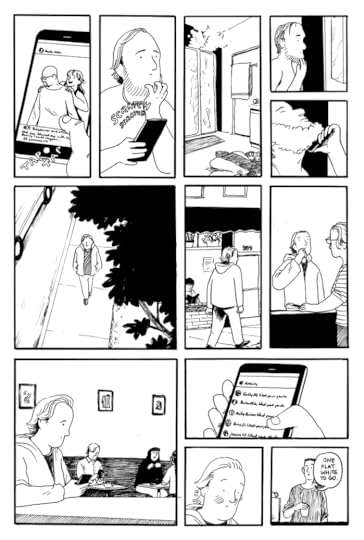
The art matches the delicateness and thoughtfulness of the writing, and even does interesting things with panel placement.
I grew up in the town that inspired this book, and was groomed into ministry from young by the megachurch that’s accurately portrayed. How the author managed to grasp the hospitality, prejudice, gravity, and stagnant stubbornness of Mennonites completely escapes me. Everything felt lifelike. Every conflict and plot point and piece of dialogue felt like a scene I’ve played in a hundred times. This book is charming, and sobering, and honest, and optimistic. My only difficulty with it was remembering the cast of characters, and having to regularly flip back to the front to find them on the chart, but this wasn’t disruptive enough to slow my reading by much. Would definitely read anything else this author puts out. I’m seeing so many reviews that it’s dull, and melancholic, and grave. Yes? And yet there were so many scenes of subdued smiles, and kindness, and optimism. Have you ever lived in a small Mennonite prairie town? This felt extremely accurate to the simple joys of life, with the overhanging fear of change.
A snoozy look at the low-key strife in a Canadian town dominated by members of the Mennonite religion. It feels like a series of interconnected short stories -- vignettes really -- as chapters rotate through a large cast of characters who are all sad for various reasons due to the current state or history of their church.
More a portrait of a conservative and repressive community than a story, I found it dreary and dull.
incredibly nuanced and empathetic look at various sects of hyper religious mennonites in manitoba. having attended family reunions in winkler and tasted the baked goods (and judgmental comments) of many a menno, this is stunning in its accuracy. but beyond that it really succeeds by portraying the wounds and frustrations of religious subcultures without coming across as bitter. a very special book.
I've been a part of this menno world for 10 years now and lovely to see a story and illustrations capture all the intricacies and nuances that I have come to be annoyed at and loved.
Oh well... I can't say I enjoyed it much, obviously.
The whole mood was kind of melancholic, and the story doesn't have a strong plot as such, but it's composed by a series of short episodes, like snippets that get to conform the bigger picture.
Lots of religion in this one, and though it's supposed not to be too preachy, it actually rubbed me the wrong way, as an agnostic. What can I tell you? I didn't appreciate some ideas there (even if they are just characters' ideas, not something that the author himself is trying to convey), such as the thought that being good is not enough in life (that's if you want to go to non-existent heaven, of course).
At least it was a good depiction of proselytism and intolerance... Cringe!
Oh, yes! I didn't love the art either, it was kind of monotonous (not only because of the lack of color), and it wasn't always easy to follow who was who... not to mention, it was hard to know what age range was supposed to be represented in each case, except for the old people.
What a thought-provoking book. It hit some very specific points for me, as I was raised in a strict evangelical home and had ties to the Mennonite community in small-town Ontario.
This book addresses many key issues that members of those belief systems have had to come to terms with, specifically the viewpoint that the LGBTQ+ community is a "problem". I loved how the author showed small acts of rebellion against organized religion, but most of all how love can still be shared despite differing opinions.
The thing that most struck me as I read this book was how applicable and relevant it felt. It was like pieces of conversations I’ve had with friends and family were written on the page - churches growing and shrinking, diversifying theology, residential school legacies, homosexuality, pacifism, pipe lines, finding God, camp….it covered so much and left so many spaces for nuance and conversation. Shelterbelts takes place in a small Mennonite town in Manitoba, told in various short stories with a large cast of characters. The town is grappling with the challenges of growth and existing in a modernizing era - generations of people wrestling with questions about what is right, what is freedom, what is faith, and what is true. I will probably be recommending this to people for years.
Read this on a recommendation of a friend without knowing what it was about at all before picking it up.
This is a book of interlinked comic stories set in the prairies — more specifically in a Mennonite community in Manitoba. The stories portray different members of the community, weaving among them and their various relationships to faith, family, and each other.
I appreciated the slice of life story style. While it might seem like there isn’t a lot that happens, action-wise — the tensions in the community felt very real and grounded in a contemporary Mennonite reality. I think the underlying tensions of faith-values-traditions-queerness-land-settler-colonialism-family-relationships were very well portrayed and believable.
I enjoyed reading these stories, would recommend, and look forward to reading more work by the author in the future.
I’m not a big graphic novel fan, though I enjoyed this more than most. Some themes/settings make this seem like a very niche book for a very niche audience (lifting voices of queer Manitoba Mennonites). But the range of topics in its interconnected stories is also relevant to Mennonite experiences more generally, ally-ship in religion more generally, evangelicalism, settler colonialism, white savior complex, pipeline-protesting-environmentalism, family, the nature of community, nostalgia vs. reality, and the inevitability of change. I might actually give this a re-read.
multiple perspectives of a mennonite community in canada. young and old, religious and secular -- a study of contrasting experiences, navigating the past as they are propelled into the future.
it was a slow read, but it was the kind of slow you savor to take in the story as it reveals itself to you. i liked the art a lot -- the dense pockets of nature and the bleak rural landscapes alike are stunning, and the characters are simply drawn but subtly strong.
Only the second Graphic Novel I have read. It is about people who live in a Manitoba town, most of them being of the Mennonite faith. Their discussions of their daily lives were interesting to read. Hey, no car chases, no murders, just serious young people working on their interests and discussing their three different Mennonite churches
3.5 out of 5. A very accurate way of writing interactions and scenes regarding Mennonite life in a small town. A number of situations read like conversations I have experienced when growing up in one of those towns so it felt like a very close to home type of book.
Wish there was some more fleshing out of characters and evolving stories. It was a good snip shot of life, but would have liked to see the progressions move further along as characters became more intertwined.
Unassuming loosely connected stories about a place and a community that I'm still thinking about. A meditative read that is lingering.
Some great scenes on cars and bikes and hikes, a feeling of surveilling/skimming and inquiring and then more deeply attending. A lot is left open to the reader + we are free to continue the stories.
What does care look like across generations + ideology? What's the difference between nature and faith as a steadying ballast vs. an escape or site of performance and consumption? How do power imbalances between friends and in relationships play out in big and small ways? What does it mean to stay and try anyway even if it feels a little hopeless sometimes? Who do we accept hospitality from + extend hospitality to? What are the social costs of getting involved? What beliefs shelter and protect us in wind-swept, exposed landscapes? Who leaves a John K Samson show halfway through?
Gonna think about these things, take another look through, and re-read again and maybe collect some better thoughts about this one.
I like that the stories are left open-ended. There are few resolutions, so readers are able to consider what might happen in the lives of the characters.
I also appreciate that so many characters remain set in their ways even after being presented with different perspectives, because that’s so often the reality of the Mennonite community. This felt true to reality. Sometimes beliefs are so deeply ingrained in us that we struggle to recognize them as harmful or “outdated”. I think this book did a good job of presenting many of the conflicting issues of our time that impact Mennonite communities — land stewardship, reconciliation with Indigenous peoples, being queer in a conservative family, the pressures from parents and relatives to find a partner at a young age.
Shelterbelts left me feeling “seen”, in many ways.
this was probably the biggest surprise of the year for me, in the gap between what I expected to engage with and what actually pulled me in. through the lens of rural Canadian Mennonite life, told in interlocking vignettes, it's a graphic novel that deals with one central question that anchors everything: how do inherited beliefs learn to share space with the world as it is?
the story frames itself kind of the way a play might: a cast of players introduced upfront, a unique ensemble of opinions, followed by a slow widening. as the story opens up, private lives begin to surface, belief starts to fray, and there’s a gradual revelation of how much work it takes to keep a shared system intact.
within that structure, there’s a pastor trying to reconcile his love for his queer daughter with a congregation that won’t grant her legitimacy; voices insisting that the community has drifted too far into “worldliness,” trading tradition for comfort without admitting it; a pipeline proposal that splits a town between economic survival and ecological risk, putting prosperity and preservation into direct opposition; and a local Remembrance Day colliding with a military recruitment effort at a high school
there are also simpler moments too. times when kindness appears without warning, strangers offering shelter after a roadside accident (although slowly revealing how conditional that generosity can be). new, warm, and tender relationships begin to form as new people enter the community, (particularly in Thomas’s story). moments where characters are forced to reconsider what they thought they once knew, (like when Métis characters speak about the ecological and cultural damage caused by the arrival of the Mennonites)
taken together, what tied all of this together for me wasn’t any single issue. i knew nothing about Mennonites before reading this, and i only know a little more now (and i can’t really verify the accuracy of the range of opinions i was shown). instead, what made it work for me was the way Dyck approached it all. his patience - his willingness to let stories breathe, to trust the reader to sit with ambiguity, and to allow empathy to develop over time - let me sit with the questions he wanted to ask and kept my attention while doing so, even coming into it with no prior interest in the subject and no real impetus to keep reading.
it was compelling to watch this sustained reckoning unfold. Can communities change without losing themselves, and what gets sacrificed when they refuse to? What happens to belief when the security it provides is threatened? Who is asked to bend first?
This book felt like a mumblecore movie with no plot…which could be fine but drifting between characters, trying to deal with a million different issues, AND lacking plot is a combination that doesn’t entirely work. The overall reading experience was quite enjoyable and it gave me a lot to think about, but I think this might have worked better as a series of books or a series of short graphic novellas, each with an actual plot line, and each able to fully delve into characters and issues.
I thought for the most part the depictions of different characters was quite nuanced…with a few exceptions. The setting and issues dealt with are really interesting and the story did a good job of interweaving all these issues…but I felt that for the relatively short length of the book it was trying to do too much. SO many topics get touched on or brushed over. In some ways this is accurate to real life, as in a given day you might casually mention or think about any number of topics…but the author was clearly trying to make a point or reveal something about each of these and it felt like there wasn’t enough time for any of them or most of them to really be dealt with in a meaningful way. Mennonite history, land rights/indigenous land claims, pipelines, pacifism, LGBT acceptance in the church, LGBT acceptance in a small town, parent/child relationships, intergenerational relationships, disability, farming issues, appreciation of nature/dominion of nature, missionaries/white saviours/voluntourism, mega churches vs. small churches vs. new conservative churches, disputes over the meaning of Remembrance Day etc….So many threads got dropped, characters that could have been interesting fade into the background.
Engaging 1). for its subject matter and 2). for solid art.
Dyck's panels ooze religious empathy; he's super skilled at bringing his observations into his drawing. I love the way Hespeler is portrayed with big fields and outstretched roads; grandmotherly furniture and houses with minimal designs. It's even more effective when his drawings show this environment being destroyed, as his images of oil pipes and missiles contrast with the farmlands. Simple and sad cartooning!
Two stories really stand out here. The first a two-parter about a gay townie and the other about a girl on missionary. These stories rule! He portrays his conservative characters with impartial depth, while still sending a bullet of a progressive message. Its a great juxtaposition, and you rarely see it so mercifully told.
But Shelterbelts comes off ... missing something. Comic short stories often feel underwhelming for me- by the time they set the scene and character, they tend to be wrapping. Shelterbelts is guilty of this - just as we get to know the people here, Dyck moves on, rarely letting the conflict become more engaging. I get he is going for a realistic, undramatized story, but by the end, characters and plot points get repetitive; just another conflicted Mennonite or a politically conservative who can't keep up with the times. I need more surprising endings! Conflicts that elevate the characters, who in turn react! Dyck is especially missing that last part.
This reads more like a bunch of interconnected short stories. There is a fairly large cast, and I found myself thinking of the people as belonging to little overlapping Venn diagrams. There isn't an us vs. them story you might expect from reading a short blurb (or just the first half of the description).
The illustrations are black and white sketches, attractive, but it's a little hard to identify all the characters easily, especially as they change clothes, facial hair, and hair styles. The story takes place over most of a year, so those changes make sense; just not a GN you can page through idly, you need to pay more attention.
There is a lot of religious content, but it's more philosophical and not preachy. Suggest to readers who connected with Blankets.
Picked up Shelterbelts from the display section of my Kitchener Public Library. With the history of Mennonites in the region, and my own attempt at fitting into this community, I found the topic of this graphic novel very interesting. It is a series of 'short stories' set in rural, Saskatchewan Mennonite community. Dyck presents the juxtaposition between mega-church and tiny churches, colonialism and Mennonites farming 'unwanted' land into prosperity, young adults exploring their sexuality while unpacking their Christian camp experiences. Some quiet despair, some calls to action, very human experiences and misunderstandings, and it ends with a scene of hope.
If the reader doesn't know too much about Mennonite background, this graphic novel might seem very strange and alien. Some of it was real and true. Some of it was deconstructing the faith while not mocking it. I felt liberated and a little bruised after reading it.
When when I read this book, I saw the cover again my mother set an hour to charge a book by its cover, but it was a graphic novel, so I tried it out. It’ll never ended up reading the whole thing until the next day it was actually pretty good. I will give it five stars.
The synopsis is that there’s Mennonite ram ram who has an LGBTQ daughter, android studio ass life as usual, but sometimes things take out how to turn. That’s what I took from the book.
This book is very good because you’re so funny and staring at the same time I was just reading this book just to know the good and funny signs of living in a small town as well. It is very important to note about how dangerous religion on Sunday. That being said, I would give us five stars. Personally, I love the storyline and the characters and what they had to go through especially the LGBTQ daughter. This one is for the ages!!!!
This book was a slow paced vignette vision of a Mennonite town. I really enjoyed the individual monologues of each and every single character. My only real gripe of this book, was that with the art style, it was hard to distinguish character by character. I don’t mind a much more simple style, but I didn’t like how hard it was to define each character. I felt that the illustrious quality of the Claire de lune worked more often than not, but it left me being confused by which character was which. I think the style needed a little bit more variation. Overall, I really appreciated the slow rhythm of this book. Most American books do not have this kind of pacing, but this one wanted me to slowly connect the dots between each character. My review of this book, is to not demean the art quality, but to critique the difficulty of understanding each point of view.
Shelterbelts” by @jandrewdyck from @conundrumpress is a stunning graphic novel giving you a snapshot of a small Mennonite town, Hespeler, and it’s complicated people. The artwork is beautiful and rich and it’s a wonderful depiction of a community trying to figure out where they are and where they are going. I was left thirsty for more about these complicated characters and have been thinking about them since I finished. I loved that it is a look into a community we don’t know that much about, and seeing that even in that community there never is one way to be. I enjoyed the religious discussion over things like being queer, profiting off religion and belonging. An excellent and captivating read.
This book was not for me. I was looking forward to a short story collection following characters from the same community. It was way to focused on religious. It seems to have different messages, but none of them were clear. I struggled with reading as well because not all the writing was clear. I kept reading Hespeler as Hespelee. The stories didn’t always seem to connect or make sense. It was a struggle to get through this book and I kept looking at the page number to see if I was any closer to the end. The characters were uninteresting and some of them were difficult to remember. It also has a very specific audience because a lot of it is not easily relatable, even though some of the situations were familiar. A shame. I wish this book had been more appealing.
This book does a fantastic job of portraying the nuances of growing up Mennonite in Manitoba. The illustrations are gorgeous, the characters are compelling, and the storytelling is compassionate. Each chapter is told from the perspective of a different character and tackles a theme such as pacifism, lgbtq+ inclusion, settler colonialism, pipelines, family, and more. So often when people talk about southern MB, it is with a disparaging or condescending tone, but this book opens the reader up to experience the complexity of a community that is changing, and people who are not just stereotypes. These are stories that will stick with me.
I checked this book out while trying to find a graphic novel to read for the summer. I found this book very engaging, having been to mennonite churches, and it was fun to get to peek into the lives of these people. I really liked how the author was able to show how the mega church affected the town and the complexities that go into small town life. I did find some of the stories much more interesting then others and as always in graphic novels--some things just didn't make sense to me (there is so much you have to extrapolate from a small picture). I would have been helped by more written narrative.