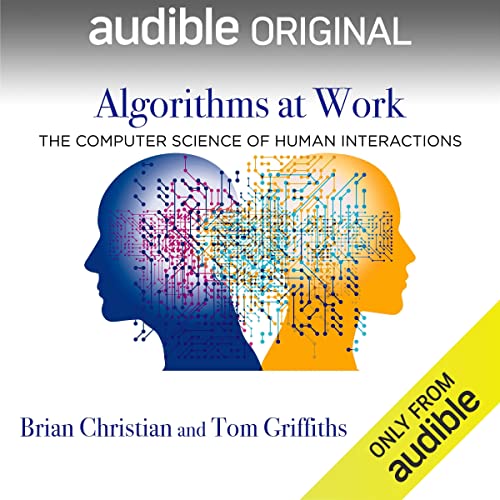
In this highly intoxicating original series, researchers Brian Christian and Tom Griffiths, authors of the best-selling smash hit, Algorithms to Live By, tackle some of the biggest ideas in computer science today—and, in the process, illuminate cutting-edge ways of understanding how we live, work and play.
They take us inside a tomato factory where no one has a job title to shed new light on decentralized network structures; visit an Olympic fencer to explore the game theory of when to make the first move; and tour the birthplace of the internet, a buzzing laboratory on the border of France and Switzerland, to examine the true—and truly human—limits to what a network of nearly one million machines can achieve.
Along the way, they interview key figures in the world of computer science—from Google's Vice President of Infrastructure Eric Brewer to ‘the godfather of distributed systems’ Leslie Lamport—plus preeminent neuroscientists, sociologists, and even the co-founder of Instagram.
Algorithms at Work is a playful and deeply inquisitive exploration of the overlapping questions of computer science and society. The result is six episodes that examine the world in unexpected and memorable ways.
Brian Christian is an acclaimed author and researcher whose work explores the human implications of computer science. He is known for his bestselling series of books:
The Most Human Human (2011) uses his experience as a human “confederate” in the Turing test to examine what chatbots reveal about the nature of language and communication. It was named a Wall Street Journal bestseller, a New York Times Editors’ Choice, and a New Yorker favorite book of the year.
Algorithms to Live By (2016), co-authored with Tom Griffiths, applies computational principles to everyday human decision making, painting a counterintuitively human picture of rationality. It was named a #1 Audible bestseller, Amazon best science book of the year, and MIT Technology Review best book of the year.
The Alignment Problem (2020) is a nuanced investigation of the ethics and safety challenges confronting the field of AI, and a portrait of the community of researchers working to address them. Nature called it “Meticulously researched and superbly written,” and The New York Times called it “The best book on the key technical and moral questions of AI.” Microsoft CEO Satya Nadella named it one of the books that most inspired him. The Alignment Problem was a Finalist for Los Angeles Times Best Science & Technology Book of the Year and won the Excellence in Science Communication Award from the National Academies of Sciences, Engineering, and Medicine.
As a researcher, Christian’s work spans from computational cognitive science to AI alignment and has appeared in peer-reviewed journals from Dædalus to Cognitive Science, and he is a recipient of the Clarendon Scholarship, the University of Oxford’s most competitive research scholarship. He is affiliated with the AI Policy and Governance Working Group at the Institute for Advanced Study in Princeton, the Center for Human-Compatible AI and the Center for Information Technology Research in the Interest of Society at UC Berkeley, and the Human Information Processing Lab at the University of Oxford.
As a writer, Christian’s work has been translated into nineteen languages, and has appeared in The New Yorker, The Atlantic, Wired, The Wall Street Journal, The Guardian, and The Paris Review. His writing has won several literary awards, including fellowships at Bread Loaf, Yaddo, and MacDowell, publication in Best American Science & Nature Writing, and an award from the Academy of American Poets.
As a software developer, Christian has contributed to a number of foundational open-source projects, including Ruby on Rails and Bundler. He served for nine years as Director of Technology for the innovative literary publisher McSweeney’s, where he led a small team responsible for the company’s technical stack.
As a speaker and public intellectual, Christian has been a featured guest on The Daily Show, The Ezra Klein Show, and Radiolab, and has lectured at Microsoft, Google, Meta, Yale, the Santa Fe Institute, and the London School of Economics. He has advised business executives as well as Cabinet Members, Parliamentarians, and administrators in six countries about matters ranging from decision making to AI.
Born in Wilmington, Delaware, Christian studied computer science and philosophy at Brown University, poetry and nonfiction at the University of Washington, and psychology and computational neuroscience at the University of Oxford. He lives in San Francisco and the UK.
What a fantastic little book! This audio documentary series dives deep into how computers make decisions, then discusses how those principles can be applied to human decision making. The author interviews an amazingly wide variety of people in different professions, then shows how each of them is applying these techniques to produce excellence.
This is a wonderfully entertaining book, full of fascinating stories and insightful takeaways. I highly recommend it.
It's been a while since I got such a kick out of a podcast. Expert and laymen alike should enjoy this fantastic foray into the world of computer science algorithms combining the practical applications even going beyond into the nooks and corners of real-world ideas.
Algorithms at Work is an endlessly fascinating exploration of how some of computer science's most powerful ideas illuminate the way people, organizations, and societies function. Brian Christian and Tom Griffiths once again demonstrate their remarkable talent for transforming sophisticated technical concepts into engaging, accessible stories that reveal the surprising connections between algorithms and everyday life.
One of the work's greatest strengths is its storytelling. Rather than relying on abstract theory, the authors immerse readers in real-world environments from innovative workplaces and elite athletic competitions to world-leading research laboratories showing how algorithmic thinking shapes decision-making, cooperation, communication, and problem solving across remarkably diverse settings.
The interviews with pioneering computer scientists, engineers, neuroscientists, and organizational thinkers add tremendous depth and authenticity. By incorporating insights from influential figures such as Eric Brewer and Leslie Lamport alongside experts from other disciplines, the series presents computer science as a profoundly human field that continually intersects with psychology, sociology, economics, and organizational behavior.
What makes Algorithms at Work especially compelling is its ability to challenge conventional assumptions. Concepts such as decentralized networks, distributed systems, game theory, and collective intelligence become far more than technical ideas they emerge as practical frameworks for understanding leadership, teamwork, innovation, and the increasingly interconnected world we live in.
Despite engaging with complex subjects, Christian and Griffiths maintain an approachable, conversational style that welcomes readers regardless of technical background. Their clear explanations and engaging examples make advanced computer science concepts feel intuitive while preserving the intellectual richness that makes the material so rewarding.
Algorithms at Work is an outstanding blend of science, technology, and human curiosity. It demonstrates that algorithms are not confined to computers they provide powerful ways of understanding how people think, collaborate, compete, and create. Whether you're interested in technology, business, psychology, leadership, or simply how the modern world works, this is an insightful and thoroughly enjoyable exploration that continues the authors' tradition of making complex ideas both accessible and deeply meaningful.
Great six-episode podcast nicely discussing how computer science can be used not only for problems involving computers but also for our everyday problems at the individual and societal level, such as how to coordinate, how to react, how to reach consensus, etc. I'll probably give it another listen at some point in the future.
Whatever information you need or want, whatever you want to do or suggest… it’s everything and most importantly supported in code in math behind the curtain where everyone ignorantly believes there is no wizard.