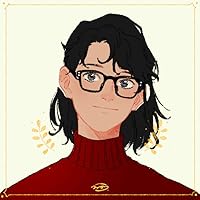
Aurelius Magnus has not yet been stolen by the Sun and Moon.
He has not yet led the Empire of Astandalas into what will later be hailed as a golden age, nor met the man whose friendship and loyalty will be celebrated in legend for two thousand years.
He has not yet even earned the epithet “Magnus”.
He is only Aurelius, twenty-one years old and already six years an emperor. War is all he has ever known.
I walked across England in 2013, fulfilling a long-held dream. I'm currently the sexton of an Anglican church in Nova Scotia, which means I am keeper of the keys and opener of doors (and shutter-off of alarms). I have a PhD in medieval studies from the University of Toronto, looking at poetry and philosophy in the works of Dante and Boethius -- both the poetry and the philosophy come into my stories a great deal (and occasionally the Dante and the Boethius).
I like writing about the ordinary lives of magical people on the other side of the looking glass ... and the extraordinary deeds of ordinary folk, too. Three of my favourite authors are Patricia McKillip (especially 'The Riddle-Master of Hed' trilogy and 'The Bell at Sealy Head'), Connie Willis ('Bellwether' and 'To Say Nothing of the Dog,' which latter would make my top-ten books on a desert island), and Lois McMaster Bujold ('The Curse of Chalion' and its sequels).
One of the things I enjoy most about The Nine Kingdoms is the way you get to know someone by reputation in one book (or many books) and then in another book get to see the story from their point of view. Fitzroy Angursell is the main example of this, of course, and I have to say I never imagined we'd get to know Aurelius Magnus (we don't, however, find out why he has the only Latin name among the descendants of Yr). Goddard writes very young men very well, and each is distinctly himself. A fun read.
From what I've read so far, the majority of author Victoria Goddard's Nine Worlds saga takes place in and around the time of Artorin Damara, the hundredth and final Emperor of Astandalas. This prequel novella, by contrast, is set many centuries prior, and functions primarily as a character study of His Radiancy's distant predecessor, the forty-ninth personage to hold that title. We find him here early in his reign, but already tired of constantly waging war to expand and preserve his empire's borders.
The action of the piece is minimal and somewhat underwhelming, even for a cozy fantasy series like this. The protagonist arrives in his mother's homeland and honors her old teacher by asking for his advice to secure a lasting peace, but the former general's response basically amounts to a suggestion that he try meditating as though going into battle within himself. When he does, he experiences a sequence of prophetic visions and ultimately unlocks the intuitive understanding to wield magic that had hitherto eluded him. It's a gift we know will radically reorient his station and that of his lineage to come, but it doesn't amount to much of a conclusion for the story currently at hand. Although an interesting picture of the reluctant young warrior and his era of the setting, this book isn't the most satisfying installment on its own.
This is good, but it's really such a small snippet of such a grand theme and character's life that it feels a bit unsubstantial. The ideas in it are great and the meditation and vision are worth reading, but it feels too much like either an the beginning of a book or an over-embellished koan for me to feel satisfied with it. I think that my biggest problem with it is that it doesn't have the substance of human connection that is the main reason that I enjoy Goddard's work. Instead, it feels like a set of promises of that kind of connection that we may never get to see kept.
um conto sobre aquele momento de reflexão pessoal que vem antes de um imperador alcançar grandeza, bem introspectivo
que bom que a victoria goddard já falou que vai ter mais do aurelius pois gostei dele
"I will fight my father’s wars, my grandfather’s wars; I will hold the empire they gave to me. But I am not only my father’s son, and my mother’s last words to me were a plea that I remember that life is more than war."
(e não leiam esse conto antes de ler the hands of the emperor)
Less a story than a philosophical meandering on war and peace disguised as a story. Almost a parable. Kind of Socratic in the seeker consulting a teacher and then journeying within to a realization. That said, very beautiful. Grounded in a glorious setting, with all the yearning that inhabits our hearts and characters wise enough to lead us. Definitely feels like a fantasy in this day and age, but offers the reader a moment outside of time to think of bigger things.
Perhaps I did this short story a disservice by reading it too late at night and not with my sharpest faculties, but I don’t think I completely ‘got’ it. I liked the start - the tone was warm and delightful, and it was both the universe we know but also somehow far in the past - but I just got confused when magic entered the story. I think I missed the symbolism it was trying to convey.
Broke my 4+ rating streak for the short stories. I just did not care enough about him but the writing was solid, I don't know if I needed more time or to see him at a different point to get pulled in.
The tonality of the story was somewhat...odd. I didnt really buy Aurelius' motivation at all somehow and it seems like the author herself doesnt really know what the wars are really about, which makes things even odder.
What an interesting glimpse into Aurelius Magnus and his origins. There are a lot of parallels to Marcus Aurelius of the Meditations fame at first, but then we leap into the magic. It's great to have this little glimpse of Astandalas in his time as well. What a very different land.
A sweet billet-doux, full of love, kindness, delight and whimsy…brief, read in ten minutes, but it left a sense of joy and, even, uplift…thank you, dr goddard…
God this was beautiful. Knowing Aurelius' fate makes this book so much more harder to digest, but I almost have a few tears in my eyes. The prose was just gorgeous.
I definitely want to read more about Aurelius. Very Alexander-like in some ways, and if he was like that so young, I want to read more about who he became!
Since I didn't mark the first time I read it, I forgot and read it again. Ofc as soon as I started reading it all came back but I read it anyways cause is such a nice (and short) book
physically restraining myself from reading at the feet of the sun until I have my life a little more together bc I can’t take the time to hyperfixate on it rn