

What do you think?

Rochester's Wife
Kit Stone moved to a small English village to share the practice of an aging country doctor. After four years of wandering aimlessly about the world, the change of pace was pleasant and diverting. And most diverting of all was lovely Mardie Rochester, a sensitive young woman who unwittingly captured Kit's heart. But there was one very large obstacle in Kit's search for happiness - the woman he so adored was Jack Rochester's wife.
334 pages, Kindle Edition
First published January 1, 1940
About the author
D.E. Stevenson
72 books690 followersThere is more than one author with this name
Dorothy Emily Stevenson was a best-selling Scottish author. She published more than 40 romantic novels over a period of more than 40 years. Her father was a cousin of Robert Louis Stevenson.
D.E. Stevenson had an enormously successful writing career: between 1923 and 1970, four million copies of her books were sold in Britain and three million in the States. Like E.F. Benson, Ann Bridge, O. Douglas or Dorothy L. Sayers (to name but a few) her books are funny, intensely readable, engaging and dependable.
Dorothy Emily Stevenson was a best-selling Scottish author. She published more than 40 romantic novels over a period of more than 40 years. Her father was a cousin of Robert Louis Stevenson.
D.E. Stevenson had an enormously successful writing career: between 1923 and 1970, four million copies of her books were sold in Britain and three million in the States. Like E.F. Benson, Ann Bridge, O. Douglas or Dorothy L. Sayers (to name but a few) her books are funny, intensely readable, engaging and dependable.
Ratings & Reviews
Friends & Following
Create a free account to discover what your friends think of this book!
Community Reviews
Displaying 1 - 30 of 39 reviews

August 21, 2015
The book was pleasant, but unremarkable. The following has absolutely nothing to do with the actual story, but it piqued my curiosity. I LOVE trivia!
...she seized her powder puff and prepared to powder her nose. "Stop!" cried Dolly. "Good Heavens you can't put white powder on your nose. Haven't you got any rachel powder in your possession?" - Rochester's Wife
I just had to know... what the heck was rachel powder?
Rachel Powder*
Early face powders produced for the mass market came in three shades: Blanche (white), Naturelle (pink), and Rachel (cream). The two most important tints of colour are rachel and naturel, the former a creamy-yellow and the latter a creamy-pink. As the names used for these powders were French, the question arises why the colour ‘cream’ was called Rachel and not Crème.
Who was Rachel?
The French actress
Élisa Rachel Félix came from an impoverished background, but with a prodigious talent, some luck and the attention of men with important connections, she rose to become a great classical French actress. Taking the stage name Rachel, she toured throughout France, Europe – from England to Russia – and the United States. She died from tuberculosis at the relatively young age of 38, which meant that, like others who have died prematurely, her beauty was locked in time.
Described as “one of the greatest actresses France, or perhaps the world, has ever known” she was associated with grace and beauty.
One factor that may have helped her was the adoption by theatres, from the 1840s, of gas lighting. Stages in gas-lit theatres were much brighter than those lit by candles or oil lamps. Improved lighting required better sets and costumes as these were now more visible, but they also enabled the bodies, faces and facial expressions of the actors to be more clearly seen. The highly exaggerated facial expressions and gestures necessary with the dimness of candle or oil light became passé. Rachel was known for her beauty, her clear diction and unexaggerated style of acting making her well suited for a stage with brighter light. Talented and beautiful, she was ideally placed to make the most of the new environment. It is understandable then, that her name might be associated with a beauty product. She was an actress, a beauty, and known throughout Europe.
But why crème and not pink or white? Most likely, the colour suited her skin tone better than Blanche or Naturelle. As the advertisement for Poudre D’Amour suggests, it is to be used to give a natural fraîcheur (freshness) to the complexion in artificial light.

1890 Advertisment for Poudre D’Amour a toilet powder for the complexion 1/- in three tints – Blanche – Naturelle – Rachel
Stage makeup during Rachel‘s time was powder-based. With the arrival of greasepaint in the 1870s and its numbered colour system, the link between the actress and the colour began to be lost in theatrical makeup. However, as powder became more acceptable for general makeup, shade names used in the theatre crossed over into common usage.
Although the collective memory of the link between the actress and the creamy colour was gradually lost, her name persisted, although it could also be spelt as Rachelle, presumably as this looked more ‘French’. As the range of powder colours increased in the twentieth century we also had the addition of other Rachel shades – Elizabeth Arden for example made a Rachel No. 1, Rachel No. 2, Rose Rachel and Special Rachel – with this proliferation of Rachels reaching its peak in the 1950s.
The other Rachel
Some sources suggest that the powder colour was not named after the French Élisa Rachel Félix but rather the English Sarah Rachel Leverson, known as ‘Madame Rachel’.
By 1910 a lady’s handbag contained powder boxes of gold or silver filled with the first compact powders in white, flesh and rachel. The latter shade was named after a notorious English woman who made a dishonest fortune by perpetrating fraudulent beauty treatments on silly women with no more beauty apparently than brains.
Sarah Rachel Leverson was one of many purveyors of ‘beauty aids’ who operated in London in the nineteenth century. As usual, these aids were based on ‘secrets’ known only to her. In her case the ‘source’ of these secrets was the mystical East and she followed this theme in the labeling of many of her products, which included Arab Bloom Powder, Sultana’s Beauty Wash, Royal Arabian Cream and Magnetic Rock Dew Water of Sahara. It is possible that she learned how to make preparations from her first husband who was an assistant chemist.
As part of the sales pitch, she dangled stories of marriage to rich noblemen in front of her clients if they would undertake her treatments. This led to complaints, convictions for fraud, and to her dying in prison. Her trial at the Old Bailey was widely reported and followed up in poems, songs and plays of the day. It is this notoriety that probably led some to associate the Rachel shade with her, even suggesting that she made and named it herself.
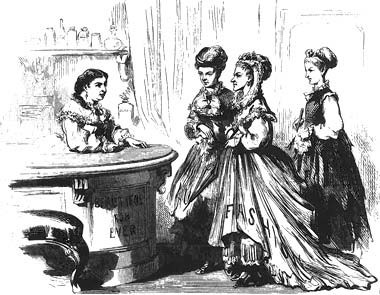
1868 Cartoon from ‘The Censor’ titled ‘Rachel – and her children!’. The three ‘beauties’ lining up for Madame Rachel’s cosmetics are Lust, Fashion and Folly.
*Taken from http://www.cosmeticsandskin.com/aba/r...
...she seized her powder puff and prepared to powder her nose. "Stop!" cried Dolly. "Good Heavens you can't put white powder on your nose. Haven't you got any rachel powder in your possession?" - Rochester's Wife
I just had to know... what the heck was rachel powder?
Rachel Powder*
Early face powders produced for the mass market came in three shades: Blanche (white), Naturelle (pink), and Rachel (cream). The two most important tints of colour are rachel and naturel, the former a creamy-yellow and the latter a creamy-pink. As the names used for these powders were French, the question arises why the colour ‘cream’ was called Rachel and not Crème.
Who was Rachel?
The French actress
Élisa Rachel Félix came from an impoverished background, but with a prodigious talent, some luck and the attention of men with important connections, she rose to become a great classical French actress. Taking the stage name Rachel, she toured throughout France, Europe – from England to Russia – and the United States. She died from tuberculosis at the relatively young age of 38, which meant that, like others who have died prematurely, her beauty was locked in time.
Described as “one of the greatest actresses France, or perhaps the world, has ever known” she was associated with grace and beauty.
One factor that may have helped her was the adoption by theatres, from the 1840s, of gas lighting. Stages in gas-lit theatres were much brighter than those lit by candles or oil lamps. Improved lighting required better sets and costumes as these were now more visible, but they also enabled the bodies, faces and facial expressions of the actors to be more clearly seen. The highly exaggerated facial expressions and gestures necessary with the dimness of candle or oil light became passé. Rachel was known for her beauty, her clear diction and unexaggerated style of acting making her well suited for a stage with brighter light. Talented and beautiful, she was ideally placed to make the most of the new environment. It is understandable then, that her name might be associated with a beauty product. She was an actress, a beauty, and known throughout Europe.
But why crème and not pink or white? Most likely, the colour suited her skin tone better than Blanche or Naturelle. As the advertisement for Poudre D’Amour suggests, it is to be used to give a natural fraîcheur (freshness) to the complexion in artificial light.
1890 Advertisment for Poudre D’Amour a toilet powder for the complexion 1/- in three tints – Blanche – Naturelle – Rachel
Stage makeup during Rachel‘s time was powder-based. With the arrival of greasepaint in the 1870s and its numbered colour system, the link between the actress and the colour began to be lost in theatrical makeup. However, as powder became more acceptable for general makeup, shade names used in the theatre crossed over into common usage.
Although the collective memory of the link between the actress and the creamy colour was gradually lost, her name persisted, although it could also be spelt as Rachelle, presumably as this looked more ‘French’. As the range of powder colours increased in the twentieth century we also had the addition of other Rachel shades – Elizabeth Arden for example made a Rachel No. 1, Rachel No. 2, Rose Rachel and Special Rachel – with this proliferation of Rachels reaching its peak in the 1950s.
The other Rachel
Some sources suggest that the powder colour was not named after the French Élisa Rachel Félix but rather the English Sarah Rachel Leverson, known as ‘Madame Rachel’.
By 1910 a lady’s handbag contained powder boxes of gold or silver filled with the first compact powders in white, flesh and rachel. The latter shade was named after a notorious English woman who made a dishonest fortune by perpetrating fraudulent beauty treatments on silly women with no more beauty apparently than brains.
Sarah Rachel Leverson was one of many purveyors of ‘beauty aids’ who operated in London in the nineteenth century. As usual, these aids were based on ‘secrets’ known only to her. In her case the ‘source’ of these secrets was the mystical East and she followed this theme in the labeling of many of her products, which included Arab Bloom Powder, Sultana’s Beauty Wash, Royal Arabian Cream and Magnetic Rock Dew Water of Sahara. It is possible that she learned how to make preparations from her first husband who was an assistant chemist.
As part of the sales pitch, she dangled stories of marriage to rich noblemen in front of her clients if they would undertake her treatments. This led to complaints, convictions for fraud, and to her dying in prison. Her trial at the Old Bailey was widely reported and followed up in poems, songs and plays of the day. It is this notoriety that probably led some to associate the Rachel shade with her, even suggesting that she made and named it herself.
1868 Cartoon from ‘The Censor’ titled ‘Rachel – and her children!’. The three ‘beauties’ lining up for Madame Rachel’s cosmetics are Lust, Fashion and Folly.
*Taken from http://www.cosmeticsandskin.com/aba/r...

December 14, 2023
This is definitely an unusual plot for DE Stevenson, but I liked it! Her gift for bringing characters to life is present here in spades, and I feel satisfied with the ending. Will probably write a bit more later.

January 22, 2025
How have I never heard of this fabulous D.E. Stevenson book before now?? Omg, I loved it!
When I first noticed the title, I thought it might be a re-telling of Jane Eyre by Charlotte Bronte (featuring the mysterious Mr. Rochester), but it actually has nothing to do with that book at all. Though there is a tiny flavor of it in one way, I don't want to spoil it for you.
This is one of those slightly obscure middlebrow books that no one seems to talk about and I have no idea why! (Maybe because this book is harder to find?) Anyway, it's a GEM of a story and there is so much DES sparkle in it that I'm really looking forward to reading it again soon.
The characters (especially Kit Stone, Mardie, Dr. Peabody and Dolly) are WONDERFUL!! I love the day-to-day English village activities and gossip, the hint of a cozy Scotland "vacation", the witty conversations, the love story and so much more. Even the difficult, unreasonable and haughty Ethel makes the story more interesting!
I truly had a hard time putting this book down, especially because the vintage cover art is so appealing. I just loved looking at it—and still do! It's one of the best vintage DES books in my collection now.
Also, if you have Audible, I listened to some of the story via audio book and it was SO good. The narrator definitely conveys the spirit, disappointment, frustration and joy of this story. Highly highly recommended, especially if you love novels with small village doctors, talented young children, uncertain love, tennis matches and a short visit to a charming cottage in Scotland.
When I first noticed the title, I thought it might be a re-telling of Jane Eyre by Charlotte Bronte (featuring the mysterious Mr. Rochester), but it actually has nothing to do with that book at all. Though there is a tiny flavor of it in one way, I don't want to spoil it for you.
This is one of those slightly obscure middlebrow books that no one seems to talk about and I have no idea why! (Maybe because this book is harder to find?) Anyway, it's a GEM of a story and there is so much DES sparkle in it that I'm really looking forward to reading it again soon.
The characters (especially Kit Stone, Mardie, Dr. Peabody and Dolly) are WONDERFUL!! I love the day-to-day English village activities and gossip, the hint of a cozy Scotland "vacation", the witty conversations, the love story and so much more. Even the difficult, unreasonable and haughty Ethel makes the story more interesting!
I truly had a hard time putting this book down, especially because the vintage cover art is so appealing. I just loved looking at it—and still do! It's one of the best vintage DES books in my collection now.
Also, if you have Audible, I listened to some of the story via audio book and it was SO good. The narrator definitely conveys the spirit, disappointment, frustration and joy of this story. Highly highly recommended, especially if you love novels with small village doctors, talented young children, uncertain love, tennis matches and a short visit to a charming cottage in Scotland.

December 24, 2013
I found this in a bargain bin, I was thrilled to find an out of print book by D E Stevenson, but sadly I was to find that Rochester’s Wife was not D E Stevenson at her best.
The story begins with Doctor Kit Stone has returning to England after four years of travelling the world. As a child he had dreamed of being sailor, but he was the son of a widowed doctor who dreamed of seeing one of his sons take over the family practice. But Kit’s father died before he completed his studies, and so the practice was old instead and the proceeds were divided between his two sons. When he qualified, Kit used his legacy to travel, to see the world.
Kit was happy to be back in England, but he didn’t feel ready to settle. He let himself be steered though. Kit’s elder brother, Henry, had used his own legacy to advance his career as a stockbroker. One of his partners, Jack Rochester, lived in a small town, not far from London, and he knew that the town doctor was growing old and in need of support. The suggestion was made, first to the doctor and then to Kit, that he join the town practice.
The old doctor and the young doctor were both wary, but they soon formed an understanding, and Kit moved into the Peabody household. He and the gruff Doctor Peabody enjoyed working together, and it was clear that the elderly doctor was pleased to have another man in the house. He grew fond of the doctor’s young grandson, the charmingly precocious and eminently likeable Jem, whose parents were abroad; a lovely elder-younger brother relationship grew between the two of them. He was less successful with Miss Peabody, Ethel, the doctor’s unmarried and unhappy daughter; but he got on very well with Dolly, the doctor’s recently married daughter, who came home when her husband had to go abroad, as she was expecting her first child.
The potential was there for an interesting story. The characters were likeable – D E Stevenson’s books always suggest to me that she likes people, that she has empathy with all of her characters – and it was lovely to watch Kit settling in, appreciating living in the country, being drawn into the country, practicing his profession …
It seemed that every time a place was mentioned Kit had been there on his travels, and that every time a problem surfaced Kit could call on experiences he’s had abroad. He must have had an extraordinary itinerary; he must have been vigilant, perceptive, and so very receptive … It was highly unlikely, but it would have been forgiveable if the heart of the story had been right.
It wasn’t.
When Kit met the Rochesters he was smitten with Mrs Rochester, who was beautiful, charming, and quietly compassionate. She was lovely, and it was understandable that Kit fell in love with her. But of course there was an impediment: she had a husband, she loved him, and she was loyal to him. And there was another problem: Mr Rochester was clearly unstable, and his wife was struggling to keep things together. Kit believed him to be insane, Doctor Peabody confirmed his diagnosis, and they had to work out what to do, given that they had not been called on in a professional capacity, given that they did not want Mrs Rochester – Mardie – to be upset.
The way that this story plays out is too melodramatic, interesting characters are side-lined, and, most of all, its presentation of mental illness is not right – even given that times and ideas have changed. I’m inclined to say that this is a classic case of an author picking a subject that doesn’t suit her, and sticking with it regardless.
There are some lovely scenes along the way. It became clear that Mardie cared for Kit as much as he cared for her. Jem – who had a wonderful talent for imitating the people around him – was always a joy. And there was a wonderful trip to Scotland. The story was readable, and was always going to keep reading to find out what happened.
The ending was odd, a strange mix of things that were right and things the were wrong, contrived so that everything could be resolved. The resolution was right but the way it was reached was wrong.
I could say almost the same thing about the book as a whole. There was the potential for a much more interesting story with the characters, and with their circumstances.
And as it stands the story feels unpolished, and it was maddening because with just a little reworking – in particular with the word ‘breakdown’ replacing the word ‘insane’ – I’m sure it could have been so much better.
Could have been …
The story begins with Doctor Kit Stone has returning to England after four years of travelling the world. As a child he had dreamed of being sailor, but he was the son of a widowed doctor who dreamed of seeing one of his sons take over the family practice. But Kit’s father died before he completed his studies, and so the practice was old instead and the proceeds were divided between his two sons. When he qualified, Kit used his legacy to travel, to see the world.
Kit was happy to be back in England, but he didn’t feel ready to settle. He let himself be steered though. Kit’s elder brother, Henry, had used his own legacy to advance his career as a stockbroker. One of his partners, Jack Rochester, lived in a small town, not far from London, and he knew that the town doctor was growing old and in need of support. The suggestion was made, first to the doctor and then to Kit, that he join the town practice.
The old doctor and the young doctor were both wary, but they soon formed an understanding, and Kit moved into the Peabody household. He and the gruff Doctor Peabody enjoyed working together, and it was clear that the elderly doctor was pleased to have another man in the house. He grew fond of the doctor’s young grandson, the charmingly precocious and eminently likeable Jem, whose parents were abroad; a lovely elder-younger brother relationship grew between the two of them. He was less successful with Miss Peabody, Ethel, the doctor’s unmarried and unhappy daughter; but he got on very well with Dolly, the doctor’s recently married daughter, who came home when her husband had to go abroad, as she was expecting her first child.
The potential was there for an interesting story. The characters were likeable – D E Stevenson’s books always suggest to me that she likes people, that she has empathy with all of her characters – and it was lovely to watch Kit settling in, appreciating living in the country, being drawn into the country, practicing his profession …
It seemed that every time a place was mentioned Kit had been there on his travels, and that every time a problem surfaced Kit could call on experiences he’s had abroad. He must have had an extraordinary itinerary; he must have been vigilant, perceptive, and so very receptive … It was highly unlikely, but it would have been forgiveable if the heart of the story had been right.
It wasn’t.
When Kit met the Rochesters he was smitten with Mrs Rochester, who was beautiful, charming, and quietly compassionate. She was lovely, and it was understandable that Kit fell in love with her. But of course there was an impediment: she had a husband, she loved him, and she was loyal to him. And there was another problem: Mr Rochester was clearly unstable, and his wife was struggling to keep things together. Kit believed him to be insane, Doctor Peabody confirmed his diagnosis, and they had to work out what to do, given that they had not been called on in a professional capacity, given that they did not want Mrs Rochester – Mardie – to be upset.
The way that this story plays out is too melodramatic, interesting characters are side-lined, and, most of all, its presentation of mental illness is not right – even given that times and ideas have changed. I’m inclined to say that this is a classic case of an author picking a subject that doesn’t suit her, and sticking with it regardless.
There are some lovely scenes along the way. It became clear that Mardie cared for Kit as much as he cared for her. Jem – who had a wonderful talent for imitating the people around him – was always a joy. And there was a wonderful trip to Scotland. The story was readable, and was always going to keep reading to find out what happened.
The ending was odd, a strange mix of things that were right and things the were wrong, contrived so that everything could be resolved. The resolution was right but the way it was reached was wrong.
I could say almost the same thing about the book as a whole. There was the potential for a much more interesting story with the characters, and with their circumstances.
And as it stands the story feels unpolished, and it was maddening because with just a little reworking – in particular with the word ‘breakdown’ replacing the word ‘insane’ – I’m sure it could have been so much better.
Could have been …

December 14, 2025
Kit Stone è appena tornato in Inghilterra per una breve visita non programmata al fratello. Solo poche ore prima si trovava in Nuova Zelanda a festeggiare il Natale in un’atmosfera decisamente estiva. Qualcosa, però, non andava, non gli sembrava giusto, allora è salito su una nave ed è tornato a casa, qualsiasi cosa questo voglia dire per un giovane che è stato lontano per quattro anni e ha viaggiato per tutto il mondo.
Il suo arrivo inaspettato spinge il fratello Henry e sua moglie a parlare a Kit del suo futuro, un futuro che loro vorrebbero stabile e prevedibile, in cui Kit possa sfruttare la laurea in medicina presa anni prima. A questo proposito, hanno saputo che il dottor Peabody sta cercando un assistente che lo aiuti con i suoi pazienti. Mrs Rochester, la moglie di un socio di Henry, potrebbe garantire per lui, mettere una buona parola affinché egli possa avere il lavoro e cominciare una nuova vita.
Kit è preso alla sprovvista, messo all’angolo e incapace di ribattere di fronte alla buona volontà di suo fratello e di sua cognata. Lui non ha mai pensato di sistemarsi, di sentirsi stringere ai polsi le catene degli obblighi e delle aspettative altrui. Ha sempre pensato sé stesso come un uomo libero, legato solo ai propri desideri. Ma non può fare a meno di pensare che forse è giusto provare, cimentarsi in qualcosa di diverso, mettersi alla prova.
In pochi giorni tutto sembra sistemato e infine Kit lascia Londra per recarsi in un piccolo paesino in campagna. Il dottor Peabody lo accoglie a casa sua e ben presto per Kit inizia una nuova vita, fatta di pazienti da conoscere e di cui guadagnarsi la fiducia, di diagnosi difficili e lunghe veglie notturne. I due riescono a trovare ben presto un equilibrio congeniale e passano le serate a parlare di pazienti, a confrontarsi.
Continua a leggere qui: https://parlaredilibri.wordpress.com/...
Il suo arrivo inaspettato spinge il fratello Henry e sua moglie a parlare a Kit del suo futuro, un futuro che loro vorrebbero stabile e prevedibile, in cui Kit possa sfruttare la laurea in medicina presa anni prima. A questo proposito, hanno saputo che il dottor Peabody sta cercando un assistente che lo aiuti con i suoi pazienti. Mrs Rochester, la moglie di un socio di Henry, potrebbe garantire per lui, mettere una buona parola affinché egli possa avere il lavoro e cominciare una nuova vita.
Kit è preso alla sprovvista, messo all’angolo e incapace di ribattere di fronte alla buona volontà di suo fratello e di sua cognata. Lui non ha mai pensato di sistemarsi, di sentirsi stringere ai polsi le catene degli obblighi e delle aspettative altrui. Ha sempre pensato sé stesso come un uomo libero, legato solo ai propri desideri. Ma non può fare a meno di pensare che forse è giusto provare, cimentarsi in qualcosa di diverso, mettersi alla prova.
In pochi giorni tutto sembra sistemato e infine Kit lascia Londra per recarsi in un piccolo paesino in campagna. Il dottor Peabody lo accoglie a casa sua e ben presto per Kit inizia una nuova vita, fatta di pazienti da conoscere e di cui guadagnarsi la fiducia, di diagnosi difficili e lunghe veglie notturne. I due riescono a trovare ben presto un equilibrio congeniale e passano le serate a parlare di pazienti, a confrontarsi.
Continua a leggere qui: https://parlaredilibri.wordpress.com/...

March 23, 2026
This book started with so much promise! Kit Stone, who has roamed the world for a few years, returns to England and is apprenticed to a country doctor. His future looks bright. Kit, the doctor, and the doctor's grandson, Jem, are charming. So is Mardie Rochester.
But the story soon takes an odd turn.
"Mrs. Rochester" (not to be confused with the mad wife in the attic from Jane Eyre), is unhappily married to a stock broker. He's on the edge of a nervous breakdown and is completely unlike the man she married a few years earlier. He's awful to her, but when Kit professes his love for her, she declares she has no desire to break her wedding vows.
This is followed by A LOT of melodrama when the husband disappears. I dreaded what I knew was coming - that the husband would be conveniently removed so that K & M could have their "happily ever after." So I was a little surprised when the husband came back on the scene safe and sound and completely healed from his previous neuroses. I thought that was a nice twist. Mardie would be rewarded for her faithfulness and they would live happily ever after.
But Stevenson had quite another twist up her sleeve. Mr. Rochester (in his sane mind) no longer loves Mardie!
I am a huge D.E. Stevenson fan, but this was pretty dreadful.
But the story soon takes an odd turn.
"Mrs. Rochester" (not to be confused with the mad wife in the attic from Jane Eyre), is unhappily married to a stock broker. He's on the edge of a nervous breakdown and is completely unlike the man she married a few years earlier. He's awful to her, but when Kit professes his love for her, she declares she has no desire to break her wedding vows.
This is followed by A LOT of melodrama when the husband disappears. I dreaded what I knew was coming - that the husband would be conveniently removed so that K & M could have their "happily ever after." So I was a little surprised when the husband came back on the scene safe and sound and completely healed from his previous neuroses. I thought that was a nice twist. Mardie would be rewarded for her faithfulness and they would live happily ever after.
But Stevenson had quite another twist up her sleeve. Mr. Rochester (in his sane mind) no longer loves Mardie!
I am a huge D.E. Stevenson fan, but this was pretty dreadful.
This entire review has been hidden because of spoilers.

September 2, 2013
Definitely different for DES. There usually is a strong adherence to marital fidelity, yet the main theme is pursuing the love of one's life despite a person being married to someone else. Granted, the hero, Kit Stone, pursues Mardie Rochester, primarily in thought, but he refuses to move on, as in to another town, another person, another way of thinking. The plot is almost Jane Eyrian--two souls meet, only to be hampered by a marriage that is keeping them apart due to the one spouse being insane. No burning houses or blindness occurred in the denouement. And, for once, DES actually included an epilogue.

February 26, 2025
Another "emotional adultery is just sooooo romantic and falling in love is just sooooo beyond our control and our desires alllllways works out in the end" story. Spare me. It was a lie in Jane Eyre (I'm assuming the similarities were intentional) and it is a lie here.
Editing quality wasn't great—a number of repeated phrases and sentences throughout—and somebody needs to tell Candida Gubbins the difference between "demure" and "demur."
Editing quality wasn't great—a number of repeated phrases and sentences throughout—and somebody needs to tell Candida Gubbins the difference between "demure" and "demur."

June 5, 2022
2.5 stars. It was worth the read for me, but I wouldn’t recommend starting here if you’re new to D. E. Stevenson. She has at least a dozen excellent and charming other books, such as the well known ‘Miss Buncle’s Book’, or the more forgotten ‘Charlotte Fairlie’ and ‘Five Windows’.

March 8, 2022
Needs to have a word or two expunged, though.

January 3, 2023
Satisfying read
Another 4.5 read from Stevenson! Well drawn characters, vivid scenes without being verbose and just enough new vocabulary to make it enjoyable!
Another 4.5 read from Stevenson! Well drawn characters, vivid scenes without being verbose and just enough new vocabulary to make it enjoyable!

February 18, 2024
Another romantic read from D. E. Stevenson, her "Rochester's Wife" is a mysterious story about the disappearance of a day trader. Published in 1940, Stevenson does not mention anything regarding WW2, the story focuses on a young doctor's new
Story in short- Kit falls for a married woman, love at first sight, it is hopeless?
➖➖➖➖➖➖➖➖➖➖➖➖➖➖➖➖➖➖➖➖➖➖➖➖➖➖➖➖➖➖➖➖➖➖➖
Highlight (Yellow) | Location 127
When Kit Stone landed at Southampton he took the boat-train to London and made a beeline for his brother’s house in Halkin Street. This was quite a natural thing to do, for his brother was his only surviving relative and they had not met for four years. It is true that Kit had not thought about Henry very often—he had had too many other things to think of—but, now that he was actually on his way to see Henry,
Highlight (Yellow) | Location 130
he realised that Henry meant a good deal to him if only for the reason that they were of one blood. For four years Kit had knocked about the world and he had enjoyed it tremendously, and had prided himself upon the fact that he was free to do as he liked and had no ties of any description ... but, now that he had set foot upon his native land and was once more amongst his own people, he felt an unexpected glow of happiness, of friendliness. He felt he had come home.
Highlight (Yellow) | Location 169
Henry was looking older. He was fatter and paler, and there were little pouches under his eyes. Kit added seven years to his own age and discovered that Henry was thirty-six; he looked much more than that, but of course the life of a London business man must be very wearing.
Highlight (Yellow) | Location 186
Mabel did not know the places or the people, but she was a good wife. She sat and sewed and listened sympathetically and thought how nice it was for Henry to have his brother to talk to, and what a pity it was that Kit did not live quite near so that they might indulge more often in this harmless pleasure. Mabel had two sisters and enjoyed nothing better than a chat with them over old times.
Highlight (Yellow) | Location 198
Kit had always wanted to be a sailor—his mother’s people had seafaring blood in their veins—but Dr. Stone had been so grieved to find that neither of his sons was desirous of following the medical profession that Kit had not the heart to oppose him. Dr. Stone wanted
Highlight (Yellow) | Location 200
Kit to become his assistant, it was the dream of his heart to have his son working beside him, to see Kit established at Garbury, where the Stones had been doctors for three generations. It seemed to Kit that he had no option in the matter, he was bound to his father by ties of gratitude and love, so he agreed to fall in with the plan and went up to Cambridge to take his degree. Kit worked hard and his interest in medicine quickened, but when he was in his sixth year his father died quite suddenly of heart failure.
Highlight (Yellow) | Location 204
So the well-laid scheme miscarried and the practice had to be sold, and presently Kit found himself the possessor of a degree and not much else. There were several openings for him, of course, for his degree was a creditable one, but Kit refused them all. He remembered now how his very real grief at his father’s untimely death had been tempered by the realisation that he was free.
Highlight (Yellow) | Location 211
He had wandered deliberately, obeying every impulse to stay or go, taking pleasure in the feeling that he was as free as air, working off the restlessness which years of hard work had engendered in his adventurous nature. Kit thought of all this, and it was a few moments before he answered
Highlight (Yellow) | Location 213
Henry’s questions, and even then his answer was vague. “I don’t know if I want to settle down,” Kit said thoughtfully. “Why should I, anyhow?” “We think you should,” said Henry solemnly. “You’re getting on for thirty, aren’t you?” Kit agreed that he was. “But I don’t feel it,” he added, “and I haven’t got any ties——” “That’s just it,” Mabel pointed out. “You ought to have ties. It’s so lonely for you wandering about by yourself.”
Highlight (Yellow) | Location 235
“And that reminds me,” said Henry, “it was really Rochester that suggested—I mean——” And he looked at Mabel for help. Mabel flung herself into the breach. “It’s like this,” she explained. “We had the Rochesters to dinner one night—they live at Minfield, you see—and Mrs. Rochester happened to mention that their doctor is getting old——” “He’s looking for an assistant,” put in Henry, “and of course Mabel and I thought of you.
Highlight (Yellow) | Location 237
Mabel flung herself into the breach. “It’s like this,” she explained. “We had the Rochesters to dinner one night— they live at Minfield, you see—and Mrs. Rochester happened to mention that their doctor is getting old——” “He’s looking for an assistant,” put in Henry, “and of course Mabel and I thought of you. We didn’t know where you were, of course, so it
Highlight (Yellow) | Location 240
wasn’t much good ... but still ... we thought of you ... and now, here you are.”
Highlight (Yellow) | Location 244
“Why not try it for a bit?” suggested Henry. “But look here——” cried Kit. “You’ve roved about for years,” Henry pointed out. “Four years, isn’t it, since you went away? Try settling down for a change.”
Highlight (Yellow) | Location 247
“You needn’t stay if you don’t like it,” Mabel pointed out. Kit listened to their persuasions, and he began to think that it might be rather nice for a change. It might be rather interesting to practice medicine seriously, to settle down in an English village. And, of course, as Mabel said, he need not stay. Nobody had the power to bind you down. You could always escape when you wanted to. Kit smiled suddenly as he thought of all the money he had forfeited by sudden whims, by the sudden urge of
Highlight (Yellow) | Location 248
Kit listened to their persuasions, and he began to think that it might be rather nice for a change. It might be rather interesting to practice medicine seriously, to settle down in an English village. And, of course, as Mabel said, he need not stay. Nobody had the power to bind you down. You could always escape when you wanted to.
Highlight (Yellow) | Location 251
wanderlust, by the sudden desire to move on, to see more of the world, to visit another country.
Highlight (Yellow) and Note | Location 316
Kit accepted the apples, and after a cordial farewell to Henry and Mabel (who had been extremely decent and had put themselves out a good deal on his account) he started up his engine and set forth upon his journey.
*** Kit Stone, 30, who has been travelling for years after his father died, he had studied to be a doctor and work along his father but his death set him free to roam. Kit longs to visit England again and see his brother Henry and his wife. They suggest he settle down and Henry's partner mentioned that their old doctor needs an assistant so Kitt decides to try it out.
❌❌❌❌❌❌❌❌❌❌❌❌❌❌❌❌❌❌❌❌❌❌❌❌❌❌❌❌❌❌❌❌❌❌❌❌❌spoiler alert
I did not know how Stevenson was going to bring Kit and Mardie together at the end. My favorite character is Jem, at seven he is a pistol. I would love a sequel with him older, his friend's Wattie, the Scottish friend's story too. I thought that Ethel loved Kit, but I don't think she did, and at first before knowing more, I thought they might get together, but soon it was evident that Ethel and Kit were very different. When Rochester runs away and rakes the driveway so it looks like the car was not used, it seemed he wanted to run away. I wonder how extreme his mental illness was, when he has amnesia and is working on the farm, it maybe he just wanted to escape his old life.
He tells Mardie he wants a divorce that he fell in love with the farmer's daughter Polly when he had amnesia, sure! Maddie and Kit will be happy but soon WW2 will begin though fictional they still would have to live this. The kicker is Mardie is told that Polly is maternal and they will have many children but Married wanted children and he refused.
Story in short- Kit falls for a married woman, love at first sight, it is hopeless?
➖➖➖➖➖➖➖➖➖➖➖➖➖➖➖➖➖➖➖➖➖➖➖➖➖➖➖➖➖➖➖➖➖➖➖
Highlight (Yellow) | Location 127
When Kit Stone landed at Southampton he took the boat-train to London and made a beeline for his brother’s house in Halkin Street. This was quite a natural thing to do, for his brother was his only surviving relative and they had not met for four years. It is true that Kit had not thought about Henry very often—he had had too many other things to think of—but, now that he was actually on his way to see Henry,
Highlight (Yellow) | Location 130
he realised that Henry meant a good deal to him if only for the reason that they were of one blood. For four years Kit had knocked about the world and he had enjoyed it tremendously, and had prided himself upon the fact that he was free to do as he liked and had no ties of any description ... but, now that he had set foot upon his native land and was once more amongst his own people, he felt an unexpected glow of happiness, of friendliness. He felt he had come home.
Highlight (Yellow) | Location 169
Henry was looking older. He was fatter and paler, and there were little pouches under his eyes. Kit added seven years to his own age and discovered that Henry was thirty-six; he looked much more than that, but of course the life of a London business man must be very wearing.
Highlight (Yellow) | Location 186
Mabel did not know the places or the people, but she was a good wife. She sat and sewed and listened sympathetically and thought how nice it was for Henry to have his brother to talk to, and what a pity it was that Kit did not live quite near so that they might indulge more often in this harmless pleasure. Mabel had two sisters and enjoyed nothing better than a chat with them over old times.
Highlight (Yellow) | Location 198
Kit had always wanted to be a sailor—his mother’s people had seafaring blood in their veins—but Dr. Stone had been so grieved to find that neither of his sons was desirous of following the medical profession that Kit had not the heart to oppose him. Dr. Stone wanted
Highlight (Yellow) | Location 200
Kit to become his assistant, it was the dream of his heart to have his son working beside him, to see Kit established at Garbury, where the Stones had been doctors for three generations. It seemed to Kit that he had no option in the matter, he was bound to his father by ties of gratitude and love, so he agreed to fall in with the plan and went up to Cambridge to take his degree. Kit worked hard and his interest in medicine quickened, but when he was in his sixth year his father died quite suddenly of heart failure.
Highlight (Yellow) | Location 204
So the well-laid scheme miscarried and the practice had to be sold, and presently Kit found himself the possessor of a degree and not much else. There were several openings for him, of course, for his degree was a creditable one, but Kit refused them all. He remembered now how his very real grief at his father’s untimely death had been tempered by the realisation that he was free.
Highlight (Yellow) | Location 211
He had wandered deliberately, obeying every impulse to stay or go, taking pleasure in the feeling that he was as free as air, working off the restlessness which years of hard work had engendered in his adventurous nature. Kit thought of all this, and it was a few moments before he answered
Highlight (Yellow) | Location 213
Henry’s questions, and even then his answer was vague. “I don’t know if I want to settle down,” Kit said thoughtfully. “Why should I, anyhow?” “We think you should,” said Henry solemnly. “You’re getting on for thirty, aren’t you?” Kit agreed that he was. “But I don’t feel it,” he added, “and I haven’t got any ties——” “That’s just it,” Mabel pointed out. “You ought to have ties. It’s so lonely for you wandering about by yourself.”
Highlight (Yellow) | Location 235
“And that reminds me,” said Henry, “it was really Rochester that suggested—I mean——” And he looked at Mabel for help. Mabel flung herself into the breach. “It’s like this,” she explained. “We had the Rochesters to dinner one night—they live at Minfield, you see—and Mrs. Rochester happened to mention that their doctor is getting old——” “He’s looking for an assistant,” put in Henry, “and of course Mabel and I thought of you.
Highlight (Yellow) | Location 237
Mabel flung herself into the breach. “It’s like this,” she explained. “We had the Rochesters to dinner one night— they live at Minfield, you see—and Mrs. Rochester happened to mention that their doctor is getting old——” “He’s looking for an assistant,” put in Henry, “and of course Mabel and I thought of you. We didn’t know where you were, of course, so it
Highlight (Yellow) | Location 240
wasn’t much good ... but still ... we thought of you ... and now, here you are.”
Highlight (Yellow) | Location 244
“Why not try it for a bit?” suggested Henry. “But look here——” cried Kit. “You’ve roved about for years,” Henry pointed out. “Four years, isn’t it, since you went away? Try settling down for a change.”
Highlight (Yellow) | Location 247
“You needn’t stay if you don’t like it,” Mabel pointed out. Kit listened to their persuasions, and he began to think that it might be rather nice for a change. It might be rather interesting to practice medicine seriously, to settle down in an English village. And, of course, as Mabel said, he need not stay. Nobody had the power to bind you down. You could always escape when you wanted to. Kit smiled suddenly as he thought of all the money he had forfeited by sudden whims, by the sudden urge of
Highlight (Yellow) | Location 248
Kit listened to their persuasions, and he began to think that it might be rather nice for a change. It might be rather interesting to practice medicine seriously, to settle down in an English village. And, of course, as Mabel said, he need not stay. Nobody had the power to bind you down. You could always escape when you wanted to.
Highlight (Yellow) | Location 251
wanderlust, by the sudden desire to move on, to see more of the world, to visit another country.
Highlight (Yellow) and Note | Location 316
Kit accepted the apples, and after a cordial farewell to Henry and Mabel (who had been extremely decent and had put themselves out a good deal on his account) he started up his engine and set forth upon his journey.
*** Kit Stone, 30, who has been travelling for years after his father died, he had studied to be a doctor and work along his father but his death set him free to roam. Kit longs to visit England again and see his brother Henry and his wife. They suggest he settle down and Henry's partner mentioned that their old doctor needs an assistant so Kitt decides to try it out.
❌❌❌❌❌❌❌❌❌❌❌❌❌❌❌❌❌❌❌❌❌❌❌❌❌❌❌❌❌❌❌❌❌❌❌❌❌spoiler alert
I did not know how Stevenson was going to bring Kit and Mardie together at the end. My favorite character is Jem, at seven he is a pistol. I would love a sequel with him older, his friend's Wattie, the Scottish friend's story too. I thought that Ethel loved Kit, but I don't think she did, and at first before knowing more, I thought they might get together, but soon it was evident that Ethel and Kit were very different. When Rochester runs away and rakes the driveway so it looks like the car was not used, it seemed he wanted to run away. I wonder how extreme his mental illness was, when he has amnesia and is working on the farm, it maybe he just wanted to escape his old life.
He tells Mardie he wants a divorce that he fell in love with the farmer's daughter Polly when he had amnesia, sure! Maddie and Kit will be happy but soon WW2 will begin though fictional they still would have to live this. The kicker is Mardie is told that Polly is maternal and they will have many children but Married wanted children and he refused.
May 25, 2019
3.5 stars. I’m giving this book just a half-mark above average because of the last 50 pages — specifically the neat-bow-tied package for an ending. I realize the author’s work is predominately that of “light romance,” but I was still hoping for something “just a bit more” in the ending.
Don’t get me wrong, I like happy endings, but something didn’t quite feel right. Maybe it was the way Jack Rochester’s mental illness was addressed? This aspect of the novel definitely shows its limitations and its age, although I can’t be too harsh in this regard; it was published in the early 1940s.
By far the most enjoyable and lively character has to be seven-year-old Jem. This is humorous because in the dedication, the author says all of the characters are not based on anyone in real-life, except for Jem. Perhaps a favourite nephew or godson? In any case, Jem IS endearing, funny and utterly unforgettable. I almost wish the author had created a children’s series just for him.
I’ve been sharing some of my current reads on Twitter and several Charlotte Bronte fans have asked if this book is a continuation or a prequel to Jane Eyre. It’s not; as I explained to them, it reminds me a bit of Rebecca — just a less-well-known version. It’s obviously been influenced by Jane Eyre thematically, from the unrequited love (at first), mental illness, and even a startling conversation between Mardie and Kit about caged birds, the inhumanity of keeping wild animals in zoos etc.
Kit is also a little like a male version of Jane. The novel begins with him returning to England to visit his brother, after spending several years “wandering” and sightseeing around the globe. Much of the novel’s initial tension derives from Kit’s inner struggle to remain at Minfield and form permanent ties, or to resist and continue his carefree, solitary wandering.
In summation, a definite “beach read” with interesting scenarios, characters and nostalgic setting.
Don’t get me wrong, I like happy endings, but something didn’t quite feel right. Maybe it was the way Jack Rochester’s mental illness was addressed? This aspect of the novel definitely shows its limitations and its age, although I can’t be too harsh in this regard; it was published in the early 1940s.
By far the most enjoyable and lively character has to be seven-year-old Jem. This is humorous because in the dedication, the author says all of the characters are not based on anyone in real-life, except for Jem. Perhaps a favourite nephew or godson? In any case, Jem IS endearing, funny and utterly unforgettable. I almost wish the author had created a children’s series just for him.
I’ve been sharing some of my current reads on Twitter and several Charlotte Bronte fans have asked if this book is a continuation or a prequel to Jane Eyre. It’s not; as I explained to them, it reminds me a bit of Rebecca — just a less-well-known version. It’s obviously been influenced by Jane Eyre thematically, from the unrequited love (at first), mental illness, and even a startling conversation between Mardie and Kit about caged birds, the inhumanity of keeping wild animals in zoos etc.
Kit is also a little like a male version of Jane. The novel begins with him returning to England to visit his brother, after spending several years “wandering” and sightseeing around the globe. Much of the novel’s initial tension derives from Kit’s inner struggle to remain at Minfield and form permanent ties, or to resist and continue his carefree, solitary wandering.
In summation, a definite “beach read” with interesting scenarios, characters and nostalgic setting.
April 27, 2025
A missed opportunity for a great book. I picked it up thinking it might be a rival to Jean Rhys’s ‘The Wide Sargasso Sea,’ but no, it wasn't anything like. A failed marriage and a husband (naturally, Rochester, but Jack, and mercifully not Edward) who displays symptoms of what we would today call bipolar disorder, and treat accordingly, form the basis of the story. Before the condition was given a name, however, the patient came under the general label of “advanced neurosis,” and saw only one way out of lifelong confinement in a cell.
In respect of the rest of the novel, there are two romances with a great deal of pain and emotional uncertainty but very sensitively narrated. That is Miss Stevenson’s forte, and she tugs at the heartstrings in a manner unique to herself. The characters are believable and likeable, even when they are the stock characters of fiction: a wise and kindly old doctor, his almost perfect assistant, the Scots housekeeper withe the right kind of indecipherable accent/dialect throwing out the old pearls of native common sense and saws and maxims. The ending too is satisfactory to all parties with a Happy Ever After tag, and a new baby to coo over.
Incidentally, I came across the phrase “Pull devil, pull baker,” something I’d never seen before. A hunt for its origin led me to the semi-autobiographical novel of the same name by Stella Gibson. In such mysterious ways do we stumble across absolute gems.
In respect of the rest of the novel, there are two romances with a great deal of pain and emotional uncertainty but very sensitively narrated. That is Miss Stevenson’s forte, and she tugs at the heartstrings in a manner unique to herself. The characters are believable and likeable, even when they are the stock characters of fiction: a wise and kindly old doctor, his almost perfect assistant, the Scots housekeeper withe the right kind of indecipherable accent/dialect throwing out the old pearls of native common sense and saws and maxims. The ending too is satisfactory to all parties with a Happy Ever After tag, and a new baby to coo over.
Incidentally, I came across the phrase “Pull devil, pull baker,” something I’d never seen before. A hunt for its origin led me to the semi-autobiographical novel of the same name by Stella Gibson. In such mysterious ways do we stumble across absolute gems.

April 10, 2022
I am a big D.E. Stevenson fan, but this particular book has some problems. It contains some pretty offensive racist statements from one of the characters, including one instance of the “N word.” I also just don’t enjoy reading storylines in which someone has to get divorced before the characters can find happiness. It is true that, because this is a case of abandonment, most of my fellow Christians would consider this divorce to be allowed by Scripture. But that doesn’t make me enjoy it.
The book still has some interesting characters (especially 7-year-old Jem) and some enjoyable scenes, but overall it’s one of my least favorite of Stevenson’s novels. The fact that it’s full of references to Jane Eyre doesn’t help (from my perspective) since I’m not a fan of the Brontes. The Kindle version is also full of typos. If you want to read some D.E. Stevenson, you’re much better off reading Miss Buncle’s Book!
The book still has some interesting characters (especially 7-year-old Jem) and some enjoyable scenes, but overall it’s one of my least favorite of Stevenson’s novels. The fact that it’s full of references to Jane Eyre doesn’t help (from my perspective) since I’m not a fan of the Brontes. The Kindle version is also full of typos. If you want to read some D.E. Stevenson, you’re much better off reading Miss Buncle’s Book!

February 12, 2026
3.5 stars rounded down for the plot. Watching a young doctor fit into the home and practice of an older doctor who practices with "instinct rather than science" was more interesting than .
Ultimately, I enjoyed this enough to finish and found most of the characters fun to read about which is damning with faint praise for a D.E. Stevenson. As usual, I felt a strong desire to visit rural Scotland when the action moves there.
The little boy called Jem was generally likable, but I found it impossible to believe the smart, inquisitive kid who plans to become a doctor himself believes what he is told about
Ultimately, I enjoyed this enough to finish and found most of the characters fun to read about which is damning with faint praise for a D.E. Stevenson. As usual, I felt a strong desire to visit rural Scotland when the action moves there.
The little boy called Jem was generally likable, but I found it impossible to believe the smart, inquisitive kid who plans to become a doctor himself believes what he is told about
March 28, 2022
I probably would have given it three stars, except for the fact that, as another reviewer mentioned, there is at least one word that just needs to go. This isn't Huckleberry Finn, where an argument can be made for the language serving a role in the story and telling us about various characters and their attitudes towards the Black characters. In these 1930s Stevenson books, she uses the term not to refer to a specific person, but as a shorthand for a person who has to work hard. Since these are new editions, I don't think it would have harmed the book at all to change the word.
Otherwise, I liked a lot of characters in the book, except for Kit. He is a bit spoiled, and his initial insistence that he knows what will make Mardie happy is off-putting. He does seem to grow up a bit, but mostly he is just lucky that everything works out in his favor.
Otherwise, I liked a lot of characters in the book, except for Kit. He is a bit spoiled, and his initial insistence that he knows what will make Mardie happy is off-putting. He does seem to grow up a bit, but mostly he is just lucky that everything works out in his favor.
This entire review has been hidden because of spoilers.

March 11, 2022
will reread
The only books I give 5 stars to are ones I will reread. And most of de Stevenson’s are on the list. Some reviewers didn’t care for this one compared to her others, but all in all I was satisfied. There are definitely some language issues in sayings of the time that now would be offensive. Mostly regarding race.
And a loose interpretation of “mad” and I’m never super happy with a fugue state as a trope. But it was an acceptable sort of occurrence in romance literature and probably still is to some extent. Although these days the diagnosis would be a bit more specific.
In general, I liked the characters and of course, because it’s d e , there is a delightful small boy who is just the right measure of naughty!
The only books I give 5 stars to are ones I will reread. And most of de Stevenson’s are on the list. Some reviewers didn’t care for this one compared to her others, but all in all I was satisfied. There are definitely some language issues in sayings of the time that now would be offensive. Mostly regarding race.
And a loose interpretation of “mad” and I’m never super happy with a fugue state as a trope. But it was an acceptable sort of occurrence in romance literature and probably still is to some extent. Although these days the diagnosis would be a bit more specific.
In general, I liked the characters and of course, because it’s d e , there is a delightful small boy who is just the right measure of naughty!

May 14, 2021
Published 1940. Since his Dr. father’s death during his last year of medical training, Kit Stone has wandered the world. Now four years later he retires to England and visiting his stockbroker brother Henry and wife Mabel, he is persuaded to accept a month’s trial as physician’s assistant to Minfield’s aging country Dr. Peabody. Kit settles quickly into the kindly Dr’s home with his sour and prickly spinster daughter Ethel and grandson Jem whose parents are in India. Despite his youthful appearance Kit makes a good impression and is accepted by Dr. Peabody’s patients. Finally with an afternoon off he stops in to meet Mrs Maddie Rochester, a tall, reserved Scotswoman, whose husband Jack is a new partner with Kut’s brother Henry’s London stockbrokerage firm. Their rapport is instantaneous. The arrival of (pregnant) Dolly whose naval husband has been transferred to Malta sets the two sisters to constant bickering. Mr Rochester’s frenetic behavior causes worry and then he disappears, upsetting everyone.
Interesting characters, look at 1940’s life styles and medical practice. Fun to see the contrasts of London city life to an expanding rural village to isolated wee Scottish midlands village in their people, lifestyle and topography.
Interesting characters, look at 1940’s life styles and medical practice. Fun to see the contrasts of London city life to an expanding rural village to isolated wee Scottish midlands village in their people, lifestyle and topography.

March 31, 2022
Incredible.
I’m blown away. I should be used to being completely knocked out by DE Stevenson, but somehow she catches me by surprise every time. I can’t even handle this story. I wish someone had made a black and white movie of it back in the day. It reminds me of Random Harvest with Greer Garson and Ronald Coleman, but darker, as a Scottish tale should be. It’s completely gorgeous. I read it in one sitting. I couldn’t imagine how it was going to turn out, I just knew it would end badly. Silly me. Don’t miss the epilogue. It looks like the end, but there’s more, hallelujah!
I’m blown away. I should be used to being completely knocked out by DE Stevenson, but somehow she catches me by surprise every time. I can’t even handle this story. I wish someone had made a black and white movie of it back in the day. It reminds me of Random Harvest with Greer Garson and Ronald Coleman, but darker, as a Scottish tale should be. It’s completely gorgeous. I read it in one sitting. I couldn’t imagine how it was going to turn out, I just knew it would end badly. Silly me. Don’t miss the epilogue. It looks like the end, but there’s more, hallelujah!

June 11, 2025
The old doctor had it right.
This seemed a very strange idea to the old doctor. Marriage was marriage to him whether it was happy or not. Of course, it was much better when marriage was happy, but even if it was not happy it was still binding.I am a fan of fidelity. It was disappointing to read a DES book where the main character disregarded the fact that the woman he loved was married to another. Meh.
June 20, 2022
an old friend revisited
DE Stevenson may be a little old fashioned but her stories have such atmosphere and attention to detail, the time is overlooked. It’s many years since one of her stories crossed my path but I see her as the forerunner of other great English country novelists such as Trollop, Pilcher and Willett.
DE Stevenson may be a little old fashioned but her stories have such atmosphere and attention to detail, the time is overlooked. It’s many years since one of her stories crossed my path but I see her as the forerunner of other great English country novelists such as Trollop, Pilcher and Willett.
June 5, 2023
wonderful story with alive characters
Heartwarming with well written characters. One of her best stories You sympathize with the relatable characters. Well written beautiful descriptions
Heartwarming with well written characters. One of her best stories You sympathize with the relatable characters. Well written beautiful descriptions
November 20, 2025
Ground breaking story for its time , well-written as all of DE Steven sons books are
The book describes a forbidden love and a divorce both taboo topics at the time of writing ,well done . Another well written story
The book describes a forbidden love and a divorce both taboo topics at the time of writing ,well done . Another well written story

September 30, 2022
Preposterous drivel.

June 6, 2023
3.5
Pleasant gentle reading.. despite the premise. Happy endings with glimpses of the Scottish countryside, "insanity" and backyard tennis! (I can't wait to read my next classic Stevenson)
Pleasant gentle reading.. despite the premise. Happy endings with glimpses of the Scottish countryside, "insanity" and backyard tennis! (I can't wait to read my next classic Stevenson)
February 21, 2024
Another enigmatic "Rochester". This one happens to be the husband of Mardie. A love story with a few unique twists. Quite enjoyable in the inimitable style of Stevenson.

August 1, 2024
Didn’t finish. Nice enough but life got in the way…in a good way…..and when I came back to it I’d lost interest. My fault not the books.

May 20, 2026
DE Stevenson never fails. A favorite 20th century British author.
August 31, 2026
A bit of a departure of DES from her other works. The ending was a twist for me. A good read none the less.
Displaying 1 - 30 of 39 reviews