

What do you think?

The Green Man of Eshwood Hall
Eshwood Hall is a great English house surrounded by sprawling woods. In 1960, Izzy is thirteen, lives in the servants' quarters and doesn't go to school. Neglected by her parents, she spends her moments of freedom exploring the forest and the village beyond. The more she comes to understand the history of the place and her own situation, the stranger are the things she hears and sees. The most tantalising of these is the Green Man who inhabits the woods, and seems to know all about her, even those desires she has buried deep inside.
A family story rooted in folk tale, The Green Man of Eshwood Hall shows us the power that the wild still holds on our imagination, and the shocking nightmares to which it can give rise.
A family story rooted in folk tale, The Green Man of Eshwood Hall shows us the power that the wild still holds on our imagination, and the shocking nightmares to which it can give rise.
256 pages, Kindle Edition
Published October 6, 2022
Ratings & Reviews
Friends & Following
Create a free account to discover what your friends think of this book!
Community Reviews
Displaying 1 - 30 of 123 reviews

April 28, 2024
3.5 stars
(Note: This review is based on an uncorrected proof of the novel, which is what I got when I ordered the book secondhand online 🙄. There may be differences in the final published version).
Izzy Whipper and her family have just moved to Eshwood Hall in northern England where he father has taken a position as handyman. The Whippers are used to moving around a lot, depending on the odd jobs father Raymond takes or mother Gerry's whims. Eshwood Hall is staffed by a number of long-time employees, serving the elderly Miss Claiborne, who is confined to her bed and suffering from dementia. Like any self respecting old country manor, Eshwood Hall is peopled with spirits as well, and in the woods surrounding the Hall, there is an abandoned chapel with a large wooden throne in place of a pulpit, and a ceiling adorned with foliate heads. One day, Izzy takes a seat on the throne and summons a god...
The Green Man of Eshwood Hall, as other reviewers have noted, is at times very uneven in tone. While the POV of Izzy, who often presents younger than 13, and some of the more fantastical elements could read as children's fiction, there are darker themes here that make the novel decidedly for adults. This includes scenes of animal cruelty and neglect that are presented as part and parcel of rural living. And as the result of some vague heart condition her mother claims to have, Izzy has been forced to leave school and essentially become her mother's maid and take over all of the housework. Izzy is also singled out as a scapegoat for anything that goes wrong and is the main target of her mother's wildly varying moods when they take a turn for the worse. The child abuse and neglect suffered by Izzy is seemingly accepted in the same casual way as the treatment of animals. I had to keep reminding myself that the book is set in 1962 and not a century earlier for both Izzy's treatment at home and the setting of the story.
What I enjoyed most about this book is the chunk in the middle that focuses on descriptions of the bucolic setting, and the Green Man lore and other fantastical elements. In those sections, the story called to mind much of what I enjoyed in Neil Gaiman's The Ocean at the End of the Lane, one of my favorite books.
A river makes sounds that have never been recorded...Yes, there was the sparkling, tinkling surface tinsel - and that was all most people ever heard, if they ever even listened. But there were deeper, booming, rumblings sounds that were forever struggling to the surface as well; things far down being turned over and over, mulled and moiled in endless confusion, as though the river were playing for time, holding back something dark among the tangleweeds and the zigzag fry.
And when the Green Man himself first appears to Izzy:
Branches twirled and unfurled on the edge of visibility, berries black as beetles clumped and clustered, knot holes in tree trunks widened and grew more important until they were revealed to be eye sockets, nostrils, a yawning mouth - and this was a man, this was the Green Man himself, and even as he drew himself together before her, stretching out and finding his length with a variety of creaks and crackles, Izzy knew that he had been here all along, in some form or other, watching.
Based on wonderful, pastoral sections like these that make up a good part of the book, I was sure this was going to be a solid four star read for me. But even though I can appreciate an unexpectedly dark ending, and I was almost expecting it here, the final scenes in this book read as unpleasantly jarring and out of tune to much of the rest of the story, hence my 3.5 rating. I'm still rounding up to four for passages like those above and also for what is probably one of my favorite book covers ever. I can see a reread in the future.
(Note: This review is based on an uncorrected proof of the novel, which is what I got when I ordered the book secondhand online 🙄. There may be differences in the final published version).
Izzy Whipper and her family have just moved to Eshwood Hall in northern England where he father has taken a position as handyman. The Whippers are used to moving around a lot, depending on the odd jobs father Raymond takes or mother Gerry's whims. Eshwood Hall is staffed by a number of long-time employees, serving the elderly Miss Claiborne, who is confined to her bed and suffering from dementia. Like any self respecting old country manor, Eshwood Hall is peopled with spirits as well, and in the woods surrounding the Hall, there is an abandoned chapel with a large wooden throne in place of a pulpit, and a ceiling adorned with foliate heads. One day, Izzy takes a seat on the throne and summons a god...
The Green Man of Eshwood Hall, as other reviewers have noted, is at times very uneven in tone. While the POV of Izzy, who often presents younger than 13, and some of the more fantastical elements could read as children's fiction, there are darker themes here that make the novel decidedly for adults. This includes scenes of animal cruelty and neglect that are presented as part and parcel of rural living. And as the result of some vague heart condition her mother claims to have, Izzy has been forced to leave school and essentially become her mother's maid and take over all of the housework. Izzy is also singled out as a scapegoat for anything that goes wrong and is the main target of her mother's wildly varying moods when they take a turn for the worse. The child abuse and neglect suffered by Izzy is seemingly accepted in the same casual way as the treatment of animals. I had to keep reminding myself that the book is set in 1962 and not a century earlier for both Izzy's treatment at home and the setting of the story.
What I enjoyed most about this book is the chunk in the middle that focuses on descriptions of the bucolic setting, and the Green Man lore and other fantastical elements. In those sections, the story called to mind much of what I enjoyed in Neil Gaiman's The Ocean at the End of the Lane, one of my favorite books.
A river makes sounds that have never been recorded...Yes, there was the sparkling, tinkling surface tinsel - and that was all most people ever heard, if they ever even listened. But there were deeper, booming, rumblings sounds that were forever struggling to the surface as well; things far down being turned over and over, mulled and moiled in endless confusion, as though the river were playing for time, holding back something dark among the tangleweeds and the zigzag fry.
And when the Green Man himself first appears to Izzy:
Branches twirled and unfurled on the edge of visibility, berries black as beetles clumped and clustered, knot holes in tree trunks widened and grew more important until they were revealed to be eye sockets, nostrils, a yawning mouth - and this was a man, this was the Green Man himself, and even as he drew himself together before her, stretching out and finding his length with a variety of creaks and crackles, Izzy knew that he had been here all along, in some form or other, watching.
Based on wonderful, pastoral sections like these that make up a good part of the book, I was sure this was going to be a solid four star read for me. But even though I can appreciate an unexpectedly dark ending, and I was almost expecting it here, the final scenes in this book read as unpleasantly jarring and out of tune to much of the rest of the story, hence my 3.5 rating. I'm still rounding up to four for passages like those above and also for what is probably one of my favorite book covers ever. I can see a reread in the future.

January 14, 2025
This seems to be a book that gets widely varying reviews from readers. I suspect that’s because it’s somewhat misleadingly marketed as folk horror, publishers’ desire to constantly pigeonhole books is often unhelpful. There is some horror here, but only enough to fill a thimble. What you get instead is a charming, affectionate and engaging written story of a 13 year old girl from a loving but slightly dysfunctional family trying to negotiate life in a new environment. She and her family move to a country village when her father gets a job at the local Manor House. The book is set in 1960 and packed with lovely detail of the rural northern England of the period. It’s cosy and amusing and I thoroughly enjoyed it. The elements of horror (focusing on a haunting and the Green Man of the title) are fun too, but I think this is a book best enjoyed as a nostalgic coming of age tale. To put it another way, this is a horror story I think my mum would like.

October 2, 2022
Ugh no. Beautiful cover but a terrible book. I don't often give up on books but gave up on this 50 pages before the end. I loved the idea of it but the writing style and structure is not good. It also just doesn't know what it's trying to be. At times it feels like a children's story, and then having had a quick flick through the last few pages, clearly becomes more graphic and very sweary. There wasn't an ounce of atmosphere or threat or even any indication of horror for over half the book (you don't even get a mention of the Green Man until over 100 pages!) and the characterisation was virtually non-existent.
Must learn a lesson to not get pulled into crap folk horror by beautiful covers ('Pine' anyone?).
I think this will be a bit of a marmite book and I'm sure some people will love it, but it's not for me.
Must learn a lesson to not get pulled into crap folk horror by beautiful covers ('Pine' anyone?).
I think this will be a bit of a marmite book and I'm sure some people will love it, but it's not for me.

August 18, 2024
2.75 stars
‘Suddenly the Green Man was on the move, swaying and hurdling across the driveway, riding the great chariot of his own limbs, a rolling cascade of branches and flung bushes, thrashing his arms for balance as though he was crossing a tightrope, and finally toppling over at full stretch until just his fingertips touched the ivy that grew on the walls of the Hall.’
This is a fairly brief slice of folk horror. It is set in the early 1960s in Northumberland (here called North Albion). It is very much in two parts. The first half of the novel is about a family who are nomadic because of the father’s inability to hold down a job for any length of time. The focus is on Izzy, his 13 year old daughter. Ray’s wife Gerry has a heart condition, consequently she does little apart from care for her youngest child (known as the Bairn) and Izzy does all the cleaning and cooking. There is also 8 year old Annie. They move to Eshwood Hall where Ray is going to be Chauffer and handyman. All fairly straightforward. It is a routinely dysfunctional family. There is a touch of folklore running through it with May Queens and the like.
Izzy spends a good deal of time in the local woods and suddenly the whole things changes direction as one reviewer says “M R James at his nastiest”. She finds a ruined chapel and meets the Green Man who consists of leaves, roots and tree: straight from the centuries old folklore. The Green Man seems to know what Izzy wants, but there’s always a price, a bargain to be made and a very nasty twist at the end.
This is a sort of combination of coming of age, gothic horror and eco-horror. It is also a little insubstantial. Rather brief and doesn’t really know what it wants to be.
“Branches twirled and unfurled on the edge of visibility, berries black as beetles clumped and clustered, knot holes in tree trunks widened and grew more important until they were revealed to be eye sockets, nostrils, a yawning mouth - and this was a man, this was the Green Man himself, and even as he drew himself together before her, stretching out and finding his length with a variety of creaks and crackles, Izzy knew that he had been here all along, in some form or other, watching.”
‘Suddenly the Green Man was on the move, swaying and hurdling across the driveway, riding the great chariot of his own limbs, a rolling cascade of branches and flung bushes, thrashing his arms for balance as though he was crossing a tightrope, and finally toppling over at full stretch until just his fingertips touched the ivy that grew on the walls of the Hall.’
This is a fairly brief slice of folk horror. It is set in the early 1960s in Northumberland (here called North Albion). It is very much in two parts. The first half of the novel is about a family who are nomadic because of the father’s inability to hold down a job for any length of time. The focus is on Izzy, his 13 year old daughter. Ray’s wife Gerry has a heart condition, consequently she does little apart from care for her youngest child (known as the Bairn) and Izzy does all the cleaning and cooking. There is also 8 year old Annie. They move to Eshwood Hall where Ray is going to be Chauffer and handyman. All fairly straightforward. It is a routinely dysfunctional family. There is a touch of folklore running through it with May Queens and the like.
Izzy spends a good deal of time in the local woods and suddenly the whole things changes direction as one reviewer says “M R James at his nastiest”. She finds a ruined chapel and meets the Green Man who consists of leaves, roots and tree: straight from the centuries old folklore. The Green Man seems to know what Izzy wants, but there’s always a price, a bargain to be made and a very nasty twist at the end.
This is a sort of combination of coming of age, gothic horror and eco-horror. It is also a little insubstantial. Rather brief and doesn’t really know what it wants to be.
“Branches twirled and unfurled on the edge of visibility, berries black as beetles clumped and clustered, knot holes in tree trunks widened and grew more important until they were revealed to be eye sockets, nostrils, a yawning mouth - and this was a man, this was the Green Man himself, and even as he drew himself together before her, stretching out and finding his length with a variety of creaks and crackles, Izzy knew that he had been here all along, in some form or other, watching.”

May 2, 2026
This is more about a dysfunctional family with a child being neglected and treated horribly who seeks out the green man. The folk element of this is mainly in the stories of the green man and he shows up in the last third of the story.
Still an enjoyable read for the atmosphere, dread, and lost childhood.
Still an enjoyable read for the atmosphere, dread, and lost childhood.

October 4, 2022
I wasn't sure what to expect with this one. Overall, it was an intriguing read, and I was never sure where the story was going to go and whilst I didn't know what to expect I didn't expect the ending. I did like the writing style, even if some of the storylines made for some uneasy moments when reading. Overall this one is 3 stars. Thanks to NetGalley and the publisher for the ARC.

December 19, 2022
⭐️⭐️⭐️⭐️⭐️
Five gorgeous, haunting little stars! I absolutely ate this up and I know it'll be playing on my mind for a long time to come. 🍎🍎🍎
🌳🌳🌳 This story is less of a horror, more of a melancholic, lingering portrait of neglect. And it's all wrapped in a verdant little parcel of post-war kitchen-sink realism and pagan forest folk. Reading this felt like being wrapped in a Northumbrian blanket that's comforting and sorrowful and unsettling all at once. The niggling discomfort within the bleak magic and dark beauty of the landscape and childhood imagination builds and builds to a conclusion that seems as inevitable as it is horrifying.
🖊 This book contains some of the most exquisite use of language I've read, which (after peeling back my fond bias for anything so woven through with north-east slang and song) I think is its greatest strength. I'm crawling with jealousy at the beauty of the descriptions, which were so delish I could eat them for dinner. God this bloke knows how to turn a phrase!
🧐 I do not understand the 1 star ratings at all. I feel like somehow those readers just wildly missed the point. Some people are saying the writing is bad???? Excuse moi????? Are you bedrunken on fermented acorn cider????? Did the Green Knight lop off your mam's/sister's/guinea pig's head??? Are you Mackem interlopers?????
⁉️ Pernickitation which did not detract from the quality of the book but personally annoyed my brain: What is the point of setting the story in a "mythical" Northumberland when everything in Northalbion is identical to the real county, just with slightly off-kilter fake names? Eshwood is Kielder. Newcastle is Oldshield. Here's the Appleby horse fair (shunted up to Bellingham) and there's the submarines at Blyth (now Ulgh). Berwick becomes Carrick. Hadrian's wall is now Trajan's wall (although there is also a Trajan's wall in real life so not sure what's going on there) and so on.
The geography is identical to the real world, and every location has an exact cognate (I spent a lot of time frowning at that map). Some of the fake names are significantly less inspired than others (Ferne Islands and Emble, I'm looking at you). The only vague change to reality I can mark is that there's a forest on top of the Simonside hills. It's a bit disappointing if you're expecting markers of magical realism or alternate history to Northalbion, because there aren't any. The music and other general culture markers of the 1960s are the same too. The setting is just 1960s Northumberland, so why not call it that? What's the point??
ANYWAY
🌟 Overall Summary: class. champion. canny. hellish. etc
🦆 Duck rating: pheasants and chooks both are victim of this novel, but no duckos to be found (probably for their own good)
📚 Will I read more: Oh yeah. Very, VERY excited for the Wolf of Whingate 🐺🌄🏚 (since the Hairy Hound of Alston or Borky Boi of Stanhope didn't have the same ring to them, I suppose...)
Five gorgeous, haunting little stars! I absolutely ate this up and I know it'll be playing on my mind for a long time to come. 🍎🍎🍎
🌳🌳🌳 This story is less of a horror, more of a melancholic, lingering portrait of neglect. And it's all wrapped in a verdant little parcel of post-war kitchen-sink realism and pagan forest folk. Reading this felt like being wrapped in a Northumbrian blanket that's comforting and sorrowful and unsettling all at once. The niggling discomfort within the bleak magic and dark beauty of the landscape and childhood imagination builds and builds to a conclusion that seems as inevitable as it is horrifying.
🖊 This book contains some of the most exquisite use of language I've read, which (after peeling back my fond bias for anything so woven through with north-east slang and song) I think is its greatest strength. I'm crawling with jealousy at the beauty of the descriptions, which were so delish I could eat them for dinner. God this bloke knows how to turn a phrase!
🧐 I do not understand the 1 star ratings at all. I feel like somehow those readers just wildly missed the point. Some people are saying the writing is bad???? Excuse moi????? Are you bedrunken on fermented acorn cider????? Did the Green Knight lop off your mam's/sister's/guinea pig's head??? Are you Mackem interlopers?????
⁉️ Pernickitation which did not detract from the quality of the book but personally annoyed my brain: What is the point of setting the story in a "mythical" Northumberland when everything in Northalbion is identical to the real county, just with slightly off-kilter fake names? Eshwood is Kielder. Newcastle is Oldshield. Here's the Appleby horse fair (shunted up to Bellingham) and there's the submarines at Blyth (now Ulgh). Berwick becomes Carrick. Hadrian's wall is now Trajan's wall (although there is also a Trajan's wall in real life so not sure what's going on there) and so on.
The geography is identical to the real world, and every location has an exact cognate (I spent a lot of time frowning at that map). Some of the fake names are significantly less inspired than others (Ferne Islands and Emble, I'm looking at you). The only vague change to reality I can mark is that there's a forest on top of the Simonside hills. It's a bit disappointing if you're expecting markers of magical realism or alternate history to Northalbion, because there aren't any. The music and other general culture markers of the 1960s are the same too. The setting is just 1960s Northumberland, so why not call it that? What's the point??
ANYWAY
🌟 Overall Summary: class. champion. canny. hellish. etc
🦆 Duck rating: pheasants and chooks both are victim of this novel, but no duckos to be found (probably for their own good)
📚 Will I read more: Oh yeah. Very, VERY excited for the Wolf of Whingate 🐺🌄🏚 (since the Hairy Hound of Alston or Borky Boi of Stanhope didn't have the same ring to them, I suppose...)
January 28, 2023
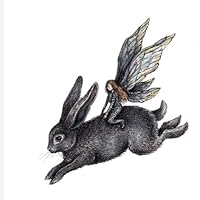
Mixed feelings on this one. Something of a chore to get through, especially for a short book. There's not much plot to speak of, Izzy doesn't come across as a girl of thirteen, rather one several years younger and the parents are awful. The chapters written from the point of view of the younger sister are painful to read and I didn't see the point of them. Although the Green Man doesn't make an appearance until halfway through, it is at least an imaginative portrayal and provides a little enchantment in an otherwise somewhat dreary read. Having said that, some passages are beautifully written and evocative, it just wasn't consistent. There's definitely a talented writer here somewhere who needs more time.
Oh, and the cover art is gorgeous.
Oh, and the cover art is gorgeous.

August 28, 2024
3🌟
I enjoyed the folk-lore-y folk horror vibe, but this short book took way too long to get through. I appreciated the coming of age storyline, but, truthfully, not a lot happens until the last few pages when the slow build-up reaches its conclusion. It's OK, but it would have been a better (shorter) short story, imo.
I enjoyed the folk-lore-y folk horror vibe, but this short book took way too long to get through. I appreciated the coming of age storyline, but, truthfully, not a lot happens until the last few pages when the slow build-up reaches its conclusion. It's OK, but it would have been a better (shorter) short story, imo.

November 1, 2022
I must be honest and say that my purchase of The Green Man of Eshwood Hall by Jacob Kerr was absolutely a case of judging a book by its cover (and perhaps also by its title) when I saw this slim hardback and its beautiful green and black dust jacket while browsing in an independent bookshop last autumn. I hadn't heard of the book or of the author, but the back cover flap tells me that this is the first in a series of folk horror novels Jacob Kerr is writing, set in an imagined version of Northumberland.
Set in 1962, the story begins with the Whipper family arriving at Eshwood Hall, a crumbling 18th century manor house at which Ray Whipper has taken a live-in job as a driver and handyman for its elderly, largely bedbound owner. He's accompanied by his wife Gerry, his daughters Izzy and Annie, and his baby son Raymond, known as the Bairn.
We're told by the omniscient narrator that this is to be the story of Izzy, aged 13, and Gerry, as well as the mysterious and nameless Green Man of the title. It's fair to say, though, that Izzy is certainly our main protagonist, and it's with Izzy that our sympathies lie, because it soon becomes clear that her parents are negligent at best (Ray) and abusive at worst (Gerry). She's forbidden to go to school and effectively treated as a servant, with the excuse being that Gerry has a weak heart and can't do much physically, although it seems pretty obvious that Gerry is a manipulative, self-absorbed hypochondriac. The Bairn, as a baby and her only son, is the only child she's really interested in, although she still expects Izzy to provide much of his care and her main interest is her collection of china figurines. Ray is more affable, but it seems he's as wary of Gerry as the rest of the family, and at no point sees fit to address his wife's cruel, coercive parenting, preferring to focus on his quixotic pastime of trying to patent his bizarre, pointless inventions.
Small wonder, then, that Izzy's perception of the world, and her sense of her place in it, is out of kilter - and small wonder too that bringing this lonely adolescent to an isolated, decaying house, where past tragedies pervade every brick and beam, and strange noises occur in the night, is the start of a dangerous downward spiral. The more time Izzy spends wandering in the overgrown woods that form the hall's grounds, the more she becomes drawn into the ancient history and folklore that has shaped the place, and the more it draws her in.
The Green Man, in English folklore, is a symbol of rebirth, a figure who appears in the spring to bring new life and fertility as new leaves appear on bare branches, and the green shoots of plants emerge from the dormancy of winter. Izzy, at the start of her adolescence and miserably trapped in a stagnant family from which nothing positive ever seems to emerge, is understandably susceptible to everything the Green Man signifies and offers. But of course, for rebirth to occur, something has to die first.
The Green Man of Eshwood Hall is extremely well-written, and gives Izzy a convincing and vivid voice. It leaves a lot unsaid, which allows for an ambiguity of interpretation, and this adds to the unsettling, uncertain atmosphere that pervades the story. It is a creepy piece of folk horror, but first and foremost it's a family tragedy with a deeply vulnerable protagonist and a powerful sense of history and place.
Set in 1962, the story begins with the Whipper family arriving at Eshwood Hall, a crumbling 18th century manor house at which Ray Whipper has taken a live-in job as a driver and handyman for its elderly, largely bedbound owner. He's accompanied by his wife Gerry, his daughters Izzy and Annie, and his baby son Raymond, known as the Bairn.
We're told by the omniscient narrator that this is to be the story of Izzy, aged 13, and Gerry, as well as the mysterious and nameless Green Man of the title. It's fair to say, though, that Izzy is certainly our main protagonist, and it's with Izzy that our sympathies lie, because it soon becomes clear that her parents are negligent at best (Ray) and abusive at worst (Gerry). She's forbidden to go to school and effectively treated as a servant, with the excuse being that Gerry has a weak heart and can't do much physically, although it seems pretty obvious that Gerry is a manipulative, self-absorbed hypochondriac. The Bairn, as a baby and her only son, is the only child she's really interested in, although she still expects Izzy to provide much of his care and her main interest is her collection of china figurines. Ray is more affable, but it seems he's as wary of Gerry as the rest of the family, and at no point sees fit to address his wife's cruel, coercive parenting, preferring to focus on his quixotic pastime of trying to patent his bizarre, pointless inventions.
Small wonder, then, that Izzy's perception of the world, and her sense of her place in it, is out of kilter - and small wonder too that bringing this lonely adolescent to an isolated, decaying house, where past tragedies pervade every brick and beam, and strange noises occur in the night, is the start of a dangerous downward spiral. The more time Izzy spends wandering in the overgrown woods that form the hall's grounds, the more she becomes drawn into the ancient history and folklore that has shaped the place, and the more it draws her in.
The Green Man, in English folklore, is a symbol of rebirth, a figure who appears in the spring to bring new life and fertility as new leaves appear on bare branches, and the green shoots of plants emerge from the dormancy of winter. Izzy, at the start of her adolescence and miserably trapped in a stagnant family from which nothing positive ever seems to emerge, is understandably susceptible to everything the Green Man signifies and offers. But of course, for rebirth to occur, something has to die first.
The Green Man of Eshwood Hall is extremely well-written, and gives Izzy a convincing and vivid voice. It leaves a lot unsaid, which allows for an ambiguity of interpretation, and this adds to the unsettling, uncertain atmosphere that pervades the story. It is a creepy piece of folk horror, but first and foremost it's a family tragedy with a deeply vulnerable protagonist and a powerful sense of history and place.

April 9, 2023
The Green Man of Eshwood Hall is folk horror and it’s awful and beautiful. Poor neglected Izzy is 13 and it’s the 60s and she lives in a rundown manor house next to ancient woods. Her mum is moody, handsome and mean with her inner weather that controls the outcome of the day. This short novel was somehow mundane and otherworldly at the same time, somehow tender and bitter too. I read it quickly and came away feeling impressed but clammy and sad.

January 12, 2023
It would be easy to fall into thinking that this was a children's book when the main protagonist is a child; Izzy aged 13, but this would be wrong. On the surface it it is the story of Izzy and her family who move to Eshwood Hall in 1960 for her father to work as a chauffeur and odd job man to the elderly widow who lives here. The blurb says that Izzy is neglected by her parents, I think this is the case with her father but her mother's treatment of Izzy would today be considered abusive both physically and emotionally. Without doubt Izzy's mother is a self-centered narcissist who uses Izzy as the scapegoat for anything she doesn't want to deal with even denying her access to education because she needs Izzy to cook and clean for the family, including a new baby brother who is just a few months old. Living in relative isolation at Eshwood Hall Izzy begins exploring the woods around the property and finds a deserted chapel in which she experiences an otherworldly connection with nature personified in the Green Man. There's very much a cross over into the genre of folk tales but growing up as I did with a narcissistic parent where I spent much of my time in the local countryside because it was a calmer place than home, I related deeply with this tale of Izzy finding solace in the woods, and the use of a chapel as the place of connection highlighted it's spiritual nature.
The connection with nature is present constantly though-out but it's important to note that while we can be sure of constancy in the turning of the wheel of the year, nature can be cruel and wild, elements reflected in the Izzy's actions and Izzy's mother's experience of the Green Man. It makes the reader think of how every act is connected in some way through cause and effect. Could Izzy's actions toward her brother be seen as a response to the treatment she has herself experienced, for example?
As I read the novel it brought back to mind so many happy days I spent at all times of the year outdoors while also having an awareness of plants that were poisonous and I must not eat, so safe in nature and in a dangerous place at the same time. While I didn't see the Green Man personified as Izzy and her mother clearly experienced him, what this tale highlighted for me is just how powerful experiencing nature is on a spiritual level and can remain into adulthood. The Green Man is ever present within everyone who has had that connection in their lives and he remains to be seen in the constant changing of the seasons.
The connection with nature is present constantly though-out but it's important to note that while we can be sure of constancy in the turning of the wheel of the year, nature can be cruel and wild, elements reflected in the Izzy's actions and Izzy's mother's experience of the Green Man. It makes the reader think of how every act is connected in some way through cause and effect. Could Izzy's actions toward her brother be seen as a response to the treatment she has herself experienced, for example?
As I read the novel it brought back to mind so many happy days I spent at all times of the year outdoors while also having an awareness of plants that were poisonous and I must not eat, so safe in nature and in a dangerous place at the same time. While I didn't see the Green Man personified as Izzy and her mother clearly experienced him, what this tale highlighted for me is just how powerful experiencing nature is on a spiritual level and can remain into adulthood. The Green Man is ever present within everyone who has had that connection in their lives and he remains to be seen in the constant changing of the seasons.

February 12, 2023
Genuinely dark. I would compare this to "El laberinto del fauno", but on a smaller scale, where you're never quite sure what is real and what is trauma. A really good, short read in my opinion.

January 21, 2023
This book was something of a slow burn for me. A sense of uneasiness pervades the whole of the novel, with the nomadic lifestyle of the family suggesting that something is not quite right, and that unsettling eerie atmosphere carries over in the depiction of the woods.
The book feels very Northern, both in the language used and the setting - a mythical Northumberland. I have noted that there are a lot of reviews which are critical of the pace of the book - and it does feel that it meanders in a meaningless way at times, yet it is this pace which allows the tension of the plot to build as bargains are made and entered into and the reader begins to understand that childlike innocence will never be an excuse for the breaking of an agreement.
The complicated mother/daughter relationship at the centre of the book, and the constant feeling that something is not quite right - often left unsaid, is actually where the strength of the book lies.
I am not going to spoil the ending, but it certainly packs something of a punch.
If you are prepared to take your time - to recognise that not all pleasure comes immediately, but needs to be built up and layered into the suspension until the moment of the final revelation, this is a book you will enjoy.
Creepy, haunting, lyrical and disturbing. Those are the words that come to my mind as I contemplate the end of the story.
The book feels very Northern, both in the language used and the setting - a mythical Northumberland. I have noted that there are a lot of reviews which are critical of the pace of the book - and it does feel that it meanders in a meaningless way at times, yet it is this pace which allows the tension of the plot to build as bargains are made and entered into and the reader begins to understand that childlike innocence will never be an excuse for the breaking of an agreement.
The complicated mother/daughter relationship at the centre of the book, and the constant feeling that something is not quite right - often left unsaid, is actually where the strength of the book lies.
I am not going to spoil the ending, but it certainly packs something of a punch.
If you are prepared to take your time - to recognise that not all pleasure comes immediately, but needs to be built up and layered into the suspension until the moment of the final revelation, this is a book you will enjoy.
Creepy, haunting, lyrical and disturbing. Those are the words that come to my mind as I contemplate the end of the story.

October 19, 2022
When I read the blurb I thought about Pan's Labyrinth and I think there're some elements in common: the child, the isolation, the unknown and the wild.
It's a short story, more a novella than a novel, and you're immediately immersed in a eery atmosphere full of strange stories.
Izzy is just thirteen but the illness of her mother makes her the one who is in charge of cooking and cleaning. Her parents are lost in their life and do not seem to care: the mother with the young boy, the father an inventor.
Izzy is free to roam and she will be the one that triggers the changes.
A coming of age story mixed with folk horror. A story that surprised and i liked it.
Recommended.
Many thanks to the publisher and Netgalley for this ARC, all opinions are mine
It's a short story, more a novella than a novel, and you're immediately immersed in a eery atmosphere full of strange stories.
Izzy is just thirteen but the illness of her mother makes her the one who is in charge of cooking and cleaning. Her parents are lost in their life and do not seem to care: the mother with the young boy, the father an inventor.
Izzy is free to roam and she will be the one that triggers the changes.
A coming of age story mixed with folk horror. A story that surprised and i liked it.
Recommended.
Many thanks to the publisher and Netgalley for this ARC, all opinions are mine

November 13, 2022
I find The Green Man interesting, so was keen to learn more about this legendary being - albeit from a work of fiction!
Jacob Kerr does a wonderful job. I personally liked the slow build story of Izzy and her family. I felt the author waited the right amount of time to introduce the legend, and liked his interpretation of him, and how his influence over the story manifested.
This is the first in a series of folk-horror novels.
Looking forward to the next 😀
⭐️⭐️⭐️⭐️
Jacob Kerr does a wonderful job. I personally liked the slow build story of Izzy and her family. I felt the author waited the right amount of time to introduce the legend, and liked his interpretation of him, and how his influence over the story manifested.
This is the first in a series of folk-horror novels.
Looking forward to the next 😀
⭐️⭐️⭐️⭐️

March 9, 2023
This book was dope! 3 star reviews on Goodreads? Wtf were the rest of you reading?! This book was amazing!
I’ll admit the book you read isn’t the book that was promised from the blurb but damn was it good! Kind of had a Pans Labyrinthine vibe to it that I loved!
Arguably one of the best books I’ve read for a while!
5/5 Stars. Borrowed from my library but you can bet your ass I’m buying it!
I’ll admit the book you read isn’t the book that was promised from the blurb but damn was it good! Kind of had a Pans Labyrinthine vibe to it that I loved!
Arguably one of the best books I’ve read for a while!
5/5 Stars. Borrowed from my library but you can bet your ass I’m buying it!

October 17, 2023
Why are there any one-star reviews for this book. I absolutely loved this book! It's not as dark as I thought it would be, but honestly, it didn't disappoint! Jacob Kerr has definitely researched folklore, I would say, and his descriptions were beautiful. It had elements of Enid Blyton, and one of her books is referenced by one of the characters in the book. If I had started this earlier in the day, I would have read it in that day, though in all honesty, it's not a long book anyway. I can't wait to read the next in his series of books set in Northalbion, a mythical version of Northumberland. Beautiful!!!

July 21, 2022
This wants to be folk horror but it doesn't have the atmosphere or the interest (or the depth of folklore.) It mostly feels very flat. The narrative shifts perspectives a lot, which settles down and is fine in the latter half or so of the book but in the beginning is wildly patchy and inconsistent and makes the book a chore to read. The characters range from having almost no character to being a random mash up of stereotypes or character traits in service of what story there is. The plot drags on, veering into seemingly random tangents, most of which eventually turn out to have some importance to the story but give an impression of a book with zero narrative flow. The descriptive writing is clearly what is intended as the strength of this book, but it's odd - often excessively flowery while not saying anything new or in interesting ways, at other times sparse but seemingly random, in what is probably supposed to be slice-of-life but ends up somewhat muddled. The best part is the Green Man, and that's only really because I like Green Man tales and am very easily pleased with descriptions of him.
The book is largely unpleasant in terms of plot - it isn't a plot driven story by any means, but what there is is clearly of the brutal rural realism oeuvre, which is not my cup of tea unless there's a reason for it - which there is here, but I don't think it's done well enough for me to want to read through the various dull miseries. It's probably not my kind of book, which is a shame as I so enjoy folklore-based gothic-leaning stories, but this is a little too far from those and not well-written enough for me to really get into. It just felt like a bit of a struggle to read from beginning to end.
The book is largely unpleasant in terms of plot - it isn't a plot driven story by any means, but what there is is clearly of the brutal rural realism oeuvre, which is not my cup of tea unless there's a reason for it - which there is here, but I don't think it's done well enough for me to want to read through the various dull miseries. It's probably not my kind of book, which is a shame as I so enjoy folklore-based gothic-leaning stories, but this is a little too far from those and not well-written enough for me to really get into. It just felt like a bit of a struggle to read from beginning to end.

September 24, 2022
This one just didn’t grab me at all, which is a shame as fantasy / horror based on rural folklore is one of my favourite things. It’s tonally inconsistent, and the story wasn’t involving. Lovely cover though.

April 23, 2023
I liked the folk tale basis or this book and the fact the characters talk like me ( geordie) as the book is set in an alternative world northalbion. The blurb said the book is a horror but I didnt find it scary just a little unsettling.

December 30, 2022
Regrettably, an absolute snooze.
Came for The Wickerman and got a lesser episode of Jon Pertwee era Dr Who instead.
Came for The Wickerman and got a lesser episode of Jon Pertwee era Dr Who instead.
October 24, 2023
A boring slog of a story, that neither entertained nor scared!

January 22, 2024
This is a curious mix of light and dark, the cosy and the sinister, in a folkloric, occasionally with a gothic lean, tale of a decrepit country house in the 1960s to which a family arrives to work.
The protagonist Izzy, 13 years old, has been taken out of school to look after her sick mother, while her father works as handyman at the house. She cooks, and looks after her two younger siblings.
Like many disillusioned children in literature, she has an imaginary friend, a green man she meets in the woods, where she roams when her mood is low. As times passes she spends more and more time in the forest, appreciating the nature and the atmosphere, and her time with the green man.
For its main part this reads like a YA novel, a sort of Famous Five, but in its denouement it gets much darker. Kerr manages to give the book the feel that it was published at the time it was set.
It’s curious, as I said at the outset, as it invites many questions having finished it; could the green man be real for example, just a confused war veteran who, like Izzy, couldn’t settle in society.
There are also questions also, about a strange man’s hidden relationship with a pubescent girl, though maybe that’s my mind wandering. In that regard, it brings to mind, Graham Joyce’s excellent The Tooth Fairy, where a similarly aged teenager, a boy, is visited by an imaginary friend, not entirely for innocent reasons..
The protagonist Izzy, 13 years old, has been taken out of school to look after her sick mother, while her father works as handyman at the house. She cooks, and looks after her two younger siblings.
Like many disillusioned children in literature, she has an imaginary friend, a green man she meets in the woods, where she roams when her mood is low. As times passes she spends more and more time in the forest, appreciating the nature and the atmosphere, and her time with the green man.
For its main part this reads like a YA novel, a sort of Famous Five, but in its denouement it gets much darker. Kerr manages to give the book the feel that it was published at the time it was set.
It’s curious, as I said at the outset, as it invites many questions having finished it; could the green man be real for example, just a confused war veteran who, like Izzy, couldn’t settle in society.
There are also questions also, about a strange man’s hidden relationship with a pubescent girl, though maybe that’s my mind wandering. In that regard, it brings to mind, Graham Joyce’s excellent The Tooth Fairy, where a similarly aged teenager, a boy, is visited by an imaginary friend, not entirely for innocent reasons..

September 18, 2023
I think I rated this book low because I was so dissapointed in it, and Im not sure if that is the books fault or my expectations.
I went into this book hoping for a new dark, haunting woodland horror and in the end got what felt like a slice of life of a child that has to move around a lot with her family.
I found it pretty uneventful, the aspects that I think were meant to have suspence and give me chills, left me feeling not much. The characters were well developed for the length of the book. Im just not sure what the overall goal of the book was meant to be.
I went into this book hoping for a new dark, haunting woodland horror and in the end got what felt like a slice of life of a child that has to move around a lot with her family.
I found it pretty uneventful, the aspects that I think were meant to have suspence and give me chills, left me feeling not much. The characters were well developed for the length of the book. Im just not sure what the overall goal of the book was meant to be.

October 1, 2025
I quite liked this little book. I was at Hyde Bros looking for like a ghost book, and I saw this in the Newly Arrived Horror and Paranormal pile. It is, in fact, not a ghost book. It is probably paranormal. I'm not sure where the line is drawn between paranormal and fantasy. It also was not scary. So, if you're looking for a scary ghost book, this is not it.
If you're looking for a book that is a quick and light read but still keeps you constantly guessing what will happen next and an ending that is shocking and sad, then this is the one for you.
If you're looking for a book that is a quick and light read but still keeps you constantly guessing what will happen next and an ending that is shocking and sad, then this is the one for you.


September 1, 2024
This book has so much potential. The characters are interesting and the story should have been brilliant. I think the writing and the pacing is a bit off for me. It was a slow read that I couldn’t get into, sadly.
June 8, 2025
Really enjoyed this book! I wouldn't say it was terrifying whilst reading it, more that it's unsettling after you've read the whole story. Good book, well written with a good flow to it. Felt like the ending came around too quickly though and it built to a crescendo very suddenly. Saying that, it was really enjoyable and leaves you with a vaguely haunting feeling. Highly recommend a read for people who enjoy folklore.
Displaying 1 - 30 of 123 reviews