Jump to ratings and reviews
Rate this book

Interpretation of Dreams: Oneirocritica

Rate this book
From the Editor
Oneirocritical or the Interpretation of Dreams by Artemidorus Daldianus(An English translation of a 2nd-Century A.D. Greek classic.) Oneirocritica is the most comprehensive, the most sought-after and the most quoted book on dream interpretation to have been written from antiquity to present times. This is more than an elaborate dream dictionary. Artemidorus, a 2nd-Century professional dream-interpreter, tried to impart to his son, and thus to anyone reading this book today, the basic principles he followed, to reveal the dreamer's psyche and future. All human cultures have entertained the common belief that dream images, like words in a language foreign to us, have hidden meanings trying to convey the secrets of our personality or of our future. We are therefore fortunate to have Professor White's superb translation of this unique work on dream interpretation, coming to us from an early professional of this ancient art. Artemidorus writes: 'I have not relied upon conjectures here, nor have I constructed a system of probabilities. My writing is based on personal experience. I myself have observed, in each occasion, how these dreams have come true.'
Quote from Oneirocritica of Artemidorus Daldianus, Book I: '31. 'Tooth dreams are open to many different interpretations...upper teeth represent the more important and excellent members of the dreamer's household; the lower, those who are less important. For we must interpret the mouth as a house and the teeth as the inhabitants of a house....'39. The right side signifies the men; the left side, the women...Furthermore, the so-called incisor teeth or front teeth signify the young; the canine teeth, the middle-aged; the molars... old people. Therefore the type of person he is to lose is indicated by the type of tooth he loses. 'But since the teeth signify possessions as well as people, we must regard the grinders as representing treasures; the canine teeth, as objects of no great value; the incisors, as household objects. And so it is quite reasonable that some of the teeth, when they fall out, signify the loss of these possessions. '40. The teeth, moreover, also signify the functions of life...And so, when these teeth fall out, impediments to the functions that correspond to them will follow. Let us now indicate the distinctions. If a debtor dreams that any of his teeth fall out, regardless of their type, it signifies that he will pay off his debt.'
This first-time complete translation into English of the Oneirocritica, is enriched by Professor White's in-depth commentary on the text and on the vast Greek and Roman culture of Artemidorus' time. The extensively revised index pages of this second edition are designed to be of help to curious readers trying to make sense of their own dreams. Also, from a desire to be helpful, dream subjects or symbols, of which Artemidorus wrote, have been highlighted in boldface by the publisher.
— Michael Wurmbrand (origbks@wgn.net), editor of Original Books, Inc.

270 pages, Hardcover

First published January 1, 100

Loading...
Loading...

About the author

Artemidorus

11 books8 followers
Artemidorus was surnamed Ephesius, from Ephesus, on the west coast of Asia Minor, but was also called Daldianus, from his mother's native city, Daldis in Lycia. He lived in the 2nd century.

According to Artemidorus, the material for his work was gathered during lengthy travels through Greece, Italy and Asia, from diviners of high and low station. Another major source were the writings of Artemidorus' predecessors, sixteen of whom he cites by name. It is clear he built on a rich written tradition, now otherwise lost. Artemidorus' method is, at root, analogical. He writes that dream interpretation is "nothing other than the juxtaposition of similarities" (2.25). But like other types of Greek divination, including astrology, celestial divination and pallomancy, Greek dream divination (Oneiromancy) became exceedingly complex, a given dream subject to a number of interpretations depending on secondary considerations, such as the age, sex and status of the dreamer. At other times, subtle distinctions within the dream itself are significant. In a particularly memorable passage, Artemidorus expounds upon the meaning of dreams involving sex with one's mother:

"The case of one's mother is both complex and manifold and admits of many different interpretations—a thing not all dream interpreters have realized. The fact is that the mere act of intercourse by itself is not enough to show what is portended. Rather, the manner of the embraces and the various positions of the bodies indicate different outcomes." (Trans. Robert J. White)

There follows a lengthy and minute recitation of the divinatory significance of enjoying one's mother in various sexual positions.

The first three books of the Oneirocritica are dedicated to one Cassius Maximus and were intended to serve as a detailed introduction for both diviners and the general public. Books four and five were written for Artemidorus' son, also Artemidorus, to give him a leg-up on competitors, and Artemidorus cautions him about making copies.

According to the Suda (Alpha 4025), Artemidorus also penned a Oiônoscopica (Interpretation of Birds) and a Chiroscopica (Palmistry), but neither has survived, and the authorship is discounted. In the Oneirocritica Artemidorus displays a hostile attitude to palmistry.

Among the authors Artemidorus cites are Antiphon (possibly the same as Antiphon the Sophist), Aristander of Telmessus, Demetrius of Phalerum, Alexander of Myndus in Caria, and Artemon of Miletus. The fragments of these authors, from Artemidorus and other sources, were collected by Del Corno in his Graecorum de re onirocritica scriptorum reliquiae (1969).

Ratings & Reviews

What do you think?
Rate this book

Friends & Following

Create a free account to discover what your friends think of this book!

Community Reviews

5 stars
34 (33%)
4 stars
23 (22%)
3 stars
35 (33%)
2 stars
9 (8%)
1 star
2 (1%)
Displaying 1 - 16 of 16 reviews
Profile Image for Yann.
1,413 reviews400 followers
November 3, 2015
Les Hellènes qui désiraient obtenir un songe favorable plaçaient au dessus de leur tête une branche de laurier: ils employaient aussi des amulettes et prononçaient certaines éjaculations aux formules consacrées. S'étant de la sorte préparés à l'oracle oniromantique, ils posaient au dieu et dans son temple une question précise. Ils appelaient l'ensemble de ces dispositions préalables "l'incubation".


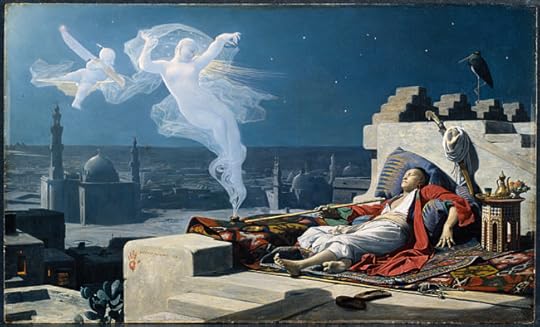
Rêve d'Eunuque, Jean Lecomte de Nouy (1874)

Voilà des mois et des années que je voulais mettre la main sur l’Onirocritique (l’interprétation des rêves) écrite par Artémidore d’Ephèse (ou Daldis, village de sa mère). Malheureusement, aucune édition critique sérieuse n’étant disponible, j’ai du me rabattre sur une occasion vendue à prix d’or par un aigrefin, une édition en ruine dans une collection érotique interlope des années 50, traduit et introduit par une dandy pétri de préjugés, cynique par orgueil, désabusé par érudition et superstitieux par artistocratisme, doté d’une faconde torrentielle et surtout méchant traître, pour avoir osé modifier le texte original en le purgeant de toutes les références aux divinités antiques. Au moins, il avoue sa faute. C’est que le traducteur croit dur comme fer à l’oniromancie, au rebours de ces naïfs de sceptiques grossiers et bourgeois dont le tout-venant est infesté. N’ayant pas les moyens de faire la fine bouche, j’ai du malheureusement me contenter de ce texte, qui m’a néanmoins fait la bonne surprise d’être accompagné des songes de Valère Maxime.

Le texte lui-même est composé de cinq livres, que l’auteur destinait à son fils afin de l’installer dans la carrière d’interpréteur de rêves professionnel. Ils exposent par courts paragraphes thématiques un ensemble de suites possibles pouvant être associées au rêve d’une chose particulière. Artémidore a une prétention scientifique : il se démarque explicitement des charlatans qui font trafic d’interprétations mensongères et non fondées sur un savoir. Il a récolté un ensemble de témoignages, et complète ses connaissances par des conjectures fondées par induction, quitte à les modifier au fur et à mesure. Quand on voit ça, on peut se demander ce que sont les choses que l’on désigne par les noms de « cause » ou « loi de la nature ». Ses interprétations sont souvent accompagnées de l’exemple de tel ou tel individu auquel il est arrivé ceci ou cela après avoir fait un rêve correspondant au thème en question.

Le seul contenu du rêve n’influe par sur son interprétation. Pour Artémidore, c’est une grande importance de connaître la situation sociale du rêveur pour lui donner une interprétation correcte. Il y a une sorte d’harmonie qui doit s’établir entre le contenu du rêve et la condition, dont la rupture est invariablement un mauvais signe. Il y a aussi quelques idées associées de manière binaire et systématiques. Dans l’ensemble, il s’en faut de beaucoup que l’ensemble offre l’aspect d’un système bien serré ; c’est plutôt un salmigondis de principes qui partent dans toutes les directions, de règles contradictoires non hiérarchisées, un chaos d’idées disparates successibles de changer à chaque nouveau fait.

L’interprétation des rêves tient une grande place dans la culture antique : cela se voit particulièrement chez les historiens romains de la période impériale, mais aussi dans les écrits néo et vétéro-testamentaires. Joseph gagne un crédit considérable en interprétant correctement les rêves du Pharaon. La croyance en l’onirocritique était si établie qu’on allait jusqu’à se couvrir d’amulettes (phylactères), suspendre du laurier sur le lit, et prononcer des formules pour rêver de telle ou telle chose, et ainsi influer sur l’avenir : ils appelaient cela « l’incubation », puisqu’il s’agissait d’attirer un « démon ». L’Église a ainsi eu une position ambiguë sur ce sujet, résolue par la distinction des rêves inspirés par la divinité et des autres (révélation vient de rêver). Une distinction bien claire et fort aisée à établir.
Profile Image for Isaac Clemente ríos.
265 reviews25 followers
June 24, 2020
"Un hombre soñó que era el río Janto que discurre por la Tróade. Durante diez años sufrió hemorragias, mas no llegó a morirse, lo cual era lógico, ya que el río es inmortal."

Artemidoro de Éfeso nos da las más estrambóticas explicaciones para los sueños que atormentaban a los habitantes del mediterráneo a mediados del s. II.

Muy interesante como pieza de arqueología para entender aquel mundo antiguo. Estrafalario se queda corto para describir lo que hay ahí escrito.
Profile Image for Adam Fitzwalter.
113 reviews3 followers
August 31, 2026
This is my first time reviewing an ancient text itself on this site. I’m not a classicist, and my approach may be a bit different, but I’m excited to share. Artemidorus is just so much fun — he tells us what the Romans dreamt about! Yet I find it difficult to ‘rate’ a text from nearly two millennia ago, let alone one as unique as the Oneirocritica. Hence a rather neutral ‘three star’ rating. This review will simply reflect what I have learned and allow me to share some thoughts with those interested. Namely, I have read Martin Hammond’s 2020 English translation alongside Peter Thonemann’s companion book.

Artemidorus and The Oneirocritica
——————

Artemidorus was a professional dream-interpreter from the Greek-speaking Roman city of Ephesus, in modern day Türkiye. His Oneirocritica, composed around 200 CE, is a treatise and manual on dreams and dream-interpretation. Its five volumes compile dreams told to Artemidorus by a variety of people met on his wide travels across Asia Minor, Greece, and Italy. It is our only systematic source on Roman dream-divination, although Artemidorus does cite several predecessors and besmirch some contemporary rivals, evidencing a rich tradition of ancient dream-writing now lost.

Aside from select biographic details mentioned in the Oneirocritica, such as his mother being from nearby Daldis, we know very little about Artemidorus. The mere fact that his book survives should not delude us into thinking he was a major Roman author. Nonetheless, he provides the modern reader with a vast, carefully-ordered, thematic encyclopedia of ancient dreams and their supposed meanings, offering a truly extraordinary perspective of the second century CE Graeco-Roman world.

Book One explores ‘internal’ dreams about the human body and physical activities, while Book Two investigates the ‘external’ world of nature, society, and the gods. Book Three then amounts to an unstructured florilegium of topics not detailed previously. These initial books were seemingly intended for other professional diviners to act as a comprehensive dream-interpretation manual, while Books Four and Five were written sometime later by Artemidorus for his son, also called Artemidorus, who aspired to follow in his father’s footsteps by becoming a professional dream-decipherer himself.

Dream Theory
——————

Artemidorus explores a great medley of dreams ranging from the mundane to the absurd — from dreaming that you lost your house keys, that your teeth have fallen out, or that an eagle flew overhead… to dreaming that you transformed into a fish, that you had sex with your mother, or that you flayed your children to use their carcasses as wineskins… Artemidorus works systematically and scientifically. For instance, when evaluating dreams about bodily anatomy, he moves from head to toe. More conceptually, he separates unconscious ‘mental residue’ dreams (Enypnion) from prophetic dreams (Oneiros) that, he alleges, foretell future events. It is this latter, predictive dream-type that the Oneirocritica is interested in.

Artemidorus’ approach to dreaming is noticeably different to the psychoanalytical methods popularised by Sigmund Freud (who references Artemidorus frequently), despite Freud and Artemidorus sharing a fondness for linguistics and wordplay. For Artemidorus, dreams are useful not for understanding one’s unconscious psychology, but rather for decoding an allusion or analogy that reveals something about one’s future. For example, according to Artemidorus, if a wealthy woman dreams that she gives birth to a snake, she will have a son who will go on to become a great orator, because both snakes and orators have ‘forked tongues’.

Crucially for Artemidorus, the correct interpretation of an oneirocratic dream depends entirely upon the social status of the dreamer. He is not interested in his client’s personality or life-history. Essentially, he treats his patrons as if they occupy an objective position within a web of social relationships, not as individuals with quirks and quiddities. Accordingly, it is through the social circumstances and status of the dreamer that the professional dream-interpreter may divine the dream’s metaphorical symbols and therefore its latent predictive qualities.

Namely, Artemidorus is interested in whether the events of the dream are natural or supernatural, whether the dream conforms to local social and cultural norms, whether the dream relates to the dreamer’s lifestyle or occupation, whether the dream involves some etymological or linguistic association, or whether the dream relates to the current season or stage of the dreamer’s life. For instance, he offers seven different interpretations of the snake-birth dream depending on the social position of the hypothetical dreamer (if the mother was ill when pregnant, a snake-birth dream means that the child will be born lame, because snakes have no legs; or, if the mother was a slave, a snake-birth dream means that the child will try to run away, because snakes are slippery). To give another example, if a slave dreams of flying, this signifies an upcoming transfer to a more prominent household (interestingly, it does not signify freedom from slavery, telling us something about social hierarchy from Artemidorus’ relatively elite perspective). But if a criminal dreams of flying, this signifies that they will be crucified (i.e they will be raised-up high).

Perhaps more telling, when analysing sex-dreams, for Artemidorus the gender of two parties involved in the sex-act is not in itself a significant determinant of a dream’s meaning. Instead, whether a sex-dream is auspicious or malign depends entirely on the relative social statuses of the penetrator and the penetrated (for Artemidorus, sex always means phallic penetration of a bodily orifice). For example, “for a man it is auspicious to be penetrated by someone richer and older, as it is usual to receive benefits from such people; but penetration by someone younger is malign, as it is usual to confer benefits on such people.” Here, Artemidorus is entirely disinterested that one of his clients has dreamt of what the modern reader would recognise as a homosexual, male-on-male, penetrative sex-act. He is instead far more interested in determining whether the metaphor of penetration within the sex-dream either confirms or subverts the social order — if it confirms social expectations, this is propitious for the dreamer’s future; if it subverts social expectations, this is ominous.

Using Artemidorus
——————

The Oneirocritica is a vital source for understanding class dynamics and status-assumptions within the Greek-speaking Roman provinces of Asia Minor in the late second century CE. It is particularly important for allowing an insight into the mentalities of both slave-owners and slaves during the high Roman imperial period — some dreams even vividly invoke the violent hatred that some slaves felt for their masters. Athletes and actors are among the most visible of all social groups, both as clients and dream-subjects, evidencing the popularity of games and festivals during this period. Roman cultural institutions also stand out, like public bathing and gladiatorial shows.

Yet it is notable how high politics, the empire, and the emperor occupy curiously marginal positions in the thinking of Artemidorus and his clients, even if the threat of the Roman penal system remains depressingly prominent. He also casually assumes that there are ‘Romans’ (Rhōmaioi) and that there are ‘Greeks’ (Hellēnes), and that the two are different. I suspect that the assumptions embedded here may not be what the Roman historian might expect to conclude if they were to analyse the official public documents or grand monuments of this period in isolation. Artemidorus therefore offers a usefully unusual perspective on the cultural politics of Graeco-Roman Asia. He implies a hard line imagined between distinct cultures, a tendency to think of the governmental administrative system as a hazy blur, a prevailing fear of punishment for wrongdoing, and a priority on the celebrity culture of sportspeople and actors — while very different in the specific details, do these bigger thoughts not seem basically similar to those that continue to hover over many of our modern day-to-day thoughts?

Although it is very difficult to say whether the Oneirocritica ever found a significant readership outside of a narrow circle of professional dream-interpreters, one of its most striking features is the ubiquity of dreamers of modest or low social status, and how it reflects their beliefs, conventions, and anxieties. Despite representing a relatively elite class of citizen himself, Artemidorus is primarily interested in the meaning of dreams experienced by those ranked lower in the social hierarchy than he, including slaves, debtors, craftsmen, actors, and shop-keepers. The demography of the Oneirocritica thus rather beautifully reflects the ordinary social fabric of the marketplaces and festivals of the Graeco-Roman East — Artemidorus professionally cares for the hopes, fears, and, of course, dreams of everyday people.

One nice example is how frequently mice appear in the dreams of Artemidorus’ clients. When one imagines the Roman Empire, I’m not sure that mice immediately come to mind… but, if thinking about it, mice must have been everywhere! To the ordinary ancient person tending to their daily domestic chores, mice were evidently an everyday pest, and hence appeared in dreams. While Artemidorus was more interested in what Roman dream-mice may or may not symbolise, he nonetheless helps us recognise the very basic fact that the ancients had a rodent-problem — reminding us of the vulnerability of Roman household food supplies, insula life, and standards of urban sanitation, all through the excitingly interpretative world of dreaming.

However, because Artemidorus endeavoured to categorise dreams and dream-interpretations so thoroughly, his hyper-systematised methodology may actually be moving the modern reader slightly further away from the real concerns of ordinary ancient people. The Oneirocritica is not a piece of anthropological research. Rather, it is a scientific manual designed as a logical, empirical, and utilitarian ethnographic database of dreams. It’s extremely nerdy… Not only is Artemidorus’ prose plain and his methods coldly formulaic, his whole system of interpretation assumes that the dream-interpreter can place a client with absolute certainty on a spectrum of overlapping statuses, and that this placement will be the primary determinant of the meaning of one’s predictive dreams. Yet there are many glaring omissions. Most noticeably, women are rarely mentioned, both as the subjects of dreams and as a hypothetical category of dreamers. Moreover, any dream could realistically have been interpreted to symbolise any potential outcome, especially if the dream-interpreter makes a point of consulting an ostensibly objective dream-manual. The Oneirocritica therefore tells us much more about Artemidorus’ own assumptions and prejudices than those of anyone else.

Resultantly, although small snippets of everyday ancient life certainly shine through — like children playing with knucklebones in the street —, Artemidorus’ obsession with careful organisation and rigid objectivisation forces us to assume that he was often taking great liberties to fit the details of his clients’ dreams into his tediously strict methodological framework. Indeed, he explicitly advises his son to deceive and exaggerate in order to succeed as a professional dream-diviner. While he was certainly no quack, it is nonetheless telling that at no point does Artemidorus mention any of his predictions actually proving true… So, the next time you have a dream, see what Artemidorus has to say, but don’t hold out hope that he will be at all helpful…

Receiving Artemidorus
——————

What I found most interesting is the perhaps taken-for-granted fact that the Oneirocritica has remarkably survived. It’s especially interesting how Byzantine copies were so energetically taken up by the Abbasid Translation Movement, translating Artemidorus into Arabic and reinterpreting his comments pertaining to mythology, sexuality, and other contemporary practices to reflect the receiving Islamic culture of ninth century CE Baghdad.

Yet despite enjoying lively periods of study and debate in the past, today the Oneirocritica is a very marginal ancient text indeed. Artemidorus almost never finds himself included on any modern Classics or Ancient History university syllabus. Nonetheless, there are some fascinating reception histories which underlie our contemporary readings of the Oneirocritica, and which I think are deserving of more attention. I felt my companion commentary rather let me down in this regard, as appreciating the Oneirocritica’s Byzantine and Islamic transcriptions, its Renaissance print boom, and its Freudian ‘hijacking’ are important for understanding why Artemidorus has been moved to the fringes, and how this might be redressed.

As mentioned, Freud cited The Oneirocritica in his The Interpretation of Dreams (1899) as an ancient precursor to his own theories. Michel Foucault also mentions Artemidorus for an insight into ancient identity and notions of selfhood. Quite rightly, we may suppose that these thinkers were attempting to legitimise their own theories by citing a classical forerunner. But Artemidorus’ dream-readings were also a popular subject in Georgian England, largely rejected by the rationalist intellectual elite but nonetheless enjoying commercial success within popular street literature. Likewise, academic debates among nineteenth century classicists contested whether the Oneirocritica was the ancient-equivalent of a technical scientific treatise on dreaming, or merely an overly commercialised fortune-telling dream-book. Freud, especially, was a little closer to these kind of discussions about Artemidorus’ usefulness than we are. The absence of the Oneirocritica on the modern curriculum therefore speaks somewhat to the inconclusiveness of these debates — historically, we simply haven’t known what to do with a text as unusual (or, as weird) as the Oneirocritica.

In my opinion, it is certainly worth recognising Artemidorus, his later receptions, and ancient ‘dreamwork’ more broadly, all as serious intellectual topics, even if traditional disciplinary structures are reluctant to do so. Not only might studying the Oneirocritica help students understand and adapt our processes, biases, and selection criteria in determining what qualifies as a ‘valid’ ancient text deserving of scholarly scrutiny, it may moreover help redraw the boundaries between elite literature and popular superstition in the how the modern ‘classical canon’ is imagined and constructed. If Classics, as a discipline, wants to become more inclusive, why not include the dreams of the ordinary ancient public, as Artemidorus prioritises? It may just allow the modern, everyday student to ‘dream-up’ some exciting new ways for reapproaching and reconceptualising the ancient past.
234 reviews183 followers
December 24, 2022
It will be an advantage, and not only an advantage but a necessity both for the dreamer and for the consultant, to have the dream-interpreter briefed as to the identity of the dreamer, his occupation, his birth, his financial situation, his state of health, and his age. And the nature of the dream itself must be examined in precise detail—any small addition or omission can skew the predicted outcome, as we go on to demonstrate. So anyone failing to adhere to these conditions can only blame himself, rather than us, if things go wrong. 1.9

You should only offer interpretations of dreams which are remembered in their entirety, when the dreamer has a precise recollection and can remember all details precisely. 4.3.2

If you do not know the local customs and peculiarities of any given place, you should find them out. Travel and wide reading will give you the best handle on this: books on dream-interpretation alone will not be of enough help to you, but you will need other material too. Two examples. A married woman dreamt that she entered the temple and house of Ephesian Artemis and dined there, and not long afterwards she died: death is the penalty for any married woman entering that temple. A prostitute dreamt that she had entered the temple-precinct of Artemis: she was set free and abandoned her prostitution, because she could not have entered the precinct if she had not abandoned her life a as prostitute. And so with all other customs which are local to any given city or region, you must have regard to the local culture in your interpretations. 4.3.4

You should always try to assign a cause and accompany any interpretation with a stated reason and some credible explanations: otherwise, even if you are quite accurate in your interpretation, giving a bare declaration of the outcome stripped of all its surrounding material will make you seem less professional. But you must not let yourself be misled into thinking the the causes you assign do actually determine the outcomes. Some people have frequent dreams with the same outcome, and we know that there is some logical pattern to these outcomes from the fact that they always turn out the same, but we cannot find the causes why that outcome is as it is. That is why it is our opinion that outcomes are arrived at on the basis of practical experience, but explanations of their causes are simply the best that each of us can come up with from his own resources. 4.20.1
__________
But you must remember that this book is addressed to you, for our own use, and you must not make copies for general distribution. If what I am going to write in this book stays with you alone, it will make you pre-eminent among all dream-interpreters, or at least second to none: but if it is made public property, it will leave you exposed as having no grate knowledge than anyone else. I can assure you that many, in fact almost all, of the other works which aim to be a guide to successful prophesy are inferior to my own. 4.pref.4

And I hope that those who come cross my books will read them in a fully sympathetic frame of mind, and not make any criticism before they have gained a precise understanding of their contents. One thing I am prepared to swear to is that these books will never give the careful reader any cause to reject their arguments. 3.66.6

__________
To dream of having ears where your eyes are signifies that you will become deaf and do your hearing through sight. And to dream of having eyes on your ears signifies that you will go blind and do your seeing by means of hearing. 1.24.4

To dream of having birds of meat or pickles or anything else stuck in the teeth prevents one from giving voice to some important concerns, and foretells unemployment. But if someone dreams of removing such things from his teeth, he will regain employment and talk his way to some success. 1.31.8

And it relates to rational discourse and education, as, like reason itself, there is nothing more creative than the penis. When I was in Cyllene I saw there a statue of Hermes which was simply a phallus sculpted in quite a realistic way. 1.45.1

All tools which cut and sever signify discord, divisions, and damage. Tools which fuse or join foretell benefits, marriages, or partnerships, but prevent travel abroad. Surface-smoothing tools put and end to enmities. And tool used for levelling or showing the straight line bring secrets to light. That is why we have come to think that dreams of land-measuring and surveyors are also relevant in this respect. 1.52.3

We must also consider the question of drinking vessels. Cups of gold, silver, and earthenware are auspicious for all and sure indicators of profound security, the first two because they are made of solid material, and the third because it is a familiar part of our lives at home. Cups made of horn are also auspicious because they are old and un breakable, but glass cups are malign because of their material—sometimes they are predictive of dangers because they are easily shattered, and they can bring secrets to light because of their transparency. There is another line of interpretation which correctly holds that drinking vessels symbolise those who greet us on the lips. 1.66.3

Pickled fish and all salted meats signify delays and postponements in one’s immediate business, a salting preserves things for a long time. In other contexts they signify wasting away in tears of grief, and often actual illness, because the flesh is withered by the salt. 1.71

But for anyone who is ill, either man or woman, a dream of dancing is malign: all that movement of the body indicates madness and derangement. 1.76.2

I know of someone who dreamt that he entered a brothel and could not leave. He died just a few days later, and this outcome made sense of his dream. Brothels are called ‘communal facilities’, and so are cemeteries. Much human seed goes to waste there, so those places can reasonably be equated with death. 1.78.3

And then again I know of someone who dreamt that he was being masturbated by his master: he was tied to a post and soundly whipped—that was how his master had him erect. 1.78.7

All species have their one habitual method of copulation, and they do not deviate from it, because they are following the dictates of nature . . . some do it gradually, like the ostrich, some, like all birds, get on top of the females and use their weight to force them down to the mating position; and some, like fish, have no contact at all, but the females gather up the sperm which the males have extruded. So it is reasonable to suppose that men also have a. Specific position, which is face to face, and that they have invented the others when giving rein to abuse and lust. 1.79.6

A dream of fellating oneself is advantageous for a poor man, a slave, and a debtor—they will relieve the pressure that burdens them. But it is bad for anyone who has children or wants to have children: in the first case the children which he has will die, and in the second the children he wants will not be forthcoming. This is because the penis symbolises children, and the mouth symbolises a tomb—the dream also deprives a man of his wife or lover, as a man who is capable of providing his own sexual gratification has no need of a wife. For the rest ir prophesies either crushing poverty or disease, so they will either have to resort to their ‘taskmasters’ for their livelihood—that is, to sell what they would never have wanted to sell—or else find their body so emaciated by disease that they are thin enough to reach their penis with their mouth. 1.80.1

But a dream of kissing people who are red is ominous for anyone sick—it prophesies his own death. For the healthy such a dream is a message telling them not to discuss any important business for the time being, because they have put their lips to a dead mouth. But to imagine kissing those now dead who in life were one’s closest and dearest friends is no bar to any sort of tap or any other activity. 2.1.2

Apart from that, a dream of wearing black clothes is malign for all except those engaged in some shady business. 2.3.3

Wearing multicoloured clothes or a robe of the finest sea-purple is favourable only for priests, pantomime performers, actors, and the ‘artists of Dionysus’. 2.3.4

To dream of washing one’s own or other people’s clothes signifies the removal of some inconvenience clogging one’s life, because the clothes are also shedding their dirt. It also signifies the exposure of secrets and public knowledge of them. The old authors used ‘cleaning’ as a slang term for ‘exposing’, as Menander has it in one of his plays:
If you foul-mouth my wife like this, I’ll nail your dad
And take him to the cleaners—you and yours as well,
Which stands for ‘I’l repose him’. That is why it is malign for those fearful of exposure to dream of clothes being washed. 2.4

Pigeons and doves signify women: pigeons signify complete whores, but doves can sometimes signify decent women who are mistress of their house. 2.20.7

. . . but a pickaxe and a hoe signify women and women’s work—women’s work because their function is to bring things in for the benefit of the man who has them in his hands, and women because of the gender of the words for them. 2.24.2

I know of someone who dreamt that a familiar companion of his, a rich man and a good friend, shat over his head: this man inherited his friend’s property, having been named his heir. Then again someone else dreamt that he was shat on by one of his acquaintances who was poor, but he suffered great damage from this acquaintance and was covered in great humiliation. It makes sense that the rich man conferred his substance on the dreamer, whearas the poor man, with nothing else to bequeath, treated the other dreamer with contempt and covered him in shame. 2.26.2

I heard someone telling of a man who dreamt that the stars had disappeared from the sky, and he went bald: the sky has the same relation to the whole universe as that of the head to the body, and again the stars have the same relation to the sky as that of the hairs to the head. 2.36.12

To dream of eating books is beneficial for teachers and sophists and all who make their living from discourse or books. For all others it foretells sudden death. 2.45

Both marriage and death are considered rites of passage in human life, and it is always the case that the one makes reference to the other. 2.49.2

Nevertheless there is a further point to be made on this subject, namely that people who have the same profession as the dreamer, even if they are otherwise well known to him, have significance only for the dreamer’s own profession. So you must take it that a schoolteacher represents for a schoolteacher nothing other than his art of teaching, and an orator represents for an orator his art of rhetoric. The same applies to the manual trades: a smith signifies for a smith his trade in metalwork, and a carpenter signifies for a carpenter his trade in carpentry. Examples are the orator Philagrus, who saw a dream in which the orate Virus fell sick, and then Philagrus himself, not of his own choosing, had no public voice for a long time: and there was a carpenter in Cynics who dreamt that the carpenter next door had died and was being carried out for burial—what happened was the creditors obliged him to vacate his own workshop and emigrate from the city. 4.1.4

A further point. Anything that is always and inevitably the result of happenings in real life must also be the result of those happenings in dreams. An example is the painter who dreamt that that he had intercourse with his stepmother. After that dream he fell out with his father: that was because any act of adultery results in jealousy and hostility. Observe this principle with all other dreams as well, and you will not go wrong. 4.20.2

But I think it clear enough to those with even a modicum of intelligence that the dream-prescriptions recorded by some writers are a farrago of ridiculous nonsense—these are not the records of actual dreams, but fancies of their own invention. When one of them says that ‘Nereid soup’ has been given as a prescription to some people in winter, I think he tossed up between ‘clams’ and ‘mussels’ as the answer to the riddle and came down in favour of clams. Other such riddles they invent are ‘the brain of a <. . . . . .>’ for a cock, ‘biting Indians’ for pepper (because pepper is black and it bites), ‘virgin’s milk’ for a dose of salts, ‘blood of the stars’ for dew, ‘a Cretan sheep’ for a Cydonian apple, and other stuff like that. No need for me to go on: we should not let exposure of other people’s nonsense divert us from our main subject, as quoting just a few examples is enough to nail this sort of rubbish. 4.22.2

And it strikes me that Aristander was felicitously lucky in his interpretation of the dream men by Alexander of Macedon when he was besieging Tyre, fretting at the time the blockade was taking, and becoming impatient. Alexander imagined in his dream that he saw a satyr (satyros) playing about on his shield. Aristander happened to be there at Tyre accompanying the king in his campaign against the Tryians, so by separating the syllables in the word satyros into ‘sa Tyros’ (‘Tyre is yours’) he was able to sharpen the king’s appetite for the war, with the result that he took the city. 4.24.3

An example. Someone dreamt that he had lost his nose. He happened to be a dealer in perfumes. His dream of having no nose meant that he lost his stock and ceased dealing in perfumes—without the means of testing the perfumes it was obvious that he could no longer stay in the perfume business. When he was a perfume-dealer no more, this same man dreamt again that he had no nose. He was convinced of forgery and sent into exile from his own country. Any deficiency in the face degrades it, and one’s face is the representation of one’s decency and entitlement to respect: not surprising, then, that the man was sick, he dreamt again of having no nose, and not long afterwards he died—the skulls of the dead do not have noses. So the first time, when he was a dealer, the dream had an outcome for his perfume business; the second time, when he was a citizen with full rights, it had an outcome for his status; and the third time, when he wa sick, it had an outcome for his whole bodily existence. So here we have an example of the same dream having three different consequences for thee same man. 4.27.3

Next, dreams with something of a literary element to them are never seen by ordinary people (by which I mean the uneducated), but only by the intelligentsia and those who have had some education—and this is the clearest demonstration one could have that dreams are products of the mind, and do not come from any external source. 4.59.3

A man dreamt that he had an iron penis. He fathered a son by whom he was killed. Iron is destroyed by the rust of its own generation. 5.15

A man dreamt that he are his own excrement on bread and enjoyed it. He acquired an inheritance by illegal means. The enjoyment in his dream meant that his claim went undisputed, but the excrement meant that he did not escape suspicion. It made sense that his gain was smeared with shame. 5.38

A man who had three sons dreamt that he was chopped in pieces and eaten by two of them, and that the youngest son came on them, voiced his anger and grief to the others at what they had done, and in utter disgust, said, ‘There is no way I shall eat any of my father’. What happened was that this youngest son died. He was the only one not to partake, not of his father’s flesh, but of his property, because he died before his father and did not inherit, whereas the other brothers who had eaten became the heirs of their father’s substance. 5.42

A man dreamt that he was feeding bread and cheese to his penis as if it had a life of its own. He died a criminal’s death. He was giving his penis the food which should have been for his mouth, as if he was intimating to himself that he would have no face and no mouth. 5.62

A man dreamt that a thick mat of hair had suddenly grown on his penis and covered it with hair all the way to its very tip. He became an overt catamite, ready to indulge in any gross form of sexual gratification, but just not putting his penis to the normal male use. And so that part of him was left so idle that it actually grew hair for lack of friction with another body. 5.65

A runner who was about to compete in the sacred games dreamt that he came to a spring with an earthenware jug to draw water. Until he arrived at the spring the water was flowing, but as soon as he approached and tried to draw some water the flow stopped. After waiting a while he approached again, and again in the same way the flow stopped as soon as he approached, and then the same happened for a third time. Finally the spring stopped flowing altogether, so that the man lost his temper, broke his jug, and smashed it into pieces.
He tied in a race with another competitor, and although he had the marginal advantage he was obliged to run again. For the second time it was tied finish at the line with his competitor, so there was a third race. This time he had a significant advantage, but he was denied the crown because the referee was biased in favour of his competitor.
Several analogies could be drawn: between the spring and the games, between the pipe feeding the spring and the referee, between the water and the crown, between the man’s jug and his training, between the failure of the water because the pipe would not supply it and the failure to win the crown because of the referee’s bias, and between the waste of his training and the smashing of the jug. 5.78 (1-3)

A man dreamt that he dipped bread in honey and are it. He immersed himself in the works of philosophy, acquired the wisdom they contained, and mad himself a great deal of money. The honey naturally signified his eloquence in communicating this wisdom, and the bread signified the livelihood he earned from it. 5.83

A man dreamt that he was sexually penetrated by Ares. He developed a condition in his anus and rectal passage which could not be cured by any other means, and he submitted to surgery to effect the cure. Ares signified the surgical knife, as we often refer metaphorically to a knife as an ‘Ares’, and the pleasure the man took in the intercourse indicated the the surgery would not be fatal. 5.87

A man dreamt that he had three penises. He was a slave at the time and was subsequently freed, thus acquiring three names rather then the one name he already had, the additional two names coming from the man who freed him. 5.91
Profile Image for Ezra.
207 reviews1 follower
December 24, 2024
This is a thorough textbook for dream interpreters written in the 2nd century AD by some ancient Greek guy. I thought it would be more interesting, but it's mostly an exhaustive list of what specific things in dreams mean, so it gets pretty monotonous.

There are interesting things you can glean about the Mediterranean world during the Roman Empire, but it wasn't enough to make the reading worth it. Although, it was cool to see that people at that time also dreamed about flying, and other things of that sort. But unless you are doing research for a history or historical fiction book, I wouldn’t recommend this bad boy.
17 reviews
May 26, 2026
I love this book! Freud? Pass. Foucault? Fuck off. Give me more totally unscientific guesses at what dreams mean from the ancient Anatolian Greeks
Profile Image for Marlon.
24 reviews3 followers
November 3, 2014
One of the only historical books that shows what was going on in the minds of Greeks, highly interesting. Keep in mind though, different culture, different times, and still a ways to go from Seth's understandings.
Profile Image for Shona Nelson.
7 reviews1 follower
September 13, 2012
I got this book to see if I could find universal themes for dreams.

I found some but most were very cultural, time specific. I enjoyed it reading it anyway using my interest in cultural anthropology.

I found it fascinating that he broke themes down to gender and caste level.
Profile Image for Anastasia Walker.
Author 3 books4 followers
Read
December 5, 2022
Artemidorus' Oneirocritica is a fascinating read not just for classicists, but for anyone interested in the history of the human psyche. The book is in many respects the product of a sensibility quite alien to modern readers. Artemidorus was by his own account a believer in the Greco-Roman pagan gods, and in the prophetic nature of dreams. That is to say, unlike Freud, who viewed dreams as expressions of unconscious desires and fears, Artemidorus saw in them coded disclosures from the gods about the dreamer's future, and considered his role as a dream interpreter to be to help the dreamer understand what a given dream was communicating about that future. His method for doing so is informed by both extensive empirical observation and a straightforward premise about what I'll call the grammar of dreams, which he sets forth succinctly early in book 2: "the interpretation of dreams is nothing other than the juxtaposition of similarities." Put another way, dreams are metaphorical. We see this metaphorical method put in practice throughout the book. To choose one representative example:

"If a sick man dreams that he is marrying a maiden, it portends his death. For the same things that happen to a bridegroom happen to a dead man. But this dream is auspicious for a man who wishes to try his luck in a new business venture...and for a man who hopes that he will get assistance from somewhere. For a newly-married man certainly receives additional property, which the bride brings in as her dowry."

What complicates this method for the modern reader is the historically and culturally specific nature of "similarities," since affinities that were commonplace, or at least not that outre, for second century readers are not necessarily so for those of us living 19 centuries later. The views on marriage expressed above, for example, are not informed by our romantic beliefs about the institution. A more striking example of this difference is his handling of "dreams involving illegal sexual intercourse:"

"To possess a son who is not yet five years old signifies, I have observed, the child's death. That the dream should have this meaning is quite understandable, since the small child will be corrupted and we call corruption 'death'...But if the son is more than a child, it has the following meaning. If the father is poor, he will send his son to school and pay his expenses, and will strain off his resources into him in this way. If a rich man has this dream, he will give and transfer to his son considerable property, and in this way spend part of his resources on him."

Thus while Artemidorus sees incestuous intercourse with a young child as unequivocally polluting, he interprets the same act with a young adult in the context of dreams as a metaphor for the transfer of financial and other resources. To the contemporary reader for whom the discourse on sex is fundamentally constitutive of one's being (if we accept Foucault's influential account of the subject), this matter-of-fact equation of taboo sex with property transactions is doubtless strange, and perhaps shocking.

Artemidorus addresses this difference in views in an indirect but sophisticated way when he talks about interpreting dreams about questionable legends: "even though a story is more or less fictitious, because men assume that it is true, the soul brings the story to our attention whenever it wishes to announce beforehand that something resembling the story in its content is about to take place." The implication of this assertion is that the significance of dreams differs not only for people in different classes (viz. the rich and poor men above), vocations, age groups, or general circumstances, but also for people holding different belief systems. It's an implication that he doesn't explore in his work: the Oneirocritica is first and foremost a practical manual of dream interpretation for his contemporaries. (As such, its encyclopedic nature makes it a dry read at times.) Still, this implicit framing gives the book, if not a modern feel, then at least an interpretive tool with which to approach and appreciate it.
Profile Image for Nathan Wikman.
55 reviews6 followers
May 25, 2024
This was a slow read because it is dense. It is an interlinear translation of an ancient Greek oneiromancer (dream interpretation/divination). It influenced the likes of Freud and Foucault, among others, so is a lesser known but important piece of philosophical literature. The work itself isn't all that engaging on a surface level. It reads like a modern dream analysis book, and can be just as wishy-washy. The fascinating thing is *what* they dream about, and how they interpret the symbols in the dreams. Artemidorus in the book itself says "you must account for the culture of the dreamer in interpreting the signs". It's through this work that Freud originally developed the theory of dreams and story as narrative symbols by which we give life meaning (The Interpretation of Dreams), express our symbolic fears, and conceive of new worlds (Logos in Homer meant to dream, in Heraclitus it was kind of like the Dao in Daoism, and then in classical philosophy it retained its original meaning of sleeping/laying down in the sense of 'to lay down an argument'...one can also think of Dream World in man Native American religions and philosophy).

If you have a background in psychoanalysis, critical theory, and french postmodernism then this text will contain insights that loop back into concepts within these fields, you can kind of trace their thoughts backwards. The work is heavily esoteric, in the sense of heavily specialized language and use, so I would not recommend this to someone without a background in the modern fields mentioned. Anthropologists could also probably find it interesting too idk.
Profile Image for Cep Subhan KM.
344 reviews27 followers
May 31, 2020
By the time i read this book i also read its available Arabic version. Freud mentioned Artemidorus in his monumental "Interpretation of Dreams" and it makes me feel curious enough to read it by myself. Well, after reading it i have one assumption: it is possible that the common "Islamic interpretation of dream" is possibly influenced by this Artemidorus book. I have also read several writings discussed this assumption and, yes, there are several traces linked Artemidorus and the popular work of Ibnu Sirin. I say thanks to Oxford publisher which has published this english translation with a great introduction, editing, and notes.
Profile Image for Aaron Michael.
1,187 reviews1 follower
reference-notes
January 25, 2026
“One reason for the lack of symbolic meaning is Artemidorus's selection of dream material. We must not expect him to have any philosophical considerations. His dreams are taken from everyday life. The dreams in this collection come from the regular clientele, the people who daily come to the consulting room of the general practitioner or the clinical psychologist. They are, nearly with out exception, "minor dreams." The "great dreams" of those who had individual religious problems, however, are missing in Artemidorus’s collection.”
—C.G. Jung
20 reviews
August 19, 2026
Artemidoro (de Daldis) es suuuuuper petty y eso hace entretenida la lectura de a ratos, pero creo que cometimos un error al pretender leer este libro de tapa a tapa y no tomarlo como lo que es: un libro de consulta.

No hay libro que se me haya hecho más pesado de leer este año que este, porque me daban cero ganas de seguirlo leyendo por lo mismo.

Igual, algunas de sus interpretaciones de los sueños parecen bastante sacadas de algún recóndito lugar de su posterior, honestamente.
Displaying 1 - 16 of 16 reviews