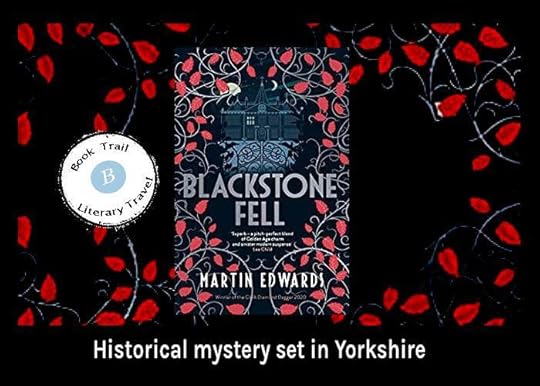
The Puzzle of Blackstone Lodge is a complexly layered mystery perfect for fans of impossible mysteries inspired by Agatha Christie. Martin Edwards pens the perfect locked-tower puzzle with a gothic edge set in 1930s Northern England.
1930: Nell Fagan is looking for a second chance at a career in investigative journalism and the call of Blackstone Fell's sanatorium is irresistible. In 1606, a man vanished from a locked gatehouse in a remote Yorkshire village, and 300 years later, it happened again. Nell confides in the best sleuth she knows, Rachel Savernake Looking for answers, Rachel travels to lonely Blackstone Fell in Yorkshire, with its eerie moor and sinister tower. With help from her friend Jacob Flint – who's determined to expose a fraudulent clairvoyant – Rachel will risk her life to bring an end to the disappearances at Blackstone Fell where people go in, but never come out.
Martin Edwards has been described by Richard Osman as ‘a true master of British crime writing.’ He has published twenty-three novels, which include the eight Lake District Mysteries, one of which was shortlisted for the Theakston’s Prize for best crime novel of the year and four books featuring Rachel Savernake, including the Dagger-nominated Gallows Court and Blackstone Fell, while Gallows Court and Sepulchre Street were shortlisted for the eDunnit award for best crime novel of the year. He is also the author of two multi-award-winning histories of crime fiction, The Life of Crime and The Golden Age of Murder. He has received three Daggers from the Crime Writers’ Association and two Edgars from the Mystery Writers of America and has also been nominated three times for Gold Daggers. In addition to the CWA Diamond Dagger (the highest honour in UK crime writing) he has received four other lifetime achievement awards: for his fiction, short fiction, non-fiction, and scholarship. He is consultant to the British Library’s Crime Classics, a former Chair of the CWA, and since 2015 has been President of the Detection Club.
EXCERPT: 'And this is such a remarkable puzzle. The first occasion in particular. Think of it! A man is witnessed entering a building and locks the door behind him. When the door is opened, there was no sign of him inside.' Nell paused. 'Edmund Mellor vanished from this very spot!' With a melodramatic gesture, she indicated their surroundings. It was getting dark outside, and although the fire burned brightly, Judith Royle's face was in shadow. 'I'm sure there was some perfectly straightforward explanation.' 'I want to discover it,' Nell said. 'This story will make a wonderful feature. It might even stretch to a book. Especially if it was a criminal case. If Edmund Mellor was murdered.'
ABOUT 'THE PUZZLE OF BLACKSTONE LODGE': 1930: Nell Fagan is looking for a second chance at a career in investigative journalism and the call of Blackstone Fell’s sanatorium is irresistible.
In 1606, a man vanished from a locked gatehouse in a remote Yorkshire village, and 300 years later, it happened again. Nell confides in the best sleuth she knows, Rachel Savernake
Looking for answers, Rachel travels to lonely Blackstone Fell in Yorkshire, with its eerie moor and sinister tower. With help from her friend Jacob Flint – who's determined to expose a fraudulent clairvoyant – Rachel will risk her life to bring an end to the disappearances at Blackstone Fell where people go in, but never come out.
MY THOUGHTS: I read the 4th book in this series, Sepulchre Street, before this, the 3rd, and I can unequivocally state that I much preferred this to the later book. The mystery in The Puzzle of Blackstone Lodge is far more engaging and enjoyable, the writing tighter, the characters more interesting. They include a medium, a Doctor of Philosophy, a psychiatrist, a fire-and-brimstone preaching rector and his very attractive wife, a charming village doctor, and a recluse, amongst others. The locals are pure Yorkshire - short on talk and far more interested in their pints and darts than any supposed goings on.
The setting is magnificent. Who can resist an isolated sanitorium in the Yorkshire wilds? A house where people enter, but never come out? A crumbling tower inhabited by a taciturn recluse? A dangerous landscape populated by bogs and chasms? A place where anything may happen, where deaths are easily put down to accidents?
The plotting is complex and the suspense palpable. There's no shortage of secrets to be uncovered, and motives are muddied by a succession of well-placed red herrings. The denouement surprised me. I do like to be surprised. It was clever and perfectly feasible, although I think the explanation was a little long-winded.
There is a clue finder at the end of the book, listing the various clues that pointed to the outcome, and where they occurred in the story.
A very enjoyable Golden Age mystery.
Although this is a series, each book contains a complete mystery and may be read as a stand-alone.
My favourite quote: 'Justice and the law are different beasts. Laws are two a penny, justice is rare.'
⭐⭐⭐⭐
#puzzleofblackstonelodge #NetGalley
I: @medwardsbooks @poisonedpenpress
X:@MartinEdwarsBooks @PPPress
THE AUTHOR: Martin Edwards has written sixteen contemporary whodunits, including The Coffin Trail, which was shortlisted for the Theakston’s Prize for best crime novel of the year. His genre study The Golden Age of Murder won the Edgar, Agatha, H.R.F. Keating and Macavity awards, while The Story of Classic Crime in 100 Books has been nominated for two awards in the UK and three in the US. Editor of 38 anthologies, he has also won the CWA Short Story Dagger and the CWA Margery Allingham Prize, and been nominated for an Anthony, the CWA Dagger in the Library, the CWA John Creasey Memorial Dagger, and a CWA Gold Dagger. He is President of the Detection Club and Chair of the Crime Writers’ Association, and Archivist of both organisations. He has received the Red Herring award for services to the CWA, and the Poirot award for his outstanding contribution to the crime genre.
DISCLOSURE: Thank you to Poisoned Pen Press, via Netgalley for providing a digital ARC of The Puzzle of Blackstone Lodge by Martin Edwards for review. All opinions expressed in this review are entirely my own personal opinions.
The third book in the Rachel Savernake series but the first one I have read.
The Puzzle of Blackstone Lodge is set in Yorkshire in the 193o's. It is a compelling tale involving a locked room type mystery, a spooky tower, seances, dangerous caves and a very suspicious sanatorium. There are a huge number of characters to keep track of as well as a feast of clues to help the reader solve the mystery. This reader did not have any idea but that was my fault not the author's.
All the main characters were well written and interesting although I found Rachel Savernake herself to be very smart but indifferent, and not as likeable as she was supposed to be. I think if I had read the earlier books first things might have been different, and I fully intend to read them as soon as I can.
The Golden Age type ending was outstanding. Perfectly contrived to explain the murders and the chief offenders. A little bit is held back to give us a shock just before the book ends. It was very well done. On the whole I enjoyed the book very much. Four stars.
Thanks to Netgalley and the publisher for the opportunity to read and review this book.
The Puzzle of Blackstone Lodge is my first time reading a Rachel Savernake novel though I have read many other books from Martin Edwards in the past. The world of this book is 1930s England, with action essentially split between London and a small village of Blackstone Fell in Yorkshire. We are first introduced to Nell Fagan, a woman who is somewhat desperately trying to find a great story to get back in the good graces of a good London newspaper. She is on the trail of a hoped for story in that small village, looking into historic and modern disappearances as well as questions about a local sanatorium. When she realizes the extent of her possible case, she decides to consult Rachel Savernake and request assistance, but she makes a critical error: she isn’t fully honest as Rachel requires and is dismissed.
Nell returns to Yorkshire to continue her investigation alone, and with difficulty. Meanwhile Rachel enlists some associates to look into the matters that Nell had mentioned. She appears somewhat sorry at having dismissed her so summarily. While Rachel seems drawn as something of a cipher, Nell, Rachel’s friends and associates have more individuality and character, as do many of the suspects and secondary characters. The plot itself is complex but not overly so. It’s very much of the Golden Age in which it is set, where waiting for enlightenment is probably as good as guessing “who done it.” Believe me, everything is answered in the end.
Now I must read the earlier books in this series.
Recommended for mystery lovers, especially Golden Age and Agatha Christie.
Thank you to the publisher and NetGalley for providing a copy of this book. This review is my own.
Blackstone Fell (third book in Martin Edwards’s Rachel Savernake) series took me by surprise. I am not sure what I was expecting, but what I got was a thoroughly entertaining whodunit that gave me Agatha Christie vibes. The writing was well done. It held up well as a standalone. The plot was engaging and intricate. The characters intriguing. The setting atmospheric. And I really loved the addition of the "cluefinder" at the end. That was a nice bonus. 👍🏻👍🏻
Blackstone Fell is the third book in Martin Edwards’s Rachel Savernake series. I haven’t read either of the earlier books in the series – Gallows Court and Mortmain Hall – but I don’t think it is essential to have done so in order to enjoy Blackstone Fell. If anything waiting for the first appearance in person of Rachel Savernake, having had snippets of information about her from other characters, only increased my curiosity. And wasn’t it worth the wait because she makes a fascinating central character, a sort of female Sherlock Holmes (but without the pipe).
Rachel is a rich young woman whose early life is shrouded in mystery (although it will be more familiar to readers of the earlier books). As Rachel admits, she loves the thrill of the unexpected. ‘Puzzles, mysteries – the more outlandish, the better.’ She guards her privacy with ‘a ruthless zeal’ and is a formidable adversary. The members of Rachel’s household – Martha Trueman, Martha’s brother Clifford and Clifford’s wife Hetty – are devoted to her; not so much servants as a ‘tight-knit cabal’. Rachel is good at utilising their talents as part of her investigations whether that’s gathering gossip or conducting a little subterfuge.
I confess it took me a while to familiarise myself with the different inhabitants of Blackstone Fell and understand the layout of the village. (The book contains a map but this wasn’t included in my advance digital copy.) Safe to say there are the usual features of small village life: gossip, petty rivalries and tall stories exchanged at the bar of the public house.
The book has a number of different strands including those inexplicable disappearances from Blackstone Lodge, efforts to expose a medium who is preying upon the loved ones of the deceased and a series of deaths from natural causes (or were they?) at a local sanatorium. Throw in some religous zealotry, infidelity, poison pen letters, financial skulduggery, greed and thwarted ambition, and you have a heady mix all set against the backdrop of a remote location. ‘The brooding moors, the deadly marsh, Blackstone Leap.’
Blackstone Fell contains many of the elements of classic crime fiction including a denoument at which, with all the suspects gathered together, Rachel reveals the solutions to what turn out to be more than one mystery. A neat touch is the addition of a ‘cluefinder’ at the end of the book (apparently all the fashion during the so-called ‘Golden Age’ of detective fiction) in which the author identifies the pages on which clues appeared. Well done if you spotted any of these because most of them passed me by, but then I don’t have the observational skills, breadth of knowledge or deductive ability of Rachel Savernake.
Blackstone Fell will appeal to fans of classic crime fiction (think Agatha Christie and Dorothy L. Sayers), those who like to be immersed in the milieu of an earlier age and who enjoy the challenge of unravelling an intricate plot.
The Puzzle of Blackstone Lodge is the third volume in Martin Edwards' Rachel Savernake "Golden Age" Mysteries series. Technically, it isn't a "Golden Age" mystery, since it's being released for the first time, well after the end of that golden age. Calling it a golden age mystery is, nonetheless, appropriate, as it has all the characteristics of the best golden age mysteries: • a cast of "types" that are both true to form, but not irritatingly so • a wealth of clues, some helpful, some misleading • a mystery that spans centuries • "goth-ish" elements like caves, seances, precarious cliffs, a sanatorium with suspicious deaths, a rigid and unforgiving vicar, and a small village hostile to outsiders • an absolutely brilliant denouement scene—followed by yet more surprises • a "clue finder" at the end—a feature of many Golden Age mysteries that allows readers to identify where clues to specific parts of the mystery were placed within the novel.
What The Puzzle of Blackstone Lodge *doesn't* have is also important: • no excessively graphic violence • neither sidelining of women nor belittling of women's intelligence • no stomach-churning thriller/psychological terror elements
The Puzzle of Blackstone Lodge offers a more-exciting-than-cozy-but-not-blood-soaked mystery structured with such intelligence that even the most seasoned readers of mysteries will find themselves startled at times. It will make for excellent reading, both on the beach and during a dark and stormy night.
I received a free electronic review copy of this title from the publisher via NetGalley; the opinions are my own.
A brilliant who- dunnit style read with twists galore to keep me gripped to the very end. I really enjoyed getting to know Rachel, Jacob and Nell and loved their interactions. This is really cleverly written as the two strands of storyline flow alongside eachother before carefully combining in the end. The descriptions of Blackstone Fell were vivid and bleak and made the perfect setting for such a story and I loved the ‘clue-finder at the end of the book. My first Martin Edwards’ read but definitely not the last.
This overly complicated book has knotted my brain. The story here revolves around the mysterious deaths happening at the Blackstone Fell. Contradictory to the behaviour of its residents, this place in Yorkshire reaks of ill fate and fatalities. When a journalist (Nell) sniffs the stories of this mysterious town, she can't resist solving the mystery. But as she knows she can't take this big bite of a case, she confides in the expert (Rachel) for help. And thank God she did, as only a week in Blackstone and Nell is already dead, leaving Rachel to unearth the secrets of the deceased.
The book is marked 2nd in the Rachel Savernake Golden Age Mysteries series but can be read as a standalone too. There were too many characters to keep track and if you attempted to solve the mystery as you went along the story, you would surely end with a scribbled maze on paper, like me. Don't worry though, everything is explained towards the end, but I still feel the need to emphasise the level of complications this book has is relatively high.
Thank you @netgalley @dreamscape_media @medwardsbooks for this mysterious ARC.
It's autumn 1930 and disgraced crime reporter Nell Fagan is on the trail of a story which she hopes will pave her way back to the good graces of Fleet Street. The trail starts with Vernon Murray and his request that Nell help him solve the murder of his mother. After his father's death she had married a younger man whom Vernon was certain was just after her money. Thomas Baker soon put a barrier up between Vernon and his mother and before the marriage was too old, Ursula Baker fell ill (according to Baker) and was sent to a sanitarium at Blackstone Fell for rest and recuperation. Except she didn't recuperate...she died. Vernon is certain that his mother was deliberately killed so Baker could make off with the money, but has no proof and the authorities just believe him to be a disgruntled, disinherited man.
Nell goes to to Blackstone Fell and finds plenty of mystery...the place has been the site of two disappearances--300 years apart--from a locked gatehouse connected to Blackstone Tower. Two men went into the gatehouse and never came out (or so they say) Nell, under a pseudonym, professes great interest in the legends surrounding the disappearances and uses her interest to cover her investigation of the sanitarium. But someone has seen through her pose and a boulder narrowly misses her when she walking in one of the areas where the men's bodies may have been hidden. So, Nell returns to London to seek help from an unexpected source...Rachel Savernake, the woman who made every effort to see that Nell would never write for a reputable paper again.
But Rachel has a reputation for solving incredible mysteries and Nell is sure that Rachel won't be able to resist the stories circulating about Blackstone Fell. She's right, but Rachel still isn't keen to help the woman who tried to dig up her past especially since she knows Nell isn't telling her everything she knows. When Vernon Murray winds up dead--an "accident" in the underground--and then Nell is also killed in an apparent accident, Rachel decides to take up the case in earnest. As might be expected, she finds that the mystery is deeper than even Nell imagined.
Martin Edwards has done his best to tick all the boxes for Golden Age fans--from clues hidden in plain sight to a handy map at the front of the book, from shady clerics and charming medicos to characters who aren't at all what/who they seem, from a locked room setting to mediums and seances, from small village setting to fog-bound countryside to a suspenseful wrap-up scene and a handy Cluefinder list at the end to show readers where they missed all those "plain sight" clues. The only thing missing to make it perfect in GAD trappings is the list of characters with pithy little descriptions.
This is the third in the Rachel Savernake series and Edwards is still going strong. Great setting and set-up and he manages to keep things fresh with new ways to connect to the Golden Age era but with his own twists. A thoroughly enjoyable mystery experience that I raced through. ★★★★ and 1/2. (rounded up)
Setting is key here. Blackstone Fell might be fictional but goodness me, you will soon be there in mind, body and spirit. The book does contain a map but it’s the one in your mind that will really capture your imagination.
Blackstone Fell is a small village where Blackstone Lodge stands. People are going missing from this lodge and this forms the central part of the mystery. There are more gothic overtones than you can shake a stick at, a medium, poison pen letters, dark financial dealings and darkness in all its forms. All of this in a remote Yorkshire Lodge surrounded by trees and the dark abyss and you have a heck of a setting.
This is the third case for Rachel Savernake but if you haven’t met her before, never fear as she is fearless and will soon become part of your reading mindset. This time Martin sends her to a remote Yorkshire lodge to solve a locked-room mystery…..
I’ve met her before in Gallows Court and Mortmain Hall and she is already a favourite character. Think Agatha Christie with a mix of Sherlock Holmes. Even if you haven’t met her before, wait until you hear the other characters talk about her – the tension rises – and then Rachel herself appears on the page.
Rachel is one of the most interesting characters I have ever met. She loves puzzles, mysteries and all that goes with them. In Blackstone Fell, she is confronted with spiritualism and the danger of the new science of eugenics. It is very interesting to read about issues of the time and what people thought of them.
The writing is just perfect. Agatha Christie would be proud. There’s that classic moment at the end where Rachel gathers the suspects together and the villain is revealed. What a thrill to read a novel like this, that harks back to the heart of Golden Age fiction. When you’ve finished reading, don’t forget to head to the back of the book to find the Clue finder. This is like a map of the novel which reveals the clues you missed along the way. This used to be all the rage apparently in the Golden Age itself. Genius of the author to have brought this back to life!
Love this series. If it came to TV, that would make my day.
I am not in the least surprised Martin Edwards has won so many awards for his crime writing, as this is a mystery Poirot himself would revel in solving! Or more a string of mysteries which overlap and entwine.
The story is set mainly in the Yorkshire village of Blackstone Fell. Home of not one but several mysteries, unexplained disappearances and possible murders.
Nell Fagan, a London reporter, is approached by a man who believes his mother was murdered at the sanatorium in Blackstone Fell. Under a pseudonym she rents Blackstone lodge, pretending to be a photographer, so she can poke around. She is also interested in the disappearances of two men, spanning 300 years, from the very lodge she is renting. If she can get to the bottom of all of these mysteries she would have some fantastic scoops, and she would regain her standing in Fleet Street.
She is under no illusion that she is not capable of solving the mysteries singlehandedly, so approaches her friend Jacob, who is also a reporter, to ask him to help her persuade Rachel Savernake who has a reputation for solving extraordinary puzzles by playing amateur detective, to assist her in solving the disappearances.
Jacob is tasked by his boss to investigate and uncover the murky world of mediums and spiritualism, and Jacob begins to investigate the top spiritualist of the time, Ottilie Curle.
Yes by the end of the novel these two storylines will overlap.
It did take me a while to get into the book as there are so many characters but once the action and murders began I was consumed and blown away by the detailed plotting.
Brilliantly done and I will be reading more by this author, this being the first I have read.
Thank you so much to Sophie Ransom at Ransom PR for allowing me to join the blog tour.
One of my favorite settings for a mystery is the moors of England. Blackstone Fell is set in northern England in the small fictional village of Blackstone Fell, where not only will you find a moor, but caves and a treacherous river and a sanatorium/asylum and a looming tower. All you need is some fog to complete the perfect atmospheric setting, and, oh, you get some of that, too. Now, the place setting is ready for the sinister secrets and disappearances and, well, murder that the peculiar inhabitants of such a setting are so adept at. Fall of 1930 is a time setting that makes the odd occurrences in the village most challenging to decipher and piece together to form a whole picture and more dangerous to investigate, as none of the modern resources of computers or cell phones are available. On the ground legwork, incognito snooping, and direct involvement with people is a necessity. One must get their hands dirty if answers are to be found. There are some resources, of course, for those who live in places with them, such as British Museum in London for newspaper reporting of disappearances and deaths. So, our snoops in Blackstone Fell, who hail from London, have a bit of an advantage over the village residents themselves.
This new Rachel Savernake book starts out in a deliciously mysterious manner. Nell Fagan is chasing ghosts, or rather the disappearance of two men three hundred years apart. She also has an interest in a recent death at the Sanatorium. In the small village of Blackstone Fell, Nell has rented the very Lodge House from which the men disappeared, so she can live there and talk to the people who would have knowledge of the rumors and facts she needs. She has her work cut out for her, as the villagers do not take to strangers and even less to strangers asking questions. The sanatorium/asylum located there is a mystery itself and adds to the sinister atmosphere. Nobody seems to know exactly what goes on there. Nell is posing as a photographer who wants to do a photo story on the village, so her moving about the area is not a suspicious activity. But her disguise won’t last long, and her identity as a London journalist will be exposed. Her first attempt to visit the village pub and buy a round of drinks to ease her way into the community fails. The only people who talk to her at all are the vicar’s wife and the doctor. She soon realizes just how unwelcome she is when a boulder rolls down from the cliff and comes close to smashing her like it does her tripod. Nell knows that this was no accident; someone tried to kill her. There’s no shortage of suspects with the likes of piously querulous Reverend Quintus Royle, the creepily reclusive Alfred Lejeune, and any of the haughtily taciturn Sambrooks of the Sambrook Sanitorium.
Nell takes a train back to London after her near brush with death, not giving up on her mission but trying to save it by engaging the best detecting mind she knows, a woman Nell describes “as sharp as a stiletto.” However, Nell has angered Rachel Savernake at an earlier time, so Nell must seek out assistance in getting an audience with Rachel in her fortress of a home, Gaunt House. Jacob Flint is the chief crime correspondent for the Clarion newspaper in London, and he knows Nell as a fellow reporter who is seasoned and sometimes a bit too outspoken. He knows that Nell has been blackballed on Fleet Street, home of the London newspapers, due to her earlier run-in with Rachel Savernake, and he also knows what an excellent reporter she is. Unfortunately, Nell’s habit of unreserved enthusiasm and single-mindedness is a handicap to her career, as she can be quite the bulldozer personality. The mystery she’s working on in Blackstone Fell could help get her back into the good graces of the newspapers though. Jacob is friends, as much as anyone can be a friend to the enigmatic Rachel Savernake, with Rachel and feels sorry for Nell, so he does manage to get Nell another interview with the reclusive Rachel. However, the second attempt to get Rachel interested in a project doesn’t go too well for Nell, as once again she withholds information and isn’t completely honest, which she agreed to be. Nell returns to Blackstone Fell and the Lodge to continue her investigations and face danger from someone who wants to silence her.
Jacob has his own investigation of another issue for his paper. His boss is determined to expose the spiritualists/mediums who take advantage of desperate people wanting to make contact with their dearly departed ones. His editor, Gomersall, is enraged at this hoodwinkery, and it is Jacob’s assignment to get the goods on one of the perpetrators in this scheme of fleecing the bereaved. Jacob has his sights on one Ottilie Curle, who has risen to great prominence as one of the most successful spiritualists, giving those left behind one more chance to hear the voice of their loved ones. As a quid pro quo with Nell for him having gotten her the chance with Rachel, Nell agrees to help him gain access to a meeting Ottilie is having with Nell’s aunt. Ottilie is a pro through and through, and Jacob realizes just how challenging tripping her up will be. You may be wondering if Jacob’s assignment of exposing fake spiritualists is just an interesting interlude in the action of the mysteries at Blackstone Fell. All I can say is that the connection between the two provides for a most thrilling denouement.
Rachel Savernake does become involved in the goings on at Blackstone Fell. Rachel admits she has “an unhealthy interest in murderers, especially those who masquerade as respectable.” She wants to know why they do it, since “by killing someone, they risk their own necks.” She also believes that justice “is much rarer than people like to think.” When someone dies a suspicious death by train in the underground, someone related to a person whose death Nell was investigating, and someone Rachel and Jacob were on their way to question, Rachel decides she must go to Blackstone Fell to solve the puzzles that are resulting in murder. As always, Rachel and her servants/companions work as a team in putting answers to questions, so Rachel and Hetty Trueman and Martha Trueman move into a cottage for rent, with the doctor and rector (and his wife) living as neighbors. Rachel has a cover story for her presence in Blackstone Fell, as does Cliff Trueman, who is staying at the local inn and pretending to be in the motor trade. All four in the ensemble have their roles to play if the darkness of Blackstone Fell is to be exposed. Of course, Jacob Flint is deeply involved in the investigation, too, both as a cohort to Rachel and a journalist wanting the big scoop.
From beginning to end, Blackstone Fell had commonalities with Agatha Christie novels, and Christie’s novels made me fall in love with mystery/crime fiction years ago. The small village set-up of Blackstone Fell with the vicar and the vicar’s wife, the local doctor, the eccentric person living in a tower, a widowed major, the wealthy and secretive lords of the manor all serve to pull me into a thrilling cast of suspect characters. The ending is also reminiscent of Agatha Christie. Without spoiling any of the ending, I will simply say that all the major players hear the solution to all the puzzles and murders at the same time in that wonderfully familiar way of Miss Marple or Hercule Poirot. I rather enjoyed the way Rachel announces the guilty, as just when you think you’ve heard all the revelations, there seems to be one “but wait a minute” and then another. All the rocks are turned over to lay bare the wickedness beneath.
In comparison to the familiar sleuths of Christie, Rachel Savernake seems a more modern sleuth, a more deliberate thrill seeker, and she comes with the team of her three capable servants, who are more like family and always have her back. Miss Marple and Poirot seem more old-fashioned and set in their ways. Rachel is a risk taker, often in contrast with her logical thinking skills. The Golden Age vibe is continued by the inclusion of a “cluefinder” at the end of the book. These were often a part of a Golden Age mystery, listing clues to the solution and the pages upon which they’re found. The second Rachel Savernake book had an ending of the same form as this third book and the fascinating cluefinders, too. Something else that Martin Edwards does that always drew me to the Agatha Christie books is choosing apposite words to use. It’s not that every word is eye-catching, but there are those greatly satisfying instances where a word just feels so congruous in its application. I think the timing for this series couldn’t be better, as more and more people seem to have taken an interest in Golden Age and classic mystery/crime fiction. I don’t know who better to write a new Golden Age mystery than the person who literally wrote the book on Golden Age mysteries. Martin Edwards has brought all his Golden Age knowledge and seasoned fiction writing talent to create this brilliant Rachel Savernake series for readers to savor. Blackstone Fell is my favorite Rachel Savernake yet, although I reserve the right to repeat that line after reading the next book.
I’m a sucker for an early 1900’s murder mystery, and I picked this book up because the blurb reminded me of Kerry Greenwood’s spectacular Phryne Fisher series.
Unfortunately, it was nothing like them.
The heroine, Rachel Savernake, is ruthless, cold, vengeful, petty and proud of it. She is also beautiful and rich, so apparently all the other character flaws are forgivable and everyone loves her.
What really frustrated me about this book was that Rachel didn’t need to do any investigative work at all. The story starts with journalist Nell Fagan investigating a supposed murder and also a centuries old missing person. She goes to Rachel for help, and Rachel immediately knows the answer to all the mysteries just from Nell’s recitation. That’s it. Mystery solved. Except of course Rachel doesn’t tell Nell, she lets her go off and be killed, and then swoops in afterwards for the big ‘gather all the characters and solve the mystery’ moment, having not participated in the actual story in any way at all. She didn’t interrogate any witnesses, talk to suspects, investigate anything. She literally skips over a river and magically “knows” the answer.
She also sends off a couple of staff to do some investigating for her, but both those tactics completely fail, and also seem to be totally pointless because she already knew all of the answers, including to mysteries that the reader doesn’t realise until the end were included. She knows the answers to mysteries for characters she’s not only never met, but never even seen! Rachel Savernake is just amazing!!!
But what all this adds up to is a story that has zero stakes and is ultimately boring because we know Rachel knows everything right from the start. It’s not like the genius of Poirot, because he was still involved in figuring things out. Rachel doesn’t need to figure anything out, she’s just omniscient.
Also, side note, but the author constantly referring to Rachel as a woman in her mid-twenties but who was so beautiful she could be taken for a 17 year old is just ick. For that alone, I won’t be reading anything else from this author.
Blackstone Fell is the third book in Martin Edwards’ excellent Rachel Savernake mysteries. I still don’t feel like I really know the enigmatic Rachel, but I thoroughly enjoy her sleuthing with her household staff and friends.
Blackstone Fell is full of brooding Yorkshire landscape, fraudulent mediums, a sinister sanatorium and a high body count. The story moves along at a nice pace and the denouement is satisfying. An easy five stars from me.
I look forward to the next book in the series coming in 2023.
Journalist Nell Fagan's first meeting with Rachel Savernake didn't go as planned, but Nell knows that Rachel can't resist a puzzle so she inveigles mutual friend, Jacob Flint, to act as an intermediary. Nell has started investigating at Blackstone Fell, a Yorkshire village with an ancient tower & lodge where two men disappeared centuries apart. In 1606, a man vanished from a locked gatehouse & 300 years later, it happened again. Do the disappearances have anything to do with the imposing sanatorium which has seen its fair share of deaths? Are the strange near misses a coincidence or is someone really trying to kill Nell Fagan to keep their secrets?
This series continues to improve for me. I was immediately drawn by the premise of strange disappearances & managed to pretty much guess what had happened. I also worked out the murderer so was feeling rather smug after finishing it. It's set in the 1930s & there is a nice namecheck to Agatha Christie's Miss Marple book 'Murder at the Vicarage'. Rachel Savernake is a bit of a 'Mary Sue' in many respects but after this third book, I am growing a little more accustomed to her. 4.5 stars (rounded down )
England, 1930. Nell Fagan wants to know: why the hell have so many people who lived in the gatehouse Nell is renting in Blackstone Fell? And what's going on at the sanatorium? It took me a very long time to get halfway through this book only to realise - the person I thought was the main character is, in fact, not, and the actual main character only becomes relevant from that point on. This is partly my fault because I didn't refer back to the title of the series, but even if I had, I would have been very confused. Sadly, this book really didn't do it for me. The characters didn't feel real, the language wasn't particularly interesting and the narrative arc didnt have enough tension for me to stay interested, which is why it took me ages to even get through the first half. I dnf'd this book, even though the general premise sounded quite interesting.
I have enjoyed many of the novels by this author including the two previous books in the Rachel Savernake series. However, I struggled with this and thought it a little over complicated.
I found I had to remind myself who a character was too often and perhaps because of this, I didn't have the interest that I should have had, in finding the guilty party. Indeed, the impact of the finale wasn't as great as it undoubtedly should have been.
I was very proud of myself early on for realising what the inscription meant and having that confirmed shortly afterwards by the mention of a couple of names. Regretably I missed the significance of the other significant historical event of the time.
I liked the inclusion of the "Cluefinder" at the end of the book which listed all of the clues that the author had included even though it showed just how much I had missed.
I’m still not sure how I feel about this book. On paper I should have loved it: an historical mystery from centuries ago, suddenly being investigated again due to further mysterious occurrences.
And yet it wasn’t until about halfway through that I started to find it interesting and while I enjoyed parts of the story very much, it could have been much better. In addition, not one character is likeable. This isn’t necessarily a problem in a book, but it makes it harder to engage with a story. Jacob is the least obnoxious, but Rachel was a patronising know-it-all and did not come across as believable in the slightest.
The number of deaths is impressive. Unfortunately, none makes an impact, due to the lack of character connection. There’s also a lot going on and with these sorts of books, less is often more. While the clues are there, they are very discreet and it doesn’t seem to be a reader-friendly book. Language is pretentious and wordy, which makes the book very slow and the final reveal of the mystery is underwhelming and far fetched.
In spite of this, I did enjoy the historical references and my existing knowledge helped me to work out the parts of the mystery relating to James I. The insight into mysticism and seances also works well, adding a bit of excitement and rescuing the story somewhat. The second half of the book is much better written, which also helps to improve the pace (although a few typos remain).
The sense of place is excellent; the contrast between London and Blackstone Fell is so vivid and the locations are beautifully described. The attention to detail here really helps to visualise this remote village.
Overall, it’s pretty good and works well as a standalone novel. Would I read another Rachel Savernake book? Absolutely. Will it be any time soon? Probably not.
In first place for the year of our lord 2022 on Death of the Reader, winner of the coveted prize, the Sulari Gentill Award, is Blackstone Fell by Martin Edwards. We talk a lot on this show about the way that murder mystery has evolved over the centuries, nay millennia, but I haven’t read a piece of detective fiction in a long while that manages to feel so very familiar while also taking me by surprise at every twist and turn of the deep-flowing river at the centre of Blackstone Fell.
This is the third book in the Rachel Savernake series, after Gallows Court and Mortmain Hall, and this detective is but the latest in a prestigious career for Edwards. The story begins straightforwardly enough, with a character named Nell Fagan investigating the backwater town of Blackstone, which is cut down the middle by class and struggling to pull itself into the modernity of 1930s England. The town is populated with all sorts of landmarks that reflect the twisted inhabitants. The menacing Blackstone Tower is exactly as it sounds, leaning over the village just as its lone inhabitant, the reclusive Harold Lejeune, lords his wealth over the inhabitants. His home threatens to collapse at any moment, taking the whole village with it. There’s the creepy as heck Christian church that is regularly visited by the townsfolk, shepherded by their rector, Quintus Royle who laments that he has no children of his own to rear, though perhaps his dog is a better thing to train to do his bidding anyway - at least it would listen to him. There’s the near-medieval tavern, complete with buxom wench, the mental hospital some distance both physically and psychologically from the rest of the town, and then there’s the bog.
The Fell itself is a character. It ensnares the town, forcing them to continue their ways and showing them no method of escape from its mire. It conceals and encourages the very act of deceptive murder within its clutches. It is fitting then, that the very first act of the story, wherein we follow Nell Fagan and her initial impressions of the town, that nature itself would try to kill her. As she stands upon the cliffs around the fell, investigating disappearances from the Blackstone Lodge, Nell is almost crushed by a boulder.
Now an ordinary person might assume that this boulder fell by chance, and even more ordinary person might be terrified with suspicion that perhaps this Fell place is not as safe as it looks. But not Nell. Not only does she immediately and rightly suspect that somebody pushed that boulder with intent to murder, but she pushes back. Nell and her journalistic crusade provide the cornerstone of this novel, her journey to uncover the secrets of the town and bring the true killer of the story to justice is what drives the entire narrative from start to finish. I can’t understate how even when the real capital D detective is brought into the case the presence of Nell’s ghost can be felt, wherever mystery lies dormant. This purpose behind the character’s journeys through the novel is what will keep many reading, as the story escalates and the game turns from one of cat and mouse to one of Rachel the detective with her army of servants and confidants working their way systemically through the mystery. What impressed me most about the story is how focused it is on what matters.
The mysteries in this story are devilishly clever, there’s the obvious mystery of who is trying to kill Nell but then Martin Edwards decides to try his hand at a locked room mystery. Now because Edwards is a murder mystery aficionado he knows that the real secret to traditional locked room mysteries is that the door was never really locked, it’s just a matter of how. He also knows that locked room mysteries are a trope for a reason, they whet the appetite. They invite the reader with an impossible challenge. Therefore the right and proper place for a locked room mystery is to whet the appetite of the detective. Rachel herself declares many different layers of the mystery trite and predictable before the end of the tale, and unlike certain other Golden Age detectives who are far too powerful, I found Rachel to be just the right calibre for the stakes set up during Nell Fagan’s prior investigation.
Let’s be clear, Blackstone Fell is fair. It even has an old-fashioned cluefinder at the back of the book, just to show you it’s serious. When we were offered the opportunity to chat with Edwards for the show earlier this year we had a wonderful chat about the cluefinder and the thought that went into it, how he developed it after including his first cluefinder in Mortmain Hall, decades from its last known appearance in mystery fiction altogether. You can tell that this isn’t just a checklist inclusion, the clues are written in such a way that if you accidentally happened to flick to the back of the book to have a look at the finder, none of the clues or passages contained in that section would outright spoil the mystery that they are proving can be solved. Edwards walks a fine line throughout the novel, but I think the fine thought put into how someone handling his book would interact with the ‘answers section’ really takes the cake. It proves the lengths Martin has gone, to care for reader and character alike.
Blackstone Fell this year has the honour of receiving the Death of the Reader Sulari Gentill award for our most-recommended novel in 2022. When I read this novel we had already started pondering how the Review Season list would pan out by the end of the year. I’m happy to say that on every reread, every cursory flip through the pages, every conversation about this text, Flex and I just kept rating it higher and higher. It’s an accessible book with a fantastic mystery, and a really moving set of themes about the ties of family, justice, and why you should consider a career in leaping over deadly gorges. You can of course pick up a copy of Blackstone Fell from your local bookstore, published by Head of Zeus.
While you’re there getting Blackstone Fell, you might also want to consider Martin Edwards’ latest comprehensive non-fiction ‘The Life of Crime’. Regular listeners to Death of the Reader will find an odd familiarity with the way Edwards writes, given how foundational his non-fiction like ‘The Golden Age of Murder’ has been to our research, so I suppose now is a good a time as any to extend this recommendation beyond the murky reaches of Yorkshire.
Whenever a book is marketed “for fans of Agatha Christie” I can’t help but snatch it up. I have long been enamored with her ability to weave together a captivating puzzle, intriguing setting, and unforgettable characters into one snappy, little mystery. But truthfully, these modern-day comparisons to the Queen of Mystery often fall far short of expectation. And I’ve learned to approach books with this hook with some caution.
So when I started reading The Puzzle of Blackstone Lodge, I was very happy to find that it was absolutely on point with the Christie vibes! Give me a small town, a host of characters with hidden motivations, a detective with brilliant deductions, and a twisty plot to keep me on my toes — and I’m all in!
Then again, this is exactly what I would expect from a mystery by Martin Edwards, the current president of the Detection Club. Christie fans might remember that Agatha herself was a President of this club, as was G.K Chesterton and Dorothy L. Sayers! While I haven’t read this author before, that fact alone was enough to persuade me! (Not to mention his Edgar nomination and Diamond Dagger award!)
I love it when a murder mystery involves lots of murder, and The Puzzle of Blackstone Lodge certainly met that requirement! The plot was complicated and had quite a few characters, but once I got into it, the story was difficult to put down. I also appreciated how all of the details tied together at the end — there are no wasted clues or irrelevant characters, it’s all a part of the larger plot. This makes for a very twisty, layered story.
Despite the 1930s setting, Rachel Savernake has a much more “modern detective” feel in comparison to Poirot or Miss Marple. She is a risk-taker and an admitted thrill-seeker, but she also has a brilliant mind and is able to use those “little grey cells” to sort through the abundance of mysterious and deadly happenings in Blackstone Fell. I loved her little band of found family and how they helped her investigate.
This book also came with some really fun add-ons, including a map at the beginning and a “cluefinder” at the end. The cluefinder was a really fun touch and was apparently a common device used in murder mystery novels in the twenties and thirties. Essentially, the author lays out the various clues to the mystery and highlights the page you could find it on. It was fun to see which clues I picked up on and which ones absolutely passed me by! (Just try not to peek ahead to avoid spoilers!)
While this is the third book in the Rachel Savernake series, I had no problem reading it as a standalone. Set in a creepy little town and filled with both intricate puzzles and delightful characters, The Puzzle of Blackstone Lodge was a thoroughly entertaining mystery.
Thanks to the publisher, Sourcebooks for my gifted copy!
This has quickly become one of my new favourite series'. I absolutely love the completely unorthodox character of Rachel Savernake and the way she does absolutely nothing that the society in which she lives prefers women to behave. Rachel's early life (read the first book in this series to learn about that) has made her into someone who can do as she pleases without any real consequences to her (at least, none that she cares about) and what she pleases is to investigate and solve murders with the assistance of her - also unorthodox - small group of loyal retainers who also function as her chosen family.
London reporter Jacob Flint is an extended member of Rachel's circle who also assists her with her investigations .
This third installment was my least favorite of the series, but that's only because Rachel doesn't really come into the story until about a third of the way in and I missed her unique way of approaching not only an investigation, but her way of dealing with and managing people to suit her own objectives.
The murder and its solution are a "small British town filled with secrets" sort of thing and it was well done. My favorite thing in this series is always how Rachel interacts with people because it is so unique and unorthodox and "take no prisoners" but in an oh-so-polite and eminently British way. I absolutely love that, and definitely intend to be continuing with this series!
I’m a big fan of Martin Edwards but have not particularly liked the previous Rachel Savernake books, so this was a pleasant surprise.
It’s by far the best of the series, with an intricate and well-paced mystery and plenty of atmosphere.
There’s some implausibility to this that is common to puzzle mysteries, but despite the convoluted series of events and WAY too many murders that aren’t ac tally directly related, but at least it all makes sense in the end.
I liked the setting a lot and though Rachel isn’t really to my taste as amateur detectives go, her role in this works better than in other books in the series and the rest of the cast is an intriguing group of characters.
*I received an ARC of this book in exchange for an honest review.*
“Her arrival in Blackstone Fell had panicked someone into attempted murder. But she’d lived to tell the tale.”
If you are looking for a complex puzzle to solve then read this story. If you are intrigued by stories about sanatoriums, seansces, dangerous characters with many secrets then you should definitely read this story.
I can say this was a very interesting story with many mysterious involving characters that kept my interest till the end. It was atmospheric with gothic vibes that I really liked! I recommend it!
Thank you NetGalley and Poisoned Pen Press for the opportunity to read this book!
Ok so as a thriller this was most irritating - the style-1930’s mystery with ‘clues’ throughout but no way of following the thinking of the amateur sleuth, was just too Midsummer Murders meets Miss Marple … not psychological / detailed enough for me. I didn’t feel the time nor the place nor the characters well. Just too contrived … and yet you had to read to the end to try to make sense of the myriad of complexities …. Not my favourite.
Thank you to Head of Zeus and NetGalley for my advance review copy of this book.
Agatha Christie in Yorkshire ★★☆☆☆
In 1930s Yorkshire, journalist Nell Fagan has become embroiled in the mystery of two disappearances from a locked gatehouse and a secretive sanatorium. When Nell also disappears, brilliant amateur detective Rachel Savernake is left to solve the case with the help of journalist Jacob Flint…
Fans of Agatha Christie will enjoy this murky cast of characters and layering of mysteries. However, for me the characters needed more refinement and I wanted a chance at solving the case(s). This was possible only for Rachel’s genius, just like Miss Marple and Poirot before her.
This is definitely better than the first two, but I still am not sure about the main character. I am still wanting her to have a bit more of a human side to her and some weaknesses because I am getting irritated with her smug and arrogant and condescending way she speaks to people and her friends, I hope she makes a big mistake and one that costs her dear. It’s a good book and one that many fans of Agatha Christie and other golden Age greats will enjoy.