The arresting pictures of Frida Kahlo (1907–54) were in many ways expressions of trauma. Through a near-fatal road accident at the age of 18, failing health, a turbulent marriage, miscarriage and childlessness, she transformed the afflictions into revolutionary art.
In literal or metaphorical self-portraiture, Kahlo looks out at the viewer with an audacious glare, rejecting her destiny as a passive victim and rather intertwining expressions of her experience into a hybrid real-surreal language of living: hair, roots, veins, vines, tendrils and fallopian tubes. Many of her works also explore the Communist political ideals which Kahlo shared with her husband Diego Rivera. The artist described her paintings as “the most sincere and real thing that I could do in order to express what I felt inside and outside of myself.”
This book introduces the rich body of Kahlo’s work to explore her unremitting determination as an artist, and her significance as a painter, feminist icon, and a pioneer of Latin American culture.
Magdalena Carmen Frida Kahlo Calderón was a Mexican painter, who has achieved great international popularity. She painted using vibrant colors in a style that was influenced by indigenous cultures of México as well as by European influences that include Realism, Symbolism, and Surrealism. Many of her works are self-portraits that symbolically express her own pain and sexuality.
In 1929 Kahlo married the Mexican muralist Diego Rivera. They shared political views, and he encouraged her artistic endeavors. Although she has long been recognized as an important painter, public awareness of her work has become more widespread since the 1970. Her "Blue" house in Coyoacán, México City is a museum, donated by Diego Rivera upon his death in 1957.
“Passion is the bridge that takes you from pain to change.”
Best Taschen I've read so far. An excellent guide through Frida's life and art creation, with a beautiful representation of paintings and great commentary and analysis on them. What a tragic yet vibrant and passionate life, full of painful events mixed with creative power! Frida's pain of infertility deeply intertwined with sensuality and imagery of fertility is truly inspirational. The way she at the same time vulnerable and strong, deeply emotional but not pathetic, and innovative in the midst of suffering is fascinating. That itself makes her a valid female role model and feminist icon. Her femininity not at all constricted in gender stereotypes but free in the abolition of taboos surrounding sexuality, creative and also fully expressed, not repressed as it sometimes occurs in women that tend to overcorrect strict societal norms surrounding feminity in completely despising and abandoning even elevating sides of the female principle. Frida's paintings are deeply rooted in the imagery of Mexican culture as well as in symbolisms of unconscious. She is not considered to be a surrealistic painter in the classical sense, as she was free from Freudian symbolism and a typical philosophy that burdens surrealist painters. Frida used the traditional imagery of both Christian religion (retablos; saints and martyrs) and native spirituality. The pre-Columbian and colonial cultural influences also played a big part in defining her own lane of "naive" surrealism. Frida was not painting dreams, but her reality, while continuously blurring the border of irrational, imagination and real-world events. The paintings are metaphorical summaries of specific life experiences, with surrealistic and fantastical elements, but never outside objective reality. The strong point of paintings is a real-time correlation with her personal history, as Khalo did not paint retrospectively, but in the moment of raw emotions that are powerfully conveyed on canvas. Her messages are not elusive and illogical - facts and imagination meet, as two equal components of one and the same reality.
“They thought I was a Surrealist, but I wasn't. I never painted dreams. I painted my own reality.”
Frida also continuously studied her own reflection in a mirror, and the honesty of self-exploration is immense, as this sentence perfectly captures the essence of Frida's work:
“I am my own muse. I am the subject I know best. The subject I want to better.“
Her portraits helped her in the quest of finding and defining her identity in constant self-innovation and rebirth. But Frida herself is a paradox, both explicitly honest and vulnerable, bearing all her conflicts, longings and wounds right before our eyes, yet remaining a mystery. Her facial expression is similar to Mona Lisas, always indistinguishable, vague and hard to read. It is hard to understand her tumultuous life-long relationship with Diego Rivera, full of affairs and drama as I also couldn't disagree more with her political views in idolizing communism, Marx and Stalin, as I don't see how a woman so full of creative forces of art and life passion can cling to materialistic ideology. To put her political beliefs aside, as I believe they were a clumsy expression of her internal longing for freedom and a better world, Frida Khalo's work for me reflects the potency and fullness of life itself; Love of homeland, animals, nature, fruits, colors, human body, love of people in her life, her lifetime partner Diego and herself.
“Fall in love with yourself, with life and then with whoever you want.”
Identity is a process. Identity is synaesthetic. Identity is integral, dynamic, relational. Identity is recognition, the 'click', helpless ecstatic laughter. Identity is performance, acting out the stories of self, other, community, history. Identity is read, misread, projected, overwritten, rewritten, stolen, defaced, reclaimed, debunked, pronounced unreal, unreadable, unrepresented, invisible
Frida painted her identity, she painted her stories. Frida painted passionate mestiza queerness. She painted in readable symbols, she painted the personal as a gift, an offering, an ex voto to the universe that knows itself in consciousness. Frida painted poetry, social criticism, her thanks and kind wishes. She painted 'naturaleza VIVA' instead of naturaleza muerte. She lay in her bed painting, but when she taught, she took her students into the streets, into the countryside, to go in search of a vision decolonised. Frida painted revolution, nation, a Mexico coming into being from grief and longing for the 'pre-columbian' and acknowledgement of all its broken elements, all its mixed blood. She painted hope and truth and the beauty that pushes out from under whatever boot or wheel or falsehood crushes it and everywhere feeds the soul. Such was her genius that she could paint all this in her own incomparable face.
This is a wonderful book, about an extraordinary woman who led an extraordinary life – and she articulated this life via her paintings - every step of the way. I still feel on a high from reading it. Library fanatic that I am - I nevertheless had to stop half way through and buy my own copy.
Kahlo was a woman of enormous passions. Passion for Mexico and its culture, passion for politics – particularly Communism, passion for the love of her life - Diego Rivera, and passion for her appalling bad health. The last was not in any way hypochondria, rather it was a courageous and noble fighting against the most horrendous physical burdens, caused firstly by polio, and secondly by her involvement in a bus and tram accident.
I had of course seen Kahlo’s work before (though sadly never first hand), but I had never heard any sort of commentary about it. Andrea Kettenmann’s insights were water on parched soil…what a delight to have Kahlo’s beautiful and sometimes frightening work unfolded and discussed. Suddenly all that symbolism – a defining part of her work even at a casual glance – took on more depth.
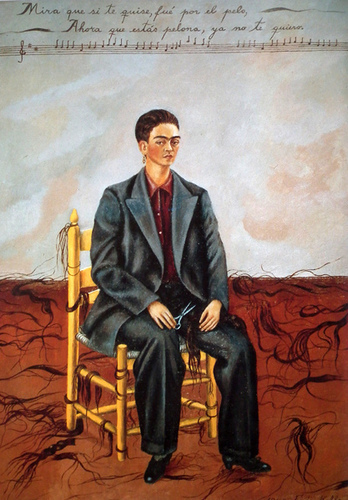
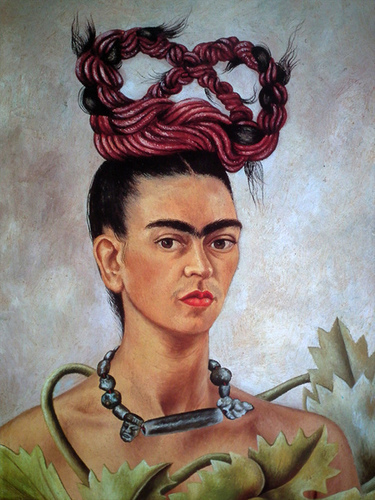
I loved the way that Kahlo’s work is so linked to her life and experiences. For instance in the year of her divorce from Rivera she does a painting of herself,(see below), not wearing one of her usual lovely Mexican costumes, but wearing a baggy man’s suit, and with her hair cropped closely around her head. The floor is littered with locks of hair. There are words in the painting, taken from a popular song of the time “See, if I loved you, it was for your hair; now that you’re bald, I don’t love you anymore.” A year later, when she and Diego remarried, she did a portrait of herself with her hair in an ornate plaited bow on top of her head, and little wisps and tufts of hair sticking out of the plait …. This picture is a celebration. “The strands of hair littering the floor of the first picture have clearly been gathered up again in the second and plaited into a new braid….thus the femininity which she rejected and symbolically renounced in 1940, she now takes up again one year later.” All of her work is like this – resonating with her life experiences. She doesn’t even do it retrospectively; she paints as it happens, as she undergoes the experience, and the results are immensely powerful.
The book ends with an excellent timeline of Kahlo’s life, which ended far too soon, when she died of pneumonia aged 47.
My one gripe is that not only is the author’s name not on the cover of the book, but there is no short biography of her either. I was also unable to find her on the internet. So thank you Ms Virtually Anonymous Andrea Kettenmann for a fantastic book.
***Warning*** The book I bought has arrived. It is about 1/3rd smaller than the book that I reviewed above (its the same book, but smaller). The illustrations therefore don't have the same impact. The ideal book is the one that is 11.75 inches x 9 inches, which should still be available second hand.
Ako se prihvate žanrovske ograničenosti ovakvih knjiga čija je prevenstvena svrha da pruže kratak uvod u život i stvaralaštvo određenog slikara, ovo je sasvim pristojno. Tekst je pristupačan, čitljiv, napisan dosadnim stilom, ali i bez onih pompeznih stručnih reči iz ere strahovlade kustosa, i negde se u tekstu neguje balans između biografskih podataka, anegdota, analize radova i istorijsko-političkih okvira u kojima je Frida stvarala. Ono što je za dodatnu pohvalu jeste kvalitet reprodukcija slika, posebno kada se uzme da ovo nije nikakva luksuzna monografija.
Posebno mi je milo što je autorka u više navrata u analizi pisala o nadovezivanju Fride Kalo na tradiciju meksičke votivne umetnosti, jer je to ono što mene najviše privlači njenim slikama. Voleo bih da pročitam studiju koja se bavi isključivo time.
This is a treasure of a book, not only some of her amazing artwork but also a biography and an in depth discussion of the meaning in what the reader is viewing. The many paintings, especially the self portraits and the ones that incorporated her thoughts are so personal to the artist. Her heart is broken, the pain she felt, what she lost and what mattered most to her are all included and on display. She was her own person, that is for sure. I thought it a wonderful book and would recommend for any one who appreciates her art.
Een kort maar verrassend volledig boek over een buitengewoon krachtige vrouw. Zoveel verdriet meegemaakt en dan zo schilderen en omgaan met je ongewenste kinderloosheid, heel knap. Ik word heel emotioneel van sommige van haar zelfportretten, de rauwe en voor mij herkenbare pijn is tastbaar op het doek. Om heel stil van te worden. Kunst met een grote K.
Ik weet nog dat ik met mijn pa in een museum was (geen idee meer waar) en ik zag daar een schilderij van een dode baby die uit de vagina van de moeder (symbolisch voor kindloze Frida) kwam. Ik vond het zo heftig dat ik met tranen in mijn ogen stond te kijken. Ik weet nog dat mijn vader over haar vertelde. Wat voor sterke vrouw het was en dat ze door een ongeluk geen kinderen kon krijgen.
Jaren later ontdekte ik haar werk weer en ik denk dat ik instant verliefd werd op Frida en haar werk. Ik weet zeker dat als ik in die tijd had geleefd dat we zouden trouwen. DAG Diego 🙃💗
La vida de Frida Kahlo ha dado para mucho, en este libro se muestran sus pinturas y y escuetamente su vida, desde su infancia hasta la vida con su marido Diego Rivera. En sus obras se aprecia una fuerza extraordinaria, unos colores vibrantes en los que detalla sin tapujos sus sufrimientos y los de otros, sin temor a la muerte pero también con mucha fuerza ante la vida. Una mujer de carácter, tanto en lo personal como en su pintura. muy buen libro para ir abriendo boca del mundo Kahlo.
This is a short biography on Kahlo, with many, many pictures of her paintings. If one wants a good introduction to Kahlo, this might be it.
In another book on her, I was struck by how many of her paintings were self-portraits, without any explanation in the text about why. Ketternmann deals with this straight up, quoting Kahlo herself: "'I paint myself because I am so often alone and because I am the subject I know best.'" Kettermann adds this: "With her highly personal images, she broke the taboos of her day in particular surrounding the female body and female sexuality." I am not sure what this means. The paintings were often gory, gruesome, grisly. That, not the female body or female sexuality, stood out, though of course the paintings were of her female body.
In a note on one of Kahlo's pictures, Kittermann writes that "Many of the artist's self-portraits suggests that the face shown is in fact a mask, behind which her true feelings are hidden." Here too, I am not sure what this means. These Kahlo paintings leap out. Kahlo's inner world emerges, clearly, for the world to see, warts and all. Are the paintings good as art technique, I have no idea, but the psychological aspects reveal a refreshing honesty - a ripping off of the mask for all to see. Of course her, Kahlo's, motivation might have been, and probably was, not to share herself with the world that way but, rather, and self-therapeutically, to take inner, festering energy and express it via her paintings in striking and even mind-blowing ways.
Kahlo started out with some European influences that quickly gave way to Mexican folk art. This too could be an example of her honesty. Rather than copying the styles of the reputedly European masters, she honored what was near and dear to her in her own life situation. In fact, Kittermann notes that Kahlo had contempt for European surrealists* in particular and, of them, quotes from a Kahlo letter as follows: "'They make me vomit. They are so damn intellectual and rotten that I can't stand them any more. [...] It was worthwhile to come here only to see why Europe is rottening, why all this people - good for nothing - are the cause for all the Hitlers and Mussolinis. I bet you my life I will hate this place and its people for as long as I live."**
*On Kahlo's surrealism, Kittermann writes: "Although many of her works contain surreal and fantastical elements, they cannot be called Surrealist, for in none of them does she entirely free herself from reality."
**As her 1932 painting, "Self-portrait on the Borderline between Mexico and the United States," indicates, Kahlo was not wild about the U.S. Kittermann refers to "Kahlo's ambivalent feelings towards 'Gringolandia." The painting is of two worlds - "the ancient Mexican landscape, governed by the forces of nature and the natural life cycle, and...the dead, technology-dominated landscape of North America."
Voor zo'n compacte paperback uitgave van Taschen is dit een hele fijne, met veel plezier herlezen en haar schilderijen bewonderd. Zó intrigerend en uitzonderlijk krachtig. Ergens in het boek staat een uitspraak van Diego Rivera over dat ze 'de eerste vrouw in de kunstgeschiedenis (was) die met absolute en nietsontziende eerlijkheid, en je zou kunnen zeggen met gelaten wreedheid, alle bijzondere en algemene thema's oppakte die vrouwen betreffen'. Daar kan mij helemaal in vinden.
'Pies para que los quiero si tengo alas pa'volar.' 'Wat moet ik met voeten als ik vleugels heb om te vliegen.' —Frida Kahlo
Un recorrido breve y muy bien organizado por la vida, la trayectoria artística y la obra de Frida Kahlo.
Es una muy buena opción para una primera aproximación a la vida y obra de la artista.
No profundiza demasiado en los aspectos formales de sus obras, pero sí en la dimensión iconográfica, en diálogo permanente con la vida de la pintora mexicana.
This isn't the first book I've read on Kahlo, but it will almost certainly be the last. This should please fans of the artist, but what I did discover without doubt, is that I am really not a fan of Kahlo at all. There is maybe the odd painting here and there, but overall she is definitely not for me.
So this is a decent guide and gives an overview of her short, dark and troubled life. I had forgotten how hard her life must have been, as she struggled with so much, between her serial cheating husband, who she married twice, and her life-long health issues, she didn't have it very easy. I like her political beliefs a lot more than her art.
Reading Andrea Kettenmann' s Kahlo brings back good memory of visiting La Casa Azul in summer 2015. Before visiting Museo Frida Kahlo, my only knowledge of the amazing artist came only from the movie Frida (2002) starring Salma Hayek. But even so, it was a fairly long time ago when first watching it that I could barely remember much.
Seeing paintings and almost original infrastructure and status of the house in my own eyes, I started to get a sense of how Frida' s life was although I did not think for a second that anyone in this world could ever come close to dare to imagine what she had exactly gone through physically and mentally. Reading this book intensifies my admiration and awe for her. She was as strong and resilient as Jane Eyre. Those many portions and segments of strong faith and heartaches tormented her much. Yet nothing could ever beat her and bring her down. Frida Kahlo was the truly independent, intelligent, influential, outstanding human being of our time. We are lucky to have her to look up to. Thanks to her honest and naked honesty expressed in her painting that brought us too much food for thought than we could have ever deserved.
I went through a major Frida Kahlo stage in my life, before her life was made into a movie. I had a friend who was a history professor who went to Mexico every year, and said that at that time it wasn't even a museum, and he would just walk in and sit in the chairs she sat in.
I always liked that idea.
I love her colors, and the bizzare way she depicts her inner world.
I think she was a little touched in the head sometimes, but maybe jealousy drives you to act that way to get back the attention of the man you love.
I liked this better than the book I read earlier this year (Frida & Diego) because it focused more on her (obviously) but I actually found that there was quite a bit of information in the first book that wasn't in the second book. However, Frida & Diego really lacked examples of her artwork, whereas here it was chalk full of it in beautiful, smooth, thick pages. I want to buy it because honestly cutting out some of that artwork and framing it would look beautiful.
It seems fitting to finish reading this on International Women’s Day. If you don’t know a lot about Frida Kahlo and want to learn more, this is a good book to start with - it showcases a lot of her work, whilst also describing major events in her life that influenced how and what she painted. Kahlo is a remarkable woman, and I hope to be able to see some of her work in the flesh one day.
"Frida also displayed herself as a woman who was unconventional and willful; she was obsessed by a need to be strong and independent. Her personality and very existence, the focus of her art, have been transformed into iconography."
I had this on my shelf but picked it up to read after I went to a Kahlo exhibit a few weeks ago. This a great, succinct biography that includes a lot of her works. Perfect for people who want to learn about her without having to read a whole detailed biography.
Una activista mexicana que admiro mucho, me hubiera gustado una mejor explicación de lo que fue su lucha en México, faltaron algunas cosas más que abordar, pero es un libro muy bueno
Frida heeft zo’n complex en zwaar leven geleid. Haar moed en kracht zijn enorm inspirerend. Daarnaast bevat dit boek een erg duidelijke en goede biografie, wat mij heeft geholpen bij het schrijven van mn verslag <3.
I really loved the style of Andrea Kettenmann, who is very good art & history specialist, her research about the life of Frida is written with passion and detailed work observations.The book succeed to make the reader familiar with the great art of the Mexican painter and give impression about her amazing personal life, filled with pain and hope. Frida remains one of my favorite painters, loved by her totally realistic view to life,her exact and deep self-look in her authoportraits, she remains original artist of her era. Even she suffer so much from countless spin operations, in her love life with Diego Rivera, but she always remain herself, in her last years, she had the happiness of the sucessful painter, she wrote in her diary : Why I need legs, if I have wings to fly?" ~nour
Four stars only because this book took me back to a period where I was infatuated with Kahlo and her work when I was 14 years old. Are you in joyed learning more about her life and the symbolism in her art, but I felt this book did not teach me as much as I wanted to learn. The chapters are quite short, and the writing style is a bit dry and choppy. It does quotes and passages from her letters and journal entries here and there, but most of it reads like history textbook. On top of that there was the choppy Dutch (translated from the original German) as well as typos and some linguistic mistakes that were distracting and came across as careless. So five stars for Frida, but three for the actual content.
This small book (fewer than 100 pages) packs a punch. It contains prints of her most famous paintingss and a love letter to Rivera, photos showing her campaigning, a couple of smalls of Rivera's works which contain images of her campaigning for Communism. This little book has many of the things I want a history or biography to have: images of the important work, copies of letters, and a time line. Bonuses here: images of the house where she grew up, images of her journal. Great little book.