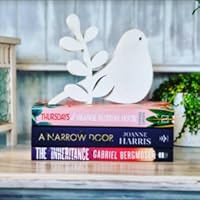
An intriguing dual timeline plot built around a house filled with puzzles. It’s more of a mystery story than a romance, but it’s very readable.
Here’s the premise: in 1890, Clement Bellingham’s wife leaves him. Bitter and angry, he takes his rage out on his two sons, Leonard, 16, and Sidney, 6. Growing up neglected and unhappy, they are told that their house, Halesham Hall, has been constructed with a number of mysteries within it. Whichever of them can solve the sequence of puzzles in its entirety will inherit everything - the board game business and the house. The loser will have nothing. In 1920, Phoebe Bellingham, the daughter of the losing brother, arrives at Halesham Hall with the intention of solving the puzzles and taking control of the inheritance to avenge her father for his exile from the family.
As in usual in books of this type, the story is told by jumping back and forth between 1920 and the earlier period, in order to drip feed snippets of information. I have to say, this all seemed a bit manipulative to me. For instance, it’s not revealed at first just which of the brothers inherited, and if you know this in advance (as I did - I always read reviews first) it’s easy to see the places where the author uses sleight of hand to maintain the secret. But this is a natural function of this kind of story, so it’s hard to criticise it for that, and the use of the two timelines is very cleverly utilised here.
The puzzles (and there are lots of them) are the best part of the book. The house itself is nicely gothic in feel, with deliberately uneven steps, odd noises in places, a maze that’s impossible to solve, doors that open in odd ways, and distorting murals on the walls to confuse the eye or even the sense of balance. The solving of the puzzles is a bit lacklustre, but that’s inevitable when the medium is the written word. There’s a clue, the character has a flash of inspiration, rushes from A to B, and hey presto, solves the puzzle. On to the next. It’s not terribly exciting, as written. I can imagine it would be very dramatic as part of a film, with suitably stirring music and actually seeing the relevant pieces move, or whatever.
As for the mysteries in the lives of the characters, I think the book is trying to do too much. There’s the mystery of the two boys’ mother and what happened to her (was she murdered?). There’s the mystery of who Phoebe’s real father was. There’s the mystery of what happened between Sidney and Leonard to cause such a deep rift. And that’s on top of the sequence of mysteries/puzzles in the house. Now that I think about it, I’m not sure we even discovered who Phoebe’s father was (but I might have missed it).
And then there was the romance. This was a real disappointment for me, because I like my romance to be fully formed and operational if not exactly from the word go, then at least from an early stage. Not so here. In fact, for most of the book, Phoebe has the hots for the cute gardener, only to have a dramatic revelation that she’s actually in love with the hero a couple of chapters from the end. He shows signs a little earlier, but not much. So it all felt a bit bolted on, but it’s hard to see how else it could be done since the hero is also acting as the antagonist for most of the book.
I think the sudden transformation from enemies to lovers would have been a bit more credible if it had developed earlier, and then, having become friends (or even lovers) they could have solved the final puzzle together, in proof of their rapprochement. I’m not convinced they have a real future together, however. Someone says at one point that the hero will always be an adolescent in some ways (and it’s true, he’s being contrary and petulant right to the end), which sounds awfully difficult to live with. I’m not mad keen on an immature hero who never quite grows up, even under the effects of love. Mind you, I can’t say I liked Phoebe very much, either, so perhaps they deserve each other.
I confess I’m not the ideal reader for this genre, but I enjoyed the book anyway. It’s cleverly constructed and well-written, and although there isn’t much of a late Victorian/twenties feel about either the language or the characters’ behaviour, the odd historic detail kept it anchored. The disappointing romantic element keeps it to four stars for me.