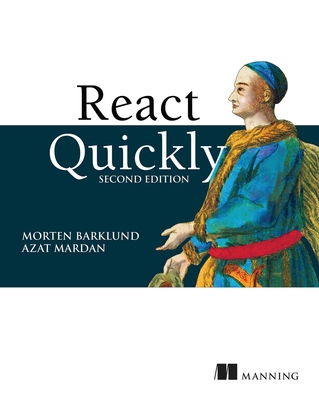
Learn the skills you need to build React applications quickly! This fully revised second edition introduces functional components, React hooks, static site generators, and more.
In React Quickly, Second Edition you will learn how
Build your skills with React fast! There’s no slow theory and tedious history in React Quickly—you’ll dive into React code right from the very first chapter. As you go, you’ll explore over 80 useful and practical examples that put React into action. This new second edition has been completely rewritten to cover the latest developments in the React framework. Perfect, whether you’re a React beginner or an experienced pro looking to keep their skills up to date.
Purchase of the print book includes a free eBook in PDF, Kindle, and ePub formats from Manning Publications.
About the technology
React makes it a breeze to build beautiful, reliable web frontends. This amazing JavaScript library has a modular architecture, so you can create, combine, and test components seamlessly. React is perfect for small prototypes, enterprise scale sites, and everything in between.
About the book
React Quickly, Second Edition offers a unique approach to learning the React framework. More than 80 concise examples guide you from your first steps through advanced applications. You’ll appreciate the up-to-date coverage of functional components, React hooks, and web accessibility, along with interesting projects to practice your new skill.
What's inside
About the reader
For developers comfortable building web applications with JavaScript.
About the author
Morten Barklund is an expert in React, web testing, and accessibility and is the founder of Coding Heaven. Azat Mardan is a seasoned software engineer, startup mentor, and best-selling author.
Table of Contents
1 Meeting React 2 Baby steps with React 3 Introduction to JSX 4 Functional Components 5 Making React interactive with states 6 Effects and the React component life cycle 7 Hooks to fuel your web applications 8 Handling events in React 9 Working with forms in React 10 Advanced React hooks for scaling 11 Website menu 12 Timer 13 Task manager
React Quickly jump-started my learning of React. It is not just a book, it is a well-supported learning experience with a brilliant companion website helping you run and adapt every piece of sample code in the book.
React Quickly 2nd Edition concentrates on React 18 and the new hooks that have been introduced. It also clearly explains the memory improvements in this version of React. I was relatively new as a programmer to React but had been following it keenly from afar. This book gave me a good in-depth knowledge of the most up-to-date React best practices.
I read many computer science books. I found React Quickly very well-written and easy to read. It will remain a reference book for me that I have and will continue to annotate and I intend to reread many of the chapters on specific hooks.
In my adventure to be a competent data visualizer, I was on my second book on D3.JS - D3.JS in Action by Elijah Meeks and Anne-Marie Dufour, when I hit chapter 8: Integrating D3 in a frontend framework. I'd already been getting some grief over my dogged pursuit of learning D3 from some frontend engineers, and when this chapter discussed the pros and cons of combining D3 with React, I thought, "bugger, I probably should learn a bit of React".
(Doesn't help I wrote a brief thing over D3 being verbose, which went to the front page of Hacker News, and gathered its fair share of critical comments https://news.ycombinator.com/item?id=...).
I used my favourite learning platform - Codecademy to get a start (after doing a bit of reading around React), and after a few days it just wasn't clicking.
Let's be clear. I'm a data guy. I eat SQL for breakfast. I know a thing or two about Python. I've also been on the web long enough to be passingly okay with JavaScript (but not that good). So I understand the difference between declarative and imperative programming.
But React? Jesus Christ - it just wasn't clicking. All the exercises I got, I felt I was just a monkey typing code. Do this, then that. But the inherent model behind React? I was learning nothing about that.
See, with SQL the mental model is simple - you're working with tables. You're just giving instructions on how the table should be built. Initially it can seem daunting, but then one day you read SQL code and it reads like English. It's intuitive. You subconsciously visualise the table being built as you read it. Sometimes you're so good you can even visually see the base table it's reading off of, without having ever seen it. SQL is powerful because of this model. It's never going away.
With React, the mental model behind it just evaded me.
So I thought, "damn, okay. I need to dig deeper for this. I need to read a book to understand a bit more." React Quickly was recommended in D3.JS in Action, and also elsewhere online, so I picked it up.
The book patiently takes you through React. My only criticism is that while it suggests you don't need to be an experienced JavaScript programmer to read the book, I did find a few concepts hard to properly understand (events. God damn events), and had to read around/outside to understand. But otherwise, it's self-contained. It takes you from when React used class-based components (so you can understand what's going on when you read some really old React code) to its current functional component state.
I will say that, in terms of building a mental model, I still found it hard. Perhaps because I'm not a professional front-end programmer, so I'm not coding day in and day out on things that might feel intuitive to front-end programmers. I had to search around online to find someone else's mental model of React - this was a great start: https://obedparla.com/code/a-visual-g...
I've reached chapter 11 of the 13 chapters of the book, which are now exercises which pull all the learnings together. However, as I picked up the book to get a gentle and slow explanation of the concepts, I got what I needed. I'm putting the book down now and going back to Codecademy.
I still find React hard. But it's less hard than before.
React Quickly, Second Edition builds on the foundation of its predecessor, offering a comprehensive guide to the world of React. Catering to both beginners and intermediate developers, the book dives deep into the nuances of the React framework, ensuring readers have a holistic understanding by the end.
Pros:
Updated Content: The second edition has been updated to cover the latest features and updates in React, ensuring that readers are learning the most recent best practices.
Hands-on Examples: Practical exercises and real-world examples make learning interactive and relevant.
Deep Dive into Concepts: The book doesn't just touch on surface-level concepts; it delves deep, ensuring readers have a thorough understanding. Clear Structure: Concepts are logically organized, making it easy for readers to progress through the chapters.
Cons: Pace: For absolute beginners, the book might seem fast-paced. Some readers might need to revisit certain sections to grasp the content fully.
Focus on Class Components: The book, while updated, still retains some emphasis on class components. A shift towards functional components and hooks would be more aligned with the current trend in React development.
In conclusion, React Quickly, Second Edition stands out as a valuable resource for those looking to delve deep into React. While not without its minor flaws, the comprehensive coverage and hands-on approach make it a strong contender for those serious about mastering the React framework.
I have loved every bit of this book. I had some experience creating apps with React but this has taken me to the next level. The explanations are concise, the writing style is very joyful and fresh. I like the examples and the explanations around them. It even covers server rendering, how to create a UI library from scratch, what being a full stack React developer means. This book is packed with information explained in a very good pace, the examples are great and also very useful for our day to day lives like the expense tracker or the habits/workouts tracker.
My overall feeling after going through the book, and yes they area a lot of pages, is that despite being a long book packed with information it doesn't feel overwhelming on the contrary it is a very entertaining read/practice. I went through it during the summer.
I also believe this book is for any developer from beginners to experts. It can be a reference as well to look for best practices.
Fantastic book to learn React for beginners. Well written and the author is really enthusiastic and has good energy. The book summary and the projects are really awesome and I love how the book is laid out with the theory first. Highly recommend this for anyone wanting to learn React!