Hideo Yokoyama (横山 秀夫) worked as an investigative reporter with a regional newspaper north of Tokyo for 12 years before striking out on his own as a fiction writer. He made his literary debut in 1998 when his collection of police stories Kage no kisetsu (Season of Shadows) won the Matsumoto Seicho Prize; the volume was also short-listed for the Naoki Prize. In 2000 his story Doki (Motive) was awarded the Mystery Writers of Japan Award for Short Stories. His 2002 novel Han'ochi (Half Solved) earned a Konomys No. 1 and gained him a place among Japan's best-selling authors. He repeated his Konomys No. 1 ranking in 2013 with 64 Rokuyon (64), his first novel in seven years. Other prominent works include his 2003 Kuraimazu hai (Climber's High), centering on the crash of JAL Flight 123 that he covered as a reporter in 1985; the World War II novel Deguchi no nai umi (Seas with No Exit, 2004); the police novel Shindo zero (Seismic Intensity Zero, 2005); and the story collection Rinjo (Initial Investigation, 2004).
This story is based on true events that the author participated in as a young reporter for a regional Japanese newspaper. In 1985 Japan Air Lines Flight 123 (JAL 123) crashed into a mountain 60 miles north of Tokyo, killing 520 people. That tragedy remains the greatest number of people ever killed due to a single aircraft disaster anywhere in the world.
Our reporter is put in charge of coordinating the reporting on the story. It will be the most significant story in this newspaper’s history. It’s a big operation – we are told the newspaper employs more than 500 people! (Tell that to the private equity buyout people who are acquiring major US newspapers and simply firing half the staff. “What do all these people do?”)
Controlled chaos ensues as entire teams of reporters are sent out to the remote, almost inaccessible site in the days before cell phones. Those who stay behind (almost all men) eat and sleep in the office for days, illustrating that stereotypical behavior we read of, that for Japanese men, their work is their life.
Unfortunately this book was a DNF for me. I gave the controlled chaos 70 pages. All the action (as far as I read) took place in the office. The rivalry of older seasoned reporters and younger ones, the inability to communicate with those at the site, or did they even reach the site? They’ll have to get to a payphone. The decisions about where in the paper to place this or that aspect of the reporting, what is rumor, what is true, what is uncertain, how much of what is being reported by other papers and on television is true or just speculation? There’s the conflict between the space needed for the story and the advertising and the dirty tricks played as part of office politics.
There is more to the story than this. The book opens in 2002, 17 years after these events, thus the title. Back in 1985 the reporter had been scheduled to climb a steep mountain face with a buddy, a skilled climber. The reporter is scared because he’s still essentially an amateur.
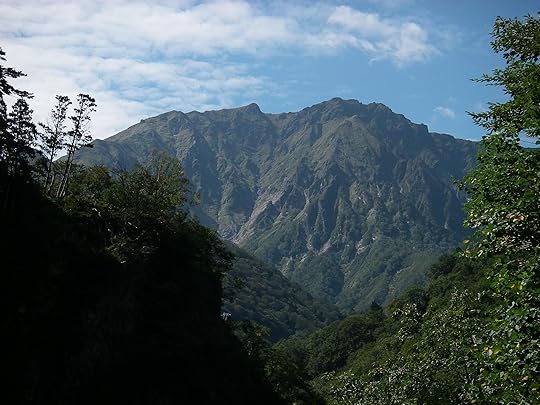
And how hazardous is this mountain? It’s Mt. Tanigawa which has been called ‘The Mountain of Death.’ Here it is from that font of all wisdom, Wikipedia: “As of December 2014, since its initial exploration and route-finding in the early 1930s, a total of 805 people have died on Tanigawa-dake. (Compare with the approximately 200 people who have died on Mt. Everest over a comparable period.)” I didn’t get to this part, but we know from the book blurbs that the reporter will attempt to face his fears years later.
Because I did not finish the book I did not give it a rating. I notice it is rated 3.7 on GR, kind of so-so. I also skimmed the first five reviews from friends. Those five were 5, 4, 3, 2 and another DNF, so all over the map. Most of those who gave it a good rating still had qualifications such as ‘don’t expect a thriller.’
The author (b. 1957) has written ten or so novels, about half translated into English. His best-known work or GR is Six Four, a crime thriller about the kidnapping of a Japanese girl.
Top photo: Mount Tanigawa from Wikipedia.com The author from abc.es
Don't believe the blurb! This is not an "investigative thriller" about how and why the biggest plane crash in Japanese history occurred, it's a newsroom drama about a bunch of journalists trying to cover the event, which puts them in numerous moral predicaments: 520 passengers have died, and what is a major tragedy for their friends and families is the chance of a lifetime for local reporters - everybody wants to be the first to report from the crashsite on a remote mountain, the coverage of grieving relatives becomes a source of revenue, and whoever will manage to find the cause of the catastrophe will have landed a major scoop.
It is easy to judge journalists in these situations, and some of the characters we get to know certainly are real cynics, but Hideo Yokoyama shows that it is nearly impossible for them to get out of the double-bind: Newspapers need readers and companies which advertise, so they have to present attractive content - the media consumer is always present in this book, as a looming invisible power, as a caller and as a letter writer. It is obvious that the author knows what he is talking about: Before he became a fiction writer, he worked as an investigative reporter with a local newspaper North of Tokyo.
The book gains an interesting perspective by focusing on the head of the "crash desk", Yuuki, who has to coordinate the coverage from the office - he (mostly) decides what will get published without being present at the site. The reader feels the pressure he is under, and the claustrophobia that comes with his difficult position - he sometimes feels trapped inside the office, trying to fight for his reporters when arguing with the bosses of the paper and pushing back deadlines to incldue the latest developments. As readers, we also never climb the mountain or talk to relatives and the police - the whole time, we stay in the office with Yuuki.
This main storyline runs parallel to a second one, in which Yuuki's colleague and good friend Anzai, an enthusiastic mountain climber, suffers a cerebral hemorrhage and falls into a vegetative state. 17 years later, Yuuki and Anzai's son climb the mountain that Yuuki and Anzai himself wanted to climb when he was still well. The journey helps Yuuki to come to terms with the things that happened in the office and to his friend 17 years ago, thus intertwining the national disaster with the personal tragedy.
I enjoyed reading this unusual thriller which discusses morality and the dynamics of human relationships. My only problem was that some parts are a little too long, and some observations are stated explicitly although their insight would have unfolded more powerfully if just implied. Still, a very worthwhile read.
Author Hideo Yokoyama has been described as a crime author who says that the crime is the least interesting part of his books. As a reader, you need to bear this in mind; as this is very much a novel described as a ‘thriller,’ which is much more interested in the aftermath of events, and – in particular – the way events are covered by the press, than in the air crash, which is central to the plot.
Indeed, Yokoyama worked as a journalist on a regional newspaper, in the same way that the main character in this novel does. Kazumasa Yuuki is a reporter on the North Kanto Times and we see his story presented from two time periods – 1985, when he is thrown into leading the story of an airline disaster in the locality, as well as seventeen years later, in 2003, when he climbs a mountain with the son of a friend and looks back on that fateful week of the crash.
Yuuki is an interesting character. He is the longest serving reporter on the newspaper he works at, working as a ‘roving,’ or ‘relief,’ reporter. Some envy him the ability to work on different stories, but others see him as lacking ambition or unwilling to take responsibility for others. Indeed, there is an event in which a young reporter has died, after Yuuki sent him back to cover a story and, although he is found not to be responsible, this obviously colours the way that his colleagues see him. He is closest to Kyoichiro Anzai, another outsider, with whom he likes to go climbing and he is meant to be going on an expedition with him the day that the plane crashes.
This is a slow moving, interesting novel, which centres on Yuuki’s character and, very much, on office politics and journalism. Obviously, this is something that Yokoyama knows well and his world (although culturally different from our own) has great authenticity. In 2003, Yuuki is about to finally challenge himself with the climb he meant to do so many years ago, but this time with Anzai’s son. This novel is about the way that week in the newsroom changed Yuuki, about the way major news stories are covered, about politics at work and you do always view events as he does – from the outside, as an observer. Interesting, but not as gripping as I had hoped.
If by any chance, you picked up this book hoping that you will get to read an action-packed, adrenaline-fueled, strenuously thrilling novel, then it is indubitably probable, that your enjoyment during the entire course of examination of the manuscript may deteriorate enormously. This novel neatly elucidates a drama-filled, politically-charged, detailed account of the inner workings and procedures, that dwell inside the crackerjack world of newspaper writing.
Your personal view, perception, and judgment about professional journalism as a quite harmless and less risky profession compared to several other more physical labors; such as constructing a building or military operations; may never hold together as firmly as before upon a successful tackling of the challenging subject matter poised at the center of this contemporary Japanese literature, as we witnessed and followed, the convoluted journey and struggles of our lead character, Kazumasa Yuuki, a competent and loyalist senior reporter, and journalist navigated through the perplexing dilemmas of his everyday existence.
Diction-wise, the author, Hideo-san, has seamlessly jotted down and injected his narrative with a sufficiently balanced dose of compact, notably simple repertoire of vocabularies, as well as conventionally salted it out with a quite abundant amount of lexical terms and technical jargon, which we can normally found within the common journalism-related contextual dictionary. To portray, as realistic as possible, the life account of a journalist behind his desk at a daily newspaper agency, the pacing of the tale has been deliberately toned down, making for a tantalizing slow-burn chronicle that builds up its tension, in the best assertable way, by giving the readers a harrowing, hooking, interminable impression of progress, keeping the readers curious enough to want to turn page after page, trying to voraciously binge-read the manuscript in only one sitting.
The snail pace of the novel, due to Hideo-san's unabridged attention to every little detail, for obvious intent as in showcasing a true depiction of the haranguing and stressful work-life situation in the media industry, may be off-putting to some readers without vehement, outstaying patience, or those who wanted a novel with plentiful exciting action sequences. Taken at face value, this book, it seemed, was most likely written and geared towards more mature readers, with seasoned tastes and preferences, those who were adroitly accustomed to reading multi-layered, structurally complex, sagaciously plotted, character-driven fiction.
Climactically, perusing Seventeen did not feel so much like reading a book at all. The sensation and experience we attained from it were comparable to the satisfaction we will procure, after watching a great Japanese dramatic motion picture.
I have always had a fascination with Japan, as well as Japanese authors, with my favourite writer, Haruki Murakami, hailing from that part of the world, so it was an easy decision to read SEVENTEEN. I love to learn about different cultures and this title educated me in a way that fit within the story, just like Yokoyama's previous release, SIX FOUR, which I also enjoyed immensely.
I found the story incredibly addictive, and written in an easy to read style that grabs you and doesn't let you go. The author breaks everything down, giving an examination of situations in minute detail. The characterisation is pretty amazing too, this guys knows how to write!
On publication in Japan SEVENTEEN achieved a 2003 Weekly Bunshun Mystery Ranking #1 and came second in the first Honya Award in 2004. It was subsequently made into a TV drama (2005) and then a film (2008), both of which won multiple awards in Japan.
This is a book that is more than worthy of your time, I hope he keeps writing in this vein as I for one would read anything else he decided to publish. A Japanese crime phenomenon!
I would like to thank Hideo Yokoyama, Quercus Books, and NetGalley for providing me with an ARC in exchange for an honest and impartial review.
Yokoyama's whole thing is to dive fully into procedure and process, to find meaning and purpose there. In some of his other work it's been more mystery but here there is no mystery to solve, we follow Yuuki, a reporter in a local paper who is given the role of Lead when a massive plane crash in their country prefecture becomes the focus of worldwide media attention. Yuuki doesn't go to the crash site or investigate the cause, instead he navigates the work of getting the reporting done, getting the paper made, and keeping the focus on the crash.
To anyone who's worked in an office (particularly in media) there is a lot you'll recognize here. The push and pull of one team vs another. Layout has a grudge against Editorial, who likewise don't find Layout's work all that important compared with their own. It's like this over and over, with Yuuki butting heads with practically everyone at the paper, as they each care more about their own job or their own agenda than the big story that Yuuki has to care about more than anything else.
There's a great framing device of Yuuki looking back years later as he undertakes a difficult mountain climb.
For me, this wasn't as successful as some of Yokoyama's other work because the conflicts start to feel repetitive. If you took a drink every time Yuuki used the phrase "world's biggest airline disaster" you would be dead within a few chapters. The grudges and the politics of the paper comes down to simple egotism and without a bigger narrative to play out, it can get to be a bit of a slog. And as has been the case before, Yokoyama could have made this shorter and more effective. But I didn't hate it.
Couldn’t get on with this one at all sadly. It was very dense and detail-heavy. I’ll get back to it again another time maybe, but for now it didn’t work for me!
It pains me at page 72 to have to give up on this pretty, debossed cover with its airplane tail and red-purple-blue ombré (the spine is yellow-blue-green ombré). On the reverse side the little specks feel pleasingly like braille. But this is so boring. This "thriller" is "about" the worst airline disaster in history yet everything takes place in a newsroom. None of these occurrences and conversations between journalists are even remotely interesting. Sample:
Yuuki felt faint all of a sudden. The announcement of the mall's opening had been left out of the paper on the very day it opened. He bowed his head deeply.
"It was a very careless mistake."
I flip forward. Will we ever be taken to the remote mountainside where body parts have been strewn?
Yuuki nodded. The first galley proofs would be made with the Nodai Niko High School story as the lead, and they would go to press. The pages would be collated and loaded into the delivery vans. This had to be done, otherwise there would be substantial delays in the deliveries to remote locations.
Does the exciting title refer perhaps to 17 minutes of terror inside the doomed aircraft as it freefalls through the sky, trays and forks slicing through the cabin, suitcases tumbling from overhead bins? No. Seventeen years after the 1985 crash, "Yuuki remembers the adrenaline-fueled, emotionally charged seven days that changed his and his colleagues' lives."
Of course, there's nothing wrong with writing a "thriller" which isn't really that. Novels about newsroom politics full of discussions about page layouts are allowed in our solar system and such subject matter is not inherently uninteresting (I suppose). But Yokoyama's writing is matter of fact and dry as dust. (In the 72 pages I got through, the translator also peevingly used the nonexistent contraction "it'd" three times.) The publisher is MCD, an imprint of Farrar, Straus and Giroux which wikipedia informs "is viewed as a kind of a lab to experiment with new styles and genres." The only other book I've read from this imprint is Uncanny Valley which I got through, but not without annoyances.
This book was on the BTBA longlist. I had skipped over Six Four, last year since I was not tempted by the thought of a police procedural. I will reconsider that having now read Seventeen. The novel focuses on a local newspaper man who is elevated to assignment editor for the story of a jumbo jet airliner crash in the newspaper's prefecture and is based on the author's own experiences. The novel then becomes a masterpiece of tensions and resolutions that range from political rivalries at the paper to personal issues at home, with Yokoyama's hero being tested to a potential breaking point. The strength of the novel lies in how Yokoyama can exact such emotion and drama from the mundane and accord nobility to the common.
Seventeen bills itself as "an investigative thriller in the aftermath of an air disaster". Truly, it isn't.
Instead, Seventeen is a competent and intriguing evocation of the inner workings of a local Japanese newspaper, the North Kanto Times, using the backdrop of an air disaster on the paper's doorstep to allow simmering resentments and rivalries to boil over. We are introduced to Kazumasa Yuuki, who is trying to make an ascent on Tsuitate rock face some seventeen years after making a promise to his colleague, Anzai, to climb the face with him. This leads Yuuki into a spiral of reminiscences of the events seventeen years ago, where the planned ascent of the rock was interrupted by the crash of a Japanese Airlines 747 into a nearby mountain, causing the deaths of 524 people.
Seventeen years ago, Yuuki had been a roving reporter with the North Kanto Times, assigned to lead the Air Crash desk. He was responsible for sending reporters out into the field, editing their stories, deciding the layout and, ultimately, which stories would make the cut and which would not. Yuuki was the most experienced reporter at the paper who had not gone into management, leaving him both respected and shunned.
The paper itself was constantly compromised in its effort to sustain circulation. It could not make political statements, could not ally more with one side than another (a problem in a province where the two main rivals in Japan's ruling political party held their bases), and shunned real news in favour of reporting local school sports fixtures, naming every player in an effort to sell the paper to kids' parents. But politics loomed large in the boardroom where the chairman and managing director were engaged in a bitter power struggle, sucking staff into one faction or the other.
So when the 747 went down in the paper's area - despite not being on a major flight path - the paper entered an existentialist crisis. The natural instinct of a journalist is to go after a scoop, but when the scoop comes, the fear is paralysing. Nobody knows how to play it, and the temptation is to retreat to the familiar comforts of routine basketball games and ceremonial openings of arts festivals. This is the context into which Yuuki is thrust - with all eyes on him. And at the same time, Yuuki has his own personal issues to resolve, not least of which is the sudden collapse of his climbing buddy Anzai from the circulation department...
Seventeen is a very complex novel with many characters and a network of relationships between them. It can be tricky to keep up with exactly who is who, particularly for anglophone readers who are not attuned to Japanese names. Hideo Yokoyama includes little summary lines when reintroducing a character to remind us of their role - this can feel irritating and repetitive, but without it I suspect the reader would be hopelessly lost. A further issue raised by the complexity is the uneasiness the reader will have in discerning what is actually the focus of the novel. Is it the plane crash? Is it the office politics? Is it Yuuki's personal situation? In truth it is all of these and none of them. It is really a slice of drama, a fly on the wall, from a newspaper office at a time of crisis. There is no particular beginning and no end. There is no great narrative arc, no moral, no winners and losers. It just is.
And then there's the present day, climbing Tsuitate. I can see that there was a need to have the odd period of relief from the intensity and claustrophobia of the North Kanto Times - and the open air and focus on small, technical details of the climb provided that. It also offered an opportunity for Yuuki to put some distance between himself and the events of the past. But this came at the expense of elevating one strand of the story - Yuuki's personal life - above the others in significance even though it was perhaps not the most prominent line at the time of the disaster.
Overall this is a complex, thoughtful and thought-provoking novel that has been somewhat cruelly mis-labelled to give a sure-fire guarantee of disappointing many of its readers.
This was a really good book about the minutiae of newspaper reporting in the aftermath of a catastrophic accident that claimed many lives. The author writes from personal lived experience and we get insight into the workings of the newsroom - from the internal politics among different divisions to the different kinds of personnel and their psyche to the challenges of publishing "breaking news" (for want of a better term). Our protagonist faces the challenge of meeting the demands of a local newspaper fighting to stay afloat while simultaneously maintaining journalistic integrity and being respectful to the victims. There is also a parallel timeline where he tries to exorcise some personal demons and gain some closure.
The dual timelines and the sometimes claustrophobic, adrenaline-fuelled atmosphere of the newsroom were brought to life very effectively, making for a riveting read.
ow. This was an immersive and utterly compelling read. Though billed as a mystery, it isn’t really; it is literary fiction, and damned fine literary fiction at that. Not that classification matters when a book is as good as this one.
Seventeen is one of those books that stay with you. On one level it is a fascinating insight into the workings of a small daily newspaper with all the tensions, infighting and personality conflicts that come from a group of people working together. Overlaying that is the local and regional political dimension control of the newspaper is in the hands of rival political factions, and each side spends a long time trying to oust the other in a rivalry that seeks to benefit local politicians, but has no thought for the readers of the paper.
In the midst of this endless petty bitching and squabbling is our seasoned reporter, Yukki, working at the North Kanto Times, who finds himself in charge of the coverage of the biggest air disaster the area has ever seen – and it is in their patch. Seventeen tells the story of how that coverage impacts on Yuuki, his family and everyone involved in the reporting and does so in an intimate, searching and very on point fashion.
Here are all the small decisions that make a huge impact on coverage and circulation; the big editorial decisions that make or break the reputation of those in charge; the tensions between advertising, circulation and editorial and in the midst of this, one man, Yuuki, struggling to make sense of it all.
Seventeen is very much a human story. Yuuki struggles with maintaining a home/work balance and pretty much loses all the time. Not by nature an outgoing individual, he prefers to stay out of the political squabbles, but when they threaten to overpower the biggest story the paper has ever handled, he knows he has to step up to the plate whatever the personal cost.
Seventeen is a dual timeline story. Written in part in the present as he fulfils a promise made to an old friend to climb a mountain, and also in the past with Yuuki looking back on that time seventeen years ago to a period which defined his future.
This is a complex novel which takes a bit of time to really settle into. This is partly because the Japanese situation feels a bit clunky to begin with to this western reader, with so many characters and a huge series of interwoven relationships. But once I had overcome my uncertainty, this book held my attention in a strong and steady grip.
Yuuki is no archetypal hero, but he overcomes some pretty big personal obstacles to find his way through and in the end his courage is rewarded.
For those who love newspapers, this is a must read. For an insight into the world of journalism and macho culture, it is exceptional. For those who just love to read a deeply personal story of loss and self-realisation, it is a unique and joyous read.
A Japan Air Lines jumbo jet crashed in a mountainous area between Gunma and Nagano prefectures on a summer evening. 520 lost lives, 4 survived. A seasoned reporter was tasked to lead the reporting team covering the accident of unprecedented scale.
Seventeen was a fiction written based on a real tragedy. Set in 2 different timelines of 17 years apart - the year when Yuuki was the JAL Crash Desk Chief, and the year when he and an ex-colleague's son attempted to conquer an infamously deathly rock climbing route.
Yokoyama's detail writing based on his experience as a journalist brought me to the North Kanto Times office, where everything seemed tense yet dramatic. From the race against time, office politics and in-fighting, to deciding between journalism ethics and publishing the hottest scoop ahead of the other newspapers.
Despite the protagonist, who may seemed as a failed journalist and father at the beginning, the author successfully touched the human side of Yuuki - he felt so real and human afterall.
'He always escaped this way. Always telling himself he'd do something about it next time. How, next time, he'd try to have a deeper conversation. That they were father and son living under the same roof and there'd be plenty of time. Yuuki paused at the landing. Was it true? Was there still plenty of time for Jun and him? Life is just a series of moments.'
It is definitely too early to be a fan of Hideo Yokoyama after just one book but I have unexpectedly enjoyed this book so much, I'm going to find more of his writings.
Definitely not a thriller, imo, but more of a delving into the psyche of the news cycle in times of disaster, as well as an inner look at a middle-aged journalist assessing his life. It held a few surprises & grew on me more & more as I read. A book that would most likely appeal to middle-aged people because of some of the musings in there -- good life decisions, bad life decisions, just going through the motions, regrets, impermanence, facing the past & the future, etc. Probably somewhat semi-autobiographical as the author himself used to be a newspaper reporter in Japan who covered the JAL Flight 123 plane crash in 1985 (just like the main character in the book). Seventeen refers to the number of years the main character needs to finally come to terms with covering the devastating event, as well as other personal issues in his life at that time. A book for the heart, I think.
This wasn’t what I was expecting. It was all about internal politics in a newsroom as they plot how to cover the story of a plane crash (including where to place the ads). The reporters jealously guard their turfs. I made it a third of the way through and the book showed no signs of getting more interesting so I skimmed to the end. Despite the depiction of the newsroom, the book winds up being smugly self congratulatory about the reporters. This book just wasn’t for me. I received a free copy of this book from the publisher.
'Five hundred and twenty four people died on that mountain. That sparkling mountain.'
The blurb that promises 'an investigative thriller' isn't doing this book any favours. There's no real investigation, nor much to thrill - instead we have a thoughtful piece about newspaper politics and the impact that reporting on an air disaster has on a group of reporters and others. Setting expectations clearly would help receptions of this book.
There's something very Japanese about the way the present story of a climb up a difficult mountain face is set against the main air crash strand set 17 years ago. The translation, however, feels distanced and somewhat opaque, as if we're experiencing the book at one remove rather than directly. I found myself skimming in parts but there's an indefinable air of a kind of metaphysical mystery that kept me reading to the end. An oblique book with a subtle hold on the right reader's imagination: 3.5 stars.
A major disappointment. Yokoyama's "Six Four" is one of my favorite Japanese novels, which is all the more striking (to me) since I often don't care for the country's contemporary literature. "Seventeen," his second book to be published in English, is shockingly lame, trite (even cloying), predictable, and not all that interesting. I rushed to snag a copy from the UK because I simply could not wait for the US release, began reading it a couple months ago, and gave up for several weeks because it simply wasn't compelling, with prose that seems to be written by a different, much less talented, writer. I began it again, thinking I was too hasty in dismissing it, only to find out 400 pages later that it never gets any better.
The second I heard what this book was about, I was intrigued. I read Six Four last year and found it somewhat confusing but largely enjoyable. This one I enjoyed more for reasons I can't quite put my finger on.
Having now read two books by Hideo Yokoyama, I've come to realise that his stories are veeeeeeery character driven and not huge on plot. Which isn't a bad thing, it's just that when you read the blurbs, you expect far more plot than you get.
This one predominantly follows the characters working at a newspaper after a plane crash that causes the deaths of over 500 people. I found it to be a surprisingly fast-paced read, given how long it is, and I'm really glad that I picked it up.
Not quite what I was expecting from the blurb. But a thriller, the book focuses on the newsroom as they try to report on the plane crash that actually happened Japan in 1985. The tension and drama and how it is dealt with personally and by the organisation. The effects it has on the people involved and the outcomes. Different but not much intensity to keep me hooked.
On the day that Yuuki was scheduled to meet his best friend, Anzai, and go on a short climbing holiday, a plane crashes into the mountains, killing over 500 people. As the senior reporter for a local provincial paper, Yuuki stays in the office and is put in charge of the paper's coverage of the crash. Anzai also doesn't make it to the meeting point. He collapses on a city street and is taken to the hospital where he lays in a coma.
What follows is an intense procedural novel about how the news coverage is put together. Yuuki assigns reporters to specific stories, determines which stories go where, navigates the difficult office politics of a paper where the managing director is battling for dominance with the chairman, and anxiously waits for the stories to make it in to the paper before the presses have to roll. And he tries to sneak out of the office now and again to visit his friend's bedside, where he takes Anzai's son under his wing.
Framing the airplane crash story is one set seventeen years later, when Yuuki sets out to follow the original climbing plan with Anzai's son. Hideo Yokoyama's story is not a thriller or a crime novel, but an oddly compelling detailed look at how a provincial newspaper covered a major story that happened to occur in their area. Set in 1985, the story is devoid of the modern electronics that makes communication so easy, with reporters running for pay phones to send in updates and newspapers could scoop each other by printing a story in an earlier edition than their competitors.
I'm gonna be a bit bias here cause this is one of my favorite genre and it was written in a way that every bits worth reading to me. Be it in a hectic messy scene or during a freaking heated argument between Yuuki and Todoroki at the barbecue place, it was so vivid, so real so descriptive yet very intriguing. How Yuuki reminiscing every inch of last seventeen years incident, so gripping and tense. I love the narratives that it always gave me that emotional, nervous and exciting feelings at the same time. It was long but not draggy, it seems like every chapter giving me absolute enjoyment.
When I finished this that I suddenly realized how Yuuki did teach me few lessons about hardships and surviving while taking care of others hearts, on how to keep on being rationale and doing the right thing and avoiding such unfairness and judgement. It was a great reading journey, getting goosebumps here and there. Reading about Anzai as well as how Yuuki trying his hard to be a better father to Jun and Yuka it was all so heart-warming. The crash incident that grabbed all the time and giving restless nights to Yuuki, bringing such emotional roller coaster both to him and people around him was being told in detailed with nice prose and wordings (thanks to great translation work). I was been transported to North Kanto Times HQ, experiencing the massive work of journalists and reporters in all division, some office politic that giving me so much annoyance to few characters, a story of an avid mountain climbers, good friends and subordinates. It was all wrapping up in this novel so beautifully, very sharp, a bit harsh and bitterness but portraying a great brilliant plot as a whole.
Hideo Yokoyama did great with SEVENTEEN. From the idea of combining both factual incident and fiction to elaborating the plot development and characters, even my enjoyment of reading it all, this deserve a 5 stars.
I have no idea why people insist on calling this a thriller. It's not one. It's a novel following a journalist's dealing with the breaking news of a huge plane crash that killed 520 people over several days, focussing heavily on the internal politics of the newsroom at a local paper. I found it quite compelling, but if you go into this expecting thrills and chills, you'll end up disappointed.
DNF - I think this was just an unfortunate misunderstanding between the book description and me :/ it’s not really a mystery or a thriller, and within like the first 30 pages you kind of know everything that is going to happen/did happen. And then it just chronicles from the newsroom what it’s like reporting on this. I just really struggled to keep interested so at page 200 I called it quits
I will say, I love the idea of combing fiction with real life events which is the case here of JAL flight 123, I just think the newsroom “drama” wasn’t that interesting as a non-journalist and maybe if I was alive during JAL 123 I’d feel the impacts more, but i felt too disconnected
This story gives the reader a look into a Japanese newsroom following the tragic crash of JAL flight 123. It also has a mountain climbing subplot that I don't think linked well with the rest of the story -- at least I didn't see how it did, other than to build some suspense and at the end, closure. Perhaps it reflects the life is often messy and complicated. The character glossary at the end and the newsroom flow chart in the inside cover were very helpful to keep track of all the characters. One part I found interesting from a cultural perspective was how Japanese fathers are/were rather ostracized from their families because of work life. This seems to have changed a little since the 1980's, but definitely seems to still exist with the poor life-work balance that Japanese society seems to struggle with.
I read Hideo Yokoyama’s Six Four at the start of 2018. I was expecting it to be one thing (a dense, layered murder mystery) and instead got another (a character study and bureaucracy-heavy police procedural). It wasn’t what I would normally read but I appreciated that it was something different. I appreciated the inflections of the main character and how Yokoyama could inject such nuance about life in Japan in the midst of a professional crisis.
I had difficulty focusing in the beginning of Seventeen. Yokoyama takes his sweet time setting the stage and I’m not quite sure for awhile why I’m supposed to care about Yuuki and these people. Only as he begins to reveal things about the coverage of the crash, about Yuuki’s life, about the existence of journalism, and the fragile nature of families did I began to fall deeper and deeper into the story. This is being billed as a thriller but in so many ways, it’s not just not a thriller but almost an anti-thriller, not in a sense that it moves too fast but because it takes the pieces of a thriller and grinds them to reveal the story. I don’t know many writers who have this kind of specific talent.
Seventeen is basically Six Four stripped down and with a focus on journalism instead of law enforcement. It left me with the same feelings the other did. The meditations on life and death, rock climbing, journalism, etc. are deep and profoundly felt. I don’t know who to recommend these books to but I do recommend them all the same.
A thoughtful piece about newspaper politics and the effect that reporting on an air disaster has on a group of reporters and others. Seventeen is about Japan’s deadliest airline accident (the very real JAL flight 123 that went down in 1985) but from the point of view of the editorial department of a regional newspaper that spends a week fighting over how the paper should cover each new revelation. This story is interspersed with the return of the editor to the mountains for a climb near where the plane went down, still haunted by the events of that week. I found it engaging and I enjoyed the look at running a newspaper in 80’s Japan. The current day parts with the mountain climbing were also more interesting than I would have expected. A good look at the demands of work and effect on family life, friendship and finding peace in your choices later in life. Check it out if you want to read about office politics, corruption, and a look into the nasty practices that propel people to the top.
I feel like cultural differences kept me from fully understanding everything that was going on. Maybe the translation wasn't as good as it could have been.
This investigative thriller bounces between two times of seasoned reporter Kazumasa Yuuki life, one time seven days of non stop office politics and power struggles the likes of which we here in the states might not totally understand, just to get the story of his life. The other time 17 years later, during a trip he is taking to fulfill promises he made during those 7 days to fight some of his own doubts and demons, not to mention to answer some unanswered questions still plaguing him from that earlier date, but will he get everything he needs or wants?
This is a interesting book, full of action, suspense and much Japanese culture. This was once written in Japanese but has been expertly translated in to English.
Dakle, stavim ja 'Sedamnaest' u torbu i odvezem se na tehnički pregled mog 26-godišnjeg Tica. Sjedim u autu i čekam red, čitam stranicu na kojoj Yokoyama priča o planinaru koji je na vrhu Mt. Everesta gledao u nebo, pogledom tražeći ždralove, jedinu od 400 stranica na kojoj se spominje Everest, kad zazvoni mobitel. Gledam ekran i ne mogu vjerovati. Ma čujemo se mi sigurno jednom u mjesec dva, ali baš tada, na toj stranici??? OK, pogodili ste, moj dobri dragi prijatelj Stipe. Stipe Božić. Eto, što je trenutak.
Japanskim knjigama očito treba prilično vremena kako bi dospjele do našeg tržišta. 'Sedamnaest' je izdana 2003., na engleski jezik prevedena i izdana 15 godina kasnije (da se pričekalo 17, mogao je to biti i dobar marketinški štos), da bi se kod nas pojavila nakon još 5 godina, 2023. Parafrazirat ću onu izreku o pravdi u 'knjige su spore, ali dostižne'.
Iako je posao izdavača da što prije pošalje djelo u tisak, distribuciju, pa i u prijevode, ovo je dobra pouka za sve autore i urednike koji prebrzo odobre objavu novih uradaka ne vodeći računa o kvaliteti. Trajnost pisanih djela je izuzetno duga, netko će ih možda pročitati i s par desetljeća zakašnjenja, stoga rad vrijedi ispolirati, pregledati, ne puštati 'urbi et orbi' misleći kako knjiga traje onoliko koliko stoji u izlogu trgovine.
'Sedamnaest' je u Hrvatsku stigla 20 godina nakon izlaska i to ne u rubriku 'Retro' nego kao svježe izdanje. S potpuno pogrešnom kategorizacijom 'triler' u pučkom shvaćanju tog žanra. Ja bih je svrstao u izvanrednu dinamičnu dramu, s nevjerojatno dobrim psihološkim ocrtavanjima glavnog lika. I preporučio svima koji se na neki način bave novinarskim radom, bilo kao reporter, kolumnist ili urednik.
Cijeli život su me poslovi vezivali uz medije, iako nikad nisam bio novinar. Honorarčio sam kao dopisnik i za 'Džuboks' i za 'Omladinsku iskru', surađivao i producirao emisije na 'Radio Splitu', 'Radio Braču', bio prvi urednik 'Radio Studoma', radio promocije za 'Nedjeljnu Dalmaciju', čak i kolportirao na ulici razne novine pa mi je redakcijski sustav poznat. Ovo je knjiga o mnogima koje sam u tom miljeu upoznao.
Kroz lik novinara u godinama, i njegove pozicije u trenutku ekstremnog događaja, pada aviona koji je odnio 520 života, Yokoyama je opisao cijeli urednički i novinarski posao, dodao grafičku redakciju pa čak i distribuciju. Tu su borbe nacionalnih i lokalnih medija, stres, deadline, upravljanje ljudima, sukobi s marketingom, upravom i vlasnicima, redakcijski odnosi, politički presinzi, zavist, podmetanja, diobe na zaslužnike i novajlije, borba sa savješću, izbori naslova, moralne dvojbe, niz pogrešnih odluka ... Cijela je knjiga velika i napeta drama glavnog junaka. Uspio je Hideo kroz 'Sedamnaest' prikazati i onaj dio u kojem obitelj trpi zbog novinarstva, kao i pokušaje da spasi što se spasiti da.
Ne uzimajte ovaj roman u ruke, ako očekujete uzbudljive opise čina udara aviona u planinu. Sama tragedija (istinit slučaj) je izuzetno vješto prikazana uglavnom kroz novinske naslove, a poseban ton daje Yuukijevo bavljenje slobodnim penjanjem i pokušajem da već u godinama svlada tešku stijenu. Dakako da se radi o prenesenim značenjima, pokušaju prolaska kroz vlastite osjećaje, od čega je Hideo također napravio neizvjesnu dramu.
Još za vrijeme čitanja sam prijateljima, urednicima, poslao poruku da trebaju 'imati 'Sedamnaest', kako bi je posuđivali ostalima u redakciji', no vjerujem da će se svidjeti i onima koji samo prate medije, baš kako bi bolje razumjeli stres novinarskog posla. Četiri zvjezdice.