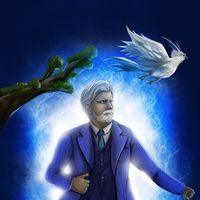
Every three thousand nights, Youths of Javari gather to pledge themselves to one of the four Stratums. The Vaincre is home to soldiers and warriors, the Explorateur home to artisans and inventors, the Enlightenment home to historians and educators, and the Unir, home of politicians and leaders.
Orianne Duchamp is excited to pledge to the Enlightenment Stratum but worries that her physical prowess overshadows her intellectual interests. An unexpected visitor confirms those fears, coercing Orianne into joining a dangerous expedition. When the expedition is massacred, Orianne must rely on her mind as much as her muscle to survive…
Loosely based on the mythology of West African nations, French folklore, and phantasmagoric fantasies of T. Aaron Cisco (author of Teleportality, Dragon Variation, and Rod String Nail Cloth) comes an epic, afro-fantasy novel.
T. Aaron Cisco loves stories- reading them, sharing them, and, of course, writing them. Growing up, he didn’t have many friends, but he had more than his share of bullies, so he found refuge in towering stacks of books, endless hours of television, and weekends spent at the multiplex.
A lifetime of feeling like the last kid picked for a game he never wanted to play could have made him bitter. Instead, it gave him a vivid imagination, an irrepressible sense of longing, and an unshakable determination to love what he loves freely, enthusiastically, and without apology.
These days, T. Aaron is a little less lonely and a whole lot more determined to make sure no one ever feels less than for digging what they dig.
Not only something new for Cisco, but new in fantasy. The world-building is on the level you’d expect from a novel twice it’s length, but he manages to convey the fabric of the world effortlessly. There’s history, and depth to it, an extremely vibrant ecosystem, and different cultures that are all fleshed out well, without ever bogging down the narrative. There’s a lot I’d love to explore further (fingers crossed for future books) but nothing stood out as lacking where I felt in the dark about what was going on.
The writing itself is beautiful, Cisco’s love of words is evident, and it was a delight to read. I rarely highlight passages but found myself loving so many sections I started highlighting them to save them. It’s hard to explain why but the whole thing felt very cinematic to me, I think it was the occasionally focusing in on a small detail to help set the scene, a mud puddle splashed through for instance. I could see it as the opening shot to establish weather/mood/location before the camera cut to what was happening. The pacing is a bit quicker than some other books as well, it gets going right away and you just can’t stop turning those pages!
Bought for $3 on 7/22/22 for Second Foundation discussion at Diversicon, Twin Cities sci-fi meeting on July 31, 2022.
Fun and likable characters, even the bad guys and assassins (called shellskin) are diverting: there is a consistent theme of smarts and warrior skills cooperating together, trickery for spice and Magycs for solving problems, including an elixir called coppermilk that heals all wounds.
The world-building is strong, but the social and political hierarchies, e.g., the tiers of the Strata, are difficult to discern. The new-minted vocabulary and geography are disorienting. In that respect it reminds me of Katherine Addison’s Witness for the Dead. The “Tutelage Lessons” posted at appropriate momonts throughout the novel are indeed timely and helpful, but still we readers could do with a glossary and/or an index.
The most irritating aspect of the novel is the lack of an editor; perhaps this Kindle edition is just a poor knock-off of a better text, but even so, an editor should have been applied to the resulting digital file. I marked over 50 instances where an editor was clearly needed, from grammar to missing words to word choice.
Stratums p. 7
The Magycs is a bit heavy-handed, from the spelling and initial cap, to the incinerating fire from fists and subsequent mirages of resurrection, p. 20, men not like men 166, mirage disguises and assumed identities passim.
First five (Magycs) p. 184
The plotting often feels vertiginous - sometimes arbitrary - but it is always imaginative, and becomes part of the fun once one gets used to it.
Other (unnecessary? or just an integral part of this world?) extremes: 600 survive of 5000 p. 31, Asanda’s death p. 37, killing the Dominie in Vadim’s fable p. 54, disgusting details of the Filet Noir pp. 58-62, other Exaggerated violence pp. 64, 89, legend of Luella and Aurora pp. 154-156, Marie’s graphic monologue p. 162, pluck out the eyes of opponents 164, slitting the throats of 100 sleeping soldiers 213, flying hands 227, killing of Zamaya 234, many more not identified here.
Crux: colonialism and colonialists of the Javari vis a vis farfadets and the visitants (Klnovos).
Cultural and ecological ignorance and arrogance, pp. 83, 142, 144 (aggressive and careless expansion), 158 (calling Klnovos “visitants”), 189 (ignorance of Klnovos culture),
Irritations include plot points that are illogical or arbitrary rather then organic; very poor or absent editing; labored and often inappropriate descriptions of speech including:
“Smirked” “sputtered” “leered” “spat” “snarled” “snarled deliciously” “yawned” “snapped back jovially” “gasped” “barked” “hissed” “roared” “quipped” (a concerned look), “teased”
My very first time reading a book by this author and I was pleasantly surprised by how engaging and entertaining this book was it exceeded my expectations on several occasions this will not be my last book by this author for a fact...