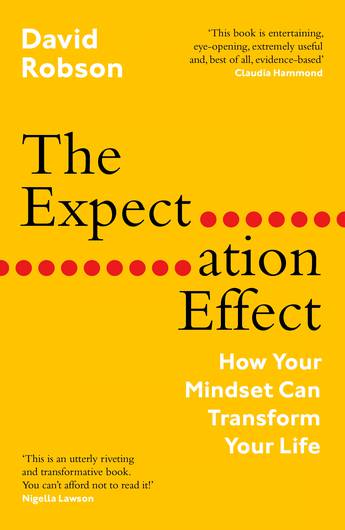
Ekspektācijas izmaina un izmainīs tavu dzīvi. Varētu teikt, ka šī ir "the Secret" dižpārdokļa zinātniskā versija.
"Let me be absolutely clear. Your mind alone cannot perform miracles—you cannot simply imagine piles of money and think yourself rich, or cure yourself of a terminal illness through positive visualizations. But your expectations and beliefs can influence—indeed are already influencing—your life"
HOW TO THINK ABOUT … HEALING:
*If you hear that a treatment’s effects can be partially explained by the placebo effect, don’t panic! Remember that the biological effects are still meaningful, even if they arise from expectation.
*All other things being equal, bigger tablets are more effective than smaller tablets—but capsules are better still.
*if you have a choice over your health-care provider, try to choose someone you find to be empathetic and caring. Their attitude could change the way you respond to the treatment they offer.
*try to visualize your recovery and, if relevant, make a plan for your journey to better health. Doing so should maximize your chances of improvement.
*Above all, be realistic but optimistic about what the mind-body connection can achieve.
HOW TO THINK ABOUT … HEALTH SCARES
• Be aware of the people around you and the ways that your body might start to mimic their mental and physical state through the brain’s mirror neuron system.
• Bear in mind the particular situations that are likely to give rise to a mass psychogenic illness—such as times of high political anxiety, the introduction of new technologies
• Apply critical thinking to the health news you read.
• If you feel sick with a potential psychogenic illness, seek medical advice, but be open-minded about the possibility that your symptoms could be the result of an expectation effect.
HOW TO THINK ABOUT … FITNESS
• Before you exercise, think carefully about your aims for the session. How do you hope to feel at the end? And what are your performance goals? You might hope to set a new personal best, or you might be looking for a quick mood boost—either way, you’ll increase your motivation and help to calibrate the prediction machine for the oncoming activity if you define what you want from the activity before you start.
• Embrace any of the mental crutches that help you to feel good about exercise. Certain foods, drinks, clothes, or songs will lead you to feel energized.
• Remember that your expectations can be more important than known genetic factors in determining your physiological response to a workout.
• Reframe feelings of exertion and effort. Moderate aches and pains and sensations of fatigue are proof that you are strengthening your body.
• Recognize the physical activity you perform outside your regular workouts—during housework, commuting, or working on your hobbies.
• Avoid “upward comparisons”—judging yourself harshly against other people—since this will lead you to form more negative impressions of your level of fitness.
• During rest periods, spend a few minutes visualizing yourself performing the exercises of your next workout. This will increase your muscle strength and prime your brain for better performance.
HOW TO THINK ABOUT … EATING
• Avoid distractions during meals and pay attention to the food you are consuming. Try to cultivate strong memories of the experience, which will help you to feel and stay sated.
• If you are trying to cut down on snacks, remind yourself what you ate for your last meal. You may find that recollection helps to curb hunger pangs.
• Be aware of food descriptions that create a sense of deprivation. Even if you are looking for low-calorie meals, try to find products that evoke a feeling of indulgence.
• When dieting, pay particular attention to flavor, texture, and presentation—anything that will heighten your enjoyment of the food and leave you feeling more satisfied afterward.
• Avoid sweetened drinks—it is hard for the body to adapt its energy regulation to their high calorie content.
• Enjoy the anticipation of food—this will prime your digestive response and help you to feel more satisfied afterward.
• Don’t feel guilty about the occasional treat, but instead relish the moment of pleasure.
HOW TO THINK ABOUT … STRESS, HAPPINESS, AND SLEEP
• Try to adopt an accepting attitude to unpleasant feelings, rather than actively suppressing them.
• When dealing with anxiety, consider the potential benefits of physical feelings. Fast breathing and a racing heart, for instance, help to transmit oxygen and glucose to your body and brain, providing you with the energy you need to cope with the challenge, while sweating helps cool the body as it works hard to meet its goals.
• Can you relabel your feelings? Anxiety can feel much like excitement, for example, and reminding yourself of these similarities can help you to feel more energized.
• If you have an imaginative mind, visualizing the ways that anxiety could boost your performance in specific situations can cement the message, leading to longer-term effects.
• If you struggle to fall asleep, try to accept the feeling of restlessness without judging it, and remind yourself that you will still be able to function the next day, even if your sleep has been less than optimal.
•
HOW TO THINK ABOUT … WILLPOWER
• A sense of autonomy—the feeling that you have control over your activities—can reduce the sense of ego depletion, even if you have the limited mindset. Where possible, make an effort to establish your own routines rather than following others’ orders, and regularly remind yourself of their purpose and meaning to you personally.
• Try to recognize the instances when you personally find mental effort to be invigorating. What difficult tasks do you enjoy because of their difficulty? Reminding yourself of these activities will help you to build up your beliefs in your potential.
• When you find an activity to be draining, consider whether it is objectively more difficult than the things you find energizing, or whether it is just a preconception. Do other people find it energizing, for instance, and is it objectively more difficult than the other activities that do not feel so depleting? By questioning these assumptions, you may begin to see that you are capable of much more than you thought.
• Establish your own rituals and secular superstitions that will help you to establish a feeling of control in times of high pressure. It could be a “lucky” charm that has positive associations or a set of reassuring gestures—anything that feels personally significant and brings the promise of success.
HOW TO THINK ABOUT … INTELLIGENCE, LEARNING, AND CREATIVITY
• Try to honestly assess your abilities and question whether you have internalized negative expectations. Is there really good reason to think you are inherently bad at math or art, for instance? Or might you have the capacity to improve?
• Once you have identified potential areas of growth, try to test whether those negative assumptions are true by looking for new challenges that push you out of your intellectual or creative comfort zone.
• Throughout this process, recognize that any moments of frustration are themselves a sign of effective learning and reflect the importance of the task at hand.
• If you feel especially anxious or believe you may be suffering from stereotype threat, try to practice self-affirmation (here). As a way of neutralizing your fears and negative expectations, note the many other personal characteristics or values that matter to your identity, and the reasons that they are important to you.
• If you are a teacher or manager, try to think about the ways your behaviors may be transmitting your expectations to others, both verbally and nonverbally.
HOW TO THINK ABOUT … AGING
• Rather than idealizing youthfulness, focus on all the things that you can gain from living a longer life—including experience, knowledge, and improved emotional regulation and decision-making.
• Remember that many of the things that we typically associate with aging—such as physical weakness—are within your control and can be improved with a healthier lifestyle.
• Avoid attributing sickness to your age, since this will reinforce the idea of an inevitable decline. People with a positive view of aging tend to recover from illness more quickly than those with negative expectations.
• Look out for good role model
• Be aware of your media diet—many films and TV series will reinforce offensive stereotypes about older people.
• If you are young or middle-aged, befriend people outside of your own age group—the research shows that doing so, on its own, can improve expectations of aging.