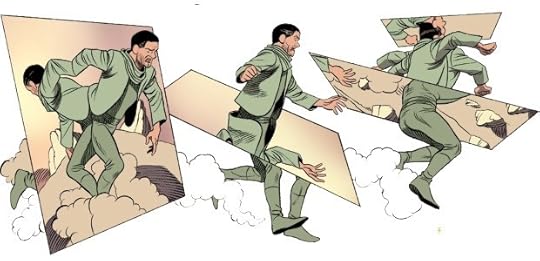
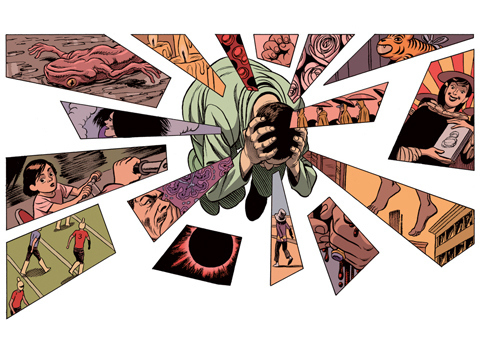
Verloc Nim przegrywa swoje życie. Jego małżeństwo się rozpadło, nadużywa narkotyków a na dodatek stracił źródło utrzymania. Budzi się gdzieś na pustkowiu, i nic nie pamięta. Łącząc skrawki wydarzeń z niedawnej przeszłości, Verloc uświadamia sobie nędzę swojej egzystencji ale i początek czegoś nowego, zupełnie nieoczekiwanego. Na ostatniej odkrytej planecie, w zapomnianej stacji badawczej, dzieją się rzeczy niemożliwe.
Frédérik Peeters (born 13 August 1974, in Geneva) is a contemporary Swiss graphic novelist. He received his bachelor of arts degree in visual communication from the École Supérieure d’Arts Appliqués in Geneva in 1995. Peeters currently lives with his partner Cati, her son, and their daughter in Geneva.
His autobiographical graphic novel Blue Pills received the Polish Jury Prize at the Angoulême International Comics Festival, where it was also nominated for Best Book. Blue Pills also won the Premios La Cárcel de Papel in Spain for Best Foreign Comic. This is his first work to be translated into English.
The promising first volume of what is shaping up to be a trippy yet politically charged sci-fi thriller by Swiss cartoonist Frédérik Peeters. In terms of recent sci-fi comics, it reads like a cross between Remender’s Fear Agent (alcoholism, broken family, need for reunion and redemption) and Graham’s Prophet (amnesia, disorientation, mission) - less obnoxious than the former and more coherent than the latter. Peeters’ drawings are a bit on the simple side, but a great, Moebius-influenced sense of style and gorgeous coloring ensure that the whole thing looks great anyway. What I enjoyed the most, though, were the iconic yet strangely relatable characters. I am certainly on board for the remaining three volumes.
[No spoilers; this review deals with the complete four-volume story, which is how I ordered it and read it -- a book in four chapters. I recommend buying them all if the story appeals to you, and more importantly, if the art appeals to you.]
Aama is a visual masterpiece, IMO; but Peeters' confident ligne-claire simplicity, combined with dry-brush texturing and spot-blacks, makes for a more subtle species of artistic genius and originality. He has used his early Blutch-influenced style for the depth and contrast, and a Giardino-style on the linework, but the synthesis is all him.
Frederik Peeters quietly turned a corner and climbed a fucking mountain some time ago (I guess while I was napping), taking his art from a gently impressive suburban proficiency to an Alpine Eyrie of Euro-comics genius. I've got love enough for both the Metal Hurlant school of high-art/low-story BD, as well as the literate and subtle artistry of those cartoonists published by L'Association and Cornelius; but I had once assumed there was a relatively clear divide between them, like the rigid distinction that once existed between mainstream and underground comics in North America. This is apparently not the case.
Neverthless, Aama is the first real fusion of the two I've read -- with the notable exception of the oeuvre created by the prolific Jacques Tardi -- that wanders freely across genre borders, claiming no citizenship. Peeters has told tales of this kind before, clever and mature science fiction that concerns itself with characters and relationships more than the fantastic setting, most notably with Lupus and Koma -- suitably, the former is available as a gorgeously-produced 500-page hardcover from Peeters' independent publishing concern, Atrabile, while the latter is courtesy of Les Humanoides Associes, the house that Metal Hurlant built (founded by Moebius, Dionnet, et al).
While his previous SF tales are thoroughly excellent, Aama is goddamn brilliant. The story is instantly engaging, the characters are unforgettable, and the art is both unique and stunning. It's a seamless blend of his mainstream and 'alternative' styles, like a fusion of Moebius, Otomo, and Blutch. Only 'Pachyderme' comes near to equalling Aama's 'gorgeousness & gorgeosity'.
This is just the first of four volumes collecting the entire 370-page space saga, the English-language version released by Selfmadehero; all four are available now. Despite being a bit smaller at 8" x 11" than the 9.5" x 12.75" Gallimard French editions, the format is still large enough to fully appreciate the details. They're otherwise very close, using the same thick and glossy art-book stock that I consider necessary for full-color art to look its best. Selfmadehero have been giving English audiences translations of David B.'s historical fiction and non-fiction, like Black Paths and Best of Enemies, as well as some of Peeter's other works, Sandcastle and the surrealistic mystery Pachyderme.
Pachyderme, by F. Peeters:
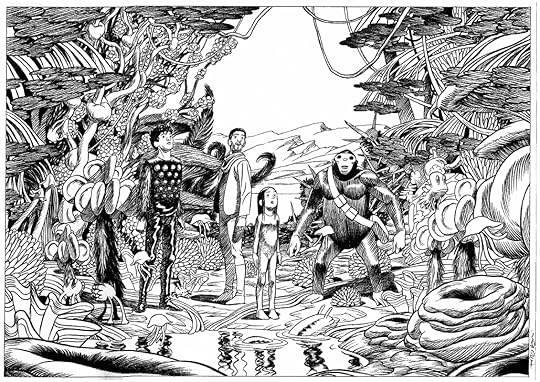
Aama, B & W promo art by F. Peeters:
The artwork really is fantastic in Aama, and it gets more spectacular as the story progresses; the final volume, "You Will Be Glorious, My Daughter", is suitably mind-bending in proper Jodorowsky tradition, but without lapsing into his boring mysticism or awful dialogue. There are obvious similarities to 'The Incal', and I personally think Peeters has done something every bit as impressive -- I'm a Moebius fan, and I know how bold a claim that is. There's also moments clearly inspired by Katsuhiro Otomo's manga masterpiece 'Akira' (including a full-on Tetsuo-type metamorphosis), and Peeters has incorporated the intricate, realistic manga style of Otomo into his own (since the art of Otomo was itself strongly affected by Moebius and Francois Schuiten, that might become a kind of stylistic feedback loop). The expressionistic brush of Blutch has long influenced Peeters as well, and while books like 'Le Vitesse Moderne' are closer stylistically to Lupus and thematically to Pachyderme, his debt to Blutch is still evident in Aama. The evolution of his inking seems properly organic; Lupus has a much looser, sketchier feel, but with thick, confident brush-strokes combined with variegated texturing, reminiscent of the prodigious black-and-white pages of Blutch, Jens Harder, and US-based peer Craig Thompson. Pachyderme is full-color, and while the hatching and spot-blacks are still prevalent, the lines are cleaner. Aama isn't exactly 'ligne claire', but the refined linework suits the intricate details of the SF setting. I wouldn't be shocked to see Peeters return to the style of Pachyderme or Sand Castle for his next book.
There's so many incredible artists working in the comics medium, I almost get tired of throwing out praise. How many different routes can you take to reach the 'I like this' destination? Nevertheless...
I really liked Aama by Frederik Peeters. He draws real good. There. That wasn't so hard. Very concise, for once.
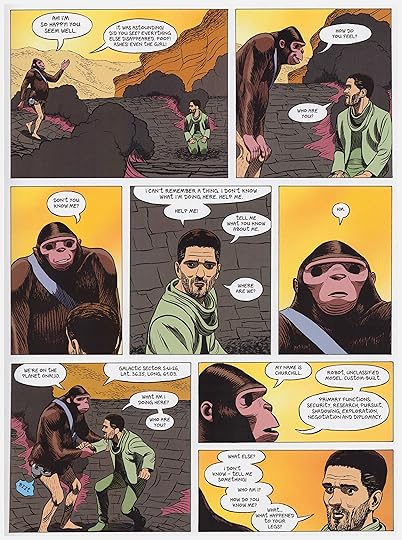
You'd think a book that opens with a man waking up with no memory and reading his own diary about how last week he was a drug addict being picked up out of a puddle by a robot in an ape suit would be memorable, wouldn't you?
That's unfair, though -- I did remember within two pages that I had read this a couple years back and failed to move it from one list to another. I think that I forgot it is due not to poor quality but to the fact that it is very much a beginning of a story. The plot is barely underway, much less resolved.
It is an interesting story, plotwise. The memory loss, the bleak future that is not precisely post-apocalyptic but simply after things have gone pretty badly. Disease, poverty, genetic damage, economic and political corruption. Nothing new. Verloc is a divorced, penniless addict when his lost-unseen (not lost, merely on poor terms) younger brother shows up with his ape robot and asks Verloc to accompany him on a mission to another planet where some sort of experiment was meant to be carried out, but was interrupted by crisis of five years prior. What have the scientists been doing for this years of abandonment? Well, that may be important to them but it isn't to their sponsors, who are more concerned with retrieving their valuable product -- or are they? Clearly more is going on than our lumpenprotagonist is aware of.
The prose is adequate and the art, although rather ugly, suits the story and is narratively fine. By which I mean I never had any difficulty telling the characters apart or distinguishing what was going on with the action. The artists is quite good at subtle expressions and does a lot more with eye contact that one usually sees in graphic novels.
L’odeur de la poussière chaude est le premier tome d’une série de quatre albums (à ce jour) de bande-dessinée, signé par l’artiste suisse Frederik Peeters, publié en 2011 chez Gallimard et primé à Angoulême.
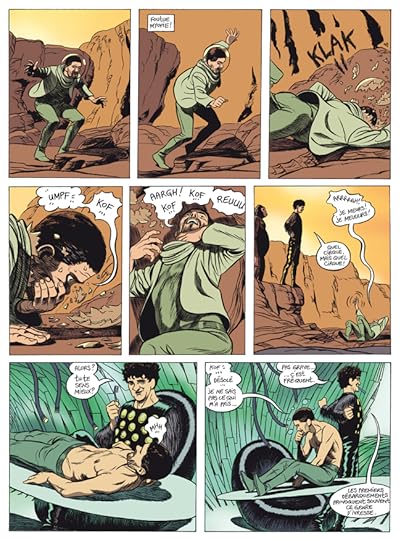
Il s’agit d’un récit de science-fiction où le protagoniste, amnésique et accueilli sur une planète inconnue par un robot singe fumeur de cigares, se rappelle à travers le journal qu’il a lui-même écrit, les péripéties qui l’ont amené là. On y découvre, à travers différents flash-backs emboîtés, les bas-fonds d’une mégalopole qui rappelle celle de Metropolis ou de l’Incal, le voyage vers la planète Ona(ji), le groupe de scientifiques qui y séjourne, dissimulant un mystérieux projet du nom d'Aâma...
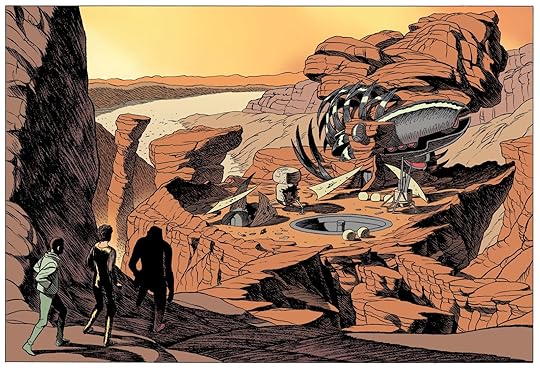
Ce premier volume, s’il fait preuve d'inventivité en jouant avec les lieux communs de la SF, et s’il ménage un certain suspens, laisse toutefois le lecteur un peu sur sa faim (c’est sans doute voulu). Les dessins, souvent en format large donnent la part belle aux décors (le vaisseau spatial tuilé en forme de hérisson est particulièrement original). Les dialogues sont parfois quelque peu maladroits, mais le ton du journal intime est le plus souvent convaincant. Sans doute à suivre...
aama 1. The Smell of Warm Dust Written and illustrated by: Frederik Peeters Translated by: Edward Gauvin
First, before the review, I believe this is the first graphic novel I have read where the author and the illustrator are the same person. I think that Frederik Peeters has done a really decent job at both parts of this book. The art isn't as pretty as some of the comics I'm currently reading, but it's nice nonetheless. The writing was exceptional though, and I think that Peeters has done a great job telling this story.
The Cast of Characters:
Verloc Nim - Main character, addict, will not win father of the year. Conrad Nim - Verloc’s baby brother, works for giant evil corporation (Muy-Tang) as a communications liaison. Churchill - Robotic ape bodyguard. BAMF award goes to him (probably always).
Professor Woland - Not really here, but seems extremely important. The creator of the AAMA experiment. Professor Kaplan - Lady seems to have gone a bit crazy. Master Manipulator. Fulmine - Biorobotics Researcher. Kaplan’s right hand man. Pilgrimm - The colony’s math and computer whizz. Myo - Biotech professor. Also a manipulative lady (by choice or necessity, hope to find out in #2). Dr. Frienko - Colony’s physician. The mysterious little girl - Mute. Looks identical to Lilja, Verloc’s daughter.
Silika - Verloc’s wife (they’re separated). Her boyfriend is the one that helped her to keep Verloc from Lilja (Silika and Verloc’s daughter). Lilja - Mute, daughter, kept from her father.
aama takes place in a distant future, and it starts with Verloc already on another planet - Ona(ji). The story is told through his memories, by him reading entries in his journal.
We see Verloc as this really depressing main character, and honestly, not a character I would ever see as a hero. He wallows in his self loathing and despair, drinking his loneliness away. That is, until his brother comes along, and give Verloc an adventure he didn’t really want, but decided to go on, nonetheless. After all, he didn’t have much going for him in his current situation anyway.
Conrad had been tasked by his company, Muy-Tang, to visit an uninhabited planet, Ona(ji) and to contact a colony that had settled there for the research and experiment conclusions of the colony’s leader, Professor Woland. The colony had shipped out to this isolated planet five years ago, and prior to the Great Crisis (some type of economical collapse).
Verloc, Conrad, and Churchill make their way to Ona(ji), and that’s really where the story begins to unfold, both in plot developments and setting. When they reach Woland’s colony, they discover a lot has happened in the Colony’s five years of isolation on this lonely planet.
The biggest discovery is that the Colony’s leader, Woland, is no longer there. She had taken her project (AAMA) and left.
Why? Well, no freaking clue. The Smell of Warm Dust is definitely a book filled with world building and plot build-ups, and character developments. It should have been a boring book to me, but the artwork, and the writing really kept the story very engaging. I was truly consumed with wanting to know more about the characters and where the story was going, and when I reached the end, I really wanted to just pick up the next one and get back into this world ASAP.
However, I knew if I did that, I wouldn’t end up writing out this review, and I really wanted to. This book is definitely worth looking into, but be prepared that it does take a little bit to get going, and with only 88 pages, I think some of the build-up was unnecessary.
But, who knows? I’m hoping that a lot of this build-up gets used in Book 2, and if that’s the case, then of course, it was important.
I’m really looking forward to continuing Verloc’s story. I think he’s going to end up being an unlikely hero, a character that redeems himself, and becomes someone that I will admire and respect. I hope so anyway.
Aama was created by the author of mysterious Pachyderme. This one has some of that mysterious feel to it, but more sci fi thriller, it would appear. This is the first of five books, so as usual if I get into it more I might reread this and reassess, but for now I have to warm up to it a bit more. Lots of interweaving narratives, lots of hooks. Verloc is a drug and alcohol addicted delinquent father--our "hero"- and his brother Conrad, who sort of rescues him and his gorilla robot sidekick, Churchill, works for some multi-galactic corporation. They visit other worlds. The father-brother stuff is supposed to humanize the world Peeters is creating. A woman Verloc gets to know may function in this way, too. There's this mix of existentialism and sci-fi thriller he is going for. I think Peeters is better at the mysterious feel than the sc fi, artistically, but the art is well done, for sure, overall. Apparently a lot of people like it or liked it a lot, as it was the winner of the Angouleme International Comics Festival, 2013, and just began releasing here in fall of 2014.
I was led to Peeters through his first translated text here, Blue Pills: A Positive Love Story, which is a memoir about his marrying an HIV-positive woman and having a traditionally conceived child with her. I got connected to that book because I had heard Craig Thompson had been influenced by Peeters, and I like graphic memoirs, and liked that book a lot, and generally like them more than gn sci fi stories, but this sci fi graphic tale seems pretty good to me so far, but not much has happened yet. Mostly world-building.
Taken as a whole (4 parts) I think this is one of the best sci-fi comics I've read. Brings to mind movies like Bladerunner and 2001 but with enough originality to stand on its own.
Ce qu'il y a de bien avec la science-fiction c'est que l'on découvre l'univers en même temps que l'histoire. En marge de l'intrigue et des personnages, la découverte et la compréhension du monde constituent à eux seuls un plaisir intellectuel. Dans ce domaine, les bons auteurs de SF excellent et trouvent toujours des technologies, des systèmes sociaux ou politiques originaux et intelligents qui poussent le lecteur à la réflexion. Il pense à leur transposition possible dans le monde réel ou, plus subtilement, à reconsidérer son univers à l'aune de ces nouveautés.
Arrêtons là ces digressions pour parler de cette BD qui m'a inspiré ce commentaire introductif. L'auteur a su créer un univers particulièrement original — sans l'être trop — et intéressant, le dessin donnant corps et cohérence à l'ensemble. Au fur et à mesure que l'histoire progresse et, au delà de la découverte de l'univers dont nous avons déjà parlé, on découvre des personnages profonds. Loin des stéréotypes de la SF, ils sont complexes et n'ont pas livré l'intégralité de leur caractère dès les premières cases. Ils cachent encore leurs failles et de faiblesses. Ajoutez à ceci de l'aventure et de la profondeur dans l'exploration des sentiments et vous obtenez une BD de très grande qualité.
Le tout est servi par un schéma narratif efficace. La BD débute alors que le personnage principal se reveille sans souvenir. C'est en consultant les notes prises dans son carnet qu'il va reconstituer ce qu'il lui est arrivé dans le passé alors que l'histoire continue à évoluer dans le présent. La narration avance donc sur deux plans temporels distincts. Je ne suis pas spécialiste de science-fiction en bande dessinée, mais c'est l'un des tout meilleurs album que j'ai lu. J'ai été séduit par son originalité et sa profondeur sans oublier une mention particulière pour les dessins. Cet album prouve qu'il est possible de concevoir une oeuvre de qualité sans faire de concession à la compréhension. De la très grande BD et la suite arrive.
PS: Je ne suis pas du tout fier de mon article, je pense que mon inspiration est inversement proportionnelle à mon admiration pour les oeuvres dont je parle. Plus j'aime et plus je suis mauvais pour en parler — je dois être tétanisé par le talent des auteurs ou juste mauvais. Vous jugerez donc, grâce à cette indication, que ce livre vaut vraiment le détour. http://www.aubonroman.com/2013/10/aam...
Book blurb: In the distant future, Verloc Nim wakes up in the middle of nowhere suffering from complete amnesia. He remembers nothing of his former life. But when Verloc is handed his diary by a robot-ape called Churchill, he is able to revisit his past.
This sci-fi graphic novel, the first in the Aama series, is a bit perplexing for me. I liked some of the ideas in the book - who could not love Churchill, and where can I get one of my very own? - but, overall this book felt like a barely remembered dream. Maybe that was the point, but I was not along for the ride. The art is not to my taste, but the coloring is really well done. Still, I'm intrigued enough with the premise that I've got the rest of the series on request from my library.
Devo ammettere che a forza di non aver bisogno di nessuno mi ero ritrovato solo al mondo
Robot, correzioni genetiche, prodotti tecnologici rivoluzionari… Non sono appassionata di fantascienza, ma ogni tanto mi piace uscire dalla mia confort-zone e questo primo volume di aâma mi ha coinvolta. Il protagonista ha perso famiglia e lavoro. È pieno di problemi che cerca di affogare nello shia -una sostanza stupefacente- quando un incontro fortuito lo costringe ad un nuovo inizio, ad un viaggio ai confini della galassia che lo porterà a sentire l’odore della polvere calda e il profumo d’avventura. Interessante la ricostruzione a ritroso affidata ad un mezzo quasi dimenticato in un mondo ipertecnologico: un quaderno di carta scritto a mano. Tanti i punti ancora da scoprire non solo degli eventi sul pianeta Ona(Ji), ma anche del passato di Verloc. Belli i disegni.
Good mysterious sci-fi adventure. A lot happened but still doo not have idea much what exactly is happening. Characters are interesting and likeable. I do not like the artwork, but I got used to it while I was reading, it fits the story well. 1/4 volumes so I hope I will get explanations for some things I am confused about. Things that could maybe tell yout ot give a try? One man who lost his father's shop, his wife and daughter. His brother who is important guy and has toothbrush in his mouth most of the time because is obssesed with hygiene. His companion and bodyguard - robot-ape Churchill. Other robots. 3,5/5
Es un caso particular el de Frederik Peeters y su estilo de hacer cómics. No voy a decir que me parezca sobrevalorado, sino mas bien que, aun dejándome con buen sabor de boca, no me llegan de la misma manera que al gran publico o a la critica. Me pasó con "Lupus", su otra gran saga con ambientación de ciencia ficción y algo menos con "Píldoras Azules".
Aun así, son 4 estrellas relativas que significan mas que no voy a comprar esta saga, porque vale su buen dinero, pero si que me interesa lo suficiente para llevármela de la biblioteca. Lo mismo que hice con Lupus, y no así con "Píldoras azules" que si que compré.
En la linea de sus protagonistas imperfectos, aquí conocemos a Verloc que se despierta en un planeta que le es extraño, sin recordar ni su propio nombre y asistido por un gorila robot fumador de puros llamado Churchill que parece conocerle. El mono le da a Verloc un diario que este empezó a escribir unos días, y así vamos aclarando que ha ocurrido y porqué está en ese planeta.
Tiene lo suficiente de locura para interesar e ir a por el segundo tomo. No cuento mas de la trama y eso lo dejo un poco mas para el segundo tomo, pero tiene que ver con una colonia en un planeta muy lejano, que queda incomunicada durante unos años por culpa de la gran crisis y una decisión de la empresa. Solo que como pasa con la ciencia ficción de Peeter, realmente eso no es lo importante, sino que lo son las circunstancias personales del protagonista. Y tiene un mono que reparte hostias como panes, y esa suele ser una carta ganadora.
This was pretty damn out there and I'm not sure if I liked it or not. I have volume 2 sitting in front of me so maybe I'll have a clearer picture after I finish that one.
Frederik Peeters has his own style of sci-fi, both visually and story wise. There is a curious mix of playfulness (the robot character being "ape-oid" and not android, for instance) and classic space adventure themes, a refined sense of humour, an impressive style in his character design, somewhere between realism and an european young adult BD look and then all things alien are absolutely gorgeous.
This will be a short review for the first 3 volumes with no spoilers. The way the story develops from volume to volume makes the series worth reading: the story really advances, and a lot of things happens. The narratives inside a narrative work well. As we can see in the first few pages, the main character is trying to remember what led to the present moment. The story unfolds from the recent past to the moment that character fights to get his memory back. Aama is something I maybe should not refer to, in a review of the first volume. Let's just say it reminded me of two films ("Nausicaä of the valley of the wind" and the recent "Annihilation").
Peeters is confortable both with text+image storytelling and moments when the narrative occurs only in images, and he keeps alternating both. This is something that has other good examples, and usually occurs with a great artist that does the whole book (writes and ilustrates), like Bilal in his recent trilogy or Mœbius in his "Le Monde d'Edena". The creativity we see in Aama is both wild and very coherent, and a feast for the eyes.
A wonderful first installment in Peeters's Aama series. The story is gripping, and the characters -- esp. Verloc -- are complex enough that you want to know more about them. In fact, the entire narrative makes you yearn for more. The story so far is like an elaborate sci-fi mystery. The worse thing about this book is that I have to wait until the next installments to find out what happens...or what has happened. But what I appreciate most about this book is its elaborate storytelling. There are multiple levels of narration going on here, stories on top of stories on top of stories. Peeters handles it well, so much so that while you admire the complexity of the narration, you are still able to stay on track and not get lost.
I don't recall how this graphic novel (1st of 4 parts) from Swiss artist Frederik Peeters ended up on my reading list, but I am glad it did. The story is a very humanist science fiction, with many threads not yet revealed. Big (and likely genetic) things have happened in the very recent past. I am pleasantly reminded of one or two Space 1999 stories. Looking forward to reading the other three volumes.
Aama vol. 1 begins the story with futuristic socialrealism - but later will turn the volume up as a politically charged sci-fi. We meet our washedout hero who wakes up in nowhere, only accompanied by an robot ape.
From there on we find out he was taken on a journey by his more successful and likeable brother who works a a major company. As we explore the story through flashbacks and dreams, we delve into the ethics of human relaionship with themselves and technology - accompanied by a thorough worldbuilding. The characters are well-deveoped and sympathetic even in their more unsympathetic moments, all in all a treat to read.
Le pongo un cuatro por su gran imaginación visual, incluyendo ese robot con forma de simio que fuma puros y los paisajes alienígenas. También por la forma correcta de organizar la narración.
El pero que le pongo a esta y otras historias del autor es la futilidad de la trama, de poca consistencia y aires new age un poco empalagosos.
On découvre cette nouvelle planète en même temps que le personnage principal. Surtout avec un robot chimpanzé qui fume le cigare. Je suis juste moins fan de l’art côté BD. Les visages me plaisent moins et les quelques phrases sont un peu navrantes. Correct ds l’ensemble.
‘’Mais certaines personnes comme ça savent inspirer d’emblée confiance, et mentent avec aplomb et une adaptabilité stupéfiants. Des personnes qui savent parfaitement dissimuler un poignard au creux d’une main tendue.’’•§₽36
Trippy art and an intriguing world make up for a meandering story. I like the Churchill character but the main character Verloc doesn’t really do much and is just being pulled around by the plot. This is a decent set-up for the series but could have been better.
All 4 volumes tell one single story which I read straight through (in the English translation), so I'll comment on the whole thing at once. (No spoilers).
The artwork is very clear and beautiful. The drawings of the future city and it's inhabitants are quite nice, and who wouldn't like a cigar-smoking robot ape. But the real stunner for me is the freaky, hallucinatory landscapes and creatures on the strange planet. The creatures are truly alien-looking and imaginative, reminding me of the animated French films Fantastic Planet and Time Masters. (This aspect is most pronounced in volumes 2 and 3.)
The story is told in multiple levels of flashbacks, and even in dreams. And yet it was easy to follow which time period you were in at all times. That was masterful. That doesn't mean I understood everything. I don't think you are supposed to.
In interviews, the author/artist cites as top inspirations Ray Bradbury and Stanislaw Lem, and those influences seem clear. As in their work, the story takes precedence over issues of absolute scientific plausibility. I will never be able to accept the plausibility of microscopic machines that can manipulate reality at a molecular level, at least not to the extent displayed here.
The final volume was a bit disappointing to me. It does tie the story together in a logical way -- though I had to re-read volumes 1 to 3 to see that -- but it was just a bit more of an action story, almost a superhero story, than the rest, and felt like a let-down.
I very much look forward to reading more from this author/artist.
Op de achterzijde van dit boek wordt terecht verwezen naar de sci-fi van Moebius en Bilal. Er valt niet te kijken naast de invloeden die Peeters in 'Aāma' verwerkt. In mijn ogen komt hij met een mooier resultaat dan zijn voorbeelden op de proppen. Dit is te wijten aan de manier waarop de emoties van de personages zijn uitgewerkt, ze voelen zo echt aan in deze dystopische wereld een wereld waarin alles in handen lijkt van de industrie (zelfs de mogelijkheid om gezonde lucht in te ademen). Het boek gaat (als de beste sci-fi) moralistische en ecologische vraagstukken verre van uit de weg. Het einde van dit eerste deel laat de lezer hongerend achter, er valt nog heel wat te verklaren en te beleven. Bij het verschijnen van het tweede deel zal het een plezier zijn dit eerste deel te herlezen. Dit is één van de weinige grote stripparels die er tot nu toe in 2014 in het Nederlands zijn verschenen. In 2013 werd deze vierdelige reeks (na het verschijnen van het derde deel) uitgeroepen tot 'Beste Serie' op het stripfestival van Angoulème wat me het beste doet vermoeden voor de vervolgen die we nog tegoed hebben.
P.S. Kan een uitgever als SAGA of SHERPA alsjeblieft LUPUS vertalen (eventueel in de vorm van een integrale) ? Deze Aāma bevestigt nogmaals hoe stiefmoederlijk Peeters in het Nederlandse taalgebied wordt behandeld.
I came across Aama at the Toronto Comic Arts Festival. The hardcover art was so compelling, especially of vol. 4, that I made a rash decision to pick up the first two volumes and hope I liked it.
I didn't, though. I loved it.
Volume 1 is rife with mystery that sets up the remaining 3 volumes. I'd give vol. 1 4 stars if only because Peeters establishes a difficult to parse narrative mode which, while compelling, can leave you a touch confused at times at the expense of storytelling. But these are minor things and the further you dig into the ensuing volumes, the clearer they become (even as the plot becomes even more abstracted and existential).
I'll be giving vols 2-4 5 stars.
This is as close to a must-read series as you can find. It's challenging in its humanist subject matter. It's beautiful in the familial relationships it presents. And it's viscerally exciting as you join these characters into a world you simply cannot predict and will delight in exploring. It's not frequently you can say that in sci-fi these days, where tropes and styles are recycled many times over. This book is fresh, solidified by its unique art, as detail-oriented as Killian Eng but with a brighter colour palette and take on what it means to be "alien."
I'd rather not dig into synopses because this is simply one to be experienced. Find time for it. And read it as quickly as you can - I'd recommend not taking any breaks between volumes to keep the cohesiveness of the story intact.
O que mais impressiona em Aâma é a capacidade de seu autor, Frederik Peeters, de criar um mundo ficcional totalmente diferente do nosso, tanto em conceitos como em visuais. O inusitado, irônico, engraçado, contudo, foi que essa obra do quadrinista me lembrou outra obra de quadrinhos de ficção científica europeia que é Nathan Never. O fumetti de Never também trabalha com explorações espaciais e com a irresponsabilidade paterna de cuidar de uma família. Contudo, Peeters é um suíço radicado na frança e os criadores de Nathan Never são italianos. De qualquer forma, podemos ver que os europeus possuem uma visão da ficção científica de uma forma diferente da dos americanos: a deles é mais séria e mais interpessoal, enquanto a dos americanos, geralmente serve para acudir determinados anseios e frustrações daquela sociedade. Vale lembrar que Peeters também é autor do premiado e elogiado quadrinho Pílulas Azuis, sobre seu relacionamento com uma mulher que possui o vírus HIV. Conseguir se posicionar entre a realidade e a ficção científica de maneira tão desenvolta mostra que Peeters é realmente um autor pau para toda obra.