Jump to ratings and reviews
Rate this book

The Mahabharata

Rate this book
The Mahabharata is some 3,500 years old and is the longest poem in any language. It is one of the founding epics of Indian culture and, with its mixture of cosmic drama and profound philosophy (one small section forms the BHAGHAVAD GITA) it holds aunique place in world literature. In this drastically shortened prose rendering, Narayan uses all his extraordinary talents to convey to a modern reader why this is such a great story. Filled with vivid characters, obsessed with the rise and fall of gods, empires and heroes, Narayan's MAHABHARATA is an enormously enjoyable experience and the perfect introduction to the otherwise bewildering Indian cosmology.

ebook

First published January 1, 1987

160 people are currently reading
3198 people want to read

About the author

R.K. Narayan

143 books1,930 followers
R. K. Narayan is among the best known and most widely read Indian novelists who wrote in English.

R.K. Narayan was born in Madras, South India, in 1906, and educated there and at Maharaja's College in Mysore. His first novel, Swami and Friends and its successor, The Bachelor of Arts, are both set in the enchanting fictional territory of Malgudi and are only two out of the twelve novels he based there. In 1958 Narayan's work The Guide won him the National Prize of the Indian Literary Academy, his country's highest literary honor.

In addition to his novels, Narayan has authored five collections of short stories, including A Horse and Two Goats, Malguidi Days, and Under the Banyan Tree, two travel books, two volumes of essays, a volume of memoirs, and the re-told legends Gods, Demons and Others, The Ramayana, and the Mahabharata. In 1980 he was awarded the A.C. Benson Medal by the Royal Society of Literature and in 1982 he was made an Honorary Member of the American Academy and Institute of Arts and Letters.

Most of Narayan's work, starting with his first novel Swami and Friends (1935), captures many Indian traits while retaining a unique identity of its own. He was sometimes compared to the American writer William Faulkner, whose novels were also grounded in a compassionate humanism and celebrated the humour and energy of ordinary life.

Narayan who lived till age of ninety-four, died in 2001. He wrote for more than fifty years, and published until he was eighty seven. He wrote fourteen novels, five volumes of short stories, a number of travelogues and collections of non-fiction, condensed versions of Indian epics in English, and the memoir My Days.

-Wikipedia & Amazon.co.uk

Ratings & Reviews

What do you think?
Rate this book

Friends & Following

Create a free account to discover what your friends think of this book!

Community Reviews

5 stars
1,021 (44%)
4 stars
755 (32%)
3 stars
438 (18%)
2 stars
82 (3%)
1 star
24 (1%)
Displaying 1 - 30 of 140 reviews
Profile Image for Terence.
1,311 reviews469 followers
March 31, 2014
R.K. Narayan’s abridged, prose version of India’s national epic, The Mahabharata, is concise, fast paced, well written, and – unfortunately – passionless. Narayan has excised nearly everything not directly related to the Pandavas (Yudhistira, Bhima, Arjuna, and Nakula and Sahadeva) and their wife, Draupadi. In the process, he’s also stripped the story of any emotional power. For the most part, it’s like reading a book summary rather than a proper story. For example, there’s the chapter that has come down to us as The Bhagavad Gita, one of the more profound scriptures by anyone’s reckoning. In Narayan’s telling, it’s reduced to:

When Arjuna fell into a silence after exhausting his feelings, Krishna quietly said, “You are stricken with grief at the thought of those who deserve no consideration.”

Krishna then began to preach in gentle tones, a profound philosophy of detached conduct. He analyzed the categories and subtle qualities of the mind that give rise to different kinds of action and responses. He defined the true nature of personality, its scope and stature in relation to society, the world, and God, and of existence and death. He expounded yoga of different types, and how one should realize the deathlessness of the soul encased in the perishable physical body. Again and again Krishna emphasized the importance of performing one’s duty with detachment in a spirit of dedication. Arjuna listened reverently, now and then interrupting to clear a doubt or to seek an elucidation. Krishna answered all his questions with the utmost grace, and finally granted him a grand vision of his real stature. Krishna, whom he had taken to be his companion, suddenly stood transformed – he was God himself, multidimensional and all-pervading.

Time, creatures, friends and foes alike were absorbed in the great being whose stature spanned the space between sky and earth, and extended from horizon to horizon. Birth, death, slaughter, protection, and every activity seemed to be a part of this being, nothing existed beyond it. Creation, destruction, actity and inactivity all formed a part and parcel of this grand being, whose vision filled Arjuna with terror and ecstasy. He cried out, “Now I understand!”

The God declared, “I am death, I am destruction. These men who stand before you are already slain through their own karma, you will be only an instrument of their destruction.”

“O Great God,” said Arjuna, “my weakness has passed. I have no more doubts in my mind.” And he lifted his bow, ready to face the battle. Krishna then resumed his mortal appearance. (pp. 147-8)


If all you’re looking for is a readable English synopsis of the epic, then I would recommend this book. But if you’re looking for an English version that captures the gravitas of the original, you won’t find it here.
Profile Image for miaaa.
482 reviews420 followers
July 26, 2011
Bagi seseorang dengan daya ingat yang pendek, terutama soal nama, awalnya membaca kisah epik Mahabarata ini merupakan sebuah tantangan. Untungnya sang penulis, mungkin penerjemah dan penyunting juga, paham mengenai kerumitan nama Sansekerta ini sehingga membuatkan daftar tokoh dan tempat serta glosarium. Tidak ketinggalan juga silsilah keluarga para Pandawa dan Kurawa yang dimulai dari Santanu. Bisa dibayangkan setiap bertemu dengan satu karakter akan kembali ke daftar tersebut untuk memastikan siapa orang ini.

Namun ternyata kerumitan tidak berhenti di situ saja, selain mengingat nama ternyata hubungan satu tokoh dengan yang lain juga njlimet. Rasanya seperti saat kecil diminta bantuin emak mengurai benang sulamannya yang kusut. Kunci kesuksesan membaca buku ini ternyata membaca dengan perlahan dan seksama dalam tempo yang mengalir juga.

Alkisah Santanu, seorang raja dari sebuah kerajaan kuno, menikahi seorang perempuan yang tujuh kali membenamkan setiap bayi yang dia lahirkan ke sebuah sungai. Santanu terikat janji untuk tidak akan pernah mempertanyakan apa yang dilakukan oleh istrinya ini. Namun ketika istrinya, yang ternyata adalah Gangga sang dewi sungai, membawa putra kedelapan mereka, Bhisma, ke sungai itu Santanu menghentikannya. Tak lama berselang Santanu bertemu putri seorang nelayan dan jatuh cinta, namun sang putri berkehendak agar keturunannya yang akan menjadi penerus kerajaan Santanu. Dan Bhisma pun mengucapkan sumpah akan selibat dan tidak memiliki keturunan agar ayahnya bisa menikah dengan sang putri.

Dan dimulailah kerumitan silsilah. Setyawati, sang putri nelayan, memiliki dua putra dari Santanu namun keduanya tewas sebelum memberikan keturunan. Sebelumnya Bhisma melarikan tiga putri Amba, Ambika dan Ambalika untuk dinikahkan kepada Wicitrawirya, putra Setyawati dari Santanu yang akhirnya jatuh sakit dan meninggal. Karena Bhisma berpegang teguh dengan sumpah selibatnya, Setyawati akhirnya memanggil Vyasa putra hasil hubungannya dengan resi Antasara. Dari Ambika, Vyasa melahirkan seorang putra Destarastra yang buta sejak lahir karena ibunya memejamkan mata saat bersenggama. Dari Ambalika, lahirlah Pandu yang kulitnya pucat serta Widura putra Vyasa dari seorang pelayan yang menggantikan tempat Ambalika.

Destarastra sang pewaris kerajaan memiliki 100 putra dari istrinya Ghandari, sebenarnya agak kaget juga mengetahui seorang ibu bisa melahirkan 100 putra namun yah namanya juga epik. Yang unik adalah Pandu yang dikutuk akan meninggal saat bersenggama, namun beruntung sekali Kunthi istrinya pernah mendapat berkat sehingga bisa memanggil Dewa untuk mendapat anak dari mereka. Kunthi melahirkan tiga putra [Yudistira, Bhima dan Arjuna:] dari tiga dewa berbeda [Batara Yama, Batara Bayu dan Batara Indra:], sementara Madrim istri kedua Pandu melahirkan si kembar, Nakula dan Sahadewa dari dewa kembar Aswin.

Di titik ini aku mendapat pelajaran menarik bahwa setiap tindakan yang kita lakukan atau ucapan yang keluar dari mulut kita berdampak atas kejadian di sekitar kita. Amba bertransformasi menjadi prajurit pria bernama Srikandi karena beberapa kali diping-pong antara Salwa dan Bhisma. Bagiku agak aneh Amba memendam kemarahan kepada Bhisma, dan menyebabkan sang sesepuh tewas dalam pertempuran antara Pandawa dan Kurawa di Kurusetra, tetapi tidak kepada raja Salwa.

Srikandi yang ditempatkan Arjuna di sisinya menyerang Bhisma yang menjadi jenderal perang pasukan Duryudana dan saat itu juga Bhisma menyadari ajalnya telah tiba. Dia menangkis semua anak panah Arjuna tetapi membiarkan anak-anak panah Srikandi yang mengenai tubuhnya. Pertempuran berhenti ketika Bhisma jatuh dan Arjuna menancapkan sebatang panah ke tanah dan air memancar dari situ langsung ke mulut Bhisma, yang kehausan di penghujung ajalnya.

Sama halnya dengan Kunthi yang melahirkan Karna, putra Batara Surya, dan membuangnya ke sungai dan kemudian dirawat dan dibesarkan oleh Rada istri seorang kusir. Jika Kunthi mengakui keberadaan Karna, mengingat semua putranya lahir dari ayah yang berbeda, maka bisa jadi dia tidak akan mati di tangan Arjuna dan Yudistira tidak akan meratapi kematian orang yang seharusnya menjadi kakak sulungnya itu.

Pertemuan Karna dengan Kunthi sebelum peperangan berlangsung di buku ini sedikit berbeda dengan pertunjukan yang ditonton Rahel di the God of Small Things. Dalam pertunjukan tersebut diceritakan bagaimana Karna berkata bahwa satu-satunya alasan Kunthi memintanya tidak berperang melawan Pandawa adalah demi keselamatan kelima putranya sementara di buku ini Karna lebih memilih berperang bersama Duryudana karena dia telah mengucapkan sumpah untuk berperang di pihak sepupunya tersebut. Walau memang akhirnya dia bersumpah bahwa dia hanya akan melawan Arjuna sehingga jika salah satu mati, Kunthi masih memiliki lima putra.

Semua menyayangkan kesetiaan Karna pada Duryudana, termasuk Vyasa dan Bhisma. Kematian Karna juga tragis karena di saat-saat genting roda kereta kudanya terperosok lumpur dan dia lupa mantra Brahmastra yang dimilikinya. Ternyata kedua kejadian tersebut akibat kutukan yang dijatuhkan atas Karna karena dua tindakan yang pernah ia lakukan. Melihat Karna dalam keadaan putus asa Arjuna sempat ragu-ragu namun Krishna, inkarnasi kedelapan dewa Wisnu, mendesaknya terus hingga Arjuna mengangat Gandiwa, busur besarnya dan melepaskan sebatang anak panah yang memenggal leher Karna.

Perang pun selesai, Destarastra dan Ghandari kehilangan 100 putranya [seharusnya 99 karena Wikarna menyeberang dan bergabung dengan Pandawa, namun mungkin Karna dihitung menjadi adik Duryudana karena kesetiaannya:]. Yudistira yang bersedih ingin menyerahkan kerajaannya kepada Arjuna dan menjadi pertapa karena kemenangan yang mereka raih mengorbankan Bhisma, Drona, Karna, Abimanyu, dan Gatutkaca. Namun akhirnya dia tetap menjadi raja dan membagi tugas kerajaan kepada adik-adiknya dengan adil sesuai kemampuan masing-masing.

Pemerintahan itu berjalan dengan damai. Destarastra, Ghandari dan Kunthi bersemadi ke hutan dan meninggal saat hutan tersebut terbakar. Pengikut Krishna, Vrishnis, saling membinasakan dalam suatu perang saudara. Krishna sendiri, yang punya andil besar dalam pertempuran antar dua keluarga dari wangsa Kuru ini, tewas ketika sedang beristirahat dan pemburu yang lewat memanah telapak kakinya karena mengira itu seekor burung. Kesedihan akibat kematian Krishna menyebabkan kelima Pandawa dan Drupadi memutuskan untuk meninggalkan dunia ini.

Dengan demikian tidak ada satu tokoh pun yang tersisa, kecuali putra Abimanyu yang dilindungi Krishna bahkan ketika masih berada di dalam rahim ibunya. Ia tumbuh dewasa untuk menjadi Raja Hastinapura dan melanjutkan garis keturunan Pandawa. Agak sedikit penasaran sih karena entah mengapa nama putra Abimanyu dan cucu Arjuna ini tidak disebutkan dalam buku ini.
Profile Image for Alan (on December semi-hiatus) Teder.
2,705 reviews251 followers
April 16, 2025
Pandavas vs Kauravas Highlights
A review of the University of Chicago Press eBook (February 12, 2016) of the original Vision Books hardcover (1987) adapted from the ancient Sanskrit verse epic (c. 2000 -400 BCE).
The main story is accepted on all hands and beyond all argument: once upon a time in ancient Hastinapura lived a royal family—with five brothers of divine origin on one side, and their one hundred cousins on the other, at war with each other.
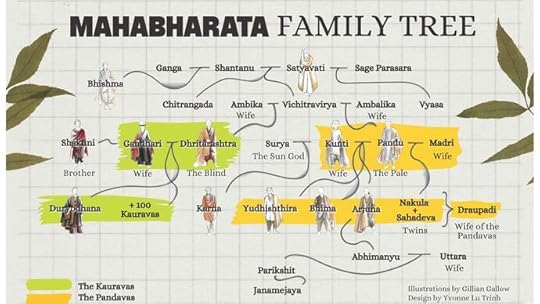

Mahabharata Family Tree used for the 2023-2025 Why Not Theatre production.

I was seeing the Why Not Theatre stage adaption Mahabharata (2023) at Toronto's Canadian Stage and wanted to read a condensed version of the plot. This book was ideal for that purpose but anyone reading should know that all they will get is the broad strokes of the rivalry and eventual war between the 5 Pandava brothers vs. their 100 Kaurava cousins.

So it is essentially the marriage and birth stories, the start of the conflict, the attempted murder via a house arson, the gambling away of a kingdom in a fixed dice game, a 13 year exile and eventual emergence from hiding, the 18-day war and death of many, an eventual peace.

All of the philosophy and ponderings are skimmed over. For example, the normally book length The Bhagavad Gita with Krishna's teaching to Prince Arjuna of the Pandavas is basically summarized in a few paragraphs.


Krishna reciting the Bhagavad Gita to Prince Arjuna on the Kuru Field of Justice. Image sourced from Quora.

Also, the nasty bits are censored or glossed over. e.g. the Pandavas substitute a lower-caste family into the house that the Kauravas will burn down so that there will be corpses to fool them into thinking their plan succeeded. The bloodshed on the battlefield is skimmed over. etc.

Trivia and Links
A complete English translation of Mahabharata is available in the 10 volume Mahabharata series translated by Bibek Dibroy and published by Penguin Books (2015). This totals several thousand pages.

The version by the Bhandarkar Oriental Research Institute (BORI) is considered the most thorough authorized edition and is usually the basis for most translations.

There is an online edition at Wikisource in Sanskrit here and an in progress transcription of Kisari Mohan Ganguly's English translation (1883-1896) here.
Profile Image for Omar Ali.
232 reviews242 followers
April 30, 2014
A great easy to read version of the story. Everything that is out there is in here...what is not here, is nowhere.
175 reviews20 followers
October 7, 2019
The Mahabharata is one of the most complex stories I have ever read. I read this book following The Ramayana by R.K.Narayan. The ethical dilemmas presented in this story is at a whole different level than Ramayana. While in Ramayana, there are good guys and bad guys in Mahabharata there is nothing like that.

No one is entirely good or no one is entirely bad. The Pandavas and Kauravas are brothers, just competing against each other, but their quarrel reaches to a level for war.

Coming to the war, which is an important topic of this story, the book has 3 chapters dedicated to the avoidance of war and only one chapter for the war.

In spite of suffering all the atrocities presented by Duryodhana, Pandavas realize that war is not good for anyone, and try for multiple attempts to prevent the war. Duryodhana plays politics and chooses to listen, and highlight points only which could give a chance for war.

And when it comes to war, Pandavas understands that a deterministic outcome is achieved by eliminating everyone in the enemy camp, even babies. So, after trying to avoid war, when the war becomes inevitable, Krisha proposes and leads a _genocide_ against the Kaurava clan.

To me, the most complex characters in this story were that of Karna and Krishna.
Karna has chances to prevent war, he understands his background well but still chooses to side with Duryodhana. Krishna is one who leads the Pandavas to war and gives guidance "on duties" in ambiguous times.

There is no good or a bad person in this entire story.
Profile Image for Swapnil.
42 reviews7 followers
April 26, 2020
I picked this book for my admiration for this epic and how much I had enjoyed R. K. Narayan's Malgudi Days in my childhood. Unfortunately, I was thoroughly disappointed. Even though Narayan in his Foreword clears that he cannot make it sound as lyrical it is in the original Sanskrit, this shortened version is terse, quick and also completely lifeless.
Mahabharata was one of my first books as a child, and I can still recount the small anecdotes and accidents that the epic is famous for. Until now, it was impossible for me to conceive of any manner of retelling the story which could be this drab. Although, I have a lot of respect for Narayan, this book is more of a boring timeline and I can place no association of this with the 'story.' If you want to know the story in an abridged version, I would rather recommend you to ask your grandparents or somebody you know who has read it to tell it to you rather than read this.
Profile Image for Amalia Dillin.
Author 30 books287 followers
Read
December 10, 2014
Now I want to read a more extended version.

although even the shortened version felt very reminiscent of the kinds of digressions which are in the Iliad.
Profile Image for Karina Paramitha.
41 reviews1 follower
August 31, 2019
This book left a good mark in my heart and mind. Vyasa was indeed a wonderful philosopher.
Profile Image for Ajay.
56 reviews28 followers
May 18, 2013
Long while ago, while I was deputed back to a different city, I was so desperate to spend my time in contemplation after reading a book. I thought this particular effort will weed away the time. By then , several of my endeavour with various genres have never satisfied my appetite , even though I enjoyed reading them. As I have read almost the entire collection of R K NARAYAN, I have just kept the Indian epics away for a while to prepare my mind amidst the hectic work. Time just waned away and at one point, I thought of giving it a try. Although I am a sort of person who would like to flip the pages of a book in a single sitting, I just kept down my speed and spent more time in reading this book. The amount of time I was on contemplation really proved how depth the content were and it was not just the story that was so gripping , but also the life lessons one could take away from it. Although things weren't so apparent , I kept brooding over all the stuffs depicted in the story.

I sobbed with Draupati when she was pulled down in the assembly of dice played. I kept brooding over duriyodhana's and Sakuni's deceit that made pandava's life miserable. I lived with Yudhistrar, Bhima, Arjuna and with Drona, Bhishma and Satyavathi.

The family tree the author has put forth after the preface was very helpful at times as the number of characters involved in Mahabharata story is way high than any epic.

When I was In a dilemma to select a suitable author to read this life teaching epic, there were many in the cards. Of all , I chose RKN with the strong belief in his penman ship and of course every time I pen down a review of his books, I have never missed to praise his penmanship. As my thirst of reading texts kept growing, I invariably feel low to believe that RKN is no more.
Profile Image for aba.
5 reviews19 followers
September 7, 2015
This shortened version must have taken all the juice out of the original. It gave me very little except for a family tree of over 20 names who apart from Bhisma, Krishna and Arjuna left few impressions of themselves apart from their names. I'd try the longer version (for which this could serve as a summary if you want to prepare) or don't try it at all..
Profile Image for Aman Sharma.
61 reviews2 followers
June 22, 2020
Yudhistira's Grief after the end of the war is something I have faced and many do one time or the other. That is the thing about great fictions. They capture minute realities to such perfection. Whether it be straight or woven in fantasies is just a choice of the masters hands which are at work of his expanding mind. Vyas🙏
Profile Image for Kristi.
3 reviews1 follower
September 19, 2012
I read this for my Myth & Culture class and found it very enjoyable. There are some very important life lessons to be learned from this epic.
Profile Image for Fawad Khan.
92 reviews72 followers
September 12, 2022
Mahabharat is an epic of such magnitude that even this bare-essentials-retelling is worth reading.
Profile Image for Pontus Presents.
134 reviews127 followers
July 7, 2025
R.K. Narayan did a very good job keeping the Mahabharata this short while still keeping it coherent and entertaining. But a work like this can never be understood or enjoyed fully unless it's read in its entirety.

I would recommend this abridgment as a first stepping stone to those curious about this epic and then either read the Smith abridgment or a full translation.
4 reviews2 followers
June 5, 2013
A useful introduction to the epic before reading the full version!
Profile Image for mary stuart.
284 reviews
September 1, 2020
‘Twas a wild time! This translation is fantastic as well, it really makes the story very engaging and you want to keep reading — which is rare for such an old epic. This is right up there with the Iliad and the Odyssey for me, baby.
Profile Image for Manas Vyas.
7 reviews20 followers
April 16, 2021
Ok for a light read.
But it too much summarized and condensed.
Everything is not covered.
Profile Image for rohit ✦ ݁ ˖.
8 reviews2 followers
Read
October 30, 2025
I think the author did a good job in summarising this epic. But since it's an epic ,I cannot say that he did justice to it. Many crucial details were missing. Still, for a beginner it's alright.
Profile Image for Vanda Dien.
90 reviews13 followers
February 9, 2009
many years ago, a friend of mine was trying to find a complete translation of mahabarata --the original proses by bagawan vyasa and later additionals-- with no luck!

He persistently asked me to help out by (at the least) narrate him the storyline briefly from an indonesian adaptation (baratayuda) which was a great pain for me...afraid that his curiosity would kill him...j/k duh, i lent him this copy, and it appeased his curiosity. So for us this book was a win-win situation...

i have read several indonesian adaptations/versions of Mahabarata and this shortened version by Narayan is the only English version i read and it is very good. i cant compare it with the real one since i havent read it (nor do i have the intention of reading the entire never-ending prose)...and the indian tv series i watched a long time ago is too vague for a medium of comparison...

so based on my friend's situation, this book is really really helpful!
Profile Image for Andina Widya.
2 reviews1 follower
September 26, 2013
a short and general brief to get to know Mahabharata. I get to read this in order to fully understand the next book I wanna read: Bilangan Fu by Ayu Utami & Centhini: Kekasih yang Tersembunyi by Elizabeth D. Inandiak.

And so I started my journey.
Profile Image for Anish.
19 reviews2 followers
December 29, 2007
This is definitely more of a broad overview than an exact translation, but it's a good primer if you don't want to read the complete Mahabharata.
Profile Image for Sankar Kolla.
5 reviews1 follower
March 15, 2013
Its an epic rewritten in a lucid way....the depth of it is covered nicely but not the width....This book is for who want know the abstract view of the original mahabharata..
Profile Image for Sarah Hush.
5 reviews1 follower
October 18, 2019
Might be unpopular opinion, but, I expected to like this book more. Maybe the true essence of the Mahabharata is lost in translation in this version.
Profile Image for Manan Nayak.
31 reviews5 followers
June 14, 2022
If you want a quick, dry summary of the epic - maybe this will suffice.
Profile Image for Riz.
85 reviews
April 1, 2018
It is certainly a daunting task to read the Mahabharata whether you read it in actual poetic form or in other prose. I have tried to read Mahabharata before but every time I got lost due to its complexity of plot and characters and eventually I would give up. I came across this book while I was searching for some digestible version of this epic which could give me a summarized version of the Mahabharata.

The epic of the Mahabharata is composed of over 100,000 verses and it is said to be eight times larger than the Iliad and Odyssey combined. Clearly, it must have been a gargantuan task for the author, R.K. Narayan who has beautifully produced this book with compressed these verses into an intriguing novelized narration of the epic by focusing on the important features and disregarding marginal characters and events. Hence, he has made this epic accessible to everyone who wants to get acquainted with it. Apart from that, what I really liked most about this book is that the author has provided reader with a list of characters and a generation tree of both the warring parties i.e. Pandavas and Kauravas which the reader can use for reference and I would find it greatly helpful when I revisit this book sometime in the future.

Due to a limitation to keep it short, R.K. Narayan has described some scenes and characters vividly whereas others are not. For instance, how Draupadi gets humiliated by Dussasana and how it affects her especially the passivity of her husbands which she remembers till the end of story. On the other side, I would have highly appreciated it had he described them in more detail scene in which Lord Krishna appears in his full glory to Arjuna before the commencement the battle on day one. Moreover, I couldn’t find the famous quote of Lord Krishna in which he tells Arjuna that whenever there is a disorder, he would reincarnate himself to restore the order.

In the end, I would say that even though this narrative is not complete but this book sufficiently serves as a very good primer particularly, if you are not familiar with the Mahabharata and would like to familiarize yourself with it. Hence, I would recommend it to anyone who wants to delve into Hindu mythology or quickly wants to get familiarized with this epic.
29 reviews1 follower
November 18, 2022
"Man is what he believes." - Sri Krishna, The Bhagavad Gita

I am born Hindu and am cocooned to my culture as a bird is to its nest. However, to me, Hinduism in itself is more of a way of life than a religion per say. And furthermore, I prefer calling myself spiritual than religious.

R.K Narayana is suberb at creating and retelling stories. This version of one of the world's most splendid epics is approachable in its storytelling that takes steady prose in modern English, incorporated with authentic descriptions of the story translated from Sanskrit.

The Mahabharata has been passed down from generations to generations, and still retains the ability to pass through the test of time. So long ago, yet near us in our nature as humans.

There are no heroes nor villians, but beings with motivaions and experiences.

Duryodhana's resentment;

Kunti's internal conflict and sacrifice to please society;

Yudhistira's heart being pulled to a constant battle of Dharma vs. Duty;

Arjuna's conscience as a warrior;

Bheema's outside invincibility, yet internal emotion;

Draupadi's objectification as a woman;

Gandhari's literal and figurative blindness to the acts of her offspring;

Karna's frustration at the societal labels that reduced his merit;

Pandu's desire for lust overcoming his restraints;

And Dhritarashtra's obligations of parental love....

are all aspects of life that we as humans are faced with.

And furthermore, in spite of being the all seeing God and preserver of the universe, even sri Krishna understands the conflict of a mortal.

Though at times redundant in its philosophical explanations and lacking certain character details or omitting some important events, Narayana's novel illustrates the brilliance of the Bhagavad Gita, and the larger than life premise that it is apart of.
Profile Image for William Rumball.
53 reviews5 followers
July 30, 2022
Reviewing a condensed version of a major epic from a culture pretty disconnected from Western writing is difficult. Nevertheless, from reading Naryana's shortened epic, it is clear that the Mahabharata derives its strength and weakness from its grandiosity. The original is 200,000 lines long a spans multiple generations (in both characters and writers). This creates the problem that the narrative is disjointed both in story and themes. One may say this critique is unfair, comparing it to the Bible, but while the Bible has been compiled, it is originally intended as a multitude of narratives and writings unified by its common theological core as opposed to a singular epic. Like the Illiad, the Mahabharata succeeds in nuance of characters in a war based story (the greatest hero being Bhishma, a man who fights for the enemy side), but this is dampened by the shortcoming of the protagonist (if it is accurate to call him that) Arjuna who acts foolishly and shirks responsibility both before and after the war which calls into question the karmic doctrine that this Hindu text intends to espouse.
The condensed text succeeds in retelling the plot points but falls short in presenting the thematic and theological elements of the epic, leaving the reader understanding the story but not the meaning behind the story. While it would be too unfair to overly criticise this book, the falws are too large to regard it as great.
If you want to enjoy some Indian TV, Chopra's series is a fun, passionate presentation (even if the Bollywood-isms are somewhat humorous to a Western audience).
Profile Image for Shraavya Malli.
102 reviews
November 1, 2025
I have read and watched several adaptations of the Mahabharata. I am familiar with most of the plot and the sub-plots (katha and upakatha). Even so, I never tire of experiencing the epic’s grandeur and timeless charm again. I really like Malgudi Days and was excited to read R.K. Narayan’s rendering of this saga. Unfortunately, I was disappointed.

The Mahabharata is a story of dharma, of right versus wrong, set against the backdrop of two groups of cousins at war. It has politics, emotions, secrets, and high drama. But the narration in this book feels flat and devoid of passion. There are neither highs nor lows, just a straightforward recounting of events.

The storytelling often feels abrupt and choppy. For example, after the war, Yudhisthira laments the loss of countless lives and wishes to renounce the throne. His brothers, wife, and everyone else try to change his mind, but in vain. Then Krishna arrives and, with just one sentence, Yudhisthira suddenly agrees to stay. There are many such moments where we are never told what goes through a character’s mind or heart.

As the author himself admits, this is a highly condensed and simplified version of the Mahabharata. It may work for beginners or for someone seeking a very brief overview of the epic. But for readers who already know and love the story, it feels too thin and emotionally detached. If you’re looking for a more engaging beginner-friendly adaptation, I’d recommend the 42-volume series of The Mahabharata by Amar Chitra Katha. It is a comic series, but covers far more topics and can be read easily.
Displaying 1 - 30 of 140 reviews

Can't find what you're looking for?

Get help and learn more about the design.