

What do you think?

Mademoiselle Julie
Tu crois que je je veux porter tes enfants sous ma peau, les nourrir avec mon sang... te faire un fils et prendre ton nom ? Au fait, quel est ton nom ? Je ne l'ai jamais entendu, ton nom - tu n'en as même pas, probablement. Je serais « madame la gardienne » ou « madame Durand », chien qui portes mon collier, laquais qui as mes armes sur tes boutons ! Moi, te partager avec ma cuisinière, être la rivale de ma propre servante ! Oh ! Oh ! Oh ! Tu penses que j'ai peur et que je veux filer ! Non, maintenant, je reste, souffle le vent, tombe la foudre !
78 pages, Paperback
First published January 1, 1888
About the author
August Strindberg
2,021 books802 followersJohan August Strindberg, a Swede, wrote psychological realism of noted novels and plays, including
Miss Julie
(1888) and
The Dance of Death
(1901).
Johan August Strindberg painted. He alongside Henrik Ibsen, Søren Kierkegaard, Selma Lagerlöf, Hans Christian Andersen, and Snorri Sturluson arguably most influenced of all famous Scandinavian authors. People know this father of modern theatre. His work falls into major literary movements of naturalism and expressionism. People widely read him internationally to this day.
https://en.wikipedia.org/wiki/August_...
Johan August Strindberg painted. He alongside Henrik Ibsen, Søren Kierkegaard, Selma Lagerlöf, Hans Christian Andersen, and Snorri Sturluson arguably most influenced of all famous Scandinavian authors. People know this father of modern theatre. His work falls into major literary movements of naturalism and expressionism. People widely read him internationally to this day.
https://en.wikipedia.org/wiki/August_...
Ratings & Reviews
Friends & Following
Create a free account to discover what your friends think of this book!
Community Reviews
Displaying 1 - 30 of 898 reviews

September 5, 2016
Book Review
Miss Julie is one of the more naturalistic pieces that I have ever seen. Throughout the piece, everything is real and truly shows a tranche de vie or ‘slice of life.’ The characters are usually treated much more as psychological personas than in realistic productions like Ghosts. In Miss Julie it seemed as if each character was representative of a specific type of person. Julie was the vixen from a higher class who was attracted to Jean, a man from a lower class. Jean was the strong man who put up with their relationship enough to hold a sexual advantage, or at times, disadvantage, but put a stop to it in the end. Kristin was a typical cook or maid in the house who was forced to put up with things simply because she had to. All of the characters were incredibly strong. Although the play was an idea play, it was the characters that stick out in my mind. Also, the characters are different when one looks at the idea of a crowd. While in Ghosts there was a priest, a matriarch, a diseased son, a housemaid turned inheritor, and a bum for a father, in Miss Julie, there were the three main characters and a group of characters that was representative of lower servant’s games. It is typical in naturalistic pieces that a group of characters stand for one idea or persona. In Miss Julie, the lower class servants are showing the pagan ritual of losing virginity. This highly symbolic scene contributes to the idea that a crowd can sometime be the protagonist of a play. Although the servants were not the main characters, they contributed to the understanding of when Julie loses her virginity to Jean in the upstairs bedroom at the same time as the pagan ritual.
The characters in Miss Julie also seemed to have more life in them than the characters in Ghosts. Although in Ghosts they constantly talk about the “love of life,” I don’t always see this love. Also, the characters in Ghosts are never truly defined. It is left for the audience to interpret who set the nursery on fire, and whether Pastor Manders has lust inside of him or if he doesn’t. I never understood whether or not Engstrand was a pious and reverent man, or if he was an unscrupulous man who wanted to offer his ‘daughter’ up to others. Each of the characters had some good and each had some bad so that they were just common everyday people. They could represent any man or woman. In Miss Julie though, there were stereotypes and strongly defined characters. They weren’t just any characters put on a stage so get an idea across, which is the impression that I received after seeing Ghosts.
About Me
For those new to me or my reviews... here's the scoop: I read A LOT. I write A LOT. And now I blog A LOT. First the book review goes on Goodreads, and then I send it on over to my WordPress blog at https://thisismytruthnow.com, where you'll also find TV & Film reviews, the revealing and introspective 365 Daily Challenge and lots of blogging about places I've visited all over the world. And you can find all my social media profiles to get the details on the who/what/when/where and my pictures. Leave a comment and let me know what you think. Vote in the poll and ratings. Thanks for stopping by.
Miss Julie is one of the more naturalistic pieces that I have ever seen. Throughout the piece, everything is real and truly shows a tranche de vie or ‘slice of life.’ The characters are usually treated much more as psychological personas than in realistic productions like Ghosts. In Miss Julie it seemed as if each character was representative of a specific type of person. Julie was the vixen from a higher class who was attracted to Jean, a man from a lower class. Jean was the strong man who put up with their relationship enough to hold a sexual advantage, or at times, disadvantage, but put a stop to it in the end. Kristin was a typical cook or maid in the house who was forced to put up with things simply because she had to. All of the characters were incredibly strong. Although the play was an idea play, it was the characters that stick out in my mind. Also, the characters are different when one looks at the idea of a crowd. While in Ghosts there was a priest, a matriarch, a diseased son, a housemaid turned inheritor, and a bum for a father, in Miss Julie, there were the three main characters and a group of characters that was representative of lower servant’s games. It is typical in naturalistic pieces that a group of characters stand for one idea or persona. In Miss Julie, the lower class servants are showing the pagan ritual of losing virginity. This highly symbolic scene contributes to the idea that a crowd can sometime be the protagonist of a play. Although the servants were not the main characters, they contributed to the understanding of when Julie loses her virginity to Jean in the upstairs bedroom at the same time as the pagan ritual.
The characters in Miss Julie also seemed to have more life in them than the characters in Ghosts. Although in Ghosts they constantly talk about the “love of life,” I don’t always see this love. Also, the characters in Ghosts are never truly defined. It is left for the audience to interpret who set the nursery on fire, and whether Pastor Manders has lust inside of him or if he doesn’t. I never understood whether or not Engstrand was a pious and reverent man, or if he was an unscrupulous man who wanted to offer his ‘daughter’ up to others. Each of the characters had some good and each had some bad so that they were just common everyday people. They could represent any man or woman. In Miss Julie though, there were stereotypes and strongly defined characters. They weren’t just any characters put on a stage so get an idea across, which is the impression that I received after seeing Ghosts.
About Me
For those new to me or my reviews... here's the scoop: I read A LOT. I write A LOT. And now I blog A LOT. First the book review goes on Goodreads, and then I send it on over to my WordPress blog at https://thisismytruthnow.com, where you'll also find TV & Film reviews, the revealing and introspective 365 Daily Challenge and lots of blogging about places I've visited all over the world. And you can find all my social media profiles to get the details on the who/what/when/where and my pictures. Leave a comment and let me know what you think. Vote in the poll and ratings. Thanks for stopping by.

June 20, 2009
[Original review, 2008]
Boy meets girl, girl seduces boy, boy plans to elope with girl, boy chops girl's pet bird's head off, boy changes his mind, girl kills herself. For some reason, Hollywood have never wholeheartedly embraced this formula. I can't imagine why not.
My late grandmother-in-law was an amazing, larger-than-life character, who looked as though she'd stepped straight out of Fanny och Alexander. Her family was distantly related to that of Strindberg's first wife, and, until the day she died, she steadfastly refused to read any of his books, "because he behaved so badly towards poor Siri von Essen".
__________________
[Update, Apr 25 2023]

A few days ago, we saw Goodwood Theatre's version of Miss Julie. I thought it was excellent, but was perplexed that hardly a single line seemed familiar. It was a long time since I'd looked at the play, but could my memory of it have faded to that extent?
On rereading a copy of the original text that I found online here, I realised that I hadn't recognised any of the lines because they were all new. The director had made the bold decision to discard everything except the characters and the basic dynamics of the story and start over. And it works: it's the best production of Fröken Julie I've ever seen. For a twenty-first century audience, it's much better than the original, which even for Swedish people has become a bit hard to relate to: the characters talk a strange, old-fashioned language that has long ago disappeared, addressing each other in the formal third person with every other sentence containing a French word and constantly being tortured by their nineteenth century Scandinavian interpretation of Lutheranism. All of this had been ruthlessly ripped out, and the play was much the better for it.
Translation is such a difficult business.
Boy meets girl, girl seduces boy, boy plans to elope with girl, boy chops girl's pet bird's head off, boy changes his mind, girl kills herself. For some reason, Hollywood have never wholeheartedly embraced this formula. I can't imagine why not.
My late grandmother-in-law was an amazing, larger-than-life character, who looked as though she'd stepped straight out of Fanny och Alexander. Her family was distantly related to that of Strindberg's first wife, and, until the day she died, she steadfastly refused to read any of his books, "because he behaved so badly towards poor Siri von Essen".
__________________
[Update, Apr 25 2023]
A few days ago, we saw Goodwood Theatre's version of Miss Julie. I thought it was excellent, but was perplexed that hardly a single line seemed familiar. It was a long time since I'd looked at the play, but could my memory of it have faded to that extent?
On rereading a copy of the original text that I found online here, I realised that I hadn't recognised any of the lines because they were all new. The director had made the bold decision to discard everything except the characters and the basic dynamics of the story and start over. And it works: it's the best production of Fröken Julie I've ever seen. For a twenty-first century audience, it's much better than the original, which even for Swedish people has become a bit hard to relate to: the characters talk a strange, old-fashioned language that has long ago disappeared, addressing each other in the formal third person with every other sentence containing a French word and constantly being tortured by their nineteenth century Scandinavian interpretation of Lutheranism. All of this had been ruthlessly ripped out, and the play was much the better for it.
Translation is such a difficult business.
This entire review has been hidden because of spoilers.

January 25, 2023
Август Стриндберг считается величайшим писателем и драматургом Швеции. Он был образован, дружил и переписывался с Ницше, восхищался его философией. Он был новатором для своего времени, пытаясь сформировать принципы «новой драмы» - натурализм и правдивость. Но главным недостатком в его мировоззрении была приверженность антифеминистическим взглядам, которые, возможно, имели своей основной какие-то конфликты с суфражистками или феминистками, его современницами. Ницше тоже не был сильно уж привержен принципам равенства, если уж говорить о принципах. Эта пьеса отличается наличием большого предисловия, в котором автор излагает свои весьма ценные и прогрессивные для того времени взгляды на драматургию и организацию постановки – свет, грим, декорации, а главное «Надо помнить, что абсолютного зла не бывает, ибо гибель одного рода – счастье для другого, получающего шанс возвыситься, и смена возвышений и падений составляет одну из самых притягательных черт жизни, поскольку счастье существует лишь в сравнении.». Но там же есть уничижительные для женщин мнения, которые не могут не возмущать, тем более, что он жил уже в более просвещенные времена.
Пьеса была призвана поднять вопрос отношения полов, взаимоотношения социальных слоев – аристократов и их слуг, падения первых и возвышения последних, амбиций и возможностей, в том числе характерных, то есть может ли раб, трепещущий от звука колокольчика, стать господином?
На первый взгляд, пьеса кажется простой. Фрекен Жюли жаждет любви, отдается не лишенного приятности лакею, владеющего французским языком и вкусом к вину, и осознавая свое унижение и не найдя способа бежать от своего позора, она покоряется приказу этого самого лакея покончить с собой. Но разве жизнь так проста? Жюли рассказывает о том, как ее воспитывали – не совсем обычно, как мальчика, как женщину, могущую заменить мужчину, как равную мужчинам. И ее семья не была союзом равных. Мать была служанкой, возвысившейся до графского рода. Поэтому Жюли не соответствовала рамкам и ожиданиям общества – была простой, тогда как от нее ждали если не высокомерия, то осознания своего превосходства, была воспитана прогрессивно, что она ни в чем не уступает мужчине. Она была смелой, потому что презрела условности и последовала своему физическому влечению к смазливому и ничтожному лакею с одной стороны, и она была слепа, глупа и невзыскательна, выбрав такое убожество, с другой. Была ли здесь любовь? Нет. Жюли чувствовала физическое влечение, но это не было любовью. Жан желал не упустить складывающуюся ситуацию, чтобы использовать фрекен в качестве трамплина, но у трамплина ничего, кроме титула не было. Кристина тоже не сильно любила Жана – ей просто нужно было выполнить свою социальную роль – выйти замуж, не остаться старой девой. Она не ревнует, не испытывает чувств, ведет себя ровно, разумно, по-христиански добродетельно и осмотрительно, но при этом бесчувственно.
Да, Жюли презрела законы общества и стала любовницей без и до брака, любовницей низшего по рождению. Но она не была свободна от условностей, что переспав с Жаном, она не будет подвергнута пересудам, насмешкам и осуждению людей. Не надо думать, что Жюли, воспитанная в духе равноправия с мужчинами и даже мужененавистничества, окажется самостоятельной личностью – напротив, она передает право решения Жану, который принимает его с позиций своей выгоды. Если бы были деньги, они бы уехали в Швейцарию открывать отель его мечты за деньги ее отца, да еще бы и его невесту прихватили, но поскольку денег нет, то он приказывает малодушной фрекен убить себя, что она, как зазомбированная, идет исполнять. Она не знает, чего хочет, не знает, как добиваться своей цели, она с самого начала была обречена, поскольку противоречия были заложены с детства.
Оба герои видят пророческие сны – она о падении, и не просто о падении, а о низвержении под землю – то есть о смерти. Он видит сны о невозможности восхождения на дерево, на вершине которого находится гнездо с золотыми яйцами, которое он мог бы разорить. Он страстно желает зацепиться хотя бы за первую ветку, но ствол такой гладкий… И здесь опять в сравнении автор показывает разницу в мировосприятии – оставаясь рабом в душе, пусть и тщеславным, Жан не помышляет ни о совести, ни об ответственности, а фрекен Жюли не желает нести позор, быть на устах обывателей предметом обсуждения, и она предпочитает умереть.
Я признаю достоинства пьесы и ее автора, но мне не нравятся его антифеминистская позиция и мне кажется, что с точки зрения правдивости девушка с феминистским воспитанием нашла бы в себе силы жить дальше и продолжать поиски настоящей любви. Мне кажется, Стриндберг до конца не понимал феминизма. В общем, пьеса заставляет думать и спорить, и хотя бы в этом она достойна прочтения или просмотра в театре.
Пьеса была призвана поднять вопрос отношения полов, взаимоотношения социальных слоев – аристократов и их слуг, падения первых и возвышения последних, амбиций и возможностей, в том числе характерных, то есть может ли раб, трепещущий от звука колокольчика, стать господином?
На первый взгляд, пьеса кажется простой. Фрекен Жюли жаждет любви, отдается не лишенного приятности лакею, владеющего французским языком и вкусом к вину, и осознавая свое унижение и не найдя способа бежать от своего позора, она покоряется приказу этого самого лакея покончить с собой. Но разве жизнь так проста? Жюли рассказывает о том, как ее воспитывали – не совсем обычно, как мальчика, как женщину, могущую заменить мужчину, как равную мужчинам. И ее семья не была союзом равных. Мать была служанкой, возвысившейся до графского рода. Поэтому Жюли не соответствовала рамкам и ожиданиям общества – была простой, тогда как от нее ждали если не высокомерия, то осознания своего превосходства, была воспитана прогрессивно, что она ни в чем не уступает мужчине. Она была смелой, потому что презрела условности и последовала своему физическому влечению к смазливому и ничтожному лакею с одной стороны, и она была слепа, глупа и невзыскательна, выбрав такое убожество, с другой. Была ли здесь любовь? Нет. Жюли чувствовала физическое влечение, но это не было любовью. Жан желал не упустить складывающуюся ситуацию, чтобы использовать фрекен в качестве трамплина, но у трамплина ничего, кроме титула не было. Кристина тоже не сильно любила Жана – ей просто нужно было выполнить свою социальную роль – выйти замуж, не остаться старой девой. Она не ревнует, не испытывает чувств, ведет себя ровно, разумно, по-христиански добродетельно и осмотрительно, но при этом бесчувственно.
Да, Жюли презрела законы общества и стала любовницей без и до брака, любовницей низшего по рождению. Но она не была свободна от условностей, что переспав с Жаном, она не будет подвергнута пересудам, насмешкам и осуждению людей. Не надо думать, что Жюли, воспитанная в духе равноправия с мужчинами и даже мужененавистничества, окажется самостоятельной личностью – напротив, она передает право решения Жану, который принимает его с позиций своей выгоды. Если бы были деньги, они бы уехали в Швейцарию открывать отель его мечты за деньги ее отца, да еще бы и его невесту прихватили, но поскольку денег нет, то он приказывает малодушной фрекен убить себя, что она, как зазомбированная, идет исполнять. Она не знает, чего хочет, не знает, как добиваться своей цели, она с самого начала была обречена, поскольку противоречия были заложены с детства.
Оба герои видят пророческие сны – она о падении, и не просто о падении, а о низвержении под землю – то есть о смерти. Он видит сны о невозможности восхождения на дерево, на вершине которого находится гнездо с золотыми яйцами, которое он мог бы разорить. Он страстно желает зацепиться хотя бы за первую ветку, но ствол такой гладкий… И здесь опять в сравнении автор показывает разницу в мировосприятии – оставаясь рабом в душе, пусть и тщеславным, Жан не помышляет ни о совести, ни об ответственности, а фрекен Жюли не желает нести позор, быть на устах обывателей предметом обсуждения, и она предпочитает умереть.
Я признаю достоинства пьесы и ее автора, но мне не нравятся его антифеминистская позиция и мне кажется, что с точки зрения правдивости девушка с феминистским воспитанием нашла бы в себе силы жить дальше и продолжать поиски настоящей любви. Мне кажется, Стриндберг до конца не понимал феминизма. В общем, пьеса заставляет думать и спорить, и хотя бы в этом она достойна прочтения или просмотра в театре.

August 16, 2024
Miss Julie, whose last name we never learn, is the daughter of a Swedish count. The whole point of the title of this 1888 play is that she is “Miss Julie” to anyone who is “below” her on the socioeconomic scale of late-19th-century Sweden. With her aristocratic status, all Miss Julie has to do is follow the unspoken rules of her society for upper-class women; if she does so, a comfortable life is seemingly assured for her. But she does not end up following her society’s norms for women of the aristocracy, and the process of her fall is set forth mercilessly by August Strindberg over the course of his play Miss Julie.
Long before he wrote Fröken Julie, August Strindberg had established himself as Sweden’s premier playwright. Like his contemporary Henrik Ibsen in Norway, Strindberg crafted tough-minded, uncompromising dramas, with modern settings, characters drawn from ordinary life, and subject matter that might have been considered unthinkable for the more “respectable” playgoing of an earlier time. Today, the Strindberg Museum, in the playwright’s home on Drottninggatan in Stockholm, is still a site of pilgrimage for lovers of literature and drama from all over the world – a testament to Strindberg’s continuing power and influence.
Strindberg was drawn to naturalism – that particularly bleak form of realism that looks at human behaviour as being nothing more than programmed response to deterministic drives – and his naturalistic philosophy comes forth unmistakably in a preface that he wrote for Miss Julie. Regarding his method of characterization, he writes that “My souls (or characters) are conglomerates, made up of past and present stages of civilization, scraps of humanity, torn-off pieces of Sunday clothing turned into rags – all patched together, as is the human soul itself” (p. 13). With regard to plotline, he states that “I find the joy of life in its violent and cruel struggles, and my pleasure lies in knowing something and learning something” (p. 12). Those pithy statements, from an author who is more than capable of distancing himself from his characters, prepare the playgoer or reader for Miss Julie.
The play takes place in the kitchen of the country house of Miss Julie’s aristocratic father, on Midsummer’s Eve. That holiday, in the Sweden of those times, was an occasion when the ordinarily rigid barriers between people from different social classes might be relaxed somewhat – rather like the festival of the Saturnalia in imperial Rome. And from the beginning of Miss Julie, familiarity between people of differing socioeconomic status is central to the play.
As the play begins, two members of the count’s household – 35-year-old cook Christine and 30-year-old valet Jean – are talking about what they describe as the “crazy” behaviour of 25-year-old Miss Julie, the count’s daughter, during the fortnight since the breaking of her engagement. Jean remarks on Julie’s recent tendency to spend time around the servants, stating that “It’s peculiar…that a young lady – hmmm! – would rather stay at home with the servants…than go with her father to their relatives!” Christine, in turn, feels that Julie may be “sort of embarrassed by that rumpus with her fellow” (p. 27).
What Jean knows, and Christine does not, is exactly what led to the breakup of Julie’s engagement. Jean tells Christine (with whom he has an unspoken engagement) that Julie and her fiancé “were in the stable-yard one evening, and the young lady was training him, as she called it. Do you know what that meant? She made him leap over her horsewhip, the way you teach a dog to jump. Twice he jumped, and got a cut each time. The third time, he took the whip out of her hand and broke it into a thousand bits. And then he got out!” (p. 27).
Julie’s dehumanizing treatment of her fiancé – treating him as if he were an animal, to be trained with a whip – hints at a certain contradictory element in her nature. Why would she behave in a way that was virtually certain to derail a suitable and advantageous marital match? I thought, in this connection, of Edgar Allan Poe’s suggestion, in his story “The Imp of the Perverse,” that there might be a certain element of perversity in human nature that causes human beings to willfully engage in behaviour that they know will harm them. I thought also of Sigmund Freud’s ideas of the thanatos, the death-drive.
But there needs no Poe come from Baltimore, no Freud come from Vienna, for us to be aware that there is something unusual, and potentially self-destructive, about the way Julie is behaving.
Most of the play takes the form of an extended conversation between Julie and Jean, during most of which Christine is outside of the room. We learn that Jean, while of “lower” socioeconomic status, has strengths of his own; he speaks French at least as well as Julie does, and he has travelled internationally.
Jean is acutely conscious of being of a lower socioeconomic status, talking of how Julie, for him, “symbolized the hopelessness of trying to get out of the class into which I was born” (p. 48). Yet he has ambitions of rising above his station, stating that “I know that if I could only reach that first branch, then I should go right on to the top as on a ladder. I have not reached it yet, but I am going to, if it only be in my dreams” (p. 42). He describes his tactics for learning the ways of the aristocrats he would like to walk among as an equal: “I have listened to the talk of better-class people, and from that I have learned most of all” (pp. 48-49).
Julie meanwhile seems to enjoy flirting with Jean – asking him for a dance, watching him closely, touching his arm, and praising his muscular strength. Jean cautions Julie regarding her behaviour, but does not flee the room.
A crisis in the action of the drama occurs when Julie and Jean find that a group of peasants, dancing and singing as part of their Midsummer’s Eve revels, are approaching the kitchen. Worried about what might happen if they are found together, they hide in Jean’s room. It takes some time for the peasants to finish their dancing and singing, and to leave the kitchen; and when Julie and Jean re-emerge from the privacy of Jean’s room, it is clear that their earlier flirtations have proceeded all the way to consummation.
Julie’s early feelings of joy and intimacy – she initially tells Jean to drop the “miss” and “Call me Julie” – are soon replaced by fear, as she comes to realize the potential consequences of what she has done. “Do you think I am going to stay under this roof as your concubine? Do you think I’ll let the people point their fingers at me? Do you think I can look at my father in the face after this? No, take me away from here, from all this humiliation and disgrace! – Oh, what have I done! My God, my God!” (p. 58) For his part, Jean feels that his place in the house is likewise compromised by what he and Julie have done, and says that he sees no way that the two of them can both stay there.
Things turn very ugly between Jean and Julie, very quickly. Julie tries to pull rank on Jean: “You lackey, you menial, stand up when I talk to you!” In response, Jean asks, “Do you think any servant girl would go for a man as you did? Did you ever see a girl of my class throw herself at anybody in that way? I have never seen the like of it except among beasts and prostitutes” (p. 63). It is painful, scarring, to see two people verbally flaying one another in this way – and even more painful and scarring, upon further reflection, to imagine what comparably bitter arguments are no doubt unfolding right now, even as we speak, between two people bound by a former intimacy and locked in mutual hatred. My hope for you, friend reader, is that you never, ever, ever find yourself in an argument like the one that unfolds between Julie and Jean in this play.
One can consider Jean’s and Julie’s verbal battles in terms of something that Strindberg writes in his preface for the play: “Jean stands above Miss Julia not only because his fate is in ascendancy, but because he is a man. Sexually he is the aristocrat because of his male strength, his more finely developed senses, and his capacity for taking the initiative. His inferiority depends mainly on the temporary social environment in which he has to live, and which he can probably shed together with the valet’s livery” (p. 17).
At the same time, though, I find myself reminding myself to trust the tale and not the teller. Strindberg may feel that Jean is better equipped to survive in a Darwinian natural-selection battle for the survival of the fittest, but there are indications in the play that Jean, like Julie, is a creature molded by his environment. At one point, Jean says of his employer the count that “If I only catch sight of his gloves on a chair I feel small. If I only hear that bell up there, I jump like a shy horse. And even now, when I see his boots standing there so stiff and perky, it is as if something made my back bend” (p. 56). And when it becomes clear that the count (who is never actually seen in the play) has returned, Jean shows a craven, subservient side of himself that is quite different from the assured sexual conqueror hurling cruel insults at Julie.
So can Jean really rise above his station, as he dreams of doing? Perhaps – if he relocates to Minneapolis/St. Paul, or Winnipeg, and makes a new start in a new land. If he stays in Sweden, I can’t help thinking that things may stay very much the same for him.
As for the “fallen” Miss Julie, she reveals to Jean that her family’s seemingly assured place in the Swedish aristocracy in fact reflects a turbulent family history. From her mother, Julie tells Jean, “I learned to suspect and hate men – for she hated the whole sex, as you have probably heard – and I promised her on my oath that I would never become a man’s slave” (p. 69). It becomes evident that her contradictory behaviour, in the world of the play, is, at least in part, a result of the contradictory influences that have molded her character.
A desperate Julie beseeches Jean: “I can’t leave! I can’t stay! Help me! I am so tired, so fearfully tired. Give me orders! Set me going, for I can no longer think, no longer act –” (p. 76). In response, Jean emphasizes the change in their relative status: “Do you see now what good-for-nothings you are! Why do you strut and turn up your noses as if you were the lords of creation? Well, I am going to give you orders. Go up and dress. Get some travelling money, and then come back again” (p. 76). There is some talk of the two decamping together to Switzerland, using some of the count’s money to start a hotel; but as the play moves toward its conclusion, one gets a strong sense that there is no future for the unfortunate Miss Julie.
Looking back on Miss Julie’s sad fate, Strindberg reflects that “The fact that the heroine arouses our pity depends only on our weakness in not being able to resist the sense of fear that the same fate could befall ourselves” (p. 11). It is a modern twist, with a naturalistic orientation, on Aristotle’s idea of catharsis – a purging, for the audience, of the emotions of pity and fear that are aroused by witnessing a tragic drama.
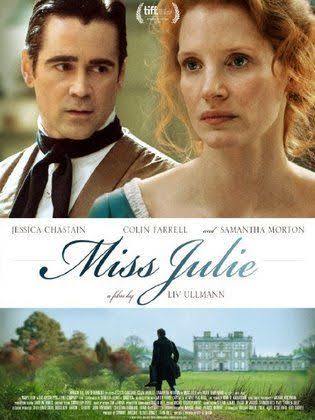
Miss Julie is still very much with us. Strindberg’s play has been filmed twice in recent years – once in 1995, by Leaving Las Vegas director Mike Figgis, and once in 2014, by Swedish actress and filmmaker Liv Ullmann, who cast Jessica Chastain as Julie and Colin Farrell as Jean. What has drawn all this movie-making talent to a play that – with only three speaking parts, and only one setting – seems singularly ill-suited for cinema? Perhaps it is, purely and simply, the singular dramatic intensity of this work. With no scene breaks, no intermission, Miss Julie leaves us with no escape from the starkness of the emotions it evokes. It may be set on Midsummer’s Eve, but it is a play suffused with the chill of a particularly bleak emotional winter.
Long before he wrote Fröken Julie, August Strindberg had established himself as Sweden’s premier playwright. Like his contemporary Henrik Ibsen in Norway, Strindberg crafted tough-minded, uncompromising dramas, with modern settings, characters drawn from ordinary life, and subject matter that might have been considered unthinkable for the more “respectable” playgoing of an earlier time. Today, the Strindberg Museum, in the playwright’s home on Drottninggatan in Stockholm, is still a site of pilgrimage for lovers of literature and drama from all over the world – a testament to Strindberg’s continuing power and influence.
Strindberg was drawn to naturalism – that particularly bleak form of realism that looks at human behaviour as being nothing more than programmed response to deterministic drives – and his naturalistic philosophy comes forth unmistakably in a preface that he wrote for Miss Julie. Regarding his method of characterization, he writes that “My souls (or characters) are conglomerates, made up of past and present stages of civilization, scraps of humanity, torn-off pieces of Sunday clothing turned into rags – all patched together, as is the human soul itself” (p. 13). With regard to plotline, he states that “I find the joy of life in its violent and cruel struggles, and my pleasure lies in knowing something and learning something” (p. 12). Those pithy statements, from an author who is more than capable of distancing himself from his characters, prepare the playgoer or reader for Miss Julie.
The play takes place in the kitchen of the country house of Miss Julie’s aristocratic father, on Midsummer’s Eve. That holiday, in the Sweden of those times, was an occasion when the ordinarily rigid barriers between people from different social classes might be relaxed somewhat – rather like the festival of the Saturnalia in imperial Rome. And from the beginning of Miss Julie, familiarity between people of differing socioeconomic status is central to the play.
As the play begins, two members of the count’s household – 35-year-old cook Christine and 30-year-old valet Jean – are talking about what they describe as the “crazy” behaviour of 25-year-old Miss Julie, the count’s daughter, during the fortnight since the breaking of her engagement. Jean remarks on Julie’s recent tendency to spend time around the servants, stating that “It’s peculiar…that a young lady – hmmm! – would rather stay at home with the servants…than go with her father to their relatives!” Christine, in turn, feels that Julie may be “sort of embarrassed by that rumpus with her fellow” (p. 27).
What Jean knows, and Christine does not, is exactly what led to the breakup of Julie’s engagement. Jean tells Christine (with whom he has an unspoken engagement) that Julie and her fiancé “were in the stable-yard one evening, and the young lady was training him, as she called it. Do you know what that meant? She made him leap over her horsewhip, the way you teach a dog to jump. Twice he jumped, and got a cut each time. The third time, he took the whip out of her hand and broke it into a thousand bits. And then he got out!” (p. 27).
Julie’s dehumanizing treatment of her fiancé – treating him as if he were an animal, to be trained with a whip – hints at a certain contradictory element in her nature. Why would she behave in a way that was virtually certain to derail a suitable and advantageous marital match? I thought, in this connection, of Edgar Allan Poe’s suggestion, in his story “The Imp of the Perverse,” that there might be a certain element of perversity in human nature that causes human beings to willfully engage in behaviour that they know will harm them. I thought also of Sigmund Freud’s ideas of the thanatos, the death-drive.
But there needs no Poe come from Baltimore, no Freud come from Vienna, for us to be aware that there is something unusual, and potentially self-destructive, about the way Julie is behaving.
Most of the play takes the form of an extended conversation between Julie and Jean, during most of which Christine is outside of the room. We learn that Jean, while of “lower” socioeconomic status, has strengths of his own; he speaks French at least as well as Julie does, and he has travelled internationally.
Jean is acutely conscious of being of a lower socioeconomic status, talking of how Julie, for him, “symbolized the hopelessness of trying to get out of the class into which I was born” (p. 48). Yet he has ambitions of rising above his station, stating that “I know that if I could only reach that first branch, then I should go right on to the top as on a ladder. I have not reached it yet, but I am going to, if it only be in my dreams” (p. 42). He describes his tactics for learning the ways of the aristocrats he would like to walk among as an equal: “I have listened to the talk of better-class people, and from that I have learned most of all” (pp. 48-49).
Julie meanwhile seems to enjoy flirting with Jean – asking him for a dance, watching him closely, touching his arm, and praising his muscular strength. Jean cautions Julie regarding her behaviour, but does not flee the room.
A crisis in the action of the drama occurs when Julie and Jean find that a group of peasants, dancing and singing as part of their Midsummer’s Eve revels, are approaching the kitchen. Worried about what might happen if they are found together, they hide in Jean’s room. It takes some time for the peasants to finish their dancing and singing, and to leave the kitchen; and when Julie and Jean re-emerge from the privacy of Jean’s room, it is clear that their earlier flirtations have proceeded all the way to consummation.
Julie’s early feelings of joy and intimacy – she initially tells Jean to drop the “miss” and “Call me Julie” – are soon replaced by fear, as she comes to realize the potential consequences of what she has done. “Do you think I am going to stay under this roof as your concubine? Do you think I’ll let the people point their fingers at me? Do you think I can look at my father in the face after this? No, take me away from here, from all this humiliation and disgrace! – Oh, what have I done! My God, my God!” (p. 58) For his part, Jean feels that his place in the house is likewise compromised by what he and Julie have done, and says that he sees no way that the two of them can both stay there.
Things turn very ugly between Jean and Julie, very quickly. Julie tries to pull rank on Jean: “You lackey, you menial, stand up when I talk to you!” In response, Jean asks, “Do you think any servant girl would go for a man as you did? Did you ever see a girl of my class throw herself at anybody in that way? I have never seen the like of it except among beasts and prostitutes” (p. 63). It is painful, scarring, to see two people verbally flaying one another in this way – and even more painful and scarring, upon further reflection, to imagine what comparably bitter arguments are no doubt unfolding right now, even as we speak, between two people bound by a former intimacy and locked in mutual hatred. My hope for you, friend reader, is that you never, ever, ever find yourself in an argument like the one that unfolds between Julie and Jean in this play.
One can consider Jean’s and Julie’s verbal battles in terms of something that Strindberg writes in his preface for the play: “Jean stands above Miss Julia not only because his fate is in ascendancy, but because he is a man. Sexually he is the aristocrat because of his male strength, his more finely developed senses, and his capacity for taking the initiative. His inferiority depends mainly on the temporary social environment in which he has to live, and which he can probably shed together with the valet’s livery” (p. 17).
At the same time, though, I find myself reminding myself to trust the tale and not the teller. Strindberg may feel that Jean is better equipped to survive in a Darwinian natural-selection battle for the survival of the fittest, but there are indications in the play that Jean, like Julie, is a creature molded by his environment. At one point, Jean says of his employer the count that “If I only catch sight of his gloves on a chair I feel small. If I only hear that bell up there, I jump like a shy horse. And even now, when I see his boots standing there so stiff and perky, it is as if something made my back bend” (p. 56). And when it becomes clear that the count (who is never actually seen in the play) has returned, Jean shows a craven, subservient side of himself that is quite different from the assured sexual conqueror hurling cruel insults at Julie.
So can Jean really rise above his station, as he dreams of doing? Perhaps – if he relocates to Minneapolis/St. Paul, or Winnipeg, and makes a new start in a new land. If he stays in Sweden, I can’t help thinking that things may stay very much the same for him.
As for the “fallen” Miss Julie, she reveals to Jean that her family’s seemingly assured place in the Swedish aristocracy in fact reflects a turbulent family history. From her mother, Julie tells Jean, “I learned to suspect and hate men – for she hated the whole sex, as you have probably heard – and I promised her on my oath that I would never become a man’s slave” (p. 69). It becomes evident that her contradictory behaviour, in the world of the play, is, at least in part, a result of the contradictory influences that have molded her character.
A desperate Julie beseeches Jean: “I can’t leave! I can’t stay! Help me! I am so tired, so fearfully tired. Give me orders! Set me going, for I can no longer think, no longer act –” (p. 76). In response, Jean emphasizes the change in their relative status: “Do you see now what good-for-nothings you are! Why do you strut and turn up your noses as if you were the lords of creation? Well, I am going to give you orders. Go up and dress. Get some travelling money, and then come back again” (p. 76). There is some talk of the two decamping together to Switzerland, using some of the count’s money to start a hotel; but as the play moves toward its conclusion, one gets a strong sense that there is no future for the unfortunate Miss Julie.
Looking back on Miss Julie’s sad fate, Strindberg reflects that “The fact that the heroine arouses our pity depends only on our weakness in not being able to resist the sense of fear that the same fate could befall ourselves” (p. 11). It is a modern twist, with a naturalistic orientation, on Aristotle’s idea of catharsis – a purging, for the audience, of the emotions of pity and fear that are aroused by witnessing a tragic drama.
Miss Julie is still very much with us. Strindberg’s play has been filmed twice in recent years – once in 1995, by Leaving Las Vegas director Mike Figgis, and once in 2014, by Swedish actress and filmmaker Liv Ullmann, who cast Jessica Chastain as Julie and Colin Farrell as Jean. What has drawn all this movie-making talent to a play that – with only three speaking parts, and only one setting – seems singularly ill-suited for cinema? Perhaps it is, purely and simply, the singular dramatic intensity of this work. With no scene breaks, no intermission, Miss Julie leaves us with no escape from the starkness of the emotions it evokes. It may be set on Midsummer’s Eve, but it is a play suffused with the chill of a particularly bleak emotional winter.

November 17, 2023
دوستانِ گرانقدر، شخصیتِ اصلی این نمایشنامه، «جولیا» نام دارد.. جولیا دخترِ بیست و پنج سالهٔ کنتِ ثروتمندیست که در منزلشان به همراه چند کارگر، «کریستین» که سِمتِ آشپزِ این خانه و کلفت را دارد و همچنین «جین» که نوکرِ این خانواده است، زندگی میکنند
جولیا، دلباختهٔ نوکرِ خانه یعنی جین میشود.. و تا حدی خود را پایین می آورد که رقیبِ عشقیِ کلفتِ خانه یعنی کریستین میشود.. جولیا با آنکه اشراف زاده است و نباید با طبقاتِ پایینِ جامعه دم خور شود، ولی دختری ساختار شکن است و به حرفِ مردم و پچ پچ هایِ آنها، اندکی اهمیت نمیدهد... جولیا شب تا صبح را با جین که جوانی مغرور است، مست میکند و خودش را نزدِ نوکرِ منزلشان کوچک و پست میکند.. تا جایی که جین او را یک فاحشه خطاب میکند.. حال جولیا به دنبالِ راهیست تا خودش را از این بیچارگی رها کند........ عزیزانم، بهتر است خودتان این نمایشنامه را خوانده و از سرانجامِ آن آگاه شوید
-----------------------------------
جولیا به جین: تو این دنیا، چی عادی است که من باشم؟؟ زندگیِ مان عادی است یا آدم ها؟؟ همه چیز غیرِ عادی است
**********************
جین به جولیا: شما برایِ من به مظهرِ ناامیدیِ محض تبدیل شدید.. ناامیدی از اینکه یک روز بتوانم دیوارهایِ طبقه ای را که در آن به دنیا آمده ام را بشکنم و خودم را بکشانم بالا
-----------------------------------
امیدوارم این ریویو در جهتِ آشنایی با این کتاب، کافی و مفید بوده باشه
«پیروز باشید و ایرانی»
جولیا، دلباختهٔ نوکرِ خانه یعنی جین میشود.. و تا حدی خود را پایین می آورد که رقیبِ عشقیِ کلفتِ خانه یعنی کریستین میشود.. جولیا با آنکه اشراف زاده است و نباید با طبقاتِ پایینِ جامعه دم خور شود، ولی دختری ساختار شکن است و به حرفِ مردم و پچ پچ هایِ آنها، اندکی اهمیت نمیدهد... جولیا شب تا صبح را با جین که جوانی مغرور است، مست میکند و خودش را نزدِ نوکرِ منزلشان کوچک و پست میکند.. تا جایی که جین او را یک فاحشه خطاب میکند.. حال جولیا به دنبالِ راهیست تا خودش را از این بیچارگی رها کند........ عزیزانم، بهتر است خودتان این نمایشنامه را خوانده و از سرانجامِ آن آگاه شوید
-----------------------------------
جولیا به جین: تو این دنیا، چی عادی است که من باشم؟؟ زندگیِ مان عادی است یا آدم ها؟؟ همه چیز غیرِ عادی است
**********************
جین به جولیا: شما برایِ من به مظهرِ ناامیدیِ محض تبدیل شدید.. ناامیدی از اینکه یک روز بتوانم دیوارهایِ طبقه ای را که در آن به دنیا آمده ام را بشکنم و خودم را بکشانم بالا
-----------------------------------
امیدوارم این ریویو در جهتِ آشنایی با این کتاب، کافی و مفید بوده باشه
«پیروز باشید و ایرانی»

October 22, 2011
The modern mind rebels instantly against the extreme misogyny expressed in the preface to this play. Strindberg may be typical of his time (the play was written in 1888) but he comes across as a man without any understanding of the reality of humanity. Stating that women, who he ranks with the uneducated and children, are incapable of full understanding and making a plea for the development of humankind into creatures who eschew emotion, he reveals himself as a man only half alive to the wonders of our species.
The play tells the story of a high ranking woman who has an affair with a servant. It has, of course, to be read with the mores of its period in mind. At the time, and in the land in which it is set, ultra-conservatism would make her sin intolerable and render her reaction to it wholly understandable.
I nevertheless found his characterisation of both women in the play not credible. These were superficial sketches drawn by a man with no grasp of what women really are. He certainly shows no love or respect for the gender, giving them lines that illustrate his prejudice rather than allowing them to develop into rounded human beings. The affair, initiated by Julie, is given no sound basis, seeming to come about almost by accident. It could even be argued that she is the victim of a predatory male in the form of the unscrupulous servant, Jean, a man who claims to be engaged to fellow servant, Kristin, but happily mates with his employer.
I found this a thoroughly unsatisfactory account of an event that could so easily have been made into a tale of tragic love formed under the pressures of a restrictive and conservative society. Strindberg’s rejection of the role and importance of emotion prevents him developing any true understanding of the motives and concerns of his players, rendering them into no more than the mouthpieces for his narrow views of humanity. He was a married man and one can only wonder at the life his wife must have led with such a mountebank.
Not a play I would wish to see performed.
The play tells the story of a high ranking woman who has an affair with a servant. It has, of course, to be read with the mores of its period in mind. At the time, and in the land in which it is set, ultra-conservatism would make her sin intolerable and render her reaction to it wholly understandable.
I nevertheless found his characterisation of both women in the play not credible. These were superficial sketches drawn by a man with no grasp of what women really are. He certainly shows no love or respect for the gender, giving them lines that illustrate his prejudice rather than allowing them to develop into rounded human beings. The affair, initiated by Julie, is given no sound basis, seeming to come about almost by accident. It could even be argued that she is the victim of a predatory male in the form of the unscrupulous servant, Jean, a man who claims to be engaged to fellow servant, Kristin, but happily mates with his employer.
I found this a thoroughly unsatisfactory account of an event that could so easily have been made into a tale of tragic love formed under the pressures of a restrictive and conservative society. Strindberg’s rejection of the role and importance of emotion prevents him developing any true understanding of the motives and concerns of his players, rendering them into no more than the mouthpieces for his narrow views of humanity. He was a married man and one can only wonder at the life his wife must have led with such a mountebank.
Not a play I would wish to see performed.

September 23, 2019
مسرحية الآنسة جولي للأديب السويدي أوغست ستريندبيرغ
وهي اللقاء الأول لي مع الأدب السويدي

وأحقا، إن العالم يمتلئ بالحب، إلا أن مقداره لا يكفي لدحض كل هذه الشرور التي بداخلنا؟
إلي أي حد يمكن للمظاهر الخارجية أن تخدعنا بحيث تنقلب الأحوال فجأة، ونري أنفسنا في حال غير متوقع إطلاقا بعد بضع ساعات.. في ليلة واحدة بدأت بالضحكات وانتهت بالخوف والألم والدموع والمذلة القاتلة؟
حين نسجن أنفسنا في قفص جميل .. حين نحيا كطيور الزينة، لا ندري ماضينا، ولا نعرف مستقبلنا، ولا نتنبأ بلحظة قادمة، ولا نتوقع أبدا حالنا بعد بضع دقائق .. حين نحيا هكذا، كيف يمكننا ان نقرر كبشر مصيرنا، أو أن نفهم واقعنا ؟
كيف يمكن لبصيص الحب والكرامة أن يجد الطريق وسط أحراش الماضي، ومتاهات الحاضر، وضباب المستقبل؟
....
آنسة جولي، كيف تدهور بك الحال هكذا في ليلة واحدة ؟
وهي اللقاء الأول لي مع الأدب السويدي
وأحقا، إن العالم يمتلئ بالحب، إلا أن مقداره لا يكفي لدحض كل هذه الشرور التي بداخلنا؟
إلي أي حد يمكن للمظاهر الخارجية أن تخدعنا بحيث تنقلب الأحوال فجأة، ونري أنفسنا في حال غير متوقع إطلاقا بعد بضع ساعات.. في ليلة واحدة بدأت بالضحكات وانتهت بالخوف والألم والدموع والمذلة القاتلة؟
حين نسجن أنفسنا في قفص جميل .. حين نحيا كطيور الزينة، لا ندري ماضينا، ولا نعرف مستقبلنا، ولا نتنبأ بلحظة قادمة، ولا نتوقع أبدا حالنا بعد بضع دقائق .. حين نحيا هكذا، كيف يمكننا ان نقرر كبشر مصيرنا، أو أن نفهم واقعنا ؟
كيف يمكن لبصيص الحب والكرامة أن يجد الطريق وسط أحراش الماضي، ومتاهات الحاضر، وضباب المستقبل؟
....
آنسة جولي، كيف تدهور بك الحال هكذا في ليلة واحدة ؟

April 14, 2012
Miss Julie an aristocracic woman that expresses the social Diseases common in many of the families of her class, still recovering from a broken engagement—an engagement ruined because of her attempt to train her fiancé like a dog , flirting in a moment of despair her servant Jean ,she takes an adventure of uncalculated results,Jean seduce Julie, , telling a heart-breaking story of his childhood love to her,after their love affair ,Jean rejects her and confesses that he has deceived her, leaving her to her disgrace......
Julie kept having afrequent dream ,that symbolize the desires of her own fall...

Julie kept having afrequent dream ,that symbolize the desires of her own fall...

June 5, 2024
Aus Strindbergs Vorwort:
Ich finde die Lebensfreude in den starken, grausigen Kämpfen des Lebens, und es bereitet mir Genuß, etwas erfahren, etwas lernen zu können.
Und darum habe ich einen ungewöhnlichen, aber lehrreichen Fall gewählt, mit einem Wort eine Ausnahme, aber eine große Ausnahme, welche die Regel bekräftigt, was sicherlich diejenigen, die das Alltägliche lieben, verletzen wird.
Was ferner bei einzelnen Anstoß erregen wird, ist, daß meine Motivierung der Handlung nicht einfach ist, und es nicht nur einen Gesichtspunkt dafür giebt.
Ein Ereignis im Leben — und das ist eine ziemlich neue Entdeckung — wird gewöhnlich von einer ganzen Reihe mehr oder minder tiefliegender Motive hervorgerufen
Ich finde die Lebensfreude in den starken, grausigen Kämpfen des Lebens, und es bereitet mir Genuß, etwas erfahren, etwas lernen zu können.
Und darum habe ich einen ungewöhnlichen, aber lehrreichen Fall gewählt, mit einem Wort eine Ausnahme, aber eine große Ausnahme, welche die Regel bekräftigt, was sicherlich diejenigen, die das Alltägliche lieben, verletzen wird.
Was ferner bei einzelnen Anstoß erregen wird, ist, daß meine Motivierung der Handlung nicht einfach ist, und es nicht nur einen Gesichtspunkt dafür giebt.
Ein Ereignis im Leben — und das ist eine ziemlich neue Entdeckung — wird gewöhnlich von einer ganzen Reihe mehr oder minder tiefliegender Motive hervorgerufen

March 11, 2025
Fräulein Julie, ich habe Mitleid mit Dir und Deinem Schicksal. Dennoch bist Du nicht das typische Opfer einer Tragödie. Ja, die Umstände haben es Dir schwer gemacht: Frucht einer erzwungenen Verbindung, vielleicht sogar einer Vergewaltigung, vom Vater im Namen einer natürlichen Erziehung vernachlässig, von der Mutter zum Männerhass getrieben, aufgerieben von dem Trieb zum anderen Geschlecht. Eifrige Verfechterin von Standesschranken – selbst Deiner Hündin verzeiht Du es nicht, sich mit einem einfachen Hofhund eingelassen zu haben - zugleich aber betört vom Rausch der Grenzüberschreitung und der Anbiederung an das Gesinde. Andererseits bist Du mit 21 Jahren ein erwachsener Mensch und musst für Deine Taten geradestehen. Stattdessen wählst Du die Flucht vor der Verantwortung, zuerst die räumliche, und als diese nicht gelingt, die in den Freitod. Damit hast du endgültig den Ehrenkodex Deiner Klasse hinter Dir gelassen. So ist es nicht verwunderlich, dass zu Deiner letzten Stunde keine Kirchtumglocke, sondern die Bedienstetenklingel schlägt.
Strindbergs polemisiert in diesem Drama mit dem modernen Selbstverständnis der Frau als dem Manne ebenbürtiges und selbständiges Wesen. Als Tochter solch einer Mutter zeichnet er Julie als triebhaftes Wesen, das unfähig ist die Auswirkungen seiner Handlungen abzusehen oder taub für den Rat anderer. In seinem Vorwort wird Strindberg noch expliziter: Das Halbweib ist ein Typus, welches sich hervordrängt, sich jetzt für Macht, Ansehn, Auszeichnungen und Diplome, sowie früher für Geld verkauft. Da fällt es schwer die literarische Qualität des Stückes, die Lebhaftigkeit der Charaktere, die gelungenen Sprachbilder und die moderne Komposition noch zu würdigen.
Strindbergs polemisiert in diesem Drama mit dem modernen Selbstverständnis der Frau als dem Manne ebenbürtiges und selbständiges Wesen. Als Tochter solch einer Mutter zeichnet er Julie als triebhaftes Wesen, das unfähig ist die Auswirkungen seiner Handlungen abzusehen oder taub für den Rat anderer. In seinem Vorwort wird Strindberg noch expliziter: Das Halbweib ist ein Typus, welches sich hervordrängt, sich jetzt für Macht, Ansehn, Auszeichnungen und Diplome, sowie früher für Geld verkauft. Da fällt es schwer die literarische Qualität des Stückes, die Lebhaftigkeit der Charaktere, die gelungenen Sprachbilder und die moderne Komposition noch zu würdigen.

May 27, 2012
It is difficult and quite uncomfortable to read and write a review for a writer was/is famous for his open misogyny and especially more difficult for someone who is a feminist and a woman. You might then say, then why read the play? The answer to this is that I had to read the play as the dramatics society of where I work was putting up a performance of the same play. However, that is not when I got around to reading it, that was last year and as you can see I have read play the six months later and that too on and around Midsummer (that is when the action of the play takes place) . I firmly believe that one reads a particular book or watches a particular movie when one is supposed to, not before, nor later. Now, after having read the play, I have as you seen given it three stars and I found it to be alright. Just about alright. Sure, the play grapples with very relevant social themes of class and social hierarchy, sexual relations and the power struggle between the sexes, themes which are very much relevant today in 2012 as they were in 1888, however the inherent and deep seated patriarchal and misogynistic moorings of the writer are so blatant that they can’t be ignored.
Jean the valet, in the play is the archetypical ‘Bosola’, if you may, the social climber and aspirant, someone who wants to transcend his class, having a fascination and an abhorrence of the same class that he aspires for- the aristocracy. Miss Julie is portrayed as this ‘wild’ (pg. 3) woman, given to impulse and fancy. This image of a woman gone ‘wild’ and of being ‘fanciful’ has been a common portrayal in literature, also seen as ‘untamed’ and hence deserving to be punished. The setting of the play is also such which Strindberg seems to suggest brings out the ‘unconscious’ of the characters to the surface. It is Midsummer’s Eve, a festival which is often associated with paganism and a surfeit of gluttony, lust and general wantonness. Moreover Miss Julie as is suggested by Christine, the cook is on her period (pg. 8) and is hence more ‘strange’ than usual. This is again quite usual of patriarchy to either ‘devaluate’ women’s experiences or associate a woman’s biological experience/ function with her ‘indiscreet’ behavior. Midsummer’s Eve, some wine and menstruation seems to be suggested by Strindberg is quite a heady combination for a woman to completely transgress not only her class but her sex as well. Women are like ‘witches’ (pg. 43) and can only concoct disorder and a ‘witches brew ‘(pg. 6).
It is not Jean who will take the ‘extreme measure ‘at the end of the play, it instead will be Miss Julie who has to ‘pay’ for her ‘sin’ as not only is she a person of noble birth who has ‘defiled’ herself with having sexual intercourse with a ‘lowborn’ but also a woman who dared to break the barriers of patriarchy and asserted her sexual desire. It is quite alright for Jean to have libidinous desires and can have a ‘fuck’ (pg. 23) when he wants to and can ‘cheat’ on Christine if he so wishes to, but the same rules do not apply to Miss Julie. She is called a ‘whore’ (pg. 24) by Jean and a ‘fallen’ woman. Miss Julie always dreams of ‘falling’ while Jean dreams of ‘rising’. What was also quite grating to note was the fact that Miss Julie who was hitherto seen as a woman who is ‘wild ‘ and ‘ strange’ is ‘tamed’ by Jean and almost under a hypnotic trance induced by Jean, she does his bidding and obeys him. Strindberg seems to suggest that a woman must be ‘tamed’ at the end and Miss Julie’s fate is same as her Serine, who must be taken to the chopping block by Jean – a man! The constant animal imagery used as a motif in the play alludes to Miss Julie; she is both – her pet bird and her pet dog. She is likened to a female dog in heat and a bird in the cage if it tries to fly away is set right by its master. The Count is conspicuous by his absent presence in the play. He is a shadow which can’t be ignored, both Jean and Miss Julie fear him , he is perhaps representative of the ultimate Patriarchal Power- the Ultimate Authority; Jean is only the cog in the machine of Patriarchy. Miss Julie is always known as Miss Julie and never called by her first/given name and that is because patriarchy always sees a woman with respect to her social relations, she is always someone’s daughter/ wife/ mother and never her own self, and that is why towards the end of the play Miss Julie says “I haven’t got a self” (pg. 44) It is because the self that she earlier knew; that of being an aristocratic lady has been ‘compromised’ after having sex with Jean and there is no other ‘ self’ that she knows. It is highly ironic to note that Diana, the hunting Goddess in Greek mythology, her pet dog’s name in the play reminds us of Miss Julie who is not only ‘hunted’ at the end but as we know that Jean can never change his class, Miss Julie’ casts off’ her caste by tainting her honour and the valet who was kissing her shoe earlier on in the play ( pg. 11) now dares to throw a coin at her (pg. 33) implying that women if they have sex of their own volition are ‘ whores’ ( pg. 24) , while no such term applies for men.
A word about Christine - She is a woman but not entirely sympathetic to Miss Julie’s predicament, she calls her “Poor woman/ girl (pgs. 8 and 35 ) “, she merely chides Jean for taking ‘advantage ‘ of Miss Julie and we see her fawning over Jean throughout the play, she knows about his sexual encounter with Miss Julie and is strangely indifferent to it, as she herself points out and instead of helping her fellow woman ‘ sister’ she merely leaves Miss Julie to her own devices by going to the Church to pray for them.
There is an interesting talk of love in the play. Strindberg though excellently blurs the line between sex and love. Is it lust that drives both Jean and Miss Julie or is there love on the part of Jean towards Miss Julie but which is overridden by his desire to overreach his class? The play is deliciously ambiguous on this matter.
It is highly ironical that Strindberg shows us that ‘nurture’ plays a huge part in ‘nature’. He presents to us this figure of Julie’s mother who is portrayed as a ‘diabolical’ woman, hell bent on breaking societal boundaries. She does not believe in marriage and motherhood, both are thrust upon her, she goes on to remodel societal structures by reversing the gender hierarchy by making the men do the ‘women’s work’ and vice versa at her house , which results in her and the Count becoming the laughing stock of society and an utter disaster, this according to Strindberg is what happens when the ‘natural order’ of things is reversed and tampered with and such a woman can only have given birth to something ‘wild ‘ as Miss Julie. Strindberg seems to suggest that women are half- brained, dull creatures who if given power will only wreak havoc in society and bring about anarchy and disorder. Which is precisely why Miss Julie needs to be gotten rid off as she is a threat to ‘order’ with her ‘disorderly’ and ‘wild’ ways. A woman is ‘fallen’ if she transgresses and expresses her sexual desire and volition. Miss Julie then is reminiscent of the figure of Eve, tempting Adam, in this case Jean, with the forbidden fruit of knowledge, leading to the ‘fall’ (pg. 15).
I am guessing that patriarchy must have had a field day with the play as the class issue is just a smokescreen, the real success of the play, In my opinion lies in the fact that women are reviled and ‘taught’ a lesson, lest they wish to transgress. Can you begrudge me then that I thoroughly enjoyed the scene wherein Miss Julie asks Jean to kiss her shoe? I feel deeply disturbed and angry that Strindberg, a deeply misogynistic writer is hailed as one of the greatest dramatists. I guess if I have to talk about the greatness of drama, I would say that Strindberg is not a patch on the greatness that was Henrik Ibsen.
Jean the valet, in the play is the archetypical ‘Bosola’, if you may, the social climber and aspirant, someone who wants to transcend his class, having a fascination and an abhorrence of the same class that he aspires for- the aristocracy. Miss Julie is portrayed as this ‘wild’ (pg. 3) woman, given to impulse and fancy. This image of a woman gone ‘wild’ and of being ‘fanciful’ has been a common portrayal in literature, also seen as ‘untamed’ and hence deserving to be punished. The setting of the play is also such which Strindberg seems to suggest brings out the ‘unconscious’ of the characters to the surface. It is Midsummer’s Eve, a festival which is often associated with paganism and a surfeit of gluttony, lust and general wantonness. Moreover Miss Julie as is suggested by Christine, the cook is on her period (pg. 8) and is hence more ‘strange’ than usual. This is again quite usual of patriarchy to either ‘devaluate’ women’s experiences or associate a woman’s biological experience/ function with her ‘indiscreet’ behavior. Midsummer’s Eve, some wine and menstruation seems to be suggested by Strindberg is quite a heady combination for a woman to completely transgress not only her class but her sex as well. Women are like ‘witches’ (pg. 43) and can only concoct disorder and a ‘witches brew ‘(pg. 6).
It is not Jean who will take the ‘extreme measure ‘at the end of the play, it instead will be Miss Julie who has to ‘pay’ for her ‘sin’ as not only is she a person of noble birth who has ‘defiled’ herself with having sexual intercourse with a ‘lowborn’ but also a woman who dared to break the barriers of patriarchy and asserted her sexual desire. It is quite alright for Jean to have libidinous desires and can have a ‘fuck’ (pg. 23) when he wants to and can ‘cheat’ on Christine if he so wishes to, but the same rules do not apply to Miss Julie. She is called a ‘whore’ (pg. 24) by Jean and a ‘fallen’ woman. Miss Julie always dreams of ‘falling’ while Jean dreams of ‘rising’. What was also quite grating to note was the fact that Miss Julie who was hitherto seen as a woman who is ‘wild ‘ and ‘ strange’ is ‘tamed’ by Jean and almost under a hypnotic trance induced by Jean, she does his bidding and obeys him. Strindberg seems to suggest that a woman must be ‘tamed’ at the end and Miss Julie’s fate is same as her Serine, who must be taken to the chopping block by Jean – a man! The constant animal imagery used as a motif in the play alludes to Miss Julie; she is both – her pet bird and her pet dog. She is likened to a female dog in heat and a bird in the cage if it tries to fly away is set right by its master. The Count is conspicuous by his absent presence in the play. He is a shadow which can’t be ignored, both Jean and Miss Julie fear him , he is perhaps representative of the ultimate Patriarchal Power- the Ultimate Authority; Jean is only the cog in the machine of Patriarchy. Miss Julie is always known as Miss Julie and never called by her first/given name and that is because patriarchy always sees a woman with respect to her social relations, she is always someone’s daughter/ wife/ mother and never her own self, and that is why towards the end of the play Miss Julie says “I haven’t got a self” (pg. 44) It is because the self that she earlier knew; that of being an aristocratic lady has been ‘compromised’ after having sex with Jean and there is no other ‘ self’ that she knows. It is highly ironic to note that Diana, the hunting Goddess in Greek mythology, her pet dog’s name in the play reminds us of Miss Julie who is not only ‘hunted’ at the end but as we know that Jean can never change his class, Miss Julie’ casts off’ her caste by tainting her honour and the valet who was kissing her shoe earlier on in the play ( pg. 11) now dares to throw a coin at her (pg. 33) implying that women if they have sex of their own volition are ‘ whores’ ( pg. 24) , while no such term applies for men.
A word about Christine - She is a woman but not entirely sympathetic to Miss Julie’s predicament, she calls her “Poor woman/ girl (pgs. 8 and 35 ) “, she merely chides Jean for taking ‘advantage ‘ of Miss Julie and we see her fawning over Jean throughout the play, she knows about his sexual encounter with Miss Julie and is strangely indifferent to it, as she herself points out and instead of helping her fellow woman ‘ sister’ she merely leaves Miss Julie to her own devices by going to the Church to pray for them.
There is an interesting talk of love in the play. Strindberg though excellently blurs the line between sex and love. Is it lust that drives both Jean and Miss Julie or is there love on the part of Jean towards Miss Julie but which is overridden by his desire to overreach his class? The play is deliciously ambiguous on this matter.
It is highly ironical that Strindberg shows us that ‘nurture’ plays a huge part in ‘nature’. He presents to us this figure of Julie’s mother who is portrayed as a ‘diabolical’ woman, hell bent on breaking societal boundaries. She does not believe in marriage and motherhood, both are thrust upon her, she goes on to remodel societal structures by reversing the gender hierarchy by making the men do the ‘women’s work’ and vice versa at her house , which results in her and the Count becoming the laughing stock of society and an utter disaster, this according to Strindberg is what happens when the ‘natural order’ of things is reversed and tampered with and such a woman can only have given birth to something ‘wild ‘ as Miss Julie. Strindberg seems to suggest that women are half- brained, dull creatures who if given power will only wreak havoc in society and bring about anarchy and disorder. Which is precisely why Miss Julie needs to be gotten rid off as she is a threat to ‘order’ with her ‘disorderly’ and ‘wild’ ways. A woman is ‘fallen’ if she transgresses and expresses her sexual desire and volition. Miss Julie then is reminiscent of the figure of Eve, tempting Adam, in this case Jean, with the forbidden fruit of knowledge, leading to the ‘fall’ (pg. 15).
I am guessing that patriarchy must have had a field day with the play as the class issue is just a smokescreen, the real success of the play, In my opinion lies in the fact that women are reviled and ‘taught’ a lesson, lest they wish to transgress. Can you begrudge me then that I thoroughly enjoyed the scene wherein Miss Julie asks Jean to kiss her shoe? I feel deeply disturbed and angry that Strindberg, a deeply misogynistic writer is hailed as one of the greatest dramatists. I guess if I have to talk about the greatness of drama, I would say that Strindberg is not a patch on the greatness that was Henrik Ibsen.

July 31, 2019
Very modern in terms of how short lived a love affair between high-on-harmones youngsters was.

January 9, 2011
It had strong langugae,the form,layout of the play was well done. The story was pretty shallow,not much of a story really. It was only two characters with over the top feelings screaming at each other. That sounds like many great plays but you need more quality,depth than this.
In the foreward Strindberg says he wanted the characters to be characterless. It felt too much like the main female character was only a way to write his views on how a woman of his times should not be. Jean the male main character had more depth,motive he was a person while she was only a symbol of everything that is wrong with a woman in the writers eyes.
In the foreward Strindberg says he wanted the characters to be characterless. It felt too much like the main female character was only a way to write his views on how a woman of his times should not be. Jean the male main character had more depth,motive he was a person while she was only a symbol of everything that is wrong with a woman in the writers eyes.

December 2, 2017
Gender and Society

Strindberg’s play, Fröken Julie, from 1888 focuses on gender and society in late 19th century Sweden. Even though it is quite brief it brings a lot of fire to these topics so I can see why it gained such prominence at the time. Even today it seems to be one of the works that Strindberg is recognized for abroad (together with his other plays) even though I personally favor his novels and stories to a much greater extent. The latter are generally not translated into English or are OOP.
I sense a very negative view of womanhood in Strindberg’s writing. Based on his life (as well as this particular play) it appears as if he favors bright and able women, but simultaneously view such individuals to hate men by default. I suspect he had some bad experiences that clashed with his own narcissism and manhood in his relationships with women.
The play unfolds during a midsummer eve when the daughter of a rich household (Miss Julie) has a powerful and fateful interaction with the man servant Jean. As an audience we get exposed to a warped passion viewed through the spectrum of their imagined futures, a pulsating passion and the immersion of the magic of the shortest night of the year. Fate seems to be in the room as the play unfolds. A recent film version (2014) directed by Liv Ullmann seems to be an interesting follow-up to reading this play. However, an older Swedish film (1951) (starring Ulf Palme (Jean) and Anita Björk as Miss Julie) is even more alluring to me. Reading/watching this play is literally a requirement if one is interested in Strindberg as an author. Besides, just like Ibsen, Strindberg has the ability to bring forward themes that are eternal. These issues are still reverberating through our modern society.
Strindberg’s play, Fröken Julie, from 1888 focuses on gender and society in late 19th century Sweden. Even though it is quite brief it brings a lot of fire to these topics so I can see why it gained such prominence at the time. Even today it seems to be one of the works that Strindberg is recognized for abroad (together with his other plays) even though I personally favor his novels and stories to a much greater extent. The latter are generally not translated into English or are OOP.
I sense a very negative view of womanhood in Strindberg’s writing. Based on his life (as well as this particular play) it appears as if he favors bright and able women, but simultaneously view such individuals to hate men by default. I suspect he had some bad experiences that clashed with his own narcissism and manhood in his relationships with women.
The play unfolds during a midsummer eve when the daughter of a rich household (Miss Julie) has a powerful and fateful interaction with the man servant Jean. As an audience we get exposed to a warped passion viewed through the spectrum of their imagined futures, a pulsating passion and the immersion of the magic of the shortest night of the year. Fate seems to be in the room as the play unfolds. A recent film version (2014) directed by Liv Ullmann seems to be an interesting follow-up to reading this play. However, an older Swedish film (1951) (starring Ulf Palme (Jean) and Anita Björk as Miss Julie) is even more alluring to me. Reading/watching this play is literally a requirement if one is interested in Strindberg as an author. Besides, just like Ibsen, Strindberg has the ability to bring forward themes that are eternal. These issues are still reverberating through our modern society.

August 23, 2020
3.5
قرمهسبزی شور!ا
از یک نظر، اینجا هم یک مشابهت جالب توجه با نمایشنامه "طلبکارها" داریم. یعنی به دام افتادن یک زن هرزه. حالا اینکه چرا جناب استریندبورگ اینقدر درگیر این مساله بوده، شاید به خاطر این بوده که خودش همیشه علاوه بر زنش، چندتایی معشوقه هم زیر سر داشته. ولی کتمان نباید کرد که فارغ از زنستیزی، واقعا نبوغ خاصی در ریزبینی و کنکاش احوالات آدمها و رفتارها داشته
به علاوه، اون نگاه "هر انسان زاییده مجموعه عوامل محیط پیرامونش است و نمیتواند از چارچوب آنها خارج شود"-طور، اینجا به یک پختگی رسیده که در عین کوتاهی اون رو به یک اثر شاخص در میان آثار ناتورالیستی تبدیل میکنه. و شاید اگر استریندبورگ اینقدر تفکرات زنستیزانه نمیداشت، حقش بود خیلی بیشتر از اینها معروف بشه
قرمهسبزی شور!ا
از یک نظر، اینجا هم یک مشابهت جالب توجه با نمایشنامه "طلبکارها" داریم. یعنی به دام افتادن یک زن هرزه. حالا اینکه چرا جناب استریندبورگ اینقدر درگیر این مساله بوده، شاید به خاطر این بوده که خودش همیشه علاوه بر زنش، چندتایی معشوقه هم زیر سر داشته. ولی کتمان نباید کرد که فارغ از زنستیزی، واقعا نبوغ خاصی در ریزبینی و کنکاش احوالات آدمها و رفتارها داشته
به علاوه، اون نگاه "هر انسان زاییده مجموعه عوامل محیط پیرامونش است و نمیتواند از چارچوب آنها خارج شود"-طور، اینجا به یک پختگی رسیده که در عین کوتاهی اون رو به یک اثر شاخص در میان آثار ناتورالیستی تبدیل میکنه. و شاید اگر استریندبورگ اینقدر تفکرات زنستیزانه نمیداشت، حقش بود خیلی بیشتر از اینها معروف بشه

December 22, 2022
I don't remember the last time I've read something that seemed so pointless.

March 3, 2024
⭐️3.5 «تقصیر کی بود؟ پدرم؟ مادرم؟ یا خودم؟ خودم؟ ولی من هیچ خودی ندارم. فکرم فکر پدرمه، احساساتم احساسات مادرم.»
این نمایشنامه رو برای کلاس مبانی کارگردانی خوندم و احتمالا آخر ترم که کارگردانیش کردیم میام یه ریویو شخصی تر مینویسم اما نمایشنامهای بود که در حین جذاب و خواندنی بودنش حرفای زیادی برای گفتن داشت و اتفاقات عمیقی درش میفته.ترکیبی که نمایشنامه رو برای من کامل و به یاد موندنی میکنه. استرینبرگ قطعا یکی از نمایشنامهنویس های موردعلاقمه و بی صبرانه دلم میخواد بیشتر ازش بخونم.
«میس جولی یک کاراکتر مدرن است، نه به این خاطر که نیمه زنی مرد گریز در تمام اعصار وجود نداشته، بلکه به این خاطر که حالا، پس از کشفِ او، جولی به جلو قدم نهاده و توجهات به او جلب شده. نیمه زن، سنخی است که بیشتر و بیشتر بهسوی برتری میل کرده و امروزه خودش را به قدرت، تزئینات، تمایزات و مدارک تحصیلی میفروشد، همانطور که قبلاً خودش را به پول میفروخت و چنین سنخی رو به تباهی دارد. این سنخِ خوبی نیست، چرا که دوامی ندارد، اما متأسفانه این قدرت را دارد که خودش و بدبختیاش را در نسلی دیگر باز بپرورد؛ و مردان منحط انگار که از روی غریزه، چنین زنانی را برمیگزینند تا بدین طریق جنسهای نامعینی را تکثیر و تولید کنند که زندگی برایشان بهمثابهی شکنجه است.»
«این اثر بهعنوان میراثی رمانتیک که توسط ناتورالیسم گسترده شده هم تراژیکال است. چرا که ناتورالیسم چیزی جز شادی طلب نمیکند: و برای شادی، قدرت و صحت جسمی نیاز است.»
این نمایشنامه رو برای کلاس مبانی کارگردانی خوندم و احتمالا آخر ترم که کارگردانیش کردیم میام یه ریویو شخصی تر مینویسم اما نمایشنامهای بود که در حین جذاب و خواندنی بودنش حرفای زیادی برای گفتن داشت و اتفاقات عمیقی درش میفته.ترکیبی که نمایشنامه رو برای من کامل و به یاد موندنی میکنه. استرینبرگ قطعا یکی از نمایشنامهنویس های موردعلاقمه و بی صبرانه دلم میخواد بیشتر ازش بخونم.
«میس جولی یک کاراکتر مدرن است، نه به این خاطر که نیمه زنی مرد گریز در تمام اعصار وجود نداشته، بلکه به این خاطر که حالا، پس از کشفِ او، جولی به جلو قدم نهاده و توجهات به او جلب شده. نیمه زن، سنخی است که بیشتر و بیشتر بهسوی برتری میل کرده و امروزه خودش را به قدرت، تزئینات، تمایزات و مدارک تحصیلی میفروشد، همانطور که قبلاً خودش را به پول میفروخت و چنین سنخی رو به تباهی دارد. این سنخِ خوبی نیست، چرا که دوامی ندارد، اما متأسفانه این قدرت را دارد که خودش و بدبختیاش را در نسلی دیگر باز بپرورد؛ و مردان منحط انگار که از روی غریزه، چنین زنانی را برمیگزینند تا بدین طریق جنسهای نامعینی را تکثیر و تولید کنند که زندگی برایشان بهمثابهی شکنجه است.»
«این اثر بهعنوان میراثی رمانتیک که توسط ناتورالیسم گسترده شده هم تراژیکال است. چرا که ناتورالیسم چیزی جز شادی طلب نمیکند: و برای شادی، قدرت و صحت جسمی نیاز است.»

December 4, 2020
Last night I stumbled upon a film adaptation (from 2014 ) of Miss Julie. As soon as I finished watching the film, I knew that I just had to read the play. I must have read this play in half an hour today. What a play it is! Full of verbal and physical violence, opposing passion, incredible cruelty, neurotic behaviour and full blown hysteria. I can understand why many should find this play a rather difficult read. I definitely wouldn't call it an enjoyable or an easy read. It's rather sickening at times and distinctly unpleasant all the way. However, this play definitely made me think and the ending broke my heart a little, so I'm going to score it highly.
I realized just now that I have been familiar with this play for a long time, having learned about it in high school, but today was the first time that I actually read it cover to cover. As a high school student, the brutality and the violence of the plot rather shocked me. Strange how I forgot all about it until yesterday. Anyhow, Miss Julie is a brief play and can be performed on stage in a few hours I believe. A lot happens in a short period of time, but only three characters appear directly in this play (we might call the count the fourth, even if his voice is suggested and not heard). Miss Julie can be described as a naturalistic play with a district Darwin influence. It is mightily depressive in its atmosphere and brutally pessimistic in its view on mankind. Stripped bare, it can be seen as an evolutionary battle for the survival of the fittest. The author itself hints at it in his Preface to this play. Nevertheless, this play can be read in a number of ways and that is what I find so fascinating about it. Miss Julie can mean different things to different people and while one can argue that is the case with all good literature, there is a certain strength in this book that cannot be disputed.
My opinion is that Miss Julie is one of the best, if not the best, naturalistic play that I have read. It is beautifully complex and open to different readings and interpretations. A lot of things in this play are suggested, rather than showed. The film version wasn't bad, it was beautifully shot and the acting wasn't bad. The Northern Ireland also seemed a good location for the movie because its complex history gives new depth to the gap between Miss Juliet and Jean. Still, it is not hard to imagine a similar gap in the Swedish setting. After all, all European nations had and still have many divisions between classes. I haven't seen all the film versions, but I definitely recommend you to read the book first.
I did like the play more than the film version. There might be a few spoilers as I comment on the differences of the two. Jean of the book is more of a social climber, it seems obvious that he is suggesting suicide to save his neck. Jean of the movie is a bit more complex because the movie invented a story about him waking up next to his brother who died of hunger- imagine what kind of hate would that install in a person, having a sibling of yours die from hunger while you live next to a Baron estate. So, that part was cleaver on the part of the film maker. Jean of the book shows signs of humanity, but not enough to make the reader feel for him (at least it was hard for me to understand him). On the other hand, the miss Julie in the film version is less likeable than one in the play itself, despite the fact that she also seems more neurotic and vulnerable. The written version gives us more insight into Julie's past and her relationship both with his father. Moreover, the film version shows suicide rather than suggest it. Does Julie kill herself? The play leaves the answer to us, the 2014 movie version doesn't.
What I found most fascinating about the book was the character of Julie's mother, a radical feminist of some kind. When play takes place, Julie's mother is long dead but continues to haunt the home. Apparently, Julie's mother was a feminist who taught Julie to be like a man, forcing her to dress and act like a boy at times and installing hatred towards all man in her. At their estate, Julie's mother forced men to do women's work and vice versa, causing financial ruin to her estate and mocking of everyone around. It seems like a rather cruel thing to do. Julie's mother displayed signs of mental illness, but she was also calculated as when she burned the estate a day after insurance expired and forced her husband the Baron to borrow money from her lover. Julie's father the Baron seems to have been the victim of his wife's tyranny and cruelty. It is clear how such a traumatic childhood has left traces on Julie as she feels guilty for siding with her mother while she was still a child and didn't understand what was going on. Baron taught Julie to hate women and her mother taught her to hate both women and men. At the end of the play, Julie concludes that she has only her mother's and her father's thoughts in her. No wonder Julie feels so out of place, so lonely and sad! She's as much a victim of her mother and she is of her father.
I realized just now that I have been familiar with this play for a long time, having learned about it in high school, but today was the first time that I actually read it cover to cover. As a high school student, the brutality and the violence of the plot rather shocked me. Strange how I forgot all about it until yesterday. Anyhow, Miss Julie is a brief play and can be performed on stage in a few hours I believe. A lot happens in a short period of time, but only three characters appear directly in this play (we might call the count the fourth, even if his voice is suggested and not heard). Miss Julie can be described as a naturalistic play with a district Darwin influence. It is mightily depressive in its atmosphere and brutally pessimistic in its view on mankind. Stripped bare, it can be seen as an evolutionary battle for the survival of the fittest. The author itself hints at it in his Preface to this play. Nevertheless, this play can be read in a number of ways and that is what I find so fascinating about it. Miss Julie can mean different things to different people and while one can argue that is the case with all good literature, there is a certain strength in this book that cannot be disputed.
My opinion is that Miss Julie is one of the best, if not the best, naturalistic play that I have read. It is beautifully complex and open to different readings and interpretations. A lot of things in this play are suggested, rather than showed. The film version wasn't bad, it was beautifully shot and the acting wasn't bad. The Northern Ireland also seemed a good location for the movie because its complex history gives new depth to the gap between Miss Juliet and Jean. Still, it is not hard to imagine a similar gap in the Swedish setting. After all, all European nations had and still have many divisions between classes. I haven't seen all the film versions, but I definitely recommend you to read the book first.
I did like the play more than the film version. There might be a few spoilers as I comment on the differences of the two. Jean of the book is more of a social climber, it seems obvious that he is suggesting suicide to save his neck. Jean of the movie is a bit more complex because the movie invented a story about him waking up next to his brother who died of hunger- imagine what kind of hate would that install in a person, having a sibling of yours die from hunger while you live next to a Baron estate. So, that part was cleaver on the part of the film maker. Jean of the book shows signs of humanity, but not enough to make the reader feel for him (at least it was hard for me to understand him). On the other hand, the miss Julie in the film version is less likeable than one in the play itself, despite the fact that she also seems more neurotic and vulnerable. The written version gives us more insight into Julie's past and her relationship both with his father. Moreover, the film version shows suicide rather than suggest it. Does Julie kill herself? The play leaves the answer to us, the 2014 movie version doesn't.
What I found most fascinating about the book was the character of Julie's mother, a radical feminist of some kind. When play takes place, Julie's mother is long dead but continues to haunt the home. Apparently, Julie's mother was a feminist who taught Julie to be like a man, forcing her to dress and act like a boy at times and installing hatred towards all man in her. At their estate, Julie's mother forced men to do women's work and vice versa, causing financial ruin to her estate and mocking of everyone around. It seems like a rather cruel thing to do. Julie's mother displayed signs of mental illness, but she was also calculated as when she burned the estate a day after insurance expired and forced her husband the Baron to borrow money from her lover. Julie's father the Baron seems to have been the victim of his wife's tyranny and cruelty. It is clear how such a traumatic childhood has left traces on Julie as she feels guilty for siding with her mother while she was still a child and didn't understand what was going on. Baron taught Julie to hate women and her mother taught her to hate both women and men. At the end of the play, Julie concludes that she has only her mother's and her father's thoughts in her. No wonder Julie feels so out of place, so lonely and sad! She's as much a victim of her mother and she is of her father.

September 10, 2012
I reread Miss Julie this past week in conjunction with my attending a production of the play by Court Theater in Chicago's Hyde Park/University fo Chicago neighborhood. The translation I read was done for the Court, several years ago, and this production revives that translation.
"It must be terrible to be poor"--Miss Julie
The production's set was fascinating, putting the action all within the kitchen, surrounding my a circular screen or scrom that made the action appear hazy. The key feature of the set was a huge wood burning stove that actually fucntioned as stove, it seemsed? Or the steam from it was manufactured? But it was large, and the cook, Christine, is seen before the dialogue begins, alone, cooking at times feverishly to the sound of loud drumming, pulsing, setting an intense, manic tone that matches the "crazy"--Jean calls her that--Julie who enters anxious, restless, mad, lusty. Kristine tells her fiancee, Jean, that Julie is always a bit like this around her period.
When Kristine is gone form the stage, Julie seduces Jean, as they get drunk together through what appears to be a long night, tries to talk him into going away with her. Kristine comes down when Julie is gone for awhile and wants Jean to go to church with him, figures out what has happened, is willing to set this aside and work toward a saner future. It's to her disgusting, a indiscretion, this drunken scene, but she wants a life for herself and wants Jean in that life.
This is a play about class struggle, gender, sex, gender, Miss Julie says she hates men but is driven insane by lust for them. She is in this play manic, crazed, anguished. The play is a little bit Prince and the Pauper, as she wants out of her aristocratic life and all of its limitations--ala Hedda Gabler, or The Yellow Wallpaper--and Jean wants to be a Count, he wants what she has. Is the grass greener for either of them on the other side? (No). Suicide ,as in Hedda, is a relevant question for her, but not for Jean. He wants to live! Reminds me of Who's Afraid of Virginia Woolf? by Edward Albee, also an all-night orgy of lust and drunken talk and power struggles.
"It must be terrible to be poor"--Miss Julie
The production's set was fascinating, putting the action all within the kitchen, surrounding my a circular screen or scrom that made the action appear hazy. The key feature of the set was a huge wood burning stove that actually fucntioned as stove, it seemsed? Or the steam from it was manufactured? But it was large, and the cook, Christine, is seen before the dialogue begins, alone, cooking at times feverishly to the sound of loud drumming, pulsing, setting an intense, manic tone that matches the "crazy"--Jean calls her that--Julie who enters anxious, restless, mad, lusty. Kristine tells her fiancee, Jean, that Julie is always a bit like this around her period.
When Kristine is gone form the stage, Julie seduces Jean, as they get drunk together through what appears to be a long night, tries to talk him into going away with her. Kristine comes down when Julie is gone for awhile and wants Jean to go to church with him, figures out what has happened, is willing to set this aside and work toward a saner future. It's to her disgusting, a indiscretion, this drunken scene, but she wants a life for herself and wants Jean in that life.
This is a play about class struggle, gender, sex, gender, Miss Julie says she hates men but is driven insane by lust for them. She is in this play manic, crazed, anguished. The play is a little bit Prince and the Pauper, as she wants out of her aristocratic life and all of its limitations--ala Hedda Gabler, or The Yellow Wallpaper--and Jean wants to be a Count, he wants what she has. Is the grass greener for either of them on the other side? (No). Suicide ,as in Hedda, is a relevant question for her, but not for Jean. He wants to live! Reminds me of Who's Afraid of Virginia Woolf? by Edward Albee, also an all-night orgy of lust and drunken talk and power struggles.

June 24, 2013
I read the translation made by Peter Watts.
A beautiful play by the master Strindberg, This is the kind of paly that makes the one sure about the role of inspiration in the art. The most remarkable element of the play is how it shows the changes in the characters in a smooth unconstrained way, You believe what you watch and understand it although its characters very odd behaviours specially Julia's.
The relationship between the servant and the master presented in this powerful way only in Losey's important movie The Servant (1963) which is a Harold Pinter adaptation of a 1948 novelette by Robin Maugham.
A beautiful play by the master Strindberg, This is the kind of paly that makes the one sure about the role of inspiration in the art. The most remarkable element of the play is how it shows the changes in the characters in a smooth unconstrained way, You believe what you watch and understand it although its characters very odd behaviours specially Julia's.
The relationship between the servant and the master presented in this powerful way only in Losey's important movie The Servant (1963) which is a Harold Pinter adaptation of a 1948 novelette by Robin Maugham.

May 25, 2014
This thoroughly nasty play works very well on the stage even with less than stellar casts. Do not read Miss Julie. Go and see it performed; productions are still quite frequent.
If nothing is available then download one of the versions available on Netflix. A new Miss Julie movie with Colin Farrell is coming in the Fall.
If nothing is available then download one of the versions available on Netflix. A new Miss Julie movie with Colin Farrell is coming in the Fall.

March 22, 2025
In einer einzigen Mittsommernacht spielt dieses Trauerspiel, ein fataler Konflikt zwischen dem adligen Fräulein Julie und Jean, einem ehrgeizigen Diener. Dabei werden zentrale Themen wie Klassenunterschiede, Geschlechterrollen und die Macht der Triebe in einem dichten, konfliktreichen Dialog zusammengemixt.
Julie, die von einem destruktiven Freiheitsdrang getrieben wird, gerät in eine verhängnisvolle Beziehung zu Jean. Was als Verführung beginnt, entwickelt sich schnell zu einem Machtkampf. Die gesellschaftlichen Gegensätze zwischen den beiden Protagonisten brechen in voller Wucht hervor: Julie ist trotz ihrer aristokratischen Herkunft unsicher und labil, auch wenn sie mitunter die Herrscherin herauskehrt. Mir schien, sie wusste vor allem durch fehlende Vorbilder und Bezugspersonen nicht, welchen Platz sie in der Gesellschaft einnehmen kann und will. Jean hingegen ist sich seiner untergeordneten Stellung bewusst, nutzt aber jede Gelegenheit, um sich zu behaupten. Beide träumen von einer Überwindung der gesellschaftlichen Klassenschranken, obwohl sie im Inneren wissen, dass sie ihre Träume letztendlich nicht umsetzen können.
Strindberg verbindet Naturalismus mit symbolischen Elementen. Die Kontraste zwischen Herr und Knecht, zwischen Mann und Frau werden durch Dialoge, durch subtile Andeutungen in den Figurenzeichnungen und wohl auch durch die Bühnengestaltung unterstrichen. Besonders die Darstellung Julies als innerlich zerrissene Figur zeugt von einer psychologischen Studie, die ihrer Zeit voraus war.
In meiner Lesegruppe wurde ein anderer Blick auf das Stück geworfen, ausgelöst durch Strindbergs Frauenhass. Tatsächlich zeichnet er Julie als instabile, ihrer Herkunft und ihrem Geschlecht ausgelieferte Figur, die letztlich scheitert. Seine Schriften außerhalb des Dramas enthalten ebenfalls polemische Aussagen über Frauen, was den Eindruck verstärkt. Doch ich finde, das Stück kann gleichzeitig als scharfe Analyse gesellschaftlicher Zwänge gelesen werden. Jean ist ebenso gefangen in seiner Rolle, und das Drama zeigt nicht nur eine persönliche Tragödie, sondern auch das erstarrte soziale Gefüge, das Männer und Frauen gleichermaßen einschränkt.
Trotzdem konnte ich den Frauenhass nicht mehr völlig ausblenden und musste die Bewertung entsprechend anpassen.
Julie, die von einem destruktiven Freiheitsdrang getrieben wird, gerät in eine verhängnisvolle Beziehung zu Jean. Was als Verführung beginnt, entwickelt sich schnell zu einem Machtkampf. Die gesellschaftlichen Gegensätze zwischen den beiden Protagonisten brechen in voller Wucht hervor: Julie ist trotz ihrer aristokratischen Herkunft unsicher und labil, auch wenn sie mitunter die Herrscherin herauskehrt. Mir schien, sie wusste vor allem durch fehlende Vorbilder und Bezugspersonen nicht, welchen Platz sie in der Gesellschaft einnehmen kann und will. Jean hingegen ist sich seiner untergeordneten Stellung bewusst, nutzt aber jede Gelegenheit, um sich zu behaupten. Beide träumen von einer Überwindung der gesellschaftlichen Klassenschranken, obwohl sie im Inneren wissen, dass sie ihre Träume letztendlich nicht umsetzen können.
Strindberg verbindet Naturalismus mit symbolischen Elementen. Die Kontraste zwischen Herr und Knecht, zwischen Mann und Frau werden durch Dialoge, durch subtile Andeutungen in den Figurenzeichnungen und wohl auch durch die Bühnengestaltung unterstrichen. Besonders die Darstellung Julies als innerlich zerrissene Figur zeugt von einer psychologischen Studie, die ihrer Zeit voraus war.
In meiner Lesegruppe wurde ein anderer Blick auf das Stück geworfen, ausgelöst durch Strindbergs Frauenhass. Tatsächlich zeichnet er Julie als instabile, ihrer Herkunft und ihrem Geschlecht ausgelieferte Figur, die letztlich scheitert. Seine Schriften außerhalb des Dramas enthalten ebenfalls polemische Aussagen über Frauen, was den Eindruck verstärkt. Doch ich finde, das Stück kann gleichzeitig als scharfe Analyse gesellschaftlicher Zwänge gelesen werden. Jean ist ebenso gefangen in seiner Rolle, und das Drama zeigt nicht nur eine persönliche Tragödie, sondern auch das erstarrte soziale Gefüge, das Männer und Frauen gleichermaßen einschränkt.
Trotzdem konnte ich den Frauenhass nicht mehr völlig ausblenden und musste die Bewertung entsprechend anpassen.
June 18, 2009
This was my first stab at Strindberg, and dear lord did he stab back. This is a play about hate & power, and about passion & the lack thereof.
I'm shocked, looking back on this emotionally brutal play, to see how deeply engaged it was with the same "topics" of oppressive gender and class power structures. It does these right: they inform the emotional physics of the scenario, instead of being it's end.
The play is set over the course of a perfect Summer night. The characters are Jean (30), a servant to the count; Kristine (35), cook to the count; and Julie (25), daughter to the count. The seeds of the drama are already present in their ages. Jean and Kristine are (kind of, sort of, if nothing better comes up) together. Julie is drunk & Jean is bored. One thing leads to another and no one ends up happy.
The thing that hits you so hard in this play is the tension between passionate emotion and muddledness. For the most part the characters carry on in normal, everyday dialogue- self-contradicting, unarousing, stable. Every now and then though, this erupts in vivid, imagistic and often horrifying language. After the emotional strain of the commonness of the rest of the dialogue, these interruptions have a fantastic rending strength.
Thoroughly enjoyed, thoroughly recommended.
I'm shocked, looking back on this emotionally brutal play, to see how deeply engaged it was with the same "topics" of oppressive gender and class power structures. It does these right: they inform the emotional physics of the scenario, instead of being it's end.
The play is set over the course of a perfect Summer night. The characters are Jean (30), a servant to the count; Kristine (35), cook to the count; and Julie (25), daughter to the count. The seeds of the drama are already present in their ages. Jean and Kristine are (kind of, sort of, if nothing better comes up) together. Julie is drunk & Jean is bored. One thing leads to another and no one ends up happy.
The thing that hits you so hard in this play is the tension between passionate emotion and muddledness. For the most part the characters carry on in normal, everyday dialogue- self-contradicting, unarousing, stable. Every now and then though, this erupts in vivid, imagistic and often horrifying language. After the emotional strain of the commonness of the rest of the dialogue, these interruptions have a fantastic rending strength.
Thoroughly enjoyed, thoroughly recommended.

July 1, 2013
That was awful! This was definitely the worst play I have ever and probably will ever read. A boring girl used as a symbol for everything the playwright dislikes in women, an arrogant little cockroach disguised as a man(Seriously, he's a walking insult to all sane men) to ruin the lives of the other characters(Both women) and a plot so boring that a lesson in mathematics seems like a blockbuster compared to that. The views of the writer's time can not excuse everything he does, even if he explains himself in his little as-long-as-half-the-play foreword. The foreword was even worse than the play itself.
The good thing? It's not very long(As in: It's actually very short, my version has 34 pages, more than 40 with the foreword), so it's not a great waste of time. But still, it IS a waste of time.
For those who want to read a naturalistic work: Try Henrik Ibsens "A Doll's House"(or: "Nora"). But "Miss Julie" is absolutely not worth a try.
The good thing? It's not very long(As in: It's actually very short, my version has 34 pages, more than 40 with the foreword), so it's not a great waste of time. But still, it IS a waste of time.
For those who want to read a naturalistic work: Try Henrik Ibsens "A Doll's House"(or: "Nora"). But "Miss Julie" is absolutely not worth a try.

December 17, 2016
مرحله دوم استريندبرگ خواني...
تقريبا نا اميدم كرد.
اگر داروين نمايشنامه مينوشت قطعا همين شكليا ميشد، يعني شور ناتوراليسم و بقاي اصلح رو درآورده بود، انقد كه حواسش به تم سوشال داروينيزم بود اگر حواسش به پيرنگ و كاركترپردازي بود الان بهش پنج ميدادم... كاركترا كاركتر نداشتن، خيلي ميساجنيست بود، خيليا زنشون ولشون ميكنه ولي همشون انقد از زنا متنفر نميشن كه...
اصلا با اثري مثل پدر قابل مقايسه نبود، استريندبرگ پدر واقعيه يا دوشيزه جولي؟ براي پاسخ به اين سوال بايد وارد مرحله سوم استريندبرگ خواني شد!!!
تقريبا نا اميدم كرد.
اگر داروين نمايشنامه مينوشت قطعا همين شكليا ميشد، يعني شور ناتوراليسم و بقاي اصلح رو درآورده بود، انقد كه حواسش به تم سوشال داروينيزم بود اگر حواسش به پيرنگ و كاركترپردازي بود الان بهش پنج ميدادم... كاركترا كاركتر نداشتن، خيلي ميساجنيست بود، خيليا زنشون ولشون ميكنه ولي همشون انقد از زنا متنفر نميشن كه...
اصلا با اثري مثل پدر قابل مقايسه نبود، استريندبرگ پدر واقعيه يا دوشيزه جولي؟ براي پاسخ به اين سوال بايد وارد مرحله سوم استريندبرگ خواني شد!!!

September 27, 2022
youre in a women hating contest and your oppent is august strindberg

February 11, 2012
A classic piece of work, considered to be one of the best Swedish plays of all time. Strindberg understood characters and their dreams, he created something that feels real and the play portrays people's thoughts as they are. Not embellished.
This is a silent battle between a woman and a man, upper class and lower class, love and deceit. Fröken Julie, the daughter of a count, is a very perplexed character that has struggled all her life trying to find her place in the world. Her upbringing (learning about gender equality must have been confusing in the 19th century) has made her unsure of what she wants in life and more importantly, how to get it. In some ways, she behaves like a man, which wasn't approved of at the time. Thus, she is a divided character, susceptible for manipulation.
Jean, the servant of the family, is everything that Julie isn't. He is strong, ruthless, cold-hearted and intelligent. He manipulates Julie for his own reasons and behaves alternately regardfully and cruelly to bend her after his will. It's only his occupation as servant that prevents him from being something truly great, because of his strong will and merciless character. He reminds me of a ruler of old times, and his only goal in life is to climb to the top. But his plan includes Fröken Julie and therefore he tries to convince her of his love.
Jean is climbing while Julie is falling, due to her behavior. At least, according to Jean. I think it's a sad story. It's all about the survival of the fittest and how far you're willing to go to reach your goal. Strindberg wanted to write something with only a few characters and concentrate on their psychological aspects. Somehow, I think it's brutal, and at the same time, very percipient.
This is a silent battle between a woman and a man, upper class and lower class, love and deceit. Fröken Julie, the daughter of a count, is a very perplexed character that has struggled all her life trying to find her place in the world. Her upbringing (learning about gender equality must have been confusing in the 19th century) has made her unsure of what she wants in life and more importantly, how to get it. In some ways, she behaves like a man, which wasn't approved of at the time. Thus, she is a divided character, susceptible for manipulation.
Jean, the servant of the family, is everything that Julie isn't. He is strong, ruthless, cold-hearted and intelligent. He manipulates Julie for his own reasons and behaves alternately regardfully and cruelly to bend her after his will. It's only his occupation as servant that prevents him from being something truly great, because of his strong will and merciless character. He reminds me of a ruler of old times, and his only goal in life is to climb to the top. But his plan includes Fröken Julie and therefore he tries to convince her of his love.
Jean is climbing while Julie is falling, due to her behavior. At least, according to Jean. I think it's a sad story. It's all about the survival of the fittest and how far you're willing to go to reach your goal. Strindberg wanted to write something with only a few characters and concentrate on their psychological aspects. Somehow, I think it's brutal, and at the same time, very percipient.

November 17, 2024
لوهلة ستظن أنك تقرأ عمل رومانسي، عمل جميل، مسرحية من الأدب السويدي لكنه عمل به الكثير والكثير من المعاني، به ثلاث شخصيات رئيسية فقط، اي نعم ثلاث شخصيات، لكن العمل مليئ بالأفكار والثيمات التي تستحق أن نقف عندها ونفكر ولو قليلاً من الوقت وبتأني عن مداخلها ومخارجها
الشخصيات: الآنسة جولي، الخادم جان، والطاهية كريستين
المكان: المطبخ في منزل الكونت
سوف تجدون هذا التصنيف مع أعمار الشخصيات قبل بدء المسرحية
المسرحية تم نشرها أول مرة عام 1888, وتم ترجمتها إلى الإنجليزية ومن ثم إلى العربية، لكن ترجمها الأستاذ مشكور - إبراهيم عبد الملك - مباشرة من السويدية عن نصها الأصلي إلينا
سلّط الضوء strindberg على الصراع الطبقي والجندري من غني وفقير وذكر وأنثى، تكلم كثيراً عن تقلبات مزاج المرأة وطريقة اتخاذ قراراتها وكيف هي المرأة في المجتمع الحديث، وتطرق إلى فكرة بغظ النساء بسبب معاملتهم المُحيرة وأنهن متسلطات وهذه العلاقة كانت واضحة بين الآنسة جولي وخطيبها السابق، ومما لا شك فيه والدي الآنسة جولي كان لهم دور كبير في شخصيتها هذه
بنهاية المطاف، عمل خفيف وبالتأكيد أنصح به، ممكن لا يعجب الجميع لكن أنصح بقراءته ببطء لفهم معانيه وعلى فكرة هو سهل القراءة
وهذه المراجعة لا تعطيه حقه
أيضاً أنا قرأت العمل على طول ثم رجعت إلى مقدمة المُترجم والكاتب.
الشخصيات: الآنسة جولي، الخادم جان، والطاهية كريستين
المكان: المطبخ في منزل الكونت
سوف تجدون هذا التصنيف مع أعمار الشخصيات قبل بدء المسرحية
المسرحية تم نشرها أول مرة عام 1888, وتم ترجمتها إلى الإنجليزية ومن ثم إلى العربية، لكن ترجمها الأستاذ مشكور - إبراهيم عبد الملك - مباشرة من السويدية عن نصها الأصلي إلينا
سلّط الضوء strindberg على الصراع الطبقي والجندري من غني وفقير وذكر وأنثى، تكلم كثيراً عن تقلبات مزاج المرأة وطريقة اتخاذ قراراتها وكيف هي المرأة في المجتمع الحديث، وتطرق إلى فكرة بغظ النساء بسبب معاملتهم المُحيرة وأنهن متسلطات وهذه العلاقة كانت واضحة بين الآنسة جولي وخطيبها السابق، ومما لا شك فيه والدي الآنسة جولي كان لهم دور كبير في شخصيتها هذه
بنهاية المطاف، عمل خفيف وبالتأكيد أنصح به، ممكن لا يعجب الجميع لكن أنصح بقراءته ببطء لفهم معانيه وعلى فكرة هو سهل القراءة
وهذه المراجعة لا تعطيه حقه
أيضاً أنا قرأت العمل على طول ثم رجعت إلى مقدمة المُترجم والكاتب.

January 19, 2015
I have no idea what the hell I just read.
March 27, 2026
As Disturbing As Ever
A review of the Dover Thrift Edition eBook (March 1, 2012) of the English language translation by Edwin Björkman (first published in Plays by August Strindberg, Second series (1913)) from the original Swedish language playscript Fröken Julie (1888).
I had never seen or read Miss Julie previously but had a general sense that it was considered a classic of modern theatre, although Strindberg himself was by all reports a particularly nasty man and an unrepentant misogynist. Seeing that there was a modern day adaptation, Polly Stenham's Julie: After Strindberg (2018) playing in Toronto this week I decided to read both the original and the adaptation in order to discover what it was all about.
Without getting too spoilery, this was totally shocking and cringeworthy in its depiction of the title character and her release of sexual inhibition with her father the Count's manservant leading to a sort of crazed madness and her fatal end. Strindberg subtitled it a naturalistic tragedy and provides a lengthy introduction / manifesto (about 25% of the book) stating his vision of a new theatrical realism.
It can be played as a survival of the fittest, a war between the sexes, a battle between the classes or as a battle between the colonizers/imperialists and the colonized/subjugated. It is difficult to see how it could have a feminist interpretation unless you reverse-gendered the roles. Oddly, many synopses that I read describe it as Julie seducing Jean with her flirtations but it seemed the complete reverse to me with Jean's pleadings of an early childhood crush and an alcohol driven manipulation to get Julie into his bedroom.
It is hard to imagine this being sold on stage in the present day, so even with Stenham's adaptation yet to be seen, I'm feeling rather hesitant about it now.
It is a 3 rating more for its historical significance, rather than for any of its content.
Trivia and Links
Miss Julie is in the Public Domain in its original Swedish and its early English language translations. Read the Swedish language original here and read the 1913 English translation at Project Gutenberg here (Miss Julie is the 2nd play in the book).
I was curious about the photo used for this Dover Thrift edition cover. Was it some actress who had played the title role sometime in the past? An image search via TinEye revealed that it was Miss Békássy, Young Feminist president photographed at the International Woman Suffrage Congress, Budapest, 1913. So, no tie-in to the theatre at all.
A review of the Dover Thrift Edition eBook (March 1, 2012) of the English language translation by Edwin Björkman (first published in Plays by August Strindberg, Second series (1913)) from the original Swedish language playscript Fröken Julie (1888).
I had never seen or read Miss Julie previously but had a general sense that it was considered a classic of modern theatre, although Strindberg himself was by all reports a particularly nasty man and an unrepentant misogynist. Seeing that there was a modern day adaptation, Polly Stenham's Julie: After Strindberg (2018) playing in Toronto this week I decided to read both the original and the adaptation in order to discover what it was all about.
Without getting too spoilery, this was totally shocking and cringeworthy in its depiction of the title character and her release of sexual inhibition with her father the Count's manservant leading to a sort of crazed madness and her fatal end. Strindberg subtitled it a naturalistic tragedy and provides a lengthy introduction / manifesto (about 25% of the book) stating his vision of a new theatrical realism.
It can be played as a survival of the fittest, a war between the sexes, a battle between the classes or as a battle between the colonizers/imperialists and the colonized/subjugated. It is difficult to see how it could have a feminist interpretation unless you reverse-gendered the roles. Oddly, many synopses that I read describe it as Julie seducing Jean with her flirtations but it seemed the complete reverse to me with Jean's pleadings of an early childhood crush and an alcohol driven manipulation to get Julie into his bedroom.
It is hard to imagine this being sold on stage in the present day, so even with Stenham's adaptation yet to be seen, I'm feeling rather hesitant about it now.
It is a 3 rating more for its historical significance, rather than for any of its content.
Trivia and Links
Miss Julie is in the Public Domain in its original Swedish and its early English language translations. Read the Swedish language original here and read the 1913 English translation at Project Gutenberg here (Miss Julie is the 2nd play in the book).
I was curious about the photo used for this Dover Thrift edition cover. Was it some actress who had played the title role sometime in the past? An image search via TinEye revealed that it was Miss Békássy, Young Feminist president photographed at the International Woman Suffrage Congress, Budapest, 1913. So, no tie-in to the theatre at all.
Displaying 1 - 30 of 898 reviews