

What do you think?

Lazare Family Saga #1
Necessary Sins
In antebellum Charleston, a Catholic priest grapples with his secret African ancestry and his love for a slaveholder’s wife.
Joseph Lazare grows up believing his black hair and olive skin come from a Spanish grandmother, and he’s shocked to learn she was an enslaved African. At thirteen, Joseph allows racial prejudice to limit his future and chooses the seminary. At twenty-three, he is ordained “a priest forever.”
But when he meets Tessa Conley, a devout Irish immigrant who shares his passions for music and botany, Joseph’s ordered world cracks at its foundation. He must conceal his true feelings as Tessa marries another man—a plantation owner who treats her like property. Acting on their love will ruin Joseph and Tessa in this world and damn them in the next.
Can two broken people heal each other and find heaven on earth—or will there be hell to pay?
Necessary Sins is the first book in the epic Lazare Family Saga quartet. If you like character-rich dramas, vivid period detail, and heart-wrenching choices, then you’ll be swept away by this page-turning series, perfect for fans of The Thorn Birds and Outlander.
Joseph Lazare grows up believing his black hair and olive skin come from a Spanish grandmother, and he’s shocked to learn she was an enslaved African. At thirteen, Joseph allows racial prejudice to limit his future and chooses the seminary. At twenty-three, he is ordained “a priest forever.”
But when he meets Tessa Conley, a devout Irish immigrant who shares his passions for music and botany, Joseph’s ordered world cracks at its foundation. He must conceal his true feelings as Tessa marries another man—a plantation owner who treats her like property. Acting on their love will ruin Joseph and Tessa in this world and damn them in the next.
Can two broken people heal each other and find heaven on earth—or will there be hell to pay?
Necessary Sins is the first book in the epic Lazare Family Saga quartet. If you like character-rich dramas, vivid period detail, and heart-wrenching choices, then you’ll be swept away by this page-turning series, perfect for fans of The Thorn Birds and Outlander.
Kindle Edition
First published August 7, 2019
About the author
Elizabeth Bell
4 books101 followersElizabeth Bell has been writing stories since the second grade. At the age of fourteen, she chose a pen name and vowed to become a published author. That same year, she began The Lazare Family Saga.
New generations and forgotten corners of history kept demanding attention, and the saga became four epic novels. After three decades of research and revision, Elizabeth decided she’d done them justice.
Upon earning her MFA in Creative Writing at George Mason University, Elizabeth realized she would have to return her two hundred library books. Instead, she cleverly found a job in the university library, where she works to this day.
Her historical series The Lazare Family Saga follows a multiracial family struggling to understand where they belong in the young United States. The first book, Necessary Sins, was a Finalist in the Foreword Indies Book of the Year Awards. The second and third books, Lost Saints and Native Stranger, were Editors’ Choices in the Historical Novels Review.
New generations and forgotten corners of history kept demanding attention, and the saga became four epic novels. After three decades of research and revision, Elizabeth decided she’d done them justice.
Upon earning her MFA in Creative Writing at George Mason University, Elizabeth realized she would have to return her two hundred library books. Instead, she cleverly found a job in the university library, where she works to this day.
Her historical series The Lazare Family Saga follows a multiracial family struggling to understand where they belong in the young United States. The first book, Necessary Sins, was a Finalist in the Foreword Indies Book of the Year Awards. The second and third books, Lost Saints and Native Stranger, were Editors’ Choices in the Historical Novels Review.
Ratings & Reviews
Friends & Following
Create a free account to discover what your friends think of this book!
Community Reviews
Displaying 1 - 30 of 136 reviews

November 18, 2019
This is an exceptionally well-written and well-researched book, the kind that surely took decades to weave together. And the reader is the beneficiary. A modern reader will discover many uncomfortable moments - especially in regard to slavery and the use of historically accurate language - but far from sanitizing the past, the author makes one feel as if they have been transported in a time machine to a difficult moment in history that was still saturated with an array of human responses. She did not hold back - and I learned more for it.
Beyond being immersed in another time, the story itself is a page-turner. Joseph's piety is palpable, his family's dynamic is real and heartwarming, the love interest is intriguing, and this reader looks forward to the next three in the series.
Beyond being immersed in another time, the story itself is a page-turner. Joseph's piety is palpable, his family's dynamic is real and heartwarming, the love interest is intriguing, and this reader looks forward to the next three in the series.

August 18, 2020
Well researched historical fiction
I was impressed by all the research. I even read all the many epigraphs, which I usually ignore. All the philosophers, novelists and theologians, I really enjoyed the chosen passages. With that said, I would not have chosen to read this book if I had realized I would be immersed in the inner struggles of a young boy deciding whether to become a priest and a priest trying to resist and later justify having a relationship with a woman. The author provides endless quotes with different points of view from centuries of writings on these subjects. Even though historically fitting and accurate the idea of the division between mind and body with the body being bad and all those hateful thoughts and actions against one’s own body may just not be my favored reading.
I did like the way the author showed the cruelty of slavery--not from the point of view of the slave but the point of view of the owners and specifically foreigners like Tessa and her brother Liam and children seeing slavery and their thoughts about it. At the same time, the book does show there is no easy solution within the constraints of the time period since a caring owners' hands are tied due to laws of the time and they cannot just set their slaves free.
The book is well-written and well-edited, the characters were well developed even though some of them were quite tedious in their own way.
Four stars because I enjoyed it enough to read all the way through it.
I was given this copy to review, the opinions expressed are my own !
I was impressed by all the research. I even read all the many epigraphs, which I usually ignore. All the philosophers, novelists and theologians, I really enjoyed the chosen passages. With that said, I would not have chosen to read this book if I had realized I would be immersed in the inner struggles of a young boy deciding whether to become a priest and a priest trying to resist and later justify having a relationship with a woman. The author provides endless quotes with different points of view from centuries of writings on these subjects. Even though historically fitting and accurate the idea of the division between mind and body with the body being bad and all those hateful thoughts and actions against one’s own body may just not be my favored reading.
I did like the way the author showed the cruelty of slavery--not from the point of view of the slave but the point of view of the owners and specifically foreigners like Tessa and her brother Liam and children seeing slavery and their thoughts about it. At the same time, the book does show there is no easy solution within the constraints of the time period since a caring owners' hands are tied due to laws of the time and they cannot just set their slaves free.
The book is well-written and well-edited, the characters were well developed even though some of them were quite tedious in their own way.
Four stars because I enjoyed it enough to read all the way through it.
I was given this copy to review, the opinions expressed are my own !

June 17, 2019
Set in the antebellum South, this is a poignant tale of courage, sacrifice, love, the search for meaning, and battling social conventions that had caused a whole lot of suffering for a whole lot of time in human history.
From a young boy who makes an agonizing decision to commit to a lifetime of celibacy because of a drop of African blood in his veins, to a young woman who agrees to marry a callous, insensitive man in order to lift her family out of poverty, the heroes of Necessary Sins struggle to do the right thing within the frame of the social norms of the time and place - which makes the reader rejoice in how far we've come as a society. The story ebbs and flows, sometimes uplifting, sometimes heartbreaking, but always compelling.
Elizabeth Bell spins a masterpiece of a story, a beautifully written, seamlessly crafted, perfectly paced historical novel that will grab you and won't let you go until the very end. A fantastic first installment in the best tradition of the epic family saga genre. Definitely one of the best reads I have come across lately!
From a young boy who makes an agonizing decision to commit to a lifetime of celibacy because of a drop of African blood in his veins, to a young woman who agrees to marry a callous, insensitive man in order to lift her family out of poverty, the heroes of Necessary Sins struggle to do the right thing within the frame of the social norms of the time and place - which makes the reader rejoice in how far we've come as a society. The story ebbs and flows, sometimes uplifting, sometimes heartbreaking, but always compelling.
Elizabeth Bell spins a masterpiece of a story, a beautifully written, seamlessly crafted, perfectly paced historical novel that will grab you and won't let you go until the very end. A fantastic first installment in the best tradition of the epic family saga genre. Definitely one of the best reads I have come across lately!

August 12, 2022
4.5 Stars to this deep dive into culture, community, Catholicism, slavery in the Carolinas from one of the most revolutionary historical periods known in the 19th century!
Historical Fiction readers this is a must read for you!!
Historical Fiction readers this is a must read for you!!

August 23, 2020
The depth of this story is just amazing for a debut author.
It's obvious she has put many hours of research into this book.
There are a lot of things going on in this book including a priest involved in forbidden love hiding a deep secret. Antebellum South, The plot is deep,complicated,well researched and believable.
The descriptions take you right there whether it's the lush gardens or the confessional . You will become invested in the characters lives and definitely want to read the next three books in this historical saga as each book goes right into the next story.
Published August 7th 2019 by Claire-Voie Books.
I was given a complimentary copy of this book. Thank you.
All opinions expressed are my own.
It's obvious she has put many hours of research into this book.
There are a lot of things going on in this book including a priest involved in forbidden love hiding a deep secret. Antebellum South, The plot is deep,complicated,well researched and believable.
The descriptions take you right there whether it's the lush gardens or the confessional . You will become invested in the characters lives and definitely want to read the next three books in this historical saga as each book goes right into the next story.
Published August 7th 2019 by Claire-Voie Books.
I was given a complimentary copy of this book. Thank you.
All opinions expressed are my own.
December 15, 2019
Rating: 4.5/5.0
Drama and tragedy are intertwined in an emotionally-packed story of secrets, heartache and forbidden love!
Read full review in the 2019 December issue of InD'tale Magazine.
Drama and tragedy are intertwined in an emotionally-packed story of secrets, heartache and forbidden love!
Read full review in the 2019 December issue of InD'tale Magazine.

September 2, 2021
This book is brilliant. Bell addresses so many taboo topics in a deep, compassionate manner while creating a real family as full of love, tragedy, and conflict as any of our own. It is easily the best novel I have read this year, and I'm already downloading the next book in the series.

September 3, 2019
This book, the first installment in an ambitious four-book family saga, has a lot to like. The portrayal of the slave revolt in Saint Domingue (now Haiti) that opens the book is powerful stuff. Author Elizabeth Bell doesn’t sugarcoat any of it. The story then moves ahead in time to focus on a family in Charleston, founded by survivors of that revolt. A secret from the past—the slave ancestry of one survivor, René Lazare—threatens the status of him and his children, living as they are in a slave state in the first half of the 1800s. The focus gradually narrows to René’s son Joseph, whose deeply religious nature makes him pursue a vocation as a Catholic priest. He fears that he is unworthy, yet he hopes service to God is a way to atone for his “tainted blood”—not my view, not the author’s, but rather the view of Joseph, a man of his own time. Unfortunately, Father Joseph’s devotion to God is threatened by his growing attraction to and deep emotional kinship with the beautiful Irish immigrant Tessa Conley. This internal conflict becomes the primary driving force of the second half of the book. Readers who loved The Thorn Birds should enjoy this aspect of the story.
I had a couple of quibbles with the book. I needed a little more transition between the Saint Domingue section and the Lazare family in South Carolina. And while I appreciate the way Bell didn’t “modernize” Joseph’s beliefs in an anachronistic way, I wish his views weren’t so relentlessly focused on sin and unworthiness. I think for people to have a true vocation, they need to find something positive in their relationship with God.
Despite those concerns, I applaud Bell for tackling such serious issues in a work that remains engaging.
I had a couple of quibbles with the book. I needed a little more transition between the Saint Domingue section and the Lazare family in South Carolina. And while I appreciate the way Bell didn’t “modernize” Joseph’s beliefs in an anachronistic way, I wish his views weren’t so relentlessly focused on sin and unworthiness. I think for people to have a true vocation, they need to find something positive in their relationship with God.
Despite those concerns, I applaud Bell for tackling such serious issues in a work that remains engaging.

December 10, 2022
Thank you to NetGalley and BooksGoSocial Audio for accepting my request to audibly read and review Necessary Sins. My sincerest apologies to the publisher, author and everyone involved for not having this read by at minimum the archive date; my review will be honest.
Author: Elizabeth Bell
Narrator: Dallin Bradford
Published: 05/12/22
Genre: Historical Fiction -- Literary Fiction
Reading throughout my life was always a love, a hobby, a way of life. Prior to my birth, there was a Twilight Zone episode with Burgess Meredith made and the ending predicting my potential future. I still tear up every time I see the crack in his lenses.
Upon completion of Necessary Sins, my eyes were swollen and I decided I'm going to need therapy. This may be the first saga that I've ever read. This is a whole new experience for me.
I was thoroughly engaged from page one. I went forward without looking back. At the conclusion I was emotionally drained, completely satisfied, and have no questions. The story was well-written. It flowed seamlessly. I was impressed that the author didn't dumb down. Every person/character in the book had a role and played it exceptionally well. I wasn't eye-rolling and exacerbated with tropes.
Joseph was real in my head. His struggles, pain, agony and naivety encompassed me. My review doesn't do justice to the book. Even now I'm choked up and wiping tears. The historical aspects are not completely new to me. However, Joseph was written so well and that is new to me. His reactions were spot on in my head.
The narrator was amazing.
I would carefully gift this. At 490 pages and 16 hours of audio it's not for everyone. It is an amazing tale.
Author: Elizabeth Bell
Narrator: Dallin Bradford
Published: 05/12/22
Genre: Historical Fiction -- Literary Fiction
Reading throughout my life was always a love, a hobby, a way of life. Prior to my birth, there was a Twilight Zone episode with Burgess Meredith made and the ending predicting my potential future. I still tear up every time I see the crack in his lenses.
Upon completion of Necessary Sins, my eyes were swollen and I decided I'm going to need therapy. This may be the first saga that I've ever read. This is a whole new experience for me.
I was thoroughly engaged from page one. I went forward without looking back. At the conclusion I was emotionally drained, completely satisfied, and have no questions. The story was well-written. It flowed seamlessly. I was impressed that the author didn't dumb down. Every person/character in the book had a role and played it exceptionally well. I wasn't eye-rolling and exacerbated with tropes.
Joseph was real in my head. His struggles, pain, agony and naivety encompassed me. My review doesn't do justice to the book. Even now I'm choked up and wiping tears. The historical aspects are not completely new to me. However, Joseph was written so well and that is new to me. His reactions were spot on in my head.
The narrator was amazing.
I would carefully gift this. At 490 pages and 16 hours of audio it's not for everyone. It is an amazing tale.

July 22, 2019
Wow, what a book. It is hard to find the words to describe this epic start to the Lazare family story. Bell has meticoulsy researched and written this book. At times the events are shocking and hard to read. This novel will touch you deeply. The characters are real and flawed living with misunderstandings that shape their view of things and turn their lives in different directions. This is a true masterpiece.

March 17, 2020
I read about a third of the book before I called it quits. It is so historically correct and the main character so devout. I get that but it needs a reason to be a book. It needs a story line. I give up.

August 4, 2021
Necessary Sins is a multi-generational family saga spanning from 1789 to 1843. Readers travel through a variety of settings, some of which include Saint Domingue (now Haiti), Paris, Rome, and Antebellum South prior to the Civil War. At the center of the novel is Joseph Lazare – a young, devout Catholic priest facing a family secret, and wrestling with forbidden love.
As a child, Joseph was told that his darker complexion came from his paternal grandmother, who was Spanish. Quite by accident, he later discovers that his grandmother was actually an African slave in Saint Domingue, and his father had been stolen from her during the slave revolt and brought to America. Joseph spends years coming to terms with the truth about his family and biracial heritage. He later confronts another crisis when he finds himself falling in love with Tessa – a young, married, Irish immigrant. Torn between his staunch commitment to God, the demands of the church and his feelings for Tessa, Joseph must wrestle with an inner battle that tests everything he thought he knew about himself and his faith.
Necessary Sins is a well written, engaging, and multi-themed novel. Despite the fact that it’s almost 500 pages long and covers over four decades of time, the plot line is smooth, clear and well-paced. Necessary Sins is a story of love, faith, secrets, betrayal, racial divides, and epic loss. It explores the toxic power of family secrets, and the resulting devastation they have on generations to come. This is a well-researched, authentic portrayal of life in the 1800s; the injustices of slavery, and the fragility of human life. Necessary Sins provides an abundance of multidimensional characters – each of them trekking through their own arduous path, enduring unthinkable tragedies and heartbreak along the way. Bell did a magnificent job of demonstrating how the unrealistic demands of the Catholic priesthood collide with the basic human need for connection. She presents Joseph’s desires and subsequent self loathing. Every “unpure” thought is met with shame, guilt and torturous self-punishments in the name of religion. Starting in childhood, Joseph was determined to sacrifice everything for the priesthood, including his freedom. He entered seminary at age thirteen. While there, his mail was opened and reviewed before it was given to him. He was completely isolated from his family. He was taught that his sole purpose in life was to serve God and the church, and nothing more. Joseph learned that pleasure of any kind, sexual or otherwise, is a sin. One must question if this training was perhaps more about a brainwashing agenda than it was about God. When describing a conversation between Joseph and another priest about their vocation, Bell writes, “It has…..puffed itself up with rules that have little to do with God and everything to do with control. That’s what celibacy is about. The Church tries to terrify us into submission; it claims we endanger our ministry and forfeit our souls if we fulfill the needs God himself has implanted.” Bell’s account of Joseph’s struggles with celibacy are honest, open, and appropriately detailed.
I devoured Elizabeth Bell’s first book in the Lazare Family Saga. Moving and thought provoking, Necessary Sins tackles complex life issues. This novel illustrates that no matter how hard we aspire to perfection, the truth is we are all just human beings struggling to navigate our complex world. We are all fighting inner battles. We are all flawed. And the most damaging lies are the ones we tell ourselves.
I look forward to Bell’s second book in the series, Lost Saints.
“The true priest immolates himself on the alter of duty…His whole life is a perpetual sacrifice.” – James Cardinal Gibbons, The Ambassador of Christ (1896), as quoted by Elizabeth Bell, Necessary Sins
As a child, Joseph was told that his darker complexion came from his paternal grandmother, who was Spanish. Quite by accident, he later discovers that his grandmother was actually an African slave in Saint Domingue, and his father had been stolen from her during the slave revolt and brought to America. Joseph spends years coming to terms with the truth about his family and biracial heritage. He later confronts another crisis when he finds himself falling in love with Tessa – a young, married, Irish immigrant. Torn between his staunch commitment to God, the demands of the church and his feelings for Tessa, Joseph must wrestle with an inner battle that tests everything he thought he knew about himself and his faith.
Necessary Sins is a well written, engaging, and multi-themed novel. Despite the fact that it’s almost 500 pages long and covers over four decades of time, the plot line is smooth, clear and well-paced. Necessary Sins is a story of love, faith, secrets, betrayal, racial divides, and epic loss. It explores the toxic power of family secrets, and the resulting devastation they have on generations to come. This is a well-researched, authentic portrayal of life in the 1800s; the injustices of slavery, and the fragility of human life. Necessary Sins provides an abundance of multidimensional characters – each of them trekking through their own arduous path, enduring unthinkable tragedies and heartbreak along the way. Bell did a magnificent job of demonstrating how the unrealistic demands of the Catholic priesthood collide with the basic human need for connection. She presents Joseph’s desires and subsequent self loathing. Every “unpure” thought is met with shame, guilt and torturous self-punishments in the name of religion. Starting in childhood, Joseph was determined to sacrifice everything for the priesthood, including his freedom. He entered seminary at age thirteen. While there, his mail was opened and reviewed before it was given to him. He was completely isolated from his family. He was taught that his sole purpose in life was to serve God and the church, and nothing more. Joseph learned that pleasure of any kind, sexual or otherwise, is a sin. One must question if this training was perhaps more about a brainwashing agenda than it was about God. When describing a conversation between Joseph and another priest about their vocation, Bell writes, “It has…..puffed itself up with rules that have little to do with God and everything to do with control. That’s what celibacy is about. The Church tries to terrify us into submission; it claims we endanger our ministry and forfeit our souls if we fulfill the needs God himself has implanted.” Bell’s account of Joseph’s struggles with celibacy are honest, open, and appropriately detailed.
I devoured Elizabeth Bell’s first book in the Lazare Family Saga. Moving and thought provoking, Necessary Sins tackles complex life issues. This novel illustrates that no matter how hard we aspire to perfection, the truth is we are all just human beings struggling to navigate our complex world. We are all fighting inner battles. We are all flawed. And the most damaging lies are the ones we tell ourselves.
I look forward to Bell’s second book in the series, Lost Saints.
“The true priest immolates himself on the alter of duty…His whole life is a perpetual sacrifice.” – James Cardinal Gibbons, The Ambassador of Christ (1896), as quoted by Elizabeth Bell, Necessary Sins

August 10, 2021

[Blog]::[Youtube]::[Twitter]::[Instagram]::[Pinterest]::[Bloglovin]
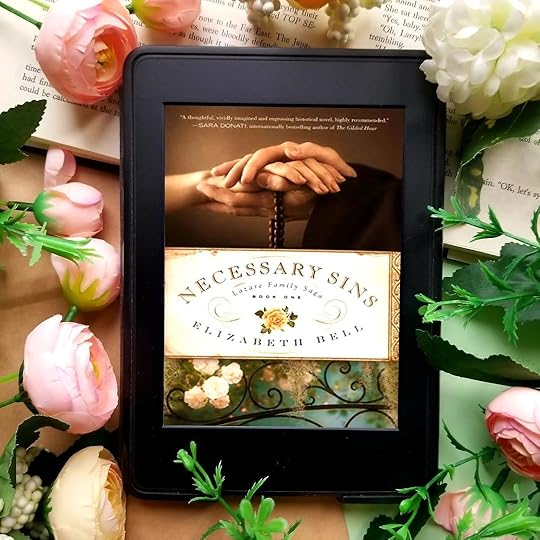
“Necessary Sins” is what I would benchmark how a perfect historical fiction should be. This book, in my opinion, is the epitome of the genre, and I loved every bit of it.
You know that feeling you get when you pick up a book to read? It’s big and heavy, but you can sense something special about it? That is precisely how “Necessary Sins” was to me. Even though I am not a fan of massive books, everything about the book, from its gorgeous cover to its poignant epigraphs, the characters, and the situations, compelled me to read the story. Moreover, people who follow my reviews know that I am a sucker for family sagas, and this book did not disappoint. We meet the Lazare Family, and this beautiful saga focuses mainly on Joseph in this book.
The author also writes the characters so compellingly that it makes you feel like you are with them in that era. I enjoyed beginnings with Matthieu and Marguerite, but the highlight of the tale was Joseph. The author portrayed his emotions beautifully. You can see the complex feelings he goes through whenever he sees Tessa. He feels self-conscious and awkward about his feelings, even though he is a good person in all other ways. I loved the way the author spun the tale between Joseph and Tessa. Also, the author ends the story on a high note, yet open-ended, that makes you immediately want to read the next book.
Similarly, the author touches on topics like Slavery and Catholicism and the mindset of the people during that era. If you are a fan of historical fiction and family sagas, you NEED to read this book. Overall, “Necessary Sins” was hard to put down, and I loved reading every page.

August 15, 2020
A friend recommended Necessary Sins! Wow! From the first page I was hooked. I love the historical account of Antebellum Charleston. This book was professionally researched and beautifully written. The drama, emotion, but mostly the tragedy that the Lazare family endured is beyond comprehension. I can’t wait to read the next book is this saga.
June 23, 2022
Excited that there are 3 more that follow this one.
Fans of historical fiction would enjoy this book.
Fans of historical fiction would enjoy this book.

June 24, 2019
As soon as I read the first chapter, I knew this book would tear at my heart and make me want to reach through the pages to slap a couple of characters. The author dives right into the mind and life of each character, period prejudice and all, giving a vivid experience of the times and culture. Heroes are conflicted. Villains live up to their labels. Every scene, character, and phrase drives the story forward with relentless irony.
It's also refreshing to see an intact, loving family at the center of chaos. That makes it especially hard when...well you'll have to find out. Joseph's father has some incredible one-liners that will have you rooting for justice and adoring him.
I cannot fathom the amount of research and connections made to craft this story. Being the kind of person who falls asleep during mass, I am impressed at how the author found ways to bring life to old texts, teachings, opinions about them, etc., and use them to create conflict and peace.
Looking forward to the next one. I need to find out what happens!
It's also refreshing to see an intact, loving family at the center of chaos. That makes it especially hard when...well you'll have to find out. Joseph's father has some incredible one-liners that will have you rooting for justice and adoring him.
I cannot fathom the amount of research and connections made to craft this story. Being the kind of person who falls asleep during mass, I am impressed at how the author found ways to bring life to old texts, teachings, opinions about them, etc., and use them to create conflict and peace.
Looking forward to the next one. I need to find out what happens!

August 16, 2021
There is nothing that will grab my attention more than a hefty family saga filled with drama, secrets, and family dynamics, so I was very excited to finally read Necessary Sins and happy to report that it checked all the boxes!
The author takes us back to Antebellum South and delivers a raw glimpse into the times back then. It features the Lazare family and spans decades and locations. It tackles some pretty harsh topics such as slavery and racism which were hard to read and I definitely went through some tissues in a few scenes. Religion is also a strong theme in the novel, with the devout Joseph. A recently discovered secret about his heritage has caused him inner turmoil about who he is and his religion. His faith is tested even more when he falls in love with a married woman.
Necessary Sins is a door-stopper of a book but the pages go by quickly as the author keeps the reader entranced in the story. It's obvious that she poured her heart and soul into this novel and I'm excited to read the next book in the series!
This is a historical fiction saga not to be missed!
The author takes us back to Antebellum South and delivers a raw glimpse into the times back then. It features the Lazare family and spans decades and locations. It tackles some pretty harsh topics such as slavery and racism which were hard to read and I definitely went through some tissues in a few scenes. Religion is also a strong theme in the novel, with the devout Joseph. A recently discovered secret about his heritage has caused him inner turmoil about who he is and his religion. His faith is tested even more when he falls in love with a married woman.
Necessary Sins is a door-stopper of a book but the pages go by quickly as the author keeps the reader entranced in the story. It's obvious that she poured her heart and soul into this novel and I'm excited to read the next book in the series!
This is a historical fiction saga not to be missed!
December 10, 2019
A Charleston setting. An interracial family secret. A forbidden love. What could be better?
This is the story of Joseph Lazare, whose family flees Haiti during the San Domingue uprising and who grows up in its shadow in Charleston. His soul is promised to the Catholic Church, but after he takes his vows, he falls in love with the unhappily married wife of a wealthy South Carolina planter.
The historical context is powerfully evoked, and the framework of the Church—its shadow, and its yoke—greatly adds to the tension of the tale of the last two souls who should feel fleshly love for one another.
This is the story of Joseph Lazare, whose family flees Haiti during the San Domingue uprising and who grows up in its shadow in Charleston. His soul is promised to the Catholic Church, but after he takes his vows, he falls in love with the unhappily married wife of a wealthy South Carolina planter.
The historical context is powerfully evoked, and the framework of the Church—its shadow, and its yoke—greatly adds to the tension of the tale of the last two souls who should feel fleshly love for one another.

August 24, 2020
I expected it to be about several generations of a multi-racial family in Haiti and the American south but it was more about the Catholic church, Its painfully strict restrictions and "laws" were shown from the pov of priest and parishoners. I found it to be quite unsettling and depressing, probably because I never gave this subject much in-depth thought before,. I am curious and anxious to read the second book in this series

September 7, 2019
Good but not quite what I expected at least based on the blurb; interesting enough though, so I plan to check out the next volume
October 29, 2019
I enjoy historical fiction. This has is all. Interesting and believable characters that are woven into the history of the time. Can't wait for the next book.
August 22, 2024
Follow the Lazare family from the Caribbean islands to Charleston, SC. Learn their secrets, and there are several, and watch as the family grows and changes. While this book follows the family, the main character is Joseph Lazare.
Joseph grows from a boy to a man and becomes a caring Catholic priest. His life is made difficult though by his unwavering attraction to Irish immigrant Tessa Conley. It’s heartbreaking to watch Joseph struggle to keep his holy vows in the face of such a powerful temptation. If that’s not enough to test his mettle, Joseph must face loss and deal with misgivings about his hidden African heritage and his family. Joseph finds himself torn between right and wrong. Despite his religious calling, can he fight the fascination he and Tessa share?
You’ll likely notice the influence of Colleen McCullough’s The Thorn Birds on the book. The author freely admits to being impressed by the mini-series starring Richard Chamberlain. (I was, too.) While there are some similarities, this book tells its own story, one of slavery, freedom, discrimination, and the ability to rise above life’s limitations and restrictions.
Necessary Sins is a beautifully written and developed tale, the beginning of the story of a close and loving family, of struggles, and of things hidden and forbidden. The narration is well performed, and it brings the story to life.
I enjoyed this audiobook, and I highly recommend that you read it in any format.
I won this audiobook in a giveaway on Facebook. I thank the author for her generosity, but it had no effect on this review. All opinions in this review reflect my true and honest reactions to reading this book.
Joseph grows from a boy to a man and becomes a caring Catholic priest. His life is made difficult though by his unwavering attraction to Irish immigrant Tessa Conley. It’s heartbreaking to watch Joseph struggle to keep his holy vows in the face of such a powerful temptation. If that’s not enough to test his mettle, Joseph must face loss and deal with misgivings about his hidden African heritage and his family. Joseph finds himself torn between right and wrong. Despite his religious calling, can he fight the fascination he and Tessa share?
You’ll likely notice the influence of Colleen McCullough’s The Thorn Birds on the book. The author freely admits to being impressed by the mini-series starring Richard Chamberlain. (I was, too.) While there are some similarities, this book tells its own story, one of slavery, freedom, discrimination, and the ability to rise above life’s limitations and restrictions.
Necessary Sins is a beautifully written and developed tale, the beginning of the story of a close and loving family, of struggles, and of things hidden and forbidden. The narration is well performed, and it brings the story to life.
I enjoyed this audiobook, and I highly recommend that you read it in any format.
I won this audiobook in a giveaway on Facebook. I thank the author for her generosity, but it had no effect on this review. All opinions in this review reflect my true and honest reactions to reading this book.

July 17, 2022
This was my second reading of this fantastic book. I thoroughly enjoyed listening to the audio version which Dallin Bradford narrated so brilliantly. If you're looking for an engaging historical read with compelling characters and beautiful writing, then you should definitely read Necessary Sins. I can't wait for the next book to come out in audio form!

October 12, 2024
I can't wait to start Book 2!

March 13, 2021
Read my review on NovelsAlive.com by clicking the link below. It is also posted in full below.
https://novelsalive.com/2021/04/26/4-...
Necessary Sins is the first book in the Lazare Family Saga by Elizabeth Bell. It’s historical fiction that takes place from the late 1700s to the mid-1800s and spans over fifty years. It’s over five hundred pages, and the story started out slowly for me with many characters and locations. But once it picked up and I became vested in the diverse set of characters, it was an emotional albeit enjoyable read.
The prologue takes place in Charleston, South Carolina, in 1822, but that’s not when the story begins. It begins in 1789 in the West Indies, and from there, we go to Paris, Charleston, Rome, and back to South Carolina, where most of the story takes place. This is a multigenerational tale of the Lazare family, and while we find out that they descend from black slaves, Rene was led to believe that his coloring and those of his children were from their Spanish grandmother. Rene, the patriarch, is raised by his stern grandmother, Marguerite, who is meanspirited, evil at times, very harsh, and lies. Is it because of what happened to her own family and its effects on her outlook on life? We learn of his life, marriage, children, profession as a doctor, his friendships, and his beliefs of the Catholic Church and how they differ from his devout wife and son. When Joseph, at a young age, declares he wants to become a priest, his mother, who is a deaf-mute, is thrilled, while his father feels he’s shortchanging his life. Will his father’s prediction come true?
Each chapter begins with an interesting quote. There are a lot of Bible passages and prayers sprinkled throughout, especially since Joseph does become a priest and the Catholic Church and their beliefs play a major role in the story. The story has many twists and turns with a depth to the characters and the storyline. I enjoyed the relationship Joseph had with his mother and his sisters, as well as his friendship with Teresa and her brother, Liam. It was heartbreaking to see how Joseph treated his father, but his father was always there for him. There is often a darkness to the story, and at times I had tears rolling down my face. The amount of loss endured was distressing, and it was upsetting to see how poor some people were and how they lived, like Teresa and Liam. The way the slaves were often treated was sad, while others were treated with dignity and like part of the family even though they were the property of their landowners. Blacks, as well as the poor, were treated horribly in the South, and it was often heart-wrenching to see. There was also a lightness in some of the relationships, the feelings for other family members and friends, and the love and happiness often portrayed. There are vivid descriptions throughout that often made me feel like I was there. The story ended too abruptly for me, but I’m happy to see there are three additional books in the saga. I do hope to read them all. The cover is attractive and is meaningful to the story. The Author’s Note and Acknowledgments were both interesting and gave a nod to the amount of research that went into the telling of this tale.
Ms. Bell has a writing style that I enjoyed, and I will look for her books in the future.
https://novelsalive.com/2021/04/26/4-...
Necessary Sins is the first book in the Lazare Family Saga by Elizabeth Bell. It’s historical fiction that takes place from the late 1700s to the mid-1800s and spans over fifty years. It’s over five hundred pages, and the story started out slowly for me with many characters and locations. But once it picked up and I became vested in the diverse set of characters, it was an emotional albeit enjoyable read.
The prologue takes place in Charleston, South Carolina, in 1822, but that’s not when the story begins. It begins in 1789 in the West Indies, and from there, we go to Paris, Charleston, Rome, and back to South Carolina, where most of the story takes place. This is a multigenerational tale of the Lazare family, and while we find out that they descend from black slaves, Rene was led to believe that his coloring and those of his children were from their Spanish grandmother. Rene, the patriarch, is raised by his stern grandmother, Marguerite, who is meanspirited, evil at times, very harsh, and lies. Is it because of what happened to her own family and its effects on her outlook on life? We learn of his life, marriage, children, profession as a doctor, his friendships, and his beliefs of the Catholic Church and how they differ from his devout wife and son. When Joseph, at a young age, declares he wants to become a priest, his mother, who is a deaf-mute, is thrilled, while his father feels he’s shortchanging his life. Will his father’s prediction come true?
Each chapter begins with an interesting quote. There are a lot of Bible passages and prayers sprinkled throughout, especially since Joseph does become a priest and the Catholic Church and their beliefs play a major role in the story. The story has many twists and turns with a depth to the characters and the storyline. I enjoyed the relationship Joseph had with his mother and his sisters, as well as his friendship with Teresa and her brother, Liam. It was heartbreaking to see how Joseph treated his father, but his father was always there for him. There is often a darkness to the story, and at times I had tears rolling down my face. The amount of loss endured was distressing, and it was upsetting to see how poor some people were and how they lived, like Teresa and Liam. The way the slaves were often treated was sad, while others were treated with dignity and like part of the family even though they were the property of their landowners. Blacks, as well as the poor, were treated horribly in the South, and it was often heart-wrenching to see. There was also a lightness in some of the relationships, the feelings for other family members and friends, and the love and happiness often portrayed. There are vivid descriptions throughout that often made me feel like I was there. The story ended too abruptly for me, but I’m happy to see there are three additional books in the saga. I do hope to read them all. The cover is attractive and is meaningful to the story. The Author’s Note and Acknowledgments were both interesting and gave a nod to the amount of research that went into the telling of this tale.
Ms. Bell has a writing style that I enjoyed, and I will look for her books in the future.

January 24, 2020
Holy cow. Amazing book. Believe all the other five star reviews. It was that good. At first I doubted that I'd like it. I've never been more wrong about anything. By the end, I could not put it down. I have many thoughts:
Very unique plot structure. I can’t think of too many books that would spend 70 pages with one generation, skip the second generation, spend 30 pages in the third generation, and then spend 300 pages in the fourth. It reminded me of how Jane Eyre spent so much time on backstory. It only works when a tremendous amount of plot is self-contained in backstory and here it is.
Fascinating spin on the typical love story formula. Most love stories in fiction and on film have the lovers meet, keep the lovers from each other through some plot mechanism, and then end the story when they get together. This book absolutely followed that formula, but it put a unique spin on it by making the lover a celibate priest and a rigid, anxiety induced one at that.
I don’t think I’ve ever seen a more anxious person in fiction, though I’ve definitely seen them in life. So bravo for showcasing that particular personality trait.
I really wanted to see more slave characters’ perspectives. I know that if the point of view character in fiction doesn’t think too much about slaves’ or servants’ conditions, then it’s hard to get into the heads of the lower classes, but I still wanted to see more of that.
There definetly was too much religious talk for my taste. I know that it’s huge part of the story, but there were a few times when I wanted to say, move along with the story. I don’t care about what Saint so-and-so did hundreds of years before this story.
I found it odd that Catholic was so much “the default” in this book. Like, I get that every character is so deeply catholic. But in such a Protestant country, Catholicism felt oddly assumed in some way. It wasn’t that the characters thought badly of Protestants. It was as though Protestantism never crossed their minds as a thing that existed. The world these characters lived in seemed like a 1400s world where Catholicism literally would be the default.
Very unique plot structure. I can’t think of too many books that would spend 70 pages with one generation, skip the second generation, spend 30 pages in the third generation, and then spend 300 pages in the fourth. It reminded me of how Jane Eyre spent so much time on backstory. It only works when a tremendous amount of plot is self-contained in backstory and here it is.
Fascinating spin on the typical love story formula. Most love stories in fiction and on film have the lovers meet, keep the lovers from each other through some plot mechanism, and then end the story when they get together. This book absolutely followed that formula, but it put a unique spin on it by making the lover a celibate priest and a rigid, anxiety induced one at that.
I don’t think I’ve ever seen a more anxious person in fiction, though I’ve definitely seen them in life. So bravo for showcasing that particular personality trait.
I really wanted to see more slave characters’ perspectives. I know that if the point of view character in fiction doesn’t think too much about slaves’ or servants’ conditions, then it’s hard to get into the heads of the lower classes, but I still wanted to see more of that.
There definetly was too much religious talk for my taste. I know that it’s huge part of the story, but there were a few times when I wanted to say, move along with the story. I don’t care about what Saint so-and-so did hundreds of years before this story.
I found it odd that Catholic was so much “the default” in this book. Like, I get that every character is so deeply catholic. But in such a Protestant country, Catholicism felt oddly assumed in some way. It wasn’t that the characters thought badly of Protestants. It was as though Protestantism never crossed their minds as a thing that existed. The world these characters lived in seemed like a 1400s world where Catholicism literally would be the default.
July 21, 2026
Would have made a more interesting read w/out the bible verses, a bit too redundant.

July 30, 2019
NECESSARY SINS by Elizabeth Bell is a beautifully-written and compelling work of historical fiction set mainly in Charleston, South Carolina. It is an epic multi-generational family saga that spans several decades and moves from the West Indies to Europe and finally to the antebellum South. The story of the Lazare family held me captive from the very beginning of the book to the dramatic conclusion of Book 1. The characters were richly portrayed and the vivid descriptions of the settings made me feel I was right there with them. NECESSARY SINS is a moving tale of family, love, sacrifice and resilience that is, at times both heart-breaking and uplifting. The time periods covered are captured with accuracy and authenticity. Certain parts are hard to read because of what happens to the characters, but their experiences are shared with compassion and empathy. I highly recommend this book and can’t wait to delve into Book 2 when it becomes available. Thank you to the author, publisher and NetGalley for the chance to read an early copy.
August 8, 2019
I was given an advance review copy, and here is my honest review: This is a beautifully written, well-researched work of historical fiction. The characters are well-drawn, complex, and believable, and I was eager to see them succeed and grow. The depiction of Christianity and the main character's relationship with it was also complex and nuanced. One of the book's major strengths, I think, was the immersive settings: they were rich, vivid, and meticulously detailed. In terms of plot, I would call this book "quiet" and "gentle"; it doesn't hurtle along, it takes its time, helping us truly understand the characters and get to know them, and each step along the way is careful and deliberate.
I'm looking forward to future books in the series.
I'm looking forward to future books in the series.

August 5, 2019
Necessary Sins is stunningly beautiful historical fiction! It is a sweeping saga that takes readers from Haiti in the late 18th century to Charleston in the 1840s. The book about the Lazare family is filled with passion, goodness, temptation, duty, and sacrifice. I was completely riveted by the subjects that this novel deals with—slavery, Catholicism, and those affected by both. I look forward to reading the next installment in this saga.
Displaying 1 - 30 of 136 reviews