Jump to ratings and reviews
Rate this book

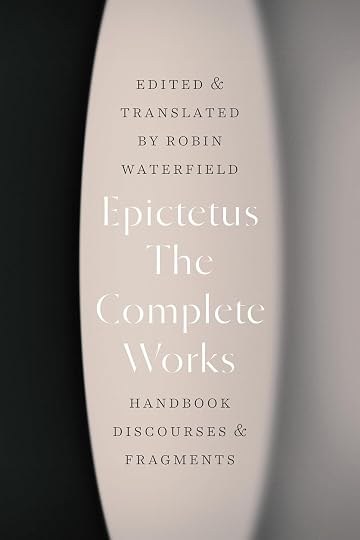
The Complete Works: Handbook, Discourses, and Fragments

Rate this book
The complete surviving works of Epictetus, the most influential Stoic philosopher from antiquity.

“Some things are up to us and some are not.”

Epictetus was born into slavery around the year 50 CE, and, upon being granted his freedom, he set himself up as a philosophy teacher. After being expelled from Rome, he spent the rest of his life living and teaching in Greece. He is now considered the most important exponent of Stoicism, and his surviving work comprises a series of impassioned discourses, delivered live and recorded by his student Arrian, and the Handbook , Arrian’s own take on the heart of Epictetus’s teaching.

In Discourses , Epictetus argues that happiness depends on knowing what is in our power to affect and what is not. Our internal states and our responses to events are up to us, but the events themselves are assigned to us by the benevolent deity, and we should treat them—along with our bodies, possessions, and families—as matters of indifference, simply making the best use of them we can. Together, the Discourses and Handbook constitute a practical guide to moral self-improvement, as Epictetus explains the work and exercises aspirants need to do to enrich and deepen their lives. Edited and translated by renowned scholar Robin Waterfield, this book collects the complete works of Epictetus, bringing to modern readers his insights on how to cope with death, exile, the people around us, the whims of the emperor, fear, illness, and much more.

CUSTOMER THE HARDCOVER IS FOR LIBRARIES AND HAS NO JACKET.

476 pages, Paperback

Published October 6, 2022

Loading...
Loading...

About the author

Epictetus

1,038 books2,426 followers
Epictetus was a Greek Stoic philosopher. He was probably born a slave at Hierapolis, Phrygia (present day Pamukkale, Turkey), and lived in Rome until his exile to Nicopolis in northwestern Greece, where he lived most of his life and died. His teachings were noted down and published by his pupil Arrian in his Discourses. Philosophy, he taught, is a way of life and not just a theoretical discipline. To Epictetus, all external events are determined by fate, and are thus beyond our control, but we can accept whatever happens calmly and dispassionately. Individuals, however, are responsible for their own actions which they can examine and control through rigorous self-discipline. Suffering arises from trying to control what is uncontrollable, or from neglecting what is within our power. As part of the universal city that is the universe, human beings have a duty of care to all fellow humans. The person who followed these precepts would achieve happiness.

Other language versions:
Epictète
Epícteto
Epiktet

Ratings & Reviews

What do you think?
Rate this book

Friends & Following

Create a free account to discover what your friends think of this book!

Community Reviews

5 stars
156 (64%)
4 stars
63 (26%)
3 stars
18 (7%)
2 stars
2 (<1%)
1 star
3 (1%)
Displaying 1 - 30 of 33 reviews
Profile Image for Jim Puskas.
Author 2 books151 followers
June 4, 2026
In addition to translating this compendium of the known teachings of Epictetus, editor Robin Waterfield has provided an extensive and very helpful Introduction. The book offers us an easily accessible education in stoicism, as it was taught by Epictetus, beginning about 93 CE.
The fundamental question his teaching sought to address was:
”How must we live if our lives are to be subjectively fulfilling and objectively worthwhile?”
His answer was ”Get ever closer to yourself, your true self.”
In support of his goal of making that apparently simple statement a reality in the lives of his acolytes (rather than just a philosophic mantra discussed around the dinner table) Epictetus enunciated a set of core principles, intended to prevail over every aspect their daily lives. These principles and their application were summarized in a comparatively concise “Handbook.”
1. Learn to distinguish between what is “up to us” and what is not.
2. Our minds and all aspects of our character belong exclusively to us. They cannot be thwarted by anyone or anything else.
3. Events imposed by others or by fate are neither “good” nor “bad” and cannot contribute to our happiness or misery. Such events are opportunities, not constraints.
4. Each of us has the resources to achieve happiness. It’s “up to us.” We can take control of our own lives.
5. Rationality is our birthright and an inalienable human capacity. We have both the capacity and the obligation to act rationally and with virtue.
6. Virtue (which is the proper functioning of the soul in accord with nature, under the guidance of reason, always fulfills and benefits us, regardless of what others do.
7. If we are virtuous, nothing external can make the slightest difference to our happiness.
Since it is our nature’s tendency to be rational, it is the job of philosophy to help us realize this inborn potential; cure us of attachment to anything that is not conducive to this end. None of this is easy, it requires commitment and hard work. This philosophy must be applied to every aspect of daily life; it must govern our actions, habits and behavior.
For Epictetus, the goal is that the student shall continually strive to become a better person. Not more learned but to live and act in accord with a rational perception and understanding of the real world; to live according to a set of ethical concepts and beliefs. To “know oneself” and become confident in one’s role, beliefs and habits. Epictetus was a stern taskmaster; he had no patience with sophistry and empty rhetoric. He was often blunt and abrasive.
Stoicism, as advocated by Epictetus, offers man a pathway to contentment (Discourses 1.1.17) When faced with conditions over which one has no control, the student is instructed to ”Make the best of what is ‘up to us’ and take everything else as it comes.” Complaining about misfortune is not only futile, it distracts man from what he should be doing. Use your own gift of reason to make wise choices. Deal with each situation by examining each impression and deciding whether to respond or not, and how to respond.
In the “Discources” — a free-form discussion mode that will be familiar to anyone who has studied Plato and Socrates — Epictetus takes his philosophy into every imaginable aspect of a person’s daily life, striving to make his teachings as practical and life-changing as possible, demonstrating how the accomplished stoic can deal with any number of life's challenges, from one’s kinship with God to choosing style of dress, from family relations to dealing with a tyrant.
Epictetus’s interchanges with students, visitors, opposing philosophers (and interlocutors that he conjures up to illustrate a point) are expressed in free-wheeling vernacular; it's forthright, often humorous, even mocking or rude. For example, I found especially entertaining his interchange with a supposed tyrant — who claims to be ”the most powerful man in the world” and who believes himself to be “”the focus of everyone’s attention”. Epictetus chaffs ”Can’t you see that everyone attends to his own mundane needs and attends to you as he does to his donkey. I mean, who cares for you as a person? Who takes you for a role model?”
It’s hardly surprising that Emperor Domitian exiled all philosophers from Rome, suspecting them (probably with some justification) of having republican sympathies. Epictetus established himself on the coast of Greece and took a dim view of Rome, seeing it as a place of false values and lose morals — very much at odds with his teachings.
I find much to applaud in Epictetus’s ideas. Although I recognize that seeking to live by his principles is likely to put one out of step with much of the world that surrounds us, doing so should be very rewarding in terms of peace of mind. One thing I’m sure of: a true stoic is sure to be an honorable person.
The only person I’ve met who might readily have been considered a stoic was my maternal grandfather — although he could never have thought of himself that way. It may be my memories of him and his worldview that render this philosophy so appealing to me.
I wish I had read this in my youth; it would have helped me to face the many “slings and arrows” I faced from a world where I did not fit in.
Profile Image for Mark Wooten.
40 reviews1 follower
October 2, 2024
This was my first stoic book to read and I found it very interesting. The main message seems to be that a person should concern themselves with what they are actually in control of, and stop worrying about what they can’t. What can we control? It seems Epictetus would say the use of our will and rational judgements.

An example that comes up several times is the idea that Caesar can arrest me or whip me or even kill me if he wants. I can’t do anything about that, and this shouldn’t worry. But as powerful as Caesar is, he can’t make me say something is false when I know it to be true. That is a thing that is entirely up to me, and so I should work to hone that skill.

That main message is really hammered in. You can pick that up in the first bit of this, and then you get 300 or so more pages of examples and repetition. It’s not a book I could just go straight through. I felt that it benefitted from coming back to it again and again over a longer period of time than I would normally spend on a book.

Maybe the most interesting thing to me was how often this work of philosophy overlapped with what I believe are core theological concepts. So many of my marginal notes read like “that’s Romans!”or “that sounds like 1 Peter”. Epictetus talks a lot about Providence and honoring God with your life. I believe he’s a little off track with the “god” he aims to worship, but the amount of this secular wisdom that accords with God’s Word is really fascinating.
Profile Image for Patrick.
5 reviews
June 23, 2024
Much better translation than what i was reading before!
Profile Image for Morgan.
39 reviews18 followers
September 18, 2023
Important read. Nearly ran my highlighter dry. I don't think the individual quotes hold much strength on their own though - they need the full context, explanations, and time to absorb.

Anyways...

2.16.1 "Where should we look for what is good? In will. And for what is bad? In will. And for what is neither good nor bad? In things that aren't subject to will. All right, but do any of us remember this except when we're discussing it as we are now?"
3 reviews
March 13, 2024
Very interesting collection of lectures from an Ancient Greek Stoic philosopher.
While I don't agree and follow everything he believes in and teaches, I do find many of his practices very insightful and am eager to apply them to my own life from now on.
Profile Image for Keith.
1,109 reviews14 followers
August 28, 2026
A Philosophy of Life: On Waterfield's Complete Epictetus

Five stars. Robin Waterfield's Epictetus: The Complete Works (2022) is the first single-volume English translation of all surviving Epictetan material — the Handbook, the Discourses, and the Fragments — and it is the edition I would recommend to any reader approaching Epictetus seriously. I have reviewed the Handbook and the Discourses separately; this review focuses on Waterfield's editorial and translatorial achievement, on his introduction, and on what the complete edition offers that the individual texts cannot.

The Translator and the Edition

Robin Waterfield is one of the finest translators of ancient Greek working today: his previous translations of Herodotus, Plato, Aristotle, and Xenophon for Oxford World's Classics and Penguin are widely considered the best available in English. The expert consensus on this Epictetus edition is similarly strong. Brad Inwood, one of the leading authorities on Stoicism, calls it "now the best English translation of Epictetus available — idiomatic yet accurate, it captures Epictetus's voice in all its moods: direct and personal, often brusque and challenging, sometimes ironic, sometimes humorous." John Sellars describes the introduction as "a reliable and up-to-date guide to the most influential Stoic in today's world."

Waterfield's translation policy is worth noting: he combines accuracy with contemporary English fluency, and he has chosen not to gender-neutralize Epictetus's pronouns. He explains this decision honestly: Epictetus's anonymous student is consistently depicted in masculine terms throughout the texts, and neutralizing this would misrepresent Epictetus and his world. He was working two thousand years ago, at a time when male dominance was simply assumed. This is the right scholarly decision even if it will occasionally jar modern readers.

The Fragments

The Fragments section,running from page 353 to 365 in the print edition, is available in English elsewhere, but having it gathered in the same volume as the Handbook and Discourses is genuinely useful. The Fragments are shorter surviving passages from Epictetus's teaching that did not make it into Arrian's compilations: preserved in quotations by other ancient writers. They are uneven in quality and length, but several are striking, and they round out the picture of Epictetus's teaching in ways the main texts do not. Fragment 1, for instance, deals with whether a curriculum of philosophical study is indispensable, and Fragment 27 appears in Waterfield's listing of the three-phase exercise program. Reading them alongside the Discourses gives a sense of how widely Epictetus's voice circulated in the ancient world even in his lifetime.

Did Epictetus Read and Write?

Waterfield notes plainly that Epictetus wrote nothing himself: all surviving material comes through Arrian. This raises a question I have found myself considering: was Epictetus himself literate?

He was born into slavery, probably in Hierapolis around 50 AD. His master was Epaphroditus, a powerful freedman in Nero's court, who permitted him to study philosophy under Musonius Rufus. Literacy in the ancient world was the norm even among free citizens, and for an enslaved person born in a provincial city, formal education would have been dependent entirely on the goodwill of his owner. It is genuinely uncertain whether he could read and write.

There is a useful historical parallel here: Charlemagne, the greatest ruler of the early medieval period, reportedly could not master literacy despite considerable effort as an adult. The difficulty of learning to read and write after childhood is well-documented. Even the most intelligent person in the world faces a genuine neurological challenge in acquiring written language as an adult. If Epictetus was literate, he acquired that literacy under conditions of slavery — which makes it even more remarkable. If he was not, he constructed an entire philosophical system through oral teaching alone, which is arguably more remarkable still.

What is certain is that Epictetus focused entirely on teaching rather than writing — in sharp contrast to Seneca, who was prolific. Whether this was a matter of philosophical conviction (that wisdom must be transmitted person to person, not through texts), practical circumstance, or both, we cannot know. Arrian's preface to the Discourses suggests he was recording the lectures because he did not want them lost — implying Epictetus himself was not concerned with preserving them in written form.

Philosophy Then and Now

One of the most important arguments in Waterfield's introduction is the distinction between how philosophy was studied and practiced in Epictetus's world and how it is practiced today. This distinction is worth dwelling on because it transforms how you read the text.

Waterfield writes:
"Modern philosophy is pursued in classrooms, seminars, and the written word, and much of it consists of analyzing abstract concepts and arguments, but much ancient philosophy, especially in the postclassical centuries, was philosophy to live by and practice daily. It was supposed to purge you from your base attachments and make you a better person. It was supposed to help you cope with difficulties you encountered and things that might disturb your equanimity" (p. 15).


Ancient philosophical education was understood as transformation of character, not acquisition of knowledge. Topics were chosen for their practical relevance — old age, death, anger, poverty, exile — and studied with the specific goal of learning how to cope with them. Epictetus's school was not a seminar room for intellectual discussion; it was closer to what we might now call a therapeutic training program combined with a spiritual discipline.

In 2026, a philosophy degree in the United States has very limited vocational application outside of academic philosophy itself, a field with a notoriously difficult job market. I do not perceive a philosophy PhD as necessarily producing a wiser or more emotionally content person than someone with no formal philosophical training. The best advocate for philosophy as a genuinely useful practice I have encountered is Sam Harris, a neuroscience PhD who functions essentially as a public intellectual in the tradition of Gore Vidal and William F. Buckley, using philosophical reasoning to address questions about consciousness, ethics, and how to live. His career is one of the few contemporary examples of philosophy practiced as the ancient schools intended it: not as an academic exercise but as a guide to living.

Epictetus would have recognized Harris's approach. He would not have recognized most academic philosophy departments.

Waterfield also makes a point about access worth emphasizing: "Humankind had to wait many centuries for the ideal of universal access to education; in Epictetus's time it was almost entirely for the rich" (p. 15). In 2026, as college education becomes increasingly unaffordable, the fact that Stoicism is freely or inexpensively accessible through the ancient texts (including this Waterfield edition in eBook form, which I purchased for less than $5) is genuinely valuable. Epictetus's philosophy requires no institutional affiliation, no tuition, and no credentials. Anybody can study and practice it.

Waterfield's Introduction and the Three-Phase Practice Program

The introduction is the most practically valuable part of this edition and the reason I rate the Complete Works separately from the individual texts. At 42 pages it is substantial, covering Epictetus's biography, the Stoic philosophical framework, the structure of the surviving works, and (most valuably) a synthesis of the practical training program Epictetus describes across the Discourses.

On pages 30-34 of the eBook edition, Waterfield identifies three progressive phases of Stoic training, drawing on passages scattered across all four books of the Discourses. This synthesis is his own editorial contribution: Epictetus never presented the three phases in a single organized list, and Waterfield's work of gathering and organizing them makes the philosophy genuinely actionable rather than merely admirable.

I want to present these exercises in plain contemporary language, stripped of chapter references, as a practical guide for anyone who wants to apply Epictetan philosophy to daily life.

General Daily Practices (supporting all three phases)

Each morning, anticipate what difficulties might arise during the day (such as frustrations, disappointments, things outside your control) and mentally rehearse your response to them. This is what Stoics called negative visualization: not pessimism, but preparation. Difficulties that have been anticipated lose much of their power to destabilize you.

Each evening, review the day honestly but without self-punishment. Where did you handle things well? Where did you assent to impressions you should have questioned? The goal is calibration, not self-flagellation. Epictetus notes that the human mind is more malleable than people think, and that both ruination and improvement come from within.

Throughout the day, keep key principles available in memory. Not as slogans, but as genuine reminders: What is up to me here? What is not? Have I done what was mine to do?

Phase One: Training Desire

The goal of Phase One is to want only what is genuinely within your control. Completion of this phase, Waterfield notes, would make one "almost a complete philosopher" (p. 31) — which gives you a sense of both its importance and its difficulty.

In practice this means: identify where your desires are attached to outcomes you cannot guarantee (such as a particular result at work, another person's behavior, your reputation, your health) and practice loosening that attachment. This is not indifference to outcomes. It is refusing to make your peace of mind contingent on them.

Practice responding correctly to things that disappoint you. When something goes wrong, notice the impression that arrives — "this is bad," "this reflects on me," "this is unfair" — and practice substituting an accurate description of what actually happened, without the evaluative overlay.

Gradually work on reducing attachment to anything other than your own character and conduct. What you do with full attention and genuine care is yours. What results from that is not always yours to determine.

Phase Two: Training Inclination

The goal of Phase Two is to act appropriately in every role you inhabit. Where Phase One achieves inner tranquility, Phase Two achieves appropriate outward behavior toward others.

In each situation, ask what the appropriate response is: not the emotionally reactive one, not the self-protective one, but the one that honors your role. As a parent, what does genuine care for this child require? As an employee, what is actually being asked of me? As a friend, what does this person need?

When you feel a pull toward a response that is pleasant but not appropriate (such as avoiding a difficult conversation, cutting corners, choosing comfort over what is genuinely right) imagine the alternative and the sense of regret you would feel if you took the easy path.

Ask yourself what a genuinely excellent person would do in this situation. Not a perfect one (Epictetus acknowledged that the fully realized Stoic sage rarely exists) but someone who is genuinely trying to live well.

Phase Three: Training Judgment

The goal of Phase Three is to think clearly and assent only to true impressions. This requires what Epictetus calls vigilance: the ongoing observation of one's own mental processes.

Before accepting an impression as true, pause. This is the hardest practice and the one Epictetus returns to most insistently across the Discourses. The impression arrives fast and feels true. The pause is what gives you the chance to ask: is this actually true? By what standard?

Before a significant decision or commitment, assess honestly what it demands of you and whether you can genuinely meet that demand.

Practice reframing situations in more accurate terms. Not falsely positive (Epictetus is not a positive-thinking coach) but accurate. An accurate description of what happened, without the evaluative overlay that transforms disappointment into failure.

Cultivate the awareness that you are part of something larger than your individual circumstances. Seeing yourself in a broader context reduces the distortion that comes from treating every setback as uniquely significant.

Mastery of all three domains, Waterfield concludes, would make one "an expert in the art of living" (p. 33) — and as with any craft, improvement goes on for as long as one practices. It is, Epictetus insists, a lifelong process.

Verdict

Five stars. Waterfield's Complete Works is the best available English edition of Epictetus: accurate, readable, comprehensively annotated, and equipped with an introduction that does the work of making this ancient philosophy immediately applicable to contemporary life. The three-phase exercise program synthesized in that introduction is worth the price of the edition on its own. Epictetus himself would insist that reading this book is only the beginning. The actual work is in applying it.


[Image: Book Cover]

Citation:

Epictetus. (2022). The complete works: Handbook, discourses, and fragments (R. Waterfield, Trans. & Ed.) [eBook]. University of Chicago Press. https://www.amazon.com/gp/product/B09... (Original works c. 108 AD)

Title: The Complete Works: Handbook, Discourses, & Fragments
Author(s): Epictetus (author), Robin Waterfield (Translator, Editor)
Year: 2022
Genre: Nonfiction — Philosophy: Stoicism
Page count: 453 pages
Date(s) read: 8/10/26–8/21/26
Book 167 in 2026
Profile Image for Sinta.
471 reviews
November 29, 2025
IS CHRISTIANITY JUST STOICISM????

Also the birth of individualism - the idea our happiness is completely dependent on our own judgments, refining our own rationality

I continue to see the attractiveness of certain Stoic ideas as psychological tactics, but it still doesn’t provide a fully sufficient, complete philosophy. Most things aren’t under your control so try to shut down all emotional response to them? Seems immature

Christianity parallels (building on Rufus)
- Scala naturae (great chain of being)
- Argument from design - orderliness of universe and made for the good of humankind shows it was created and is maintained by a cosmic reason
- Gods providential benevolence - resources to change and achieve happiness

Free will (prohairesis) is the faculty that allows us to assent or not to impressions, and therefore to make use of them

Note: I only read the Introduction and Handbook, not the full Discourses (the handbook felt like a sufficient summary given I’ve already read the prior stoics)

Notes from secondary commentary:
- Some scholars claim the first to come up with the concept of free will
- This birthed the stoic idea of not valuing anything that is not your choice
- Only your choice is truly yours because it is the only thing that cannot be taken from you
- You must always be ready to give back what has been given to you

Notes:
Introduction:
The fundamental question that his teaching was designed to address is: How must we live if our lives are to be subjectively fulfilling and objectively worth-while? And his answer was: Get ever closer to yourself, your true self.

Some things are not "up to us"-they are external to us and just happen to us—but our minds are our own, and we can con-trolour internal states and our responses to events: our desires, incli-nations, choices, judgments, and intentions; in short, all the things that make up our characters. These things are up to us and cannot be thwarted by anyone or anything else. We need to learn to accept experiences and events over which we have no control, to recognize them as "indifferent" (neither good nor bad, and with no contribution to make to our happiness or misery) and to use them as the materials on which to practice virtue and appropriate action; we need to see them as gifts of the providential God who steers and arranges everything in the universe, great and small. In this way, fated events become opportunities, not constraints.

we are fragments of the Reason that guides the universe

Epictetus was an orthodox Stoic. He introduced a few innovations, but they are changes in emphasis or terminology rather than substantial changes in doctrine. To say that he was orthodox is to say that he looked back to the first founders of Stoicism in the third century BcE, especially Chrysippus.

not surprisingly, since they reflect our nature as human beings, Stoic preferred indifferents coincide to a considerable degree with the ordinary values of society.

It is playing the game well that counts, not winning or losing, because although an action is up to us, its consequences are not.

Following Socrates's lead, the Stoies held that virtue was knowledge. They recognized four primary virtues and analyzed each as a kind of knowledge. Prudential wisdomis knowledge of good and bad; courage is knowledgeof what to fear and what notto fear; moderation is knowledge of what to pursue and what to avoid; justice is knowledge of what to give or not give others.

In this context the Stoics spoke of "appropriation" (oikeiõ-sis, literally "the process of making something one's own"), the natural preference all creatures have for what is good for themselves. A creature first and fundamentally appropriates itself to itself; hence the lifelong instinct for self-preservation (see 1.25-4). Gradually, in the case of rational creatures, the circle consisting of what it considers to belong to it, of what it appropriates to itself, widens to include family, friends, neighbors, fellow citizens, and eventually all other rational creatures, so that the motivation provided by appropriation is simultaneously self-regarding and other-regarding (1.19.13-14)." Hence, other-regarding virtues, such as justice, are good for the agent. So Epictetus insists that human beings are social creatures (e.g., 1.23.1, 1.28.20, 2.20.13, 4.11.1), by which he means that it is natural for us to take thought for others and to do them good. He repeatedly stresses other-regarding virtues such as kindness and trustworthiness.

However, some feelings were acceptable. Thinking that an indifferent is good or bad is false; so a sage, who has no false beliefs but only knowledge, experiences no passion. He does, however, experience three "good feelings" (eupatheiai): volition (the rational pursuit of something), caution (the rational avoidance of something, and joy (rational elation). Each of the three has subspecies that were therefore considered acceptable passions: kindness/benevolence, which is constantly stressed by Epictetus, was considered a form of volition, as was friendliness; modesty and reverence were forms of caution; a sense of humor and cheerfulness were forms of joy.

Since the will is free if it consists of a perfectly consistent set of true beliefs about the value of things, only the Stoic sage truly has freedom of will, while the rest of us compromise its freedom by enslaving ourselves, more or less, to the external world by false beliefs and wrong judgments. Freedom of will is something we should aim for, but it is not a birthright.

Everything we consciously do, however trivial, stems from our will and is therefore indicative of our moral character.

Whether Epictetus is talking about roles in the singular or plural, they have the same function: when it comes to making ethical decisions, we should refer to our roles. Whether or not you assent to an impression is determined in part by the kind of person you are or take yourself to be. Roles have consequences, and once we have accepted a role, we should accept as reasonable anything that follows from that role. Appropriate behavior is living in accord with nature or focusing only on things that areup to us, subject to our will, and treating all other human beings as kin-that is, with kindness and justice. Along with his development of the concept of prohairesis, this "role ethics" is Epictetus's most distinctive contribution to Stoicism.

If the earlier Stoics had claimed that true friendship can subsist only between and among people who are wise, the four Roman Stoics emphasized that, as rational creatures, all human beings are kin.

Will, as we have seen, is the faculty that determines for each of us what we believe and so influences our activities: assent, inclination/ disinclination, and desire/aversion. These, then, are the three faculties that need to be trained until they are "in accord with nature."… As several of these passages make clear, it is a progressive course: he consistently labels the three domains (as he calls them) "first," "second," and "third", and he talks of moving on from one domain to the next. The first domain is that of desire, the second that of inclinations, and the third that of judgment or assent.

[Desire domain = reasonable levels and appropriate objects. No more false conceptions of good and bad. Elimination of attachment to the external world. Achieve inner tranquility]

[Inclination domain = act appropriately in all our various roles. Recognize and fulfill your duties. Achieve appropriate outward behaviour]

[Assent domain = certainty of judgment. Assange only to true or beneficial impressions. Avoid being deceived. Observation of the way one’s mind is working. Achieve consistent and coherent judgments]

The Handbook:
"Blaming others when things are going badly for him is what an uneducated person does. Blaming himself is what a partially educated person does. Blaming neither others nor himself is what a fully educated person does."

"Instead of wishing that things would happen as you'd like, wish that they would happen as they do, and then you'll be content."

"If someone gave your body into the keeping of a passerby, you'd be furious. But you give your mind into the keeping of any random person, so that, if he maligns you, it becomes troubled and confused. Doesn't this make you feel ashamed?"

"If you're informed that someoneor other is speaking ill of you, don't defend yourself against the allegations, but respond by say-ing: Well, he must be unaware of my other faults, otherwise these wouldn't have been the only ones he mentioned!

"If you take on a role that's beyond your capabilities, you not only disgrace yourself in that one, but you've also passed up the role that you were capable of performing well."
96 reviews1 follower
February 27, 2026
A fantastic translation! It is so much easier and more meaningful to read because of Water Field's masterful update. He has some great exercises in the Introduction and great notes. This is definitely the edition to get if you are interested in Epictetus.

I read and reflected on one Discourse per day, which I really enjoyed. Additionally, reading this after Ward Farnsworth's book on the Socratic method was really helpful because I appreciated the dialog aspects of the reading more than when I've attempted this work in the past.

To use Isaiah Berlin's analogy, it seems that Epictetus is definitely a hedgehog: he knows one BIG thing, attending to and owning those impressions that bubble up from what we now know as the default mode network, using your reason to actively judge these impressions, rather than allowing oneself to get carried away by them. This big idea permeates throughout the Discourses, being practically applied in many life scenarios. The other big thread is that action trumps words: don't tell everyone your a philosopher show them by your actions that are in accordance with these principles.

Overall, a great book. But...I still like Seneca better. One cannot forget that these are lecture notes vs. highly polished letters though. Definitely recommend giving this a try.

Profile Image for Sarah.
532 reviews16 followers
July 11, 2024
4 stars: really liked it.

(University of Chicago Press 2022 edition, Waterfield translation)

An approachable and straightforward work on Stoicism. Epictetus emphasized concrete advice on how to live, so this is a largely practical work, though it does communicate Stoic theory. The ideas were understandable on their own, and the excellent introductory commentary really helped pull it all together into a cohesive philosophy.

I did not care for the haphazard organization. The Books contained no thematic groupings that I could detect. The entirety of the Discourses read as a series of vignettes, which began to feel repetitive and felt like a slog to get through by the end. The Handbook was shorter and snappier, more like a collection of proverbs, and I recommend reading it after the Discourses in order to understand the reasons behind each brief instruction.

This was my first study of Stoic philosophy. The key concepts I saw were as follows: Most things are not "up to you." The only thing of value is your own power of choice. Choose in accordance with reason. Accept life as it is. Stoicism is a lifelong journey of self-discipline.

Waterfield's translation was enjoyable and highly readable. His end notes and commentary were insightful and helpful.
15 reviews
February 16, 2026
10/10 - Wisest book I have read. Actionable and relatable words from a man's lecture from 2000 years ago.

1,023 reviews9 followers
June 12, 2025
As an advocate of stoicism I wanted to get more out of this book, but have to admit it was tough to follow, and erratic in the flow and ability of the reader to comprehend. I probably need to try a version that focuses on commentary on the teachings of Epictetus vs. the more direct version like this of his teachings. Note that Epictetus himself apparently did not write down his thoughts, so these notes were taken by a student, Arrian.

Also of interest is that Epictetus was Greek, but was taken as a slave and lived in Rome, where his master had him educated, and he later returned to Greece to teach in or around the time of Christ.

Epictetus was interested in thoughts and theories, but he wanted the focus to be on putting those arguments into action.

"A person's caliber is revealed by difficult circumstances, and so, when a difficulty occurs, think of it as God pitting you, as a trainer might, against a tough training partner."

Sarpedon, son of Zeus - "When I left home, my intention was either to distinguish myself in battle or to enable someone else to do so. If I can't achieve any kind of success myself, I won't resent it is if someone else performs nobly."

Profile Image for Dana.
29 reviews
July 5, 2024
I’ve been reading and studying this book for the last 9 months and I can say that it’s honestly changed my life. In combination with a great therapist and trying my best to apply the principles laid out by Epictetus to my daily life I’ve managed to find control over my anxiety and stop worrying about things that are outside my control.
Despite being written almost 2,000 years ago it’s still incredibly relevant today. I also had a number of laughs throughout the Discourses, especially the distain Epictetus had for the Epicureans, accusing them of “farting in public”.
This is a must read for anyone for some guidance through life.
13 reviews
January 26, 2025
This was a very challenging read for me. Not necessarily because of the translation or anything, but just because of the pacing of Epictetus’ lectures, it was hard to follow and stay interested in. I mostly have to blame my weak reading skills, but that’s the one warning I give.

When it comes to the actual content, fantastic and intuitive concepts that really hit hard. There’s a lot of theological reference, so if you’re not religious you might find some of the points hard to grasp.

Overall I’m very happy I took the time to read it, but it’s not a text I would recommend strongly to anyone outside of the niche Greek philosophy zeitgeist (which includes me; not a huge Greek philosophy guy)
Profile Image for Heath James.
10 reviews
April 27, 2025
This is a very good translation and I like that it’s all of Epictetus’ works. I’m quite new to philosophy and the older texts I’ve read so far are a bit above my “weight class”. I’ve read some modern stoicism and loved them so I wanted to read the actual works that the modern authors talk about. I enjoy Epictetus’ rhetoric and his overall style. I’ll eventually read this again (I hope) at a much slower pace and hopefully I’ll comprehend it more. For now this is a 3 star mostly from my lack of experience with classical literature.
Profile Image for Eamonn.
19 reviews
June 29, 2026
Phenomenal translation, introduction, and notes...but I really don't understand how the stoics, with all their droning on about the will of Zeus and the slavishness of caring about anything else, could have thought that the skeptics were the annoying ones. On the other hand, the dialogues are highly entertaining and even provoked a belly laugh or two. Nothing in Sextus Empiricus got me like that...
Profile Image for Steve.
334 reviews
April 6, 2024
An In-depth Look at Epictetus

This book cover all of Epictetus' teachings. Unlike other books, this one starts with the Handbook and then proceeds to the Discourses. The footnotes are helpful and shed light on Epictetus.


1 review
November 4, 2024
This is The best book I ever read on stoicism or any other book on philosophy.
Overall the best teachings of Stoicism and translator has done a good job.
If you want to read only one book on stoicism, this is the one.
69 reviews
November 5, 2025
A must-read for any student of philosophy and/or stoicism. Epictetus is a gripping speaker, and I was surprised at how funny he frequently chose to be. I adore the Waterfield's translation and footnotes and would highly recommend his collection.
Profile Image for Tim.
231 reviews1 follower
June 12, 2024
I don’t know if my mom was familiar with the works of classical stoicism, but her instructions from my childhood were eerily similar to the teachings of Epictetus.
1 review
January 1, 2025
Great read! Very approachable translation and helpful end notes.
Profile Image for Rick.
59 reviews5 followers
May 30, 2025
The book is amazing. However, this translation is not my favorite.
399 reviews3 followers
December 10, 2025
A book to be reread numerous times. A manual for being a good human who can let things go and not get caught up in things that could destroy your soul.
43 reviews
Read
April 25, 2026
Ugh.

Just Enchiridion for now.
Displaying 1 - 30 of 33 reviews