Jump to ratings and reviews
Rate this book

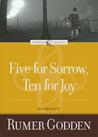
Five for Sorrow, Ten for Joy

Rate this book
“ Five for Sorrow, Ten for Joy is about growth, choice, struggle, and the freedom of the soul that transcends the license of the body. It is about finding sin where we least expect it.”
— Joan Chittister, from the introduction This haunting tale of disgrace and redemption centers on Lise Fanshawe, a prostitute and brothel manager in postwar Paris who, while serving time in prison for killing a man, finds God. Lise is helped by an order of Catholic nuns that includes former prostitutes and prisoners like her. She joins the order and is swept up in an unexpected and fateful encounter with people from her past life. Rumer Godden, author of the masterwork In This House of Brede , tells an inspiring and entirely convincing conversion story that shows how the mercy of God extends to the darkest human places. The Loyola Classics series connects today's readers to the timeless themes of Catholic fiction in new editions of acclaimed Catholic novels

368 pages, Paperback

First published January 1, 1979

190 people are currently reading
1700 people want to read

About the author

Rumer Godden

152 books552 followers
Margaret Rumer Godden was an English author of more than 60 fiction and non-fiction books. Nine of her works have been made into films, most notably Black Narcissus in 1947 and The River in 1951.
A few of her works were co-written with her elder sister, novelist Jon Godden, including Two Under the Indian Sun, a memoir of the Goddens' childhood in a region of India now part of Bangladesh.

Ratings & Reviews

What do you think?
Rate this book

Friends & Following

Create a free account to discover what your friends think of this book!

Community Reviews

5 stars
634 (43%)
4 stars
557 (37%)
3 stars
223 (15%)
2 stars
44 (2%)
1 star
10 (<1%)
Displaying 1 - 30 of 198 reviews
Profile Image for Christmas Carol ꧁꧂ .
963 reviews834 followers
April 10, 2023
A tale that combines Ms Godden's wonderful gift for beautiful descriptions of scenery & activities, with the harsh reality of some peoples' lives.

I'm not a big fan of flashbacks & more than one point of view, Well, so I always say! After reading some books recently that use these techniques (as Godden does) I would say I'm not a fan of them when they are done poorly. Indeed, I would go so far as to say that Ms Godden's writing choices greatly strengthen this book.

Liz Hawthorne, through a combination of bad luck & bad choices, becomes a prostitute (& is renamed Lise) in post WW2 Paris & then is imprisoned for murder. Whilst in prison she is visited by a compassionate nun, - & sees the direction she wants to take in life after her release.

Oh my word, my heart ached for Lise right through this book! She was a good if gullible person. Does she get a happy ending? That is for you to judge.

This book was published in 1979, & I just assumed it would be one of Godden's last works. Nope. Looking on Wikipedia, Godden was last published in 1997, the year before her death at 91.


https://wordpress.com/view/carolshess...
Profile Image for booklady.
2,729 reviews172 followers
May 6, 2020
Five for Sorrow, Ten for Joy refers to the total number of decades in the complete rosary—fifteen ... as it used to be before the addition of the five Luminous Mysteries. It is also Rumer Godden’s title for an incredible book about the lives of women, real women—suffering, tainted, fallen women, modern-day Mary Magdalenes. It is fiction and yet it is set in a very real historical context and based on an actual order of nuns, many of whom were former prostitutes and prisoners, who through Grace and the ministry of other sisters, gave their lives over to God and ministering to the poor, the outcast and the imprisoned.

The story centers around Lise, or Elizabeth Fanshawe, an innocent, young British woman caught up in the liberation of Paris at the end of World War II. Swept away in the delirious debauchery of the time period, Lise finds herself far from home, and totally dependent on a man who runs a brothel when the post-war madness finally ebbs. Oh, and she has the bad fortune of being in love with him as well.

From the beginning of the story we know Lise has a deforming scar on her face and that she has gone from bordello, to years in prison, only to enter a third form of ‘bondage’, a convent. But why? And how is such a transition possible? Who is Vivi? Why has Lucette followed Lise? What is the significance of the rosary to the English Elizabeth, raised Protestant, turned prostitute, then prisoner, finally cloistered nun? These are some of the many questions the story confronts us with as we try to put all the pieces together.

Ms. Godden’s novel is intriguing from start to finish, both as a story and as a commentary on human weaknesses, the longing for God and the never-ending struggle to overcome the self. Two of my favorite passages are these:
It was a revelation to the aspirants that the sisters, some of them elderly impressive nuns, filled with quiet holiness, should publicly admit their faults. Could Soeur Imelda de Notre Dame, the calm saintly person, really have snapped sharply at anyone? Could Soeur Marie Dominique have lost her temper? “Then do you go on being you until the end? they could have moaned. “Even after all this trying and training?” “Always,” Soeur Théodore would have told them. It was a good thing Compline finished with a prayer to Mary Magdalen: “Intercede and pray without ceasing for us, Marie Magdaleine, you who are most close to our Lord Jesus.” (page 156 )

“I wish I had your imperturbability,” said Lise. It was not just a shell; Lise herself could keep her face and voice in control when in reality she was in turmoil; this was deeper—the nuns were not perturbed over things like this. “When you have seen as much of God’s providence as I have,” said Soeur Raymonde, as any of the nuns would have said, “seen the unfathomable ways in which He works, if you have any sense at all, you learn not to question or to judge—only to trust.” (page 212)
Prayer and trust: two simple words, two powerful actions.

For those familiar with Ms. Godden’s better known novel, In This House of Brede, Five For Sorrow picks up some of the same themes and re-examines them in a new light. However, although both books deal with convent life, they are totally different stories. Which is better? I’d be hard pressed to say. They are both excellent!

May 6, 2020: updated (for a second time) when I noticed my previous link for a prayer to Mary Magdalen was no longer any good.
Profile Image for Jane.
820 reviews782 followers
July 30, 2017
I’m so glad that I picked up this book, the third of Rumer Godden’s three ‘convent novels’, when she was The LibraryThing Virago Group Author of the Month.

It is a quietly compelling account of one woman’s life, telling of the downfall of Elizabeth Fanshawe, a young Englishwoman in Paris and the chain of circumstance that would lead her to become Soeur Marie Lise, one of the Sisters of Béthanie at the convent of Belle Source.

That historical setting is very real. The author spent time with the real Sisters of Béthanie, who minister to the poor, the downtrodden and the imprisoned; and she speaks wonderfully well for them. The pictures she paints of convent life is are vivid, rich with detail, and utterly captivating.

Elizabeth grew up in the quietest of English villages; raised by an elderly aunt as she was orphaned at a very early age. War came and, wanting to see more of the world, Elizabeth joined the army as a driver. She was in Paris when the city was liberated, and she was swept up in wild and joyful celebrations.

That would change her life.

She met Patrice Ambard, a handsome and charming elder man that night and he would draw her into his world of crime and high-class prostitution. It was clear that he had prospered during the war years, that he had been a collaborator, but Lise – he called her Lise – was far to innocent and inexperienced to see him for what he was.

She fell in love with him, and by the time she realised where he was steering her, and that he didn’t love her it was much too late. She had no family or friends to turn to; and because she had taken his name and lived openly with him she couldn’t bring herself to approach the church. And so she was trapped, she was broken and she became hardened.

Lise never lost her compassion for others, and so she had to care for the damaged, unhappy young girl she found.

That would change her life again.

Lise took her in; Patrice seduced her and set her in Lise’s place; and Lise’s love for the girl and her wish to guide her to a happier life than she had would lead to her downfall. Because she didn’t understand how damaged the girl was, she didn’t understand that she didn’t see the world as Lise did.

One desperate act would make her notorious, and send her to prison.

It was there that she met Sisters of Béthanie, who ministered to prisoners. She realised that she wanted to join them, she felt that it would be impossible for someone with her background, but she was told that her background would be no obstacle at all. The order included former prisoners and former prostitutes like her, and their experience of the world would help them to understand others in need of their help.

That would truly change her life.

Lise began a long journey that would lead to her becoming Soeur Marie Lise du Rosarie.

This wonderful story – of one woman’s downfall and redemption – is quite beautifully told. It moves backwards and forwards in time, setting stories of Lise’s past against stories of her life at the convent. The stories flowed into one another, and the author had such skill that it felt completely and utterly natural and I always understood where I was and what was happening.

She brought all of the women in this story and their world to life. They were utterly real, she cared about them and she made me care.

There was such love and compassion in this book that I couldn’t doubt for a moment that Rumer Godden was inspired by the real Sisters of Béthanie.

That is not to say that it is her best work. The story of Lise’s downfall wouldn’t stand up to close scrutiny, at least one character is compromised to make the latter part of the story work, and the conclusion is rather too contrived and melodramatic,

The arc of this novel though is quite wonderful; and the other side of the story, following Lise from the moment when she that she may have a vocation, through her novitiate and into her life as a fully professed nun, is exquisitely drawn and rich with detail.

For that, and for what this book has to say, I have to love it.
Profile Image for  Cookie M..
1,436 reviews161 followers
March 27, 2020
I began reading Rumer Godden stories when I was a little girl. She wrote such delicious takes about dolls who were alive and little girls with unique lives and problems.
As I grew I discovered her adult novels and loved them just as much. In the 1970's and 80's many of them were OOP or not available in my small town library. I am just getting the chance to read them now on Kindle.
"Give for Sorrow, Ten for Joy" is on of her religious novels, about a woman's journey from lost young British woman, post WWII, to French whore, to Catholic nun. No one can tell a story like this the way Hidden can. It brings my faith close to me again, and makes me feel the strength, joy and peace of being a woman.
To look back over 53 years and to be able to list someone as a favorite author that long days something about that writer.
Profile Image for Tracy.
94 reviews4 followers
July 21, 2016
Stunning. Not many writers can match Godden’s ability to weave seamlessly back and forth between past and present within a single phrase, a single sentence, or a single paragraph, and yet maintain tightly woven and purposeful threads between them all. But isn’t this what life is...a daily walk in the present, toward the future, with shades and memories of the past…some invited and yet others arise which are clearly unwanted and intrusive?

It is true that in Five for Sorrow, Godden masterfully illustrates how God gives the lowest of the low a never ending chance at redemption, yet my saying that doesn’t even come close to communicating the fullness of the journeys portrayed within. This continual sense of limitless forgiveness in her novels is such a joy to read…read one sentence that makes you cringe and then like a physical weight lifted from your heart, redemption comes, somehow, only a few words away.

Every thought, every comment, and every action in Five for Sorrow has meaning, is a piece of the whole, and therefore makes this Rumer Godden novel fully satisfying and totally complete.
Profile Image for Margaret.
1,055 reviews399 followers
June 19, 2025
Godden had a gift for writing books about religious subjects in a way that interests even non-religious me. Five for Sorrow, Ten for Joy is one of those books (along with the marvelous In This House of Brede and the very good Black Narcissus).

Lise is an English girl who falls into bad company in Paris after the end of World War II and becomes madam of a successful brothel. Eventually, she commits a crime and is sentenced to prison for fifteen years, where she encounters the Sisters of Béthanie, a religious order devoted to work in prisons and among the lower classes, and decides to join them.

The Sisters are a real order, and Godden apparently researched them extensively for this book; it shows in her in-depth portrayal of Lise's life at the convent. I didn't like as much as In This House of Brede (one of my all-time favorite books), but it's a beautifully told story, well worth reading.
Profile Image for Christy.
156 reviews
December 11, 2014
Staggeringly good. I cannot believe how Godden takes you through a complete range of emotions but at the same time can so perfectly communicate hidden spiritual realities. These characters become so real as you journey through their terrible and painful pasts through to hope and redemption.
Profile Image for Stef.
181 reviews6 followers
June 19, 2014
I didn't think this could be better than In this House of Brede, but it is 10x more powerful and moving.
Profile Image for Sonia Gomes.
341 reviews133 followers
August 12, 2018
Five for Sorrow, Ten for Joy Five for Sorrow, Ten for Joy by Rumer Godden

My rating: 5 of 5 stars


If Elizabeth Fanshawe had not got caught in the celebrations of the Liberation of France her life would never have taken the turn it did. That night caught in the midst of drinking gallons of wine, dancing with thousands of people, jumping in fountains she is ‘rescued’ by Patrice Ambard, who turns out to be a pimp of a high-class Parisian brothel. She falls in love with him, enamored too by the good things Patrice has to offer, jewels, clothes and good food. Falling in love with a pimp however, cannot last for long as Lise soon finds out. She has to ‘work’ to keep herself, but a fight that earns her the sobriquet, 'La Balafree' (the Scarred One), puts an end to her days as a prostitute. Patrice then keeps her on as the Manageress of his brothel.
On one of her long walks very early in the morning, she finds a very young, beautiful girl Vivi in a pool of vomit but what is surprising, is the very delicate rosary thrown next to her in a pile of debris. Could this be an omen? It could be... because Lise rescues Vivi and takes her to the brothel where she is groomed, fed, cleaned and becomes Patrice’s new find. It is at this point that Lise in her naiveté makes a series of serious errors of judgment. But are they really errors of judgment, or is there a higher power at work here. Trying to save Vivi from Patrice, Lise murders him, she is then in prison for a long time.
It is at the Prison that she meets the Sisters of Bethany from the Convent of Belle Source. It is here that our comparison to Rumer Godden’s masterpiece ‘In this House of Brede’ should end. The nuns in Brede are contemplative, cloistered nuns who live their lives in Prayer and the Sisters of Bethany at the Convent of Belle Source are nuns who have an active life outside the Convent. One of their duties is to visit women prisoners. Women who have been prostitutes, criminals, some doing a couple of years, some incarcerated for life. Murderers, thieves, prostitutes all banded together in a hell hole of misery, extreme sorrow, vice, rage and of course terrible sadness for wrong decisions taken in their lives. The most amazing aspect of these nuns however, is that some of these nuns were once upon a time in their previous lives fallen women, many of them prostitutes and murderers, who through a great deal of Prayer a lot of help from the Sisters of Bethany are now nuns. Was it easy? Of course not, like it or not you miss your old life. It is slow going, as many vocations normally are. But if God really calls you, it is amazing.
“I wish I had your imperturbability,” said Lise. It was not just a shell; Lise herself could keep her face and voice in control when in reality she was in turmoil; this was deeper—the nuns were not perturbed over things like this. “When you have seen as much of God’s providence as I have,” said Soeur Raymonde, as any of the nuns would have said, “seen the unfathomable ways in which He works, if you have any sense at all, you learn not to question or to judge—only to trust.” (Page 212)
Prayer and trust: two simple words, two powerful actions.
Although it seems to be an easy life, there is so much hard work; the nuns grow all their food, so there is the very hot work of sowing, weeding and harvesting. There are the cows to be looked after, the pigs. Oh yes, the nuns work extremely hard but this life of prayer, hard work is all they want. It is indeed a long journey from Lise, to 'La Balafree' to Soeur Marie Lise du Rosarie.
I had been intrigued by the title ‘Five for Sorrow, Ten for Joy’ but some reading shows that it refers to the total number of decades in a complete rosary—fifteen, as it used to be before the addition of the five Luminous Mysteries.


View all my reviews
Profile Image for Allison.
206 reviews13 followers
August 4, 2010
Two reviews, copied from notes I made while reading this book. . .

from a notebook:
Rumer Godden has an effortless way of keeping a story going. The reader thinks the book is about one thing, then 1/4: 1/2: 3/4 of the way through - she takes the tale to another level.

The first half of "5 for Sorrow..." is the history unfolding: Lise at the convent and flash backs explaining Patrice, & Vivi, & prison, & the trial. Its very graceful.
The middle section is about religion, life at Belle Source.
And then, the story is elevated! Lise returns to the prison - for visits w/the inmates. It sounds strange to say this, but it blew my mind.
Although Godden hints at the plot developments, they still seem like a shock - a brilliant surprise; the mark of a very skilled story-teller.

From my journal:
Five for Sorrow... is about nuns of the French Dominican Sisters of Bethany. the sisters of bethany is an unusual order in the fact that some of the nuns are ex-convicts, whores, drug addicts, etc, and no one but the prioress knows who did what before they took their vows. the way rumer godden describes the cloister the sisters live in. . . i'm almost envious. they have a purpose, and a profession, and a meaning in their lives. for these women, its not all about devotion to god, its about forgiving one's self, and self-acceptance, finding strength. its like therapy, only the shrink is god, and the relationship is a bit different.

a quote, after an ordeal with drug addicts:

It was not just a shell; Lise herself could keep her face and voice in control when in reality she was in turmoil; this was deeper - the nuns were not perturbed over things like this. "When you have seen as much of God's providence as I have," said Soeur Raymonde, as any of the nuns would have said, "seen the unfathomable way sin which he works, if you have any sense at all, you learn not to question or to judge - only to trust."

I'm sure it takes a truly good person not to become jaded when presented with the horrors of the worst.

the religious life seems so. . . simple. the characters/people in both books are the sort of religious people i love: deeply devoted to their god & belief, doing good, just very very positive. not the crazy 'THE WORLD IS GOING TO END YOURE GOING TO HELL' - they are accepting of atheists and people with different lifestyles. they just seem like good people with a structure that happens to be religious.
This entire review has been hidden because of spoilers.
Profile Image for Josephine (Jo).
664 reviews46 followers
February 3, 2015
A great story of one of the most amazing journeys imaginable. Elizabeth is a young English girl who is an army driver during the liberation of Paris at the end of World War Two. She gets caught up in the celebrations in Paris on her way to her lodgings and her life is changed for ever. She meets Patrice and is completely enthralled by him and believes him to be a gallant man, this turns out to be far from the truth and Elizabeth is brought as low as any woman can be, ending up in a prison that was almost as bad as in the days of the French Revolution. As she comes out on the other side of these tragic events Elizabeth finds some peace with the Sisters of Bethanie but her past is always lurking around the next corner.
214 reviews2 followers
February 12, 2011
Inspiring reading of a sort that has not been popular since the 1960's (Godden wrote this in 1979, when novels and memoirs with conversion themes were less popular than they had been). Still, it's a good example of the always-popular redemption story in the great Catholic tradition: sinner finds faith and devotes herself to God. My Fawcett paperback edition would have benefited from editing and proof reading.
Profile Image for Stephanie.
141 reviews72 followers
October 11, 2007
This book reminds me of why I have such a deep, abiding love for the Catholic Church. It's the story of a woman who travels to hell and back, finding redemption in a convent. If you think nuns are naive, quaint, and innocent, you'll change your mind after reading this book. I've always been grateful to Rumer Godden for depicting The Brides of Christ in such a perceptive, well-rounded way.
Profile Image for Mimi.
1,860 reviews
June 7, 2013
Another strong argument for half stars on Goodreads. This is better than three, but not quite a four star read.
For me, Godden ends her books very strongly, but it takes awhile for me to get into her books. This one followed the pattern. Interesting story line, and strong faith is woven throughout.
Profile Image for Christian Engler.
264 reviews22 followers
September 21, 2013
To be a nun means to occupy a very special and committed role in society. It is definitely a unique calling when a woman accepts to be a special witness and bearer to the truth of Jesus Christ. Five for Sorrow, Ten for Joy is not a novel purely about nuns, per se, although it does play a significant part. Rather it is about people, their humanity - and sometimes their lack of it - as well as their redemption, for even religious people require the latter.

The novel centers on the Sisters of Bethany at the Convent of Belle Source whose nuns and aspirants - though not all of them - were at one time or another, convicts at Vesoul Prison, women deemed lost or hopeless due to their past criminal transgressions. It is their grim hardness of personal life experience that makes them stellar examples of what it is to be true disciples of Jesus Christ, brides whom He plucked from the dark and horrific corners of their own making, for when things are truly at their worst for people, God is always in and at the scene.

Of all the vast array of characters that pepper the novel, it is Elizabeth Fanshawe, before she becomes Soeur Marie Lise, in which the story revolves. Before her entry into monastic life, she was better known as La Balafree or Madame Lise Ambard, the self described whore and infamous brothel managing murderess who served a ten year stint behind bars. But before she accepted that role, despite her dubious misgivings, she was a minor figurehead in the Army in France, having worked for the Motor Transport Corps. Aside from her Aunt Millicent in Greenhurst, England, she had no blood relations or friends and was thus easy prey for the bad influences that bombarded her on the eve of the armistice of the war. Intoxicated by the celebrations in Paris, Elizabeth meets Patrice, a pimp who operates out of the Rue Duchesne. And under his tutelage, she becomes his number two in the business, and it just gets worse from then on. While she is trapped in the mire of sin, she does make attempts to flee, but it is really to no avail. It is only when she commits murder that she gets free, ultimately placed behind bars and is then mythologized by the locals and the media. By this point, she has lost everything, despite the fact that she had really nothing great to start off with.

While in lock up, she encounters a group of nuns who do prison ministry, women who truly do know what Elizabeth is going through and has gone through. And it is through this encounter that thoughts of a vocation begin to develop and get nourished; it is slow going and doubtful at first, as many vocations normally are. Yet, the desire and the consistency never falter, and it is upon her impending release that she discerns a possible transition into the religious life. Although female prisoners are encouraged to look at a possible vocation upon their release, there is no pressure to do so. And those who do follow through are not always accepted, because their calling laid elsewhere. However, due to her battle scars and deep dissatisfaction with worldly offerings, religious life winds up up being a perfects fit for her. And others follow suite. Even though she becomes a nun, she still has her crosses to bear within the convent, and they are the memories of her past, deep-rooted and unrelenting. Her calling thus gets transformed into the confrontation of herself, to understand the hows and whys of her own being, of Her Own Sickness Unto Death, just like Jesus Christ felt while suffering on Calvery. Her demons can not be brushed aside and simply forgotten, for that in a way would totally nullify the essence of her vocation. They are not cast away, and that is illustrated by the climatic ending of the story.

From the very beginning of the book there is a supernatural invitation that is offered to Elizabeth: Perhaps it was right that Lise should first see the beads as they lay in the dirt and debris of a table outside the cheapest kind of cafe among the rubbish of the Paris night - Page 11. What I liked about Rumer Godden's book is that the women are not portrayed as plaster cast saintly nuns with halos of gold around their heads; they are women who've had a hard-bitten existence, and they don't want that for the next generation. Their actions are fueled by love - who is Christ - for the betterment of souls and society. The work also showcases quite clearly that God can dip down into the darkest corners of the human heart and transform that person for the better.
Profile Image for Alun Williams.
63 reviews4 followers
August 2, 2011
Five for Sorrow, Ten for Joy book describes how a "nice" English girl called Elizabeth Fanshawe is drawn into prostitution in a high-class Parisian bordel by the charming but unscrupulous and abusive Patrice, how and why she then commits a violent crime for which she is sent to prison for a long period, and how she ultimately finds redemption as Soeur Lise of the "Sisters of Bethany" (an order of nuns which really exists).

The book is much darker than most of Ms Godden's works, though the descriptions of life in the convent are written with her typical delicacy and insight, and are no doubt what motivated her to write the book in the first place. The book gives a convincing portrayal of the religious life, and should give those who dismiss religion as valueless pause for thought (or indeed religious people who dismiss Roman Catholicism.)

The narrative structure is quite complex: the story covers more than thirty years of Lise's life (from 1944 to about 1976, so that some of the changes in convent life brought about after Vatican II are mentioned). The story constantly shifts period, sometimes even within one paragraph, and there is a secondary narrative in the first person told from the point of view of Vivi, whose actions provoke the crime that changes Elizabeth's destiny.

Given the subject matter, a sensational plot was perhaps inevitable, but in this reviewer's view the plot is sometimes too sensational to be plausible, and this detracts from the quieter and deeper messages of the book. I found it hard to believe that Elizabeth would fall so easily into prostitution, and that she would be so entirely forgotten by anyone who knew her before. Vivi is almost a pantomime villain, and although we learn of her terrible history, it is impossible to feel much sympathy with her, and it is surprising that the other characters in the book do not really see her for what she is. (By contrast, Patrice, the other "villain" is very well drawn). There are perhaps too many characters, some introduced quite late on, for the book to be as satisfying as most of her well-known novels.

The Loyola press edition has some Americanised spelling, which I found disconcerting, but is printed on good quality paper. There is also a selection of questions at the end intended for group discussions.
Profile Image for Tracey.
936 reviews33 followers
March 4, 2018
The title comes from the rosary which is told in decades. Godden converted to Catholicism in 1968 and this story is a story of conversion and redemption

There are some books where the storytelling is good, and there are some where it is both good and needs to be told. This I believe is one of them.

...many were in prison not because of what they had done, but because of what other people, especially men, had done to them.

In this story Godden shows that no matter how dark a place a person may be in, the Lord can reach them and He will use our weaknesses and our strengths to work for good. No matter what prison one is in, the Lord has made a way for the chains that bind us to be loosed, and for us to be free in Him.

But thus saith the LORD, Even the captives of the mighty shall be taken away, and the prey of the terrible shall be delivered: for I will contend with him that contendeth with thee, and I will save thy children. Isaiah 49:25

Profile Image for Jamie Collins.
1,556 reviews307 followers
February 8, 2017
"They tell me that often the worst criminals make the best nuns…. Because, they have known the depths. ‘Out of the depths, I cried to Thee.’"
This novel is exquisitely written. It’s the story of Sister Marie Lise, of the Sisters of Bethany, of the Congregation of Saint Mary Magdalen, in France. The order visits prisons for women, and about half of the sisters of Bethany are former prisoners.

The details of their daily work and their annual rituals are interspersed with Lise’s narrative of her life. She tells for herself how a girl from a small English village was lured into prostitution in postwar Paris; she describes the path that led her to be convicted of murder, and then to discover, after years in prison, the promise of a new kind of life.
Profile Image for Beth.
219 reviews
May 29, 2025
In some respects, very like “In This House of Brede,” but much darker…

Two cautions:

This book deals frankly with sexual sin and violence. I’m easily troubled by such things, and while this wasn’t a particularly cozy read, I didn’t feel overwhelmed by the subject matter.

This book is very Catholic. The title is a reference to the rosary, and much of the story is set in a convent (along with a brothel and prison!), among an order of nuns with a special devotion to Mary Magdalene. Some of the symbolism is simply alien to me - rosary beads are a recurring motif but not one I understand well. But ‘Five for Sorrow’ also provides stunning pictures of providence and grace.

A quote:

‘I wish I had your imperturbability,’ said Lise. It was not just a shell; Lise herself could keep her face and voice in control when in reality she was in turmoil; this was deeper – the nuns were not perturbed over things like this. ‘When you have seen as much of God’s providence as I have,’ said Soeur Raymonde, as any of the nuns would have said, ‘seen the unfathomable ways in which he works, if you have any sense at all, you learn not to question or to judge – only to trust. Think of Lucette’s story …’ And Lise thought, ‘Think of my own.’
318 reviews31 followers
May 26, 2025
I started really slowly, but when I finished the book I wasn’t ready for it to end! I need to discuss this with someone! I also want to be a cloistered nun! “It’s not what you were, but what you are now and what you want to be that God beholds with his merciful eyes.”
Profile Image for Julie Davis.
Author 5 books320 followers
February 25, 2014
Getting ready to reread this for our book club's next discussion, I realized I'd never posted my review here.
"I took Vivi home." Why? Lise had asked herself a thousand times. "There's a little church in England," she told Soeur Marie Alcide, "at Southleigh in Oxfordshire, which has an old, old mural painting showing a winged Saint Michael holding the scales of justice. The poor soul awaiting judgment is quailing because the right-hand scale is coming heavily down with its load of sins: but on the left our Lady is quietly putting her rosary beads in the other scale to make them even. I saw it long ago, but in a way I suppose something like that happened to me.

"It happened to me," and Lise started to tremble. "How did Vivi come to have those beads?" Lise asked that for the thousandth time. "She wouldn't say. She never said ..."

Now, in the cafe, Lise seemed to hear Soeur Marie Alcide's firm voice. "Put it behind you. That is one of our first rules. You will probably never see Vivi again." and, "It's time you caught your train," Lise told Lise.
This is an inspiring tale of conversion and redemption told in flashback sequence. We meet Lise when she is being released from prison where she has served her term for murder. She is going to join an order that ministers to those on the fringes of society. Through Lise's thoughts, we watch her go from being a young WWII staffer in Paris, become seduced by a man who has a brothel and eventually turns her into a prostitute where later on she becomes the manager. The reasons behind the murder become clear as the threads come together again in the people around Lise in current time.

The first third of the book can be tough to read as Godden is devastatingly emotionally honest as always. Despite the fact that much of the book takes place in a brothel the words used are unobjectionable so one needn't worry about that. As I read, I suddenly realize that I must have tried this book at least once before but always stopped as it was too painful. However, I was selling the book short by never pressing on as the last two-thirds took an upward swing that surprised and enchanted me.

Throughout it is strung the rosary, sometimes in surprising ways and always as a pointer toward action to be taken. Interestingly, Lise doesn't even enjoy saying the rosary but it is somehow integral to her journey of faith despite that. She cannot seem to escape it no matter how she might try.

I didn't realize how integral the rosary was to the book until I was very far into it. After I finished the book and thought about it over the next few days, I wondered about the title. What did it mean? Suddenly it came to me. Five [mysteries] for sorrow, ten [mysteries] for joy. It reflects the rosary itself. Reading the book with that foreknowledge might yield even more riches. I will have the opportunity to find out as I definitely will return to this book.
It was a revelation to the aspirants that the sisters, some of them elderly impressive nuns, filled with quiet holiness, should publicly admit their faults. Could Soeur Imelda de Notre Dame, that calm saintly person, really have snapped sharply at anyone? Could Soeur Marie Dominique have lost her temper? "Then do you go on being you until the very end?" they could have moaned. "Even after all this trying and training?" "Always," Soeur Theodore would have told them. ...
Profile Image for Rosemary.
250 reviews38 followers
October 30, 2015
Five for Sorrow, Ten for Joy is a novel but it contains three historical characters: Pere Lataste (who had the idea for the Dominican Third Order of the Congregation of Saint Mary Magdalen in the 1860s), Mere Henri Dominique, and Soeur Noel; and five other characters who have allowed themselves to be portrayed under fictional names. These French Sisters of Bethanie work with women in prison in France as well as with prostitutes, drug addicts, and those who live on the streets. The women are often violent, guilty of horrible crimes, unbelievers in God or religion of any kind; many are illiterate, unsocialized, and unable to be self disciplined, but they have suffered unspeakably at the hands of others, usually men. The sisters offer kindness and their sympathetic ears, for some of them found their own vocations in prison. They show by example how to live a good life and in this way attract others to follow their example.

The main character, Soeur Marie Lise du Rosaire--called Lise throughout the book--is one of those women, a prostitute, a prisoner, and then a woman who saw the light. We learn her story through flashbacks to different parts of her past and see how she came to be a postulant. Her spiritual struggles are valiant and continuing. We see her reach bliss through meditation and prayer, and we see her past reach out to snag her more than once from her hard won serenity. Her path is one seldom taken these days but she has a true vocation and her heart opens with love and fills with grace.

"To explain the title: a rosary has fifteen "decades"-- ten beads in each -- of which five decades are the "sorrowful" ones, five "joyous" and five "glorious." The Sisters of Bethany wear the full rosary, which has three strands, one for each "mood." What most lay people use is really a "chaplet" or "chapelet," a single strand of five decades told bead by bead, three times over."
--Rumer Godden
Profile Image for Andrea Hickman Walker.
790 reviews34 followers
February 7, 2020
Religious people fascinate me. I am drawn to the religious life (by which I mean monks and nuns), but to a large degree I can understand them. What I don't understand is blind faith. I don't understand why people believe the things they do (and what is it that I believe? Do I believe anything?). Which is why they fascinate me. So when I pick up a book at random and find it involves religious themes, I devour it hoping for greater understanding of such a large proportion of the planet.

Which is what happened with Five for Sorrow, Ten for Joy, by Rumer Godden. I recall Rumer Godden (and I'm 80% sure it was her) from my childhood, with books about small dolls that came to life. Or something. So I picked up a book of hers at random while at CAFDA and enjoyed it. So I picked up a few others, including this one. This book tells the story of a woman who, after being released from prison, enters a convent. The book covers both her new life and her old life, leading up to how she landed up in prison. It's also a story that appears to have been picked up by Catholic booksellers and made much of as a tale of redemption and salvation. To me the religious aspect of this novel is interesting, but not the focus. This is a story about humanity and compassion and the ability we all have to change ourselves into the person we'd rather be.
Profile Image for Anne.
403 reviews39 followers
May 29, 2011
It's not quite In This House of Brede, but what an interesting slice of religious life from Rumer Godden. This one is about Béthanie, an order of nuns seemingly culled mostly from French prisons. The order's work in the community focuses on imprisoned women, and most if not all of the nuns have spurious pasts--but once they enter the convent, they shed that previous identity. The book follows Lise, who was one of Paris' best-known madams, but who discovers her vocation while serving a jail sentence for murder.

Godden manages to convincingly depict the daily life of both a convent and a brothel--both, if you think about it, close-knit communities of women. When I read In This House of Brede (and Black Narcissus, actually) I remember being fascinated by how much work actually goes on in a convent, even though it's a contemplative life, and by the individual descriptions of the nuns as women first. This book gave me more of that, though perhaps not as rich, plus the surprisingly sordid story of Lise's life, and the pre-convent lives of some of her sisters. My public library has a ton of Godden's other books, and I think I'm going to be looking into them--even the ones that aren't about nuns!
Profile Image for C.
197 reviews5 followers
March 11, 2013
Darker and more intense than In This House of Brede, but nonetheless an excellent tale of sin and redemption. Lise Fanshawe finds herself called to join an order of Dominican nuns after concluding a life of sin and prostitution with a stint in prison. But for better and for worse, her past follows her beyond the walls of the monastery.

The sections of the book written from Lise's perspective--both the current timeline and her remembrances--are interspersed with the inner monologue of Vivi, a young girl Lise rescued from the street and brought home to the brothel. Though her youth and vulnerability arouse Lise's sympathy, the girl is a manipulative, narcissistic sociopath. These passages I often found hard to read, because I couldn't help but despise the character, even after Godden reveals the secrets of Vivi's sad history. How much more powerful, then, are some of the later moments in the book, which remind the reader that Christ's mercy and forgiveness extend even to such a person as Vivi.
Profile Image for Alicia.
1,089 reviews38 followers
February 9, 2012
I found this book on the 50-cent outdoor bookshelf at our town's used bookstore. I love a children's story by this author (The Story of Holly and Ivy) and I plan to read her novel about a convent someday (In This House of Brede), so this book caught my eye. This 1979 novel follows a young girl in France who ends up in brothel, then in prison, then in a convent where she becomes a nun. The Sisters of Bethany are an actual order of nuns, many of whom were formerly prostitutes or prisoners. The story was fascinating (and not graphic), though it jumped around from past to present so often that I had a hard time following the story at first. I especially enjoyed the French setting and all the dialogue in French because I'm taking a French class right now.

A quote I liked:
“When you have seen as much of the God’s providence as I have,” said Soeur Raymonde,... “seen the unfathomable ways in which He works, if you have any sense at all, you learn not to question or to judge—only to trust.”
Profile Image for Marjorie Campbell.
81 reviews1 follower
November 3, 2014
While Godden's In This House of Brede is touted as her premiere Catholic work of fiction, I find Five for Sorrow, Ten for Joy a real "competitor". Part of the fabulous Loyola Classic series, this tale of redemption jumps between brothel, prison and chapel, from pimp to priest, to unravel the engaging saga of Lisa Fanshawe. The mystery of this woman's vocation to younger women winds through combating forces - always with a remarkable compassion that contrasts the suffering of darkness and the relief of light. Very highly recommended.
Profile Image for Sallie Dunn.
891 reviews107 followers
September 14, 2025
⭐️⭐️⭐️.5

Rumor Godden was a prolific writer. Of more than 60 books published, I have seven ear-marked as “want to read.” Correction, make that 6, as I just finished Five for Sorrow, Ten for Joy today.

This novel hinged greatly on spirituality, particularly Catholicism. Per the short biography of the author at the end of my E-book, Ms Godden converted to Catholicism in the 1960’s. In fact, she had a great friendship with a Benedictine nun, who inspired one of her more famous pieces, In this House of Brede.

FFSTFJ is set in post WWII France. A young English girl gets separated from her military escort in the celebration of victory in Paris and ends up in an upscale house of prostitution where she is the paramour of Patrice, who co owns this house. She falls in love with Patrice but after a few years he drops her for a much younger (think pedophile) girl. Lise hopes to protect this young “Vivi.”

How she becomes a murderess and serves 15 years and ends up in a convent is for you read this interesting story of downfall and redemption.

Goodreads 2025 Challenge - Book #89 of 125
Profile Image for Chad D.
274 reviews6 followers
January 19, 2025
Five stars for the truth it tells.

It's a slow burn. I was meh about it up through about p. 60, and put it aside for a week. Picked it up to power through, and got swept up in the holiness and redemption, didn't want to put them down.

The truth it tells is this one:

"'When you have seen as much of God's providence as I have,' said Soeur Raymonde, as any of the nuns would have said, 'seen the unfathomable ways in which He works, if you have any sense at all, you learn not to question or to judge--only to trust. Think of Lucette's story....'

"And Lise thought, 'Think of my own.'"

Displaying 1 - 30 of 198 reviews

Join the discussion

Can't find what you're looking for?

Get help and learn more about the design.