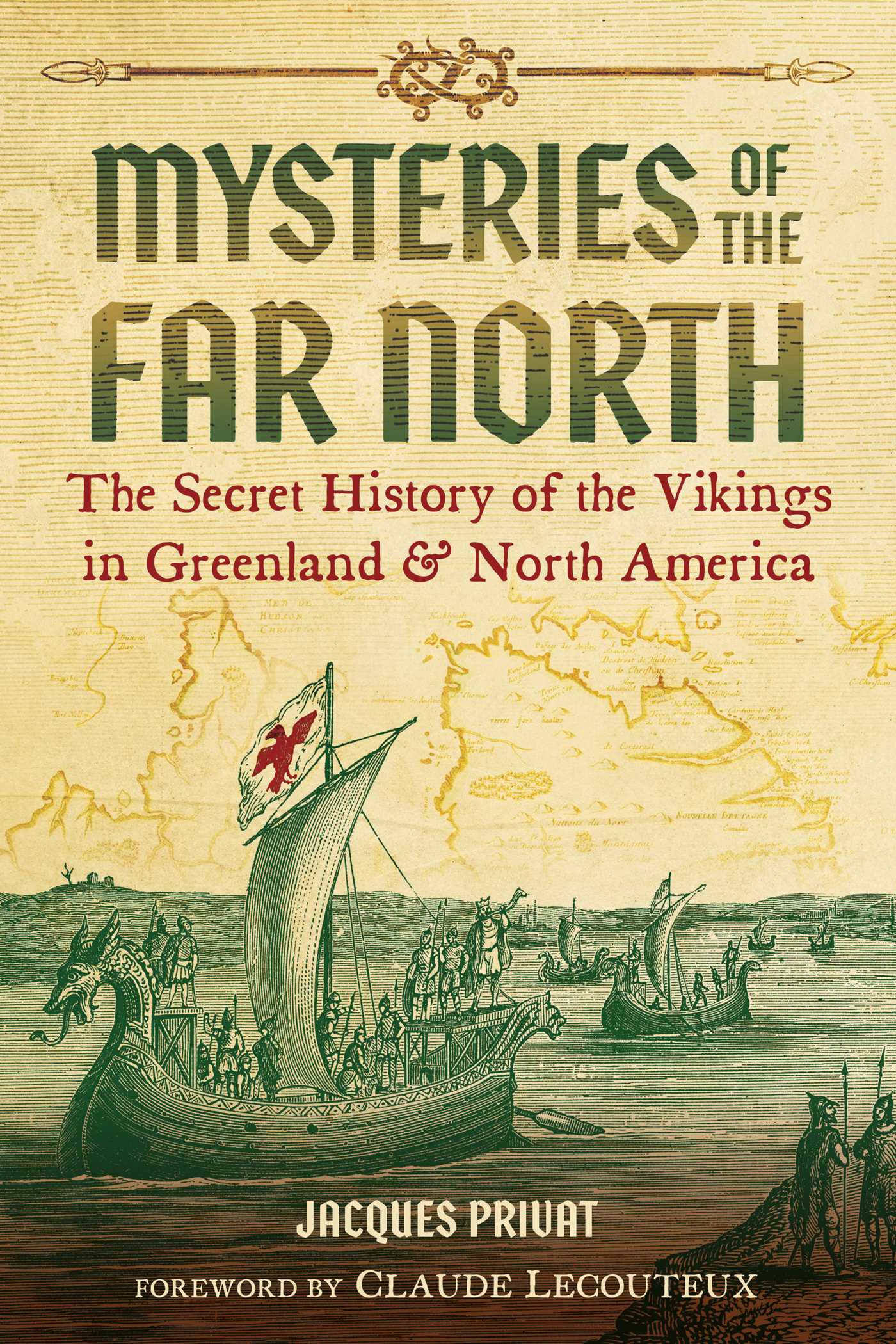
Presents evidence of early Norse settlement in Greenland and North America
• Explores in depth how Greenland and its surroundings were inhabited for nearly 5 centuries by two Nordic colonies, Vestri-bygd and Eystri-bygd
• Shares extensive evidence from the still-living indigenous oral tradition of the Far North as well as surviving sculptural art to show how the Vikings and the Inuit formed a harmonious community
• Examines ancient maps and other cartography, such as the 15th-century Martin Behaim globe, as well as explorers’ records of their voyages
Sharing his extensive and meticulous research, Jacques Privat reveals that the Vikings were in Greenland, its neighboring islands, and the eastern shores of Canada long before Columbus. He examines in depth how Greenland and its surroundings were inhabited for nearly five centuries by two Nordic colonies, Vestribygð and Eystribygð, which disappeared mysteriously: one in 1342 and the other in the 16th century. Drawing on the still-living indigenous oral tradition of the Far North, as well as surviving sculptural art carvings, he shows how, far from being constantly at odds with the native population, the Norsemen and the Inuit formed a harmonious community. He reveals how this friendly Inuit-Viking relationship encouraged the Scandinavian settlers to forsake Christianity and return to their pagan roots.
Working with ancient European maps and other cartography, such as the 15th-century Martin Behaim globe, as well as explorers’ records of their voyages, the author examines the English, Irish, German, Danish, Flemish, and Portuguese presence in the Far North. He explores how Portugal dominated many seas and produced the first correct cartography of Greenland as an island. He also reveals how Portugal may have been behind the disappearance of the Vikings in Greenland by enslaving them for their European plantations.
Dispelling once and for all the theories that the Inuit were responsible for the failure of the Scandinavian colonies of the Far North, the author reveals how, ultimately, the Church opted to cut all ties with the settlements—rather than publicize that a formerly Christian people had become pagan again. When the lands of the Far North were officially “discovered” after the Middle Ages, the Norse colonies had vanished, leaving behind only legends and mysterious ruins.
I listened to this via Audible, and I DNF’d after about 3.5 hours. I skipped around a bit to see if it was worth listening to the rest of it, and decided that it ultimately was not.
This is not a “popular history” book. From the catchy name, cover, and advertising I thought this would be an easily digestible, fun book about some of the mysteries of the Vikings we don’t know much about. That is not what this book is. In the acknowledgments, Jacques Privat says that this book was originally his Sorbonne University dissertation, and it reads like a dissertation. Privat spends way too much time going through every shred of evidence for every small topic of discussion. This book could (and should) have been so much shorter and it would have benefited so much more if it was.
Much of the information was interesting, but the writing style is so bland that I found it extremely hard to care. The most exciting parts were the Inuit stories, which Privat didn’t even write! They were all quotes from a literary periodical. I got to the point where I was skipping around a lot. I would skip to the “conclusion” part if there was one and just skip the whole chapter if not. He spends so much of the first part of the book trying to prove that the Scandinavians and the Inuit people of Greenland were in contact and mostly peaceful. That in itself isn’t uninteresting, but it gets really really dull after examining every single bit of possible evidence. It just feels like a waste of time.
For a research-based book about one specific aspect of Viking history, this is a very good deep-dive. The problem is that it wasn’t advertised like that. I’m not a history expert or someone in the history academia bubble, and thus found the language and style very confusing and boring. If you’re looking for a popular history book, this is not the one for you.
First, per the three-star reviewer, this is a dissertation-type document.
Second and related? You can learn all you want about the the various stages of pre-Inuit and Inuit culture from Wiki articles, all of which I had already read.
Third? Self contradictory in some main areas. Early on, Privat talks about how the Norse in West Greenland wrecked and desertified the land through their agriculture. Two hundred or so pages later, it's talk about how well off the were. Which is it?
Fourth? Stretches ideas beyond the breaking point in the last two chapters, which are the two that tie to his mysteries, but are largely bunk. The Viking penny at Penobscot Bay? Even if not a "plant," it's no proof of a Norse settlement or even a Norse landing. The Kensington stone is not "controversial," contra Privat; it's a hoax. Nicholas of Lynn was not an explorer. There was no "Anglo-Celtic" world in the 1300s; England had pretty much lost all hold over the Pale of Ireland by this point. Claims about Mercator's claims are wrong. Also, if the English or the Irish traded in Greenland, surely we'd see more recorded about it. Finally, evidence for the settlers returning to paganism rather than simply dying out or emigrating back to Europe is thin. Surely, if any did become pagan, it would have been along with assimilating into or with the Inuit, and I've never heard of that. (Battles between parishioners and bishops is not support for paganism.)
Even things that aren't stretched beyond breaking are stretched to the limit. Is it possible the Norse went further up the west side of Greenland than is normally believed? Yes. Likely? No. Ditto for activity, especially intensive activity, on Ellesmere Island. That's especially true when he talks about a little version of a Little Ice Age but then claims a warm-up period after it. Ditto in spades for trading in Ingava Bay. And, this idea that a group of people that never exceeded 7-8,000 would have had the time, luxury and freedom to trade over that large of an area is questionable.
As far as "paganism" and also other issues? Add this. DNA analysis of modern Inuit in the region finds Y-chromosome haplogroups but no mitochondrial DNA. In other words, these Inuit have Norse male ancestors only. So, there was no integration of Norse into Inuit as as Norse Greenland declined. At some point, a few Norse men "scattered their seed" during various wanderings and that was it.
Add in that whenever there's some degree of disagreement about interpretation of a medieval name for an area, like Finnmark, Privat will always plump for whatever favors his thesis, even if the least likely version.
Privat may not himself be a "Viking nutter," but he certainly could be seen as encouraging others. And, on things he has that aren't nutter, there's nothing new here, nor is this an actually readable-type historical narrative.
I had first thought this would be one of "those" mysteries type books. But I checked it out anyway. Then seeing Privat write in depth about Inuit cultures, etc., I thought, maybe I shouldn't have judged a book by its cover. But, it turned out it WAS one of "those" books to some degree. (Add in that one of the blurbers on Amazon's editorial overview is the author of a book called "Occult Russia.")