Jump to ratings and reviews
Rate this book

It Gets Me Home, This Curving Track

Rate this book
When all else fails, when our compass is broken, there is one thing some of us have come to rely on: music really can give us a sense of something like home. With It Gets Me Home, This Curving Track, legendary music critic Ian Penman reaches for a vanished moment in musical history when cultures collided and a certain kind of cross-generational and 'cross-colour' awareness was born. His cast of characters includes the Mods, James Brown, Charlie Parker, Frank Sinatra, Elvis Presley, John Fahey, Steely Dan and Prince - black artists who were innovators, and white musicians who copied them for the mainstream. In prose that glides and shimmies and pivots on risky metaphors, low puns and highbrow reference points (Brian Dillon, frieze), Ian Penman's first book in twenty years is cause for celebration.

192 pages, Paperback

First published August 14, 2019

52 people are currently reading
790 people want to read

About the author

Ian Penman

11 books25 followers

Ratings & Reviews

What do you think?
Rate this book


Friends & Following

Create a free account to discover what your friends think of this book!

Community Reviews

5 stars
109 (35%)
4 stars
143 (46%)
3 stars
51 (16%)
2 stars
4 (1%)
1 star
1 (<1%)
Displaying 1 - 30 of 48 reviews
Profile Image for Paul Bryant.
2,408 reviews12.6k followers
January 6, 2022
Some music writers are swiveleyed fanboys yelling in your ear and making a mess everywhere, some are stand up comedians in disguise, and some are insufferable aesthetes polishing their fingernails with Cointreau and thinking seriously about the next exactly correct word they are going to use. Ian Penman is the last sort. These eight essays are all expert, lapidary, loving and purely excellent but have that unfortunate nails on a blackboard effect on me due to a lot of excruciating precious overwriting that I can tell the author thought was truly thrilling, the very thing he was put on this earth to do.

That is some nasty slagging so I will provide some examples. These are from the essay on Frank Sinatra. Here he is commenting on the young Frank’s mystifying appeal to the bobbysoxers :

But he obviously gave off some subtle radar peep of rapt carnality, equal parts vulnerable boy-child and lazily virile roue

And later, Sinatra records the corny Vera Lynn tearjerker We’ll Meet Again :

Sinatra takes soiled £5 words and makes them glisten like mystic opals, his voice like spring light clarifying a dusty catacomb.

He was recording an album of British songs at the time. IP writes

Sinatra’s Great Britain is an Impressionist painting in sound : a mise-en-song of dawn and dew, lanes and lawns: nightingales doing their solo act in rain-iced gardens; autumn among indecisive leaves.

You want more of this stuff? He has got any amount :

Sinatra held the melody like a Faberge egg he was turning about in his palm, assessing it from every angle, seeing how light dipped or flared in different positions, exploring the weave of word and melody.

I got this book just because of the essay on John Fahey, one of my own obsessions. The other essays are about big names, Fahey is the only obscurity. And that essay is pretty good! (So is the one on James Brown.)

Conclusion : like a Faberge egg dipped in Haagen Dazs Dulce de Leche Rum Salted Caramel 266kcal per 100g this was a bit much for me.


Profile Image for Ian "Marvin" Graye.
947 reviews2,779 followers
November 11, 2023
CRITIQUE:

"Biographical Time Capsules"

I read this book and its predecessor, "Vital Signs", in preparation for a reading of the author's third book (a critique of the film-maker, Rainer Werner Fassbinder).

The book is different in format from its predecessor.

It consists of eight profiles on musicians or movements that were published in "City Journal" and "London Review of Books":

* Mods (including the Who);

* James Brown;

* Charlie Parker ("Bird");

* Frank Sinatra;

* Elvis Presley;

* John Fahey;

* Steely Dan / Donald Fagen;

* Prince.

Each profile is based on a review of one or more biographies or critical studies of the subject. However, the profile format gives Penman the opportunity to extrapolate on the content of the biographies under review. He reveals his inner fan, enthusiast, trainspotter and geek.

For example, in the case of Prince, he more or less reviews each of Prince's albums in capsule form. (In a strange [and his only] lapse of taste [from my point of view], he raves about Frank Sinatra's cover of "Downtown".) Yeugh! (to quote Sinatra.)

In contrast, Penman says of Steely Dan's version of Duke Ellington's "East St. Louis Toodle-Oo" that it "shouldn't work, but does; shouldn't swing, but really does."

As he says of Donald Fagen's "Eminent Hipsters", these reviews are, in the words of Lytton Strachey, "biographical time capsules".

"A Roll Call of Hipsterdom"

Again, as he says of Fagen's book, his profiles are a "roll call of hipsterdom". He clearly admires Fagen (who claims his own singing voice sounds like a "Jewish Bryan Ferry"):

"He digs people who straddle the divide between hep and square, margin and MOR, a no-man's zone where apparent squares take on the prompts of hip and parlay them into a wider audience...

"Fagen is funny but acute on that moment in our teenage years when we snub our parents and dismiss all authority figures but simultaneously initiate a desperate search for persuasively hep figures, people to tell us exactly what we should listen to, view, and read. What to dig."

"A Patchwork Personal Mythology"

If you examine only the contents page of the book, Penman clearly has good taste in music. However, the reality is that he received and reviewed the books that his editors at the time assigned to him, having regard to his interests or expertise. They aren't a complete or encyclopaedic summary of his taste.

Although Penman was always in a privileged position that enabled him to receive review copies, he describes himself as a "music obsessive" and "dedicated thrift-store scavenger".

While his job was to review these freebies, another role of the music, films and books that he received or collected was to piece together "a kind of patchwork personal mythology". They allowed him to express himself on subjects about which he was either reverent or passionate.

description
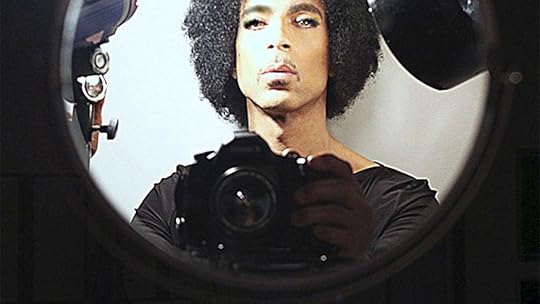
Prince: "Know Thy Selfie" (Selfie in a Mirror) (Source:)

"The Post-Modernist Prince"

As Penman did with the articles in "Vital Signs", he brought an interest in continental philosophy and post-modernism to his reviews and analysis.

For example, he analyses 1980's-era Prince in terms of mirrors and Lacan:

("Readers of Lacan may object that the subject seems a bit old to be having any kind of mirror stage moment, but we all know entertainers are a child-like crew who don't grow up at the same rate as the rest of us.").

Several times he refers to him as "the post-modern Prince".

"Shiny White Pop Signifiers"

The Prince profile is the longest and potentially the most important item. The epigraphs for it were written by Walter Benjamin, Fernando Pessoa and Gertrude Stein.

Penman says that, in the 1980's, Prince (like Madonna) was "the most fascinating pop star alive."

He describes Prince as -

"a black R'n'B artist who juggled shiny white pop signifiers; a self-amused imp who made us follow his playfully dense personal mythology from work to work, never knowing what we might find next time round, in what form Prince might return, sometimes mere months later."

He adds that "Prince snuck wild swells and shady undercurrents into mainstream pop with Janus-faced hits like 'When Doves Cry', 'Little Red Corvette' and 'Raspberry Beret'."

Soon after, he quotes the lyrics to the song, "1999":

"I was dreaming when I wrote this,
Forgive me if it goes astray."


Likewise, I could say of my experience as a reader of this collection, "I was dreaming when I read it, forgive me if I went astray."

I could also say about his taste in music (to paraphrase Penman, himself quoting a poem called "Walks" by W.H. Auden):

"They let me roam, these revolving tracks."

I hope this book has a similar impact on you (and your taste in music).

SOUNDTRACK:
Profile Image for Hugh.
1,293 reviews49 followers
June 18, 2020
I saw Ian Penman speak at a Five Leaves event early this year, and found him interesting and engaging - I was never an NME or LRB reader but I do remember some of his writing for The Wire magazine, probably 15 to 20 years ago.

To be honest I found this book a little disappointing - Penman's off the cuff discussions of his time at the NME and his more recent musical interests were rather more entertaining. Not that it isn't high quality music journalism, more that for one thing I am rather less tolerant of the whole genre than I was when I was younger, and partly because of the nature of the LRB pieces, which are loosely conversations with and criticism of other books. The artists featured are mostly either past their prime or dead, and apart from John Fahey all are very familiar names.

For me the best was saved for last, a review of Prince's career, but this made for sad reading as Penman's conclusion was that little of his output after 1989 comes close to his best work, and like many of the other artists in this book he was largely a victim of his own success.
Profile Image for Tosh.
Author 14 books776 followers
March 12, 2020
I read this book twice, which is rare for me to do. One reason is we (Kimley and yours truly) will be doing an episode of BOOK MUSIK on "It Gets Me Home, THis Curving Track" and the second reason is that I enjoyed this book so much. Ian Penman, who wrote for numerous music publications, has put together a series of essays, that are basically book reviews. But these 'reviews' become distinctive essays on their subject matters. From Mod to Sinatra to Prince to Steely Dan and more. Each piece is essential reading due that Penman is an excellent essayist. What he does is focus on the subject matter, in the essence of doing a close-up, and then pulling the camera back to expose the subject matter's culture and the importance of their art in that world. One of the great books on music, but just a fantastic book by an exceptionally wonderful writer. One is not going to read a better essay on Mod culture, or on Prince.
Profile Image for Bert Hirsch.
178 reviews18 followers
August 20, 2025
This volume also includes insightful studies on Steely Dan, James Brown, Prince, Elvis, Charlie Parker and the guitarist John Fahey. Penman has a unique depth writing about contemporary music while also citing literary figures. On Parker he calls forth the Cortazar story The Pursuer, the musician’s relationship with a Rothschild heiress and his bout with drug addiction. For James Brown he mines the singer's conflicts and mistreatment with his band members and his hard work drive for the beat, and Sinatra’s embodiment of “Mafia cool”.

I was particularly drawn to the piece on Steely Dan. Born in the same year as Donald Fagen reading this piece (originally published in a 2014 City Journal, a NY publication book review of Fagen’s book Eminent Hipsters) is like a stroll back in time when reading Burrough’s Naked Lunch was an act of rebellion, in Greenwich Village for a Ginsberg inspired reading was like going to church, and listening to music at the Fillmore East or The Bottom Line was a communal experience. We were all searching for an alternative lifestyle like Fagen’s song about JFK’s New Frontier we were hoping for a new way, a liberated means of expression and existence.

Steely Dan were New York artists and, like Billy Joel, they went west to LA only to then return to the East Coast vibes they grew up in. Joel’s New York State of Mind sums it up quite nicely. Fagen and Becker were “two cerebral New Yorkers adrift in scented candle lotusland…soon enough, they did both crash and burn…packed up and left Los Angeles. Becker negotiated a divorce from his five-fathom drug habit in sunny Hawaii. Fagen returned to New York and, by his own account, embraced a long-postponed full bore breakdown.”

Ian Penman is a British wordsmith comparable to Lester Bangs - writing about Frank Sinatra’s unique style and ability to “redeem something stultifyingly over-familiar: this is the acme of interpretive singing. Sinatra takes soiled $5 words and makes them glisten like mystic opals, his voice like spring light clarifying a dusty catacomb.”

The depth of Penman’s critiques is evidenced by the three disparate epigraphs he offers introducing the final piece on the artist Prince, here he cites three early 20th century giants of early modernism with descriptions that sound contemporaneous in discussing Prince’s signature creativity:

“Assiduously and without constraint, he conditioned his personality, making it impenetrable and resourceful, as submissive and difficult, as it had to be for the sake of his mission.” – Walter Benjamin, “The Image of Proust”
“To create in myself a nation with its own politics, parties and revolutions, and to be all of it, everything, to be God in the real pantheism of the people-I.” – Fernando Pessoa, The Book of Disquiet.
“It is the first or Christian name that counts, that is what makes one be as they are.” – Gertrude Stein, writing about Ulysses S. Grant.

A fun quick read for fans of contemporary pop, jazz, blues and rock music. An Ian Penman sample from the extensive writings of an extremely gifted critic.
Profile Image for Vilis.
704 reviews131 followers
January 5, 2020
Labākajos brīžos liek kārot pēc sen un nekad nedzirdētām dziesmām, un neko vairāk no mūzikas aprakstniekiem nevar gribēt. Diapazons varēja būt plašāks/interesantāks, bet nu, izvēlēto mūziķu stāsti vienalga ir traki un bieži virtuozi aprakstīti.
Profile Image for Robert.
2,302 reviews258 followers
December 26, 2021
As a former music reviewer, I just love reading in depth analyses of an album or a musician’s career. Ian Penman is one of the pioneering music critics, who gave a more intellectual edge to his reviews, quoting philosophers and heavily referring to other published works on the topic. This Fitzcarraldo edition collects 8 of his previously published essays. The first piece is about the development of Mod culture and the rest are biographies of James Brown, Frank Sinatra, Charlie Parker, Elvis Presley, John Fahey, Donald Fagen and Prince.

One test of an interesting bio is if the author manages to pique my interest. With the exception of Prince and John Fahey, Q magazine dedicated articles on the remaining musicians and they were ok but did not make me explore their music ( well I do have some Elvis albums) As soon as I finished reading Penman’s essay, I would go to Spotify and start listening to the discography. My interest was well and truly piqued.

Ian Penman manages to go into a lot of detail about an artist and yet it never feels overwhelming or boring, plus he peppers the essay with some interesting trivia. Personally the best of the lot is the prince essay which explores why he is such an enigma, however he does this by analysing his peak era discography.

Not to say that there aren’t personal moments as well. He gives his own opinion on every artist and how they affected him throughout his life, despite the fact that for most of these people he caught the tail lend of their careers.

Due to the tone, I would recommend It gets me Home.. for an older music fanatic, saying that I would like to see Ian Penman’s views on newer bands, just out of curiosity.

Profile Image for Jeff.
738 reviews27 followers
March 28, 2020
Penman is a U.K.-based freelancer with two regular gigs: writing book reviews for the London Review of Books and City Journal, a think-tank publication for the Manhattan Institute, that includes on its board Judy Miller. (Interesting gig, no doubt, though such company would embarrass me. If there is disgrace in American public life due to sexual malfeasance, why not intellectual disgrace?) I can't tell from the Acknowledgements which of the eight essays was published where, but in general, let's say Penman explains American vernacular music to U.K. readers of the LRB. That's a powerful gig I had not considered as a gig before I read Ian Penman.

Eight essays: two (Sinatra and Charlie Parker) on jazz-derived musics; five (on mod, James Brown, Elvis, Steely Dan & Prince) on rock 'n' rhythm & blues; one on John Fahey's vernacular soundscapes. The title, out of Auden, suggests that those eights are themselves the "track" on which Penman's thought "curves" landing always on the home or byway in American vernacular expression, however "mod," for example, is a British subcultural response to American "Blues People," as Leroi Jones called them -- cool jazz's modernism, over against "what the cat down the block likes," Jones' phrase for the James Brown audience, circa 1967. One assumes Penman's appointments in American musics are voluntary, however, they are dictated by the biographical scholarship his essays put under review being done on these eight musicians (counting Fagen & Becker [Steely Dan] as one entity and The Who as another). First, and most limiting among one's reservations with the collection, these are book review assignments. If Penman makes us forget that, bully for him. We have become generically sensitive to the career-summary as a journalistic form during a period when the great 20thC wave of American vernacular artists have been awarded scholarly concern. Whether we have ideas about such musicians (as Jones-aka-Amiri Baraka certainly did) will hardly matter where the LRB readership (and for all I know, Judy Miller) has a hankering to know what's going down in bio-historiography across the pond. Ian Penman's on that. From what I can see, the ideas are thin, but the coverage seems pretty sound.

This, despite that I take exception in almost every essay. There's a critical impoverishment where a function of the biographical burden almost each of these career-summaries takes on entails a Winnicottian approach. I thought Stanley Crouch's biography of Charlie Parker was magnificent; and I pray, despite Crouch's recent health troubles, he finishes it -- that he didn't is, from what I can tell, the only substantive criticism Penman has in a rather harsh assessment that seems to lean heavily on Clint Eastwood's authority. On Fahey, again, the assessment is harsh, nor does Penman make clear the degree to which its severity is based on Penman's own personal exposure to Fahey. Here, particularly, however, the lack of criticism, of actually unpacking what Fahey's music means in the culture of the Second Folk Revival, undermines Penman's reliance on Steve Lowenthal's biography. What's Penman and what's Lowenthal? This is the hazard of the career-summary as a journalist's line.

The essay in which the ideas intrigue is the essay on Prince. Here, Penman conjectures that the opacity in Prince's music after Parade (and here critical judgment is certainly structuring) comes from Prince's loss of Susannah Melvoin, his first fiancé -- his first wife is Mayte Garcia, to whose memoir Penman responds. Biographically, sound enough. Any reader of Garcia's memoir will be able to cite chapter and verse about the trouble Prince got into by hanging out with conspiracy-maven Larry Graham, who added his own toxic dose of Jehovah's Witnesses scientism to Prince's already brutish Seventh Day Adventism. Fame shut Prince down, not in his production but in his basic stance toward the real. How much was JB affected by Ray Charles and how much was Ray Charles affected by Elvis, and how much JB did Prince quaff? Garcia is a not-inarticulate victim of this lore -- though her tale in fact tells of the behavior most befitting the control freak Prince -- like Elvis and JB before him -- had become: having met Garcia in 1989 when she was 16, Prince kept her nearby, chastely on retainer, for three flirtatious years before inviting her into his sexual life, i.e., those drives he couldn't not share. Nothing in Garcia can tell us of how her tragic pregnancy with Prince made his creative life inchoate in the tragedy's aftermath, and here Penman has ideas.

What Prince shares with Elvis is that they both considered all drugs with Physicians' Desk Manual write-ups not drugs at all. That got them off with the Lord. What Prince took from JB is the control-mania that could make such a fantasy stick within an entourage that worked back-channels to keep their boss in dope. In this Prince was no different than Charlie Parker, who was, however, less of a control freak. Ian Penman understands these byways and the social philosophy of "go slow" cultural politics that Black Capitalism warrants. These are hard truths for the unreconstructed Nixonites in the Manhattan Institute, no doubt. To get the relation in the U.S. of culture to politics is rare enough for a Brit. In the essay on Prince, the curving track banks the insights of long listening.
Profile Image for Jacob Wren.
Author 15 books419 followers
November 27, 2024
Two lines from It Gets Me Home, This Curving Track:

*

“The tension between wanting to be unique but needing to belong underlies all subcultures.”

*

“He writes of the music as if it were entirely separate from the life, as if the air doesn’t feel different at the age of 55 from the way it feels at 21. Well, it does feel entirely different.”

*
Profile Image for Bryce Doty.
51 reviews1 follower
June 6, 2021
This collection of essays reviewing books on popular music figures is my introduction to Ian Penman’s work. My few experiences with music journalism are largely negative. My brief subscription to Rolling Stone in college and the brief years after college when I would actually read Pitchfork reviews both taught me that writing about music has nothing to do with music and everything to do with convincing the reader that you, the reviewer, are the cleverest person on earth. I ran out of time and desire for that style of writing a long time ago. Instead, I’m searching for critics and writers who will expand my musical horizons beyond their own judgmental egos. Ted Gioia’s work satisfies that search. His new Honest Broker Substack is worthy of support. And I can say, after this collection, Penman’s work does as well.

Apart from Fahey, all of the musicians are giants on the American musical landscape. Biographies abound for each artist, and many of these reviews are Penman’s assessments of how each biography succeeds in capturing the essence and mystery of what made each artist tick. Penman’s dialogue with the biographers makes for entertaining reading. The lost opportunities Penman describes when discussing how a particular biographer fails to capture a certain aspect of an artist help contribute to just how rich the source lives really were and are.

Penman’s voice is authoritative, extremely witty, and British, which means it was hard to not read him as if he is a character out of a Nick Hornby novel. That all points to a critic whose voice is definitively “cooler than thou,” but I didn’t read him as such. Instead, his excellent turns of phrase enhanced my understanding and appreciation of the subject artists. I’m grateful to learn more about each of these artists in this format. The twenty page essay is a wonderful alternative to purchasing an unwieldy biography, one I will probably never get around to reading. Either an alternative or a starting point. The real win with this book is that I’ve returned or listened to artists again for the first time. And for many of them, like Sinatra, I’ve discovered I had dismissed them far too easily.
Profile Image for Tim.
493 reviews16 followers
January 19, 2020
Eight review-essays, on: mod, James Brown, Charlie Parker, Sinatra, Elvis, John Fahey, Donald Fagen (out of Steely Dan) and Prince.
I like the aspirations: to write fairly seriously, adultly, with style and with a good few big words judiciously applied, a fair bit of historical contextualisation, and so on.
On the whole he does quite well, not brilliantly: there are a few misused words, too many cliches used straight, and maybe less food for thought than he or I would have liked.
I'm fairly familiar with Sinatra, Elvis and Prince, for instance, but by no means a scholar or devotee of any of them, yet in each case I found that I'd heard quite a bit of it before.
I suppose that's all but inevitable with names as big as those; but if the facts can't be fresh, then the reflections should offer something new, shouldn't they?

Then again, in every case except James Brown, the pieces did make me want to hear more of and learn more about the subjects (even Elvis!). So that's pretty good. And they were all fairly enjoyable to read.

Nice cover, good title. Bit tasteful in a The Face kind of way (I bet Bob Elms and Sade would have it on their coffee table).
Profile Image for Kimley.
201 reviews243 followers
April 9, 2020
Tosh and I discuss this on our Book Musik podcast.

Penman is a well-established British music journalist who has been writing since the 70s. This book of some of his more recent longform essays covers the mod music scene of the 1960s and seven additional essays on music icons James Brown, Charlie Parker, Frank Sinatra, Elvis Presley, John Fahey, Steely Dan/Donald Fagen and Prince. Penman digs deep and examines the broader cultural context of each of these amazing musicians. This is the book that every smart music junky craves.
Profile Image for Chris Jones.
43 reviews4 followers
October 11, 2019
All the essays in this are good to great, but he really needs to do an entire book about Prince
Profile Image for Sam Quixote.
4,798 reviews13.4k followers
August 25, 2025
Ian Penman is a music critic and this book collects several of his most brilliant essays on such musical titans as Charlie Parker, Elvis and Prince, looking at their rollercoaster lives and legacies. I’ve never heard of or read anything by Penman before but I was really taken with It Gets Me Home, This Curving Track (which is a line from Auden’s poem Walks).

One of the things I like about essay collections is that I can, and do, jump straight to the essay that interests me the most, then jump around reading the ones that appeal to me, until I end up with the remainder, which - as it does here - usually turn out to be the worst in the collection. So let’s start at the bottom and end on a high.

The first essay in the book is the worst - glad I didn’t start with this (I went straight to the James Brown essay) as it might’ve put me off reading the rest! It’s about Mods, who were dorks in the ‘60s obsessed with clothes and scooters. The Who are associated with them, not least because they made a movie about that clique, Quadrophenia - one of the crummiest movies I’ve ever seen. There’s nothing about Penman’s essay that interested me in that subculture, informative though it was.

The only other two essays I didn’t totally love were about John Fahey and Steely Dan’s Donald Fagen. Never heard of Fahey before but he was apparently a ‘60s folk singer who did good work early on in his career before turning into a bitter old man - a fate that also happened to Fagen. I only know the band Steely Dan by name and still remained not intrigued enough to listen to their music. Neither artists’ lives were all that compelling to read about either.

Ok: onto the gold! Which is basically everything else. These essays’ subjects are James Brown, Charlie Parker, Frank Sinatra, Elvis, and Prince. Barring Charlie Parker (I don’t think I’ll ever enjoy jazz - it just sounds like drivel to me), I like some of these artists’ songs but I wouldn’t say I was a fan of any of them. And while Penman is often brilliant at describing their music on paper, it’s reading about their lives that really grabbed me.

Like Parker’s insane heroin intake over the years, ending in an overdose at 34; Brown’s despicable behaviour to his nearest and dearest for decades; how Parker, Sinatra and Elvis all had strong mothers who played a massive part in their lives; how Brown, Elvis and Prince seemed to stave off drug abuse for a large part of their careers before getting into it full-on in their later years (culminating in death for both the king and Prince).

That’s the benefit of a good review (these essays were all commissioned articles reviewing books on these artists, buoyed up by Penman’s extensive musical knowledge): you can learn quite a bit about the subjects being reviewed without having to read an entire book on them. It helps that I didn’t know much about any of them either, so a lot of the details were new to me and made the essays that much more captivating.

It also helps that a lot of the subjects were utter bastards - Brown and Prince were especially heartless - because there’s nothing more fun to read about than a real villain. And also trying to understand how they became that way (rotten childhoods, usually).

Penman isn’t just a great writer who relates stories and information on his subjects in a riveting way - he incorporates other fascinating subjects into his essays. Like Herculine Barbin, the 19th century French intersex person, or the growing conservativeness of feted jazz critic Stanley Crouch and its impact on his musical judgments as he got older, or the seedy high society drug den run by a rogue Rothschild, Baroness Pannonica de Koenigswarter. You end up learning more than just about the advertised figures and gain a broader cultural understanding through this vivid context as well.

Besides three of the (thankfully) shorter essays, the majority of the pieces collected here are so high quality and enjoyable - consistently informative and interesting, even if you’re a casual fan of the artists covered, like I am, and written in this very smooth, beguiling, and erudite, yet accessible, prose. Ian Penman’s It Gets Me Home, This Curving Track is a marvellous collection of musical essays - definitely worth checking out.
2 reviews1 follower
Read
January 7, 2025
picked up at the 1/2 price section in waterstones knowing little of penman except mark fisher was a fan, and like fisher he likes to alloy popular music criticism with continental philosophy, which is often a bit much, especially when he pulls the dad-still-relevant-because-he-listens-to-modern-pop shtick: “i could have written about two more recent passions- Solange Knowles and Lana Del Rey. both would have fitted the underlying schematic of this collection”. The under-what Ian??
but where fisher seems primarily to be to be a kind of cultural philosopher, who uses examples of popular music to feed into an overall argument or cultural analysis, penman is primarily a music critic who uses postmodern philosophy to buff up his analysis, which often leads to it feeling tacked-on, showy-offy (as soon as i saw the title to the prince essay i winced through it in anticipation for a shoehorned mention of lacan, which of course came) and generally quite drifting. but when it’s good, it’s really good and for the most part the prince essay was superb.

and so therefore this is mostly to say what i didn’t like is that it was quite overwritten in a greil marcus does his spooky cultural oracle routine kind of way.

and it was difficult at times to understand what the subject of these essays were until waist-deep in some description of frank sinatra’s opals (i forget the metaphor) and it emerged as a review of a specific book, for example the steely dan essay took ages to get to the fact it was essentially a review of donald fagen’s book. the best writing in these essays, the most economical or whatever you want to call it, the one that feels most alive and true to the material he’s writing about, was in recalling recounting or speculating the cultural milieu out of which the music was born, which is a shame because i was mostly interested in good writing about the music itself, which was surprisingly infrequent (and when it was talked out, long often elaborate metaphors were used that most often felt a bit overblown or smothering of the music itself, like an awful loud tenor sax solo over a pretty piano line, which yes is a metaphor to describe his over-rich metaphors).

which is all to say i wish that it had spent more time talking about the music itself, rather than mostly biographical facts (and some of it is a bit questionable: “the under praised-and arguably over demonised- Ike Turner”- really?).

but all in all i have kept thinking about these essays over the last week or so, since i started it, and penman does have a way with words (maybe he should write weird poetry to get the whooshing bob dylan 1967 style verbosity out of his system). and i was only vaguely interested in sinatra, elvis (after reading the greil marcus book on him it felt like 5-course elvis buffet which im still having leftovers from) or james brown, or mod culture, and to say i kept reading them, and even had me listening back to them for things i hadn’t thought about, is all a testament really to the writing and imagination of the words here which are a good deal better than a lot of similar things i’ve read recently (reading that recent enrico monacelli book and gag at the thought of more heavy handed postmodern philosophy x music crit that makes penman look like the mozart of throwing lacan into writing about prince). it’s a shame that some of it felt like throwing bird food out into a park and only having a certain tiny amounts of it eaten. in the john fahey essay penman talks about how fahey wrote political instrumental songs that tapped into the weird, fuzzy postwar political atmosphere in a way as a rebellion against the other folksy political songs of the 60s. why not more talk about this?

good stuff, want to read more, but not perfect perfect, just good, which is itself good.
Profile Image for Alex Henderson.
63 reviews1 follower
September 26, 2025
it's the early aughts, school is out, i immerse myself into town library's back issues of Rolling Stone magazine and nearly untouched paperback rock biographies (David Bowie, Pink Floyd, Led Zeppelin, tales of highways and political landscapes and mythical reinventions), memorize all the lyrics from my Bob Dylan Greatest Hits Part 1 and The Doors Best Of CDs while singing along, argue with my father whether John or Paul is the best Beatle (i favor John cause he is real™, has cooler sunglasses and something deeply cruel and detached in the lines of his face). my then boyfriend burns me DVD -R copies of Woodstock documentary i watch obsessively on repeat on my VLC player, and Cream farewell concert in Albert Hall that we watch together and afterwards the world is blissfully quiet for a couple of days. the air smells of pencil shavings, late night AM radio static and summer, and music is, always has been, always will be, EVERYTHING.

----------------------------------------

as to the essays, yeah, they're alright. quite magical in places, giving tabloid in others. minus one star for the puzzling if daring statement that elvis did not appropriate from black culture, which he totally did.
Profile Image for Bobby Musker.
21 reviews2 followers
May 7, 2024
Damn these essays are so good. The test of a good music critic is if they can not only dissect the lyrics and historical context of songs but describe the music itself in a compelling, evocative way, and Penman certainly passes with a much higher grade than certain other feted critics (coughGreilMarcuscough). His clear, thoughtful prose seems to flow effortlessly from his mind to the page, but must have taken some serious polishing, since every sentence seems to count, no filler phrases where there could be a witty aside, a beautifully compressed description, an incisive, head-rearranging take. Reading it often made me, as an aspiring music critic/historian myself, sit back and think "How did he do that??" Reminded me of one of those scenes in a martial arts movie where the old master teaches the cocky young tyro a supposedly simple technique, and then watches laughing while his hapless pupil attempts to copy him. Only problem is, it's too short! Penman-shifu, get your ass on Substack! We need more! Train me in your style so that I may defeat Sam Sodomsky and the post-Conde Nast Pitchfork poptimists!
7 reviews
Read
December 26, 2023
Beautiful popular music journalism. I must have read a fair amount of Penman as a youth, back in the 70s and early 80s, but not until now do I appreciate him fully. His basic knowledge of music itself, just laying hands on an instrument, before all the commentating myth, murk and intrigue, makes the essays valuable. If one of music journalism's purposes is to spur us into listening for the first time, then Penman had me searching out John Fahey, extraordinary finger picking guitarist, only. The rest I know in varying degrees. (I am afraid I still don't (won't) get Elvis Presley but will listen again to the early 60s Sinatra recordings.) As many others testify, his prose style is just so compelling - dense but juicy, Hip-poetic. For this reason the opening essay on Mod makes me think the most deeply. I could never have been one ('a Mod') myself but as we know, Cool, proper, should know no socio-economic classfication boundaries.
Great book. Part of my permanent collection.
412 reviews16 followers
April 16, 2021
Reports from music criticism. While it presents itself as a book of essays, it's actually an anthology of the author's book reviews over the past decades. That's not a criticism, although until you realise what's happening it's confusing to see repeated mentions of a particular book.

The essays/reviews range over big names like Frank Sinatra, Elvis, Charlie Parker, and Steely Dan, and the lesser-known like John Fahey and entire scenes like the Mods. One name that's missing, but that strangely haunts the book by her absence, is Billie Holiday: I think it's all the jazz references, but you can feel that she should be here in her own right – and then I read the introduction (having read the book), and read the author's explanation of why he didn't feel he could do her justice. Hopefully he'll write another book just for her.
Profile Image for Jeff Smith.
117 reviews
March 21, 2020
Wonderful depth of knowledge, who else could write about such diverse musical tastes as John Fahey, Prince, Charlie Parker and Steely Dan without losing your attention. Lets us know what made them tick and floated their boat.
Plenty of others including Elvis, cranky Franky and James Brown also have their music and private lives put into some perspective, some good, some bad, some wtf!
Took ages to read as Penman's writing had me going off in a tangent over some reference he made but thankfully he has included both a bibliography and discography. Most music collectors will not be disappointed.. just read it and learn.
Profile Image for Ian Plenderleith.
Author 9 books13 followers
May 5, 2020
I used to find Penman's music writing in the NME impenetrable, but that's going back several decades and I probably was too young too have a clue what the hell he was on about. This collection of essays is the exact opposite of how I (perhaps falsely) remember his writing - lucid, insightful, original and enough to make you rush to the record racks and start taking out old LPs, or pressing the instant download button to discover stuff you've never heard. The profiles of Elvis, Sinatra and Steely Dan were particular standouts - where you find out things you never knew about acts you thought there was nothing more to say about.
Profile Image for Charlie.
727 reviews51 followers
March 15, 2020
Ian Penman writes about musicians in this wispy sort of way that melds biography and critique: he’s presenting to you a very nuanced interpretation of a figure in a way that feels like fact, perhaps because he’s not pushing one central argument but instead a cadre of minor reimaginings. This can make it a bit harder to leave an essay and lodge Penman’s writing as a “take” for better and worse. I’m not quite certain I’ll remember what he said about Frank Sinatra in a few days, but I’ll remember he wrote about Frank Sinatra.
29 reviews2 followers
August 13, 2023
Rare to find a writer I'd be tempted to call both preternaturally sensitive and surgically eviscerating - the destructive impulse tends to cloud subtlety - but Ian Penman hits both marks. His devastatingly precise usage of language matches his ability to find unconsidered avenues of exploration in some of our most famous musicians. There's an overstory to this collection of essays about identity, belonging, and the prisons of persona, but if it's by necessity a bit loose, that didn't impact my pleasure one jot.
Profile Image for Joe Norman.
44 reviews
September 27, 2024
Imagine a book about Sinatra, Dylan, James Brown et al written by a post doc English major who tramples the feeling of music to sound profound. That is this book. Prince is rocking and rolling in his grave.

Profile Image for Patrick Gamble.
60 reviews20 followers
October 3, 2019
This book simultaneously made me want to write more criticism, and quit writing all together. It’s pure perfection. It also made me re-visit Steely Dan’s ‘Pretzel Logic’ - a stone cold classic!
7 reviews
October 26, 2019
Writing about music is difficult and the results are often pretty poor. This is absolutely wonderful. Worth it for the essay on Prince alone. A truly remarkable book.
Displaying 1 - 30 of 48 reviews

Can't find what you're looking for?

Get help and learn more about the design.