The international-bestselling author answers readers’ questions and discusses the origins of the Oxford inspector with a penchant for classical music.
In 1975, Inspector Morse debuted, working to solve the case of a murdered hitchhiker in Colin Dexter’s Last Bus to Woodstock. The book led to a multimillion-bestselling mystery series and a television show that spawned a spinoff and a prequel. But how did the beloved DCI from Oxford come to be exactly?
In this quick read, Colin Dexter addresses some of the many questions posed to him by his readers. He reveals what motived him to break into crime writing and which authors and novels influenced him. He discusses Morse’s many traits and inner workings, as well as how he got his first Morse novel published. He also shares how he maintains a discipline with writing, how he deals with critics, and what it’s like to transform a series of novels into a television series.
Praise for the Inspector Morse Novels
“[Morse is] the most prickly, conceited, and genuinely brilliant detective since Hercule Poirot.” —The New York Times Book Review
“A masterful crime writer whom few others match.” —Publishers Weekly
“Let those who lament the decline of the English detective story reach for Colin Dexter.” —The Guardian
“It is a delight to watch this brilliant, quirky man [Morse] deduce.” —Minneapolis Star-Tribune
Norman Colin Dexter was an English crime writer, known for his Inspector Morse novels.
He started writing mysteries in 1972 during a family holiday: "We were in a little guest house halfway between Caernarfon and Pwllheli. It was a Saturday and it was raining - it's not unknown for it to rain in North Wales. The children were moaning ... I was sitting at the kitchen table with nothing else to do, and I wrote the first few paragraphs of a potential detective novel." Last Bus to Woodstock was published in 1975 and introduced the world to the character of Inspector Morse, the irascible detective whose penchants for cryptic crosswords, English literature, cask ale and Wagner reflect Dexter's own enthusiasms. Dexter's plots are notable for his use of false leads and other red herrings.
The success of the 33 episodes of the TV series Inspector Morse, produced between 1987 and 2001, brought further acclaim for Dexter. In the manner of Alfred Hitchcock, he also makes a cameo appearance in almost all episodes. More recently, his character from the Morse series, the stalwart Sgt (now Inspector) Lewis features in 12 episodes of the new ITV series Lewis. As with Morse, Dexter makes a cameo appearance in several episodes. Dexter suggested the English poet A. E. Housman as his "great life" on the BBC Radio 4 programme of that name in May 2008. Dexter and Housman were both classicists who found a popular audience for another genre of writing.
Dexter has been the recipient of several Crime Writers' Association awards: two Silver Daggers for Service of All the Dead in 1979 and The Dead of Jericho in 1981; two Gold Daggers for The Wench is Dead in 1989 and The Way Through the Woods in 1992; and a Cartier Diamond Dagger for lifetime achievement in 1997. In 1996 Dexter received a Macavity Award for his short story Evans Tries an O-Level. In 1980, he was elected a member of the by-invitation-only Detection Club.
In 2000, Dexter was awarded the Officer of the Order of the British Empire for services to literature.
An Endeavour Morse Q&A Review of the Mysterious Press/Open Road Media Kindle eBook (May 10, 2022)
Perhaps I was unfair to author Michael Connelly when I first discovered The Mysterious Profiles (2022) a few weeks ago and gave a 2-star rating to the Harry Bosch profile as Recycled Harry Bosch Origins. That was the result of a 'one - two' deception of discovering that the profile was dated from 2007 and that the eBook consisted of 50% advertising, not really Connelly's fault.
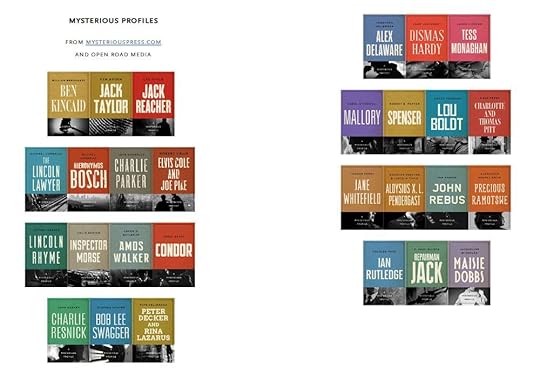
These profiles are now marketed as individual eBooks by Open Road Media as of 2022. 21 of them were mostly written in 2007 and first collected in The Lineup: The World's Greatest Crime Writers Tell the Inside Story of Their Greatest Detectives (2009) edited by Otto Penzler, who founded The Mysterious Press Bookshop and Publishing Imprint. The Bosch and Morse profiles both date from that time. 7 additional profiles have been added since then.
The current selection of 28 Mysterious Profiles eBooks published as of 2022. Image from my own screengrab.
There was more satisfaction and less deception involved in the Morse profile by Colin Dexter (1930-2017) though. I knew what to expect with the padded advertising this time and there was a sense of a more complete profile of the Inspector Morse series (1975-1999) since both it and its TV series (1987-2000) had ended by the time of writing.
Dexter structures the profile of his detective as a series of questions and answers based on what he usually had to answer from readers' enquiries. There is much wonderful trivia here, including tidbits such as Dexter switching Morse's car in the books from an original Lancia to a Jaguar when the TV-series couldn't find the correct model of the original car. There is the origin of Morse's first name in his Quaker heritage, where various virtues and attributes were the source of Christian names.
There is the reminder that Morse's faithful assistant Lewis was originally written as the older of the two, a fact that was simply ignored in the books after younger actor Kevin Whately came to embody the role in partnership with John Thaw's more senior Morse. Dexter was so caught up in John Thaw's portrayal of his detective that he even wrote into his will that no other actor would be allowed to portray the detective as long as his estate still held the copyright. The estate lawyers got around that by creating a younger version of Morse in the later Endeavour series (2012-2023) with actor Shaun Evans.
Soundtrack This can only be the yearning and mournful Inspector Morse theme music by composer Barrington Pheloung, composed for the TV series, in its extended version which you can listen to on YouTube here. The use of the morse code for M-O-R-S-E as the main theme is revealed in the video as well, by displaying the dots and dashes.
Trivia and Link I note that the Mysterious Profiles are available online at Scribd if you are a member there.
It is a very short question and answer appendage to the Morse saga. But lovely answers and the best for last. I’m still grateful to discover the series as it was being broadcast in Britain. And having it entirely on dvd. Yes the early ones are a bit dates but the books read as magic every time. Oxford lives on.
I'm a long time fan of the Inspector Morse and Lewis series via US public Tv and now streaming such as Britbox plus the DVD s, Plus now the Endeavours. I'll admit I've only read the book form of maybe 2. It may also have helped that I lived in London in the early 60s so it was/is easy to insert myself into the scenery. The background details described by Dexter in his character and story development are extra food to flesh out the stories. Just wish I'd read this 20 years ago.
Inspector Morse might be one of my all-time favorite TV series, even though I didn’t actually read the books yet, so this little article/interview published on Kindle was a cool quick read for me. I would have enjoyed something more exhaustive actually, but I’ll take it.
This entry, while short, is interesting and satisfying to any fan of Inspector Morse, the books and the television series. Certainly worth a quick read for some insights into a legendary character.