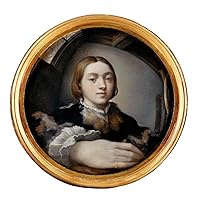
PORTRAITS is admittedly a dense piece of writing. In over five hundred pages, art critic and storyteller John Berger takes us through thousands of years of art history, closely examining such diverse talents as ancient cave painters, classic greats, and modern masters. Berger covers the expected artists (Rembrandt, Cezanne, Monet, van Gogh, and Picasso), as well as many I had never heard of (Basquiat, Broughton, Hambling, and Noel). In all, there are 74 artists explored in this book, and Berger is intimately connected with every one of them. This isn’t so much a volume of art history as it is a journey into Berger’s soul as he waxes poetic about color, texture, and the many ways art communicates. As Tom Overton writes in the introduction, “this book constructs a history of art that is not about distinction, but about connection; not just between artists, but between artists and us.”
I was surprised at how much of this book reads as a series of stories, stories about Berger’s own life as well as the world of the artists he explores. And Berger’s view of art and artists is uniquely his own. Of ancient cave paintings in Chauvet, he writes, “Deep in the cave, which meant deep in the earth, there was everything: wind, water, fire, faraway places, the dead, thunder, pain, paths, animals, light, the unborn … they were there in the rock to be called to.” Of Goya, he writes, “Goya’s genius as a graphic artist was that of a commentator . . . he was much more interested in events than states of mind.” Of Cezanne’s use of the color black, he writes, “It’s a black like no other in painting.” And of Pollack, he writes: “The suicide of an art is a strange idea.” These are enigmatic comments that Berger explores through intense analysis, personal vignettes, and clever anecdotes. Reading this, I felt I knew Berger – and I felt I knew the artists he was revealing to us.
My only complaint is the quality of the pictures in this book. All of the paintings are reproduced in black-and-white, which I at first assumed was because the book I was reading was an Advanced Reader’s Copy (ARCs are presented as “uncorrected proofs,” which seldom include color illustrations). But Berger is clear in his preface that the decision to use black-and-white illustrations was intentional. As he puts it, “This is because glossy colour reproductions in the consumerist world of today tend to reduce what they show to items in a luxury brochure for millionaires. Whereas black and white reproductions are simple memoranda.” The illustrations in this book are really superfluous, since they are difficult to see and do little to compliment Berger’s expert prose. It’s easy enough to go online to take a closer look at the works Berger references, but I wonder why the black-and-white illustrations are included at all.
But for readers interested in art, art history, or the stories behind the creative spirit, PORTRAITS is a wonderful book. Just be aware that this is not one of those coffee table art books with gorgeous glossy color prints – it’s not “a luxury brochure for millionaires.” No, it’s an intellectual, very personal, and often very spiritual look at creativity and human expression. I highly recommend it.
[Please note: I was provided a copy of this book for review; the opinions expressed here are my own.]