Jump to ratings and reviews
Rate this book

Homelessness Is a Housing Problem: How Structural Factors Explain U.S. Patterns

Rate this book
In Homelessness Is a Housing Problem, Gregg Colburn and Clayton Page Aldern seek to explain the substantial regional variation in rates of homelessness in cities across the United States. In a departure from many analytical approaches, Colburn and Aldern shift their focus from the individual experiencing homelessness to the metropolitan area. Using accessible statistical analysis, they test a range of conventional beliefs about what drives the prevalence of homelessness in a given city—including mental illness, drug use, poverty, weather, generosity of public assistance, and low-income mobility—and find that none explain the regional variation observed across the country. Instead, housing market conditions, such as the cost and availability of rental housing, offer a far more convincing account. With rigor and clarity, Homelessness Is a Housing Problem explores U.S. cities' diverse experiences with housing precarity and offers policy solutions for unique regional contexts.

284 pages, Kindle Edition

First published March 15, 2022

275 people are currently reading
5528 people want to read

About the author

Gregg Colburn

2 books12 followers

Ratings & Reviews

What do you think?
Rate this book

Friends & Following

Create a free account to discover what your friends think of this book!

Community Reviews

5 stars
527 (38%)
4 stars
633 (46%)
3 stars
181 (13%)
2 stars
25 (1%)
1 star
2 (<1%)
Displaying 1 - 30 of 228 reviews
Profile Image for Michael Lewyn.
963 reviews28 followers
April 19, 2022
This book seeks to answer the question: why is homelessness much more common in some cities than in others?

They find that only two factors are significant: 1) overall rents and 2) rental vacancy rates. Where housing is scarce and rents are high, lots of people are homeless. Where rents are lower, fewer people are homeless, even in very poor places. (In fact, high city incomes correlate positively with homelessness, because more and better jobs lead to higher demand for housing).

By contrast, many other factors that one might think are related to homelessness in fact are not correlated on a citywide basis. For example, since homeless people are generally poor, one might think that places with high poverty rates or high unemployment rates have lots of homelessness. The authors show that this is not the case. Where most people are poor, there is less demand for housing, which translates into lower rents and less homelessness.

One might also think that places with warm weather have lots of homelessness, because homeless people might be attracted to them. But high-rent cold cities like Boston have above-average levels of homelessness, while cheaper warm-weather cities like Orlando and Charlotte do not. However, homeless people are more likely to have temporary shelter in cold cities than in expensive warm-weather cities like San Diego- either because city governments are less motivated to build homeless shelters when no one is at risk of freezing to death, or because the homeless themselves are less eager to use shelters. I suspect that if the authors focused only on highly visible unsheltered homelessness, they might have found a stronger correlation with weather).

It might be argued that shelters themselves (or other social services) attract the destitute. However, the authors find that “a region’s proportion of in-migrants with incomes below the federal poverty line … is entirely unrelated, statistically speaker, to per capita rates of homelessness.”

What about drug use and mental illness? The authors were unable to unearth any city-level data on the frequency of either- but state-level data do not show a strong correlation between the amount of drug use or mental illness and homelessness rates. I didn’t find this surprising, because even if half of homeless people are mentally ill and/or addicted, many people in these categories might be functional enough that they could find cheap housing if such housing existed.

The last chapter focuses on possible government responses to homelessness; the authors tend to emphasize "government spending" policy solutions rather than deregulatory solutions that would allow more new housing to be built. They do acknowledge that government regulation limits the amount of housing, but their discussion of this issue is short and shallow: they focus on zoning that limits housing to single-family homes, but overlook that even in areas zoned for apartments, government limits housing supply in a variety of ways (e.g. by limiting the number of apartments that can be built per acre).
Profile Image for Alex Rawding.
6 reviews2 followers
August 13, 2022
Excellent book. I work in affordable housing and thought this was a great overview of modern homelessness and potential policy responses. Despite being familiar with most of the stats and conclusions, I still enjoyed the read. Every time I tell people what I do, they inevitably tell me about a recent encounter with a homeless person or encampment. I have struggled to respond in a way that addresses the complexity of the problem while also acknowledging the fear and sadness that being stuck in a subway car with a mentally unstable person or finding a needle in a public park naturally provokes. Look forward to using this book’s framework, which humanizes individual experiences in the context of structural problems and solutions.
Profile Image for Tommy.
177 reviews13 followers
February 19, 2023
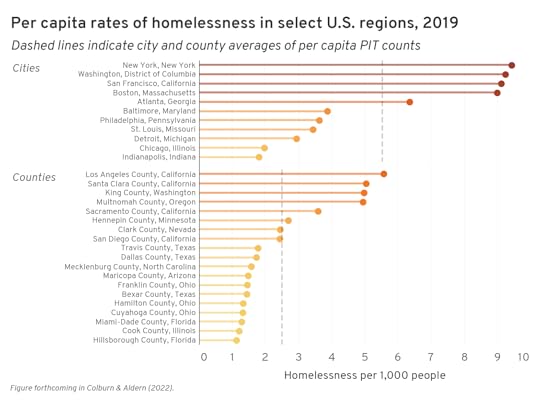
One day in January each year, the Department of Housing and Urban Development conducts its Point in Time estimate of how many homeless people are in the US. Summary of the results are shown below. The natural question from looking at the data is: Why do some cities have more homeless than others? This question is what this book seeks to answer, and it does a good job of answering it. (The graphs here were in the book itself and made available at homelessnesshousingproblem.com)


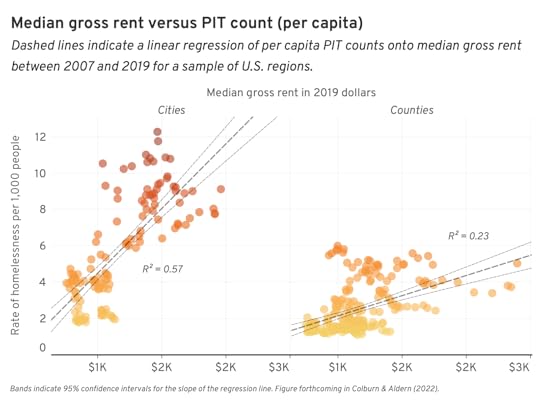
While becoming homelessness is a result of poverty, it turns out poverty rates between cities has the opposite effect of predicting homelessness rates within cities. It turns out that homelessness is a rich city problem, as the graph below shows. This is consistent with the works of Henry George, who saw that it was the centers of economic progress that saw the extremes of human suffering. As rents increase in a city on an absolute scale we see a strong correlation with homelessness; when plotted against the average share of income dedicated to rent we see no relationship.


This makes sense, because for most people, incomes increase in high rent areas. Rents might be high for a San Francisco tech worker, but so are their incomes. But when you are precariously employed in these coastal boom towns, one missed paycheck can mean an obliteration of your savings and soon you're out on the street.

Meanwhile, in low- or negative-growth rust belt cities, poverty is everywhere, but the same forces keeping wages low are keeping rents even lower. Mississippi, as the book points out, finds itself last place in just about every quality of life metric there is. Except one: homelessness. And that's because its really cheap to get housing in Mississippi.


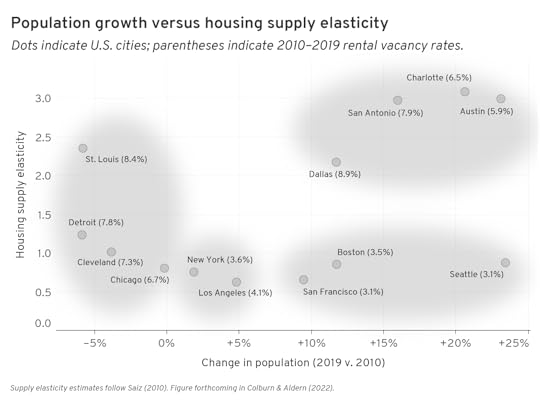
The book then breaks out cities in America into four groups: Rust Belt declining cities, the Megacities, Coastal Boomtowns, and Sun Belt Boomtowns. These places cluster nicely due to differences in their housing markets - structural differences that lead to differences in the rate of homelessness each experience. I gave the gist of Rust Belt and Coastal Boom Towns above.

As for NY/LA, these two cities have high cost of living due to the wealth they contain, but are growing quite slowly now.

The Sun Belt cities in the top right corner are interesting; these cities have been able to maintain housing production as demand has increased in these places. This has kept vacancy rates above the recommended 5% (it turns out, just like economists have an "optimal" unemployment rate, housing economists suggest there is an optimal vacancy rate of around 5%.)

I am a bit skeptical about the Sun Belt category. While it is true that these areas have been low cost of living places for decades, this is starting to change. The book acknowledged Austin may be moving from quadrant II to quadrant IV in the years to come. And I think the explanation is the reliance of these places on single-family, sprawl-based planning to alleviate housing pressure. These places are now built out. Metros like Phoenix, for example, have little room left to build out; rents in the Phoenix area have risen sharply since the pandemic (this book seems to be relying on prepandemic data).

The proscribed solutions at the end of this book are many, but one major one is to allow a market response to housing pressures. The book discusses single family zoning, parking minimums, and setback requirements, for instance, but not in very much depth. I would have liked a bit more in this realm. Nonetheless the book does make the point that more development in the private market, and at density, will help reduce overall pressure on the market.

The other major point is to decommodify housing. The book quotes economist Charles Lindblom: "A market is like a tool: designed to do certain jobs but unsuited for others. Not wholly familiar with what it can do, people often leave it lying in the drawer when they could use it. But then they also use it when they should not , like an amateur craftsman who carelessly uses his chisel as a screwdriver." This means more public and nonprofit housing.

The last chapter has other policy proscriptions and also discusses the need to change perceptions of the unhoused. A systems approach is laid out that made a lot of sense to me. There has been resounding success in cutting the rate of veteran homeless in the last few years - 50% reduction! The methods used are in line with what is laid out by the authors, all it would take is widening the scope of who we seek to help.

In the end, the issue of homelessness in America is not because of personal moral failings, or mental illness, or Democrat mayors. It's the housing market. "People design cities and structure markets. They can also choose to change them."
Profile Image for Reid tries to read.
153 reviews85 followers
December 1, 2023
As the title says, you can shut your reactionary ass up every time you try to blame homelessness solely on individual favors like poor choices or, if you’re a Republican, solely on the loony libs of the Democratic Party. Homelessness in America, and variations in the rate of homelessness across different regions and times, can be explained by the costs and availability of housing. Housing market conditions explain why cities like Seattle have higher rates of homelessness than a rustbelt hinterland like Detroit. People with wide arrays of economic and health vulnerabilities live in every city, but only looking at the structural cause of homelessness (i.e the housing market), explains why the vulnerable suffer worse in some cities than in others. Precipitating conditions, such as getting divorced, may increase someone’s chance of becoming homeless, but it and other conditions like it are not the root cause of homelessness. It is as simple as this: when housing is limited and scarce, precipitating factors are magnified. This is a solvable issue. If the number of homeless war criminals, I mean veterans, can be cut in half during the Great Recession, there is no reason we cannot pull other people out of the streets and into homes of their own.

To combat homelessness we need political willpower. People often say things get done with political will; this is false. You need the will to do something plus the force to actually knock down barriers in your way. To do this will require the dismantling of some myths about homelessness in order to build the will to fight it. One of the most pervasive myths is that homelessness is the result of mental illnesses or drug addictions/alcoholism. While a disproportionate amount of homeless people do experience either mental illness or drug addiction when compared to the average person, it should be noted first off that a large amount of housed people also experience these ailments without becoming homeless. Second, the majority of homeless people are not drug addicts and do not experience severe mental illness. Therefore, these things cannot be the cause of homelessness if they don’t affect every homeless person or turn every housed person experiencing them homeless. Correlation does not equal causation, and counter examples such as Hawaii, which has a large homeless population while also having a relatively low rate of mental illness compared to the rest of America, further weaken this argument. It is much more likely that homeless people suffer from either drug addiction or mental illness because they are homeless, and not the other way around. Being homeless, especially being chronically homeless, deprives someone of their most basic needs: shelter, food, safety, and social bonds. Being homeless also means you are more likely to be physically or sexually assaulted; it means you are more likely to die young; and it means you are more likely to contract serious diseases or illnesses. A myth associated with the “mental illness myth” is that homelessness is largely a result of the masses closure of mental institutions in the 1970s-80s, but the truth is the homelessness crisis was already occurring before these closures occurred.

Although it is counter intuitive, poverty alone also cannot explain homelessness. While only those in poverty succumb to homelessness, cities with high poverty rates such as Detroit have relatively low homelessness rates, while affluent cities like San Francisco and New York have much higher ones. Often this feed into a conservative argument that Democratic politicians and their supposedly “woke/progressive” policies lead to homelessness. This argument has no legs whatsoever. Around 85% of cities at any given time have a Democratic mayor, meaning this argument cannot in any way explain variations in homeless rates across cities or regions. If Democrats are to blame for homelessness, then why are homeless rates in Democratic footholds like Chicago, Detroit, and Cleveland lower than national average? In fact, the quintessential face of cosmopolitan liberalism, New York City, is also the city that birthed America’s harshest and must punitive response to homelessness under Rudy Giuliani . Forceful relocation policies against homeless people, whether it be in NYC in the 80s or liberal Seattle today, do not prevent or decrease homelessness. They simply move homeless people out of sight.

A third myth attempts to blame variations in homelessness rates on the mythical “homeless migrant”. One argument asserts that homeless people congregate in cities with good weather so that it is easier to survive being unsheltered. Counter examples to this argument include: the high homelessness rate in Seattle, where torrential downpours and 30-40 degree winters are common; and low homelessness rates in Sunny Florida and warm Texas. The truth is that about 80% of all homeless people stay in the very state/city/area that they originally became homeless in. Homeless people are significantly less mobile than other people due to an obvious lack of financial resources; they do not generally have the resources to move across states, and especially across the country. In an example the book cites, a comprehensive survey of the homeless population in San Francisco reported that 55% of the homeless population in the city had been a resident there for more than 10 years, while only 6% had been living in San Francisco for under a year.

The authors find two factors of the market which lead to high homelessness rates. The first, and less important factor, is housing cost burden. Housing cost burden is the proportion of one’s total income spent on housing costs/rent. Over a certain threshold when housing cost burden is high enough (usually around 33% of income) the homelessness rate increases. What’s most important here is the absolute level of rent (actual price of rent rather than the proportion of one’s total income). When the median absolute level of rent is high, it sets a cap on what the cheapest available rent in an area can be. The higher the absolute cost of rent, the higher the cheapest rents will be. Anybody unable to afford those will likely become homeless. The second factor is rental vacancy rates, AKA the proportion of available rentable units in a region at any given time. Rents tend to be higher when vacancy rates are low. The lower the vacancy rates, the higher the per capita rate of homelessness tends to be. When vacancies are limited, rent prices receive upward pressure and rise. In cities a third factor has been shown to be a statistically significant causal factor of heightened rates of homelessness: income inequality. Income inequality in cities tends to produce high housing costs and higher rates of homelessness. The reason this is a factor in cities alone is because only cities tend to see such massive scales of income inequality.

Here are the conditions that bring about these two factors (high housing cost burdens/absolute rents and low vacancy rates): More people with more money living in a given area increases the demand for housing, raising the prices of homes and rent. When large private employers bring high paying jobs to cities this boosts the demand for houses. Often we can see this when cities bid for companies such as Google and Amazon through tax subsidies. Cities often redistribute billions of people’s hard earned incomes (through tax dollars) to essentially bribe private conglomerates to set up shop in their cities; the most sought after jobs are in the FIRE (Finance, insurance, and real estate) sector. When cities bring in these companies, and as higher skilled labor follows these companies to new cities, demand for houses rise which raises housing prices. Studies shows that the supposed benefits state and localities received when giving out tax incentives to large companies are not worth the loss of tax revenue in the first place. That money could have been much better allocated to other programs rather than relying on “spill over” effects gained from bringing in these companies. Generally, corporate giveaways have little to no effect on where a corporation chooses to relocate to or set up shop in, and on top of that these corporations often do not deliver the number of jobs they promise. At the same time, the “talent” these companies require must be imported from outside as they aren’t available where they relocated.

Housing supply is also totally reliant on the private sector and its profit motive. Geographic barriers, such as mountains or bodies of water, and regulations both can cut into the private housing sectors bottom line, and therefore restrict the supply of houses. One of the biggest ways governments restrict housing supply is through zoning laws. The middle class suburbanite dream of single family housing (houses that aren’t connected with each other) means that large portions of cities restrict the development of multifamily homes (structures which contain multiple residential units within one building). This leads to the easiest way to provide more housing (AKA building more mutlifamily homes) being squeezed. The class logic of modern America (which is elaborated in “The Asset Economy”), where real wages have stagnated since the 1970s while asset prices have inflated, means that most people’s wealth is tied up in home ownership. Homeowners will do whatever they can to push forward policies which they believe will ensure their assets worth will continue to be inflated, which means shooting down things such building new residential developments such as nearby multifamily housing. By preventing the construction of new housing in their communities, homeowners (mostly boomers) ensure their housing supply stays low and its value continues to rise.

To deal with this crises and prevent it in the future will require making housing cheaper, likely either by providing government subsidized housing or through rent controls. To those who are chronically homeless, the best way to help them is to give them housing. After giving them real non-temporary shelter, you can begin treating the other mental, physical, or substance abuse issues that arise due to being chronically homeless. Most studies have found that the “treatment first” method, where attempts to treat substance abuse or mental health issues are made before providing housing, is significantly less effective than the reverse method. Housing without requirement for treatment has consistently proved to be more effective than requiring treatment to get housing. Once housing has been set up for the chronically homeless, it is then effective to provide them with voluntary, rather than required, secondary treatment options.
Profile Image for Sarah.
560 reviews17 followers
October 13, 2022
Essential reading for anyone in the Puget Sound! An incredibly well-researched dive into the causes of (and myths surrounding) homelessness. The thesis is extremely clear (it’s the title, y’all!) and there are scads of supporting data visualizations and statistics. The book deftly debunks claims like “it’s the weather!”, “it’s mental illness!”, and “it’s poverty!” causing homelessness to disproportionately plague certain cities—instead, affluence and lack of availability of rental housing are to blame. Be warned, the book is a bit jargon-y/overly academic, but I found it a small price to pay for the importance of the content.
Profile Image for Ryan Greer.
349 reviews45 followers
November 20, 2022
Ok, look, none of us are ever as smart as we think we are. Everyone's got an opinion based on the article they read or that one time when that thing happened to them or a friend of theirs. I am the same way, I try to pretend like I'm not, but I'm as shaped by my own little slice of experiences we call life to believe I know up from down.

This book is a helpful reminder to me that data matters, that just because we perceive a thing to be true doesn't actually mean it's true. Gregg Colburn has spent a large portion of his career helping to dispel myths about the root causes of homelessness and this book is a summation of his research on that topic. I also recently saw him present virtually at a conference on housing and homelessness and the guy knows, I mean really really knows, what he's talking about and how it fits into larger narratives around policy and planning.

This book is quite academic, I wouldn't recommend it if you're looking to casually educate yourself on issues related to homelessness, but if you're willing to work through some of its complexity you'll find yourself richly rewarded.

Some of my favorite sections:

In virtually all studies that analyze intercommunity variation in homelessness rates, measures of rent costs have been identified as significant predictors of homelessness.

In most cities, the majority of people experiencing homelessness are not visible to the general population, because most people without housing sleep in shelters or other supportive housing facilities. On any given night in this country, the chronically unsheltered constitute only about one-tenth of the population experiencing homelessness. Yet the visibility - the literal conspicuousness - of the chronic, unsheltered population in many cities help to cement a belief that people experiencing homelessness are mentally ill and/or addicted to a substance, as these conditions are disproportionately represented in the unsheltered population.

(on mental illness and substance abuse) - Certainly, these conditions are disproportionately represented in the population of people experiencing homelessness, but two central points are worth making: First, a majority of people experiencing homelessness don't have these conditions; and second, the vast majority of people with these conditions never lose their housing.

First, for many people experiencing homelessness, living in a quality shelter is preferable to living unsheltered on the street. By extension, investments that fail to reduce overall levels of homelessness - but instead shift homelessness from the street into shelters - ought not be viewed as worthless or ineffective, as they're responding to people's immediate needs.
Second, that greater investments in the homelessness response system sometimes appear to pull people into that system suggests that there are many precariously housed people who desperately need housing.

The point here is that so-called soft policing isn't to blame for the homelessness crises in many cities. It's possible that tougher responses from law enforcement may move visual evidence of homelessness to less apparent locations, but they won't alter the total number of people experiencing homelessness.

Critically, we argue for a paradigm shift in how we think about housing. Rather than conceptualizing housing as solely a private good - one procured through market transactions - housing must be de-commodified. Shelter is fundamental to human survival and demands a different treatment than iPhones.

If homelessness continues to be seen exclusively as a personal problem - and not one of structure - policy prescriptions will remain reactive in nature.
Profile Image for Mona.
125 reviews12 followers
March 4, 2024
this book does an excellent job in presenting arguments, breaking them down, and explaining concepts. although i knew a lot of the info in here already, the clarity and structure in which it presented its research questions and arguments made me feel more clear-eyed and informed about the state of housing/homelessness in the US and the central question of why different US cities see different rates of homelessness than others.
Profile Image for Catherine Hayden.
373 reviews3 followers
October 30, 2023
I chose this book to do a report on for one of my classes and was pretty pleased with it! I'll probably update this after I actually write the paper but off the bat (and my 30 pages of notes), it was pretty understandable for an academic text.
Profile Image for LaanSiBB.
305 reviews18 followers
Read
February 8, 2022
An interesting review of different factors of homelessness, covering poverty, drug, mental illness, race, gender, generosity, population growth and the only one critical factor - rent.
Profile Image for Erin Crane.
1,182 reviews5 followers
dnf
May 17, 2023
I want the essay version of this 😂
Profile Image for Sallie Lu.
564 reviews10 followers
February 23, 2024
I love how the authors start with laying out the structure of the book, the argument that will be made, and the conclusions they are driving towards. It literally tells you what each chapter is going to be about and I really love that for this kind of educational book.

A clear and approachable look into the structural causes of homelessness in the US. It uses straightforward statistical analysis and research to demonstrate why people’s common perception of the causes of homelessness (mental illness, drug use, poverty, weather, etc.) is unsubstantiated. The book logically explains why it isn’t helpful nor entirely truthful to think of homelessness as an individual problem. Rather, it makes a very compelling argument that the primary drivers of homelessness are housing market conditions and policies that influence them. It then concludes with what a robust response to homelessness looks like.

I like how this was written for the everyday person to self-educate on such a pervasive issue. I think everybody would benefit from reading this.
Profile Image for Natalie Silver.
186 reviews1 follower
August 8, 2025
A really good research article that got a little too long so they decided to publish it as a book. Are the findings groundbreaking? No, but I think that’s what makes the book so effective. Everything you need to know is in the title, but reading the book makes you really equipped as a person in society to have a productive understanding of homelessness as a policy issue. At moments I wanted the conclusion to do more, but this is a book on homelessness and it stayed in its lane, which I actually appreciate much more than poorly understood musings on zoning codes as contributing to the housing crisis. Something I wish more people understood after reading this book is unsheltered homelessness and data on the number of people experiencing homelessness in a city are not the same, and west coast cities like Seattle and SF that have these reputations don’t have a bigger crisis than cities like New York and Boston. Would recommend for those interested!
16 reviews
May 19, 2023
Essential reading for those wanting to learn more about why people become homeless.
Does a good job at explaining why different cities have varying rates of homelessness across the US. In addition to the various structural factors that create a high risk of losing housing and why it is incredibly difficult for people to regain it once they lose it.
Profile Image for Graeme Newell.
466 reviews239 followers
January 2, 2024
This book dives deep into the heart of homelessness. But if you're expecting a gripping narrative that tugs at your heartstrings or a page-turner filled with dramatic stories of individuals experiencing homelessness, this isn't that kind of book.

This isn't so much a book about homelessness, it is, in fact, a book about RESEARCH that's been done on the issue. It is a deeply academic presentation of the statistics and trends surrounding this contentious issue.

The information presented in this book is nothing short of revelatory. Colburn delves into the root causes and dispels common stereotypes associated with homelessness. He tackles all the tropes: drug abuse, mental illness, weather, employment, laziness and so many more. He methodically presents the research and statistics, effectively debunking these misconceptions. He takes each one and dissects it with a surgeon's precision. Colburn presents a solid case supported by data. It's informative and eye-opening.

However, here's where my enthusiasm wanes. While the information is undeniably top-notch, the writing style is as dry as the Sahara desert. Colburn's prose feels like a lecture from the dullest college professor you've ever had, the kind who delights in showcasing his extensive vocabulary in a cavernous lecture hall. This, unfortunately, makes the book a slog to get through.

I think this is one of the foundational problems with the world of nonfiction writing. It seems the author camp is broken up into two constituencies: authors who can research well, and authors who can write well. Rarely are people blessed with both skills. In the world of non-fiction books, storytelling is often considered optional. I believe that’s why so few people read nonfiction. It’s just too boring.

A few years back, I read the book “Chasing New Horizons.” This is a science book about the mission to launch the satellite that did the flyby of Pluto. The book was cowritten by Alan Stern, the mission commander scientist, and David Grinspoon, a science journalist. It was an absolutely fantastic read, full of drama, nail-biting cliffhangers, and deeply impactful science.

If I had my way, every science book would be written this way. Before anyone was allowed to write a science book, they would be required to take a basic writing test. If they failed, they would be required to bring on a science journalist cowriter.

In conclusion, "Homelessness is a Housing Problem" is a fantastic book and I learned so much. It really has me thinking differently about this whole issue of homelessness. I just know that this book could have been so much more had the authors acknowledged that they weren’t up to the task of adding basic storytelling to their outstanding research. I’m just sad that a lot more people will not read this book because it is just so abysmally dull.
Profile Image for andré crombie.
785 reviews9 followers
September 21, 2022
Consider the following vignette about musical chairs, often deployed by homelessness researchers, to think through causality and homelessness. We use this example to highlight the difference between a precipitating event and a root cause:

Ten friends decide to play a game of musical chairs and arrange ten chairs in a circle. A leader begins the game by turning on the music, and everyone begins to walk in a circle inside the chairs. The leader removes one chair, stops the music, and the ten friends scramble to find a spot to sit—leaving one person without a chair. The loser, Mike, was on crutches after spraining his ankle. Given his condition, he was unable to move quickly to find a chair during the scramble that ensued.

In other words, when housing is scarce, vulnerabilities and barriers to housing are magnified. Limited financial resources, mental illness, addiction, or interpersonal strife, under a specific set of circumstances, could each precipitate a bout of homelessness—just as a sprained ankle might prevent one from finding a chair in musical chairs. But the fundamental question remains: Would we say that Mike’s ankle injury caused him to lose the game? Under the specific conditions of the game (say, nine chairs and ten people), Mike’s impairment prevented him from finding a chair. But under different conditions—ten chairs and ten people—Mike would have easily found one. One could argue, and we will in this book, that the fundamental cause of Mike’s chairlessness—was a lack of chairs, not his ankle injury. The rules of the game meant that someone had to lose.


Notes: B u i l d m o r e h o m e s.
Profile Image for Matt.
466 reviews
August 13, 2023
Musical chairs is a good start.
Ten friends decide to play a game of musical chairs and arrange ten chairs in a circle, A leader begins the game by turning on the music, and everyone begins to walk in a circle inside the chairs. The leader removes one chair, stops the music, and the ten friends scramble to find a spot to sit- leaving one person without a chair. The loser, Mike, was on crutches after spraining his ankle, given his condition, he was unable to move quickly to find a chair during the scramble that ensued. Pg. 13


In housing, lots of other causes are cited for not grabbing that chair- mental illness, substance abuse, physical disabilities, poverty, criminal convictions, racism, laziness, and the list goes on. All these factors play into who may be more vulnerable, but the glaring fact is not that someone had a vulnerability, but that there are not enough chairs. “The rules of the game meant that someone had to lose.” Pg. 14.

Colburn and Aldern do a nice job statistically explaining this reality. So many reasons for U.S. homelessness, often systemic reasons with an eye toward the personal obstacles people face, are commonly thrown out there to avoid the obvious reason. The market economy. Housing is a wealth generator. According to the data, homelessness is highest where market prices are highest and flexibility to build affordable housing is lowest. It’s not the “poor” cities that are the most problematic. It is the expensive cities that, either intentionally or unintentionally, keep it expensive.

I have spent many years working with and for people sitting at the margins and currently working at our local homeless shelter. This data all seems to coincide with the real word. Finding an affordable place to live is a struggle for many. Housing is no longer viewed as a necessity but as a means for wealth generation. Affordable homes are too often rehabbed for expensive flips or left to deteriorate as many landlords collect overpriced rents for places many would consider barely habitable.

Of course, there are no easy answers and many of the future solutions look a lot like polices that have been tried in the past. However, Colburn and Aldern give it a go. They recognize the tension between using funds to support short-term crisis solution versus achieving long term housing stability. Primarily, they support a long-term solution that combines local and federal funding for long term supportive housing. Obviously, there is a desire to avoid the fiasco of the public projects of the past, but relying on market forces alone to solve this problem is faulty. There needs to be reimagining of what housing means in this country. Some scoff that housing is a human right, but these are the same people that often don’t want to see the unhoused in their communities. Or sitting outside their favorite restaurant. Some things have reached beyond the grasp of the market here. Social security, water, air. We don’t have to treat every human experience as a capitalist endeavor. Hopefully, the data Colburn and Aldern present help support making it clear that we need to stop being distracted by the music and just make some chairs.

Profile Image for Becky.
1,664 reviews1,952 followers
February 5, 2025
Excellent and thorough analysis of the reasons why some cities have high rates of unhoused people than others, and a sound debunking of the easy hand-wave arguments that demonize homelessness as a personal responsibility issue - drug use, poverty, familial instability, laziness, etc. None of those are the reason why the city San Francisco has a higher rate of homelessness than the state of Mississippi.

Spoiler: It’s housing. Access and affordability.

That’s it. We could fix it, but another thing we lack is the political will to do so. We like to think that those experiencing homelessness deserve it, and we are somehow better, but the truth is that most of us are a medical crisis or job loss away from being on the streets ourselves.

Study after study shows that providing adequate housing and even a basic income stipend costs less than current “solutions”, and FAR less than relocating or jailing people only guilty of needing a place to sleep in public.

Compassion isn’t cheap, but it is affordable.

This was a little dry and statistic-heavy, but very interesting and enlightening. Highly recommended.
Profile Image for Jasmine Liu.
75 reviews4 followers
October 17, 2023
A book that is good at establishing that homelessness is a housing (supply) problem (go figure), but the authors aren’t too interested in historical analysis (I’d be particularly interested in how local regulations came to prioritize single-family zoning, or how the federal government came to incentivize home ownership through mortgage subsidies, or how cities came to privilege the construction of luxury developments through tax incentives) or in outlining political strategies for overcoming the opposition to developing housing on the lower end
Profile Image for Max D'onofrio.
403 reviews
February 12, 2024
A nice overview of homelessness and through data creates a strong argument about why housing is the most important favorite surrounding homelessness. The policy approaches on how to solve the issue I found a bit more impractical. Sometimes it seemed to not understand what I would say are the political challenges on the issue. But great if you are someone just interested in knowing more about why housing is so important. Probably my favorite fact was that homelessness is more prevalent in richer cities than poorer.
Profile Image for Sarah Joyce.
133 reviews
May 14, 2024
This book is so so good & important. Lays out the reasons why cities have different levels of homelessness & uses data to disprove all of the common reasons people think (poverty, substance abuse, homeless-friendly policies, nice weather, mental illness) & SPOILER ALERT!!! It’s all about housing!! Such a non-academic way of writing & so accessible & so so important to think about homelessness as systems level problem that cities face rather than individual level problem. Would recommend to anyone interested in housing/homelessness at all!
Profile Image for Megan.
41 reviews
January 22, 2024
good overview on why homelessness is so prevalent in america. sucks that we continue to have potential solutions to problems like these but we choose to ignore them. i worry about human rights issues becoming too “clinical” in a book like this but the authors did a good job approaching this topic with both empathy and dignity. focused a lot on the west coast for obvious reasons but i think the authors are from/based in seattle, so i understand why that would be most prevalent for them.
Profile Image for KaBbage.
39 reviews
March 23, 2025
“The homelessness system is somewhat circular, as it begins and ends with housing. When we think about some abstract notion of system improvement, then, this thinking must also begin and end with housing” (pg. 191).

The thesis of this book is its title, and now it will aid me in writing my thesis. Very good ideas and breakdown of what homelessness actually is and how we can do something about it.
Profile Image for Frances Krumholtz.
461 reviews7 followers
September 13, 2025
I was EXTREMELY skeptical when the introduction of this book wonders why homelessness inhabits such a large amount of political and social imagination when so relatively few people experience homelessness. Skepticism continued when the authors pin Gavin Newsom and Donald Trump as separate poles of ideological extremity.... BUT this book actually pulled through. Rather than examining factors influencing an individual's entry into homelessness, the authors dig into the variation in relative rates of homelessness across the country. Ultimately they identify several housing market conditions (inventory, cost, etc.) that have a stronger correlation to homelessness rates than other factors that may impact an individual's cause of homelessness.
Profile Image for Kiziah.
53 reviews
April 1, 2025
This is my kind of non-fiction book!! Super straight forward, not too in the weeds, and very stats-centric. I HIGHLY recommend this to anyone who’s at all interested in homelessness, what precipitates it, and how to solve it.
Profile Image for Avery.
32 reviews1 follower
June 20, 2024
Homelessness literature, when you read it in mass quantity, will inevitably become redundant. However, this one was pretty insightful and did a masterful job of using quantitative evidence. Reading this was such a lovely break from the coding element of my job, so that also helped!!! Very thoughtful, very thorough, and very analytical.
Profile Image for Adamson Bryant.
44 reviews
April 12, 2025
Good overview of the research, lots of suggestive evidence but I’m not convinced by univariate R2s on 30 observations
Profile Image for Ben.
2,737 reviews235 followers
August 27, 2022
Important Read

This was a great book - appropriate to my job.

I found it a particularly important read.

Would recommend!

4.1/5
Displaying 1 - 30 of 228 reviews

Can't find what you're looking for?

Get help and learn more about the design.