Jump to ratings and reviews
Rate this book

剥开鸟蛋的秘密

Rate this book
这是一本由外向内、从形状到颜色、从博物学到微生物学,深入探索鸟蛋秘境的“旅行指南”。鸟蛋的形成始于一颗卵子,随后是受精卵的产生和发育,接下来鸟蛋成形、产出,直到雏鸟出壳,鸟蛋这一生命阶段便画上了圆满的句号。

本书以历史上收藏家对崖海鸦蛋的痴迷与狂热作为开篇,以生动的笔触回顾了鸟蛋与人类生活千丝万缕的关联。随着数百年来科学家的研究不断深入,当排除了种种猜测与假说之后,人们发现鸟蛋的神奇绝不仅仅体现于它们的精巧外形而已。基于数十年的野外观察,鸟类学家伯克黑德将缤纷各异的鸟蛋呈现于我们面前。通过图解严谨的科学实验,伯克黑德阐释了它们独特的外形和构造所具有的适应性意义。小小一枚鸟蛋,实际上是在多种自然选择的压力之下形成的完美产物。

280 pages, Paperback

First published April 12, 2016

60 people are currently reading
1760 people want to read

About the author

Tim Birkhead

17 books98 followers
Tim Birkhead is an award-winning author and one of the world’s leading bird biologists. He is the coauthor of Ten Thousand Birds: Ornithology since Darwin (Princeton) and the author of The Wonderful Mr. Willughby: The First True Ornithologist, The Most Perfect Thing: The Inside (and Outside) of a Bird’s Egg, and Bird Sense: What It’s Like to Be a Bird, among other books. He is a Fellow of the Royal Society and professor emeritus of zoology at the University of Sheffield.

Ratings & Reviews

What do you think?
Rate this book

Friends & Following

Create a free account to discover what your friends think of this book!

Community Reviews

5 stars
160 (30%)
4 stars
228 (43%)
3 stars
115 (21%)
2 stars
18 (3%)
1 star
3 (<1%)
Displaying 1 - 30 of 84 reviews
Profile Image for Paul.
2,230 reviews
September 12, 2016
Way back in the 1950’s the Egg Marketing Board recommended that we should ‘go to work on an egg’. It was something that the nation took to heart and nowadays we consume over 11 billion hen’s eggs in the UK. They are a healthy nutritious food; though in my household most of them end up in cakes…

Tim Birkhead has been fascinated by birds and eggs for his entire career. In this book, he seeks to answer a variety of questions. Such as how are eggs formed, how are their colours and shapes created, is the pointed end laid first and are some designed to roll in a circle on a cliff face. Using information from his own scientific research and examples from museum collections and from a whole variety of different birds Birkhead sets about answering some of these by beginning from the moment of fertilisation to the point where the unborn chick makes that first chip in the shell.

We learn how the eggs are made in the oviduct, how the shells are strong enough to be sat upon during incubation and weak enough to allow the chick to escape. There is masses of detail explaining how they breathe, whilst still having a protective layer against water and microbes and explains the purpose of the yolk and albumen. As well as the science, he looks at the history and mankind’s fascination, and sometimes obsession, with eggs bringing alive all sort of weird and wonderful facts. There is details on the parasitic birds like the cuckoo who have the ability to mimic other birds shells almost exactly, as well as lots of his passion for the guillemot and their beautifully patterned eggs.

It is a fascinating account of what you would think is a simple entity. He writes well, managing to get the balance between details, clarity and scientific jargon just about right. Throughout the book, he regularly points out that answering one question frequently prompts two more and tells us where more research is needed as we simply do not know the answers. What makes this particularly special is his boundless enthusiasm for his subject, not just in his own research, but also for the history behind this most perfect of things. 4.5 stars
Profile Image for Holly (The GrimDragon).
1,179 reviews282 followers
July 12, 2016
And eggs are perfect in so many different ways. They have to be, for birds lay and incubate in such incredible diversity of habitats and situations, from the poles to the tropics; in wet, dry, clean and microbe-infested conditions; in nests and without nests; warmed by body heat and without body heat. The shape, colour and size of eggs as well as the composition of their yolk and albumen all constitute the most extraordinary set of adaptations. The fact that birds' eggs also provided biologists with their first insights into human reproduction makes their story even more momentous.

My friend inspired me to seek out this book from the library, after highly praising the author. I thought it would be good to read right now, since I just had five baby robin's hatch under our deck & have been watching them grow daily!

To see the nest became this intricate spot to lay eggs; the father robin standing guard on the fence, protecting the eggs & the mother from predators (like magpies!); the mother dutifully sitting on her eggs; seeing the most gorgeous color in person, robin's egg blue; experiencing the first egg having hatched, just hours before; watching as the babies started to develop; some of the first flights for the wee robin's; the parents bringing the babies food; hearing the little chirps coming up from under the deck; naming one of the robin's "Birdie Sanders" because of his wild grey feathers; complaining about the bird shit everywhere, but not really caring because of this amazing life event that is going on.. then having my cold, black heart feel a bit sad that they have flown off to greener pastures.. it really has been such an incredible experience & one that my daughter's were able to take part in & learn about, too!

For me, reading about the altricial & precocial hatching process was the most fascinating. The robin's we observed were, I now know, altricial (like humans, cats & dogs!) They were basically these creepy little blobs of matter. It was so cool, to see them go from that naked, helpless state to the development of feathers, beaks, eyes. Truly amazing! I never really put in any thought that anything but precocial chicks existed, to be honest. The cute little chicks that just burst out of the shell, covered in downy feathers, ready to take on the world!

This book was not only insightful, but an absolute joy to read! The author has such a passion for his subject, which shone brightly through his engaging writing. A completely fascinating topic, of which I now know more about.


(Reading challenge: A book from the library)
Profile Image for Ints.
847 reviews86 followers
September 22, 2016
Cik gan daudz cilvēks, no rīta pamodies un izdzēris uz cūkaizgalda malas uzsistu olu, aizdomājas par to, kas ir ola? Par to, kā putni viņu ražo, kādēļ olu formas, krāsas un struktūra ir tik atšķirīga? Katrs, kas pavasaros ir nodarbojies ar putniņu ligzdu izlaupīšanu kā jaunais naturālists zina, ka ar olām viss ir dikti sarežģīti. Varētu domāt, ka mūsdienās ir izpētīts viss, un olas sevī slēpj daudz neskaidrību. Šīs grāmatas autors solīja lasītājam parādīt nezināšanas patiesos apmērus, un es biju pārsteigts uzzinot to, ka par putnu olām mēs vairāk nezinām nekā zinām.

Autors šo grāmatu sācis rakstīt pavisam triviāla iemesla dēļ - skatījies pa televizoru dokumentālo filmu. Tā esot veltīta kairām, un vadītājs apgalvojis, ka kairu olas esot tik spicas tādēļ, lai nenoripotu no klintīm lejā. Tās autoram esot šķitušas muļķības, un viņš ātri uzcepis dusmīgu epastu, taču tad nolēmis pārliecināties literatūrā un tad atklājis, ka literatūras nemaz nav tik daudz, fakti pretrunīgi un vispār, ka par olām mēs zinām tikai tik daudz, cik to izpētījusi mājputnu industrija. Tad nu viņš uzrakstījis veselu grāmatu - par formu, krāsu, čaumalu, olbaltumu un dzeltenumu. Neizpaliek arī perēšanas un inkubācijas nianses.

Nenoliedzami grāmata ari pilna ar faktiem, te ir olu kolekcionāru kustības vēsture, tirdzniecība un labākās olu iegūšanas vietas. Par to, kādu iespaidu tas atstāja uz putnu populācijām. Piemēram, lai kolekcionāram nepārdotu pusperētu olu, tad savācot vienu no ligzdas, pārējās uzdauzi, tad varēsi redzēt, kura izdēta no jauna. Cilvēki ir maksājuši par olām brangu naudu. Savukārt runājot par olu dēšanu, tad izrādās, ka vairums putnu olu pirms izdēšanas apgriež sev iekšā otrādi, ar strupo galu pa priekšu. Kādēļ tas tiek darīts, nevienam nav ne jausmas.

Var uzzināt, ka olbaltums baktērijām un vīrusiem ir totāls tuksnesis, tur nav ko ēst, un pie tam perēšanas procesā tam uzsilstot, tas iegūst antibakteriālas īpašības. Cālim olbaltums lielākoties ir vajadzīgs kā ūdens avots. Un olbaltums nav viendabīga substance, tam ir veseli četri veidi. Nevienam tā ar’ nav skaidrs kā putni uz olām dabū svītras un dažādus plankumus, ja vienmērīgi nokrāsotu olu teorija atbalsta, tad diagonālas krāsas svītras ir visnotaļ grūti izskaidrojamas. Superīga nodaļa ir veltīta dzeguzēm, katru perēšanas sezonu notiek slepena un klusa cīņa, dzeguzes cenšas izdēt tādu pašu olu kā mazputniņš, tas savukārt mēģina iegaumēt savas olas rakstu, lai atšķirtu svešo.

Ja kāds dārzā ir priecājies par pupuķi, tad viņš nav lasījis senos grieķus. Pēc to uzskatiem pupuķis perē olas cilvēku mēslos. Jā, tas tiesa - putniņš ir diezgan liels sušķis un mierīgi var perēt mēslos, jo viņam ir īpašs antibakteriāls ierocis, kas padara spīdīgu spalvu, atbaida olu tīkotājus un aizsargā olas no infekcijām. Arī par kairu ligzdošanas paradumiem es uzzināju daudz vairāk, nekā būtu gribējis. Taču grāmata zināmā mērā man paskaidroja, to ko es putnu salās redzēju pirms pāris gadiem .

Vienīgais mīnuss ir autora stāstījuma stils, tas nav aizgrābjošs un aizraujošs, interesanti fakti tiek pasniegti diezgan garlaicīgā manierē. Darba dienas beigās bija grūti palasīt vairāk kā desmit lapaspuses uzreiz. Smadzenes atslēdzās, un daudz ko no rīta nācās pārlasīt. Lieku 8 no 10 ballēm, bet tikai par rakstības stilu, informācijas te netrūkst un apskatītā tēma pati par sevi ļaus uz olām skatīties pavisam citādi.
Profile Image for Nicole.
852 reviews96 followers
June 23, 2016
I'm genuinely sad that this book is over. Partly because it's a fascinating topic, written about in an accessible way; but mostly because it felt like the author had fun writing the book, which made it just as fun to read. Birkhead's passion and respect for his chosen field of study is almost tangible, and his enthusiasm in sharing his knowledge about one of nature's most perfect things is infectious. I loved this read!

2016 reading challenge: a book from your comfort zone
Profile Image for Victor Sonkin.
Author 9 books318 followers
September 2, 2019
What it says. A story of egg-collecting; what is probably most amazing is that many details of egg biology are still not very clear. How are eggs painted inside the bird, for instance, is not quite clear.
Profile Image for Roxanna López.
Author 1 book58 followers
July 13, 2023
3.7 stars rounded up.

Full of fascinating details, this book could have been better if it had a little bit less chauvinistic banter.

I particularly enjoyed the last few pages when the author briefly explains the importance of long term scientific studies. As a scientist, I do identify with that. Sadly, no money, no research and society is the poorer for it.
Profile Image for Mark Avery.
74 reviews95 followers
September 6, 2016
In this book Tim Birkhead has unscrambled the complexities of the biology of eggs with writing as smooth and rounded as an eggshell.

As I sit writing this review I am listening to a dawn chorus dominated by Blackbird song, and I am thinking of the female Blackbird who is sitting on a nest containing four eggs in the ivy on the wall by the shed in my back garden.

The more you ponder those eggs, the more amazing they seem. They are the perfect mixture of the beautiful and functional: they look good and they do the job very well. ‘My’ female blackbird can sit on those eggs most of the day and keep them safe and warm, but she can also nip off to feed unencumbered by them. She and her mate can choose where exactly to build their nest so that it is in a convenient but safe position. The developing eggs are separated from the outside world by a hard protective shell but one which allows water vapour and other gases to escape through it. This Blackbird nest is well hidden in thick ivy but for other species the eggshell can be coloured and patterned for crypsis as the eggs sit in the open.

As a former evolutionary biologist myself, I can easily get taken away by thoughts of ‘Why is it like that?’ about the functional significance of animal behavior and ecology and there are plenty of explanations of that sort in this book, for example, ‘Why are eggs egg-shaped?’. But there are some pretty intriguing ‘How?’ questions about eggs too: ‘How is an egg laid?’, ‘How is the hard shell produced?’, ‘How does an egg survive attacks by bugs and microbes?’ etc etc. This book is full of clear explanations of those first few weeks of any bird’s life, from fertilisation to hatching. And it’s fascinating. Here you will find the answers to questions that have passed through your mind already, but even more explanations of things that you didn’t know about but are equally intriguing. I found the whole story of how eggs repel microbial attack fascinating.

Just in case you might still be thinking ‘A whole book about that?’ then I should tell you that the writing is wonderfully clear and there are lots of stories about the author’s research and experiences, and insights into past characters who have pillaged or studied birds’ eggs. This is a very good example of science writing that is factually accurate but also a jolly good read.

This review first appeared on my blog on 20 March 2016 http://markavery.info/2016/03/20/sund...
Profile Image for Sonia.
139 reviews22 followers
April 7, 2021
Wish the author would stick to describing eggs, as elsewhere he just comes off as ignorant. On a Zambian farm he describes the 'black workforce....each time I'm surprised by how much they vary in manner and appearance. Some you'd be happy to have round for dinner, others you'd give a wide berth to even during daylight if you didn't know them.' Really? surprised that people look different from one another???

Equally annoying is his comparison of the curator and rare egg shells in a museum to 'the same decree my granddad once used when referring to other women: you can look but you cannot touch.' Cringe.
Profile Image for Irene.
1,330 reviews129 followers
June 15, 2022
Absolutely fascinating!! My entire life I've been oblivious to the marvels of the internal structure of eggs, of the differences between species, of how and why some birds are altricial when they're hatched and others precocial, the variations in incubation depending on their habitat, how eggshells are formed and coloured, and an endless amount of information I didn't even know I didn't know. A must read for anybody interested in birds!
Profile Image for Paula Jiménez Cáseda.
19 reviews3 followers
February 12, 2025
Un libro que refleja lo maravilllosa y fascinante que es la biología.
Trata sobre aspectos relacionados con los huevo; su forma, color, incubación… desde una visión evolutiva muy interesante. Sobre cada tema arroja diversas hipótesis, muchas de las cuales fueron rechazadas para construir una actual.
Aborda cuestiones que nunca me había planteado y que me hace ver los huevos y la biología como algo asombroso.
Profile Image for Andy.
36 reviews16 followers
November 11, 2017
Enthusiastically told, but didn't grab me as much as I wanted it to. The stories of the various eccentric figures from history who have contributed to our understanding (and misunderstanding) of eggs were my favourite, and the adventure ends on a wonderful note. I will be looking out for Birkhead's research in future.
26 reviews6 followers
January 27, 2018
A book that takes a long while to get through, not because it is boring, but because it is filled with a lot of research, that too into an esoteric and underrated discipline - oology. The writing is equal factual and anecdotal, both of which need some diligence on the reader's part as well.
Profile Image for Emmylou Kidder.
34 reviews
June 17, 2024
This book is full of so much interesting factual info about eggs but it is not a dry read at all! I really enjoyed all of the content on evolutionary adaptations of different species' eggs to ecosystem pressures & the part on how oology contributes to conservation knowledge.
Profile Image for Laurie.
25 reviews
June 27, 2017
great book. didn't think a whole book about eggs would be this interesting. liked it very much, just like the other books I read from Tim Birkhead so far.
Profile Image for Emma.
11 reviews
December 27, 2025
This book captures your interest from the first page and keeps it to the end. It has some fun and interesting anecdotes while still keeping focus on the eggs.
Profile Image for Christa.
Author 5 books117 followers
June 24, 2021
A fascinating, detailed look at something I never considered much about - the egg, how it's made and how it functions. Delightful read, with a good balance between jargon and whimsy.
Profile Image for Todd Martin.
Author 4 books83 followers
May 28, 2017
Guillemot Eggs

A box without hinges, key or lid,
Yet golden treasure inside is hid.

- Bilbo Baggins (The Hobbit by J.R.R. Tolkien)

The Most Perfect Thing: Inside (and Outside) a Bird's Egg, as you might have guessed from the book’s subtitle, is all about bird’s eggs. Tim Birkhead, a British zoologist, and professor of behavior and evolution at the University of Sheffield, covers such topics as:
- The physiology of egg formation: the egg membrane forms first, then the shell is formed around it.
- Egg anatomy: they contain pores, for example, to allow oxygen exchange
- Eggshell shape: elongated eggs allow smaller birds to produce yolks that are 8% larger than they otherwise would be if the eggs were spherical (but otherwise egg shape doesn’t seem to have any survival advantage).
- Eggshell color: birds produce two colorants (one is brownish, the other bluish). The combination of these colorants determines the color of the eggshell. Egg color can serve as camouflage and also helps parents recognize their own eggs (an important defense against brood parasitism).
- The albumen: provides water to the developing chick and serves as an antimicrobial barrier.
- The yolk: provides food and nutrients for the developing chick. Female birds invest quite a few resources to produce a yolk and may shortchange its production if they feel their mate doesn’t measure up.
- The processes of egg laying, incubation and hatching. The shell must be strong enough to allow parents to sit on it, while weak enough to allow the hatchling to escape.

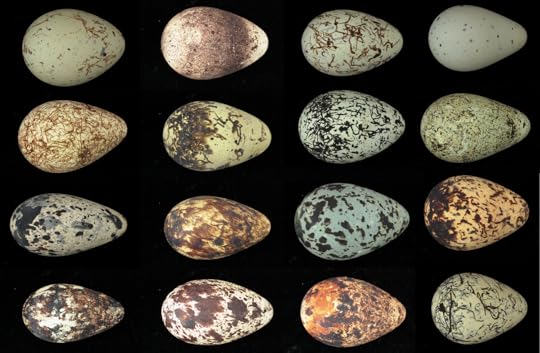
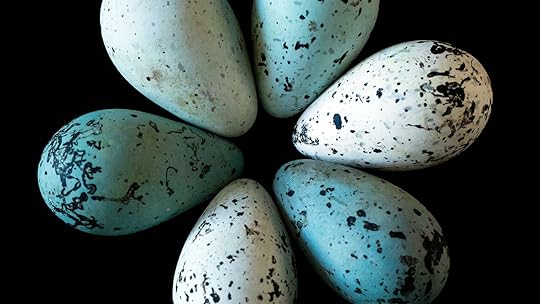
Birkhead writes in particular about the guillemot, a dark brown and white seabird in the auk family whose defining characteristic appears to be their predilection for spraying everything in their vicinity with foul smelling excrement. They also have pretty and variable eggs (seen above), which they also, not coincidentally, spray with foul smelling excrement.

Nicely written book with just the right amount of detail for a popular audience.
Profile Image for Tony Parsons.
4,156 reviews102 followers
February 25, 2016
When I was a kid I had every kind of collection imaginable: rocks, bugs, bird feathers, stamps, & a chemistry set.

We moved to 13 different states & I attended at least 23 different schools. At 1 time I could tell you about all of that. In my head, Books & no computer.
After a while, my biological dad said no more moving the rocks.

He was an avid big game hunter. I on the other hand was an avid bird hunter. They stand a 50/50 chance, Bambi there is no hope.

In the springtime, it was amazing to watch certain species of birds hatch out of their eggs on the ground or in their nests. Then the survival of the fittest took over.

The Audubon Society in New Orleans was my favorite.

I love to go to the zoo with my 2 granddaughters.

To this day I still love to admire the different species of birds.

I did not receive any type of compensation for reading & reviewing this book. While I receive free books from publishers & authors, I am under no obligation to write a positive review. Only an honest one.

A very awesome book cover, great font & writing style. A very well written book about birds. It was very easy for me to read/follow from start/finish & never a dull moment. There were no grammar/typo errors, nor any repetitive or out of line sequence sentences. Lots of exciting scenarios, with several twists/turns & a great set of unique characters to keep track of. This could also make another great educational movie on birds, a college PP presentation, or a mini TV series or even a documentary. Lots of interesting facts I had no clue about. A very easy rating of 5 stars.

Thank you for the free Goodreads; MakingConnections; Bloomsbury; ARC; paperback book
Tony Parsons MSW (Washburn)
106 reviews3 followers
August 4, 2016
I stumbled upon this book quite by accident: it was on the library shelf right next to a book I had already been on the lookout for. And I only picked it up because both my mom and I had had mama birds nesting with easy view this spring/summer (I had a robin, she had a cardinal) and had shared daily updates of the growing baby birds. And I am so glad I did, because I adored this little gem of a book.
The author, who has spent decades studying guillemots and their eggs, clearly both knows, and loves, both of them and can communicate these to a broad non-specialist audience. He can reach back hundreds of years to trace ornithology, and yet also describe an eggshell being created around the egg cell as akin to foam sprayers and spray paint.
An egg truly is nearly perfect. Strong enough to protect its contents from both larger predators and microscopic bacteria, and yet fragile enough for the chick to peck its way out. Needing to contain all the food and water the developing embryo needs, yet allowing the needed air to diffuse in as well. I am not looking at the eggs in my refrigerator the same way any more.
767 reviews2 followers
May 30, 2016
Birthed writes as though he were sitting in your living room, chatting.

Who has not thought that the blue of a robin's egg is just the prettiest color for an egg? But then one sees eggs of different species that are equally beautiful in color and/or in shape. Ever wonder what goes on inside the egg? What about before the egg becomes an egg and while it is becoming an egg?

This book explains the facts and conjectures past and present about how that chicken got into the egg. And a marvelous process it is. And has to be--I never before thought so deeply and widely about eggs. We take them for granted--and yet, they have to be tough to withstand weather and the buffets of colony living but soft enough for the chick to hatch. They have to let the chick breathe and yet keep out bacteria, fungi, viruses. Tough and tender, tough and vulnerable. Learn why we should care and worry about chickens and wild birds by studying their eggs.
Profile Image for Cheryl Dietr.
285 reviews4 followers
February 28, 2016
I don't like to eat eggs and I have had one too many freakish accidents involving bird poop but this book, well, it no longer made me want to chase the annoying seagulls on a sandy beach. This is in part because I learned so many interesting tidbits about some of these fabulous feathered creatures

This is the PERFECT book for the bird lover and those who like their eggs sunny side up. While Birkhead manages to make everything bird factual and interesting, at points his unbridled enthusiasm can get to be a bit much unless you are a lifetime member of the Audubon Society.

Save this one for when you really have the time to sit down and digest all the books intricacies, insight and information. From mating, to formation, to what is really going on inside that little perfect wonder; it will surely make you look at your breakfast in a slightly different way!

.
Profile Image for Rebecca.
4,189 reviews3,451 followers
May 27, 2018
If you’ve ever wondered why birds’ eggs come in such different sizes and patterns, this is the book for you: packed full of scientific detail, but written with the layman in mind. Birkhead has studied guillemots on Skomer Island for decades, so guillemots are his point of entry into the topic – specifically, why their eggs taper to a point. It’s not so they won’t roll off cliffs; that’s an urban myth, because the eggs can and do roll off cliffs all the time. But to find out the real reason you’ll have to read this all the way through (or skip to the epilogue).
Profile Image for Mark Walker.
517 reviews
February 16, 2019
Full of fascinating information. One of the best things about the book is that it poses lots of questions that the author doesn't have the answer to. It is an exercise in stimulating curiosity and speculating on the answers.
A good approach to structure the book by starting on the outside and working inside.
Profile Image for Katie.
8 reviews1 follower
January 5, 2025
I love birds. the beginning was a bit slow with the history of egg collecting and climbers, but once it got to the bio related info I was really hooked
Profile Image for Sayani.
121 reviews10 followers
March 16, 2023
If you live in the Tropical region of the world, chances are you have never seen a guillemot. At least not in its natural habitat. These sea birds reside in the North Pacific and North Atlantic regions often found in dense colonies on huge limestone cliffs. A common sight in places like Skomer, Wales, and Bempton cliffs in Yorkshire where the author takes us to observe guillemots and their unusual eggs.

Harvesting these eggs of various sizes and colors from cliffsides began around the late 1500s and by the 1920s-1930s, ‘climming’ was a notorious venture for collectors for creating cabinets of curiosities. The eggs were collected for human consumption and were also staples for natural history studies. The guillemot egg has an unusual pyriform shape, pointed at one end. It was falsely believed that since these birds do not form nests, the pointy eggs keep them from rolling off the cliffs since they roll in an arc. A professor at the University of Sheffield, the author has spent decades studying these birds. His publication from 2018 found that the pyriform eggs don’t roll in arcs naturally. The mystery of the shape continues.

The book contains chapters on the various stages of the formation of a bird egg from the creation of shells to coloring, roles of albumen and yolk, warding off microbes via shell pores, laying of the egg, incubation, and finally hatching.

Few things in nature are as flawless as a bird’s egg. Evolution has created ‘a self-contained life support system.’ It is hard enough to protect the embryo inside but weak enough for the chick to break through the shell. It has a shell surface that keeps the microbes out but at the same time allows the embryo inside to breathe. And the thickness of the shell is just right for the parent to incubate sitting atop them. Considering the number of bird species around the planet, natural selection was hard at work.

Consider the eggshell. The soft balloon-like egg inside a bird is actually sprayed with calcium carbonate as it travels through the uterus. As the aerosol sprays deposit calcium, tall pillars of calcite are formed all across the surface. There are spaces where these pillars don’t harden and leave empty spots which become the pores of the shell. How the number and size of the pores are determined in any species is still unknown. But the pores are essential for the survival of the embryo inside. All this happens within 24 hours. And where does all this calcium come from? Well, the birds have to feed on calcium-rich foods. Some birds forage for long hours just to make one egg. Many birds feed on snail shells. The calcium-sensing ability of birds is both innate and acquired. After reading this section, my respect for the batch of eggs in my pantry increased manifold.

How did climate change and industrialization affect birds and the survival of their eggs? Intensive agriculture led to the loss of woodlands, decreased soil quality, leaching of calcium, and reduction in the snail population. Acid rain further reduced the available calcium for foraging resulting in poor eggshell quality for birds like the Dutch great tits. Less calcium, more foraging, more energy expenditure, fewer eggs, tougher survival. On the other hand, intensive poultry is an altogether different ball game and has got me thinking about the overconsumption of eggs by humans.

The most engaging chapters are on the shape and color of eggs. Alfred Russel Wallace puzzled over the conspicuous coloring of bird eggs as an adaptive feature. Something Darwin never pondered over. Wallace surmised that since calcium carbonate is white, reptilian ancestors had white eggs (hello Jurassic Park movie scene.) Later eggs started acquiring colors to ward off predators via natural selection. But does that mean white eggs don’t have advantages of their own? They do. Experiments from the 1970s show that chicken and laughing gull eggs have lower internal temperatures showing that a white eggshell protects eggs from solar radiation. On the other hand, colored eggs are adaptive for camouflage and individual egg identification. Indeed, guillemots can identify their own eggs via their color patterns.

This enjoyable book is teeming with such interesting studies. We meet many naturalists, zoologists, oologists, and ingenious collectors throughout the book. Even though bird eggs have been studied for a long time questions remain. Did dinosaurs lay eggs in the open to be heated by the sun or did they participate in parental care? The debate continues. The book is a perfect case study of investing in bird conservation activities and engages the reader in appreciating the humble commonplace egg as an evolutionary miracle.
Profile Image for Richard Derus.
4,194 reviews2,266 followers
July 29, 2025
Real Rating: 4.5* of five

The Publisher Says: Renowned ornithologist Tim Birkhead opens this gripping story as a female guillemot chick hatches, already carrying her full quota of tiny eggs within her undeveloped ovary. As she grows into adulthood, only a few of her eggs mature, are released into the oviduct, and are fertilized by sperm stored from copulation that took place days or weeks earlier. Within a matter of hours, the fragile yolk is surrounded by albumen and the whole is gradually encased within a turquoise jewel of a shell. Soon afterward the fully formed egg is expelled onto a bare rocky ledge, where it will be incubated for four weeks before another chick emerges and the life cycle begins again.

The Most Perfect Thing is about how eggs in general are made, fertilized, developed, and hatched. The eggs of most birds spend just 24 hours in the oviduct; however, that journey takes 48 hours in cuckoos, which surreptitiously lay their eggs in the nests of other birds. From the earliest times, the study of birds' ovaries and ova (eggs) played a vital role in the quest to unravel the mysteries of fertilization and embryo development in humans. Birkhead uses birds' eggs as wondrous portals into natural history, enlivened by the stories of naturalists and scientists, including Birkhead and his students, whose discoveries have advanced current scientific knowledge of reproduction.

My Review: I thought "guillemot" was a Dr. Seuss name before I read this book. Author Birkhead disabused me of this with his praises sung for the aesthetics of their shells:


I mean pretty enough, but this guy's obsessed....

And eggs are perfect in so many different ways. They have to be, for birds lay and incubate in such incredible diversity of habitats and situations, from the poles to the tropics; in wet, dry, clean and microbe-infested conditions; in nests and without nests; warmed by body heat and without body heat. The shape, colour and size of eggs as well as the composition of their yolk and albumen all constitute the most extraordinary set of adaptations. The fact that birds' eggs also provided biologists with their first insights into human reproduction makes their story even more momentous.

He is not overselling the burden of his refrain. This is a fascinating look at what these dinosaur revenants do in the reproductive world (I got a new insult out of the read: I told one person I detest that she was an altricial birth to a precocial species) and what that has revealed to scientists in applicability to all others.

People's love of the beauty of eggs has led to some dark consequences. Egg collectors hunted their favorites to actual or functional extinction, inspiring the UK to pass pretty draconian laws against private ownership of the things...in 1954! Even *I* wasn't born then, and Rachel Carson's Silent Spring was still a love-offering in progress!

What you need to know most is: was it fun to read? I'll say yes, because I really like science and am not afraid of the dictionary. If you're not a science nut, maybe it won't delight you; maybe you'll have to look stuff up; and maybe that won't agree with you.

It agreed with me.
Profile Image for Nico Van Straalen.
155 reviews5 followers
July 20, 2019
Tim Birkhead has written the ultimate egg book. Everything there is to be written about shape, colour, laying and incubation of bird eggs, is written in this remarkable book, and written extremely well. I didn’t know the term existed – oology – but certainly Birkhead is the ultimate oologist including a remarkable rich knowledge of the history of egg studies. His passion for bird eggs and especially eggs of his beloved guillemot, a seabird breeding on the ledges of steep coastal cliffs, pervades this book from cover to cover. Guillemots are among the most vulnerable birds to suffer from oil pollution at sea and therefore deserve our attention. Yet a book like this comes with some professional comments, which I think it can stand. First, Birkhead is a Darwinist of the adaptationist type, restlessly seeking adaptations in every corner and showing disappointment when these are not to be found. The peculiar shape of guillemot eggs (oval but quite pointed to one end) is often explained as an adaptation to minimizing the likelihood of eggs falling from the ledge, however, this hypothesis is dismissed fiercely by Birkhead. His own explanation, related towards the end of the book, is even more a just-so story. Why can’t evolutionary ecologists find rest with neutral explanations? The answer to bird egg shape was given in a paper published after Birkhead’s book was first published (Caswell Stoddard, 2017, Science 356); a comparative analysis of 1400 bird eggs revealed that the shape of an egg is a consequence of the shape of the pelvis, which in itself is related to the mode of flying. Finally, the book is lacking any reference to oology's most important contribution to fundamental biology: embryonic development. We know all about organogenesis primarily from one the main model animals of developmental biology, chicken.
113 reviews5 followers
Read
July 11, 2021
Whereas Birkhead's other book, Promiscuity: An Evolutionary History of Sperm Competition, absolutely blew me out of the water, this book was not quite as fascinating. It still delivered on what it promised to set out, which is a scientific, historical, and aesthetic appreciation of eggs, or more specifically bird eggs, or more specifically guillemot (murre) eggs.

What is perhaps most interesting in this book is not any of the particulars about what eggs are and how they work, but rather the relative dearth of knowledge that we have of eggs, and au contraire the abundance of myths and misunderstandings that have propagated through the scientific record. Birkhead traces our understanding of eggs from the time of Aristotle, then taking a large leap to the late Renaissance and Age of Enlightenment, onward into the age of modernity where (lo and behold) many of the myths have remained, and many of the mysteries have remained unanswered.

If nothing else, one has to appreciate Birkhead's modesty and honesty. There are no fantabulous claims to be made in this book, and nary a statement which is not qualified and questioned in subsequent sentences or chapters. And nestled in this book—much as the albumen and yolk are nestled within the shell—is a history of science and knowledge itself, seen through the eyes of one of the most bewildering and surprisingly understudied aspects of life.
Displaying 1 - 30 of 84 reviews

Can't find what you're looking for?

Get help and learn more about the design.