Drawing on eyewitness accounts from both the RAF and the Luftwaffe, this is a compelling story of history in the making through an intensely fought battle, taking the reader into the heart of the action as told by those who fought and experienced it. The book not only captures the often savage reality of the air battles over the Channel and southern England, but it also traces the true course of the Battle of Britain as it unfolded between August 6th and September 15th, 1940 as the German and British Commanders made their fateful decisions, and Spitfires and Messerschmitts whirled and fought in the skies. It was in these six weeks that the fate of the war, and Britain, were to be decided. A classic account of one of the Second World War's most iconic battles, perfect for readers of Max Hastings or James Holland.
Richard Collier, was born in London, England in 1924. He joined the Royal Air Force at eighteen after that, as a war correspondent, he traveled throughout the Far East.
He worked on numerous British and American magazines and wrote more than half a dozen books about the Second World War.
Eagle Day: The Battle of Britain does not add much to the well-known history of that historic battle. What gets 5 Stars (an ace!) is the wide palette of war stories from combatants of both sides. These vignettes are priceless:
Oberleutnant Paul Temme is shot down on Eagle Day and is invited to breakfast with three different RAF and British Army units as they try to figure out where a POW should go and who is responsible for him. There is Miss Arlett's maid serving food: "Shall we have plums and custard for dessert--oh, and they're machine-gunning the back garden." An English farmer watches a Hurricane falling towards his farm, will all his family be killed? A Luftwaffe pilot and gunner adrift in the Channel overnight, reciting poetry to keep awake. British and German rescue seaplanes sitting close to each other in the Channel, neither bothering the other, each picking up survivors regardless of which side. The Luftwaffe pilot who parachutes into the outhouse "out of the shit into the shit"! The Polish RAF pilot shot down on 15 Sep 1940, looking at all the parachutes from the furious air battle, exclaims “They’ll think we are a parachute division!”
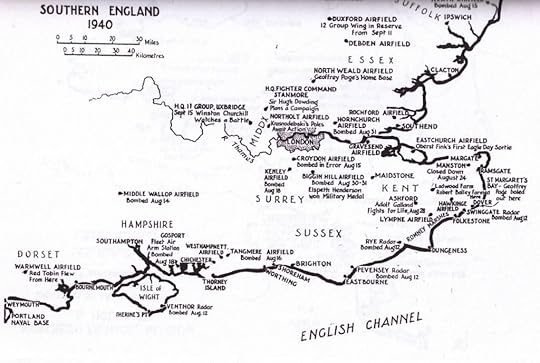
Two excellent maps at the back of the book make it easy to track the action. The chapters are pithy and loaded with action. It is one of the few books I have read that accurately portray air-to-air combat and all its terrors. You will meet individuals on both sides who suffer terrible physical and mental injury, yet go back to the fight as soon as they can. You will experience the battle in the words of those who were there. A WAAF plotter who wins the Military Medal for her actions when Biggin Hill control station is savaged by Luftwaffe bombers, pilots from many nations supporting the RAF, Luftwaffe pilots and crewmembers, an outstanding assembly of first-person narratives. One aspect stands out for me. It was a good thing the Luftwaffe was led by that fat pig Goering, “Der Dicke”, who sends so many to capture and death by his poor decisions. If someone like Galland had been in charge, the outcome would likely have been very different. At the end of the battle, both sides are exhausted but the German decision to concentrate on civilian targets and not on the RAF bases and factories gives needed respite to rebuild the RAF. After Sep 15, the battle is decided, even if not over.
Very highly recommended, history at its’ most exciting!
Absolutely the best book I have ever read on the Battle of Britain. I would give it ten stars if I could. There are so many first-hand stories, and Richard Collier makes everyone involved seem so real and human they are right in the room with you. From the youngest, haughtiest German ace, to the oldest, most rugged English farmer, all the players in the great drama come to magnificent life.
I wish the book had gone on longer, or that he had written a second volume on the London Blitz. I also wish he had given a larger strategic picture and paid more attention to the mistakes the German air commanders made, and why they lost the battle. (Though the unforgettable picture of Herman Goering, lost in a fantasy world in his decadent mansion, is explanation enough.) But this is truly an incredible work of history.
I just wish the copy I got out of the junk pile at my new library job hadn't been fifty years old and falling to pieces!
There were so many battles in the Second World War that it is hard to justify the labeling of any single one as existential. Yet, the Battle of Britain or the air war over Britain in late 1940 was truly existential for the British Empire. For if the German air forces had been able to gain control of the air over the British coast facing France, the Germans could have launched an invasion. People look back at the Allied invasion of Normandy with the massive force used to storm the beaches and think that the Germans would have had to use similar force to invade Britain. However, the defending Germans were well armed and fortified, In 1940, the British coast was not. Some areas were defended by little more than pitchforks, hunting shotguns and stout sticks. Even with their limited naval means, the Germans could have made a strong run at it. One very important point repeatedly made in this book is that the aerial Battle of Britain was one of attrition. The pilots of both sides flew to the point of exhaustion and the majority were put out of action. At the end, it was the tactical error by the Germans to end the bombing of airfields and airplane factories and bomb cities instead that led to their defeat. The British reached the point where they were putting pilots into the air to combat the Germans that had only two weeks of training and no combat experience. Written with an emphasis on the lives and actions of the pilots on both sides, this book gives the credit where it is due. To the brave men that shook off terror and fatigue to launch themselves skyward in what was a repeated battle to the death. If you want to know the battle from the perspective of the boots in the sky, this book is one you must read.
First published in 1966, but revised with much amended illustrations in this 1980 edition, 'Eagle Day - The Battle of Britain' tells the story of this famous air battle through the personal anecdotes of many who took part. These anecdotes are what makes the book so good, and explains why they have been quoted from on so many subsequent accounts since. The illustrations that have been allegedly improved on so much since the original printing are a bit of a mixed bunch - poor copies of good photos with excellent captioning. If you are interested in the Battle of Britain, then this one has to be on your 'to read' list.
I'm guessing this book is worthy of more than 3 stars, but I had a bit of a difficult time following along.
It really is praise-worthy, following stories of pilots and support personnel from both sides of the Battle of Britain, and there were very specific stories that stood out: Red Tobin's terrifying description of his first air combat; a german pilot's capture in which his captors took him to 3 differ breakfasts on the same morning; Mr. Page's sad description of his learning of the horrifying burns he suffered when he was shot down; and Ms. Esbeth Henderson's work tracking incoming german attack formations.
This is an amazing read. It was my first of any sort on the Battle of Britain. In hindsight I’d have benefited from 1st reading a fuller history of the details of the whole battle. Eagle Day contains a fair amount of that, but is mainly an exceptional collection of first-hand accounts of those who flee and those on the ground below, covering both sides (though far more of the Brits than Germans) of things.
I loved this book, and it will inform my future reading very well.
One of the older Battle of Britain books and many very good ones have been written since,but this holds up as one of the best due to the narrative style and the sheer number of dramatic first hand accounts from both sides. I first read this many years ago and I have dipped into it many times since. If you only read one book on the Battle, this wont give you all the strategy but it will convey the action and the drama as well as any.
brilliant as ever in the same way as are his books 1940 the world in flames and 1941. Written from memoirs, govt papers, newspaper reports,autobiographies any corroborating resource this is yet another,easily readable, comic, tragic , sobering and neutral account of the war in the air above the south east in late summer and early autumn 1940. Every day is Remembrance Day
A fitting tribute to the defenders of Britain, their determination, heroism, professionalism, dedication and quite remarkable endurance. There are many examples of individual experiences not just on the British side but the German too. Description of air battles is exceptional. Highly recommended.
The blurb about the author says he was a Daily Mail feature writer and it shows in the florid style this book is written in. The Hardest Day by Alfred Price is a much better snapshot of the Battle of Britain.
A good read but I think it should be clarified that this book is less about the Battle of Britain and more about the experiences of men and women throughout the ordeal. However, I will applaud the book for how well-researched it is.
One of the really good books. Very well written and detailed. Up there with Anthony Beavor and Max Hastings. I couldn't put it down - and I have a lot of similar.
Marvelous day by day, person by person accounts of the Battle of Britain. Vignettes of flyers, commanders, ground crew and civilians lend detail and immediacy to the story. By including the actions and words of Allies and Germans involved in the fight it reaches a powerful level of authenticity.
Many first person accounts of various air battles and life on the ground during the crucial six weeks of the Battle of Britain. Good impression of what it was like during the chaos!
A gripping and fast moving account of the Battle of Britain from 8 August to 15 September 1940. First published in 1966 it has stood the test of time. It reads like a fast-paced novel, although it is based on over 400 eye-witness accounts; of course, many participants from both sides of the Channel were very much alive in the early 1960s. Whilst there is much heroism and chivalry, it does not shy away from the darker side of the battle, with cruelty and stupidity aplenty. I am not an air war enthusiast, but I found this to be an excellent account of a battle that I have otherwise only known at a superficial level.
Great storytelling in this book, but the writing style sometimes made it hard to follow. I enjoyed many of the characters in the story. I also enjoyed the story being told equally from both German and British perspectives.