As Peanuts hits the mid-'80s, Charles M. Schulz hilariously satirizes the rampant consumerism and litigious nature of the era. This volume of The Complete Peanuts reaches the middle of the go-go 1980 a time of "mallies" (mallgoers), "punkers" (behold the sight of Snoopy with a mohawk), and endless litigation about the most trivial matters. Also in this Peppermint Patty wins her school's essay contest, but snatches defeat from the jaws of victory with a disastrous acceptance speech; Lucy talks Charlie Brown into posing for their school's "Swimsuit issue"; Snoopy accidentally destroys his doghouse with a cannon; Sally gives Santa Claus a heart attack (literally!); and Snoopy's brother Spike pops up in various deadpan vignettes set in the desert. The Complete Peanuts is the publishing project that launched a renaissance in comic strip publishing and the only place Charles M. Schulz's classic has ever been collected in its entirety. Featuring impeccable production values, each volume of this series features two successive years of newspaper strips (dailies and Sundays), plus bonus material such as celebrity introductions, interviews, and a brief biography of Schulz himself. Black-and-white illustrations throughout
Charles Monroe Schulz was an American cartoonist, whose comic strip Peanuts proved one of the most popular and influential in the history of the medium, and is still widely reprinted on a daily basis. Schulz's first regular cartoons, Li'l Folks, were published from 1947 to 1950 by the St. Paul Pioneer Press; he first used the name Charlie Brown for a character there, although he applied the name in four gags to three different boys and one buried in sand. The series also had a dog that looked much like Snoopy. In 1948, Schulz sold a cartoon to The Saturday Evening Post; the first of 17 single-panel cartoons by Schulz that would be published there. In 1948, Schulz tried to have Li'l Folks syndicated through the Newspaper Enterprise Association. Schulz would have been an independent contractor for the syndicate, unheard of in the 1940s, but the deal fell through. Li'l Folks was dropped from the Pioneer Press in January, 1950. Later that year, Schulz approached the United Feature Syndicate with his best strips from Li'l Folks, and Peanuts made its first appearance on October 2, 1950. The strip became one of the most popular comic strips of all time. He also had a short-lived sports-oriented comic strip called It's Only a Game (1957–1959), but he abandoned it due to the demands of the successful Peanuts. From 1956 to 1965 he contributed a single-panel strip ("Young Pillars") featuring teenagers to Youth, a publication associated with the Church of God. Peanuts ran for nearly 50 years, almost without interruption; during the life of the strip, Schulz took only one vacation, a five-week break in late 1997. At its peak, Peanuts appeared in more than 2,600 newspapers in 75 countries. Schulz stated that his routine every morning consisted of eating a jelly donut and sitting down to write the day's strip. After coming up with an idea (which he said could take anywhere from a few minutes to a few hours), he began drawing it, which took about an hour for dailies and three hours for Sunday strips. He stubbornly refused to hire an inker or letterer, saying that "it would be equivalent to a golfer hiring a man to make his putts for him." In November 1999 Schulz suffered a stroke, and later it was discovered that he had colon cancer that had metastasized. Because of the chemotherapy and the fact he could not read or see clearly, he announced his retirement on December 14, 1999. Schulz often touched on religious themes in his work, including the classic television cartoon, A Charlie Brown Christmas (1965), which features the character Linus van Pelt quoting the King James Version of the Bible Luke 2:8-14 to explain "what Christmas is all about." In personal interviews Schulz mentioned that Linus represented his spiritual side. Schulz, reared in the Lutheran faith, had been active in the Church of God as a young adult and then later taught Sunday school at a United Methodist Church. In the 1960s, Robert L. Short interpreted certain themes and conversations in Peanuts as being consistent with parts of Christian theology, and used them as illustrations during his lectures about the gospel, as he explained in his bestselling paperback book, The Gospel According to Peanuts, the first of several books he wrote on religion and Peanuts, and other popular culture items. From the late 1980s, however, Schulz described himself in interviews as a "secular humanist": “I do not go to church anymore... I guess you might say I've come around to secular humanism, an obligation I believe all humans have to others and the world we live in.”
*Snoopy typing*: "Dear Sweetheart, I miss you morning, noon and night." Lucy: "That's too vague... When you write to a girl, you have to be more specific..." *Snoopy typing*: "I miss you at 8:15, 11:45 and 9:36..."
I am a Peanuts fanatic and have been for as long as I can remember (I'm 46 now). Before Fnatagraphics started putting out these "Complete" collections, I would buy every Peanuts paperback I could find and, when I could afford them, every hardback. On my shelf, I still have over a hundred paperbacks, even though most of the strips in them have been covered in these Complete collections.
I keep those old books for nostalgia's sake--they provided me with a lot of laughs and inspiration in my school years--but these Fantagraphics collections are spectacular. The lines are so crisp and--unlike my oldest paperbacks--the pages are yellowed and crumbling. I just wish the Sunday strips were in color, but even that little quibble is not enough to knock off a star.
In the early volumes of this series, there were many strips that had never been published in book form, so it was a delight to read so many "new" strips (to me, anyway). As the years have gone on, more and more of the strips have been ones I either already had in a book, or had seen "live" when they first appeared. Still, the series has been great because of a] the beautiful print and b] it's a chance to see the strips in their original order. Plus, often, my paperbacks would have one of Schulz's two week story arcs but would, for some reason, leave out one or two strips. It's nice to see those strips back in place--like watching the extended scenes on a favorite movie.
So I was very surprised to find a two week arc I didn't remember ever seeing before. It was from July of 1986--so I guessed I missed it as I was working in Farmington, NM, that summer and didn't often see the newspaper. In the story, the Peanuts gang is sent off to summer camp, except that instead of their usual camp of swim races and baseball games, they are given camo outfits as they try to navigate survival camp. The strip for July 10 made me laugh out loud just because of the surreal absurdity of Snoopy reading a bulletin board and thinking (Snoopy doesn't talk, remember), "'Bayonet Drill - One O'clock' .. I think I'll skip that one."
The strip for January 2, 1986 may be my all-time favorite Peanuts strip (if I could even name a single strip as favorite). I won't spoil the punchline, so go read it for yourself!
Snoopy (writing his novel): It was a dark and stormy night. Lucy (reads it): You know what's wrong with your stories? Lucy: They lack subtlety Snoopy (corrected it): It was a sort of dark and kind of stormy night.
If I didn’t give Snoopy & the Li’l Folks five stars, you’d know I’ve been kidnapped & sending a distress signal. This particular time shot—mid 80s—brings us aerobics and lawyer Snoopy. We find out Charlie & Sally Brown’s dad is a barber. Linus’s baby brother starts wearing a helmet while riding on the back of his mother’s bike, and a new annoying loud gal Tapioca Pudding is introduced & all she cares about is branding herself & being a face seen everywhere: greeting cards, lunchboxes, and tv. Seriously and sadly, and all the more obvious when you read the two years together, is Spike, Snoopy’s brother who lives in the desert: that dog has issues and is an existentially disquieting character. To end on a high note, Sally emeges—for the first time ever for me—as my favorite character of the strip. She is by far the funniest and is ultimately a far more astute philosopher than even her Sweet Baboo.
Spike features relatively heavily with fun and games with cacti, Snoopy is still trying to write his dark and stormy novel, new character Tapioca Pudding has me wanting tapioca pudding (although I always preferred sago pudding), the summer camp is a survivor camp and what has happened to the disappearing candy canes?
Snoopy’s brother Spike remains a weak link and Tapioca Pudding is beyond doubt a character experiment gone badly wrong. Desert strips and pointless riffs notwithstanding, Schulz crosses the mid-80s with vigour, sharing his attention amongst old favourites and tapping rich new veins.
Okay. I have to stop being surprised that these later years Peanuts anthologies are good in and of themselves, not mere ghosts of earlier days in Charles Schulz’s half-century career. This volume, the 18th in the series, even has Spike on the cover, one of Schulz’s least interesting characters. Yet, I quite enjoyed it. Lucy tells Charlie Brown he expects too much of his team. “After all, we’re not professionals! We’re only…” She' stumped for a word. “Only what?” asks Charlie Brown. “What’s below amateur?” Peppermint Patty finds her own special way of expressing her love for Charlie after he answers her question, do you think I’m dumb by saying, “No, not at all…Actually I think you’re very smart.” Patty, smitten anew, says earnestly, “Sometimes I wish I couldn’t strike you out on three straight pitches.”
Despite Charlie Brown’s opinion Patty piles up her D minuses—and when she gets 100% on a spelling test, her teacher tells her to fill out an accident report. Linus, Sally and Snoopy find themselves in a survivalist camp. Sally is told she will have to learn to go without eating and that some survivalists have gone days without food. “I once went a half hour without carrot cake,” she replies. How long does it take to mend a broken heart? After the WWI Flying Ace gets a Dear John letter saying his girlfriend is going to marry his cousin (“Good luck with the war,” the letter concludes), the Flying Ace discovers broken hearts only last as long as it takes to wolf 14 doughnuts. Charlie Brown’s hapless team never has one of its losing baseball games rained out but his love life does endure a rain out when a sudden deluge drowns the opportunity to finally go talk to the Little Red-Headed Girl. As fellow Minnesotan Bob Dylan once sang, “It’s life and life only.” But charming, funny and frequently touching.
Not the most compelling volume in this series. One obscure character surfaces (Tapioca Pudding), but other than that there aren't many distinguishing features about this one. Very few of the strips have the mini-storylines of previous decades, and Schulz seems to be relying more on gags—although the gags aren't bad! Molly Volley makes a brief return—I love her scowling face! This volume doesn't scream the 80s like previous volumes screamed their eras (especially the 70s), but references to the 1984 Los Angeles Olympics, answering machines, the rise of litigious America, and "Refrigerator" Perry the football player are referenced. Perhaps it's because I was reading "Peanuts" by this time, but this volume seems to give me a familiar feeling, like the Peanuts I know. If you're reading the series in order, of course you'll need to read this—if not, I can think of other volumes that are perhaps more worthy of your time.
Schulz, now thirty five years into his run, is in great form during this period - he's genuinely funny with frequency and he doesn't run any particular bit into the ground, something of a relief after his seeming obsession with Peppermint Patty's penchant for getting D minuses in the two previous volumes. That's still pops up here, but not with quite the same frequency.
And for Pigpen and Violet watchers, there's a brief appearance by each. Shermie, though, never graces these pages.
So since you don't need me telling you how great Peanuts is (because you already know) instead of writing a review, I always share my favorite strip from the collection.
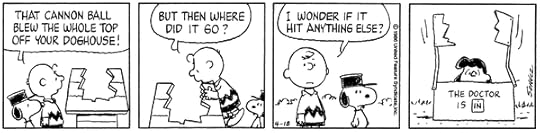
This volume's strip is from April 18, 1986 and requires a bit of setup. In the April 14, 1986 strip, Snoopy and the birds (Woodstock, et al) are pretending that they are going to fire a cannon on Fort Zinderneuf, except somehow they have gotten their hands on a real cannon and in the following day's strip it is fired and ends up revealing that the cannonball tore a chunk out of Snoopy's doghouse. Of course, a cannonball has momentum and isn't going to be stopped by a wooden doghouse, so Charlie Brown wonders what else got hit. Eventually (on April 19th) it is revealed that the cannonball stopped on top of Schroeder's piano, but it is the April 18th strip where Charlie Brown's musings are at their most comical:
I think the look on the usually cocksure Lucy's face as she hides behind the stand is absolutely classic and laugh out loud funny. Just another indication of Schulz's understated genius when producing Peanuts.
One other small aside about this volume--the introduction was penned by the person who I think is the funniest human on planet Earth--Patton Oswalt. Unfortunately, the introduction feels rushed and is not indicative of Oswalt's best work. Perhaps Patton felt that nothing he would say would accentuate the experience of reading yet another volume of The Complete Peanuts but after the excellent job Robert Smigel did in his introduction to the 1975-1976 edition I feel like Patton could have said so much more. It's a minor complaint but given my love of Patton's work, I think my view of this is understandable.
After a short discussion with my friend Ross over the previous volume, I went into this one with a different attitude, which just goes to my understanding that much of my reaction to a book has as much to do with my state of mind and reading approach as it does with the quality of the book itself. In this case, I found myself enjoying this volume, and even laughing out loud a fair number of times. Schulz has a gentle sense of humor and he makes his characters so familiar and comforting even as they suffer the minor insults of life. The only real downside of this book was the new character Tapioca Pudding with her one note, persistently annoying screed. Everything else was pleasant and soothing, and gave the appearance of subtly reflecting Schulz's own adjustments towards a changing world.
Well, there are certainly some funny strips here, but 1980s Peanuts often seemed rudderless, and this volume is no exception. Schulz does not seem on top of his game--he even repeats one gag within a few months of its previous appearance. He tries out a couple of new characters, but none of them stand out, and as far as I know, none of them became mainstays, except perhaps Snoopy's lawyer persona. Still, mediocre Schulz is still pretty entertaining.
It’s the mid-80s and the last strips before the decline in quality, marked by the end of the 4-picture format. The tone of the strips is gradually changing, it’s easiest to see in Snoopy’s behaviour, soon he becomes obsessed with cookies and sleeping in Charlie Brown’s lap. The quality of Peanuts was always high compared to other strips, but compared to itself, this is just before the downfall began.
(3.5 stars) Perhaps Schultz was starting lose a little of his fastball in the strip and he was tied up more in commercial actions. However, a weaker Peanuts era is still stronger than 90% of whatever else is out there. Still amusing, even as Snoopy has long emerged as the dominant character. Always like Spike, so he is a factor here. Still, always worth a read.
The Tapioca Pudding joke wasn't funny from the beginning and gets far too many strips. Though they're always pretty much the same, the several Spike gags mixed throughout are pretty good. The rest is the gang as usual.
This issue introduces a new girl in school, Tapioca Pudding (her dad's in licensing, you know). Much more of Spike, Snoopy and his troop do a lot of hiking, and Marcie and Peppermint Patty go to a bunch of concerts.
It's really quite a remarkable feat that 35 years into this daily strip (that's everyday including sunday) Mr. Schulz can still find new ways to keep these characters funny and fresh. And there's still 15 years to go.
It is another fun Peanuts collection. There are a lot of Spike-focused strips in this collection. I would also add that Peppermint Patty is also getting a lot more focus in the 1980s strips. My favorite strips are the ones that focus on Charlie Brown, Woodstock, and Snoopy.
Of course it is 5 stars. All of the "Complete Peanuts" are 5 stars, though Patton Oswalt should probably stick to stand up and lay off writing introductions.
In a mid-'80s taste of things to come, some of the gang go to a shady "survival camp." A one-off character named Tapioca Pudding hints at Schulz's views on licensing and merchandising.
Sally being concerned about the health of a Santa Claus and causing him a heart attack is one of the funniest, saddest, darkest and most realistic storylines.
Another good but not great collection of 1980s Peanuts strips. There aren't very many laugh out loud moments anymore. The pure snark of the early years is pretty much gone. But the gags still make you grin more often than not.
Some notes all over the place:
Peppermint Patty and Marcie attend a lot of music concerts. With the current state of music and arts in many public schools this really stands out. However, it also highlights that the only character that plays an instrument is Schroeder.
It felt like Spike showed up with alarming regularity but flipping back through the book I don't see him actually popping up too often so I guess it's just my negative perception of the character that makes his strips stand out. I can't help but feel I've seen the basketball one (November 16, 1986) before.
Some of the old classic standbys, such as the annual Great Pumpkin gag, feel a bit like they were included because they were expected not because Schulz really wanted to write them. And many of the holidays aren't given much special treatment, a far cry from the golden era that produced all the holiday TV specials. On the other hand some of the baseball strips in this volume are the best. The baseball team's "trick play" was particularly hilarious (March 21, 1986).
Tapioca Pudding felt like a one-shot character who keeps returning with the exact same joke. I understand she's a stand-in for some commentary on consumer culture but sheesh I was done with her after the first week. I can just hear the exasperation in Linus' voice when he replies "I know" to Tapioca's introduction every strip. The lack of good social commentary really feels like a letdown after the older Peanuts collections, but I suppose the 1980s were a different era than the 1960s and 1970s.
In the second half of 1986 there's a fair number of strips that end with the punchline being one of the characters saying "whatever." This feels out of place in the Peanuts universe. I wonder if this was the advent of that usage of "whatever" so the novelty just isn't there like it would have been in 1986. There are several other instances where I think the strip's gag isn't funny because it must rely on some knowledge of the mid-1980s that I don't posses (e.g. "Hum baby!" from November 1, 1986 apparently is related to the San Fransisco Giants).
There's a couple long running stories but they aren't particularly interesting, including the WWI Flying Ace catching the flu and Lucy signing up the gang for "survival camp." One story I wish got developed more was Marcie and Patty debating the femininity of football. Marcie doesn't think she should play the game because it isn't feminine enough while Patty obviously wants to play. This felt like it could have been mined much more than the four strips (October 14-17, 1986) it got, especially since two of the strips use the aforementioned "whatever" gag.
It's often evident how much influence Peanuts must have been on Bill Watterson. Even simple stuff like Snoopy crashing his sled (January 19, 1986) are extremely reminiscent (or rather, predictive) of Calvin and Hobbes.
It's a shame to see a transcendent comic strip declining but it still started so high that even its declining years are more entertaining than many other comic strips in their prime.