

What do you think?

Krieg
Fast paced Astra Millitarum story focussing on the troops of the Death Korps of Krieg.
Krieg is a dead world.
Fifteen hundred years ago, it declared its independence from the Imperium of Man, and paid the price. One loyal soul defied its treacherous rulers, and laid the world to waste. From these ashes emerged a unique fighting force, forged and tempered in nuclear fire…
Today, the Death Korps of Krieg lay siege to a captured hive city on the outskirts of the system-spanning Octarius War, in a desperate attempt to secure the cordon that stops untold masses of orks and tyranids from spilling out into the Imperium at large. The Korpsmen are relentless, ruthless, implacable and unstoppable, even in the face of a war that seems unwinnable. How far will they go to achieve victory, and is history doomed to repeat itself?
Krieg is a dead world.
Fifteen hundred years ago, it declared its independence from the Imperium of Man, and paid the price. One loyal soul defied its treacherous rulers, and laid the world to waste. From these ashes emerged a unique fighting force, forged and tempered in nuclear fire…
Today, the Death Korps of Krieg lay siege to a captured hive city on the outskirts of the system-spanning Octarius War, in a desperate attempt to secure the cordon that stops untold masses of orks and tyranids from spilling out into the Imperium at large. The Korpsmen are relentless, ruthless, implacable and unstoppable, even in the face of a war that seems unwinnable. How far will they go to achieve victory, and is history doomed to repeat itself?
304 pages, Paperback
First published January 29, 2022
About the author
Steve Lyons
193 books118 followersSteve Lyons is a science fiction writer, best known for writing television tie-ins of Doctor Who for BBC Books, and previously, Virgin. The earliest of these was Conundrum in 1994, and his most recent was 2005's The Stealers of Dreams. He has also written material for Star Trek tie-ins, as well as original work.
Ratings & Reviews
Friends & Following
Create a free account to discover what your friends think of this book!
Community Reviews
Displaying 1 - 30 of 239 reviews

February 14, 2022
Several BL books of late have weighed up weighty moral issues and the psychological implications of life in a society wholly devoted to eternal, grinding war. Krieg holds it’s own in such company. As you might expect from the faction this lacks the tales of camaraderie in the face of adversity that typifies much Astra Militarum fiction, but this leaves room for a really interesting story about sacrifice, both personal and social.
The book consists of two narratives, one set in the ‘past’ and covering the key events of Krieg Civil War, and one in the post-rift ‘present’ where the DKoK are deployed alongside a Cadian regiment and some Inquisitoral forces in a war against Orks and a surprising number of Squigs. Of the two threads, I’d say that the one concerning the Civil War is more engaging as the conflict escalates and genuinely difficult decisions seem to be agonised over; the contemporary scenes lack the same levels of moral ambiguity and in the face of Xenos invaders the Imperium’s actions are not deliberated over to the same extent. The Krieg-set chapters also feel grander in scope; we see many theatres of conflict and get different perspectives, whilst Ork perspectives are sadly absent- these can be really fun to read so would have added to my enjoyment.
Krieg is a really solid 40K novel, one that contains enough deep lore dives and genuinely tense action scenes as well as emotional and moral conflict to satisfy most readers. The only sour note in the book for me is an (unintentional?) allusion to the infamous 14 words; the moral ambiguity of the characters and situation in which this is made just made me a little uncomfortable; tying in fictional repugnant actions to real-world repugnant ones that a significant number of people support is perhaps a little too nuanced for tie-in fiction to handle. The Imperium of Man is already a totalitarian fascistic horror, it doesn’t need ambiguous dogwhistle phrases to emphasise this. Or maybe I read far too much into it.
The book consists of two narratives, one set in the ‘past’ and covering the key events of Krieg Civil War, and one in the post-rift ‘present’ where the DKoK are deployed alongside a Cadian regiment and some Inquisitoral forces in a war against Orks and a surprising number of Squigs. Of the two threads, I’d say that the one concerning the Civil War is more engaging as the conflict escalates and genuinely difficult decisions seem to be agonised over; the contemporary scenes lack the same levels of moral ambiguity and in the face of Xenos invaders the Imperium’s actions are not deliberated over to the same extent. The Krieg-set chapters also feel grander in scope; we see many theatres of conflict and get different perspectives, whilst Ork perspectives are sadly absent- these can be really fun to read so would have added to my enjoyment.
Krieg is a really solid 40K novel, one that contains enough deep lore dives and genuinely tense action scenes as well as emotional and moral conflict to satisfy most readers. The only sour note in the book for me is an (unintentional?) allusion to the infamous 14 words; the moral ambiguity of the characters and situation in which this is made just made me a little uncomfortable; tying in fictional repugnant actions to real-world repugnant ones that a significant number of people support is perhaps a little too nuanced for tie-in fiction to handle. The Imperium of Man is already a totalitarian fascistic horror, it doesn’t need ambiguous dogwhistle phrases to emphasise this. Or maybe I read far too much into it.

November 3, 2024
You know how I love reading stories featuring our favorite shovel boys, right? But the problem with reading a full-length novel named Krieg, despite the solid lore and action, is just how morose it seems to get.
Who knew, reading about an irradiated planet full of religion fueled child soldiers who venerate a cult of suicide can be so depressing; go figure.
For context, the infamous Death Korps of Krieg are a regimental army hailing from the death world of, you guessed it, Krieg. Hailing from a world where horrendous nuclear fallout had turned the surface into a frozen, dark, irradiated wasteland where nothing can survive, the Kriegsman carried a great burden. Of treason and betrayal against the emperor, by their ancestor some millennia ago.
Even after the loyalist factions won, and rejoined the imperium, their subsequent generations were forever scarred and changed due to what they see as this ultimate treachery. For context, if asked who the greater traitor is, the Arch vile Horus himself, or the counsel of Autocrats who seceded their planet from the Imperium, your average Kriegsman would reply without missing a beat, their own traitorous leaders. Such deeply ingrained is the collective generational hatred against those they saw as responsible for leading them away from the light of the Emperor.
Unfortunately for Krieg, everything from their day-to-day life, survival, conduct and battlefield tactics were shaped, in part due to their hostile planet, and in part their hatred.
You would often see online in meme circles, how the Krieg armies are renowned for two things: their unparalleled siege tactics, and their suicidal charges with utter disregards to their own life. The latter is partially true.
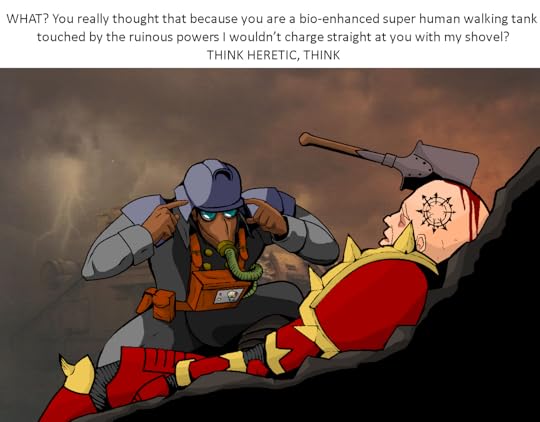
Yes, the Krieg regiments on average have a disturbingly high number of casualties and turnover. And yes, they see their lives as ultimately expendable in service to the emperor. But that doesn’t exactly make them suicidal.
The soldiers of Krieg are pragmatic, disciplined and with an unhealthy amount of fatalism. They view themselves as tools, no different from the guns they carry or the bullets within them. Resources to be spent for the glory of the Emperor. So, in the battlefield, their commanders always formulate how most efficiently their human resources can be expended to defeat the enemy.
If a particularly tough enemy can be defeated by sacrificing 1000 of their rank, they would do so, no question, no fear, no doubt. For each of them know, by expanding those 1000 lives, they might be saving many more. On the other hand, if the same enemy can be defeated using just 500 soldiers, by incorporating a different, more efficient tactic, they would prefer that. For the lives of a Krieg soldier is a resource to be consumed, not to be merely wasted. But if the objectives require that tens of thousands of them need to be sacrificed in what is ultimately a failed suicide charges, that too would be acceptable for them.
Whatever humanity and empathy they have, is either wiped out, or suppressed deep within their psyche, after generations of indoctrination. And what you’re left with, are an army full of unfeeling, uncaring, unerring machines like soldiers, who tank losses like nobody's business, and whose ferocity in attack is enough to give pause to even the conflict loving Orks.
This story, Krieg, by Steve Lyons, explores in essence this dehumanization of arguably normal people, shaped through collective trauma, suffering and war, into entities whose only purpose is war and glorious death. And Lyons, with this and his previous short story, ‘ Down Amongst the Dead Men’ has showcased he has a deft handle in exploring this particular form of fatalism endemic to Krieg.
The narrative is split into two time periods. One set during the golden period of Krieg, where treachery and sedition laid the ground for what would be the ultimate fate of the planet. And another set after the fall of Cadia, with the now ubiquitous Krieg regiments engaged in pitched battle across the deadliest battlefields across the galaxy. There are also appearances by the Cadian Shock troops and a couple of Inquisitors from the Ordo Hereticus. But their presence is largely as a proof for the audience into the functioning of your standard Krieg regimen.
Alternating each chapter, between the past and present narratives, we get a neat parallel to the decisions that shaped the people of the planet for the near future, as well as how they act and are perceived in the current era.
Or particular note, is the dramatization of Colonel Jurgen, the hero of Krieg, arguably the man who through his actions is single handedly responsible for how the people turned out; for better or worse. Even when you know the final outcome, seeing the story unfold through his eyes puts into perspective the weight and enormity of the decisions in face of insurmountable circumstances. Just from his narrative standpoint, the story might as well have been titled as ‘The Tragedy of Krieg’.
While largely sticking to the action format that the genre is famous for, the whole plot revolves around the Imperium trying to retake an Ork infested hive world, the setting serves as a backdrop almost, for a character study of Krieg as a whole.
It enlightens you in regard to the essence of their war doctrine, in fact their entire doctrine to life and death, while removing several misconceptions one might have about the group. For example, despite how they come across, with their gas masks, WWI era Prussian aesthetic, complete with pointy helmets, your average Krieg soldier is perfectly polite when it comes to dealing with their non-Krieg colleagues. They follow the rules, obey all orders, regardless of how dangerous, and even reply to your queries with courtesy. Just don’t ask them to remove their gas masks, which at this point have become like a second skin to them.
Little needs to be said in regard to their valor in battle. They don't fear, don’t falter, never buckle under pressure, never dip in morale. And even at the cost of their collective lives, will complete the mission objective.
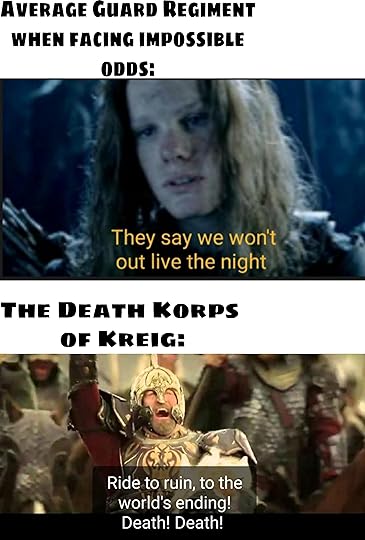
One fun tidbit, originating from anecdotes and lore, is in regard to their relationship with Imperial Commissars. You know, those Soviet inspired battlefield slave drivers, who give your average soldier a choice, death by enemy, or death by commissar. Well, in normal guard regiments, the attached Commissars job is to whip up morale, and to make sure your average rank and file charge with reckless abandon, against tyranids, chaos, orks, whatnot. But in Soviet Russia, I mean the Death Korps of Krieg, the Commissar gets shot for being not ruthless enough. Truly, they are there just to make sure that the morale of the Kriegsman is not too high, and also to reign them in, not to engage in suicidal charges.
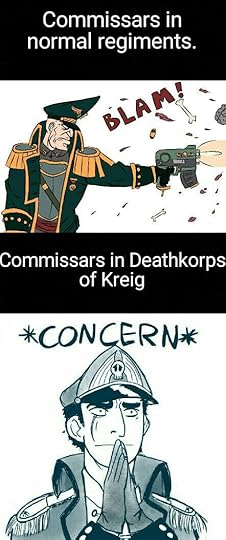
The story shares this whole fatalistic ambience as if nothing that you do would amount to anything significant. But while to your average person, this can soon devolve into nihilism, for the soldiers of Kreig they just accept this as reality and do their duty. Sadly, this is not because of some stoic sense of peace, rather because they lack a particular sense of self, and to them, death, in line of duty is a forgone conclusion.
They represent a corrupted tragic iteration of what Lord Krishna told Arjuna. To perform your duty selflessly and righteously, without attachment to the results, and to trust in the divine will.
Who knew, reading about an irradiated planet full of religion fueled child soldiers who venerate a cult of suicide can be so depressing; go figure.
For context, the infamous Death Korps of Krieg are a regimental army hailing from the death world of, you guessed it, Krieg. Hailing from a world where horrendous nuclear fallout had turned the surface into a frozen, dark, irradiated wasteland where nothing can survive, the Kriegsman carried a great burden. Of treason and betrayal against the emperor, by their ancestor some millennia ago.
Even after the loyalist factions won, and rejoined the imperium, their subsequent generations were forever scarred and changed due to what they see as this ultimate treachery. For context, if asked who the greater traitor is, the Arch vile Horus himself, or the counsel of Autocrats who seceded their planet from the Imperium, your average Kriegsman would reply without missing a beat, their own traitorous leaders. Such deeply ingrained is the collective generational hatred against those they saw as responsible for leading them away from the light of the Emperor.
Unfortunately for Krieg, everything from their day-to-day life, survival, conduct and battlefield tactics were shaped, in part due to their hostile planet, and in part their hatred.
You would often see online in meme circles, how the Krieg armies are renowned for two things: their unparalleled siege tactics, and their suicidal charges with utter disregards to their own life. The latter is partially true.
Yes, the Krieg regiments on average have a disturbingly high number of casualties and turnover. And yes, they see their lives as ultimately expendable in service to the emperor. But that doesn’t exactly make them suicidal.
The soldiers of Krieg are pragmatic, disciplined and with an unhealthy amount of fatalism. They view themselves as tools, no different from the guns they carry or the bullets within them. Resources to be spent for the glory of the Emperor. So, in the battlefield, their commanders always formulate how most efficiently their human resources can be expended to defeat the enemy.
If a particularly tough enemy can be defeated by sacrificing 1000 of their rank, they would do so, no question, no fear, no doubt. For each of them know, by expanding those 1000 lives, they might be saving many more. On the other hand, if the same enemy can be defeated using just 500 soldiers, by incorporating a different, more efficient tactic, they would prefer that. For the lives of a Krieg soldier is a resource to be consumed, not to be merely wasted. But if the objectives require that tens of thousands of them need to be sacrificed in what is ultimately a failed suicide charges, that too would be acceptable for them.
Whatever humanity and empathy they have, is either wiped out, or suppressed deep within their psyche, after generations of indoctrination. And what you’re left with, are an army full of unfeeling, uncaring, unerring machines like soldiers, who tank losses like nobody's business, and whose ferocity in attack is enough to give pause to even the conflict loving Orks.
This story, Krieg, by Steve Lyons, explores in essence this dehumanization of arguably normal people, shaped through collective trauma, suffering and war, into entities whose only purpose is war and glorious death. And Lyons, with this and his previous short story, ‘ Down Amongst the Dead Men’ has showcased he has a deft handle in exploring this particular form of fatalism endemic to Krieg.
The narrative is split into two time periods. One set during the golden period of Krieg, where treachery and sedition laid the ground for what would be the ultimate fate of the planet. And another set after the fall of Cadia, with the now ubiquitous Krieg regiments engaged in pitched battle across the deadliest battlefields across the galaxy. There are also appearances by the Cadian Shock troops and a couple of Inquisitors from the Ordo Hereticus. But their presence is largely as a proof for the audience into the functioning of your standard Krieg regimen.
Alternating each chapter, between the past and present narratives, we get a neat parallel to the decisions that shaped the people of the planet for the near future, as well as how they act and are perceived in the current era.
Or particular note, is the dramatization of Colonel Jurgen, the hero of Krieg, arguably the man who through his actions is single handedly responsible for how the people turned out; for better or worse. Even when you know the final outcome, seeing the story unfold through his eyes puts into perspective the weight and enormity of the decisions in face of insurmountable circumstances. Just from his narrative standpoint, the story might as well have been titled as ‘The Tragedy of Krieg’.
While largely sticking to the action format that the genre is famous for, the whole plot revolves around the Imperium trying to retake an Ork infested hive world, the setting serves as a backdrop almost, for a character study of Krieg as a whole.
It enlightens you in regard to the essence of their war doctrine, in fact their entire doctrine to life and death, while removing several misconceptions one might have about the group. For example, despite how they come across, with their gas masks, WWI era Prussian aesthetic, complete with pointy helmets, your average Krieg soldier is perfectly polite when it comes to dealing with their non-Krieg colleagues. They follow the rules, obey all orders, regardless of how dangerous, and even reply to your queries with courtesy. Just don’t ask them to remove their gas masks, which at this point have become like a second skin to them.
Little needs to be said in regard to their valor in battle. They don't fear, don’t falter, never buckle under pressure, never dip in morale. And even at the cost of their collective lives, will complete the mission objective.
One fun tidbit, originating from anecdotes and lore, is in regard to their relationship with Imperial Commissars. You know, those Soviet inspired battlefield slave drivers, who give your average soldier a choice, death by enemy, or death by commissar. Well, in normal guard regiments, the attached Commissars job is to whip up morale, and to make sure your average rank and file charge with reckless abandon, against tyranids, chaos, orks, whatnot. But in Soviet Russia, I mean the Death Korps of Krieg, the Commissar gets shot for being not ruthless enough. Truly, they are there just to make sure that the morale of the Kriegsman is not too high, and also to reign them in, not to engage in suicidal charges.
The story shares this whole fatalistic ambience as if nothing that you do would amount to anything significant. But while to your average person, this can soon devolve into nihilism, for the soldiers of Kreig they just accept this as reality and do their duty. Sadly, this is not because of some stoic sense of peace, rather because they lack a particular sense of self, and to them, death, in line of duty is a forgone conclusion.
They represent a corrupted tragic iteration of what Lord Krishna told Arjuna. To perform your duty selflessly and righteously, without attachment to the results, and to trust in the divine will.

February 19, 2022
I enjoyed reading the full origins of Krieg and the death korps as well as views on them from Cadians and the the inquisition but I felt the story set in modern day wasn’t as enjoyable as I the other perspective.

March 30, 2022
I never like to do negative reviews, and I wonder if I haven't missed the point of the novel entirely...
Basically, I loved Mr Lyons' previous book about the Death Korps of Krieg, Dead Men Walking because it struck a fine balance between the satirical aspect of the setting and fascinating questions about human nature. I loved it as much as I love 15 hours or Fire Caste, because it did not make the error that some recent Black Library novels do, which is to take the setting at face value and forget about its satirical aspect.
And... well, I have the feeling that it's exactly what Krieg does. The story is told with a 100% serious tone, with no perspective making it fun or thought-provoking, the opposite of Dead Men Walking. It's almost as if the author had been told to tone down what made (in my eyes) Dead Men Walking so great.
One of the things I loved in Dead Men Walking was how the book left subtle clues that the Death Korps of Krieg were inhuman killing machines, which made them in a way very efficient, and in another way very inefficient to the point of absurdity.
There's none of that in Krieg where all the actions of the Krieg characters are justified one way or another and even praised. Even when they commit genocide...
Without any perspective or satirical elements to counterbalance this, the novel is an uncomfortable read, that will probably be more enjoyed by the portion of the 40k community with stances such as "The Imperium is justified in its actions" and who are usually pretty close to the far right (or are part of the far right).
Another thing which kind of sums up the differences between the two books are the antagonists. In Dead Men Walking, the antagonists' actions could be understood and be seen as legitimate. In Krieg, the human antagonists felt like caricatural moustache-twirling villains opposed to characters who have a more noble attitude. In such a case, how doubt can there be of who you should be rooting for?
So... reading this book was a disappointment as I hoped it would be as enjoyable as Dead Men Walking, which it wasn't.
It is entirely possible I'm being unfair because I had high expectations with this book which makes me less able to see its qualities. It is well written, has good pacing with compelling action scenes, but wasn't what I was hoping for as I'm uncomfortable with the justification and glorification of the inhuman way the Death Korps of Krieg behaves. That being said, if you do read it, I hope you'll enjoy it more than me.
Basically, I loved Mr Lyons' previous book about the Death Korps of Krieg, Dead Men Walking because it struck a fine balance between the satirical aspect of the setting and fascinating questions about human nature. I loved it as much as I love 15 hours or Fire Caste, because it did not make the error that some recent Black Library novels do, which is to take the setting at face value and forget about its satirical aspect.
And... well, I have the feeling that it's exactly what Krieg does. The story is told with a 100% serious tone, with no perspective making it fun or thought-provoking, the opposite of Dead Men Walking. It's almost as if the author had been told to tone down what made (in my eyes) Dead Men Walking so great.
One of the things I loved in Dead Men Walking was how the book left subtle clues that the Death Korps of Krieg were inhuman killing machines, which made them in a way very efficient, and in another way very inefficient to the point of absurdity.
There's none of that in Krieg where all the actions of the Krieg characters are justified one way or another and even praised. Even when they commit genocide...
Without any perspective or satirical elements to counterbalance this, the novel is an uncomfortable read, that will probably be more enjoyed by the portion of the 40k community with stances such as "The Imperium is justified in its actions" and who are usually pretty close to the far right (or are part of the far right).
Another thing which kind of sums up the differences between the two books are the antagonists. In Dead Men Walking, the antagonists' actions could be understood and be seen as legitimate. In Krieg, the human antagonists felt like caricatural moustache-twirling villains opposed to characters who have a more noble attitude. In such a case, how doubt can there be of who you should be rooting for?
So... reading this book was a disappointment as I hoped it would be as enjoyable as Dead Men Walking, which it wasn't.
It is entirely possible I'm being unfair because I had high expectations with this book which makes me less able to see its qualities. It is well written, has good pacing with compelling action scenes, but wasn't what I was hoping for as I'm uncomfortable with the justification and glorification of the inhuman way the Death Korps of Krieg behaves. That being said, if you do read it, I hope you'll enjoy it more than me.

February 23, 2025
What a book!! I've always been a more of a fan of the Cadians and never really had much time for the Krieg as I always felt that they lacked significant depth this book changed my mind the book jumping back and forward from the present day to the Civil War showing you what they were and what they have become I was so invested on what happens to the the planet of Krieg knowing what happens but not how it happened a part of me is saddest of the people of Krieg to give their lives so winningly to atoned of the sins of their past
This entire review has been hidden because of spoilers.

June 25, 2025
A very good presentation of the Death Korp through two parallel narratives, one of which tells how Krieg came to produce such killing machines without emotion.
Apart from a few good action scenes, we are treated to reflections on collective responsibility, difficult moral choices, the spirit of sacrifice and atonement. Don't leave! It's still WH40K, but with added finesse in the themes and style.
A must-have in the Astra Militarum sub-set.
Apart from a few good action scenes, we are treated to reflections on collective responsibility, difficult moral choices, the spirit of sacrifice and atonement. Don't leave! It's still WH40K, but with added finesse in the themes and style.
A must-have in the Astra Militarum sub-set.
June 4, 2026
Lectura sencilla en la que el autor presenta dos momentos diferentes, pero relacionados, de la cronología Warhammer 40k.
Parece que se puede leer siendo novato en esta IP sin spoilers ni malentendidos.
En ocasiones se hace un poco pesado, pero los capítulos en los que se describen enfrentamientos armados son una delicia para quien los disfrute.
Parece que se puede leer siendo novato en esta IP sin spoilers ni malentendidos.
En ocasiones se hace un poco pesado, pero los capítulos en los que se describen enfrentamientos armados son una delicia para quien los disfrute.

August 18, 2024
Lo único que me ha fallado del libro es que no tiene grandes giros de argumento pero uno va a lo que espera encontrarse.

February 2, 2025
A really fantastic explanation and intro to the Krieg and while the current story is good, the recounting or the origin is outstanding and really elevates an already interesting faction

August 28, 2025
ME AN ALL ME OTHA ORK BOYZ WUZ AVING THE TYM OF OUR LIVEZ IN DA BIG STOMPA BEFUR DEM ONZ IN DA SPIKEY HAZZ DUN MADE BIG DRAKKA AND BLOWN DA STOMPA APARTZ TO MAKE MATTAZ WURZ WAZ WEN DEM BIG BOMBZ WENT OFF EM BLOWN UZ ALL SKY HIGH! ALLZ ME KUDZ SAYZ WUZ WAAAAAAAAAAAAAAAAGH
There’s a lot of fun action in Krieg, as we see present day combat with the Death Korps and see the history of how Krieg became the bitter wasteland that it is. I think the parallel stories suffer from introducing a lot of characters that I just didn’t really care about. With not much time devoted to any, the sacrifices made didn’t pack too much punch. It’s still a really fun book in spite of this but felt a bit all over the place at times.
There’s a lot of fun action in Krieg, as we see present day combat with the Death Korps and see the history of how Krieg became the bitter wasteland that it is. I think the parallel stories suffer from introducing a lot of characters that I just didn’t really care about. With not much time devoted to any, the sacrifices made didn’t pack too much punch. It’s still a really fun book in spite of this but felt a bit all over the place at times.

December 20, 2025
So, like many in the 40K fandom, I was curious about the Krieg. When this book came out, I was interested, what insights could it add to what had already been released?
Well, it was an okay book. The audio book was wonderfully narrated, and as with a lot of Games Workshop's stuff, it worked well and they hired good talent.
But the book itself... it's alright.
It takes place in two timelines. One showing the history of Krieg and how its people became who they are today, and how they are today, interacting with Cadians. (40K's most notable imperial guard) Personally, I think they should have picked one route over the other. Doing both, especially when in audio book form, sometimes became a bit confusing if you weren't paying attention, and I think weakened the story overall. Each storyline could have been its own novel, and I think would have been stronger because of it.
I think Lyons wrote the Krieg well, and I think they did them a service. They come across as how you would expect, and their personalities match how they have been portrayed in prior media. But even with that, this book felt flat, like there wasn't a lot to it. There was lots of action, usually Warhammer stuff, but in the end, it just felt uninteresting.
A lot of the characters ended up feeling bland and uninteresting, which again I think has to do with the book taking place in two timelines. It doubles the cast, and pulls attention away from the major characters in each story.
If you, like me, were interested in the Krieg, then I suggest you pick this book up and give it a tray. You may enjoy it more so than me. If not, and you are just a casual fan, then by all means, give this book a shot, but don't expect one of the greats in the Warhammer literature bookshelf.
Well, it was an okay book. The audio book was wonderfully narrated, and as with a lot of Games Workshop's stuff, it worked well and they hired good talent.
But the book itself... it's alright.
It takes place in two timelines. One showing the history of Krieg and how its people became who they are today, and how they are today, interacting with Cadians. (40K's most notable imperial guard) Personally, I think they should have picked one route over the other. Doing both, especially when in audio book form, sometimes became a bit confusing if you weren't paying attention, and I think weakened the story overall. Each storyline could have been its own novel, and I think would have been stronger because of it.
I think Lyons wrote the Krieg well, and I think they did them a service. They come across as how you would expect, and their personalities match how they have been portrayed in prior media. But even with that, this book felt flat, like there wasn't a lot to it. There was lots of action, usually Warhammer stuff, but in the end, it just felt uninteresting.
A lot of the characters ended up feeling bland and uninteresting, which again I think has to do with the book taking place in two timelines. It doubles the cast, and pulls attention away from the major characters in each story.
If you, like me, were interested in the Krieg, then I suggest you pick this book up and give it a tray. You may enjoy it more so than me. If not, and you are just a casual fan, then by all means, give this book a shot, but don't expect one of the greats in the Warhammer literature bookshelf.
April 12, 2023
Enjoyed it the whole way through, although I read it before reading the wiki page about Krieg itself so I could compare. I really loved all the main characters here, and the switches between the past and the present weren't as confusing as I expected them to be. Definitely a recommend.
July 27, 2023
Boring, hard to follow, not much really happens.

December 27, 2025
Book Review: Krieg (A Death Korps Novel) by Steve Lyons
From the perspective of a new, casual Warhammer 40,000 fan
Going into Krieg, I’ll be honest: my knowledge of Warhammer 40,000 was pretty surface-level. I knew the broad strokes—an absurdly grim future, endless war, a galaxy where everything is dialed up to eleven—but the Death Korps of Krieg were mostly just “those trench-war soldiers with gas masks” to me. I hadn’t played the tabletop game, and my exposure to the lore came mostly from osmosis, memes, and a few other 40K novels. That made Steve Lyons’ Krieg an interesting entry point: intimidating in reputation, but surprisingly accessible as a standalone story.
What immediately stands out is the tone. This is not a heroic military sci-fi novel in the conventional sense. From the opening chapters, the book makes it clear that the Death Korps are not meant to be relatable in a traditional way. They are not chatty, quippy soldiers or underdogs you’re meant to root for because of their personalities. Instead, Lyons presents them almost like a force of nature—disciplined, fatalistic, and utterly devoted to duty and sacrifice. As a newcomer, this felt alien at first, but also fascinating. The novel doesn’t ask you to like the Death Korps so much as to understand them.
One of the book’s greatest strengths for a casual fan is how it explains the Death Korps’ mindset without resorting to heavy exposition dumps. You learn who they are by watching what they do: how they respond to orders, how casually they accept death, and how little value they place on their own individual lives. The famous Krieg philosophy—atonement through sacrifice—comes through naturally in the narrative. Even without knowing the deep lore beforehand, it becomes clear that these soldiers come from a world that broke itself in civil war and now exists purely to repay that sin with blood.
The structure of the novel, which shifts between present-day battles and the historical events that shaped Krieg as a planet, is especially effective for new readers. The flashback sections detailing Krieg’s past civil war and self-inflicted apocalypse were some of the most compelling parts of the book for me. They give emotional and moral context to what might otherwise feel like endless, bleak trench warfare. Without these sections, the Death Korps could come across as one-note or cartoonishly grim. Instead, their behavior starts to feel tragic, even horrifying, in a thoughtful way.
That said, the grimness is relentless. As a casual fan, I sometimes found the pacing heavy. Battles are described in methodical, almost procedural detail—trenches advance, soldiers die, artillery pounds everything into mud, and then it happens again. This is clearly intentional and thematically appropriate, but it can be exhausting if you’re used to faster-paced or more character-driven sci-fi. Individual characters exist, but they are often defined by rank, duty, and function rather than personality. If you’re looking for strong personal arcs or emotional bonding between soldiers, this is not that kind of book.
However, that same approach is also what makes Krieg memorable. Lyons doesn’t romanticize war, even when writing about a faction that many fans admire for their aesthetic and discipline. From a newcomer’s perspective, this was refreshing. The Death Korps aren’t portrayed as “cool” in a power-fantasy sense; they’re disturbing. Their willingness to die in droves isn’t inspiring so much as deeply unsettling. By the end of the book, I felt like I understood why people find the Death Korps compelling—not because they’re heroes, but because they embody the Warhammer 40K theme that humanity has survived at the cost of its soul.
In terms of accessibility, Krieg works better than I expected. You don’t need an encyclopedic knowledge of the Imperium, Chaos, or the wider galaxy to follow the story. Some terminology and concepts are thrown at the reader without explanation, but context usually fills in the gaps. For a casual fan, it felt like being dropped into the deep end—but in a way that matches the setting rather than punishing the reader.
Overall, Krieg is a strong but demanding read, especially for someone new to the Death Korps or Warhammer 40,000 in general. It’s bleak, repetitive by design, and emotionally distant—but also thoughtful, atmospheric, and thematically rich. As a casual fan, I walked away with a much deeper appreciation for the Death Korps of Krieg and a clearer understanding of why Warhammer 40K is often described as “grimdark” taken to its logical extreme. It’s not a book I’d recommend as a first-ever sci-fi novel, but as an introduction to the darker, more philosophical side of 40K, it does its job exceptionally well
From the perspective of a new, casual Warhammer 40,000 fan
Going into Krieg, I’ll be honest: my knowledge of Warhammer 40,000 was pretty surface-level. I knew the broad strokes—an absurdly grim future, endless war, a galaxy where everything is dialed up to eleven—but the Death Korps of Krieg were mostly just “those trench-war soldiers with gas masks” to me. I hadn’t played the tabletop game, and my exposure to the lore came mostly from osmosis, memes, and a few other 40K novels. That made Steve Lyons’ Krieg an interesting entry point: intimidating in reputation, but surprisingly accessible as a standalone story.
What immediately stands out is the tone. This is not a heroic military sci-fi novel in the conventional sense. From the opening chapters, the book makes it clear that the Death Korps are not meant to be relatable in a traditional way. They are not chatty, quippy soldiers or underdogs you’re meant to root for because of their personalities. Instead, Lyons presents them almost like a force of nature—disciplined, fatalistic, and utterly devoted to duty and sacrifice. As a newcomer, this felt alien at first, but also fascinating. The novel doesn’t ask you to like the Death Korps so much as to understand them.
One of the book’s greatest strengths for a casual fan is how it explains the Death Korps’ mindset without resorting to heavy exposition dumps. You learn who they are by watching what they do: how they respond to orders, how casually they accept death, and how little value they place on their own individual lives. The famous Krieg philosophy—atonement through sacrifice—comes through naturally in the narrative. Even without knowing the deep lore beforehand, it becomes clear that these soldiers come from a world that broke itself in civil war and now exists purely to repay that sin with blood.
The structure of the novel, which shifts between present-day battles and the historical events that shaped Krieg as a planet, is especially effective for new readers. The flashback sections detailing Krieg’s past civil war and self-inflicted apocalypse were some of the most compelling parts of the book for me. They give emotional and moral context to what might otherwise feel like endless, bleak trench warfare. Without these sections, the Death Korps could come across as one-note or cartoonishly grim. Instead, their behavior starts to feel tragic, even horrifying, in a thoughtful way.
That said, the grimness is relentless. As a casual fan, I sometimes found the pacing heavy. Battles are described in methodical, almost procedural detail—trenches advance, soldiers die, artillery pounds everything into mud, and then it happens again. This is clearly intentional and thematically appropriate, but it can be exhausting if you’re used to faster-paced or more character-driven sci-fi. Individual characters exist, but they are often defined by rank, duty, and function rather than personality. If you’re looking for strong personal arcs or emotional bonding between soldiers, this is not that kind of book.
However, that same approach is also what makes Krieg memorable. Lyons doesn’t romanticize war, even when writing about a faction that many fans admire for their aesthetic and discipline. From a newcomer’s perspective, this was refreshing. The Death Korps aren’t portrayed as “cool” in a power-fantasy sense; they’re disturbing. Their willingness to die in droves isn’t inspiring so much as deeply unsettling. By the end of the book, I felt like I understood why people find the Death Korps compelling—not because they’re heroes, but because they embody the Warhammer 40K theme that humanity has survived at the cost of its soul.
In terms of accessibility, Krieg works better than I expected. You don’t need an encyclopedic knowledge of the Imperium, Chaos, or the wider galaxy to follow the story. Some terminology and concepts are thrown at the reader without explanation, but context usually fills in the gaps. For a casual fan, it felt like being dropped into the deep end—but in a way that matches the setting rather than punishing the reader.
Overall, Krieg is a strong but demanding read, especially for someone new to the Death Korps or Warhammer 40,000 in general. It’s bleak, repetitive by design, and emotionally distant—but also thoughtful, atmospheric, and thematically rich. As a casual fan, I walked away with a much deeper appreciation for the Death Korps of Krieg and a clearer understanding of why Warhammer 40K is often described as “grimdark” taken to its logical extreme. It’s not a book I’d recommend as a first-ever sci-fi novel, but as an introduction to the darker, more philosophical side of 40K, it does its job exceptionally well
August 6, 2025
Krieg is a slight mixed bag, and I was having difficulty deciding between 3 and 4.
Focusing on one very human faction, Krieg stars the Death Korps of Krieg, troops that serve the Imperium with a fearless, relentless and beyond fanatical ideology: their death is atonement. Why? That's what this novel explores.
The book is set in two distinct time periods, with sometimes eerily similar events. The first is 1500 years ago, on the Krieg homeworld of...well...Krieg. There, we follow Colonel Jurten as he reacts in horror to half his people declaring independence from the Imperium of Man. Determined to right this wrong, we watch Jurten as he defies the Krieg government, sparking a rageful and religiously charged civil war that ends in the grimmest darkest way possible. Intertwining this period is the 'modern' story: the Death Korps have laid siege to a colossal city overrun with Orks. This section, unlike the civil war setting, is told from the perspective of Non-Krieg; pondering on their nature, on what drives them, on their strange anonymity etc.
Although I enjoyed having two timelines for the most part, I just couldn't shake the fact that the civil war/past storyline was better in basically every way. You could really feel the hate and desperation of Jurten, his whole planet betraying everything he believes in. Fundamentally, its so compelling to see Jurten himself become the monster just to punish those he considered to be the real monsters. In contrast, I didn't really get anything from the modern story: dudes fight orks, dudes frown at Krieg.
THAT SAID, I think this novel was smartly laid out, even if the pacing was a little rough at times. The civil war setting was 5/5 for me, and probably 2 or a 3 on the modern. Some of the writing at the backend also felt a little rushed: there was a particular bit involving a storm that made no sense because of the way Steve Lyons phrased it, where I couldn't work out what direction a character was going. Really odd, because until the ending it was pretty tight in terms of language and logic. On descriptors, (and this feels unfair after reading Dan Abnett), this novel lacked a lot of description that I normally look for in a book. Sure, two folks are talking, but tell me where they are. The environment is as much of a character as the people in 40k, and it's disappointing to see such a lack of description here.
Pretty good, very good in fact, and I had a blast. Scoop out all that modern story though, and you'd have had yourself a 5/5 book without question.
Focusing on one very human faction, Krieg stars the Death Korps of Krieg, troops that serve the Imperium with a fearless, relentless and beyond fanatical ideology: their death is atonement. Why? That's what this novel explores.
The book is set in two distinct time periods, with sometimes eerily similar events. The first is 1500 years ago, on the Krieg homeworld of...well...Krieg. There, we follow Colonel Jurten as he reacts in horror to half his people declaring independence from the Imperium of Man. Determined to right this wrong, we watch Jurten as he defies the Krieg government, sparking a rageful and religiously charged civil war that ends in the grimmest darkest way possible. Intertwining this period is the 'modern' story: the Death Korps have laid siege to a colossal city overrun with Orks. This section, unlike the civil war setting, is told from the perspective of Non-Krieg; pondering on their nature, on what drives them, on their strange anonymity etc.
Although I enjoyed having two timelines for the most part, I just couldn't shake the fact that the civil war/past storyline was better in basically every way. You could really feel the hate and desperation of Jurten, his whole planet betraying everything he believes in. Fundamentally, its so compelling to see Jurten himself become the monster just to punish those he considered to be the real monsters. In contrast, I didn't really get anything from the modern story: dudes fight orks, dudes frown at Krieg.
THAT SAID, I think this novel was smartly laid out, even if the pacing was a little rough at times. The civil war setting was 5/5 for me, and probably 2 or a 3 on the modern. Some of the writing at the backend also felt a little rushed: there was a particular bit involving a storm that made no sense because of the way Steve Lyons phrased it, where I couldn't work out what direction a character was going. Really odd, because until the ending it was pretty tight in terms of language and logic. On descriptors, (and this feels unfair after reading Dan Abnett), this novel lacked a lot of description that I normally look for in a book. Sure, two folks are talking, but tell me where they are. The environment is as much of a character as the people in 40k, and it's disappointing to see such a lack of description here.
Pretty good, very good in fact, and I had a blast. Scoop out all that modern story though, and you'd have had yourself a 5/5 book without question.

October 15, 2024
3.8
-Pretty good first 40K book, I am still new so I did have to look a bunch of stuff up in the beginning
-Van Bruin is really interesting, he was an Inquisitor set out to route out traitors and yet at some points, his thoughts could maybe make him a traitor to the Imperium
-I liked how each chapter kept jumping back and fourth to the present and the past to show how they are similar
-Greel seems like a little snake, like he was trying to push Jurten to use the weapons from the dark ages
-They really hammer home how screwed people are in this universe as well lol
-I had a feeling the Death Korps was like clones of Jurten, it makes sense why they are all so dedicated
-The armored horses are so sick
-The Orks are crazy and I definitely want to read more about them lol
-Pretty good first 40K book, I am still new so I did have to look a bunch of stuff up in the beginning
-Van Bruin is really interesting, he was an Inquisitor set out to route out traitors and yet at some points, his thoughts could maybe make him a traitor to the Imperium
-I liked how each chapter kept jumping back and fourth to the present and the past to show how they are similar
-Greel seems like a little snake, like he was trying to push Jurten to use the weapons from the dark ages
-They really hammer home how screwed people are in this universe as well lol
-I had a feeling the Death Korps was like clones of Jurten, it makes sense why they are all so dedicated
-The armored horses are so sick
-The Orks are crazy and I definitely want to read more about them lol
This entire review has been hidden because of spoilers.
January 26, 2025
Fun read overall.
Pacing and story overall wasn't super good especially for the part of the story that was set in the "present". But i really liked the look into the past and the different perspectives even when they didn't go too deep. The ending while a little rushed felt satisfying in because of the ultimate changes of said perspectives.
Great look into the past of Kriegs civilwar and to get a feel of the units themselve but dont expect great fightscenes or super captivating story. So even if the story slacks a bit in the middle if you are interested in Krieg and how it became the Deathworld it is today give it a read.
Pacing and story overall wasn't super good especially for the part of the story that was set in the "present". But i really liked the look into the past and the different perspectives even when they didn't go too deep. The ending while a little rushed felt satisfying in because of the ultimate changes of said perspectives.
Great look into the past of Kriegs civilwar and to get a feel of the units themselve but dont expect great fightscenes or super captivating story. So even if the story slacks a bit in the middle if you are interested in Krieg and how it became the Deathworld it is today give it a read.

September 19, 2025
Death Korps of Krieg has become one of my favourite functions from Astra Militarum and reading the first book that shows their origins made me SO hyped!
It sets between two different timelines: The current with a siege against Orks and the past showing what happened to their planet, Krieg.
It's quite grim, their behaviour is chilling and yes, they talk. So far I'd never imagine these soldiers could talk (it doesn't make sense not to talk, otherwise how can they communicate and set their plans on move?).
This book is grim, bloody action, honourable moments inside the 43nd Krieg Regiment and one of the most important personalities, Jurten, who made them what they are now and it's just chilling reading this. One of the most legendary functions!
It sets between two different timelines: The current with a siege against Orks and the past showing what happened to their planet, Krieg.
It's quite grim, their behaviour is chilling and yes, they talk. So far I'd never imagine these soldiers could talk (it doesn't make sense not to talk, otherwise how can they communicate and set their plans on move?).
This book is grim, bloody action, honourable moments inside the 43nd Krieg Regiment and one of the most important personalities, Jurten, who made them what they are now and it's just chilling reading this. One of the most legendary functions!

April 2, 2026
Read the French version. The begininng was a bit difficult, I had to google for instance the names of the vehicles to see what they look like. Being a newbie to the warhammer universe I didnt know very much, but this book is a great way to discover the Astra Militarum.
After a few chapters I was totally in and couldnt stop reading. The writing style is very enjoyable to read, and I look forward to reading other books from that author and other warhammer books.
The book also had a surprising philosophical side, about war, loyalty and the value life, which I found very interesting. Therefore, 5 ⭐️ from me
After a few chapters I was totally in and couldnt stop reading. The writing style is very enjoyable to read, and I look forward to reading other books from that author and other warhammer books.
The book also had a surprising philosophical side, about war, loyalty and the value life, which I found very interesting. Therefore, 5 ⭐️ from me

June 11, 2025
This novel tells the story of the beginnings of The Death Korps. Going back back a millennium, we find out how Krieg became a Death World. Alongside that is a “current” story of Death Korps fighting a battle on another planet that begins to look like it may replay the death of their home planet. This is a fascinating book and I would give it 4 1/2 stars if I could. The final two chapters took away the fifth star as the tale ends with the aftermath of the vicious battle and goes on for about twenty or so pages. I don’t feel these were really needed.

February 23, 2026
I feel that this was an enjoyable book and I am sad that it's over. On here and other sites, I've read the dual story structure feels unnecessary or that the second story doesn't quite land. I think they complement each other well and I enjoyed both. Would definitely want more from Lyons in both regards, because I felt not enough attention was given to either, which is a shortcoming, but it's a good novel nonetheless.
December 26, 2025
This is only my second book from the WH40K universe, but few of the plot lines in this really resonated. Only one story line approached an interesting conundrum/dilemma for the reader to think about. Most of the book was just action scenes which kinda blend together after a while. I’d like to see more of these books feature characters that have actual growth or development arcs.

February 9, 2026
Might be one of my favorite 40k books to date
I am left with a desire to experience more of Krieg! I can’t wait to read the next book about these total bad asses.
I am left with a desire to experience more of Krieg! I can’t wait to read the next book about these total bad asses.
May 11, 2026
This was fun and a good book to read if you want to learn about the Death Korps. I’m just not as much of a fan compared to the writing styles of other 40k books, like Dan Abnett’s.
This entire review has been hidden because of spoilers.
September 10, 2026
My first foray into 40k written lore and I highly enjoyed it. An important story to know as a Guard player. It's a cool 290 pages and action packed, and gives a solid telling of who and what the people of Krieg are.
March 15, 2024
A interesting look behind the masks of the infamous Death Corps of Krieg
June 22, 2025
Me ha gustado mucho como se han cruzado ambas historias a modo de paralelismo.
November 28, 2024
It starts a bit slow, but it really gets going as soon as the loyalists start getting outnumbered. This is a great WWI/WW2 style Warhammer 40k novel which focuses more on the civil war on a small planet rather than epic space battles with space Marines and chaos demons and higher stakes. The choices that have to be made by the loyalist leaders and the origin story for Krieg and their beliefs are a highlight for sure. An army that was created by the cold and unfeeling machine that is Warhammer 40k's imperium, but just the regiment they needed
November 29, 2024
Flops the landing, that seems to be a theme among black library books.

November 8, 2024
For the mf emperor
Displaying 1 - 30 of 239 reviews