Since their debut in Punch over forty years ago, Norman Thelwell's cartoons and drawings have delighted millions of people all over the world. His portrayals of sporting pursuits, human beings at play, the life of the countryside, and, of course, ponies, are the products of a unique comic genius and are as popular today as they ever were.
Norman Thelwell was an English cartoonist well-known for his humorous illustrations of ponies and horses. A promising young student from Liverpool College of Art, he soon became a contributor to the satirical magazine Punch in the 1950s, and earned many lasting devotees by illustrating Chicko in the British boys' comic Eagle.
Known to many only as Thelwell, he found his true comic niche with Pony Club girls and ponies refusing fences, a subject for which he became best-known. His cartoons and drawings delighted millions.
For the last quarter of a century of his life he lived in the Test Valley at Timsbury, near Romsey, gradually restoring a farm house and landscaping the grounds which gave rise to his first factual book, A Plank Bridge by a Pool, which detailed the first two lakes he dug there. A third lake was later featured on the BBC’s South Today programme. Written much earlier, but published three years later, A Millstone Round My Neck described his experiences in re-building a Cornish water mill (Addicroft Mill at Liskeard, which he called Penruin), that was sold before the book was published. He always loved old buildings, and in his auto-biography, Wrestling with a Pencil wrote about his joy in the beauty of old cottages.
This is an early book of cartoons by Norman Thelwell, published in 1959. His first collection “Angels on Horseback” had been published two years before, in 1957. Thelwell Country broadened the subject, being dedicated to “those who enjoy the country life”. As usual, this is said tongue-in-cheek, as all the humans shown are usually having a hard time of it, one way or another.
Norman Thelwell’s interest in art started during the Second World War, when he became art editor of an army magazine in New Delhi, India. After the war in 1944 he took evening classes in art at Nottingham Art School, and then took a degree at Liverpool College of Art.
Thelwell sold his first drawing to the satirical magazine “Punch” in 1950, and two years later he became an important regular contributor. He stayed with them for 25 years, producing more than 1,500 cartoons, of which 60 were used as front covers. He also worked for the “News Chronicle” as a political cartoonist from 1956 to 1960, when the paper shut down.
A “Punch” journalist said that Thelwell’s Country is:
“a recognisable world where bulls have mass and momentum, stone walls have knobbliness and texture, and combine harvesters squelch heavily through genuine mud.”
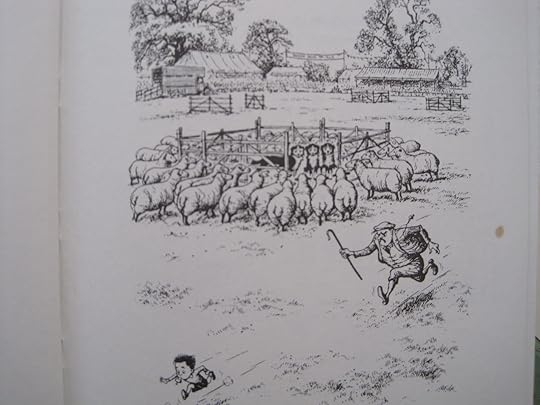
I know what he means. Many cartoonists will produce an almost minimalist drawing, with just a few telling lines. We may marvel at their skill in conveying so much with so little. Thelwell’s style however is the opposite. His characters (human and otherwise) are simple and stylised; expressive caricatures, but there is a wealth of detail in the background, and it is well worth spending time looking over. The background is real, solid and convincing.
H.F. Ellis, who wrote the introduction, was a keen ornithologist, and said that all the birds he draws are accurate. He does not merely draw seagulls on a rocky crag, but razorbills, and “very correctly” no avocets - yet he would draw them recognisably elsewhere. Thelwell does not draw sheep as a type, but breeds which an expert would recognise, and so on. He also draws en masse, when the humour demands it. H.F. Ellis found it impossible to count all the birds in one cartoon, even with a magnifying glass. (I had a similar problem with two herds of sheep moving in opposite directions.) So not only does Thelwell have a unique eye for humour, and talent for caricature, but he knows his subject - and he assumes we do too.
There are six sections:
Thelwell Country Its Horses Its Bird Life Its Nomads Its Trade And, of course, its People
The book I am reviewing is the first edition hardback, and surprisingly large for a book of cartoons at 10"x 8" (25 x 20cm). If you purchase a new copy, like most of Thelwell’s books it will be quite a small paperback. I have seen a couple of reviews which express disappointment in the production values, as the images are subsequently too small - and additionally some are blurred. Seeing the background detail is essential, as I said. Therefore I suggest you get hold of an older copy, if you can.
Perhaps this one, if you are quick! It is on its way to the Oxfam website. I like Thelwell’s work very much, but this is not my favourite selection. There are picnickers, tramps and gypsies, pony-struck children galore, and farmers, but there are also quite a few fox-hunters. Admittedly they are usually there to be poked fun at, but the best cartoons in this book may well be included in later ones too.
English country life of fifty years ago, very wittily observed. Given the truly horrible extremely wet and windy winter weather we experienced (2013-14) in the UK, I find myself relating strongly to the cartoon on page 26. It’s harvest festival in the church, and the vicar, standing in the pulpit, the church decorated with produce, is telling his flock that “On account of the widespread floods we will omit the verse about soft refreshing rain”, (from that old chestnut of a hymn, “We plough the fields, and scatter / The good seed on the land …”).
What a genius this man was All his books are superb, but this one is a collection of all his favourite subjects (ponies, foxes, farmer's, fishermen, gardens and sailing for starters) Just great
I bought this at the Devon Horse Show waaaayyy back in the early 1980s when I could whine my parent(s) into taking me (or at least dropping me off in the morning and picking me up about midnight.) Sadly my copy has not survived the years.
I read this dozens of times. I didn't get half of it. When I lived in England, I had sudden flashbacks of this book and FINALLY I got some of the jokes.
Thelwell was an excellent artist -- able to add incredible detail to cartoon panels. It's a little bit like the movie Fantasia in that every time you watch it you see different things. I used to spend five or ten minutes on just one page trying to see all of the details and wondering how Thelwell managed to draw them all.
This is not entirely about the horsey set but also hunters, farmers, vacationers to the countryside and people who just cannot handle having a lawn.
Some of the jokes and scenes may seem dated today, but were a good snapshot of life in the UK from the 1950s - before the Internet, mobile phones and EastEnders (whenever that was.) Those were the days, my friend.
A charming collection of postwar Punch cartoons by Norman Thelwell showing the amusements and annoyances of semi-rural living in a pony-obsessed, modernising but still archaic, bewildered Britain. Thelwell's drawings of country churches and stores and caravans and machinery are intricate and detailed. There's a lot of affection, and it's so very, very, very English.
I think of this sort of book as something of a useful background for understanding British fiction and history of the time and immediately after. Read these cartoons and suddenly Agatha Christie novels have a great deal more depth and resonance and what the Beatles and Beyond the Fringe and Monty Python were reacting to comes more into focus.
I am pleased to see that this book has been reprinted. It may need some annotation -- a lot of the jokes are obscure -- but it's a good-humored look at English country living of half a century ago.