Reconnect. Restore. Reciprocate. Repairing landscapes and reconnecting us to the wild plant communities around us. Integrating restoration practices, foraging, herbalism, rewilding, and permaculture, Wild Plant Culture is a comprehensive guide to the ecological restoration of native edible and medicinal plant communities in Eastern North America. Blending science, practice, and traditional knowledge, it makes bold connections that are actionable, innovative, and ecologically imperative for repairing both degraded landscapes and our broken cultural relationship with nature. Coverage Both a practical guide and an evocative read that will transport you deep into the natural landscape, Wild Plant Culture is an essential toolkit for gardeners, farmers, and ecological restoration practitioners, highlighting the important role humans play in tending and mending native plant communities. BOOK AWARDS
The Publisher Says: Reconnect. Restore. Reciprocate. Repairing landscapes and reconnecting us to the wild plant communities around us.
Integrating restoration practices, foraging, herbalism, rewilding, and permaculture, Wild Plant Culture is a comprehensive guide to the ecological restoration of native edible and medicinal plant communities in Eastern North America.
Blending science, practice, and traditional knowledge, it makes bold connections that are actionable, innovative, and ecologically imperative for repairing both degraded landscapes and our broken cultural relationship with nature. Coverage includes:
Understanding and engaging in mutually beneficial human-plant connections
Techniques for observing the land's existing and potential plant communities
Baseline monitoring, site preparation, seeding, planting, and maintaining restored areas
Botanical fieldwork restoration stories and examples
Detailed profiles of 209 native plants and their uses
Both a practical guide and an evocative read that will transport you deep into the natural landscape, Wild Plant Culture is an essential toolkit for gardeners, farmers, and ecological restoration practitioners, highlighting the important role humans play in tending and mending native plant communities.
I RECEIVED A DRC FROM THE PUBLISHER VIA EDELWEISS+. THANK YOU.
My Review: A beautiful idea: Re-wild the forests of the Eastern North American continent. How does one even start, though.
And here it is, an answer to the idea's obstacles. There's nothing complicated or threatening about the complex project's graphic presentation. It's simple and typographically clean, and the interspersed illustrations are charming and appropriate to the topics Author Rosenbaum presents clearly and lucidly in this book. There are simple, practical steps outlined for the project of re-wilding the most densely populated part of the continent. The world needs more wild, and re-wilded, places.
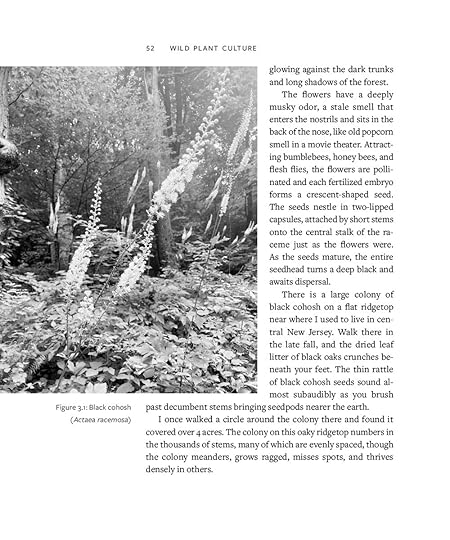
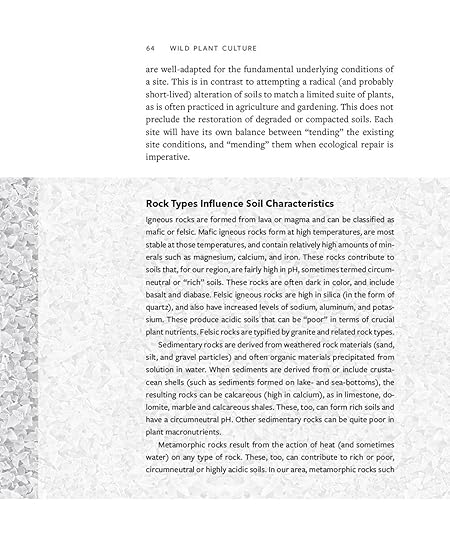
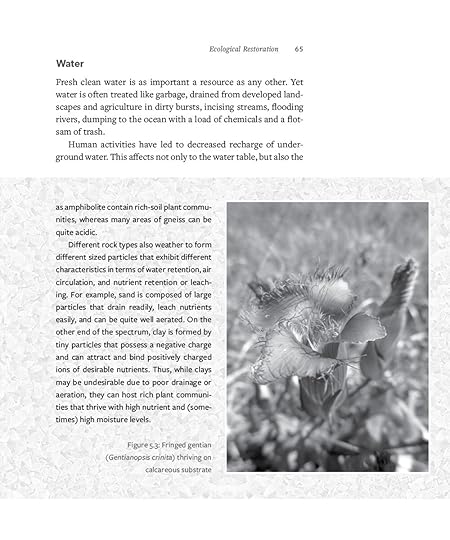
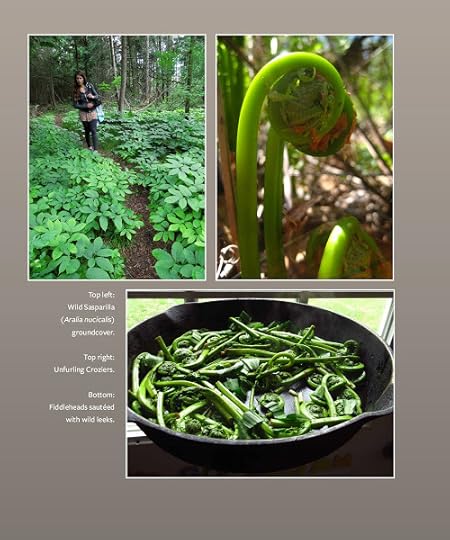
What makes me think of Yule gifting when I read and absorb this message is the sheer number of people I myownself know who, if they possessed some guidance on how, would definitely be willing...many even delighted...to join in the on-the-ground struggle to help the Earth our only home heal itself from generations of careless, heedless neglect. a typical page spread from chapter 3 Below is an example of the eight-page color illustration insert. The croziers, which in the US we call "fiddleheads" from beginning to end, is particularly beautifully framed...and the skillet full of 'em is really well-chosen here!
Finally, the gardening and plant world gets something a little more tangible on ecological restoration that is in closer reach for the average person. While this is focused on the NE United States, there are plant species in here that have a broader range and it would be easy to extrapolate and expand the species to other regions. I've loved what the author has produced elsewhere online and appreciate that this subject was written about a bit more in depth.
*I received an ARC via Edelweiss in exchange or my review.*
This is an important book – written as a guide to understanding the human place in the restoration of the wild natural landscapes of the North East (USA). Whilst the plant species may be, the ideas in this book are not specific to a geographic address. It s a practical and insightful guide, discussing new ways of mending and or tending our spaces – and applicable to any place on our planet).
I live in South Africa and have gleaned much out of this book to start consciously thinking about what I see around me in terms of our natural landscape and how we can be a part of our natural community in a way that restores the wildness of our natural home.
I love the the way Jared sees the restoration of our planet as a positive opportunity to use the gifts we have as human beings and ultimately, the stewards of our environment’s as the starting point of integrating ourselves once again (just as our indigenous communities did) into our environment for the good of all its inhabitants.
Section One of the book covers the understanding that human beings are supposed to be an integral part of the relationship to the natural world . The reciprocal relationship between man and our relationship with what grows around us is so important and Jared expounds on this beautifully. Section Two and Three are more practical, covering the “how” of learning and restoring the land.
This book has so much to offer anybody who is interested in land restoration and regeneration. its a book that you will read and re-read, finding each time, more to inspire or educate yourself.
Wild plant culture helped me understand the importance of natural spaces. Sometimes when we come across a piece of land we want to tend to it with a certain vision in mind. When in reality helping it back into its natural state would be much more productive. Not just for us but for the environment.
This book isn't about building a food forest that you must tend to. It is building a space that can naturally take care of itself - as nature would have intended.
As a person who is new in this domain. I clearly have a lot to learn. This book is a great start to learning which plants and species thrive in which conditions. I particularly like the lists and tables within the chapters. Pairing this book with a guidebook or a plant identification app would be highly effective.
I also enjoyed the first couple of chapters where the author talked about land use and land transformation. They placed a particular interest on how land was managed by indigenous people prior to colonization. Noting that a lot of that knowledge was destroyed due to the act of colonization. There are still some reminants of that knowledge through archaeological evidence and some stories. This information is precious. And when we do any sort of harvesting from wild population we need to consider the larger picture. How do our actions have an impact? Is there going to be enough left for this species to thrive? Can I harvest in a way that is beneficial to the plant?
Reading through the plant descriptions the author notes that it is equally important to accurately identify edible plants as it is important to do them due justice when preparing them. Not everything eaten raw is delicious!
Jared Rosenbaum’s Wild Plant Culture is a refreshing and deeply insightful exploration of native plant restoration, ethnobotany, and the ways we can reconnect with the landscapes that sustain us. This book is more than just a guide; it’s an invitation—to observe more closely, to tend more mindfully, and to immerse ourselves in the rich relationships between plants, people, and place.
Rosenbaum writes with both expertise and warmth, weaving ecology with storytelling in a way that makes even the most complex botanical concepts feel approachable. His passion for native plants is evident on every page, and he has a rare gift for making restoration feel like both a science and an art. Readers will find themselves drawn into his enthusiasm, whether he’s discussing seed dispersal, plant communities, or the sheer joy of seeing a once-barren landscape come back to life.
What sets this book apart is its balance of intellectual depth and accessibility. While the content is rich with ecological wisdom and practical applications, Rosenbaum’s tone is engaging and often humorous, making it a pleasure to read. It’s the kind of book that makes you want to put it down—not because you’re bored, but because you’re inspired to go outside and put its lessons into practice.
For gardeners, land stewards, educators, or anyone curious about working in partnership with nature, Wild Plant Culture is a must-read. It reminds us that ecological restoration isn’t just about plants—it’s about relationships, history, and the hopeful act of healing the land, one species at a time.
Let me start by saying I already own a lot of gardening books and a lot of field guides/books on wild edible and medicinal plants. This book bridges the two topics for the part of my property that is wooded, but heavily non-native. The author states that the “intent of this book is to help you match plant species to pre-existing habitat conditions” and it does a great job of that. It provides the soil/light/water conditions and indicator plants for multiple native plant communities (e.g. riparian forests, rich mesic forests, meadows and grasslands, forested wetlands) and even with my low-moderate plant knowledge, I was quickly able to recognize indicators of how my property would be categorized. The book also provides guidance on whether it’s appropriate to tend vs. mend (more intense intervention) as you rehabilitate the land, based on how much restoration is needed. The second half of the book is mostly profiles of plant species, with descriptions and uses of each. This is not a stand-alone book for identifying individual species and is designed to be used with a good field guide (some recommendations provided); it’s more about what those species tell you about the land, once you identify them. This was a valuable read, and definitely worth having as a reference!
Initially I hesitated to start reading, wondering if I’d like this book, as I live in Europe. However, in Europe looking at indicator plants (plant communities) helped me figure out more about the soil of the land my cousin lives on. And this book captured me from the beginning. It was as if I was taken on a holiday tour through the different landscapes, including the history of the land and great descriptions of plants growing in the various regions. There is so much to be learned from history, to understand better how we can or should work with the land. All is interconnected, but as humans we have disturbed a lot. Great solutions are offered how to read and learn about the land and how to restore it. Also tips of how to keep vegetation under control and a clarification of where land burning might help. This book has inspired me to look even more for wild plants in nature as they are very healthy. I started to grow some “missing” local wild plants in my own garden, where it fits with the location.
This is a thought-provoking approach to restoring native plants to your own landscape by focusing on the edible and medicinal species that Native Americans would have nurtured for millennia. This proposes a different view of foraging also - you could be growing your own wild food plants. Ironic that the plants on the cover illustration are not the ones written about. The good: detailed, well-researched descriptions of many valuable native plants, plus lists of species suitable to different sites. The disappointing: the author writes only about east coast North American species. If you live in a different place, it may be of less value as a resource.
This book is a fascinating depiction of ecoculture, the human participation and constant melding of natural ecology to be its most abundant and productive while benefiting plant and animal communities.
The author acknowledges the importance of traditional ecological knowledge, and how indigenous people transformed the landscape into thriving systems before Europeans invaded.
He lays out the framework to mend habitat, from evaluating, to restoring landscapes. This book also includes over 200 native plants (specific to the American Northeast bioregion).
I recommend this book for anyone learning about permaculture, regenerative agriculture, rewilding landscapes, etc.
What a gem. Having read a lot of "popular literature" on the subject, I expected a bit of the same well-trodden (albeit important and timely) narrative about the importance of biodiversity and re-wilding. What sets this book apart is how well it is written and the thoughtful nuances it addresses with keen intelligence, informed by the latest ecological science. I bought this book to nourish my heart, but it amazingly captured the attention of my brain and intellectual curiosity as well. Definitely not for the casual reader. A brilliant gift for the discerning scholars of life.
Excellent book that gives a great overview on restoration of land. I will use the outline to help me research details more specific to the area of the United States that I live in. This will help me to determine if we need to tend or mend our land.
Excellent guidebook for those who do ecological restoration. Refreshing to be brought to NE America's vegetation and ecosystems. Wild plant cooking - may be a recipe book in the future?