Jump to ratings and reviews
Rate this book

Edmund White’s A Boy’s Own Story: The Graphic Novel

Rate this book
A landmark American novel, hailed by the New York Times as J.D. Salinger crossed with Oscar Wilde, is masterfully reimagined as a timeless graphic novel.

A Boy’s Own Story is a now-classic coming-of-age story, but with a the young protagonist is growing up gay during one of the most oppressive periods in American history. Set in the time and place of author Edmund White’s adolescence, the Midwest of the 1950s, the novel became an immediate bestseller and, for many readers, was not merely about gay identity but the pain of being a child in a fractured family while looking for love in an anything-but-stable world. And yet the book quickly contributed to the literature of empowerment that grew out of the Stonewall riots and subsequent gay rights era. Readers are still swept up in the main character’s thoughts and dry humor, and many today remain shocked by the sexually confessional, and bold, nature of his revelations, his humorous observations, the comic situations and scenes the strangely erudite youthful narrator describes, the tenderness of his loneliness, and the vivid aching of his imagination. A Boy’s Own Story is lyrical, witty, unabashed, and authentic.

Now, to bring this landmark novel to new life for today’s readers, White is joined by co-writers Brian Alessandro and Michael Carroll and artist Igor Karash for a stunning graphic novel interpretation. The poetic nuances of White’s language float across sumptuously painted panels that evoke 1950s Cincinnati, 1980s Paris, and every dreamlike moment in between. The result is a creative adaptation, in collaboration with Closure Creative, of the original 1982 A Boy’s Own Story with additional personal and historical elements from the authors’ lives.

264 pages, Hardcover

Published January 3, 2023

8 people are currently reading
88 people want to read

About the author

Edmund White

139 books911 followers
Edmund Valentine White III was an American novelist, memoirist, playwright, biographer, and essayist. He was the recipient of Lambda Literary's Visionary Award, the National Book Foundation's Lifetime Achievement Award, and the PEN/Saul Bellow Award for Achievement in American Fiction. France made him Chevalier (and later Officier) de l'Ordre des Arts et des Lettres in 1993.
White was known as a groundbreaking writer of gay literature and a major influence on gay American literature and has been called "the first major queer novelist to champion a new generation of writers."

Ratings & Reviews

What do you think?
Rate this book

Friends & Following

Create a free account to discover what your friends think of this book!

Community Reviews

5 stars
12 (10%)
4 stars
30 (25%)
3 stars
41 (34%)
2 stars
24 (20%)
1 star
12 (10%)
Displaying 1 - 25 of 25 reviews
Profile Image for Doug.
2,564 reviews926 followers
February 15, 2023
White's autobiographical novel is considered a classic in the 'coming-out' genre, and justifiably so. I read it when it first came out 40 years ago, and thought I was due for a reacquaintance - but this new graphic novel version makes a hash of the narrative and is virtually incomprehensible - jumping around in time and giving little context to the scenes. Worse, it truncates White's lapidary prose so that all that is left is the basic outline of the story. The drawings are very nice and well-done, but they are in service to a completely nonsensical treatment of the material.
Profile Image for Terry.
12 reviews
February 11, 2023
Disgraceful queerwashing.

The adaptation’s ad copy describes A Boy’s Own Story’s earliest reception as, "for many readers" apparently, "not merely about gay identity." Of course, you might describe the original novel as "about" any number of things. But not merely about gay identity? White’s novel was of gay identity. It saw value in exploration founded on the specifically sexed experiences of homosexuality, which dovetailed with a specific scale of community-building. Which is to say, A Boy’s Own Story pioneered and belongs to not just any post-Stonewall literary canon, but one of writing explicitly by, about and for gay men. It is only within that history that it’s at all legible as a landmark. So shame on the adaptation’s attempt to capitalise on its landmark status while diminishing the basis on which that status was admirably earned.

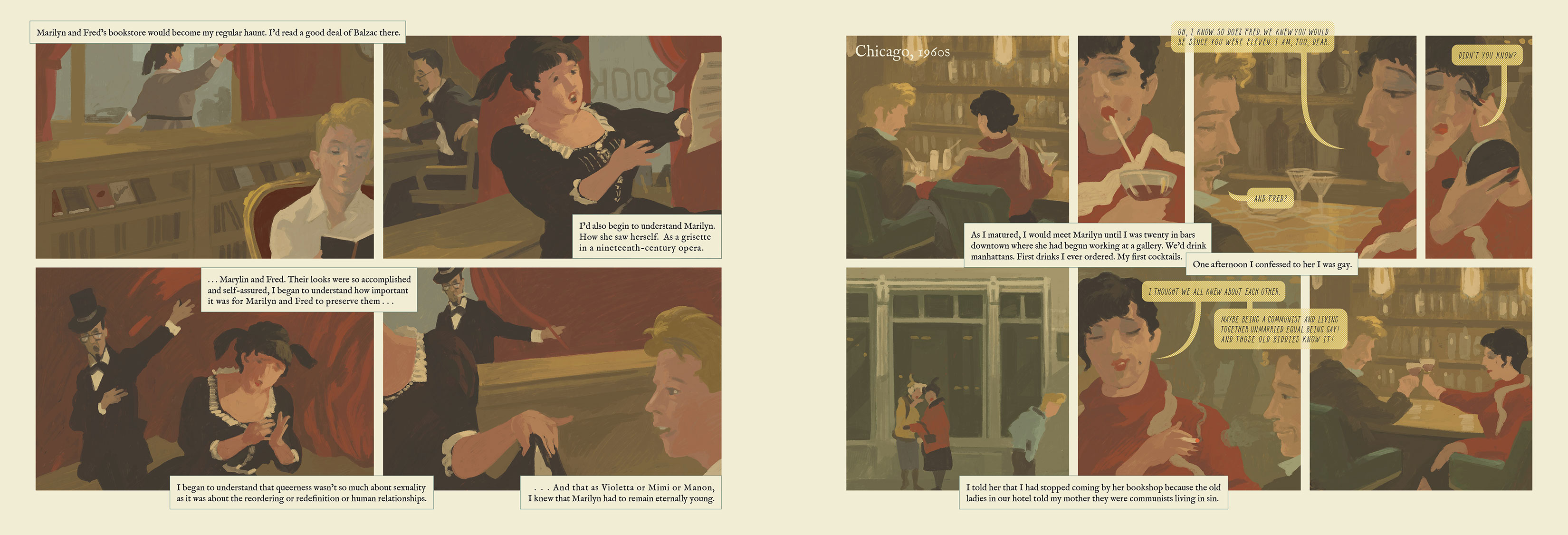
This isn’t just ad copy either. The exact contours of the market expansion this revisionist history serves become clearer through consulting further of the graphic novel’s promotional materials, namely a certain sample page from the publisher’s preview: the titular boy now learns at Marilyn and Fred’s bookstore "that queerness wasn’t so much about sexuality as it was about the reordering or redefinition of human relationships."

This academic notion of queerness is entirely alien to White’s 1982 text. There, the word queer appears exactly once, as the preadolescent boy conceptually locates his homosexuality according to the discourse available to him in his 1950s' milieu. Though pejoratively tinged, it designates as clearly as gay a sexual orientation towards people of the same sex; and with the same clarity of designation, gay is the term the boy uses to eventually confirm with Marilyn what he always had in common with her and Fred that had attracted him to their bookstore. Given the characters still identify this as their common trait in the equivalent scene in the graphic novel, the adjacent insertion of queerness produces a glaring incoherency: homosexuality is deprioritised in the frame of significance despite its foremost relevance.

More curiously, the boy of this new version grasps what queerness is more accurately "about" immediately following his appreciation of Marilyn and Fred’s nineteenth-century style of dress: "Their looks were so accomplished and self-assured, I began to understand how important it was for them to preserve them."

Across these two quotations, homosexuality is demoted as the referent of queer in favour of a project of redefining human relationships—a project that emerges out of a newfound recognition of the importance of non-normative self-presentations centring wardrobe selections. This can’t help but call to mind contemporary mainstream trans advocacy, which is heavily consumed with (1) revising the definition of woman to mean "anyone who presumably sincerely identifies as such" and (2) guiding others to infer that identification not through anatomical cues but gendered signifiers, including name, makeup, hairdo and especially clothing. That the text renders trans people analogous to Victorian-themed cosplayers is still less peculiar than the context: a story, at least originally and still to all appearances, focused on gay male sexuality.

This then is how the adaptation mediates its transmission of one of gay male identity’s cultural touchstones: by rhetorically minimising gay—meaning homosexual—identity as much as possible. It does this seeking the dollars and endorsements of a wider "queer" readership and is symptomatic of a broader homogenising LGBTQ+ cultural movement—one that increasingly subordinates homosexuality to gender identity while leveraging their underscrutinised linkage to suggest, wrongly, that they are perfectly analogous.

This adaptation is the definition of queerwashing, a phenomenon often simply understood as the targeted pursuit of an oppressed consumer demographic about whom vendors only obviously care commercially. The adaptation engages in something worse, queerwashing as akin to greenwashing; it's like a product that proclaims to be eco-conscious yet reached the shelf through gross but hard to observe environmental exploitation. The adaptation enters a queer marketplace where, to maximise its commercial prospects, it devalues gay/homosexual identity, all the while its investment in that identity is exploited as the marketplace ticket of entry.

The convergence with profit ambitions is unmistakable and occurs at the unconscionable expense of the actual meaning of White's legacy here. That White himself is to some extent complicit in this voguish undoing or outmoding of homosexuality is particularly exasperating, especially as gay males seriously need now a community project of the kind with which his book was historically involved, in order to address persistent psychosocial struggles that, in the West, legal parity with heterosexuals has covered over.

Does it matter that lesbian history, gay male history and the histories of other marginalised groups, including their cultural artefacts, might now be represented as intuitively queer—a term that, to review, hails both everyone and no one in particular of an ever-expanding cohort and that comes with immense ideological baggage, if not echoes of homophobia? It matters, yes. And that it's happened in this case both reflects and stands to contribute to a trend of profound misrecognitions. The title of White’s book was so much the point: contrary to what the adaptation pretends, A Boy’s Own Story was not and is not the story of "us" all.

Addenda

1.

During a promotional event the adaptation team live-streamed with the Queens Public Library, Brian Alessandro asked his co-adaptor and White's partner, Michael Carroll, to “tell us why A Boy’s Own Story, published in 1982, is such an enduring and important book.” Carroll's response fully realises the novel’s meaning and place in history, only to quickly manifest a terminological tension. Carroll says,

[A Boy’s Own Story] was very directly about being gay and about dealing with the emotions of being a physically homosexual person […] it runs the gamut of—of the emotions and the desires that a young—well, I’m gonna say gay person [ambivalent] or I’ll say queer person; I’m not every kind of queer, but it was highly exposing of the phenomenon.


The “phenomenon” was male homosexuality, not a generic non-heterosexuality, nor a transgender identity, nor again the anti-normativity queer theory is known for. Carroll’s answer implies he thinks of the novel, naturally, in terms of gay identity, but is adjusting his language out of some contextual obligation or sensitivity he might otherwise sooner dismiss.

2.

The adaptation modifies Marilyn’s originally period-appropriate joke about the Lavender Scare to a non-joke that naturalises the connection between homosexuality and communism.

In both versions, this much is the same: the boy explains to Marilyn that he stopped coming by the bookstore because his mother had been advised by elderly neighbours that Marilyn and Fred were cohabiting communists. But compare Marilyn’s response in the original and in the adaptation respectively:

"Of course the truth is [Fred and I are] both Catholics and gay and never touched each other. Perhaps those ladies even knew the truth but—but"—shriek of laughter—"assumed that communism and living in sin, that those two things together equaled being gay."


"Maybe being a communist and living together unmarried equals being gay! And those old biddies know it!"


In the original, the humour is in how the old ladies might have arrived at the right conclusion—that Marilyn and Fred are gay—through their inaccurate premise, since McCarthyism animated fears that communism would, by making men and women equal in their enslavement to the Soviet State, efface the differences between the sexes and thus abolish heterosexual mores. In the adaptation, Marilyn and Fred shed their more believable Catholicism and it seems Marilyn at least literally is just a communist (and don’t those old biddies know it, you go girl, haha?).

Rather than reaching the 1950s during which “perversion” was damagingly and discreditably equated with “subversion,” it's as if the adaptors' retrospective gaze falls short at queer theory's inception in the late ’60s/early ’70s, when homosexuality would again converge with communism, only this time not as part of a scare-campaign but as part of “the revolution” fermenting on college campuses.
Profile Image for Andrew.
2,336 reviews71 followers
March 3, 2023
Edmund White gives us a story of his coming out and coming-of-age story, now revisited in graphic novel form.
Adapted by Brian Alessandro and Michael Carroll with illustrations by Igor Karash,
this revisit of Edmund White's memoir-like story, is raw, sexual, primal, challenging, charged, tearful, romantic, lush, angry, and will set your reading experience on fire in a new way!
Profile Image for Philip.
490 reviews56 followers
May 13, 2023
This graphic adaptation of Edmund White’s book did not hold up for me. The drawings were very muted and dark. It was difficult to see the artwork and to read the text that was superimposed over the artwork. Plus the amount of hetero sex felt forced and not in the least natural.
538 reviews26 followers
April 1, 2025
I was really looking forward to this graphic novel version of Edmund White's classic coming of age gay novel. But I was sadly disappointed.

I haven't read the original novel since it was first published in 1982. Perhaps I need to re-read it as this version isn't particularly enlightening. Trying to capture the novel's essence didn't really work in this format although it is about forty pages longer in illustrative text than the original.

Personally, I didn't care for the artwork by Igor Karash. It's all beautifully done but I found it rather dull and uninspiring. It contains a bit too much dark and shade for my liking. A very handsome book but with so-so content.
Profile Image for Lauren.
1,586 reviews
April 25, 2023
As I have not read the book version of this, I can’t speak on how it stands as an adaptation. As a graphic novel, it is a bit disjointed and hard to follow in places. The story is honest, the people entirely unlikeable, the sexual experiences ambiguous in their level of exploitation versus exploration.
Profile Image for Timmy.
13 reviews
June 21, 2023
Despite the stunning artwork by Igor Karash (an obvious talent), the narrative of phantom "Edmund White", otherwise known as the unnamed protagonist from the original novel, completely derails the beauty, and messages from the original novel. White had joked that when originally written, his book was criticized for not having enough sexual content by his peers. This is exactly what I enjoyed about the original novel, which is not at all devoid of sexual content, but approaches it through a child-like lens that has yet to be corrupted by adulthood.

Here adaptors Brian Alessandro & Michael Carroll (with White's blessing it seems) have leveled up the sex to apparently give the older readers their sexual demands in literary entertainment, with penises, breasts, and sexual acts illuminating the pages so frequently that our protagonist no longer has any other dimensions other than his sexuality. Leave it to the gay community to support the tired stereotype that all gay men are merely identified as a result of their sexuality and nothing more. The authors do attempt to employ the layered subtext from the novel, but not at the cost of more sexual tantalizing which takes the spotlight with this graphic novel. Overshadowing the unique relationships between mothers, fathers, sons, and the themes of being queer in a heterosexual narrative while questioning individual sexual desire.

I'm not a prude, but for instance (*Slight Spoiler) the "orgy" sequence depicted by Alessandro & Carroll changes the action of the sequence completely, from what was a narrative regarding a woman having a marital-existential life crisis, to becoming an uncomfortable, creepy objectification of a teenage boy, whom the hetero couple seduce. The original novel illustrated this scene much more delicately with the protagonist being an observer over the wife's unhappiness, and although nude in the bedroom with the couple, doesn't do much more than observe the sexual act between husband and wife. (*End of Spoiler)

This becomes a complete illustrated misfire that is belabored by the use of the Phantom/White/Narrator device that is used to show the future effects for our protagonist as an adult while he looks back. A choice that was never illustrated in the pages of the original text except as reflective idiom, which results in a much better effect of staying on the point of view of the "boy" and not the "man". I refer to the title of the book to support this criticism. There is an intention to please a particular audience with illustrations of an adult narrator depicted in sexual repose in more modern settings, and quite frankly I was not "here for it" as it severed the connection I had with considering my own childhood experiences with that of the original text. The original novel perfectly illustrates how the delicacies of childhood interact with the bizarre behaviors of a suppressed adult world, where ideals, hope, and dreams have collapsed in on themselves. Navigating the uncomfortable neuroses of unexpected to bizarre situations, behavior, society, adults, peers, and strangers as an adolescent, is already a relatable experience.

Unfortunately, this graphic novel adaptation chooses to dump the intricate nuances of the original novel in favor of sexual shock, while overtly proclaiming, "See, this is why the narrator is who he is today! Because of SEX! See?" Regrettably this is what the reader will be lead to remember, instead of arriving to their own conclusions of the author's depiction of childhood from the literary content of what made "A Boy's Own Story" a classic to begin with. An artistic phallicus rendered for the modern PornHub audience, that proclaims itself a masterpiece before opening the book due to the quality of the original.
Profile Image for My Giang.
93 reviews
July 14, 2025
The art in this book was really beautiful. It looked nice, but the art style made it hard for me to read emotion and context. I understand that this is an adaptation of a book, but, as someone who’s never read said book before, it was very hard to follow. The visuals should’ve helped, but it didn’t, and I spent most of my time reading a little lost. The excerpts from the original are all beautifully written—and I’m for sure going to read the original in the future —but the adaptation wasn’t very compelling to me.
Profile Image for Esonja.
415 reviews5 followers
February 18, 2023
There is a lot to value here - evocative storytelling, good artwork, and contextual themes. But, it was a bit aggravating.
Profile Image for Dave Schaafsma.
Author 6 books32.2k followers
May 9, 2023
Edmund White’s semi-autobiographical book (autofictional?) A Boy’s Own Story is a coming-of-age/coming out story about a 15-year-old growing up in the 1950s. When White's book came out twenty years ago it was an instant-classic. The graphic novel adaptation by Brian Alessandro and Michael Carroll and beautifully illustrated by Igor Karash tacks back and forth between the fifties and the last two decades of the century, through the AIDS crisis and Stonewall.

I am pretty sure I read a chapter or excerpt of the book when it came out, but can't comment on the quality of the adaptation except to say it does what the best graphic novel adaptations do: It trades much of the beautiful language of White for the beautiful images of Karash. In the best graphic novels, the images tell the story, images that show, not tell, that bring situations to life in another, different, but still vivid way.

Some of what White describes is unsurprising, including the struggle with religion and morality, shame and guilt, and the main character also sleeps with girls and women along the way to his acceptance of his sexual identity. I have White's original book here and the writing is often wonderful, and we have a better sense of what is happening with greater attention to the broader story in it, which meanders as life does, from Chicago to New York to Paris, but we feel these situations very well in the images, the color, the subtle facial expressions. I liked it very much but now will put the original on my list to read. A different version, but both reach out to young people--and particularly gay young people--about their own struggles with identity.

As someone who grew up in the fifties and sixties, reading the Beats and French literature and craving what we called "counter-culture" at every chance we could, it reminded me of my fascination with Rimbaud, Verlaine, the poetic angst and passions of the streets, the exploration of the hip worlds outside the midwestern town I grew up in. And White grew up in summers on Walloon Lake in northern Michigan, a place I know and where Hemingway summered a generation before. I know this book is about being young and gay, but for me iy also echoed my own desires to leave western Michigan for anywhere "on the road to find out,"as Cat Stevens sang. I liked this graphic novel, which though oversized, can be read in a couple hours. Some I see express that it jumps around too much, but I felt it was just trying to give a comparative sense of what it meant to be gay in different decades.
Profile Image for Silvano.
5 reviews3 followers
June 12, 2025
I like the visual style of the book. There is an impressionistic touch without being sentimental. The fact that none of Edmund White's fiction has been adapted for TV or the big screen makes this graphic novel merit great welcome.

As I observe along the way, the story itself has many borrowings from THE BEAUTIFUL ROOM IS EMPTY, the sequel to A BOY'S OWN STORY (the all-text novel), whose action ends at the time of the Stonewall Riots. And there are scenes in which the protagonist (autobiographically called Eddie) now resides in Paris, looking back on his lived experience in America. Even if the actions jumping between different timeframes will not necessarily be confusing even to readers new to White's oeuvre, I still doubt the authenticity of this more "Proustian" approach. Because such a back-and-forth shuttle seems only to have diminished the power of the (deceptively) straightforward narrative of the original. Having a more epic scope doesn't automatically lend a narrative greater depth; here, instead, White's work seems to repeatedly resist to fit into that grander mode. Nonetheless, I relished going through this graphic novel, my first revisit to the unforgettable Edmund White since his recent death.
Profile Image for Sneha Jaiswal.
Author 8 books27 followers
January 18, 2023
What’s it like to grow up gay at a time when ‘gay rights’ weren’t even a thing? To desire those of the same gender, to be consumed by guilt, doubt and still manage to find your voice in the chaos that’s your own self? Edmund White’s semi-autobiographical book ‘A Boy’s Own Story’ follows a 15-year-old in the 1950s, who isn’t just mentally torn up about his sexuality, but is physically divided between the clashing worlds of his divorced parents. The graphic novel adaptation of the title by Brian Alessandro, Michael Carroll and Igor Karash brings to readers an easy to read illustrated version that one can binge-read and finish in a day.

Full review - https://abstractaf.in/a-boys-own-stor...
Profile Image for Blane.
706 reviews10 followers
August 1, 2023
First off, I (shamefully, I suppose) have not read White's original novel. This graphic adaptation, though spectacularly illustrated, seems a bit of a mess. Time & location jumps forward & backwards for no apparent reason, thoroughly disrupting the narrative flow. And let's talk about the unwieldy size/shape of the physical book...awful...unless you're sitting at a table to read it, which I do not tend to do.
Profile Image for Rick Hribko.
329 reviews1 follower
May 12, 2024
I am so disappointed in this book. But maybe my expectations were set too high. The pictures were so dark, I went half-blind looking at them. The storyline was hard to follow as it jumped from one time period to another (sometimes just for one picture) so often. That coupled with awkwardly placed thought bubbles and story boxes made em question where to read first, so I had a hard time following. I am thinking that I should go to the original text to see if I like that better.
Profile Image for Peacegal.
11.7k reviews102 followers
March 8, 2023
While the illustrations were very nicely done, each panel looking like a miniature painting, the storyline skipped around so much in time it was near-incomprehensible for me. I get that this is a depiction of a very specific life experience in specific times and places that I know nothing about, so that may have contributed to my confusion.
Profile Image for Fiore.
878 reviews13 followers
March 31, 2023
Soft unlined art largely defined in shadowy faces and bodies, always hinting at more than it says much like the text. Not so much a coherent story, more like emotions jumping back and forth in time. All with the common thread of longing and wanting to belong when no space for those feelings yet existed. Gentle melancholy throughout.
Profile Image for Lily.
1,163 reviews43 followers
July 1, 2023
A queer coming of age in graphic form, the formatting of the story is well-done and it's told in an engaging upfolding way. Taking place in the 50s and 60s, exploring religion and morality, familial relationships and gender nuances and complexities (and some traumas), it was a thoughtful and heartfelt memoir/experience.
Profile Image for Rick.
3,149 reviews
March 31, 2024
This graphic adaptation of the book really has an enormously different texture and emotional impact. It’s quite good, in some ways perhaps even better than the original. The structure of the book, the page layout, even the color palette used, are all brilliant choices. An absolutely gorgeous adaptation of a modern classic.
Profile Image for Robyn.
811 reviews10 followers
Read
May 15, 2023
Notables 2023 #33
Profile Image for Elena.
321 reviews5 followers
Read
January 7, 2024
I think I needed to read the original novel to know what was happening here. loved the style of the illustrations though
Profile Image for Michael Kerr.
Author 1 book10 followers
July 25, 2023
White's classic coming-of-age memoir retold in graphic novel form. The longing, the ache of not-belonging, the angst of being an outsider as a gay lad in a profoundly homophobic age, all come through in White's frank and articulate telling. And the dreamy illustrations of Igor Karash beautifully evoke the author's remembered world. Very worthwhile.
Profile Image for Tim.
214 reviews12 followers
June 21, 2023
Beautifully illustrated! The illustrations bring new depths to the work of Edmund White
Profile Image for Elizabeth Sanders.
404 reviews8 followers
August 8, 2024
In full disclosure, I have never read Edmund White’s A Boy’s Own Story before. The art for this graphic novel adaptation is beautiful, but unfortunately there are a few barriers to enjoying the work. First, the book’s proportions, necessary for how the art is laid out, make it difficult to hold and to physically read. Second, the font chosen for both the dialogue and text are tiny. There is plenty of page space reserved that could have been used to make the fonts larger and more legible. Finally, it’s difficult to follow the actual text on certain pages. Most pages rely on either dialogue/thought bubbles or text separate from the images successfully, but many pages that must combine the two are less clear. Because I couldn’t tell which order I am supposed to read the text, it confused me and broke my immersion with the work.
Profile Image for Bram.
270 reviews
August 21, 2024
Bewerking van de gelijknamige gay klassieker van Edmund White uit 1982. De gedempte kleuren van de vaak toch al donkere illustraties, zorgen dat er over het hele verhaal een soort grauwe sluier ligt. Het min of meer autobiografische coming of age verhaal van White (boordevol ellende) wordt hierdoor topzwaar. Ik vond het soms een beproeving, maar ben wel benieuwd gebleven naar de oorspronkelijke roman.
Displaying 1 - 25 of 25 reviews

Can't find what you're looking for?

Get help and learn more about the design.