Ken is a scientist, with a scientist's dispassionate eye for the material world, as he reviews his life from the difficult 1930s, through the slaughter of World War I, back to an idyllic boyhood in the Highlands. When the mature man finally reaches the source of the river that has haunted his imagination for so many years, he finds that the wellsprings of magic and delight were always there, in the world all around him at the time, inexhaustible and irreverent. Awarded the James Tait Memorial Prize 1937, Highland River is written in prose as cool and clear as the water it describes, and is the simplest, most poetic, and perhaps the greatest of Neil Gunn's novels.
Neil Gunn, one of Scotland's most prolific and distinguished novelists, wrote over a period that spanned the Recession, the political crises of the 1920's and 1930's, and the Second World War and its aftermath. Although nearly all his 20 novels are set in the Highlands of Scotland, he is not a regional author in the narrow sense of that description; his novels reflect a search for meaning in troubled times, both past and present, a search that leads him into the realms of philosophy, archaeology, folk tradition and metaphysical speculation.
Born in the coastal village of Dunbeath, Caithness, the son of a successful fishing boat skipper, Gunn was educated at the local village primary school and privately in Galloway. In 1911 he entered the Civil Service and spent some time in both London and Edinburgh before returning to the North as a customs and excise officer based (after a short spell in Caithness) in Inverness. Before voluntary retirement from Government service in 1937 to become a full-time writer, he had embarked on a literary career with considerable success.
His first novel, The Grey Coast (1926), a novel in the realist tradition and set in Caithness in the 1920's, occupied an important position in the literary movement known as the Scottish Renaissance. His second novel, Morning Tide (1931), an idyll of a Highland childhood, won a Book Society award and the praise of the well known literary and public figure, John Buchan. The turning point in Gunn's career, however, came in 1937, when he won the prestigious James Tait Black Memorial prize for his deeply thought-provoking Highland River, a quasi autobiographical novel written in the third person, in which the main protagonist's life is made analogous to a Highland river and the search for its source.
In 1941 Gunn's epic novel about the fishing boom of the late 18th and early 19th centuries, The Silver Darlings, was widely acclaimed as a modern classic and considered the finest balance between concrete action and metaphysical speculation achieved by any British writer in the 20th century. It was also the final novel of a trilogy of the history of the Northlands, the other novels being Sun Circle (1933) on the Viking invasions of the 9th century and Butcher's Broom (1934) on the Clearances. In 1944 Gunn wrote his anti-Utopian novel, The Green Isle of the Great Deep, a book that preceded George Orwell's novel on the same theme, Nineteen Eighty-Four, by five years. The novel, using an old man and a young boy from a rural background as characters in a struggle against the pressures of totalitarian state, evoked an enthusiastic response from the famous Swiss psychiatrist Carl Gustav Jung.
Some of Gunn's later books, whilst not ignoring the uglier aspects of the modern world, touch more on metaphysical speculation in a vein that is not without humour. The Well at the Worlds End (1951), in particular, lays emphasis on the more positive aspects of living and the value of that approach in finding meaning and purpose in life. Gunn's spiritual autobiography, The Atom of Delight (1956), which, although similar in many ways to Highland River, incorporates a vein of thought derived from Gunn's interest in Zen Buddhism. The autobiography was Gunn's last major work.
In 1948 Gunn's contribution to literature was recognised by Edinburgh University with an honorary doctorate to the author; in 1972 the Scottish Arts Council created the Neil Gunn Fellowship in his honour, a fellowship that was to include such famous writers as Henrich Boll, Saul Bellow, Ruth Prawar Jhabvala, Nadine Gordimer and Mario Vargas Llosa.
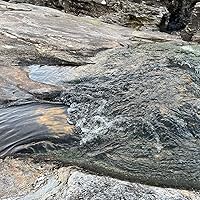
Though it is couched as a sort of biography of Kenn, a young boy growing up into manhood and early middle age, this is an unusual novel in that its focus is really on the river of the title - almost a character in its own right - and clearly rooted in the author’s upbringing in the town of Dunbeath in Caithness and his knowledge of the Dunbeath Water which runs into the sea there. Evocation of landscape is a major component of the Scottish novel in general but not always as to the fore as it is here. Gunn’s descriptions of the river are precise and detailed so that the reader almost feels present. Not that he neglects characterisation; Kenn’s mother, elder brother and father are sketched economically but powerfully and all the minor characters have the stuff of life. It is, too, a philosphical novel, crammed with the thoughts Gunn puts into Kenn’s head as he recounts his experiences. It joins the long roll of Scottish literature about times lost and a way of life remembered.
The first scene is of a very young Kenn’s struggle with a huge cock salmon in the lower reaches of the river. In the end he manages to land it and this marks his transition into boyhood. (This episode is also commemorated by a statue erected by proud locals alongside the harbour in Dunbeath.)
This is one of many instances where the catching of fish (whether trout or salmon) is portrayed, the elaborate precautions taken to avoid gamekeepers, the deep knowledge of the likely pools, the intricate procedures needed to spy the fish and entrap it. Another early scene shows the disconnect between geography lessons about the main industries of English cities and Kenn’s daily life. None of that mundane esoterica is relevant to existence in a small village. Kenn finds himself dreaming through such lessons and as a result becomes the subject of his teacher’s wrath, expressed as was the custom of the times via the institutionalised violence of the tawse.
In contrast, despite the reticence bred by Calvinism - “None of the mothers in that land kissed their sons. If it were known that a boy had been kissed by his mother, not a dozen school fights would clear him of the dark shame of such weakness,” a weakness seen as more the mother’s than the son’s, “Nor can Kenn remember having seen his father kiss his mother ….. affection was as shy and as invisible as death,” - his parent’s quiet attitude to Kenn’s academic success and his own reluctance to declare it speak volumes.
As for the rock of the family, “Kenn’s mother did not go to church simply because she believed she was not worthy ….. She had done nothing to make herself unworthy. She was seen in her life as a good woman and without reproach. Yet she believed herself unworthy.” The men, too, did not take communion; their lives, tainted by rough living (and the odd drink,) had “not contained enough solemnity of holiness to justify them in going forward.”
The narrative flits back and forth through time between Kenn’s childhood, his experiences in the Great War and his life as a physicist afterwards, but the transitions are not jarring. They seem to occur organically, scenes flowing smoothly into one another. It is a kind of stream of consciousness, but controlled, always alert to the point. The removal in the Highland Clearances of Kenn’s not so ancient ancestors from the land they had worked since time immemorial, henceforth to make their living through sea-fishing, is mentioned in passing but without it they would not have been in reduced circumstances.
Through it all the river exerts its pull, Kenn’s last journey in the book marking his progress at last up to its source where he thinks, “Out of great works of art, out of great writing, there comes upon the soul sometimes a feeling of strange intimacy.” Here, Gunn’s intimacy with his subject, his feel for his particular hinterland, reaches beyond the Dunbeath Water, beyond the village which shares its name, beyond Scotland, to become universal, recognised by Highland River’s award of the James Tait Black Memorial Prize for 1937.
Really wanted to enjoy this read but I really did not at all. What others have called poetic descriptions I found long rambling, difficult to read sentences. It really did not flow at all for me. Any feelings of empathy I had towards the main character (school beatings, wartime experiences, etc) was soon forgotten in the long intervening rambles. Sorry, but it’s one of the very few books I have struggled to finish.
A demanding book that has its ups and downs. Some bits I found quite boring, some were beautiful and powerfully written. The latter have definitely had an impact on me. Overall, I preferred The Silver Darlings, although that may be because I read that when I was younger.
This book is a slow burn for start to finish, but that’s part of what makes it so gripping.
Don’t read this book if you’re looking for a plot, the plot is very much the river and Gunn’s tracing it to its source. In the process he glides the reader through the Scottish highlands with immutable grace and eloquence.
To those looking to throw themselves into a quiet read, this book is nigh on perfect. However… it should be read with an intention of drawing out the nature and image of life it presents, not the actual facts of Kenn’s life.
Would definitely recommend. An extremely moving read.
It's the story of a young boy, growing up in the little Caithness fishing village of Dunbeath and his relationship with the local river. The parts of the story involving the boy, his brothers and family are enchanting and full of colour and adventure but once it wanders into his growing up and participating in WW1, it goes rapidly downhill. Whatever possessed the author to drone on with self-analytical drivel and philosophysing is unknown but I really just wanted to drop the book down a hole at one point.
I was bored for much of this. It starts well enough but half way through the central metaphors of man and nature, memory and eternity, have been worked to death and you're longing for one of the chapters that jumps forward into the future life of the boy at the centre of the story. I put this down for a long time, then when I came back to it I found myself temporarily charmed again by its lightly poetic style. But it was still a slog to get to the end.
I give this a 3.5 stars. The prose was absolutely beautiful and touching in places. However, there were sections that seemed meandering in nature and were difficult to penetrate. May take more than one read.
Die Geschichte spielt zu Anfang des 20. Jahrhunderts in Caithness im Nordosten von Schottland. Das Buch begleitet den Jungen Kenn über mehr als zwanzig Jahre: Von dem Tag, an dem er seinen ersten Lachs fängt, über seine Zeit in der höheren Schule und an die Front im ersten Weltkrieg.
Eigentlich sollte Kenn am Fluß nur Wasser für seine Mutter holen. Doch dann sieht er einen Lachs im Wasser und setzt alles daran, diesen Lachs zu fangen. Das gelingt ihm auch, aber die Freude darüber währt nur kurz. In der Schule wird aus dem erfolgreichen Wilderer wieder ein kleiner Junge, der von seinem Lehrer wegen Unaufmerksamkeit verprügelt wird. Aber der Fluß, in dem er den Lachs gefangen hat läßt ihn nicht los. Er begleitet ihn durch sein ganzes Leben, denn Kenn verbindet viele Erinnerungen damit. Schließlich kehrt er in das Dorf seiner Kindheit zurück um den Fluß von seinem Ursprung bis ins Meer zu begleiten.
Highland River gilt als das autobiografischste von Gunns Büchern. Auch wenn er es bestreitet: in dem Tal hinter seinem Heimatdorf Dunbeath gibt es vieles von dem, was in dem Buch vorkommt. Auch der ältere Bruder Angus in seiner Erzählung erinnert stark an seinen Bruder. Auch sonst trifft man bei der Lektüre auf alte Bekannte.
Untypisch für einen Roman von Neil M. Gunn sind die Zeitsprünge und die Tatsache, dass die Handlung nicht in einer klaren Linie verläuft. Gleich zu Anfang kämpft ein erwachsener Kenn im ersten Weltkrieg. Dazwischen liegen seine Schul- und Universitätsjahre, über die erst später berichtet wird. Die einzige Konstante ist der Fluß und die Erinnerungen, die Kenn mit ihm verbindet. Er fließt gleichermaßen durch die Handlung und durch Kenns Leben. Am Ende kommt er wieder in das Dorf seiner Kindheit zurück. Er will dem Fluß folgen, von der Quelle bis zur Mündung. Aber er ist enttäuscht, denn die Erinnerungen seiner Kindheit haben das Bild von seiner Heimat verklärt- genauso wie es auch beim Autor gewesen ist als er nach Dunbeath zurück gekehrt ist.
Mir fällt es schwer, Highland River neutral zu bewerten. Ich war im Museum in Dunbeath und bin auch an dem kleinen Fluß entlang gewandert. Deshalb ist das Buch natürlich ein sentimentales Lesehighlight für mich. Aber trotzdem habe ich mich an ein paar Kleinigkeiten gestört, deshalb gibt es einen kleinen Punktabzug.
I read this book after stopping in the village of Duneath on the road up to Thurso recently, the childhood home of author Neil Gunn. By the river there stands a statue of young Kenn wrestling a salmon as big as himself that he has poached from the road, the opening scene from this book. The story flits between the childhood of Kenn with his poaching exploits and family life, and the adult Kenn looking back from his experiences of World War 1 and as a scientist between the wars. Published in 1937 it ruminates much on life and human nature, in a surprisingly positive way, knowing now what happened next. It has the veracity of beautiful nature writing, and is happy to wear it's earnest philosophising on its sleeve. As Kenn returns home to seek out the source of the river, like an ageing salmon returned from the world he sees history and continuity and evokes a very real place. It is interesting that the book reads very much as if it is autobiographical, but the dedication at the start states clearly that much of it is from the life of the author's father, a deft act of ventriloquism.
I really enjoyed this book. It's the story of a young boy growing up in a highland fishing village some time 100 or so years ago. Part adventure with lots of narrative, and part philosophical musings, it reminded me of some of the great philosophers of the 18th and 19th century, like Cant. At times it was difficult to read but some of the musings are extraordinarily rich in meaning. At the back of my edition it reads : A journey of discovery to the source of the river and to the source of yourself.
Beautiful prose, especially the ending. The intimacy with which Gunn writes on highland culture is beautiful as is the image of the river as a spiritual basis for the protagonist. I could understand, however, that the excessive salmon poaching, whilst a necessary part of kenns upbringing, may be considered vulgar. As others have said, i also found some of the philosophical musings nonsensical and difficult to read through, especially on science etc. Urgh Nevertheless, I thoroughly enjoyed it and felt intensely emotional at the end. Would recommend
The vignettes of life along the river for a young boy, the moments of connection between Kenn and the environment, either alone or with family or friends, are powerful and to me could well have conveyed the themes and story to the reader on their own. I do not find, however, Gunn's philosophical or metaphysical extrapolations of those moments to the universal very engaging or convincing. I'm not certain whether it is primarily the language he employs, or the concepts themselves, but those are the moments that tend to sever my connection to the page.
This book would be a great read for anyone, but especially fishermen, who have been trying to connect with their ancestry, or their ancestral home. The ideas of _place_ presented in this novel are profound and still very relevant today. The unfortunate truth for white Americans is that we are all immigrants, severed from our ancestral pasts and places.
Breagha. A' leantainn beatha fear a rugadh air a' Ghàidhealtachd mu 1890. Feallsanachail, le òige an neach-aithris, e mòr air iasgach, ag obair tron leabhar gu lèir. Dealbh de choimhearsnachd. Cunntas cogaidh. Teaghlach is càirdeas.
A man contemplates his youth in the Highlands, seeing his life in the river where he used to poach salmon. He returns in adulthood, after fighting in a world war and pursues the river to its source.
Interesting and elegantly written and very much enjoyed the very 1930s Socratic dialogues near the end but I still can't take that seriously a novel that hinges on a boy fighting a salmon.
An opportunity to look back at your life as a child and moving through adulthood and the ability to look back, regardless of environment, obviously better if you know the environment, but can be applied to any river in childhood
This is a lovely story of a working class boy's childhood on the river that shaped his community's life in Scotland early in the 20th century. It is also a meditation on their relationship to the land, their progress to the sea and ultimately to the cities.
The community was created from the Clearances as the lairds–the Clan Chieftains broke the vestiges of feudal bonds and responsibilities by throwing their clansman tenants off the land. They expelled families that their own families had lived with for centuries. Some of the cleared followed the river to the coast to become commercial fishermen. The river was the source of their life yet they were not entitled to its good things, its salmon and trout. The landowners privatised fishing and hunting but their agents couldn't be everywhere and young people’s skills at poaching were some small recompense.The poaching anecdotes are so vivid they must be from the author’s experience.
Kenn’s father was a second generation fisherman and he and his wife are deeply religious but food poached on the sabbath is accepted by Kenn’s mother. There is a sense that women with their responsibilities to feed the family will do what is necessary and ask forgiveness afterwards. Kenn realises his mother and most other grown women rarely go to church and their fathers don’t take communion. They take their religion seriously but they cannot give up the occasional whisky and other small pleasures.
This is an evocative portrait of a world irrevocably changed as children left home for Canada, education and the first World War.
An evocative tale imbued with a sadness I find familiar to Gunn's work. From hard life to hard life. The main and back story offer little hope. Indeed that is only glimpsed through connection between humanity and nature. Where courage and strength in the face of adversity bring the ultimate reward of survival and satisfaction in its achievement. Beautifully written but not for the depressed.
Demands a lot of patience and attention, though beautifully, lyrically written and the chapters which deal with Ken's life are compelling. It doesn't seem a novel (not that that is necessarily a criticism!), and at times I was rather lost in the philosophy. Definitely one for re-reading, but really rewards the effort.
Not an easy book to read--sometimes I found Gunn's philosophical musings hard to follow--the stories from his life lightened the load, and the writing is lovely and rich and true. A book I think I'll need to reread in order to fully appreciate.