

What do you think?

Stephen Hawking: o viață dedicată științei
Stephen Hawking nu este un om de știință obișnuit. El a reușit, poate mai mult decât oricine altcineva, să ne ajute să descifrăm enigmele universului. Cercetările sale cu privire la găurile negre și nașterea universului au fost cu adevărat revoluționare, iar boala care l-a țintuit într-un scaun cu rotile nu i-a limitat în nici un fel strălucirea intelectuală și cariera științifică. Mai mult, Hawking a contribuit din plin la popularizarea științei, iar cărțile sale s-au vândut în milioane de exemplare în toată lumea.
Stephen Hawking: O viață dedicată științei are darul de a prezenta pe larg atât ideile științifice care l-au făcut un veritabil star la nivel internațional, cât și viața sa personală, cel puțin la fel de pasionantă din multe puncte de vedere.
Prezentând atât opera profesorului Hawking, cât şi viaţa sa personală, sperăm să-l ajutăm pe cititor să le poată vedea pe ambele din perspective diferite. Deşi există suprapuneri inevitabile, nădăjduim că acest lucru va da ideilor ştiinţifice o dimensiune umană; vom vedea că pentru Stephen Hawking ştiinţa şi viaţa sunt legate inextricabil. — MICHAEL WHITE, JOHN GRIBBIN
Stephen Hawking: O viață dedicată științei are darul de a prezenta pe larg atât ideile științifice care l-au făcut un veritabil star la nivel internațional, cât și viața sa personală, cel puțin la fel de pasionantă din multe puncte de vedere.
Prezentând atât opera profesorului Hawking, cât şi viaţa sa personală, sperăm să-l ajutăm pe cititor să le poată vedea pe ambele din perspective diferite. Deşi există suprapuneri inevitabile, nădăjduim că acest lucru va da ideilor ştiinţifice o dimensiune umană; vom vedea că pentru Stephen Hawking ştiinţa şi viaţa sunt legate inextricabil. — MICHAEL WHITE, JOHN GRIBBIN
336 pages, Paperback
First published January 1, 1992
About the author
Michael White
46 books139 followersMichael White was a British writer who was based in Perth, Australia. He studied at King's College London (1977–1982) and was a chemistry lecturer at d'Overbroeck's College, Oxford (1984–1991).
He was a science editor of British GQ, a columnist for the Sunday Express in London and, 'in a previous incarnation', he was a member of Colour Me Pop. Colour Me Pop featured on the "Europe in the Year Zero" EP in 1982 with Yazoo and Sudeten Creche and he was then a member of the group The Thompson Twins (1982). He moved to Australia in 2002 and was made an Honorary Research Fellow at Curtin University in 2005.
He was the author of thirty-five books: these include Stephen Hawking: A Life in Science; Leonardo: The First Scientist; Tolkien: A Biography; and C. S. Lewis: The Boy Who Chronicled Narnia. His first novel Equinox – thriller, an occult mystery reached the Top Ten in the bestseller list in the UK and has been translated into 35 languages. His non-fiction production included the biography Galileo: Antichrist. Novels following Equinox include The Medici Secret, The Borgia Ring and The Art of Murder.
White wrote under two further names, Tom West and Sam Fisher. He used the latter pseudonym to publish the E-Force trilogy, State of Emergency, Aftershock, and Nano.
A further novel by White, The Venetian Detective, features characters including Galileo and Elizabeth.
White wrote a biography of Isaac Newton, The Last Sorcerer. He was both short-listed and long-listed for the Aventis prize. Rivals was short-listed in 2002, and The Fruits of War long-listed in 2006. He was also nominated for the Ned Kelly Prize for First Novel (for Equinox in 2007).
He was a science editor of British GQ, a columnist for the Sunday Express in London and, 'in a previous incarnation', he was a member of Colour Me Pop. Colour Me Pop featured on the "Europe in the Year Zero" EP in 1982 with Yazoo and Sudeten Creche and he was then a member of the group The Thompson Twins (1982). He moved to Australia in 2002 and was made an Honorary Research Fellow at Curtin University in 2005.
He was the author of thirty-five books: these include Stephen Hawking: A Life in Science; Leonardo: The First Scientist; Tolkien: A Biography; and C. S. Lewis: The Boy Who Chronicled Narnia. His first novel Equinox – thriller, an occult mystery reached the Top Ten in the bestseller list in the UK and has been translated into 35 languages. His non-fiction production included the biography Galileo: Antichrist. Novels following Equinox include The Medici Secret, The Borgia Ring and The Art of Murder.
White wrote under two further names, Tom West and Sam Fisher. He used the latter pseudonym to publish the E-Force trilogy, State of Emergency, Aftershock, and Nano.
A further novel by White, The Venetian Detective, features characters including Galileo and Elizabeth.
White wrote a biography of Isaac Newton, The Last Sorcerer. He was both short-listed and long-listed for the Aventis prize. Rivals was short-listed in 2002, and The Fruits of War long-listed in 2006. He was also nominated for the Ned Kelly Prize for First Novel (for Equinox in 2007).
Ratings & Reviews
Friends & Following
Create a free account to discover what your friends think of this book!
Community Reviews
Displaying 1 - 30 of 59 reviews

October 16, 2013
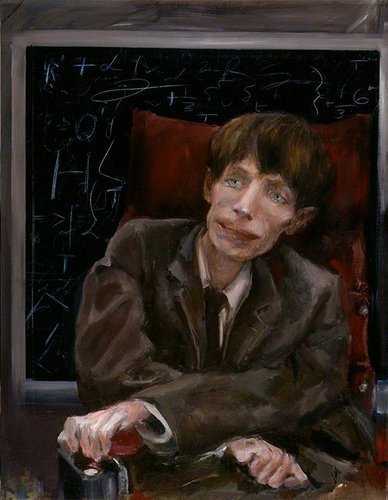
Stephen Hawking painted by Yolanda Sonnabend in 1985.
I don’t know how I have the gall to review this book, because I only read half of it. I didn’t read one half and then stop…. rather I read the whole thing, but jumping all the science chapters. I am of an age where I am no longer prepared to do battle with ideas that I will have forgotten a year later, and I’m afraid Stephen Hawking’s work in cosmology comes into this bracket.
So, what was left? A biography of a charismatic and brilliant scientist with motor neuron disease, who overcame serious limitations and went on to achieve great things.
Even without the science it was a fascinating book. Learning about Hawking’s family, and his father’s ambitions for him, his time at Oxford as an undergraduate, then as a graduate and eventually as a fellow and research scientist at Cambridge.
We learn of his accolades and honours, his family life, physical difficulties to be overcome, a medical episode where he almost lost his life, and the enormous success of his most famous book A Short History of Time – and there follows a discussion about its readability that I found most cheering in view of skipping the science chapters in this book!
His fame grows enormously. “Hawking enjoyed the adulation and celebrity. He continued to travel around the world. The invitations go give public lectures were becoming overwhelming, and he could have spent his whole time delivering them….In Japan he was received as an idol, getting the sort of reception usually reserved for heads of state or internationally famous rock stars. Back in Cambridge, the volume of mail Hawking received daily had long since become too much for him to handle personally. He continued to receive honorary degrees and international awards."
In 1990, Stephen divorced Jane, and married Elaine Mason, who had been his nurse.
A film was made based on A Brief History of Time, based on a series of interviews with Hawking. It had a three-million dollar budget, and was released in 1992.
In 1997 he made a television series - Stephen Hawking’s Universe
For me (probably because I skipped the science bits), this book was all about celebrity. I had no idea before I read it that this would be the case. Hawking is profusely admired by people all over the world. On one hand I am happy that a scientist is receiving such general respect, but on the other hand I found it all a bit Hollywood and glitzy. Hawking is more than the sum of his work – perhaps enhanced by the fact that many of us do not understand it. But we love the idea of genius, and people who rise above their limitations – and maybe that kind of celebrity is no bad thing.
-----------------------------------------------------------------------
Snips from the book I found particularly interesting (a hash of extracts and my notes)
-----------------------------------------------------
Photograph - property of The National Portrait Gallery, London.
March 31, 2018
I had to skip the chapters about physics, I'm way too stupid for these...
(btw, I've just realised i've finished reading this book on a day of Stephen Hawking's funeral...)
(btw, I've just realised i've finished reading this book on a day of Stephen Hawking's funeral...)

August 18, 2023
Foarte multa fizica si prea putin despre viata lui. Mi-ar fi placut sa aflu mai multe intimitati, mai mult despre boala lui si ce a insemnat viata lui si a celor din jurul lui, cum au trait aceasta boala, in definitiv sa il cunosc mai bine, insa nu a fost cazul. A fost o carte obositoare.

August 15, 2022
This was an interesting look into the great scientist's personal and professional life. There is much about his two marriages, especially the first to long-suffering Jane Hawking. There is much that reveals the great mind to host an irascible even mean-spirited personality. Since White and co-author John Gribbin have scientific backgrounds, there are gentle introductions to the ideas and concepts advanced and explored by Hawking. There is a fair amount here about his controversial remarks on God and his impressive efforts to advance his own access as a disabled person and help the cause for others.

May 7, 2013
Although most of the biography written when the actual person concerned is living, tend to be crappy this one is actually nice, a good read if you want to know what Hawking is all about and how he got there.

June 13, 2012
This book was a bitch of a struggle to get thru mainly because of the science based chapters. But i pushed on because the subject and the man are so fascinating. (I was also hoping to get a clearer understanding of the content in A Brief HIstory of Time which I, like a similar journalist noted in this book got to about page 29 and went huh?). Hawkings mind is a universe unto itself and thankfully for us he has the perseverance of a raging comet. Plenty of the science bits in this book were a literal cosmic wash over me but any glimmer into the universe was well worth it. Following him along his path to enlightenment while his body was slowly disintegrating was awe inspiring. Be prepared for a heady read. Maybe one day Sesame Street will get a hold of this topic so I get it fully and completely:).

October 5, 2019
The chapters with summaries of Hawking's work are quite good - I recommend them to anyone who found Hawking's own A Brief History Of Time difficult to understand. I particularly liked that the authors put the work in context of other scientific thought.
But the chapters on his personal life were irritating. Originally written in 1992, this 2002 edition still has very outdated (i.e. ableist) language and old-fashioned ideas about the role of a professor's wife. Which I could deal with except that there wasn't much insight to either Hawking's personality, or family life, or the institutions he worked for and with.
The authors obviously wanted to write about Hawking because they looked up to him. But they go out of their way to excuse any negative thing he did, which is a missed opportunity for better understanding of what drove him. I'd rather they'd been more impartial.
But the chapters on his personal life were irritating. Originally written in 1992, this 2002 edition still has very outdated (i.e. ableist) language and old-fashioned ideas about the role of a professor's wife. Which I could deal with except that there wasn't much insight to either Hawking's personality, or family life, or the institutions he worked for and with.
The authors obviously wanted to write about Hawking because they looked up to him. But they go out of their way to excuse any negative thing he did, which is a missed opportunity for better understanding of what drove him. I'd rather they'd been more impartial.

September 15, 2017
The physics was a bit beyond me, but I still found it an interesting read.
I am glad I don't have to spend my life contemplating black holes and what electrons do. :P
I am glad I don't have to spend my life contemplating black holes and what electrons do. :P

February 20, 2024
White and Gribbin, adept science writers, have masterfully depicted an indomitable genius and an expansive scientific intellect in the book - Stephen Hawking: A Life in Science. It was first published in 1992.
As I read the pages of this book, I'm struck by how the writers effortlessly blend clear explanations of Hawking's scientific achievements with a heartfelt account of his personal life. Their approach allows readers like me to gain a deeper understanding and appreciation for both facets of his remarkable journey.
The book recounts how at the age of 21, just before his marriage, Hawking was given a grim prognosis of only two years to live due to amyotrophic lateral sclerosis (ALS). Despite this, he defied the odds and lived for 55 years, surpassing all expectations and breaking records for longevity with the condition. However, the shadow of mortality always lingered over him. Part of his appeal came from this vulnerability, as well as from the contrast between his brilliant mind and his frail body.
In terms of his personal life, the book highlights the role of Jane Wilde, who married Hawking shortly after his ALS diagnosis. Jane's unwavering dedication and selflessness were evident as she cared for him and their three children for 25 years. However, their marriage eventually ended when Hawking moved in with Elaine Mason, his caregiver. It's worth noting that Mason was married to the person who had adapted Hawking's computer for his wheelchair.
The authors effectively traced Hawking’s influence on the development of cosmology. They utilized his own words to illustrate how he integrated fresh evidence into mathematical models, shedding light on the connection between black holes and the expanding universe. Additionally, they propose that Hawking could be viewed as carrying on Einstein's pursuit of a unified theory of physics, a lofty ambition indeed. However, the book emphasizes that his achievements were often the product of collaboration with other scientists, notably mentioning Roger Penrose.
Stephen Hawking and Albert Einstein share a connection forged by their profound influences on theoretical physics. Just as Einstein's name is synonymous with his revolutionary theories of relativity, Hawking's legacy is marked by his pioneering work on Hawking radiation, which he proposed as particles emitted by black holes.
This groundbreaking contribution firmly cements Hawking's esteemed reputation and enduring influence in the scientific community, echoing Einstein's lasting legacy in the field of physics.
As someone who isn't a scientist, I'm fascinated by concepts like the creation of the universe, black holes, quantum fluctuations, multiverses, spacetime fabric, and time travel. In this book, the authors have managed to explain these complex ideas in simple terms and with plenty of metaphors, which I really appreciate. I've noticed a similarity with Stephen Hawking in this regard. His ability to explain intricate concepts using accessible language, vivid metaphors, and a touch of humor is truly impressive. In fact, it's thanks to him that I've developed an interest in cosmology.
I highly recommend this book to anyone with an interest in science who is seeking an engaging and accessible read. It offers a unique blend of scientific exploration and biography, making it a captivating choice for both enthusiasts and newcomers to the field.
Reproduced from my blog: Stephen Hawking by Michael White & John Gribbin
As I read the pages of this book, I'm struck by how the writers effortlessly blend clear explanations of Hawking's scientific achievements with a heartfelt account of his personal life. Their approach allows readers like me to gain a deeper understanding and appreciation for both facets of his remarkable journey.
The book recounts how at the age of 21, just before his marriage, Hawking was given a grim prognosis of only two years to live due to amyotrophic lateral sclerosis (ALS). Despite this, he defied the odds and lived for 55 years, surpassing all expectations and breaking records for longevity with the condition. However, the shadow of mortality always lingered over him. Part of his appeal came from this vulnerability, as well as from the contrast between his brilliant mind and his frail body.
In terms of his personal life, the book highlights the role of Jane Wilde, who married Hawking shortly after his ALS diagnosis. Jane's unwavering dedication and selflessness were evident as she cared for him and their three children for 25 years. However, their marriage eventually ended when Hawking moved in with Elaine Mason, his caregiver. It's worth noting that Mason was married to the person who had adapted Hawking's computer for his wheelchair.
The authors effectively traced Hawking’s influence on the development of cosmology. They utilized his own words to illustrate how he integrated fresh evidence into mathematical models, shedding light on the connection between black holes and the expanding universe. Additionally, they propose that Hawking could be viewed as carrying on Einstein's pursuit of a unified theory of physics, a lofty ambition indeed. However, the book emphasizes that his achievements were often the product of collaboration with other scientists, notably mentioning Roger Penrose.
Stephen Hawking and Albert Einstein share a connection forged by their profound influences on theoretical physics. Just as Einstein's name is synonymous with his revolutionary theories of relativity, Hawking's legacy is marked by his pioneering work on Hawking radiation, which he proposed as particles emitted by black holes.
This groundbreaking contribution firmly cements Hawking's esteemed reputation and enduring influence in the scientific community, echoing Einstein's lasting legacy in the field of physics.
As someone who isn't a scientist, I'm fascinated by concepts like the creation of the universe, black holes, quantum fluctuations, multiverses, spacetime fabric, and time travel. In this book, the authors have managed to explain these complex ideas in simple terms and with plenty of metaphors, which I really appreciate. I've noticed a similarity with Stephen Hawking in this regard. His ability to explain intricate concepts using accessible language, vivid metaphors, and a touch of humor is truly impressive. In fact, it's thanks to him that I've developed an interest in cosmology.
I highly recommend this book to anyone with an interest in science who is seeking an engaging and accessible read. It offers a unique blend of scientific exploration and biography, making it a captivating choice for both enthusiasts and newcomers to the field.
Reproduced from my blog: Stephen Hawking by Michael White & John Gribbin
October 11, 2019
Stephen Hawking was one of the greatest scientists ever to live on this planet. He helped to completely change the realm of theoretical physics and ideas about the universe, and he did all of that while confined to a wheelchair for fifty years.
The book Stephen Hawking: A life in Science, written by Michael White and John Gribbin, could be described as half biography and half science textbook. What I mean by this is that the book would outline a part of Hawking’s life and then explain the science that he was working on at the time. The biographical chapters focused on Hawking’s personal life and academics, including the days of his youth, his marriage, his crippling disease, the books he wrote, and the movie he starred in that was based upon his book A Brief History of Time. It followed his life up until 1992, which is when this biography was written. In several sections, the authors did write about Hawking in the present tense because he was alive at the time of publication. The scientifical chapters focused on theories surrounding the beginnings of the universe and black holes, which were the main branches of science that Hawking studied. It also described the efforts to create a Grand Unified Theory that would be a set of equations that described every force in the universe including gravity, electromagnetic force, weak nuclear force, and strong nuclear force.
I found the book to be quite interesting and informative, although a little outdated. However, I doubt that people that are not very interested in science would like this book. A section that I found interesting was when they were describing the universe 0.1 seconds after the big bang. The book states, “The temperature was 30 billion degrees, and the Universe consisted of a mixture of very high energy radiation (photons) and material particles including neutrons, protons and electrons” (White 86). While not many people would find this interesting, I thought that it was fascinating that the universe had been so hot and that there weren’t even atoms at the time. However, some descriptions of Stephen Hawking were downright hilarious. At one point, the book states, “His favourite move, when he is annoyed by something someone has said, is to drive over their toes” (White 162). I found that it was hilarious that Hawking would use his wheelchair in such a manner and in fact his great regret, at least in 1992, is that “he’s not yet run over Margaret Thatcher” (White 162). This book uses colorful description effectively as shown by the previous example, but does not have much dialogue since the biography sections are written in a similar style to a documentary. There is a good reflection which talks about how Hawking became such a great scientist even though he had so many problems in his life. I would recommend this book to anybody that is interested in science and is looking for a lighter scientifical read that is mixed in with a biography of a major scientist. However, if you are not interested in science at all, this book might not be the right choice for you.
The book Stephen Hawking: A life in Science, written by Michael White and John Gribbin, could be described as half biography and half science textbook. What I mean by this is that the book would outline a part of Hawking’s life and then explain the science that he was working on at the time. The biographical chapters focused on Hawking’s personal life and academics, including the days of his youth, his marriage, his crippling disease, the books he wrote, and the movie he starred in that was based upon his book A Brief History of Time. It followed his life up until 1992, which is when this biography was written. In several sections, the authors did write about Hawking in the present tense because he was alive at the time of publication. The scientifical chapters focused on theories surrounding the beginnings of the universe and black holes, which were the main branches of science that Hawking studied. It also described the efforts to create a Grand Unified Theory that would be a set of equations that described every force in the universe including gravity, electromagnetic force, weak nuclear force, and strong nuclear force.
I found the book to be quite interesting and informative, although a little outdated. However, I doubt that people that are not very interested in science would like this book. A section that I found interesting was when they were describing the universe 0.1 seconds after the big bang. The book states, “The temperature was 30 billion degrees, and the Universe consisted of a mixture of very high energy radiation (photons) and material particles including neutrons, protons and electrons” (White 86). While not many people would find this interesting, I thought that it was fascinating that the universe had been so hot and that there weren’t even atoms at the time. However, some descriptions of Stephen Hawking were downright hilarious. At one point, the book states, “His favourite move, when he is annoyed by something someone has said, is to drive over their toes” (White 162). I found that it was hilarious that Hawking would use his wheelchair in such a manner and in fact his great regret, at least in 1992, is that “he’s not yet run over Margaret Thatcher” (White 162). This book uses colorful description effectively as shown by the previous example, but does not have much dialogue since the biography sections are written in a similar style to a documentary. There is a good reflection which talks about how Hawking became such a great scientist even though he had so many problems in his life. I would recommend this book to anybody that is interested in science and is looking for a lighter scientifical read that is mixed in with a biography of a major scientist. However, if you are not interested in science at all, this book might not be the right choice for you.

April 18, 2022
I like biographies of big, famous people in history and Hawking is a fascinating character so I read this one. I have seen the biographic movie based on his first wife's book, read A Brief History of Time (not just pretended to) and I live in Cambridge where he spent so much of his life.
This claims to be the first biography and is written by some of his fellow scientists and seeks to be a mix of personal biography and exploration of his scientific ideas. While both of these things are fascinating subjects in themselves worthy of their own books, I feel this book kind of falls between the two stools. It also feels a little bit old-fashioned having been written in the early-90's but it gave me the sense of being even older.
Firstly, the science bits: I am no scientist but I am interested in scientific ideas and if they touch on the creation of the universe, black holes, multiverses and time travel then I'm in but I do need it explained in very basic terms, ideally with lots of metaphors. This book isn't too bad here, with the authors explaining the ideas of Hawking and his fellow physicists through comparisons with balloons, strings etc. While all this is quite good the problem is it isn't as effective as Stephen Hawking did it, with simple language, powerful metaphors and great humour.
Then there is the personal life elements. This is difficult territory with lots of big choices from the authors about how to portray Hawking's disability in a way that doesn't patronise him or put him on an unreasonable pedestal as some kind of saint. In some ways this works, with stories of Hawking's occasional pettiness, massive ego, and stubbornness existing alongside his extraordinary work in the face of such huge challenges. In lots of other ways though, I didn't think it worked. The academics' view of disability is perhaps most charitably described as old-fashioned, their limited sympathy for how hard things were for his wife seem quite sexist (with a strangely unsympathetic take on his divorce from his first wife), and the text is littered with weird soliloquies about what was going on in the rest of the world at the time in that particular decade to no obvious purpose. It also says something about these academics and their sense of entitlement that they seemingly feel we should all have massive sympathy for any of them who don't have the money to send all their children to an elite private school in Cambridge (I don't).
As I say I live in Cambridge so it is interesting to hear about the places in the City where Hawking lived and worked. While harder to read, the science bits are also quite good, just not Stephen Hawking level good. The life story elements are there, some things I didn't know and some strong examples of his humour as well as his stubbornness. Overall though I thought the film was much more entertaining and that I might have been better off reading his wife's biography than this one.
This claims to be the first biography and is written by some of his fellow scientists and seeks to be a mix of personal biography and exploration of his scientific ideas. While both of these things are fascinating subjects in themselves worthy of their own books, I feel this book kind of falls between the two stools. It also feels a little bit old-fashioned having been written in the early-90's but it gave me the sense of being even older.
Firstly, the science bits: I am no scientist but I am interested in scientific ideas and if they touch on the creation of the universe, black holes, multiverses and time travel then I'm in but I do need it explained in very basic terms, ideally with lots of metaphors. This book isn't too bad here, with the authors explaining the ideas of Hawking and his fellow physicists through comparisons with balloons, strings etc. While all this is quite good the problem is it isn't as effective as Stephen Hawking did it, with simple language, powerful metaphors and great humour.
Then there is the personal life elements. This is difficult territory with lots of big choices from the authors about how to portray Hawking's disability in a way that doesn't patronise him or put him on an unreasonable pedestal as some kind of saint. In some ways this works, with stories of Hawking's occasional pettiness, massive ego, and stubbornness existing alongside his extraordinary work in the face of such huge challenges. In lots of other ways though, I didn't think it worked. The academics' view of disability is perhaps most charitably described as old-fashioned, their limited sympathy for how hard things were for his wife seem quite sexist (with a strangely unsympathetic take on his divorce from his first wife), and the text is littered with weird soliloquies about what was going on in the rest of the world at the time in that particular decade to no obvious purpose. It also says something about these academics and their sense of entitlement that they seemingly feel we should all have massive sympathy for any of them who don't have the money to send all their children to an elite private school in Cambridge (I don't).
As I say I live in Cambridge so it is interesting to hear about the places in the City where Hawking lived and worked. While harder to read, the science bits are also quite good, just not Stephen Hawking level good. The life story elements are there, some things I didn't know and some strong examples of his humour as well as his stubbornness. Overall though I thought the film was much more entertaining and that I might have been better off reading his wife's biography than this one.

December 19, 2024
Overall tone of the book was very adulatory of Hawking. Sexism is prevalent in the portrayal of some of the women throughout Hawking's life. The very first example being the juxtaposition of Shirley Maclaine to Hawking as "Hollywood actress & Cambridge professor". Maclaine is an actress but to portray it as the only noteworthy thing she's done is inaccurate. She led a politically active life campaigning for George McGovern for the 1972 presidential election. In 1970, she also began to write books, eight of which were published prior to this one.
Authors feel the need to clarify what they mean by the term theory, despite the fact that the target audience of this book is likely well aware of what theory means in this context. Briefly mentioned is Hawkings own upbringing, in which it's explained his parents both attended Oxford. The relationship between Hawking & Jane is described in a way that feels one sided. It's elaborated the ways in which Jane sacrificed her personal ambitions throughout their life together, to take care of Hawking's needs relating to his condition. A statement from jane within the book reads:
"When I married him I knew there was not going to be the possibility of my having a career, that our household could only accommodate one career and that had to be Stephen's. Nevertheless, I have to say I found it very difficult and very frustrating in those early years. I felt myself very much the household drudge, and Stephen was getting all the glittering prizes"
Hawking's attitude regarding this seems insouciant overall. The average lifespan of an ALS patient after diagnosis is 2-5 years, making Hawking's extended lifespan truly remarkable. Hawking didn't die until 55 years after his ALS diagnosis, at 76 years old. Overall the book provides some interesting info regarding both physics & Hawking's life.
Authors feel the need to clarify what they mean by the term theory, despite the fact that the target audience of this book is likely well aware of what theory means in this context. Briefly mentioned is Hawkings own upbringing, in which it's explained his parents both attended Oxford. The relationship between Hawking & Jane is described in a way that feels one sided. It's elaborated the ways in which Jane sacrificed her personal ambitions throughout their life together, to take care of Hawking's needs relating to his condition. A statement from jane within the book reads:
"When I married him I knew there was not going to be the possibility of my having a career, that our household could only accommodate one career and that had to be Stephen's. Nevertheless, I have to say I found it very difficult and very frustrating in those early years. I felt myself very much the household drudge, and Stephen was getting all the glittering prizes"
Hawking's attitude regarding this seems insouciant overall. The average lifespan of an ALS patient after diagnosis is 2-5 years, making Hawking's extended lifespan truly remarkable. Hawking didn't die until 55 years after his ALS diagnosis, at 76 years old. Overall the book provides some interesting info regarding both physics & Hawking's life.

September 13, 2020
Interesante lectura en la que aprendemos que a Hawking le dieron dos años de vida a los 21, justo antes de casarse, pero aguantó 55 años, rompiendo las estadísticas de la esclerosis lateral amiotrófica. Hawking ha sido el paciente más longevo en la historia de esta enfermedad.
Otra anécdota que me encantó fue que en los cursos de doctorado de Oxford todo el mundo medía su capacidad contra Hawking, que era siempre el mejor de la clase. Hacer 0.8 Hawkings era un honor.
El libro es entretenido y cuenta tanto anécdotas personales del científico como las líneas principales de su trabajo. Hay una anécdota sobre un simposio de gravitación en el que un trabajo de Hawking y Ellis, acerca de el espaciotiempo a gran escala, fue comprendido por exactamente 0 personas del público.
Hay una edición actualizada, por supuesto. En la que yo leí el libro acababa con un Hawking de 50 años dándolo todo aún, pero faltaban muchos años de producción del maestro.
Otra anécdota que me encantó fue que en los cursos de doctorado de Oxford todo el mundo medía su capacidad contra Hawking, que era siempre el mejor de la clase. Hacer 0.8 Hawkings era un honor.
El libro es entretenido y cuenta tanto anécdotas personales del científico como las líneas principales de su trabajo. Hay una anécdota sobre un simposio de gravitación en el que un trabajo de Hawking y Ellis, acerca de el espaciotiempo a gran escala, fue comprendido por exactamente 0 personas del público.
Hay una edición actualizada, por supuesto. En la que yo leí el libro acababa con un Hawking de 50 años dándolo todo aún, pero faltaban muchos años de producción del maestro.
August 25, 2018
This book strikes a good balance between covering the science Hawking worked on with the story of his personal life. Stephen Hawking's celebrity and his illness have created something of a caricature of the man in the public imagination. The author dispels that caricature by providing a full portrait of Hawking displaying not only his genius, but his sense of humor, his sometimes disagreeable personality, and his ambivalent relationship with the fame he acquired.
The science sections were, admittedly, a little hard to get through but I don't think that is the fault of the author. The discoveries Hawking made are truly understand by very few people. The concepts can only be simplified so far until they lose their meaning.
Overall, I found this a very enjoyable read, a fascinating look at the life of someone who has overcome serious difficulty to contribute a vast amount to human knowledge.
The science sections were, admittedly, a little hard to get through but I don't think that is the fault of the author. The discoveries Hawking made are truly understand by very few people. The concepts can only be simplified so far until they lose their meaning.
Overall, I found this a very enjoyable read, a fascinating look at the life of someone who has overcome serious difficulty to contribute a vast amount to human knowledge.
July 2, 2019
This is a chronological account of Stephen's life, interspersed with theoretical physics as the field has developed over the years.
It's a fascinating read from the physics perspective. Really interesting and really well explained for the lay-man with analogies that can be understood by anyone. Even so, I still found myself rereading the same page a few times over before things sunk in. It was amazing to understand the process behind discovering advancements in the field that fundamentally changed the way we think about the universe, and seeing how these advancements changed over time, from the theory of general relativity to neutron stars, pulsars etc.
I found the actual depictions of Stephen's life a bit contrived, but this is the downside of unofficial biographies. I'm sure the major pieces were there, but it did feel very third-person and I was conscious that I was reading someone's interpretation of Stephen's life.
It's a fascinating read from the physics perspective. Really interesting and really well explained for the lay-man with analogies that can be understood by anyone. Even so, I still found myself rereading the same page a few times over before things sunk in. It was amazing to understand the process behind discovering advancements in the field that fundamentally changed the way we think about the universe, and seeing how these advancements changed over time, from the theory of general relativity to neutron stars, pulsars etc.
I found the actual depictions of Stephen's life a bit contrived, but this is the downside of unofficial biographies. I'm sure the major pieces were there, but it did feel very third-person and I was conscious that I was reading someone's interpretation of Stephen's life.

March 30, 2020
Erittäin mielenkiintoinen, informatiivinen ja helppolukuinen kirja. Vaikka kirjan tiedot fysiikan tutkimuksen alalta ovatkin varmasti paljon kirjan kirjoittamisen jälkeen muuttuneet tai tarkentuneet, on tämä kirja Stephen Hawkingin elämän kuvauksen lisäksi myös valaiseva ja yksinkertainen teos siitä, miltä fysiikan teorioiden kehityskaari on kirjan kirjoittajien silmin näyttäytynyt vuonna 1992.
Suosittelen kirjaa varsinkin niille, jotka yhtään tavallista keskivertokansalaista enemmän ovat kiinnostuneita maailmankaikkeuden synnyn teorioiden kehityksestä, teoreettisesta fysiikasta tai vaikkapa vain niistä tiedemiehistä, jotka näitä asioita työkseen läpi elämänsä ovat pohtineet ja mallintaneet.
Suosittelen kirjaa varsinkin niille, jotka yhtään tavallista keskivertokansalaista enemmän ovat kiinnostuneita maailmankaikkeuden synnyn teorioiden kehityksestä, teoreettisesta fysiikasta tai vaikkapa vain niistä tiedemiehistä, jotka näitä asioita työkseen läpi elämänsä ovat pohtineet ja mallintaneet.

May 13, 2017
Interesting account of Stephen Hawking's life; albeit one where the chapters on that life are often alternated with chapters on the science he was working on. This is hard to avoid - one can't really do a decent bio of a person while ignoring their life's work! - but for the first half of the book I was far more interested in the biography chapters, while the pure science ones were a slightly annoying interruption. Then, about halfway through, it all swapped round for me. I actually found myself taking notes on the science chapters, fascinated and trying to understand better, then slogging my way through the life history just so I could get back to note-taking!
Never happy, that's me.
Never happy, that's me.

September 22, 2017
The cover of the book initially sent me nostalgic to see the young charming Mr.Hawking with his pressed all too classical suit and a tad tilted head that hinted of thought. As you dwelve inside its pages you come face to face with one of the world's most famous and ingenious human being. His wits and bravery are too infectious that it leaves you in awe. Wits because well, he is more than witty. Bravery to cross the chasm of ALS through all odds and stand in the brink of life that is only very well lived. Salute to the most intriguing and inspiring individual!

September 9, 2020
Este é um livro que se lê com verdadeiro gosto, pois dá a conhecer não só os contributos para o avanço da física e da cosmologia, mas também a história de um homem verdadeiramente fascinante, inspirador e único. De forma muito humana, é destacado não só o seu humor, determinação e optimismo mas também o seu Pontual mau génio e teimosia. Creio verdadeiramente que a sua passagem neste mundo teve um profundo impacto, que esta é uma pessoa significativa e que não havia obstáculo que o impedisse de realizar aquilo a que se propôs.
This entire review has been hidden because of spoilers.

Read
May 19, 2018Loved the way the authors juxtaposed between the life of Stephen Hawking and the scientific work and mind of Stephen Hawking. It made it easier to digest the scientific research than if it had all been about the research without a break in-between. The last sentence in the book speaks directly to what is occurring in my life now:
"One has to be grown up enough to realize that life is not fair. You have to do the best you can in the situation you are in." - Stephen Hawking
"One has to be grown up enough to realize that life is not fair. You have to do the best you can in the situation you are in." - Stephen Hawking

October 17, 2024
Only the physics chapters are worth reading. All the concepts are explained quite well. It was easy to understand and educational.
For the biographical chapters, there's nothing. No interesting facts, only flattery and sycophancy.
And dear M. W. and J. G., who writes like that? The room was dominated by a large desk... the walls were lined with bookshelves. Have you no better language than that?
For the biographical chapters, there's nothing. No interesting facts, only flattery and sycophancy.
And dear M. W. and J. G., who writes like that? The room was dominated by a large desk... the walls were lined with bookshelves. Have you no better language than that?
April 29, 2019
This is my first book to have got to known Stephen Hawkings, a physicist who’ve come with flying colors despite faced with the disease, ALS and still managed to live a life just like a normal being showing arrogance, sex interest, fame/popularity, travelling the world, multiple relationships, etc...

June 27, 2019
Biografia Hawkinga napisana przez dwóch naukowców. Nacisk jest więc położony na badania, świat nauki. Autorzy też wyjaśniają wiele zagadnień z fizyki teoretycznej. Książka niestety kończy się na wydaniu "Krótkiej historii czasu".

July 23, 2019
An extraordinary book. Combines science and biography with equal focus. Tries to explain the concepts in a simple way and succeeds most of the time. The breadth of Stephen Hawking’s research is breathtaking so is the longevity of his determination. Unparalleled life. Must read
February 12, 2024
There were some very heavy scientific parts in this book that were hard to understand as I am not a person of great physics and astronomy intellect. I liked the beginning a lot where the books talked about Steven Hawking’s childhood and young adult life.
December 30, 2018
A well written book covering all aspects of Stephen Hawking's life. The writers provide a good rhythm in alternating between the life of Hawking and the science behind his lifelong work.

March 1, 2019
good book, enjoyed the parts about Stephen's personal life.
March 23, 2019
Love every single chapter of the book.

Read
June 30, 2019I have two different english editions on 4y. There is another edition between autobiographies at letter H.

September 3, 2020
I've read through a bunch of Stephen Hawking's books and a couple bios. Solid read. Would easily recommend for any fan of SH.
Displaying 1 - 30 of 59 reviews