

What do you think?

Карфаген должен быть разрушен
Карфаген…
Наследник цивилизации финикийских мореплавателей, основавших множество колоний.
Богатейший город на западном cредиземноморском побережье Африки, обладающий могучим флотом и боеспособной армией.
Торговая держава, господствовавшая в регионе задолго до прихода римлян.
И все же "Карфаген должен быть разрушен!"
Почему не покорен, не завоеван, а именно стерт с лица земли?
По каким причинам существование Карфагена сделалось столь невыносимым для его главного конкурента — молодой Римской республики?
На эти и другие вопросы отвечает в своей увлекательной книге историк и археолог Ричард Майлз.
Наследник цивилизации финикийских мореплавателей, основавших множество колоний.
Богатейший город на западном cредиземноморском побережье Африки, обладающий могучим флотом и боеспособной армией.
Торговая держава, господствовавшая в регионе задолго до прихода римлян.
И все же "Карфаген должен быть разрушен!"
Почему не покорен, не завоеван, а именно стерт с лица земли?
По каким причинам существование Карфагена сделалось столь невыносимым для его главного конкурента — молодой Римской республики?
На эти и другие вопросы отвечает в своей увлекательной книге историк и археолог Ричард Майлз.
576 pages, Hardcover
First published July 21, 2011
Ratings & Reviews
Friends & Following
Create a free account to discover what your friends think of this book!
Community Reviews
Displaying 1 - 30 of 432 reviews

May 22, 2012
Until the publication of this excellent book, the preeminent text about Carthage was the 1995 volume Carthage: A History by the French historian Serge Lancel. This, an outstanding contribution to the patchy knowledge we have of Carthage, has just been eclipsed. One might think that part of the reason for this is that Carthage Must Be Destroyed did not need to be translated (inevitably, there were some places where Lancel's text became unwieldy). It's far from that: this is a better written, easier to follow, more rounded book than Lancel's.
Miles begins with the Phoenicians, the people who founded Carthage, and goes on from there. His style is at all times enjoyable, and his arguments well presented. Apart from the obvious following of Carthage's history, he goes into great depth about subjects such as the manner in which Hannibal aped the feats of Hercules in order to show that he had divine backing, and how the Romans fought back against this religious propaganda. He also explains in depth how, from the time of the Second Punic War onwards, the Romans made it their business to portray the Carthaginians as untrustworthy, perfidious liars and cheats. This in turn allowed them to show themselves as more heroic and steadfast.
Anyone who is interested in learning the full (well, what is known) details about Carthage and its history, needs to read this book. I for one will be returning to it again and again in the future. In my opinion, leading Lancel's book is also a good idea. Another interesting text is Daily Life in Carthage at the Time of Hannibal by the academic Gilbert Charles-Picard. Although it was written in the 1960s, it has some useful information about Carthaginian culture.
Miles begins with the Phoenicians, the people who founded Carthage, and goes on from there. His style is at all times enjoyable, and his arguments well presented. Apart from the obvious following of Carthage's history, he goes into great depth about subjects such as the manner in which Hannibal aped the feats of Hercules in order to show that he had divine backing, and how the Romans fought back against this religious propaganda. He also explains in depth how, from the time of the Second Punic War onwards, the Romans made it their business to portray the Carthaginians as untrustworthy, perfidious liars and cheats. This in turn allowed them to show themselves as more heroic and steadfast.
Anyone who is interested in learning the full (well, what is known) details about Carthage and its history, needs to read this book. I for one will be returning to it again and again in the future. In my opinion, leading Lancel's book is also a good idea. Another interesting text is Daily Life in Carthage at the Time of Hannibal by the academic Gilbert Charles-Picard. Although it was written in the 1960s, it has some useful information about Carthaginian culture.

April 16, 2019
From our view point of history we can see that Carthage would be destroyed.
To the people of that time no one was knew which city would rule the Mediterranean - Carthage or Rome.

The sacred chickens drink
In 249 BC the Roman consul Publius Claudius Pulcher–a man variously described as being mentally unstable, an arrogant snob and a drunk–decided to launch an attack on the Carthaginian-held port of Drepana. The mission got off to a rocky start when the sacred chickens used to gauge divine favour went off their feed, prompting the impetuous Claudius to throw them overboard with the pithy remark that perhaps they were thirsty.
"If they won't eat, then let them drink!"
He then went on to lose the battle...
By the third century BC, Rome was on the rise and showing an almost insatiable hunger for conquest; the empires drifted into the first Punic war "less for reasons of strategy and more for lack of political will to prevent it". Rome's nemesis came in the form of Hannibal, a ruthless and daring general. Departing from Spain in 218BC with 50,000 troops, Hannibal attempted the unthinkable: to invade Italy by land, marching through Spain, France and the trackless, snow-covered Alps, meeting hostile tribesmen at every turn.

For all his audacious battles Hannibal still lost to the determined Romans.
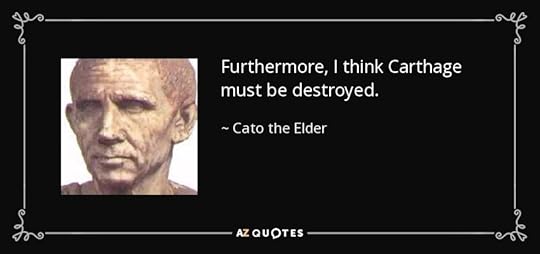
They make a desolation and they call it peace.
That was the end of Carthage.
Enjoy!
.
To the people of that time no one was knew which city would rule the Mediterranean - Carthage or Rome.
The sacred chickens drink
In 249 BC the Roman consul Publius Claudius Pulcher–a man variously described as being mentally unstable, an arrogant snob and a drunk–decided to launch an attack on the Carthaginian-held port of Drepana. The mission got off to a rocky start when the sacred chickens used to gauge divine favour went off their feed, prompting the impetuous Claudius to throw them overboard with the pithy remark that perhaps they were thirsty.
"If they won't eat, then let them drink!"
He then went on to lose the battle...
By the third century BC, Rome was on the rise and showing an almost insatiable hunger for conquest; the empires drifted into the first Punic war "less for reasons of strategy and more for lack of political will to prevent it". Rome's nemesis came in the form of Hannibal, a ruthless and daring general. Departing from Spain in 218BC with 50,000 troops, Hannibal attempted the unthinkable: to invade Italy by land, marching through Spain, France and the trackless, snow-covered Alps, meeting hostile tribesmen at every turn.
For all his audacious battles Hannibal still lost to the determined Romans.
They make a desolation and they call it peace.
That was the end of Carthage.
Enjoy!
.

January 25, 2025
Rome Wins
In Carthage Must be Destroyed Richard Miles embarks on an ambitious journey to uncover the story of one of antiquity’s most misunderstood powers. While the name Carthage often conjures images of Hannibal crossing the Alps or Rome’s fiery conquest, Miles goes far beyond these familiar moments to offer a comprehensive and nuanced portrait of this Phoenician-founded city-state. By weaving together archaeology, ancient texts, and modern scholarship, he sheds light on the rise, zenith, and tragic fall of a civilisation that shaped Mediterranean history.
As I have mentioned above, Miles chronicles Carthage’s rise from a small Phoenician trading outpost in North Africa to a maritime superpower that dominated the western Mediterranean. The book excels in showing how Carthage’s commercial prowess, cultural achievements, and religious practices made it a unique and dynamic society. However, Miles does not shy away from examining its challenges, such as internal political tensions and the brutal realities of ancient warfare.
One of the strengths of Carthage Must be Destroyed is its ability to place Carthage within a broader Mediterranean context. Miles highlights its interactions with other powers like Greece, Egypt, and Rome, emphasising how these relationships shaped Carthage’s trajectory. The focus on the Punic Wars (264-146 BC) is particularly gripping, especially the detailed accounts of Hannibal’s military genius and the eventual destruction of Carthage in 146 BC.
The wars are divided into three, the first (264-241 BC) which was largely a maritime conflict where Rome and Carthage fought over Sicily with Rome inventing the Corvus a boarding device which helped them decisively defeating the Carthaginians. The second (218-201 BC) where Hannibal famously marched through Spain and crosses the Alps inflicting the famous defeat at Cannae. Here the true nature of the Romans was first revealed, they never gave up, didn’t submit or surrender and instead avoided direct confrontation with Hannibal, attacking their colonies in Spain and Africa. This caused Hannibal to leave Italy to go back to North Africa where he was defeated by Scipio Africanus at the Battle of Zama in 201 BC. Which her power mostly taken away, Rome could never accept Carthages presence and so launched the third war (149-146 BC) where they played siege to the city and then wiped it off the map.
Miles also delves into the biases of ancient sources, particularly Roman accounts, which often portray Carthage as a barbaric and treacherous foe. By critically analysing these sources and integrating archaeological evidence, Miles reconstructs a more balanced and nuanced picture of Carthaginian society.
While Carthage Must be Destroyed is richly informative, I found it dry in places with the writing style providing more of an academic tone. Additionally, the reliance on fragmentary evidence sometimes limits the narrative’s depth, though this is more a reflection of the historical record than the author’s approach. This is a general problem when looking at the ancient world, as we know less than one percent and a lot of what we think we know might not be true.
In conclusion, Carthage Must be Destroyed offers a thorough and detailed account of a fascinating civilisation, but its dense academic style and occasional reliance on fragmented evidence may make it less accessible to the average reader. While Richard Miles provides valuable insights and challenges traditional Roman narratives about Carthage, the book can feel overwhelming at times, with its depth occasionally coming at the expense of narrative flow. For those with a strong interest in ancient history and the patience for an academically rigorous read, this book will be rewarding. However, casual readers may find it difficult to fully engage with the story.
In Carthage Must be Destroyed Richard Miles embarks on an ambitious journey to uncover the story of one of antiquity’s most misunderstood powers. While the name Carthage often conjures images of Hannibal crossing the Alps or Rome’s fiery conquest, Miles goes far beyond these familiar moments to offer a comprehensive and nuanced portrait of this Phoenician-founded city-state. By weaving together archaeology, ancient texts, and modern scholarship, he sheds light on the rise, zenith, and tragic fall of a civilisation that shaped Mediterranean history.
As I have mentioned above, Miles chronicles Carthage’s rise from a small Phoenician trading outpost in North Africa to a maritime superpower that dominated the western Mediterranean. The book excels in showing how Carthage’s commercial prowess, cultural achievements, and religious practices made it a unique and dynamic society. However, Miles does not shy away from examining its challenges, such as internal political tensions and the brutal realities of ancient warfare.
One of the strengths of Carthage Must be Destroyed is its ability to place Carthage within a broader Mediterranean context. Miles highlights its interactions with other powers like Greece, Egypt, and Rome, emphasising how these relationships shaped Carthage’s trajectory. The focus on the Punic Wars (264-146 BC) is particularly gripping, especially the detailed accounts of Hannibal’s military genius and the eventual destruction of Carthage in 146 BC.
The wars are divided into three, the first (264-241 BC) which was largely a maritime conflict where Rome and Carthage fought over Sicily with Rome inventing the Corvus a boarding device which helped them decisively defeating the Carthaginians. The second (218-201 BC) where Hannibal famously marched through Spain and crosses the Alps inflicting the famous defeat at Cannae. Here the true nature of the Romans was first revealed, they never gave up, didn’t submit or surrender and instead avoided direct confrontation with Hannibal, attacking their colonies in Spain and Africa. This caused Hannibal to leave Italy to go back to North Africa where he was defeated by Scipio Africanus at the Battle of Zama in 201 BC. Which her power mostly taken away, Rome could never accept Carthages presence and so launched the third war (149-146 BC) where they played siege to the city and then wiped it off the map.
Miles also delves into the biases of ancient sources, particularly Roman accounts, which often portray Carthage as a barbaric and treacherous foe. By critically analysing these sources and integrating archaeological evidence, Miles reconstructs a more balanced and nuanced picture of Carthaginian society.
While Carthage Must be Destroyed is richly informative, I found it dry in places with the writing style providing more of an academic tone. Additionally, the reliance on fragmentary evidence sometimes limits the narrative’s depth, though this is more a reflection of the historical record than the author’s approach. This is a general problem when looking at the ancient world, as we know less than one percent and a lot of what we think we know might not be true.
In conclusion, Carthage Must be Destroyed offers a thorough and detailed account of a fascinating civilisation, but its dense academic style and occasional reliance on fragmented evidence may make it less accessible to the average reader. While Richard Miles provides valuable insights and challenges traditional Roman narratives about Carthage, the book can feel overwhelming at times, with its depth occasionally coming at the expense of narrative flow. For those with a strong interest in ancient history and the patience for an academically rigorous read, this book will be rewarding. However, casual readers may find it difficult to fully engage with the story.

June 5, 2019
A history of Carthage. Insofar as it can be reconstructed.
Not only were there no Carthaginian histories to survive, there is the interesting history of the Greek and Roman histories, where the best source may be reconstructed from the quotations taken from another work, which also did not survive, but drew heavily on the original source. . . .
There is also some archaeological evidence. Carthaginian inscriptions give brief accounts, and other information can be pieced together. (The optimistic claim of early archaeologists that the claims of sacrificing children were false -- was too optimistic. Considerably more evidence for it has turned up, include inscriptions that carefully state that the child offered was actually the offspring of the person sacrificing the child.)
This gets discussed across its history, covering its wars, its colonies, its government insofar as it can be discerned, its religion, and its interactions with Rome, and with other forces allied with one or the other or shifting between. The period of the Punic Wars gets covered most thoroughly, of course, because of the most records -- including the peaces between, with the Mercenaries War.
It covers the campaigns, the battles with discussion enough of strategy to show how they were won, and the side effects.
Everything from the details such as the Carthaginians first coined money to pay off mercenaries in Sicily, to the intense efforts of both sides in the Punic War to claim religious sanction and the other side's impiety. Hercules was of particular importance, and the road he took driving Geryon's cattle was fraught with significance. A general whose first act on appointment was to try to counteract the frantic, superstitious practice of unauthorized sacrifices and divination by consulting the Sibylline books. I found the treatment of Roman/Greek/Carthaginian syncretism particularly interesting because of my interests in the area; it's very well done.
Not only were there no Carthaginian histories to survive, there is the interesting history of the Greek and Roman histories, where the best source may be reconstructed from the quotations taken from another work, which also did not survive, but drew heavily on the original source. . . .
There is also some archaeological evidence. Carthaginian inscriptions give brief accounts, and other information can be pieced together. (The optimistic claim of early archaeologists that the claims of sacrificing children were false -- was too optimistic. Considerably more evidence for it has turned up, include inscriptions that carefully state that the child offered was actually the offspring of the person sacrificing the child.)
This gets discussed across its history, covering its wars, its colonies, its government insofar as it can be discerned, its religion, and its interactions with Rome, and with other forces allied with one or the other or shifting between. The period of the Punic Wars gets covered most thoroughly, of course, because of the most records -- including the peaces between, with the Mercenaries War.
It covers the campaigns, the battles with discussion enough of strategy to show how they were won, and the side effects.
Everything from the details such as the Carthaginians first coined money to pay off mercenaries in Sicily, to the intense efforts of both sides in the Punic War to claim religious sanction and the other side's impiety. Hercules was of particular importance, and the road he took driving Geryon's cattle was fraught with significance. A general whose first act on appointment was to try to counteract the frantic, superstitious practice of unauthorized sacrifices and divination by consulting the Sibylline books. I found the treatment of Roman/Greek/Carthaginian syncretism particularly interesting because of my interests in the area; it's very well done.

September 16, 2023
'Carthago delenda est: Carthage must be destroyed.' These words were uttered by Cato the Elder and marked the prelude to the Third Punic War between Carthage and Rome. The First Punic War (264-241BC) and the Second Punic War (218-201BC) had previously ended with Roman victory. These wars are best characterised as great power conflicts. Rome aimed to supplant Carthaginian hegemony in the Western Mediterranean. This objective was achieved after the Second War. Without imperial expenses, Carthage remained a burgeoning centre of trade and agriculture. Driven by greed, however, Rome annihilated Carthage and annexed its lands after a brief third conflict between 149-146BC. Carthage ceased to exist.
Carthage's fall precipitated Rome's rise. Carthage is primarily remembered as the victims of Roman imperialism. Carthage, however, was a flourishing civilisation. Richard Miles spends the first half of his book analysing archaeological evidence and primary sources to vividly illuminate Carthage. He traces Carthage's origins in the 9th century BC by Phoenician settlers and their subsequent growth through warfare and commerce. The second half of the book peruses Carthage's ultimate demise by the Romans. Miles mainly utilises ancient secondary sources--e.g., Livy--to narrate this conflict, yet also critiques the sources when scepticism is warranted. Overall, Miles provides a comprehensive view of the rise and fall of this ancient civilisation.
Historical critical junctures define civilizations. During the Second Punic War, Hannibal routed Roman forces at the Battle of Cannae in 216BC. Rome was on the precipice of collapse. Hannibal offered a moderate peace deal to Rome, but it was rejected. At the time, Rome elected its leaders with one-year term limits. Perceptions of wartime weakness was political suicide. This phenomenon underpinned a culture of unrelenting commitment to victory. Rome mobilised once more and counterattacked across the Mediterranean. Hannibal was eventually recalled from Italy to protect Carthage. Rome won the war. A tyrant may have accepted Hannibal's peace. Roman defeat would have altered the course of Western history or possibly prevented the West's rise altogether.
Carthage's fall precipitated Rome's rise. Carthage is primarily remembered as the victims of Roman imperialism. Carthage, however, was a flourishing civilisation. Richard Miles spends the first half of his book analysing archaeological evidence and primary sources to vividly illuminate Carthage. He traces Carthage's origins in the 9th century BC by Phoenician settlers and their subsequent growth through warfare and commerce. The second half of the book peruses Carthage's ultimate demise by the Romans. Miles mainly utilises ancient secondary sources--e.g., Livy--to narrate this conflict, yet also critiques the sources when scepticism is warranted. Overall, Miles provides a comprehensive view of the rise and fall of this ancient civilisation.
Historical critical junctures define civilizations. During the Second Punic War, Hannibal routed Roman forces at the Battle of Cannae in 216BC. Rome was on the precipice of collapse. Hannibal offered a moderate peace deal to Rome, but it was rejected. At the time, Rome elected its leaders with one-year term limits. Perceptions of wartime weakness was political suicide. This phenomenon underpinned a culture of unrelenting commitment to victory. Rome mobilised once more and counterattacked across the Mediterranean. Hannibal was eventually recalled from Italy to protect Carthage. Rome won the war. A tyrant may have accepted Hannibal's peace. Roman defeat would have altered the course of Western history or possibly prevented the West's rise altogether.

September 10, 2018
Carthage has always been a background character in my personal narrative of history. I vaguely knew it had been there for a few hundred years when its wars with Rome started, I loved the story of Cato's "Delenda est" speeches in the Roman Senate, and as a fan of military history, I had read a few accounts of Hannibal's amazing victory at Cannae. I knew that Dido, mythic queen of Carthage, was a major character in Vergil's Aeneid. And that was pretty much the extent of it.
Beyond all that, I always had a sense, more feeling than thought, that Carthage was somehow "other", not a part of the great Graeco-Roman Mediterranean civilization that is a direct ancestor of my own. There was something alien and vaguely decadent or corrupt about it. As it turns out, I had succumbed to 2000-year-old Roman propaganda. This book beautifully lays out the case for the critical role of Carthage, and of the Phoenician culture of which it was the last bastion, in the broader cultural history of the Mediterranean world. Indeed, the author had me hooked when, in his introduction, he quoted a few historians making disparaging remarks about the paucity of lasting Phoenician contributions to nearby civilizations, and then rather diffidently pointed out that all of these authors wrote their condemnations in alphabets derived from Phoenician. That does rather call the whole "small contribution" claim into question, doesn't it?
The book does a masterful job of narrating the history of the founding, growth, trade and cultural relations, colonial expansion, wars, and eventual defeat of Carthage. This is a difficult task thanks to the relative lack of primary Carthaginian sources. Most of the texts we have that describe Carthage and its colonies were written by its foes, and thus rather predictably are often more myth and propaganda than fact. The author combines careful analysis of those sources with archaeology, trade records, religious syncretism, and a dozen other sources to build solid conjectures about how Carthaginian society worked, both in Carthage itself and in its clients and colonies in places like Sicily, Sardinia, and Spain. It's a fascinating picture, similar to the Greek trade empire but with intriguing, crucial differences.
Obviously, a book like this is going to end up covering the Punic Wars and the Roman destruction of Carthage as its climax, and the author does a wonderful job of providing the economic, political, cultural, and personal factors that led to each strategy, and to the outcome of each campaign. The battle for religious legitimacy between Scipio and Hannibal is absolutely amazing; I didn't know that armies conducted "hearts and minds" campaigns in the 2nd century BCE. When the end comes for Carthage, it is excruciating; even knowing the outlines of what happened, I was freshly appalled by the Roman perfidy and cruelty involved.
As a coda, the author discusses how later Roman sources used the story of Carthage in different ways -- either as a warning that the great may always fall, or as a proof of Rome's divine destiny to rule. I was astonished to learn that Vergil was a bit transgressive in the Aeneid -- Dido displays all the key Roman virtues of honesty, faithfulness, and hospitality, while Aeneas resorts to lying and sneaking away when he decides that he must fulfill his destiny in Italy. I'm rather surprised Vergil didn't get in trouble for writing this during the reign of Augustus!
In short, this book has opened my eyes to a world that was always at the dim edge of my understanding of classical Mediterranean history. Read this book, and you will find marvels awaiting you.
Beyond all that, I always had a sense, more feeling than thought, that Carthage was somehow "other", not a part of the great Graeco-Roman Mediterranean civilization that is a direct ancestor of my own. There was something alien and vaguely decadent or corrupt about it. As it turns out, I had succumbed to 2000-year-old Roman propaganda. This book beautifully lays out the case for the critical role of Carthage, and of the Phoenician culture of which it was the last bastion, in the broader cultural history of the Mediterranean world. Indeed, the author had me hooked when, in his introduction, he quoted a few historians making disparaging remarks about the paucity of lasting Phoenician contributions to nearby civilizations, and then rather diffidently pointed out that all of these authors wrote their condemnations in alphabets derived from Phoenician. That does rather call the whole "small contribution" claim into question, doesn't it?
The book does a masterful job of narrating the history of the founding, growth, trade and cultural relations, colonial expansion, wars, and eventual defeat of Carthage. This is a difficult task thanks to the relative lack of primary Carthaginian sources. Most of the texts we have that describe Carthage and its colonies were written by its foes, and thus rather predictably are often more myth and propaganda than fact. The author combines careful analysis of those sources with archaeology, trade records, religious syncretism, and a dozen other sources to build solid conjectures about how Carthaginian society worked, both in Carthage itself and in its clients and colonies in places like Sicily, Sardinia, and Spain. It's a fascinating picture, similar to the Greek trade empire but with intriguing, crucial differences.
Obviously, a book like this is going to end up covering the Punic Wars and the Roman destruction of Carthage as its climax, and the author does a wonderful job of providing the economic, political, cultural, and personal factors that led to each strategy, and to the outcome of each campaign. The battle for religious legitimacy between Scipio and Hannibal is absolutely amazing; I didn't know that armies conducted "hearts and minds" campaigns in the 2nd century BCE. When the end comes for Carthage, it is excruciating; even knowing the outlines of what happened, I was freshly appalled by the Roman perfidy and cruelty involved.
As a coda, the author discusses how later Roman sources used the story of Carthage in different ways -- either as a warning that the great may always fall, or as a proof of Rome's divine destiny to rule. I was astonished to learn that Vergil was a bit transgressive in the Aeneid -- Dido displays all the key Roman virtues of honesty, faithfulness, and hospitality, while Aeneas resorts to lying and sneaking away when he decides that he must fulfill his destiny in Italy. I'm rather surprised Vergil didn't get in trouble for writing this during the reign of Augustus!
In short, this book has opened my eyes to a world that was always at the dim edge of my understanding of classical Mediterranean history. Read this book, and you will find marvels awaiting you.
December 27, 2011
The author is a great scholar and very knowledgeable about his subject. The book jacket indicates that he has even led archaeological digs in North Africa. Perhaps that is part of the problem. What I mean is that maybe those with a great love for archaeology should not write books like this one. The title promises grand, sweeping scope, and the author gives us none of it. He has an obvious love for the minute details. He employs his considerable talents in mining though religious inscriptions, dietary information, and so one. All of this could have been very useful if used in support of a grand theme. But what we get is one thing after another. Nowhere does he offer any kind of theory for the utter destruction of a once mighty civilization. Was Carthage murdered, or was it suicide? Did they have an achilles heel that betrayed them, or fall to hubris, or something, anything, at all? Here again, there is a lot of information, but almost no penetrating analysis. Suddenly, they are no more, and there are no real lessons to be learned.
If you have a great interest in certain key details about Carthage, I would pick up the book and mine the index. Again, a few points are illuminating on a smaller scale. I had no idea, for example, of the religious battle that took place during the 2nd Punic War, as Hannibal tried to appropriate Hercules and the grand theme of Greek resistance to barbarians. The origins of Carthage as it related to Assyrian conquest was also good.
Given his knowledge, the book remains quite frustrating. He needed a poet to come alongside.
If you have a great interest in certain key details about Carthage, I would pick up the book and mine the index. Again, a few points are illuminating on a smaller scale. I had no idea, for example, of the religious battle that took place during the 2nd Punic War, as Hannibal tried to appropriate Hercules and the grand theme of Greek resistance to barbarians. The origins of Carthage as it related to Assyrian conquest was also good.
Given his knowledge, the book remains quite frustrating. He needed a poet to come alongside.
May 28, 2013
Finished reading Carthage Must Be Destroyed by Richard Miles
Whenever I read a history of a fallen empire, I am always sad at the end. Read a history of the fall of the Roman Empire last year, and I kept rooting for the Romans to pull it together. They didn’t. I felt very sad reading about the fall of Carthage. So unnecessary.
But I did learn a lot:
Carthage was a colony of Tyre, a Phoenician island city off the coast of Lebanon.
The Phoenicians were tremendous mariners and to a certain extent seeded civilization around the Mediterranean. They established colonies and trading posts in Egypt, Cyprus, Greece, North Africa, Corsica, Sardinia, Sicily, France, the Balearics and Spain. They settled the Atlantic coasts of Spain, Portugal and Morrocco. They circumnavigated Africa and sailed to Britain. They traded with India and Sri Lanka and visited Australia.
The two oldest cities in western Europe continuously habitated are Lisbon and Cadiz in Spain – both getting their start around 1200 BC. Both Phoenician colonies, thousands of miles from Lebanon.
The author spends a lot of time discussing the religion of the Mediterranean peoples including Greeks, Phoenicians and Romans – and in particular the worship of Heracles. All of these people tried to claim him as their own in order to justify a land grab. The Romans also had a peculiar habit of performing a ritual called evocatio where they would try to steal an enemy’s gods and make them their own – even setting up shrines to them. This way they could loot and pillage temples without being accused of sacrilege.
Carthage was founded @ 814 BC and stayed loyal to its mother city for centuries, sending tribute and temple offerings. When Tyre resisted Alexander the Great and was besieged, he captured a delegation from Carthage. They were released with the warning that Carthage was next – after he conquered Asia.
The Carthaginians were always tangling with somebody and had a lot of interesting wars and alliances. They fought a war against Marseilles, a Greek colony on the Riviera. They fought a war with Sparta. The were allied with Xerxes during his invasion of Greece. They were allied with the Etruscans against some of the Greek colonies.
They fought a war that lasted centuries against Syracuse – another Greek colony and the largest city in Sicily - over who owned Sicily. These wars swung in both directions and were ultimately a stalemate.
They were allied with the Romans against Pyrrhus from Epirus (modern Albania). Pyrrhus was a hell of a general and invaded Italy, Sicily and Africa. The war was a near thing but Roman perseverance wore him down. This was how Rome acquired southern Italy and directly preceded the First Punic War.
The First Punic War was a slugfest that lasted 24 years. In the end, Roman perseverance paid off and they took over Sicily. Carthage then had to fight its own army in the Mercenary War for another three years.
For the next generation, the Barcid clan works on rebuilding their empire in Spain. Finally Hannibal is placed in charge of the army and takes out Saguntum, a Roman ally. The Second Punic War begins.
Beyond a doubt this is my favorite Punic War. Hannibal is such an engaging hero. Raised to hate Rome and as a soldier, his feats were astounding. Operating constantly in hostile territory, he overcomes all difficulties. He crosses the Pyrenees with elephants. He forces a crossing of the Rhone (with elephants!) with hostile Celts in front and a Roman army behind him. His army disappears into the Alps with winter coming on. In an epic journey, he takes his army on a northern route (with elephants!), and triumphs over ambushes and the Alps. At the top he shows his army a panoramic vision of the Po Valley and all the riches that await them.
The Romans are shocked when a Carthaginian army appears in northern Italy, and Hannibal mops the floor with the first army they send against him. Then he ambushes a much larger army at Lake Trasimene and destroys it.
Finally a year later comes the Battle of Cannae, his masterpiece. His much smaller army faces a Roman army of 80,000 – the largest army they’ve ever assembled. They are commanded by two consuls who rotate command daily and are terribly overconfident. This battle is still studied in war colleges around the world. Classic case of a smaller army being able to surround a larger army.
Hannibal opens the battle with his troops in an odd convex position – the center of his line bowed out toward the Romans. When contact is made, deliberately the center gives way until there is a straight line. The Romans, sensing victory push harder on the center until the Carthaginian line is now concave and rapidly filling with Romans. The Carthaginian wings turn toward the center, and now their cavalry swoops in and starts chopping up the Roman rear. The Romans are now surrounded, and although they have superior numbers, only the soldiers on the perimeter can actually fight. They see their peril and attempt to retreat, but they can only move toward the center making it too dense to even raise their arms.
70,000 Romans are killed and the rest are sold into slavery. The road to Rome is wide open. The Romans have no other army in Italy. And here is where Hannibal reveals his fatal weakness:
He was afraid of urban warfare. His father had been killed by a brick thrown from a roof. He did send peacefeelers to Rome which were rejected and he did make a cavalry demonstration outside the walls of Rome, but he made no attempt to besiege the city. Instead he spent most of the next decade roaming and pillaging southern Italy.
Eventually the Romans wised up and invaded Tunisia. This is when Hannibal is recalled to Carthage. He and Scipio Africanus meet at Zama, and for the first time Hannibal loses a battle. The Carthaginians sue for peace. This time they lose all their overseas possessions, have a fifty-year indemnity to pay, and are truncated into a minor city-state.
Oddly enough, the two national heroes – Hannibal and Scipio - suffer similar fates. They both become leaders of their cities and they are both driven into exile. Hannibal wanders the Middle East constantly trying to stir up war against Rome. He is finally cornered in Bythnia (northeastern Turkey) and commits suicide before his host can turn him over to the Romans.
For the next fifty years, Carthage becomes a loyal Roman client-state, providing transport for her armies and never missing an indemnity payment. The city continues to be wealthy and prospers through trade.
Certain elements in Rome, however keep beating the drum for war with Carthage – mainly to eliminate the potential for an enemy to redevelop there. When the Romans park an army outside of the city, a delegation is sent to their camp to see if there is ANY way a war can be avoided. The Roman terms: the people have to move inland 18 miles. “Carthage will always be a menace if it has access to the sea.” The Carthaginians reject these terms and undergo a three-year siege. Like most sieges the population is quickly reduced to starvation.
Carthage had built a magnificent dual harbor – a rectangular outer commercial harbor with warehouses and hundreds of quays, and a circular inner military harbor with cranes and dry docks for 170 ships. They had excavated 250,000 tons of hard rock to build these facilities.
The final Roman assault was an amphibious attack, and instead of stopping at the outer harbor sailed directly into the military harbor where they were able to gain a foothold and take the agora. For three days against feeble resistance the Romans slaughter the people of Carthage as they inexorably burn and dismantle the city. The Roman general rotates his troops to prevent them from going mad at the unrelenting slaughter.
Finally a delegation surrenders the remaining population. 50,000 men, women and children are led away into a life of miserable slavery. Carthage had a pre-war population of 700,000.
There were some holdouts. The Carthaginian general and about 900 soldiers holed up in the citadel for weeks until starvation drove the general to desperation. He deserts his troops and surrenders to the Roman general. When his men realize they’ve been betrayed they set fire to the citadel. The Carthaginian general’s wife stands on top of the citadel and sees her husband kneeling at the feet of the Roman general. She screams every foul curse there is at her husband, kills their children and throws them into the fire before jumping in herself.
The Roman general was ordered to raze Carthage to the ground after his army had completed its looting and a curse was placed on the location. Thus ended the great city of Carthage after 700 years – half of which was spent as a maritime superpower. Coincidentally, Rome also destroyed Corinth in Greece in the same year, another ancient and proud city. This was a warning to the rest of the Mediterranean.
And now, as Paul Harvey used to say, we get to the rest of the story…
1) 120 years after its destruction Augustus decides to build a Roman colony on the site. He is the first Roman emperor, and he has thousands of discharged veteran soldiers to deal with, so his new city is going to be one of their retirement homes. The reborn Roman Carthage soon becomes a major city of the empire and the regional capital in North Africa.
2) What goes around, comes around. 600 years after its destruction by the Romans, the western Roman empire is tottering. They have been beset by barbarian invaders, and one of the cruelest is the Vandals. After a multi-generational trek from Sweden through Germany, France and Spain, they ultimately settle in North Africa with Carthage as their capital.
During one of the dying empire’s coups, the emperor is killed and the usurper forces his widow to marry him. She secretly sends a message to Genseric, king of the Vandals in Carthage appealing for his help and promising to marry HIM if he will only kill this asshole. Genseric responds by quickly sending a fleet to Rome. He kills the usurper and gets his wife, but he also gets his reward:
In an orgy of slaughter he decimates the population. For two weeks the vandals loot and burn Rome. When he leaves he takes with him thousands of their leading citizens to live a life of slavery. Rome never recovers and the empire is dead shortly thereafter.
Whenever I read a history of a fallen empire, I am always sad at the end. Read a history of the fall of the Roman Empire last year, and I kept rooting for the Romans to pull it together. They didn’t. I felt very sad reading about the fall of Carthage. So unnecessary.
But I did learn a lot:
Carthage was a colony of Tyre, a Phoenician island city off the coast of Lebanon.
The Phoenicians were tremendous mariners and to a certain extent seeded civilization around the Mediterranean. They established colonies and trading posts in Egypt, Cyprus, Greece, North Africa, Corsica, Sardinia, Sicily, France, the Balearics and Spain. They settled the Atlantic coasts of Spain, Portugal and Morrocco. They circumnavigated Africa and sailed to Britain. They traded with India and Sri Lanka and visited Australia.
The two oldest cities in western Europe continuously habitated are Lisbon and Cadiz in Spain – both getting their start around 1200 BC. Both Phoenician colonies, thousands of miles from Lebanon.
The author spends a lot of time discussing the religion of the Mediterranean peoples including Greeks, Phoenicians and Romans – and in particular the worship of Heracles. All of these people tried to claim him as their own in order to justify a land grab. The Romans also had a peculiar habit of performing a ritual called evocatio where they would try to steal an enemy’s gods and make them their own – even setting up shrines to them. This way they could loot and pillage temples without being accused of sacrilege.
Carthage was founded @ 814 BC and stayed loyal to its mother city for centuries, sending tribute and temple offerings. When Tyre resisted Alexander the Great and was besieged, he captured a delegation from Carthage. They were released with the warning that Carthage was next – after he conquered Asia.
The Carthaginians were always tangling with somebody and had a lot of interesting wars and alliances. They fought a war against Marseilles, a Greek colony on the Riviera. They fought a war with Sparta. The were allied with Xerxes during his invasion of Greece. They were allied with the Etruscans against some of the Greek colonies.
They fought a war that lasted centuries against Syracuse – another Greek colony and the largest city in Sicily - over who owned Sicily. These wars swung in both directions and were ultimately a stalemate.
They were allied with the Romans against Pyrrhus from Epirus (modern Albania). Pyrrhus was a hell of a general and invaded Italy, Sicily and Africa. The war was a near thing but Roman perseverance wore him down. This was how Rome acquired southern Italy and directly preceded the First Punic War.
The First Punic War was a slugfest that lasted 24 years. In the end, Roman perseverance paid off and they took over Sicily. Carthage then had to fight its own army in the Mercenary War for another three years.
For the next generation, the Barcid clan works on rebuilding their empire in Spain. Finally Hannibal is placed in charge of the army and takes out Saguntum, a Roman ally. The Second Punic War begins.
Beyond a doubt this is my favorite Punic War. Hannibal is such an engaging hero. Raised to hate Rome and as a soldier, his feats were astounding. Operating constantly in hostile territory, he overcomes all difficulties. He crosses the Pyrenees with elephants. He forces a crossing of the Rhone (with elephants!) with hostile Celts in front and a Roman army behind him. His army disappears into the Alps with winter coming on. In an epic journey, he takes his army on a northern route (with elephants!), and triumphs over ambushes and the Alps. At the top he shows his army a panoramic vision of the Po Valley and all the riches that await them.
The Romans are shocked when a Carthaginian army appears in northern Italy, and Hannibal mops the floor with the first army they send against him. Then he ambushes a much larger army at Lake Trasimene and destroys it.
Finally a year later comes the Battle of Cannae, his masterpiece. His much smaller army faces a Roman army of 80,000 – the largest army they’ve ever assembled. They are commanded by two consuls who rotate command daily and are terribly overconfident. This battle is still studied in war colleges around the world. Classic case of a smaller army being able to surround a larger army.
Hannibal opens the battle with his troops in an odd convex position – the center of his line bowed out toward the Romans. When contact is made, deliberately the center gives way until there is a straight line. The Romans, sensing victory push harder on the center until the Carthaginian line is now concave and rapidly filling with Romans. The Carthaginian wings turn toward the center, and now their cavalry swoops in and starts chopping up the Roman rear. The Romans are now surrounded, and although they have superior numbers, only the soldiers on the perimeter can actually fight. They see their peril and attempt to retreat, but they can only move toward the center making it too dense to even raise their arms.
70,000 Romans are killed and the rest are sold into slavery. The road to Rome is wide open. The Romans have no other army in Italy. And here is where Hannibal reveals his fatal weakness:
He was afraid of urban warfare. His father had been killed by a brick thrown from a roof. He did send peacefeelers to Rome which were rejected and he did make a cavalry demonstration outside the walls of Rome, but he made no attempt to besiege the city. Instead he spent most of the next decade roaming and pillaging southern Italy.
Eventually the Romans wised up and invaded Tunisia. This is when Hannibal is recalled to Carthage. He and Scipio Africanus meet at Zama, and for the first time Hannibal loses a battle. The Carthaginians sue for peace. This time they lose all their overseas possessions, have a fifty-year indemnity to pay, and are truncated into a minor city-state.
Oddly enough, the two national heroes – Hannibal and Scipio - suffer similar fates. They both become leaders of their cities and they are both driven into exile. Hannibal wanders the Middle East constantly trying to stir up war against Rome. He is finally cornered in Bythnia (northeastern Turkey) and commits suicide before his host can turn him over to the Romans.
For the next fifty years, Carthage becomes a loyal Roman client-state, providing transport for her armies and never missing an indemnity payment. The city continues to be wealthy and prospers through trade.
Certain elements in Rome, however keep beating the drum for war with Carthage – mainly to eliminate the potential for an enemy to redevelop there. When the Romans park an army outside of the city, a delegation is sent to their camp to see if there is ANY way a war can be avoided. The Roman terms: the people have to move inland 18 miles. “Carthage will always be a menace if it has access to the sea.” The Carthaginians reject these terms and undergo a three-year siege. Like most sieges the population is quickly reduced to starvation.
Carthage had built a magnificent dual harbor – a rectangular outer commercial harbor with warehouses and hundreds of quays, and a circular inner military harbor with cranes and dry docks for 170 ships. They had excavated 250,000 tons of hard rock to build these facilities.
The final Roman assault was an amphibious attack, and instead of stopping at the outer harbor sailed directly into the military harbor where they were able to gain a foothold and take the agora. For three days against feeble resistance the Romans slaughter the people of Carthage as they inexorably burn and dismantle the city. The Roman general rotates his troops to prevent them from going mad at the unrelenting slaughter.
Finally a delegation surrenders the remaining population. 50,000 men, women and children are led away into a life of miserable slavery. Carthage had a pre-war population of 700,000.
There were some holdouts. The Carthaginian general and about 900 soldiers holed up in the citadel for weeks until starvation drove the general to desperation. He deserts his troops and surrenders to the Roman general. When his men realize they’ve been betrayed they set fire to the citadel. The Carthaginian general’s wife stands on top of the citadel and sees her husband kneeling at the feet of the Roman general. She screams every foul curse there is at her husband, kills their children and throws them into the fire before jumping in herself.
The Roman general was ordered to raze Carthage to the ground after his army had completed its looting and a curse was placed on the location. Thus ended the great city of Carthage after 700 years – half of which was spent as a maritime superpower. Coincidentally, Rome also destroyed Corinth in Greece in the same year, another ancient and proud city. This was a warning to the rest of the Mediterranean.
And now, as Paul Harvey used to say, we get to the rest of the story…
1) 120 years after its destruction Augustus decides to build a Roman colony on the site. He is the first Roman emperor, and he has thousands of discharged veteran soldiers to deal with, so his new city is going to be one of their retirement homes. The reborn Roman Carthage soon becomes a major city of the empire and the regional capital in North Africa.
2) What goes around, comes around. 600 years after its destruction by the Romans, the western Roman empire is tottering. They have been beset by barbarian invaders, and one of the cruelest is the Vandals. After a multi-generational trek from Sweden through Germany, France and Spain, they ultimately settle in North Africa with Carthage as their capital.
During one of the dying empire’s coups, the emperor is killed and the usurper forces his widow to marry him. She secretly sends a message to Genseric, king of the Vandals in Carthage appealing for his help and promising to marry HIM if he will only kill this asshole. Genseric responds by quickly sending a fleet to Rome. He kills the usurper and gets his wife, but he also gets his reward:
In an orgy of slaughter he decimates the population. For two weeks the vandals loot and burn Rome. When he leaves he takes with him thousands of their leading citizens to live a life of slavery. Rome never recovers and the empire is dead shortly thereafter.

May 2, 2012
The title refers to a famous quote of Cato the Elder, a Roman statesman, about the threat to Rome from Carthage. The book is a case study of the rise and fall of Carthage. It is very thorough and mostly interesting. There are several nice lines in the book. One of the more interesting is that Carthage was important as an opponent to Rome and the conflictual history with Carthage forced the Roman state to mature in order to survive and thus contributed to the long period of Roman dominance under the Empire. Another line of thinking that I had not appreciated until now was the role of ideology in the wars between Carthage and Rome -- which Gods were triumphant and how did these states adapted the array of gods in an area to serve their needs. Another interesting line is the complex politics within these states. Both Rome and Carthage were far from monolithic actors and understanding the politics was critical for success. Indeed, this point is made concerning Hannibal and his ineffectiveness in following up on his military triumphs. The ability of the winners in a conflict to write the official history is also clearly brought across in the narrative. Finally, Miles does a good job covering Hannibal and Scipio and brilliant tactical generals and key battles, such as Cannae, are well covered.
On its weaker side, the book seems a bit willing to digress in order to fill in detail - and lengthen the page count. Given the lack of common familiarity with ancient African, Roman, and pre-Roman history, I am sympathetic to the author's efforts to inform and provide background and the book is fairly successful at this.
On its weaker side, the book seems a bit willing to digress in order to fill in detail - and lengthen the page count. Given the lack of common familiarity with ancient African, Roman, and pre-Roman history, I am sympathetic to the author's efforts to inform and provide background and the book is fairly successful at this.
September 25, 2021
A great overview of Carthaginian culture, religion, and military campaigns. The Punic wars aren't covered in great detail, and for that i recommend the book by B.H. Liddel Hart on Scipio Africanus or Polybius' Histories. All around interesting read tho and I'm glad I read it. Great for people new to this segment of history, may be a bit boring for those who are quite familiar with it already.

Read
May 2, 2021this took me so many months to read/listen to but it was worth it and the narrator is GREAT.
my longer review: this is a really great and in depth overview of a civilization tht has left scant archaeological evidence (on account of how rome burned them to the literal ground lmao). richard miles does an excellent job both of reframing a lot of the propogandist greek and roman histories of carthage and mining them alongside the archaeological evidence we DO have to bring this city, its people and history to life. its starts with its earlier than the actual city's settling by dido and her followers, and traces out its phoenician origins, going through its rise as a naval power, its conquest of much of north africa, italy, sardinia, and southern spain, to its fall. it also does what many books i feel often fail to do especially in regards to rome and greece and emphasizes the cultural syncretism and exchange of the entire area, especially in regards to the cult of heracles-melqart (was this my favorite thing? maybe). highly recommend if you're into north africa, the mediterranean or that weird historical spot between the bronze age collapse and the rise of the roman empire.
my longer review: this is a really great and in depth overview of a civilization tht has left scant archaeological evidence (on account of how rome burned them to the literal ground lmao). richard miles does an excellent job both of reframing a lot of the propogandist greek and roman histories of carthage and mining them alongside the archaeological evidence we DO have to bring this city, its people and history to life. its starts with its earlier than the actual city's settling by dido and her followers, and traces out its phoenician origins, going through its rise as a naval power, its conquest of much of north africa, italy, sardinia, and southern spain, to its fall. it also does what many books i feel often fail to do especially in regards to rome and greece and emphasizes the cultural syncretism and exchange of the entire area, especially in regards to the cult of heracles-melqart (was this my favorite thing? maybe). highly recommend if you're into north africa, the mediterranean or that weird historical spot between the bronze age collapse and the rise of the roman empire.

December 11, 2022
華文著作裡面,關於迦太基的專著,就我所知,之前只有遠流出的日本人寫的《黃金迷城迦太基》,薄薄的一本,始終沒啥勁去看。麥田有一本漢尼拔的傳記,可惜翻譯不怎樣。之前在三民看到這本《迦太基必須毀滅》(Carthage must be Destroyed)的原文,看Goodread風評不差,但對英文沒啥信心就沒買,後來得知社科甲骨文要翻譯,等一出就立馬搶了本先睹為快。
說真的,迦太基算是上古文明中相當不幸的一個。究其淵遠跟文化,深度跟廣度都是當時地中海的佼佼者,但後來跟羅馬爭奪霸權失敗,結果被視為眼中釘肉中刺,從地圖上抹去,歷史也被毀壞,甚至還被黑的閃閃發亮,後來一兩千年都是被視為“野蠻”的代名詞,實在是千古奇冤。
本書作者Richard Miles是考古學家,寫過幾本古文明的書,風評似乎不差。他寫這本,個人覺得最大的特色是作者運用了很多神話學上的考據,還有著重文化交流的研究,算是比較特別的角度。
要追溯迦太基的歷史,當然就得從東地中海的腓尼基開始,這群商業民族,憑藉著其才能,在列強環伺的情況下維持自身的獨立跟影響力,不斷的對外擴張其觸角,一路延伸,甚至穿過直布羅陀,來到西非,當時人類在地中海範圍的確有點超乎人們想像之廣。作者從一些古文獻記錄中討論,後來迦太基人似乎最遠曾到達過今日的奈及利亞,但證據不充分。不過希羅多德也有埃及人環繞非洲成功的記載,或許我們不該低估當時人類的航海技術。
但不管怎樣,腓尼基人很早就活躍於地中海兩岸,他們在今日的摩洛哥、西班牙南部、阿爾及利亞、突尼西亞、利比亞、義大利南部各大島、希臘等地,都有商業據點或者殖民地。他們開創了一條漫長的海上商業路線,讓許多人們需要的物資交流其中,而他們憑藉著這種能力贏得了許多帝國的重視。其中最強大的腓尼基城邦就是泰爾,不過他們的好日子也有到頭的一日,最終還是逃不過亞述的帝國主義進逼。當母邦衰弱或失去政治獨立後,西地中海的那些腓尼基人殖民地就開始走出自己的道路,其中閃閃發亮的就是位於當時貿易路線上中樞,位於今日突尼西亞的迦太基。
關於迦太基的建城傳說也不少,其中還有相當耳熟的,用一張牛皮圈地的故事,但最有趣的討論還是關於童祭這件事情,這一向是迦太基被視為“野蠻”的最大把柄跟痛腳。Richard Miles運用考古證據,拿出了各種說法,其中一種是在迦太基的托菲特(現代學者替獻祭場所取的名字)挖掘出的考古證據中,顯示有些兒童是死去後才被拿來獻祭,學者推測用意應該是希望那些夭折的孩子們可以在神的身邊得到幸福。不過其他的研究結果顯然又不是這麼回事。關於這個問題的爭議性始終不小,但這是從腓尼基母國那邊就傳來的風俗,雖然作者也指出,在其他地方都已經不再進行這樣的祭儀時,迦太基似乎還是依舊會在緊要關頭獻出兒子。不過,以此做為攻擊點或許並不妥當,畢竟放諸整個人類遠古文明,類似這樣的行為其實並不少見,純粹的道德批判只是一種無聊的舉措而已。
對於西地中海霸權的爭奪從很早就開始了,最初的行動者當然是從腓尼基人跟希臘人之間展開。作者花了一兩章討論這段經過,他描述的重點並不純在於政治軍事的角力,它更重視的是兩個民族之間鬥爭又彼此融合的文化交流,還有從神話學上展開的宣傳戰。正所謂名正言順,沒有理由、藉口是沒有辦法號召人們行動;今天我們以意識形態做為擋箭牌,在古代就是使用神話來做為依據。希臘人拿他們最喜愛的大力士赫拉克勒斯及其在西地中海的冒險傳說,當做自己對於這些土地的合理要求。迦太基人的回擊就是將自己的主神麥卡勒斯與之融合,構成新的故事。這種在今人眼中看來有些荒誕的神話,且先不討論古人是否真的深信不疑,至少它拿來做神主牌是很有效果的。不論是在政治上的口號,行為上的要求,鞏固民心力量等。後來加入這場霸權爭奪遊戲的羅馬人也不能免俗,他們也努力的編造自己的神話,把城市的起源跟特洛伊扯成一塊,讓自己加入希臘“文明”的一方來爭取認同,可見其重要性。而這些也都是經常被忽略的部分,雖然我們不用太高估其重要性,但人類就是這種有時後需要一點自欺欺人。中國所謂的天命觀在地中海世界也有類似的存在,沒有獲得神祐的民族終將滅亡。
敘拉古跟迦太基在西西里的爭奪戰是這場西地中海霸權遊戲的主旋律,它糾纏很久,令人感到不解。迦太基是當時的海上王者,它接管了母城泰爾過去的資源,擁有最強的艦隊,整體實力遠在敘拉古之上。但今人從稀有的文獻上考察迦太基的政府體系,就可以發現一些缺陷。主要是寡頭政府中的權貴鬥爭影響了軍事效率,還有使用不可靠跟欠缺忠誠的雇傭兵,以及當時存在的北非內陸至上和海權爭奪優先兩種國策的分裂導致資源不集中。這場戰爭糾纏了許久,中間我們仔細閱讀就可以以歷史的後見之明,看到日後迦太基敗在羅馬手上的種種原因,在當時早已存在,只是當時的對手,敘拉古的獨裁者阿加托克利斯雖然有看透弱點的眼光,卻沒有加以徹底擊敗的實力。
新一批加入戰局的重要影響者是伊庇魯斯的皮洛士,他自視為亞歷山大第二,而事實上此人在戰術能力上確實無人能敵,玩弄宣傳戰上也被認為極為卓越。他打著讓所有大希臘(南義地區)跟西西里的人民解放的大旗參戰,一度讓當時義大利新興的霸權羅馬跟迦太基不得不聯手。但這場戰爭的結果正如皮洛士離開之前所說的:「接下來就換他們去廝殺了。」
羅馬跟迦太基的戰爭是否不可避免,就歷史記載上,確實是吧。早在他們結盟共同對付皮洛士時,就可以看到元老院拒絕腓尼基人主動的支援所流露的一種提防。新興擴張中的羅馬你要它收手基本上不太可能,我們也很難想像迦太基人在西西里糾纏了這麼久會願意放棄。戰爭的經過正如大家熟悉般,這也不是作者擅長的部分。重點是宣傳戰,羅馬人也加入了赫拉克勒斯的傳說之列,並且開始正式編寫自己城市的歷史,採取文攻武嚇並行的方式,宣告自己對大希臘、西西里統治的正當性。
迦太基的失敗顯然不讓人意外,令人錯愕的是最終他們放棄的原因是受不了兩線作戰的經濟負擔,是的,同時他們也在跟努比底亞人交手。也就是說,直到大敵當前,迦太基人仍未對國策有個結論。但說來諷刺的是,失去西西里跟之後的薩丁尼亞,他們在這些地方的交易量反而上升。畢竟迦太基人手上還是有人家所需的商品,少了政治上的分歧,反而容易坐下來談生意。而且這樣就強迫他們未來只能在北非內陸發展,擴張了的農業產量成為地中海的糧倉。
第一次布匿克戰爭的另外一個結果是巴卡家族的出頭,漢米爾卡就作者所斷言,是個政治手腕比軍事才能強的人。他總是能避開任何損害其聲望的不幸事件,爭取到最大的支持把敵對家族漢諾打壓的抬不起頭。傭兵之亂後,他前往西班牙南部發展,自己籌組傭兵,攻城掠地,就放諸四海皆準的定義來說,都是一支軍閥,或唐朝的藩鎮水平。最顯而易見的證據是,這個勢力的首領從漢米爾卡傳到女婿哈斯德魯巴再傳到漢尼拔,迦太基政府都只能事後追認,無力干涉。他們一心
要向羅馬復仇,顯然再一次的戰爭是不可避免?
可能是吧。畢竟之前羅馬人奪取薩丁尼亞如此惡劣行徑,連擁護者波里比烏斯都在書中直言痛斥。到這時候,這個新興強權的帝國主義連後世學者都難以辯護,儘管二十世紀中葉以前的確他們都認為羅馬人是“防守反擊”,“都是人家先來招惹的”。這或許只能說元老院的宣傳戰實在太強大吧。
對Richard Miles來說,漢尼拔的遠征另外一個更值得注意的成就是他那效仿皮洛士發動的宣傳戰。他把赫拉克勒斯從西班牙延著法國南岸穿越阿爾卑斯山經過義大利回國的英雄事蹟,特別是傳說在羅馬打敗邪惡的土匪拯救原住民的故事跟自己的計劃結合,不只加強軍隊的向心力,也拿來向義大利各城邦宣傳,當然,這一切的背書當然是其戰績。而這也的確讓羅馬人頭痛不已,以至於費邊還要去希臘祈求神喻,加強其正當性。
但說來無奈的是,漢尼拔企圖分化羅馬的拉丁聯盟政策絕對是正確的,可義大利南部諸城邦彼此之間的分歧卻超乎他的想像,在強權壓制下或許暫時消弭於無形,當一旦解放後,矛盾反而導致它們不見得願意就這樣倒向迦太基人。漢尼拔爭取卡普阿的支持讓他失去了解放者的名聲,同時也堅定了這座城市的敵人對羅馬的忠誠,這之間的得失連作者的筆調下都顯得無奈。
西庇阿是漢尼拔送給羅馬的贈禮,前者的一切都是後者的影子,甚至連命運都是。戰後,漢尼拔選則從政,他支持平民的立場招致貴族的憎惡,以至於甚至他們寧願向敵方借刀殺人,把這位英雄驅逐出國,並讓其被迫害致死,也不能忍受。而那位跟漢尼拔英雄相惜的西庇阿在元老院也被老加圖釘的滿頭包,最後為了一本說不清的帳本鬱鬱而終。說起來老加圖也確實有能耐,他分別解決當時兩位軍事上的奇才的威脅,拯救(?)了羅馬共和,未來其子孫可就沒這個本事了。
迦太基是不是真的完全無法跟羅馬共存?到底是什麼原因讓老加圖不斷的叨念:「Delenda est Carthago!」是很多歷史學家嘗試回答的一個題目。曾有位蘇聯史家把重點放在階級問題上,不過這已經被否定了。但或許在經過漢尼拔那幾場如此痛心疾首的幾場屠殺式的勝利後,羅馬人可能已經很難放下對迦太基的成見了。這無關乎道德問題,而是國與國之間的利益威脅。
儘管戰後的迦太基就跟二戰後的日本,幾乎是非武裝化,但也正由於減少了國防開支,反而讓它的財政寬裕到可以到處灑錢,這種炫富式的做法更加招致羅馬人的憎惡,也許有人會說這本來就是吹毛求疵,不過考慮到八零年代美國對日本的態度,或許也不是沒有其道理。
或許如果迦太基能夠用比較不那麼深刻仇恨的方式被接納入羅馬帝國之中,其高度文化也許也能像希臘那樣被吸收,最終形成一個三元式文明,西歐歷史也許會有所不同?不過,至少這個文明是不用這樣被抹黑,當時流傳著“迦太基的誠信”,指的是一種背信棄義跟不可靠,但據說希臘人也好不到哪兒去,其實都是半斤八兩,可待遇就差遠了。
Richard Miles的評論則是帶著一種歷史的諷刺。他說,後來,羅馬人還是重建了迦太基城,雖然是其殖民地,但相信應該也還有一些帶有前仇敵血統的居民及殘餘的文化存在。帝國時代,塞維魯以其血統成為第一位北非出身的皇帝,並不是說他跟古迦太基有什麼直接關聯,但以當時的融合程度來說,這種結果或許是加圖等舊顯貴不能接受的事實。又過了一兩個世紀,當羅馬人死守著迦太基城來抵抗汪達爾人的入侵時,或許漢尼拔泉下有知,不知道是該做何表示了。
西方對於迦太基研究的書不少,但目前被引進的也就本書,它的表現也不負期望,是個頗有自己見地的著作。譯者基本上也算合格,雖然有些長句子還是沒有按照漢語語法調整,以至於變的拗口難讀,但還在可接受範圍內。
在此推薦之。
說真的,迦太基算是上古文明中相當不幸的一個。究其淵遠跟文化,深度跟廣度都是當時地中海的佼佼者,但後來跟羅馬爭奪霸權失敗,結果被視為眼中釘肉中刺,從地圖上抹去,歷史也被毀壞,甚至還被黑的閃閃發亮,後來一兩千年都是被視為“野蠻”的代名詞,實在是千古奇冤。
本書作者Richard Miles是考古學家,寫過幾本古文明的書,風評似乎不差。他寫這本,個人覺得最大的特色是作者運用了很多神話學上的考據,還有著重文化交流的研究,算是比較特別的角度。
要追溯迦太基的歷史,當然就得從東地中海的腓尼基開始,這群商業民族,憑藉著其才能,在列強環伺的情況下維持自身的獨立跟影響力,不斷的對外擴張其觸角,一路延伸,甚至穿過直布羅陀,來到西非,當時人類在地中海範圍的確有點超乎人們想像之廣。作者從一些古文獻記錄中討論,後來迦太基人似乎最遠曾到達過今日的奈及利亞,但證據不充分。不過希羅多德也有埃及人環繞非洲成功的記載,或許我們不該低估當時人類的航海技術。
但不管怎樣,腓尼基人很早就活躍於地中海兩岸,他們在今日的摩洛哥、西班牙南部、阿爾及利亞、突尼西亞、利比亞、義大利南部各大島、希臘等地,都有商業據點或者殖民地。他們開創了一條漫長的海上商業路線,讓許多人們需要的物資交流其中,而他們憑藉著這種能力贏得了許多帝國的重視。其中最強大的腓尼基城邦就是泰爾,不過他們的好日子也有到頭的一日,最終還是逃不過亞述的帝國主義進逼。當母邦衰弱或失去政治獨立後,西地中海的那些腓尼基人殖民地就開始走出自己的道路,其中閃閃發亮的就是位於當時貿易路線上中樞,位於今日突尼西亞的迦太基。
關於迦太基的建城傳說也不少,其中還有相當耳熟的,用一張牛皮圈地的故事,但最有趣的討論還是關於童祭這件事情,這一向是迦太基被視為“野蠻”的最大把柄跟痛腳。Richard Miles運用考古證據,拿出了各種說法,其中一種是在迦太基的托菲特(現代學者替獻祭場所取的名字)挖掘出的考古證據中,顯示有些兒童是死去後才被拿來獻祭,學者推測用意應該是希望那些夭折的孩子們可以在神的身邊得到幸福。不過其他的研究結果顯然又不是這麼回事。關於這個問題的爭議性始終不小,但這是從腓尼基母國那邊就傳來的風俗,雖然作者也指出,在其他地方都已經不再進行這樣的祭儀時,迦太基似乎還是依舊會在緊要關頭獻出兒子。不過,以此做為攻擊點或許並不妥當,畢竟放諸整個人類遠古文明,類似這樣的行為其實並不少見,純粹的道德批判只是一種無聊的舉措而已。
對於西地中海霸權的爭奪從很早就開始了,最初的行動者當然是從腓尼基人跟希臘人之間展開。作者花了一兩章討論這段經過,他描述的重點並不純在於政治軍事的角力,它更重視的是兩個民族之間鬥爭又彼此融合的文化交流,還有從神話學上展開的宣傳戰。正所謂名正言順,沒有理由、藉口是沒有辦法號召人們行動;今天我們以意識形態做為擋箭牌,在古代就是使用神話來做為依據。希臘人拿他們最喜愛的大力士赫拉克勒斯及其在西地中海的冒險傳說,當做自己對於這些土地的合理要求。迦太基人的回擊就是將自己的主神麥卡勒斯與之融合,構成新的故事。這種在今人眼中看來有些荒誕的神話,且先不討論古人是否真的深信不疑,至少它拿來做神主牌是很有效果的。不論是在政治上的口號,行為上的要求,鞏固民心力量等。後來加入這場霸權爭奪遊戲的羅馬人也不能免俗,他們也努力的編造自己的神話,把城市的起源跟特洛伊扯成一塊,讓自己加入希臘“文明”的一方來爭取認同,可見其重要性。而這些也都是經常被忽略的部分,雖然我們不用太高估其重要性,但人類就是這種有時後需要一點自欺欺人。中國所謂的天命觀在地中海世界也有類似的存在,沒有獲得神祐的民族終將滅亡。
敘拉古跟迦太基在西西里的爭奪戰是這場西地中海霸權遊戲的主旋律,它糾纏很久,令人感到不解。迦太基是當時的海上王者,它接管了母城泰爾過去的資源,擁有最強的艦隊,整體實力遠在敘拉古之上。但今人從稀有的文獻上考察迦太基的政府體系,就可以發現一些缺陷。主要是寡頭政府中的權貴鬥爭影響了軍事效率,還有使用不可靠跟欠缺忠誠的雇傭兵,以及當時存在的北非內陸至上和海權爭奪優先兩種國策的分裂導致資源不集中。這場戰爭糾纏了許久,中間我們仔細閱讀就可以以歷史的後見之明,看到日後迦太基敗在羅馬手上的種種原因,在當時早已存在,只是當時的對手,敘拉古的獨裁者阿加托克利斯雖然有看透弱點的眼光,卻沒有加以徹底擊敗的實力。
新一批加入戰局的重要影響者是伊庇魯斯的皮洛士,他自視為亞歷山大第二,而事實上此人在戰術能力上確實無人能敵,玩弄宣傳戰上也被認為極為卓越。他打著讓所有大希臘(南義地區)跟西西里的人民解放的大旗參戰,一度讓當時義大利新興的霸權羅馬跟迦太基不得不聯手。但這場戰爭的結果正如皮洛士離開之前所說的:「接下來就換他們去廝殺了。」
羅馬跟迦太基的戰爭是否不可避免,就歷史記載上,確實是吧。早在他們結盟共同對付皮洛士時,就可以看到元老院拒絕腓尼基人主動的支援所流露的一種提防。新興擴張中的羅馬你要它收手基本上不太可能,我們也很難想像迦太基人在西西里糾纏了這麼久會願意放棄。戰爭的經過正如大家熟悉般,這也不是作者擅長的部分。重點是宣傳戰,羅馬人也加入了赫拉克勒斯的傳說之列,並且開始正式編寫自己城市的歷史,採取文攻武嚇並行的方式,宣告自己對大希臘、西西里統治的正當性。
迦太基的失敗顯然不讓人意外,令人錯愕的是最終他們放棄的原因是受不了兩線作戰的經濟負擔,是的,同時他們也在跟努比底亞人交手。也就是說,直到大敵當前,迦太基人仍未對國策有個結論。但說來諷刺的是,失去西西里跟之後的薩丁尼亞,他們在這些地方的交易量反而上升。畢竟迦太基人手上還是有人家所需的商品,少了政治上的分歧,反而容易坐下來談生意。而且這樣就強迫他們未來只能在北非內陸發展,擴張了的農業產量成為地中海的糧倉。
第一次布匿克戰爭的另外一個結果是巴卡家族的出頭,漢米爾卡就作者所斷言,是個政治手腕比軍事才能強的人。他總是能避開任何損害其聲望的不幸事件,爭取到最大的支持把敵對家族漢諾打壓的抬不起頭。傭兵之亂後,他前往西班牙南部發展,自己籌組傭兵,攻城掠地,就放諸四海皆準的定義來說,都是一支軍閥,或唐朝的藩鎮水平。最顯而易見的證據是,這個勢力的首領從漢米爾卡傳到女婿哈斯德魯巴再傳到漢尼拔,迦太基政府都只能事後追認,無力干涉。他們一心
要向羅馬復仇,顯然再一次的戰爭是不可避免?
可能是吧。畢竟之前羅馬人奪取薩丁尼亞如此惡劣行徑,連擁護者波里比烏斯都在書中直言痛斥。到這時候,這個新興強權的帝國主義連後世學者都難以辯護,儘管二十世紀中葉以前的確他們都認為羅馬人是“防守反擊”,“都是人家先來招惹的”。這或許只能說元老院的宣傳戰實在太強大吧。
對Richard Miles來說,漢尼拔的遠征另外一個更值得注意的成就是他那效仿皮洛士發動的宣傳戰。他把赫拉克勒斯從西班牙延著法國南岸穿越阿爾卑斯山經過義大利回國的英雄事蹟,特別是傳說在羅馬打敗邪惡的土匪拯救原住民的故事跟自己的計劃結合,不只加強軍隊的向心力,也拿來向義大利各城邦宣傳,當然,這一切的背書當然是其戰績。而這也的確讓羅馬人頭痛不已,以至於費邊還要去希臘祈求神喻,加強其正當性。
但說來無奈的是,漢尼拔企圖分化羅馬的拉丁聯盟政策絕對是正確的,可義大利南部諸城邦彼此之間的分歧卻超乎他的想像,在強權壓制下或許暫時消弭於無形,當一旦解放後,矛盾反而導致它們不見得願意就這樣倒向迦太基人。漢尼拔爭取卡普阿的支持讓他失去了解放者的名聲,同時也堅定了這座城市的敵人對羅馬的忠誠,這之間的得失連作者的筆調下都顯得無奈。
西庇阿是漢尼拔送給羅馬的贈禮,前者的一切都是後者的影子,甚至連命運都是。戰後,漢尼拔選則從政,他支持平民的立場招致貴族的憎惡,以至於甚至他們寧願向敵方借刀殺人,把這位英雄驅逐出國,並讓其被迫害致死,也不能忍受。而那位跟漢尼拔英雄相惜的西庇阿在元老院也被老加圖釘的滿頭包,最後為了一本說不清的帳本鬱鬱而終。說起來老加圖也確實有能耐,他分別解決當時兩位軍事上的奇才的威脅,拯救(?)了羅馬共和,未來其子孫可就沒這個本事了。
迦太基是不是真的完全無法跟羅馬共存?到底是什麼原因讓老加圖不斷的叨念:「Delenda est Carthago!」是很多歷史學家嘗試回答的一個題目。曾有位蘇聯史家把重點放在階級問題上,不過這已經被否定了。但或許在經過漢尼拔那幾場如此痛心疾首的幾場屠殺式的勝利後,羅馬人可能已經很難放下對迦太基的成見了。這無關乎道德問題,而是國與國之間的利益威脅。
儘管戰後的迦太基就跟二戰後的日本,幾乎是非武裝化,但也正由於減少了國防開支,反而讓它的財政寬裕到可以到處灑錢,這種炫富式的做法更加招致羅馬人的憎惡,也許有人會說這本來就是吹毛求疵,不過考慮到八零年代美國對日本的態度,或許也不是沒有其道理。
或許如果迦太基能夠用比較不那麼深刻仇恨的方式被接納入羅馬帝國之中,其高度文化也許也能像希臘那樣被吸收,最終形成一個三元式文明,西歐歷史也許會有所不同?不過,至少這個文明是不用這樣被抹黑,當時流傳著“迦太基的誠信”,指的是一種背信棄義跟不可靠,但據說希臘人也好不到哪兒去,其實都是半斤八兩,可待遇就差遠了。
Richard Miles的評論則是帶著一種歷史的諷刺。他說,後來,羅馬人還是重建了迦太基城,雖然是其殖民地,但相信應該也還有一些帶有前仇敵血統的居民及殘餘的文化存在。帝國時代,塞維魯以其血統成為第一位北非出身的皇帝,並不是說他跟古迦太基有什麼直接關聯,但以當時的融合程度來說,這種結果或許是加圖等舊顯貴不能接受的事實。又過了一兩個世紀,當羅馬人死守著迦太基城來抵抗汪達爾人的入侵時,或許漢尼拔泉下有知,不知道是該做何表示了。
西方對於迦太基研究的書不少,但目前被引進的也就本書,它的表現也不負期望,是個頗有自己見地的著作。譯者基本上也算合格,雖然有些長句子還是沒有按照漢語語法調整,以至於變的拗口難讀,但還在可接受範圍內。
在此推薦之。

April 25, 2013
There's usually a strict segmentation between an archaeologist writing about artifact digs, and a revisionist historian reviewing antique histories written by the winners. The few writers who have tried to synthesize such styles (Peter Wells' 'Barbarians to Angels,' for example) often succeed only in part because they favor one method over another. Miles gets the balance right, by being appropriately skeptical of the historical sources on Carthage, while still recognizing the value of preserving a linear narrative.
Miles recognizes the problem of traditional revisionism: lionizing the party that traditionally was considered the bad guy. He does not consider the Phoenicians, the residents of Tyre, nor the Carthaginians to be above reproach. But he doesn't take the Romans' word for anything regarding Carthage. In fact, he seems to mirror my own view, that what Rome has been best at, throughout its period as republic, as empire, and as papacy, is lying about everyone else. Miles wants to give us Carthage without praise or blame, Carthage with all its warts.
The author moves further by showing us how the legend of Heracles/Hercules plays in Carthage culture, and how the universal Heracles cult displaced the Punic god of Melqart. Some readers only familiar with interpretation of narrative history may wonder why gods are considered in discussing Carthage. Miles understands an important point: There is not a strict division between "prehistory" and "history" - instead, there is a slow shift from oral storytelling traditions loaded with myth, and written history that focuses on the acts of real humans, separate from gods. In analyzing the real-world history of Carthage, Troy, Corinth, et. al., one must be ready to adopt a mixed bag of folklore and fact.
It's understandable why Miles opened his book with details of the siege of Carthage, but this made the book end rather suddenly, as he had already told the story of Carthage's final days. Should it be changed to a more linear story? I'm not certain that would work better. Perhaps he could have given more of a story on how Carthage lived again, after its people were dispersed throughout North Africa.
Miles recognizes the problem of traditional revisionism: lionizing the party that traditionally was considered the bad guy. He does not consider the Phoenicians, the residents of Tyre, nor the Carthaginians to be above reproach. But he doesn't take the Romans' word for anything regarding Carthage. In fact, he seems to mirror my own view, that what Rome has been best at, throughout its period as republic, as empire, and as papacy, is lying about everyone else. Miles wants to give us Carthage without praise or blame, Carthage with all its warts.
The author moves further by showing us how the legend of Heracles/Hercules plays in Carthage culture, and how the universal Heracles cult displaced the Punic god of Melqart. Some readers only familiar with interpretation of narrative history may wonder why gods are considered in discussing Carthage. Miles understands an important point: There is not a strict division between "prehistory" and "history" - instead, there is a slow shift from oral storytelling traditions loaded with myth, and written history that focuses on the acts of real humans, separate from gods. In analyzing the real-world history of Carthage, Troy, Corinth, et. al., one must be ready to adopt a mixed bag of folklore and fact.
It's understandable why Miles opened his book with details of the siege of Carthage, but this made the book end rather suddenly, as he had already told the story of Carthage's final days. Should it be changed to a more linear story? I'm not certain that would work better. Perhaps he could have given more of a story on how Carthage lived again, after its people were dispersed throughout North Africa.

Read
July 27, 2010http://bookcents.blogspot.com/2010/07...
I highly recommend Miles’ book for his reconstruction of Carthage’s history while trying to minimize the Romans' filter. For one example of this filter, even our terminology for the civilization and culture, Punic, comes with its own baggage since Romans used the term in a pejorative and disparaging context.
Miles spends time on the background and history of Phoenicia, showing how the expansion to Carthage and other areas in the west were motivated by survival rather than greed or glory. The view toward the Phoenicians by the Greeks seems to have been a mixed bag. There is evidence of Phoenician and Greek cooperation in trade and settlements as the goals of the two states were complementary in some areas. Yet as some lines in the Iliad and the Odyssey show, there seem to be negative attitudes toward the Phoenicians, maybe as a result of the commercial rivalry or in differing views on colonial expansion. In later writings, Aristotle praised Carthage’s government as excellent while Plato presented Carthage as a well-ordered state.
Carthage’s aims were constantly misrepresented by those that felt threatened by their expansion. With the rise to power of the tyrant Agathocles in Syracuse in the 320s BC, “Once more the totally erroneous but seductive idea that the Sicilian wars [conflicts between Carthage and Greek-backed Syracuse:] were a western extension of the age-old struggle between the civilization of Greece and the dark forces of the barbarian East would have renewed capital.” The resulting war with Agathocles, even though ultimately successful, would highlight at least two structural problems for Carthage which would return to haunt them during the Punic Wars with Rome. The first problem was their reliance on mercenary armies and their unreliability. The second problem developed as these armies would become mostly independent institutions, outside the control of Carthage’s government.
Carthage and Rome had been on the same side during one of many Sicilian skirmishes but Carthage misplayed its role and Rome established a secure base in Syracuse. From here, although neither side seemed to desire war, both sides continued expansionist policies that guaranteed conflict. Or as Miles puts it, “In fact the main antagonists of the First Punic War drifted into the conflict less for reasons of grand strategy, and more for the lack of political will to prevent it.”
Miles does a good job of following the Punic Wars, providing enough detail about the conflicts for the reader to follow without getting bogged down in minutiae. At the same time he shows how Carthage’s and Rome’s political actions fit into an central arc that guaranteed continuing war. Also of importance, he lays out how the different government structures meant very differing approaches to war. One example of the differences: Rome, with its generals/consuls having only a one year term, would be more aggressive in order to conclude a decisive action. Carthaginian generals, elected for an open term, could “dictate the pace and style of the conflict, and the Romans could do little about it.” As it turns out during the Second Punic War, a change to a temporary autocrat, which was allowed by the Roman constitution during an extreme crisis, would allow Rome to pursue longer-term strategies against Hannibal and emerge victorious.
In the wake of the First Punic War, Carthage underwent a political transformation that no longer balanced aristocratic, oligarchic, and democratic factions in the manner that Aristotle had admired. Foreign policy now became an extension of the factional struggles within (and outside) the government or even carried out by the military with the government along for the ride. Regarding Hannibal,
the Roman historian Cassius Dio would so astutely point out, “He was not sent forth in the beginning by the magistrates at home, nor later did he obtain any great assistance from them. For although they were to enjoy no slight glory and benefit from his efforts, they wished rather not to appear to be leaving him in the lurch than to cooperate effectively in any enterprise.”
Miles also reviews how ancient historians covered the Punic Wars and how their biases and mistaken assumptions are reflected in their work. Polybius, for example, visits the area surrounding the Alps and interviews the locals before writing off Hannibal’s mountain crossing as an ordinary occurrence. Polybius fails to take into account that the locals he interviewed were Roman settlers relocated after the Second Punic War instead of the Celts that fought Hannibal before he even made it to the Alps. There were writers such as Philinus, a Sicilian Greek, who were sympathetic to Carthage and their views would provide a little influence over later historians. Miles makes a convincing display regarding the propaganda used during the conflicts (most notably by Hannibal) and its effectiveness, both at the time and echoed later. But Rome, as the winner, would be able to shape not just the history of Carthage but also their pre-history through the works of Roman epic poets. The Punic Wars became cast as divinely ordained battles tied to Rome’s and Carthage’s founding. The Aeneas legend was well in place before Virgil but Miles shows how The Aeneid added dramatic flair in addition to fashioning a new Rome under Augustus.
Miles makes clear that “a constant presence throughout this book is the great hero Heracles (or Hercules).” While Heracles was associated with the Punic god Melqart and Hannibal chose Heracles-Melqart as the figurehead of his campaigns, the importance of this tie-in can feel overstated at times. I understand where Miles was going with this approach and agree with many aspects of it, but the Heracles presence or influence works more symbolically than practically (and to be fair, Miles notes this on some of his tie-ins). Also, I wanted to note that anyone wanting a history of Rome or a detailed military history should go elsewhere. Carthage Must Be Destroyed is truly about the rise and fall of that ancient civilization and while Rome and the battles are given adequate detail and background, the amount included is appropriate for focusing on Carthage’s history. While mentioning that Carthage “featured prominently in Roman literature and history throughout antiquity” and providing several of the more famous (or maybe more accessible) examples, I would have loved to seen even more instances (the footnote on this quote points to another book of his which I may have to seek).
I’ll close with the book’s concluding paragraphs (with a couple of publishing typos fixed) which look at the role Carthage played in Rome’s development, points that Miles supports throughout the book:
“It is impossible to assess the debt that Rome owed to Carthage with the same confidence as for the debt to Greece. We can clearly trace the impact of Greek art, science, literature etc. on Roman culture: indeed, educated Romans were often happy to acknowledge that influence. Carthage, however, was afforded no such place in the Roman cultural canon. This had little to do with any lack of originality, but was at least partly the result of the phenomenal success that the Greeks had in claiming sole ownership of advances that had in fact been the result of centuries of exchange and cross-fertilization. The cultural marginalization of Carthage was a Greek achievement, the city’s destruction a Roman one.
“Carthage did, however, play an important role in the development of the Roman Empire. Rome hugely benefited from the appropriation of the economic and political infrastructure that Carthage had previously put in place in the central and western Mediterranean. In Sardinia, Sicily, North Africa and Spain, the Romans inherited not wild, virgin lands, but a politically, economically and culturally joined-up world which was Carthage’s greatest achievement.
“Less tangible, but equally important, was the key role that Carthage played in the creation of a Roman national character. The brutal destruction of the city gave the Romans the freedom to transform Carthage into the villainous antitype against which the ‘Roman’ virtues of faithfulness, piety and duty could be applauded. As long as the Romans needed proof of their greatness, the memory of Carthage would never die.”
I highly recommend Miles’ book for his reconstruction of Carthage’s history while trying to minimize the Romans' filter. For one example of this filter, even our terminology for the civilization and culture, Punic, comes with its own baggage since Romans used the term in a pejorative and disparaging context.
Miles spends time on the background and history of Phoenicia, showing how the expansion to Carthage and other areas in the west were motivated by survival rather than greed or glory. The view toward the Phoenicians by the Greeks seems to have been a mixed bag. There is evidence of Phoenician and Greek cooperation in trade and settlements as the goals of the two states were complementary in some areas. Yet as some lines in the Iliad and the Odyssey show, there seem to be negative attitudes toward the Phoenicians, maybe as a result of the commercial rivalry or in differing views on colonial expansion. In later writings, Aristotle praised Carthage’s government as excellent while Plato presented Carthage as a well-ordered state.
Carthage’s aims were constantly misrepresented by those that felt threatened by their expansion. With the rise to power of the tyrant Agathocles in Syracuse in the 320s BC, “Once more the totally erroneous but seductive idea that the Sicilian wars [conflicts between Carthage and Greek-backed Syracuse:] were a western extension of the age-old struggle between the civilization of Greece and the dark forces of the barbarian East would have renewed capital.” The resulting war with Agathocles, even though ultimately successful, would highlight at least two structural problems for Carthage which would return to haunt them during the Punic Wars with Rome. The first problem was their reliance on mercenary armies and their unreliability. The second problem developed as these armies would become mostly independent institutions, outside the control of Carthage’s government.
Carthage and Rome had been on the same side during one of many Sicilian skirmishes but Carthage misplayed its role and Rome established a secure base in Syracuse. From here, although neither side seemed to desire war, both sides continued expansionist policies that guaranteed conflict. Or as Miles puts it, “In fact the main antagonists of the First Punic War drifted into the conflict less for reasons of grand strategy, and more for the lack of political will to prevent it.”
Miles does a good job of following the Punic Wars, providing enough detail about the conflicts for the reader to follow without getting bogged down in minutiae. At the same time he shows how Carthage’s and Rome’s political actions fit into an central arc that guaranteed continuing war. Also of importance, he lays out how the different government structures meant very differing approaches to war. One example of the differences: Rome, with its generals/consuls having only a one year term, would be more aggressive in order to conclude a decisive action. Carthaginian generals, elected for an open term, could “dictate the pace and style of the conflict, and the Romans could do little about it.” As it turns out during the Second Punic War, a change to a temporary autocrat, which was allowed by the Roman constitution during an extreme crisis, would allow Rome to pursue longer-term strategies against Hannibal and emerge victorious.
In the wake of the First Punic War, Carthage underwent a political transformation that no longer balanced aristocratic, oligarchic, and democratic factions in the manner that Aristotle had admired. Foreign policy now became an extension of the factional struggles within (and outside) the government or even carried out by the military with the government along for the ride. Regarding Hannibal,
the Roman historian Cassius Dio would so astutely point out, “He was not sent forth in the beginning by the magistrates at home, nor later did he obtain any great assistance from them. For although they were to enjoy no slight glory and benefit from his efforts, they wished rather not to appear to be leaving him in the lurch than to cooperate effectively in any enterprise.”
Miles also reviews how ancient historians covered the Punic Wars and how their biases and mistaken assumptions are reflected in their work. Polybius, for example, visits the area surrounding the Alps and interviews the locals before writing off Hannibal’s mountain crossing as an ordinary occurrence. Polybius fails to take into account that the locals he interviewed were Roman settlers relocated after the Second Punic War instead of the Celts that fought Hannibal before he even made it to the Alps. There were writers such as Philinus, a Sicilian Greek, who were sympathetic to Carthage and their views would provide a little influence over later historians. Miles makes a convincing display regarding the propaganda used during the conflicts (most notably by Hannibal) and its effectiveness, both at the time and echoed later. But Rome, as the winner, would be able to shape not just the history of Carthage but also their pre-history through the works of Roman epic poets. The Punic Wars became cast as divinely ordained battles tied to Rome’s and Carthage’s founding. The Aeneas legend was well in place before Virgil but Miles shows how The Aeneid added dramatic flair in addition to fashioning a new Rome under Augustus.
Miles makes clear that “a constant presence throughout this book is the great hero Heracles (or Hercules).” While Heracles was associated with the Punic god Melqart and Hannibal chose Heracles-Melqart as the figurehead of his campaigns, the importance of this tie-in can feel overstated at times. I understand where Miles was going with this approach and agree with many aspects of it, but the Heracles presence or influence works more symbolically than practically (and to be fair, Miles notes this on some of his tie-ins). Also, I wanted to note that anyone wanting a history of Rome or a detailed military history should go elsewhere. Carthage Must Be Destroyed is truly about the rise and fall of that ancient civilization and while Rome and the battles are given adequate detail and background, the amount included is appropriate for focusing on Carthage’s history. While mentioning that Carthage “featured prominently in Roman literature and history throughout antiquity” and providing several of the more famous (or maybe more accessible) examples, I would have loved to seen even more instances (the footnote on this quote points to another book of his which I may have to seek).
I’ll close with the book’s concluding paragraphs (with a couple of publishing typos fixed) which look at the role Carthage played in Rome’s development, points that Miles supports throughout the book:
“It is impossible to assess the debt that Rome owed to Carthage with the same confidence as for the debt to Greece. We can clearly trace the impact of Greek art, science, literature etc. on Roman culture: indeed, educated Romans were often happy to acknowledge that influence. Carthage, however, was afforded no such place in the Roman cultural canon. This had little to do with any lack of originality, but was at least partly the result of the phenomenal success that the Greeks had in claiming sole ownership of advances that had in fact been the result of centuries of exchange and cross-fertilization. The cultural marginalization of Carthage was a Greek achievement, the city’s destruction a Roman one.
“Carthage did, however, play an important role in the development of the Roman Empire. Rome hugely benefited from the appropriation of the economic and political infrastructure that Carthage had previously put in place in the central and western Mediterranean. In Sardinia, Sicily, North Africa and Spain, the Romans inherited not wild, virgin lands, but a politically, economically and culturally joined-up world which was Carthage’s greatest achievement.
“Less tangible, but equally important, was the key role that Carthage played in the creation of a Roman national character. The brutal destruction of the city gave the Romans the freedom to transform Carthage into the villainous antitype against which the ‘Roman’ virtues of faithfulness, piety and duty could be applauded. As long as the Romans needed proof of their greatness, the memory of Carthage would never die.”

Read
July 6, 2025I’ve officially moved this from my coffee table back to the bookshelf. One day…
DNF so few pages in it’s like I never even began. Carthage? Don’t know ‘er!
DNF so few pages in it’s like I never even began. Carthage? Don’t know ‘er!
November 25, 2022
Ancient Rome being destroyed isn't enough. We need to dig them up.

July 15, 2019
An often punishing litany of names, dates, events that too often fails to see the forest for the trees.
The book begins with some promise, with the reader having incipient hopes of learning about a fascinating and generally overlooked counterpoint to familiar stories about the Roman rise and fall—but that promise is slowly smothered, or buried alive under the relentlessly granular torrent of trivia.
Miles seems unsure what type of history he is writing. Is it popular history, that is meant to give a broad sweeping thesis statement, backed up by some detail, but not overly burdened with minutiae? Or is this a highly specific, deeply sourced history, meant to establish an extremely detailed and specific chronology? Miles fails to decide, so the book is neither, but rather falls into some untenable platypusian evolutionary dead end: the deathly boring airport popular history. Almost no one will be happy with such an unholy beast.
What’s lacking here are the 30,000-foot views: What was the general theme of Carthaginian history? Why should we care? How does it matter today? What justifies general-interest readers devoting as much time and attention as Miles has decided to demand to this corner of ancient history? These are arguments, themes that must be made with some persuasion in a general-interest popular history like this.
Admittedly, I’m only about 2/3 of the way through so far, because after the first ~100 pages, I began to lose hope that larger, more significant themes would emerge from the avalanche of detail and reading this book became just another chore to be attended to: I found myself sighing as I picked it up, thinking, “Here we go again.” So perhaps the book builds to make some kind of argument or develop some forest-level themes at the end to explain why we should care about this mountain of detail when the world is nothing but endless mountains of details, but I doubt it.
One further point re the forest-for-the-trees thing: the book lacked a narrative drive. A popular history like this is, ultimately, a storybook; Miles got too mired in trying to faithfully document every name, battle, treaty, massacre of civilians by mercenaries, example of syncretism, etc., to tell a story, to offer some kind of guiding narrative that helped hold all the details together.
It’s my sense that it’s precisely because he didn’t decide on the clear narrative, theme, or argument that he was trying to make that he couldn’t make important editorial decisions about which facts were important to advance his narrative/argument, so, instead, he threw in everything—which overwhelms and dispirits the reader, who despairs that there is no real point being made by the unending wall of historical noise
Mostly this was an exercise in will and endurance, and it’s almost certain I would’ve abandoned this book early on if not duty-bound to soldier on because my book club picked it.
The book begins with some promise, with the reader having incipient hopes of learning about a fascinating and generally overlooked counterpoint to familiar stories about the Roman rise and fall—but that promise is slowly smothered, or buried alive under the relentlessly granular torrent of trivia.
Miles seems unsure what type of history he is writing. Is it popular history, that is meant to give a broad sweeping thesis statement, backed up by some detail, but not overly burdened with minutiae? Or is this a highly specific, deeply sourced history, meant to establish an extremely detailed and specific chronology? Miles fails to decide, so the book is neither, but rather falls into some untenable platypusian evolutionary dead end: the deathly boring airport popular history. Almost no one will be happy with such an unholy beast.
What’s lacking here are the 30,000-foot views: What was the general theme of Carthaginian history? Why should we care? How does it matter today? What justifies general-interest readers devoting as much time and attention as Miles has decided to demand to this corner of ancient history? These are arguments, themes that must be made with some persuasion in a general-interest popular history like this.
Admittedly, I’m only about 2/3 of the way through so far, because after the first ~100 pages, I began to lose hope that larger, more significant themes would emerge from the avalanche of detail and reading this book became just another chore to be attended to: I found myself sighing as I picked it up, thinking, “Here we go again.” So perhaps the book builds to make some kind of argument or develop some forest-level themes at the end to explain why we should care about this mountain of detail when the world is nothing but endless mountains of details, but I doubt it.
One further point re the forest-for-the-trees thing: the book lacked a narrative drive. A popular history like this is, ultimately, a storybook; Miles got too mired in trying to faithfully document every name, battle, treaty, massacre of civilians by mercenaries, example of syncretism, etc., to tell a story, to offer some kind of guiding narrative that helped hold all the details together.
It’s my sense that it’s precisely because he didn’t decide on the clear narrative, theme, or argument that he was trying to make that he couldn’t make important editorial decisions about which facts were important to advance his narrative/argument, so, instead, he threw in everything—which overwhelms and dispirits the reader, who despairs that there is no real point being made by the unending wall of historical noise
Mostly this was an exercise in will and endurance, and it’s almost certain I would’ve abandoned this book early on if not duty-bound to soldier on because my book club picked it.

January 15, 2022
Comprehensive history of Carthage from the days when Tyrians first began exploring the western Mediterranean up to the destruction of the city by the Romans eight hundred years later. Miles is very good not just with facts but also context: how Tyre’s relationship with Assyria led to Carthage’s rise as an independent power; the nature of Carthage’s relationship to other Phoenician cities in Sicily and the western Mediterranean (it was more of a cultural and political preeminence than direct imperial dominion), and there’s a really fascinating explanation of the unique culture created by several centuries of Punic-Greek-indigenous interaction in Sicily.
There’s a lot more talk of religion than one might perhaps expect, usually concentrating on how the people involved thought their situation reflected what was going on with the gods, or else how they reconstructed their gods to serve their own ends. As such, Heracles makes frequent appearances, first for his importance to the Greeks and Phoenicians of Sicily, then as an important source of legitimacy for the early Romans, and finally as Hannibal’s patron. Also getting a good deal of discussion (and something I didn’t know) is Juno’s perceived hostility to Rome. This gets traced from her origin as an Etruscan goddess, and later Miles shows how it was retconned into Juno favouring the Carthaginians and being an enemy Aeneas’s descendants because of the events of the Iliad and the Aeneid.
The Second Punic War is treated in more depth than anything else, of course, because that’s reflective of our available ancient sources. (Miles is also great at pointing out what ancient sources are available for a given period, and what those sources’ own sources were.) But everything that comes before that is treated thoroughly as well, and I particularly enjoyed the examination of Roman-Punic relations in the centuries before the Punic Wars, when the two city-states got along very warmly, Rome seems to have accepted its role as the junior partner, and they even at one point allied militarily against Pyrrhus, only a couple of decades before the First Punic War.
There’s a lot more talk of religion than one might perhaps expect, usually concentrating on how the people involved thought their situation reflected what was going on with the gods, or else how they reconstructed their gods to serve their own ends. As such, Heracles makes frequent appearances, first for his importance to the Greeks and Phoenicians of Sicily, then as an important source of legitimacy for the early Romans, and finally as Hannibal’s patron. Also getting a good deal of discussion (and something I didn’t know) is Juno’s perceived hostility to Rome. This gets traced from her origin as an Etruscan goddess, and later Miles shows how it was retconned into Juno favouring the Carthaginians and being an enemy Aeneas’s descendants because of the events of the Iliad and the Aeneid.
The Second Punic War is treated in more depth than anything else, of course, because that’s reflective of our available ancient sources. (Miles is also great at pointing out what ancient sources are available for a given period, and what those sources’ own sources were.) But everything that comes before that is treated thoroughly as well, and I particularly enjoyed the examination of Roman-Punic relations in the centuries before the Punic Wars, when the two city-states got along very warmly, Rome seems to have accepted its role as the junior partner, and they even at one point allied militarily against Pyrrhus, only a couple of decades before the First Punic War.

October 8, 2014
The exchange of luxury goods was at the heart of Bronze Age diplomacy between c3,300 BCE and c1,200 BCE. In order to engage in high level diplomacy, the powers of the Near East required access to the relevant materials and, while some were obtained locally, many could only come from a distance. The merchants making this possible acquired the status of representatives for their various rulers and the rulers of the coastal cities of Canaan (modern day Lebanon), known to the Greeks as the Phoenicians, were able to obtain and keep their autonomy by virtue of their mastery of the Mediterranean Sea. When the Assyrian Empire reached this region in the Ninth Century BCE, Tyre held onto its independence because it controlled a trading network reaching to the Atlantic which would not have the same loyalty (and might break away from Tyre) if Tyre had been absorbed by the Assyrians and what the Assyrians wanted from Tyre was a steady, plentiful supply of silver.
Carthage was possibly founded close to the year 831BCE, as a "daughter city" to Tyre. It was strategically located on the coast of North Africa, positioned to control two separate trade routes, one leading Westwards to Gades (now Cadiz) on the Atlantic coast of Southern Spain, a major source of the silver required to meet the demands of the Assyrians, the other running North - South, to trade with Sicily, Sardinia and the Western coast of Italy. It follows that there was in existence a thriving mixture of societies around the Central and Western Mediterranean, with reasons and resources to trade with the Near East.
Well written and entertaining, this book describes seven centuries of history around the Western Mediterranean from the perspective of a substantial civilisation that was neither Greek nor Roman. In the year 146BCE, not only Carthage but also Corinth were utterly destroyed by the Romans, reduced to rubble and their populations massacred or enslaved. History since then has been told from the viewpoint of the victors and it is useful to be reminded that there was another point of view, which saw Rome as a violent oppressor of the diverse communities which shared the Mediterranean Sea and its environs, dependent for its rule on brutality and force. Similarly, when the Western Roman Empire eventually reached its end, this was certainly a mighty transformation, but it was also a release and an awakening for the diversity and complexity which might otherwise have always characterised this huge region. This might also be seen therefore, as a challenge to the very foundation myth on which Western people have relied for too long at the expense of their supposedly barbarian neighbours. For what we learn from this history is that they were never barbarians at all. They were present and civilised before the Greeks or the Romans and they taught them both a great deal.
Carthage was possibly founded close to the year 831BCE, as a "daughter city" to Tyre. It was strategically located on the coast of North Africa, positioned to control two separate trade routes, one leading Westwards to Gades (now Cadiz) on the Atlantic coast of Southern Spain, a major source of the silver required to meet the demands of the Assyrians, the other running North - South, to trade with Sicily, Sardinia and the Western coast of Italy. It follows that there was in existence a thriving mixture of societies around the Central and Western Mediterranean, with reasons and resources to trade with the Near East.
Well written and entertaining, this book describes seven centuries of history around the Western Mediterranean from the perspective of a substantial civilisation that was neither Greek nor Roman. In the year 146BCE, not only Carthage but also Corinth were utterly destroyed by the Romans, reduced to rubble and their populations massacred or enslaved. History since then has been told from the viewpoint of the victors and it is useful to be reminded that there was another point of view, which saw Rome as a violent oppressor of the diverse communities which shared the Mediterranean Sea and its environs, dependent for its rule on brutality and force. Similarly, when the Western Roman Empire eventually reached its end, this was certainly a mighty transformation, but it was also a release and an awakening for the diversity and complexity which might otherwise have always characterised this huge region. This might also be seen therefore, as a challenge to the very foundation myth on which Western people have relied for too long at the expense of their supposedly barbarian neighbours. For what we learn from this history is that they were never barbarians at all. They were present and civilised before the Greeks or the Romans and they taught them both a great deal.

October 17, 2011
There should be a special place in booklover's heaven for Richard Miles and other academics who write history, science or criticism that is based on wide and deep learning and is also accessible to the general reader (if such a being exists anymore) while not simplifying his subject too much.
Miles is an archeologist who seems to know the ancient documents concerning Carthage very well. There are no primary sources, only discussions of the Punic states by Roman authors, often based on anti-Carthage Greek works. And the Romans, obviously, had plenty of reasons to hate Carthage, Hannibal and everything about their North African rivals.
The maps are basic and clear, showing exactly what the reader needs to know--who was where and when they were there in North Africa, Sardinia which was the most important provider of grain and wine to Carthage, Sicily, where early battles were fought with powerful Greek settlements--Syracuse in particular--for mastery of the central and western Mediterranean basin and, of course, Italy where many of the decisive battles took place.
"Carthage Must be Destroyed" is a linear narrative but is anything but a simple "this happened and then that happened" slog through the centuries. Miles effortlessly includes social and economic history, the importance of geography and, most importantly to him, the immense reach of the myths that we now consider to be Greek. The best example is of Heracles (Hercules) whose twelve labors were told in many languages throughout the eastern Mediterranean at the same time the Greeks were developing their story. Miles does a great job of showing how the Greeks, Romans and Carthaginians were united by mythic beliefs, military technology and common food and wine.
An excellent book, one of the best of its kind.
Miles is an archeologist who seems to know the ancient documents concerning Carthage very well. There are no primary sources, only discussions of the Punic states by Roman authors, often based on anti-Carthage Greek works. And the Romans, obviously, had plenty of reasons to hate Carthage, Hannibal and everything about their North African rivals.
The maps are basic and clear, showing exactly what the reader needs to know--who was where and when they were there in North Africa, Sardinia which was the most important provider of grain and wine to Carthage, Sicily, where early battles were fought with powerful Greek settlements--Syracuse in particular--for mastery of the central and western Mediterranean basin and, of course, Italy where many of the decisive battles took place.
"Carthage Must be Destroyed" is a linear narrative but is anything but a simple "this happened and then that happened" slog through the centuries. Miles effortlessly includes social and economic history, the importance of geography and, most importantly to him, the immense reach of the myths that we now consider to be Greek. The best example is of Heracles (Hercules) whose twelve labors were told in many languages throughout the eastern Mediterranean at the same time the Greeks were developing their story. Miles does a great job of showing how the Greeks, Romans and Carthaginians were united by mythic beliefs, military technology and common food and wine.
An excellent book, one of the best of its kind.

April 9, 2015
With meticulous attention to detail, author Richard Miles has produced a fascinating account of the history of the Carthaginian people, their rise to power and prominence throughout the Mediterranean, and their eventual downfall at the hands of neighboring Rome. The Roman political machine insisted that Carthage be pillaged and destroyed. To that end, Roman legions systematically destroyed the cities, farms, and homes. They went so far as to salt the land. Yet the story of the Carthaginians resonates through this book, like a river of voices coming out of the past. How telling for today's politicians, that even after all the blood has been spilt and the cities burned to the ground, the ideas and the memories remain. (Reminds me of the mythological hydra.)
I have always wondered about the elephants. Hannibal famously crossed the Alps to attack Rome from the north, where did the elephants come from? Were they African or Asian elephants, or something beyond the experience of this 21st century? Author Miles detailed research provides the answer. His years of study are evident throughout the many pages of the book; which at times can become tedious and repetitive. He writes too much like a professor.
I have always wondered about the elephants. Hannibal famously crossed the Alps to attack Rome from the north, where did the elephants come from? Were they African or Asian elephants, or something beyond the experience of this 21st century? Author Miles detailed research provides the answer. His years of study are evident throughout the many pages of the book; which at times can become tedious and repetitive. He writes too much like a professor.

January 15, 2017
Interesting although overly detailed account of the rise of Carthage (as a Phoenician colony which quickly gained prosperity from various trade routes) and its interaction with Rome, culminating in the various wars and eventual destruction of Carthage.
The book is relatively light on the battles and concentrates more on: the religious cults (for example Rome turning to ancient rituals, Sibylline prophecies and Delphic oracles when in difficulty); the deliberately engineered literature and mythology of both sides (both trying to justify their descent from Greek heroes and achieve historical justifications for their aggressive actions); coinage and what it represents: motivations of contemporary and subsequent ancient historians.
The book is relatively light on the battles and concentrates more on: the religious cults (for example Rome turning to ancient rituals, Sibylline prophecies and Delphic oracles when in difficulty); the deliberately engineered literature and mythology of both sides (both trying to justify their descent from Greek heroes and achieve historical justifications for their aggressive actions); coinage and what it represents: motivations of contemporary and subsequent ancient historians.

February 11, 2013
A good summation of what is known about QartHadasht/Carthage ... well-written, well-researched. It does tend to concentrate on the surface politico-military history, particularly during the climactic conflicts with Rome. I'd like to know more about what was going on in the City while Hannibal was waging war in Italy, for example, and more about the governmental evolution of the city's government. All in all it is good-to-excellent.

February 20, 2024
Writing a history of one of the most famous cities and cultures to ever have existed is no small challenge, especially when much of the near contemporary written sources we have was written by its enemies.
However, Richard Miles combines the knowledge learned by archaeology with an analytical view of the works of Roman and Greek historians and poets of the time to provide a fascinating insight into the Carthaginians, from the city’s founding to its eventual destruction.
However, Richard Miles combines the knowledge learned by archaeology with an analytical view of the works of Roman and Greek historians and poets of the time to provide a fascinating insight into the Carthaginians, from the city’s founding to its eventual destruction.

May 13, 2017
An good overview of Carthage and the Phoenician culture which gave rise to it. The writing is serviceable and the history is limited by the paucity of Punic sources. Thus, the book reads like a history of Roman responses to Carthagian actions. Nonetheless, this is likely the most we can hope for. The early chapters on Phoenicia are especially valuable.

September 28, 2026
Just a very good and thorough history book about Carthage. There was a lot of information here that wasn't written in Eve Macdonald's book, so great to read both books.
Miles went into depth about the myth of Heracles --- and how it helped influence the image of Hannibal. It talks a great deal about Rome and why/how Carthage was such an important anti-symbol for the Romans.
The writing was certainly more 'academic' than most popular history books. Which is a plus in my opinion but I might not suggest this for low-interest readers (don't know how else to put it).
Miles went into depth about the myth of Heracles --- and how it helped influence the image of Hannibal. It talks a great deal about Rome and why/how Carthage was such an important anti-symbol for the Romans.
The writing was certainly more 'academic' than most popular history books. Which is a plus in my opinion but I might not suggest this for low-interest readers (don't know how else to put it).

February 27, 2025
Good book detailing the ethnic and mythological origins of Carthage its growth and eventual destruction. What I also appreciated is a focus on how Carthage’s success and resistance to Roman domination is explored in the development of the Roman identity, empire and myth.
September 21, 2025
3.75 ⭐️
Parts of this i really enjoyed, other parts really dragged and honestly I've already started to forget them. It was nice to read a book involving Rome written from a different perspective though and it was enlightening learning about the inherit bias that all accounts of history are steeped in.
Parts of this i really enjoyed, other parts really dragged and honestly I've already started to forget them. It was nice to read a book involving Rome written from a different perspective though and it was enlightening learning about the inherit bias that all accounts of history are steeped in.

October 29, 2013
Reading this book hammered in that old chestnut over and over again: "History is always written by the victors". Although in defense of Richard Miles, he does a fair job of trying his best to overcome it. Miles is British archeologist and historian from Cambridge, but now plies his trade at the University of Sydney.
Carthage Must Be Destroyed follows a fairly linear structure from the founding of the city by Tyrians from the Levant (legend has it was founded in 814 BCE), to it's eventual destruction by the Romans in 146 BCE. The sad bit is that all these records come from their enemies: the Greeks (mainly Sicilian Greek historians) and later the Romans. This fact is repeatedly stated by Miles, who does his best to disentangle vitriolic attacks and deep-seated biases from these records to give us a coherent and readable history. He's helped a lot thanks to the recent archeological breakthroughs which have helped us re-imagine an ancient Carthage (actually Qart-Hadasht, "New City" in Phoenician).
Consequently, since we depend on sources written by enemies of this ancient city, most of the records deal only with war, and other military interactions between Carthage and it's "Western" neighbours. A few sections do deal with the fascinating interaction between Greek/Roman religious elements and Carthaginian ones leading to a unique syncretic blend of the two traditions wherever these cultures interacted (mainly) peacefully (Especially Sicily. The island, before the Roman conquest was divided into a western Carthaginian half, and eastern Greek one). Miles is also helped greatly by numismatics, the study of coins. Since Carthage struck wonderful coins (mainly to pay mercenaries though), and due to the many Carthaginian sea-trading networks, we see them popping up everywhere which gives us a rare insight into their culture.
Quite a bit of the book is obviously devoted to Hannibal and his involvement in the Second Punic War. While I don't want to read about Hannibal's military genius again (there are enough of those), I liked that Miles tried to present a new facet of his campaign I'd never read about. Hannibal ran a very slick propaganda campaign throughout his invasion of Italy where he repeatedly associated himself with the god/hero Hercules. By repeatedly sacrificing and dedicating many spoils of war to Hercules' temples, Hannibal nearly succeeded in breaking Rome through this route rather than by force of arms.
More than his overview of Carthage's history, I liked what the author was trying to do about Carthage's historiography. History shouldn't be only about the victors, and it's important to present the other side. While many historians from antiquity itself thought that Carthage's destruction was a not something Rome should take pride in, almost all of them vilified Carthage's traditions, religion and culture. (One exception if he can be called that was Virgil who turned the tables in his Aeniad. Here, Carthage's mythical founder queen Dido is everything Rome prided itself to be: honour-bound and god-fearing; while Rome's mythical founder, the eponymous Aeneas is the exact opposite. Quite what Virgil was going for I have no idea, probably as a warning to his fellow Romans that even Rome's day might come?)
The best bit about the book overall was that Miles does his best to present both Carthage (and Rome), warts and all (like the chapter where he unabashedly talks about Carthage's practice of child sacrifice during harder times). A modern history book, and we need more like it.
Carthage Must Be Destroyed follows a fairly linear structure from the founding of the city by Tyrians from the Levant (legend has it was founded in 814 BCE), to it's eventual destruction by the Romans in 146 BCE. The sad bit is that all these records come from their enemies: the Greeks (mainly Sicilian Greek historians) and later the Romans. This fact is repeatedly stated by Miles, who does his best to disentangle vitriolic attacks and deep-seated biases from these records to give us a coherent and readable history. He's helped a lot thanks to the recent archeological breakthroughs which have helped us re-imagine an ancient Carthage (actually Qart-Hadasht, "New City" in Phoenician).
Consequently, since we depend on sources written by enemies of this ancient city, most of the records deal only with war, and other military interactions between Carthage and it's "Western" neighbours. A few sections do deal with the fascinating interaction between Greek/Roman religious elements and Carthaginian ones leading to a unique syncretic blend of the two traditions wherever these cultures interacted (mainly) peacefully (Especially Sicily. The island, before the Roman conquest was divided into a western Carthaginian half, and eastern Greek one). Miles is also helped greatly by numismatics, the study of coins. Since Carthage struck wonderful coins (mainly to pay mercenaries though), and due to the many Carthaginian sea-trading networks, we see them popping up everywhere which gives us a rare insight into their culture.
Quite a bit of the book is obviously devoted to Hannibal and his involvement in the Second Punic War. While I don't want to read about Hannibal's military genius again (there are enough of those), I liked that Miles tried to present a new facet of his campaign I'd never read about. Hannibal ran a very slick propaganda campaign throughout his invasion of Italy where he repeatedly associated himself with the god/hero Hercules. By repeatedly sacrificing and dedicating many spoils of war to Hercules' temples, Hannibal nearly succeeded in breaking Rome through this route rather than by force of arms.
More than his overview of Carthage's history, I liked what the author was trying to do about Carthage's historiography. History shouldn't be only about the victors, and it's important to present the other side. While many historians from antiquity itself thought that Carthage's destruction was a not something Rome should take pride in, almost all of them vilified Carthage's traditions, religion and culture. (One exception if he can be called that was Virgil who turned the tables in his Aeniad. Here, Carthage's mythical founder queen Dido is everything Rome prided itself to be: honour-bound and god-fearing; while Rome's mythical founder, the eponymous Aeneas is the exact opposite. Quite what Virgil was going for I have no idea, probably as a warning to his fellow Romans that even Rome's day might come?)
The best bit about the book overall was that Miles does his best to present both Carthage (and Rome), warts and all (like the chapter where he unabashedly talks about Carthage's practice of child sacrifice during harder times). A modern history book, and we need more like it.

August 5, 2017
A well-read 14-hour audiobook, profound enough to engage the old coconut but well-expressed and clear enough that you can listen to it while driving to work.
It was especially interesting to listen to this book after reading a biography of Hannibal, the only Carthaginian today who is remembered by anyone other than scholars, because after Hannibal, things did not go at all well. If Carthage was the “Star Wars” series, the life of Hannibal would be “A New Hope”, after which “The Empire Strikes Back” would be followed by “The Empire Squishes the Rebellion Like a Bug”.
It was also interesting to compare the way historians approached Hannibal. In this book, the author makes a big deal about how Hannibal consciously modeled his exploits on the mythical god Hercules/Herikles (without explicitly saying he was doing so) as an early form of spin doctoring and psychological warfare. I didn't remember any idea like this appearing the Hannibal bio.
Fun Carthage facts:
– The author makes a good case that the title phrase was one of the earliest recorded memes (in the Google-generated sense: “an element of a culture or system of behavior that may be considered to be passed from one individual to another by nongenetic means, especially imitation”), first used by a certain Roman Senator at the end of every speech, then passed into popular usage, twisted, imitated, parodied, improved, used to humorous effect in other contexts, and so forth.
– The elephants Hannibal took over the Alps were of a North African species which are today extinct. They were about five feet tall, that is, smaller than the elephants we see (less and less frequently) today.
Although this review is Hannibal-centric, please be aware that the book has long Hannibal-free parts, starting with the founding of Carthaginian civilization long before Hannibal appeared, and ending with .
It was especially interesting to listen to this book after reading a biography of Hannibal, the only Carthaginian today who is remembered by anyone other than scholars, because after Hannibal, things did not go at all well. If Carthage was the “Star Wars” series, the life of Hannibal would be “A New Hope”, after which “The Empire Strikes Back” would be followed by “The Empire Squishes the Rebellion Like a Bug”.
It was also interesting to compare the way historians approached Hannibal. In this book, the author makes a big deal about how Hannibal consciously modeled his exploits on the mythical god Hercules/Herikles (without explicitly saying he was doing so) as an early form of spin doctoring and psychological warfare. I didn't remember any idea like this appearing the Hannibal bio.
Fun Carthage facts:
– The author makes a good case that the title phrase was one of the earliest recorded memes (in the Google-generated sense: “an element of a culture or system of behavior that may be considered to be passed from one individual to another by nongenetic means, especially imitation”), first used by a certain Roman Senator at the end of every speech, then passed into popular usage, twisted, imitated, parodied, improved, used to humorous effect in other contexts, and so forth.
– The elephants Hannibal took over the Alps were of a North African species which are today extinct. They were about five feet tall, that is, smaller than the elephants we see (less and less frequently) today.
Although this review is Hannibal-centric, please be aware that the book has long Hannibal-free parts, starting with the founding of Carthaginian civilization long before Hannibal appeared, and ending with .
Displaying 1 - 30 of 432 reviews