

What do you think?

The High Sierra: A Love Story
Bestselling science fiction author Kim Stanley Robinson details his life-long love of the Sierra Nevada
Kim Stanley Robinson first ventured into the Sierra Nevada Mountains during the summer of 1973. He returned from that encounter trip a changed man, awed by a landscape that felt simultaneously like strolling through an art museum and scrambling on a jungle gym like an energized child. He has returned to the mountains again and again over the course of his life—over a hundred trips—and has gathered a vast store of knowledge about this extraordinary place in the process. The High Sierra is his celebration of this exceptional place, a treat for those who love it and a guide those who want to know it—an exploration of what makes this span of mountains one of the most compelling places on our planet.
Robinson tells the story of the Sierras through many aspects. He describes the geological forces that uniquely shaped it, and the history of its exploration, going back to the indigenous peoples who made it home and whose traces can still be found today. He celebrates the people whose ideas and actions protected the High Sierra for future generations. He describes uniquely beautiful hikes and the trails to be avoided. Robinson weaves his own experiences through the book, including life-altering events, defining relationships, and unforgettable adventures. He speaks again and again to timeless questions about the human communion with the wild and the sublime—deftly illustrating the personal growth that only seems to come from time spent outdoors.
The High Sierra is a gorgeous, absorbing immersion in a place, born out of a desire to understand and share one of the greatest rapture-inducing experiences our planet can offer. Packed with trail maps, gear advice, breathtaking photos, and much more, it is an astounding guide that will tempt experienced hikers and casual walkers alike to lace up their boots for their next adventure.
Kim Stanley Robinson first ventured into the Sierra Nevada Mountains during the summer of 1973. He returned from that encounter trip a changed man, awed by a landscape that felt simultaneously like strolling through an art museum and scrambling on a jungle gym like an energized child. He has returned to the mountains again and again over the course of his life—over a hundred trips—and has gathered a vast store of knowledge about this extraordinary place in the process. The High Sierra is his celebration of this exceptional place, a treat for those who love it and a guide those who want to know it—an exploration of what makes this span of mountains one of the most compelling places on our planet.
Robinson tells the story of the Sierras through many aspects. He describes the geological forces that uniquely shaped it, and the history of its exploration, going back to the indigenous peoples who made it home and whose traces can still be found today. He celebrates the people whose ideas and actions protected the High Sierra for future generations. He describes uniquely beautiful hikes and the trails to be avoided. Robinson weaves his own experiences through the book, including life-altering events, defining relationships, and unforgettable adventures. He speaks again and again to timeless questions about the human communion with the wild and the sublime—deftly illustrating the personal growth that only seems to come from time spent outdoors.
The High Sierra is a gorgeous, absorbing immersion in a place, born out of a desire to understand and share one of the greatest rapture-inducing experiences our planet can offer. Packed with trail maps, gear advice, breathtaking photos, and much more, it is an astounding guide that will tempt experienced hikers and casual walkers alike to lace up their boots for their next adventure.
625 pages, Kindle Edition
First published May 10, 2022
About the author
Kim Stanley Robinson
259 books7,786 followersKim Stanley Robinson is an American science fiction writer. He has published 22 novels and numerous short stories and is best known for his Mars trilogy. His work has been translated into 24 languages. Many of his novels and stories have ecological, cultural, and political themes and feature scientists as heroes. Robinson has won numerous awards, including the Hugo Award for Best Novel, the Nebula Award for Best Novel and the World Fantasy Award. The Atlantic has called Robinson's work "the gold standard of realistic, and highly literary, science-fiction writing." According to an article in The New Yorker, Robinson is "generally acknowledged as one of the greatest living science-fiction writers."
Ratings & Reviews
Friends & Following
Create a free account to discover what your friends think of this book!
Community Reviews
Displaying 1 - 30 of 354 reviews

September 15, 2022
"I'm a husband, father, and friend; I'm a writer; and I'm a Sierra person. That's me."
The romance of all romances pales beside this book. This is indeed the ultimate love story: every page is a declaration of love. I wish all of us were loved the way KSR loves these mountains. I have reveled in his words, and tried to stretch the read to last as long as possible.
I loved everything in it: the funny moments, the exquisite descriptions of landscapes, the interesting bits of geology, geography and history, the people of Sierra - both bipedal and quadruped, his personal memoirs, and most of all, his wonderful writing.
Contrary to what some said, I think that the blend between various topics in serial chapters was perfect, not at all disjointed. At least, for me. Had he followed a subject to completion, it would have been monotonous. Like this, it was delightful, and it kept my interest going and raising with each page.
I thought to name here my favorite series of chapters, but walking through them I realized that I loved almost all - just one it was irrelevant to me, and that was Routes - because I don't think hiking these mountains would ever happen in this lifetime. But I enjoyed reading them too, and they are really useful for those who actually plan to hike the Sierras.
KSR was already in the top of my favorite writers, but now is also in the top of my favorite people, and what propelled him that high was how he spoke of and depicted the animals:
"Most common are marmots. God blessed them. [...] They often perch on boulder tops to have a look around; they like a good view, just like anyone else. You can be sure of that because you see them perched on a good prospect looking around; and also, whenever you get onto a bog boulder yourself, say to get a good view of the sunset, that boulder top is almost sure to be covered with marmot turds. Also there's a kind of lichen that likes nitrogen, called red jewel lichen, and down the sides of these marmot lookout-post boulders, this red lichen tends to spill, thriving exactly where marmots urine would run off the rocks. It's very clear: marmots enjoy watching a good sunset. This I find moving. [...] Quite a few of them like to show off for the camera. They pose on top of rocks quite patiently. They respond to voices, and look back at you. They're used to humans and do not fear them. They are great people.
About reclusive animals: "They're living their lives apart from us, without our help. We've left that land to them, and they live their lives on it.
All that that implies crashes in on me. No help from people, except to be left alone. They find each other and reproduce; they are mammals with sex lives. The moms give birth and bring up their young, teach them things, and the young go out there and make their way in the world, competently or not, for better or worse, until some other animal kills and eats them, or they die of injury or disease, or old age. Die alone, or among others of their kind. They have feelings. They have thoughts. They are capable in the world. They are mammals and so they are very like us. But wild." [...] "I feel lucky to have hiked with one of these reclusive Sierra people for so long."
How I love how he thinks and feels! ❤️
I finished the book a couple of days ago, and I tried to gather my thoughts to make this review worthy of the book. But I can't. The book is just too beautiful, and no matter what I would write, I couldn't do it justice. Therefore, I will leave a few quotes below (really heartbreaking to choose just these from the myriad I have highlighted); they speak for the book way better than I will ever be able to. Enjoy!
"The LSD made the blisters seem trivial, even funny. I named one Jacob and the other Crouch, and the one developing on the front of my ankle I named Achilles, which I thought was very funny. Yes, I was stoned."
"That summer of 1973 was wild, those years were wild. Life itself was big. I always felt it as being stuffed with a huge significance, and myself embarked on a great adventure. That was true no matter what drugs I took or didn't take, and had to do more with literature, and the beach, and my friends both men and women. It was a literary feeling most of all, and a youthful feeling. It began when I read Huckleberry Finn in second grade, and has never stopped. Literature itself is the real psychedelic, the actual cosmic trip."
"A breath, a step, a heartbeat. The shadow of a cloud, racing over the land. Cloud and granite; moment and eon. Same laws of physics for both, but different affect. Or the composite affect of the two interpenetrated: very much a Sierra feeling. The eon in every moment."
"Important in this was Muir's often-expressed love of animals. His readership was much more connected with animals, both domestic and wild, than we are now; and Muir's writing is particularly good on animals, both descriptively and in his sympathies. During his childhood, farm animals had stood in for the human friends he never had; he regarded them as intelligent and worthy of our care, even our reverence. He often used the phrase "our horizontal brothers and sisters," which even now speaks to us in ways we have not taken on."
"If there are clouds, they turn orange and pink, bronze and gold, mauve and magenta; or stay gray; or do all these things at once. Nature doesn't believe any colors clash; anything can happen. If there are clouds in the west, the sun sends god rays in a spray that makes no sense astronomically speaking. It doesn't matter, there they are, spangling the sky. Glories, the English called these burst of light through cloud."
"In any case, now we are here. The 2020s are going to be a time of radical change. Currently we're killing off thousands of species, all of whom have as much right to this planet as we do. We're changing the climate in catastrophic ways. The two are parts of a single problem. From today's new headlines: UN: CLIMATE AND EXTINCTION CRISES MUST BE TACKLED TOGETHER.
So: it's time for wilderness. We need it; the biosphere needs it. Maybe it began as a nineteenth-century American project, transcendentalist in origin, full of category errors, and dodging or even adding to the guilt of crimes committed against Native Americans. There's no doubt some of its assumptions were wrong. Be that as it may, now its time has come. Now it's a crucial component in any realistic plan to avoid the mass extinction event we.ve started."
"If any readers of this book are young Sierra hikers, recall here the Baier's admonition: Don't waste your precious youth! It only comes once, and it can be a zone of freedom. Be a pinball in you pinball years. It's a big range. Go up often and wander.
As for me, I'll take one trip at a time, and keep in mind what they used to chant together at my kids' preschool, almost every day:
You get what you get and you don't throw a fit."
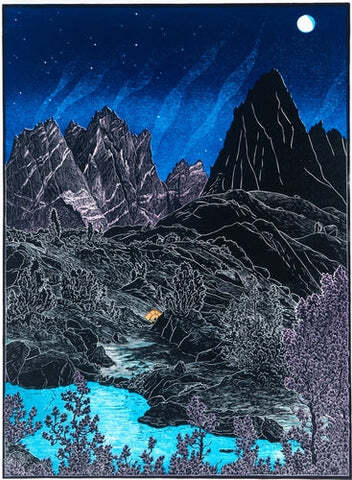
Isosceles Peak from Dusy Basin, by Tom Killion, 2012.
The romance of all romances pales beside this book. This is indeed the ultimate love story: every page is a declaration of love. I wish all of us were loved the way KSR loves these mountains. I have reveled in his words, and tried to stretch the read to last as long as possible.
I loved everything in it: the funny moments, the exquisite descriptions of landscapes, the interesting bits of geology, geography and history, the people of Sierra - both bipedal and quadruped, his personal memoirs, and most of all, his wonderful writing.
Contrary to what some said, I think that the blend between various topics in serial chapters was perfect, not at all disjointed. At least, for me. Had he followed a subject to completion, it would have been monotonous. Like this, it was delightful, and it kept my interest going and raising with each page.
I thought to name here my favorite series of chapters, but walking through them I realized that I loved almost all - just one it was irrelevant to me, and that was Routes - because I don't think hiking these mountains would ever happen in this lifetime. But I enjoyed reading them too, and they are really useful for those who actually plan to hike the Sierras.
KSR was already in the top of my favorite writers, but now is also in the top of my favorite people, and what propelled him that high was how he spoke of and depicted the animals:
"Most common are marmots. God blessed them. [...] They often perch on boulder tops to have a look around; they like a good view, just like anyone else. You can be sure of that because you see them perched on a good prospect looking around; and also, whenever you get onto a bog boulder yourself, say to get a good view of the sunset, that boulder top is almost sure to be covered with marmot turds. Also there's a kind of lichen that likes nitrogen, called red jewel lichen, and down the sides of these marmot lookout-post boulders, this red lichen tends to spill, thriving exactly where marmots urine would run off the rocks. It's very clear: marmots enjoy watching a good sunset. This I find moving. [...] Quite a few of them like to show off for the camera. They pose on top of rocks quite patiently. They respond to voices, and look back at you. They're used to humans and do not fear them. They are great people.
About reclusive animals: "They're living their lives apart from us, without our help. We've left that land to them, and they live their lives on it.
All that that implies crashes in on me. No help from people, except to be left alone. They find each other and reproduce; they are mammals with sex lives. The moms give birth and bring up their young, teach them things, and the young go out there and make their way in the world, competently or not, for better or worse, until some other animal kills and eats them, or they die of injury or disease, or old age. Die alone, or among others of their kind. They have feelings. They have thoughts. They are capable in the world. They are mammals and so they are very like us. But wild." [...] "I feel lucky to have hiked with one of these reclusive Sierra people for so long."
How I love how he thinks and feels! ❤️
I finished the book a couple of days ago, and I tried to gather my thoughts to make this review worthy of the book. But I can't. The book is just too beautiful, and no matter what I would write, I couldn't do it justice. Therefore, I will leave a few quotes below (really heartbreaking to choose just these from the myriad I have highlighted); they speak for the book way better than I will ever be able to. Enjoy!
"The LSD made the blisters seem trivial, even funny. I named one Jacob and the other Crouch, and the one developing on the front of my ankle I named Achilles, which I thought was very funny. Yes, I was stoned."
"That summer of 1973 was wild, those years were wild. Life itself was big. I always felt it as being stuffed with a huge significance, and myself embarked on a great adventure. That was true no matter what drugs I took or didn't take, and had to do more with literature, and the beach, and my friends both men and women. It was a literary feeling most of all, and a youthful feeling. It began when I read Huckleberry Finn in second grade, and has never stopped. Literature itself is the real psychedelic, the actual cosmic trip."
"A breath, a step, a heartbeat. The shadow of a cloud, racing over the land. Cloud and granite; moment and eon. Same laws of physics for both, but different affect. Or the composite affect of the two interpenetrated: very much a Sierra feeling. The eon in every moment."
"Important in this was Muir's often-expressed love of animals. His readership was much more connected with animals, both domestic and wild, than we are now; and Muir's writing is particularly good on animals, both descriptively and in his sympathies. During his childhood, farm animals had stood in for the human friends he never had; he regarded them as intelligent and worthy of our care, even our reverence. He often used the phrase "our horizontal brothers and sisters," which even now speaks to us in ways we have not taken on."
"If there are clouds, they turn orange and pink, bronze and gold, mauve and magenta; or stay gray; or do all these things at once. Nature doesn't believe any colors clash; anything can happen. If there are clouds in the west, the sun sends god rays in a spray that makes no sense astronomically speaking. It doesn't matter, there they are, spangling the sky. Glories, the English called these burst of light through cloud."
"In any case, now we are here. The 2020s are going to be a time of radical change. Currently we're killing off thousands of species, all of whom have as much right to this planet as we do. We're changing the climate in catastrophic ways. The two are parts of a single problem. From today's new headlines: UN: CLIMATE AND EXTINCTION CRISES MUST BE TACKLED TOGETHER.
So: it's time for wilderness. We need it; the biosphere needs it. Maybe it began as a nineteenth-century American project, transcendentalist in origin, full of category errors, and dodging or even adding to the guilt of crimes committed against Native Americans. There's no doubt some of its assumptions were wrong. Be that as it may, now its time has come. Now it's a crucial component in any realistic plan to avoid the mass extinction event we.ve started."
"If any readers of this book are young Sierra hikers, recall here the Baier's admonition: Don't waste your precious youth! It only comes once, and it can be a zone of freedom. Be a pinball in you pinball years. It's a big range. Go up often and wander.
As for me, I'll take one trip at a time, and keep in mind what they used to chant together at my kids' preschool, almost every day:
You get what you get and you don't throw a fit."
Isosceles Peak from Dusy Basin, by Tom Killion, 2012.

May 28, 2022
I enjoyed this one more than I was expecting to. Here's the review to read,
Jeff VanderMeer's, the best I saw online:
"... wants to be a hybrid: a personal memoir and a hiking journal, a geology lesson and a history lesson about one of the truly epic nature spots in the world. The book’s structure attempts to create order from Robinson’s sheer exuberance and enthusiasm, but only half-delivers on that promise ... I was curious as to how the landscape felt different under the influence, but Robinson for a time shies away from lived-in experience. Instead, he has a brief discussion with himself of which word—surreal, mystical or metaphysical—describes that day best and then veers into a nostalgia-laden account of his life in California at the time ... Throughout these chapters, it felt as if Robison had recorded freewheeling riffs on his life in mountains and that I was reading a transcript ... Sometimes these moments reach an ecstatic crescendo similar to the effect of Walt Whitman’s poetry, but sometimes Robinson cannot quite show us what he’s telling us, despite detailed accounts of his various hikes ... The overall effect is of someone showing slides to a neighbor, with a definite homespun charm ... It sometimes feels as if readers have been given the raw materials from which they might choose to write their own book ... Yet the book also has passion galore and glorious moments when science and poetry meet ... 'The map is not the territory,' Robinson writes, but neither is a territory always useful without the anchor of a good map—a strong argument for dipping into The High Sierra, rather than journeying through it end-to-end."
https://www.washingtonpost.com/books/...
Recommended reading, though it may be overkill for those not familiar with the High Sierra. KSR's fiction can be hit or miss for me, but this one really worked. I read it more-or-less straight through, to my surprise. First-rate book.
Here's an even better review online: https://schicksalgemeinschaft.wordpre...
Jeff VanderMeer's, the best I saw online:
"... wants to be a hybrid: a personal memoir and a hiking journal, a geology lesson and a history lesson about one of the truly epic nature spots in the world. The book’s structure attempts to create order from Robinson’s sheer exuberance and enthusiasm, but only half-delivers on that promise ... I was curious as to how the landscape felt different under the influence, but Robinson for a time shies away from lived-in experience. Instead, he has a brief discussion with himself of which word—surreal, mystical or metaphysical—describes that day best and then veers into a nostalgia-laden account of his life in California at the time ... Throughout these chapters, it felt as if Robison had recorded freewheeling riffs on his life in mountains and that I was reading a transcript ... Sometimes these moments reach an ecstatic crescendo similar to the effect of Walt Whitman’s poetry, but sometimes Robinson cannot quite show us what he’s telling us, despite detailed accounts of his various hikes ... The overall effect is of someone showing slides to a neighbor, with a definite homespun charm ... It sometimes feels as if readers have been given the raw materials from which they might choose to write their own book ... Yet the book also has passion galore and glorious moments when science and poetry meet ... 'The map is not the territory,' Robinson writes, but neither is a territory always useful without the anchor of a good map—a strong argument for dipping into The High Sierra, rather than journeying through it end-to-end."
https://www.washingtonpost.com/books/...
Recommended reading, though it may be overkill for those not familiar with the High Sierra. KSR's fiction can be hit or miss for me, but this one really worked. I read it more-or-less straight through, to my surprise. First-rate book.
Here's an even better review online: https://schicksalgemeinschaft.wordpre...

July 19, 2022
Kim Stanley Robinson, known for his science fiction, has been a fan of visiting the Sierra Nevada mountains since his youth. He has written about his favorite trips, locations, hiking trails, ranges, passes, crests, peaks, rock formations, and much more. He covers the history of the region and people that have had an impact. He discusses environmental issues. He recommends camping equipment and what it is like to spend the night in various climate conditions.
The book is organized by major topic, including My Sierra Life, Geology, Sierra People, Snow Camping, Moments of Being, Routes, Names and The Swiss Alps. He floats back and forth among these topics. I am not sure why he decided to include sections on the Swiss Alps, but it helps to contrast another beautiful area of the world with that of the High Sierra.
Robinson’s writing is lively and engaging. His stories are interesting. By the end, I almost felt like I knew his group of friends. He gets a little carried away with recommended new names for all sorts of places in the region, but one can understand his rationale.
Robinson obviously loves this beautiful terrain, and his excitement comes through in his writing. This is a fun book. I enjoyed it immensely, especially since I live nearby and know (or know of) these places. It will appeal to those who enjoy mixes of memoir, science, history, and nature.
The book is organized by major topic, including My Sierra Life, Geology, Sierra People, Snow Camping, Moments of Being, Routes, Names and The Swiss Alps. He floats back and forth among these topics. I am not sure why he decided to include sections on the Swiss Alps, but it helps to contrast another beautiful area of the world with that of the High Sierra.
Robinson’s writing is lively and engaging. His stories are interesting. By the end, I almost felt like I knew his group of friends. He gets a little carried away with recommended new names for all sorts of places in the region, but one can understand his rationale.
Robinson obviously loves this beautiful terrain, and his excitement comes through in his writing. This is a fun book. I enjoyed it immensely, especially since I live nearby and know (or know of) these places. It will appeal to those who enjoy mixes of memoir, science, history, and nature.

June 20, 2022
I grew up in the foothills of the Sierra Nevadas, and lately have had an almost-overpowering urge to go back. This book poured gasoline on that fire. It’s a perfect mix of personal experience, history, meditation, and science. It allowed me to spend many hours gone away to the Sierras in my head. It probably wouldn’t be quite such a great reading experience for someone who doesn’t feel about those particular mountains the way I do, but it’s a great book no matter what.

June 9, 2022
(...)
That takes me to the second reason: it simply is nice to read about a guy being passionate and joyful, the whole affair has something uplifting, all the more because Robinson manages to convey a cosmic sense: being amazed about our planet, deep time and human life. Rapture is real. It also has a certain radicalness to it that is inspring: his love borders obsession, and there is something radical about the praxis too – who would slice Proust’s The Captive in two to save weight?
(...)
Full review on Weighing A Pig Doesn't Fatten It
That takes me to the second reason: it simply is nice to read about a guy being passionate and joyful, the whole affair has something uplifting, all the more because Robinson manages to convey a cosmic sense: being amazed about our planet, deep time and human life. Rapture is real. It also has a certain radicalness to it that is inspring: his love borders obsession, and there is something radical about the praxis too – who would slice Proust’s The Captive in two to save weight?
(...)
Full review on Weighing A Pig Doesn't Fatten It
July 2, 2024
The closest thing to hiking in the Sierras without leaving home, KSR’s essays are as he said a love story to the mountains themselves and the people with whom he shared them.

May 18, 2022
I'm a Brit who's only been to the Sierras once (Yosemite), but I've been avidly consuming anything to do with the Pacific Crest Trail the last few years, so I jumped at the chance to listen to this.
KSR is a giant in the science fiction world, but he only ever mentions this in passing and where it's relevant, which I think is the right choice. He's also the narrator - again, the right choice, because there's a pleasing geniality to his voice.
The book is a meandering exploration of what the Sierra means to KSR, and the joys open to anyone who goes there. It's a pretty fun, educational and satisfying mix of geography, history, ecology, and culture, and I found myself equally enjoying the section on the author's experiences hiking and climbing in Switzerland; I also loved that he uncompromisingly spoke of the wildlife of the Sierras as people in their own right.
I guess the one thing that disappointed me was the near lack of PCT mentions (I mean, I know I'm biased here). I was quite surprised, given how totemic the PCT is, and how often KSR must have encountered thru-hikers. Still, we can't have everything.
(With thanks to Hachette Audio and NetGalley for this audiobook in exchange for an honest review)
KSR is a giant in the science fiction world, but he only ever mentions this in passing and where it's relevant, which I think is the right choice. He's also the narrator - again, the right choice, because there's a pleasing geniality to his voice.
The book is a meandering exploration of what the Sierra means to KSR, and the joys open to anyone who goes there. It's a pretty fun, educational and satisfying mix of geography, history, ecology, and culture, and I found myself equally enjoying the section on the author's experiences hiking and climbing in Switzerland; I also loved that he uncompromisingly spoke of the wildlife of the Sierras as people in their own right.
I guess the one thing that disappointed me was the near lack of PCT mentions (I mean, I know I'm biased here). I was quite surprised, given how totemic the PCT is, and how often KSR must have encountered thru-hikers. Still, we can't have everything.
(With thanks to Hachette Audio and NetGalley for this audiobook in exchange for an honest review)

May 11, 2022
I listened to the audio version of this book, read by the author, and it was a wonderful experience. I already have a deep lengthy love for the state of California as I was born here and lived here most of my life, and I've hiked in the Sierra Nevada Mountains. Reading this book deepened my love for the mountains - and encouraged me to want to go back. I would never be as adventurous as the author of this book with all his cross-country off-trail wanderings, but I do understand the attraction for wild places and that amazing feeling of spiritual-emotional fullness we get when we're in the presence of Sierra grandeur.
I liked how this book varied the subject matter with chapters ranging from personal hiking memoirs to geology to biographies of famous hikers and authors, and more. This kept me interested and involved, and my attention never lagged. I'm so grateful for the time I spent listening to the author's stories of hiking the high Sierra, and sympathized with his love for the lost friends and fellow hikers.
Having only audio-read this book, I now am wishing for a copy of the hardcover version with all the photographs, for reference. There are parts of this book I'll reread and parts I need to refer back to - such as equipment suggestions and more Sierra books to read.
Thanks to the author, Netgalley and the publisher for a review copy. All thoughts in this review are my own. I'm a great fan of the state of California and the Sierra Nevada Mountains, and of this book. I am always happy to read books about California.
My Goodreads Group: California Reading
For the Clean Reads people: I guess you could call this a trigger warning for language. There were a few words in this book that some might not want to read, but they didn't bother me enough to give it a lower rating. I'm giving it five stars based on the value this book has for me.
I liked how this book varied the subject matter with chapters ranging from personal hiking memoirs to geology to biographies of famous hikers and authors, and more. This kept me interested and involved, and my attention never lagged. I'm so grateful for the time I spent listening to the author's stories of hiking the high Sierra, and sympathized with his love for the lost friends and fellow hikers.
Having only audio-read this book, I now am wishing for a copy of the hardcover version with all the photographs, for reference. There are parts of this book I'll reread and parts I need to refer back to - such as equipment suggestions and more Sierra books to read.
Thanks to the author, Netgalley and the publisher for a review copy. All thoughts in this review are my own. I'm a great fan of the state of California and the Sierra Nevada Mountains, and of this book. I am always happy to read books about California.
My Goodreads Group: California Reading
For the Clean Reads people: I guess you could call this a trigger warning for language. There were a few words in this book that some might not want to read, but they didn't bother me enough to give it a lower rating. I'm giving it five stars based on the value this book has for me.

May 4, 2026
Robinson weaves together a unique blend of memoir/autobiography, psychogeography, ecology, history, philosophy and a hiking guide of the High Sierra’s. The structure of the book is such that he never dwells on a single topic for too long. I like this approach, as it kept me interested and entertained throughout. I listened to the audiobook which was narrated by Robinson which added a my enjoyment.

March 22, 2023
As a preservationist and as a Kim Stanley Robinson’s science fiction fan, I was eager to read Robinson’s memoir of hiking in the High Sierra mountains of California. While I loved his passion and found some of his chapters fascinating, the book as a whole was not as much fun as his novels. In the novels he is able to flesh out characters and landscapes, but in the The High Sierra he refers to his friends, and to the many ridges, passes, basins and peaks, by name but without making them distinctive. Nonetheless I always enjoy Robinson’s writing, and I found plenty to entertain me.
One chapter on minimalist backpacking I particularly liked. I love to hike but the prospect of carrying a thirty or forty pound backpack does not seem appealing. Robinson discusses in detail how to reduce that weight to fifteen or eighteen pounds. He does not use a stove, but rather little cubes of propellant, which can be placed between rocks to boil a cup of water. His tent is a simple tarpaulin which can be propped up by walking sticks which double as tent poles. He has advice on the warmest and lightest down-filled sleeping bags, and on how to make articles of clothing dual purpose. He is my kind of backpacker!
He has chapters on personalities, both historical and contemporary, who played a role in preserving the High Sierra, such as John Muir. He also discusses the art of the High Sierra, by a poet such as Gary Snyder, who wrote about both himself and Jack Kerouac in their mountain encounters. He also introduces me to Tom Killion, an artist who does Japanese influenced woodblock prints of the trees and the landscape of the High Sierra. Another interesting chapter is a bibliography of writings on the High Sierra, as well as many indications of how his experience of the mountains influenced his science fiction writing.
Robinson has also visited other mountain ranges such as the Alps, the Himalayas and the Transantarctics, about each of which he has written related science fiction. He uses his knowledge of those ranges to comment on the distinctive character of the High Sierra, for example noting that the Alps are much more developed with villages and roads.
Even though the book was not as exciting as Robinson’s fiction, I have now conceived the project of hiking the John Muir Trail, a north-south trail that traverses the High Sierra. I would love to have the opportunity to backpack in the High Sierra, but I may have to content myself with nature preserves closer to home. But I can dream!
One chapter on minimalist backpacking I particularly liked. I love to hike but the prospect of carrying a thirty or forty pound backpack does not seem appealing. Robinson discusses in detail how to reduce that weight to fifteen or eighteen pounds. He does not use a stove, but rather little cubes of propellant, which can be placed between rocks to boil a cup of water. His tent is a simple tarpaulin which can be propped up by walking sticks which double as tent poles. He has advice on the warmest and lightest down-filled sleeping bags, and on how to make articles of clothing dual purpose. He is my kind of backpacker!
He has chapters on personalities, both historical and contemporary, who played a role in preserving the High Sierra, such as John Muir. He also discusses the art of the High Sierra, by a poet such as Gary Snyder, who wrote about both himself and Jack Kerouac in their mountain encounters. He also introduces me to Tom Killion, an artist who does Japanese influenced woodblock prints of the trees and the landscape of the High Sierra. Another interesting chapter is a bibliography of writings on the High Sierra, as well as many indications of how his experience of the mountains influenced his science fiction writing.
Robinson has also visited other mountain ranges such as the Alps, the Himalayas and the Transantarctics, about each of which he has written related science fiction. He uses his knowledge of those ranges to comment on the distinctive character of the High Sierra, for example noting that the Alps are much more developed with villages and roads.
Even though the book was not as exciting as Robinson’s fiction, I have now conceived the project of hiking the John Muir Trail, a north-south trail that traverses the High Sierra. I would love to have the opportunity to backpack in the High Sierra, but I may have to content myself with nature preserves closer to home. But I can dream!
November 11, 2023
This was both relaxing and inspiring. Robinson gives you a good sense of the appeal of going above the treeline, interspersing geology, ecology, and his own personal history. As someone who's read much of his fiction, it was interesting to see the parallels between his real experiences and several incidents in his books. The writing goes down easy, but the ideas will stick in your mind long after. I ended up giving this a four-star review, but it was close to five.
December 25, 2023
Reading a book about the sierras is like eating ice cream. I know I’m going to enjoy it almost no matter what flavor it is.
I enjoyed a lot of these bite-sized essays, some more than others. Descriptions of routes were less interesting but he has some fun stories in there. My advice would be to pick and choose a few chapters as you go, and not to feel bad about skipping stuff you’re not into - it’s a long book.
Certainly made me want to explore the high sierras more than I have, I’ve spend most of my time at lower elevations. Lots of time ahead of me!
I enjoyed a lot of these bite-sized essays, some more than others. Descriptions of routes were less interesting but he has some fun stories in there. My advice would be to pick and choose a few chapters as you go, and not to feel bad about skipping stuff you’re not into - it’s a long book.
Certainly made me want to explore the high sierras more than I have, I’ve spend most of my time at lower elevations. Lots of time ahead of me!

May 17, 2024
This is part memoir, part nonfiction about the Sierra Nevada. Covers plants and wildlife, geology, history (including indigenous people and famous women), as well as Robinson’s many travels through the Sierra. This is truly a book about Robinson’s love for the range and he argues that the Sierra is the best mountain range in the world for hikers and backpackers. The way he describes the many basins, hanging valleys, and lakes in the range, the feelings of satisfaction and joy he feels while rambling and scrambling is infectious. My hike of the JMT is a little over two months away and I’m so pumped to get up there
August 6, 2025
A beautiful blending of stream of conscious thoughts on both Robinson's experiences in the park, external factors affecting them, and the history of the park itself. I've not yet had the pleasure of visiting this place, but after finishing this book it is certainly very high on my to do list. It's odd for this to be the first I've read by such a large name in science fiction, but I think this backstory will help me enjoy his fiction even more.

July 31, 2022
Review of Kim Stanley Robinson’s ‘The High Sierra. A Love Story’
Books, good books, affect us. They entertain, certainly, but they also educate us, challenge us, enlighten us. Frighten us, horrify us, shame us, inflame us, move us, tickle us, transport us, elevate us. There are myriad reasons to read and hopefully we find books that hit two, three or more targets during the reading.
Stanley’s ‘High Sierra’ hits a whole slew of things for me. But also provided a personal revelation.
I have been doing these ‘book reviews for writers’ for about two years. I have learned that if you go into a review looking for something to criticize, you will find it. No writer is perfect and no piece of writing speaks to everyone.
So as I read ‘High Sierra’, I generated a list of things that bothered me. Too much of the book is lists: inventories of passes, peaks, basins, crests, divides, people, hike descriptions, names, so repetitive and who is going to remember all of these. What he called an ‘Adventure’ I thought a lack of planning and stupid. And reading a book, any book, is agreeing to spend a few hours with the author, learning how they think and see the world. Spending time with dumb people is frustrating.
The maps in my e-version were nearly useless to follow along, and near the mid-point, I nearly abandoned the book.
I stuck with it, and things went from bad to worse. I found myself getting angry and inventoried why. I live right at the bottom of a mountain, Mount Seymour, on Vancouver’s North Shore. Five kilometers up and you are into rugged, unforgiving terrain. Nearly every day we hear the telltale thump-thump-thump of search and rescue helicopters. People get lost, hurt, killed and just disappeared all the time. Stanley’s lack of care and lack of preparation and dismissal of maps and compasses pushed my buttons. Popping acid before wandering out into the wilderness I found close to criminal negligence.
Still, I persevered.
I love the mountains. I have been a hiker, camper, boy scout, skier, fly fisher, bird watcher, mountain biker, everything outdoors for fifty years. This book should be right up my alley. I love what Stanley loves. I moved to British Columbia as a twenty-two-year-old boy and fell in love with the ocean, mountains and forests of BC. What was bothering me here?
About two-thirds of the way through ‘The High Sierra’, a close friend of Stanley’s, Terry Baier, has a heart valve replaced, and then becomes distant and angry. The friendship ends. Why did he get so angry?
It dovetailed perfectly with my personal anger at this book. Why was I so angry?
Three years ago, June 3, 2019, I had a catastrophic mountain bike accident on Mount Seymour. I don’t remember it, but I regained consciousness lying on the ground and had no sensation below my chin. A spinal cord damaged in two places, a mild traumatic brain injury, and a ruined shoulder. It has been a long slow recovery. I can walk. I can ride a bike. I can ski again, sort of. I have been back to work, then off again. I don’t have the mental and physical stamina I used to have. I could never do the kind of hiking, with the mileage or vertical that Stanley does. And there I finally saw why I was so angry while reading this book. At one time, I could have done everything in this book. Not now. Salt in a wound.
I have been stalled in my recovery, and deeply into denial. Before the accident, my wife and I had a trip planned to Nepal. Recently she asked me if we might be able to do an easier trip?
While reading the book we did a trip up to Whistler with another couple. My wife and the other woman did a hike from the village to the top of Blackcomb, about four thousand feet of vertical. I didn’t even consider doing it. Three or more times a week, my wife does the ‘Grouse Grind’, a two and a half kilometer trail that rises 2,600 feet. I used to do it in just over an hour. I know I couldn’t do it now.
I sort of laughed when I realized why this book bothered me so much. And I wondered if it needs to be so. Talking it over with my wife, she reminded me what the doctors and occupational therapist had told me. On the mental or cognitive side, they told me to back off when I felt concussion symptoms. But on the physical side, they told me to push through. I have been backing off on both.
So, I put my hiking shoes on and went for a walk on Mount Seymour. I thought I would start easy, go up till I was tired, then turn back. I picked a spot I knew I could loop through that I thought would take about ten minutes to get to the top. A rise of about 75 meters. It took a half hour and I was exhausted. My legs were like rubber. But I did it. And I did it again the next day.
I am going to push through. I am going to funnel that anger back into my recovery, where it belongs, and not into pot shots at authors I admire.
My favourite section of ‘The High Sierra’ was ‘Moments of Being: A Sierra Day: Sunset and Twilight’. I felt I was there watching it, experiencing it, and that is why I read. That is what I want to do again.
Good books affect us. This one did me. Thanks.
Books, good books, affect us. They entertain, certainly, but they also educate us, challenge us, enlighten us. Frighten us, horrify us, shame us, inflame us, move us, tickle us, transport us, elevate us. There are myriad reasons to read and hopefully we find books that hit two, three or more targets during the reading.
Stanley’s ‘High Sierra’ hits a whole slew of things for me. But also provided a personal revelation.
I have been doing these ‘book reviews for writers’ for about two years. I have learned that if you go into a review looking for something to criticize, you will find it. No writer is perfect and no piece of writing speaks to everyone.
So as I read ‘High Sierra’, I generated a list of things that bothered me. Too much of the book is lists: inventories of passes, peaks, basins, crests, divides, people, hike descriptions, names, so repetitive and who is going to remember all of these. What he called an ‘Adventure’ I thought a lack of planning and stupid. And reading a book, any book, is agreeing to spend a few hours with the author, learning how they think and see the world. Spending time with dumb people is frustrating.
The maps in my e-version were nearly useless to follow along, and near the mid-point, I nearly abandoned the book.
I stuck with it, and things went from bad to worse. I found myself getting angry and inventoried why. I live right at the bottom of a mountain, Mount Seymour, on Vancouver’s North Shore. Five kilometers up and you are into rugged, unforgiving terrain. Nearly every day we hear the telltale thump-thump-thump of search and rescue helicopters. People get lost, hurt, killed and just disappeared all the time. Stanley’s lack of care and lack of preparation and dismissal of maps and compasses pushed my buttons. Popping acid before wandering out into the wilderness I found close to criminal negligence.
Still, I persevered.
I love the mountains. I have been a hiker, camper, boy scout, skier, fly fisher, bird watcher, mountain biker, everything outdoors for fifty years. This book should be right up my alley. I love what Stanley loves. I moved to British Columbia as a twenty-two-year-old boy and fell in love with the ocean, mountains and forests of BC. What was bothering me here?
About two-thirds of the way through ‘The High Sierra’, a close friend of Stanley’s, Terry Baier, has a heart valve replaced, and then becomes distant and angry. The friendship ends. Why did he get so angry?
It dovetailed perfectly with my personal anger at this book. Why was I so angry?
Three years ago, June 3, 2019, I had a catastrophic mountain bike accident on Mount Seymour. I don’t remember it, but I regained consciousness lying on the ground and had no sensation below my chin. A spinal cord damaged in two places, a mild traumatic brain injury, and a ruined shoulder. It has been a long slow recovery. I can walk. I can ride a bike. I can ski again, sort of. I have been back to work, then off again. I don’t have the mental and physical stamina I used to have. I could never do the kind of hiking, with the mileage or vertical that Stanley does. And there I finally saw why I was so angry while reading this book. At one time, I could have done everything in this book. Not now. Salt in a wound.
I have been stalled in my recovery, and deeply into denial. Before the accident, my wife and I had a trip planned to Nepal. Recently she asked me if we might be able to do an easier trip?
While reading the book we did a trip up to Whistler with another couple. My wife and the other woman did a hike from the village to the top of Blackcomb, about four thousand feet of vertical. I didn’t even consider doing it. Three or more times a week, my wife does the ‘Grouse Grind’, a two and a half kilometer trail that rises 2,600 feet. I used to do it in just over an hour. I know I couldn’t do it now.
I sort of laughed when I realized why this book bothered me so much. And I wondered if it needs to be so. Talking it over with my wife, she reminded me what the doctors and occupational therapist had told me. On the mental or cognitive side, they told me to back off when I felt concussion symptoms. But on the physical side, they told me to push through. I have been backing off on both.
So, I put my hiking shoes on and went for a walk on Mount Seymour. I thought I would start easy, go up till I was tired, then turn back. I picked a spot I knew I could loop through that I thought would take about ten minutes to get to the top. A rise of about 75 meters. It took a half hour and I was exhausted. My legs were like rubber. But I did it. And I did it again the next day.
I am going to push through. I am going to funnel that anger back into my recovery, where it belongs, and not into pot shots at authors I admire.
My favourite section of ‘The High Sierra’ was ‘Moments of Being: A Sierra Day: Sunset and Twilight’. I felt I was there watching it, experiencing it, and that is why I read. That is what I want to do again.
Good books affect us. This one did me. Thanks.

December 18, 2024
I made my way through this slowly, partly in print and partly on audio. It's a great book to savor and own. Cool pictures, great writing, getting at what's beautiful about the Sierra from so many angles. I found the audio portions to be very soothing.
January 24, 2024
This has some tedious parts, as do most of KSR's novels, but also had a lot of interest and gave me lots of feels. I too love the Sierra, and disagreed with the author's strong opinions at times (we are all dogmatic about our hike your own hike prefs!), but more often felt sad over irrevocably lost time to explore more, and personal limitations. KSR points out repeatedly to go while you're young and that stings, now. He did, kudos to him... Well, on the positive side, feeling inspired to finally make it to Dusy Basin...

July 18, 2022
Mixed feelings.
I've been backpacking, hiking, and spending time in the Sierra since I was a kid, so of course this book appealed to me, especially with the beautiful descriptions of surroundings in many of KSR's books. Oddly, he never really lets that descriptive power off its leash in this book, which is structured as a collection of essays.
I take issue with his statement that backpacking cross-country is the only way to interact with the Sierra. It is a great thing to do. But it is not physically and logistically available to everyone. There is such a wealth of wildlife (this book gives rather short shrift to wildlife; talks about bighorns but barely mentions marmots and I think never names a bird at all), geology, wildflowers -- and there are so many ways to experience it that don't require being able-bodied or having time to train or the inclination to do hard treks (and, despite all his disclaimers, some of the routes he describes are indeed very hard and risky).
The idea that water is available every 'half a mile' and that you don't need to purify the majority of the water is wrong. In remote high country it's possible to drink the water without purifying, but increasingly, water sources are becoming less reliable.
As for his opinions on roof pendants, the Yosemite backcountry, and the whole Ritter Range and parts north somehow not being truly part of the Sierra, we'll just have to disagree.
I found the historical bits sort of boring -- they've been covered in many books -- although I did appreciate his correction of some myths about John Muir. And I didn't really get the part about the Alps -- okay, he didn't like the Alps, but I never really understood why. I did appreciate the reading list (the book about the history of trails, BTW, is only available on the conservancy website).
A mixed bag, in other words. I do recommend it, but different readers will find different parts they want to skim.
(8/30: I have to add an observation. Upper Cathedral Lake this past Sunday. Okay, it's Yosemite, non grata for reasons never quite explained, but you couldn't want for more sculpted white granite, and the deer are the same deer as everywhere in the Sierra. I had fun watching a little herd of mule deer chase each other across the meadow and drink from the lake. Two does and a fawn actually waded out into the water. Both does squatted and went to the bathroom -- I couldn't tell which variety -- in the lake. And then the fawn did too. A little while later, the three re-entered the lake and the does both did it again. Granted, I think of deer as clean and lovely creatures, but still... I'd purify that water.)
I've been backpacking, hiking, and spending time in the Sierra since I was a kid, so of course this book appealed to me, especially with the beautiful descriptions of surroundings in many of KSR's books. Oddly, he never really lets that descriptive power off its leash in this book, which is structured as a collection of essays.
I take issue with his statement that backpacking cross-country is the only way to interact with the Sierra. It is a great thing to do. But it is not physically and logistically available to everyone. There is such a wealth of wildlife (this book gives rather short shrift to wildlife; talks about bighorns but barely mentions marmots and I think never names a bird at all), geology, wildflowers -- and there are so many ways to experience it that don't require being able-bodied or having time to train or the inclination to do hard treks (and, despite all his disclaimers, some of the routes he describes are indeed very hard and risky).
The idea that water is available every 'half a mile' and that you don't need to purify the majority of the water is wrong. In remote high country it's possible to drink the water without purifying, but increasingly, water sources are becoming less reliable.
As for his opinions on roof pendants, the Yosemite backcountry, and the whole Ritter Range and parts north somehow not being truly part of the Sierra, we'll just have to disagree.
I found the historical bits sort of boring -- they've been covered in many books -- although I did appreciate his correction of some myths about John Muir. And I didn't really get the part about the Alps -- okay, he didn't like the Alps, but I never really understood why. I did appreciate the reading list (the book about the history of trails, BTW, is only available on the conservancy website).
A mixed bag, in other words. I do recommend it, but different readers will find different parts they want to skim.
(8/30: I have to add an observation. Upper Cathedral Lake this past Sunday. Okay, it's Yosemite, non grata for reasons never quite explained, but you couldn't want for more sculpted white granite, and the deer are the same deer as everywhere in the Sierra. I had fun watching a little herd of mule deer chase each other across the meadow and drink from the lake. Two does and a fawn actually waded out into the water. Both does squatted and went to the bathroom -- I couldn't tell which variety -- in the lake. And then the fawn did too. A little while later, the three re-entered the lake and the does both did it again. Granted, I think of deer as clean and lovely creatures, but still... I'd purify that water.)
July 28, 2022
As a fellow Sierra-obsessive, I thoroughly enjoyed this book though I'm not sure how much appeal it will hold for non-"Sierra People" (as KSR refers to our tribe). I mostly appreciated the grab-bag style coverage -- geology, history, memoir, polemic, bibliography, etc -- organized as chapters in no particular order (though the memoir bits are loosely chronological). Particular standouts were the sections on reconsidering place names and his reflections on Muir (whom I agree doesn't deserve relegation to the dust heap; he was a curmudgeon and it's complicated, but we likely wouldn't be enjoying the Sierra today without him). That said, if you're inspired by this book to undertake some cross-country hiking in the Sierra, it's full of terrible advice for the novice hiker! Trekking over high-altitude passes (both on-trail and off) is HARD -- don't let KSR convince you otherwise (despite his claims that anyone can pick up and do it, take note of KSR's lifelong athleticism -- swimming, surfing, running, etc.). Also, know your water sources before you decide not to carry any water. And KSR's ultralight packing system is based on years of experience and dialing in his personal needs. I'd argue that a 40-degree low is cold (typical during summer) and there's no way I'm going into the backcountry without an insulated jacket.
While his voice in this work sometimes struck me as too golly-gee-wiz simple, KSR is clearly gobsmacked in the best possible way. His enthusiasm for the Sierra obviously comes from a place of deep, profound awe and the feeling was infectious.
Unfortunately, the photo quality is terrible.
While his voice in this work sometimes struck me as too golly-gee-wiz simple, KSR is clearly gobsmacked in the best possible way. His enthusiasm for the Sierra obviously comes from a place of deep, profound awe and the feeling was infectious.
Unfortunately, the photo quality is terrible.

August 15, 2022
Edward Abbey once advised “it is not enough to fight for the land; it is even more important to enjoy it.” In his book on a life adventuring and contemplating the Sierras, Kim Stanley Robinson conveys his deep love for the place. And yes, how much he has enjoyed it!
Not a peak bagger, trail bagger, FKT achiever, but an enjoyer of the Sierras. The people, the culture, the geology, the wildlife. An infectious enthusiasm for a place but also the relationships - with people and points along the way. I love how he celebrates this and shows us a way to enjoy the wilderness without speed hiking the PCT.
The book is organized into the different lenses he has on the Sierras. He comes back to these at various stages vs having a big chunk of geology and then a fun story and then a people story. Written this way, it feels like a very long and enjoyable chat by the fire with someone with endless amusing stories and knowledge. This is in sharp contrast to The Emerald Mile, by Kevin Fedarko, which had similar pieces and subject matter but lacked orchestration (and the live and regard you feel when Robinson when he talks about his trips).
This book is a treasure and I will think of its anecdotes and points of discourse often. Outdoors. Often in the Sierras.
Not a peak bagger, trail bagger, FKT achiever, but an enjoyer of the Sierras. The people, the culture, the geology, the wildlife. An infectious enthusiasm for a place but also the relationships - with people and points along the way. I love how he celebrates this and shows us a way to enjoy the wilderness without speed hiking the PCT.
The book is organized into the different lenses he has on the Sierras. He comes back to these at various stages vs having a big chunk of geology and then a fun story and then a people story. Written this way, it feels like a very long and enjoyable chat by the fire with someone with endless amusing stories and knowledge. This is in sharp contrast to The Emerald Mile, by Kevin Fedarko, which had similar pieces and subject matter but lacked orchestration (and the live and regard you feel when Robinson when he talks about his trips).
This book is a treasure and I will think of its anecdotes and points of discourse often. Outdoors. Often in the Sierras.
May 10, 2025
I finally finished it!!!!
What a interesting book, and so far removed from Kim Stanley Robinson’s other works that I know of. I am still holding out hope I will run into him on the streets :)
I think this book would be fantastic in its entirety if you also were the sort of Sierra lover that KSR is. There is joy in hearing about experiences that reflect your own and getting to remember them, and he is a beautiful writer! But there was a lot here that is not super explained/there are soooo many names that are hard to follow when you haven’t been to these places and don’t love them like he does. Or if you owned the book and left it on your coffee table and read it slowly, when you had time, it could be so awesome too!
But many beautiful stories. I especially loved the sections about backpacking in general and the final chapter about his jungle gym experience!
What a interesting book, and so far removed from Kim Stanley Robinson’s other works that I know of. I am still holding out hope I will run into him on the streets :)
I think this book would be fantastic in its entirety if you also were the sort of Sierra lover that KSR is. There is joy in hearing about experiences that reflect your own and getting to remember them, and he is a beautiful writer! But there was a lot here that is not super explained/there are soooo many names that are hard to follow when you haven’t been to these places and don’t love them like he does. Or if you owned the book and left it on your coffee table and read it slowly, when you had time, it could be so awesome too!
But many beautiful stories. I especially loved the sections about backpacking in general and the final chapter about his jungle gym experience!

December 14, 2022
I tore through this book. It's not for everyone, in fact, it's probably only for "Sierra people".
Which I was once, long ago and far away. There was a time when all I could think of, and my friends could think of, was how we could get back up into that Range of Light. And read Gary Snyder. And watch the sun come up along the ridge. A long time ago.
Robinson quotes a poem by TH Ferril on the frontispiece - it rings like a bell - come back little birds:
"There was a range of mountains
Once I loved until I could not breathe."
That's so very how Robinson feels about the Sierra. His love is wild, and abundant, and seems to be the core of himself. He writes of his rambles cross the high country with specifics, and, well, love love love. He can't contain himself, and for more than 500 pages - and lots of photos - he pulls you into the Sierra.
And what I have missed, not being there for years! I've left a part of myself (I'm not whining, it was grown over by other wonders) - but so many memories tumbling back.
Love this book.
Which I was once, long ago and far away. There was a time when all I could think of, and my friends could think of, was how we could get back up into that Range of Light. And read Gary Snyder. And watch the sun come up along the ridge. A long time ago.
Robinson quotes a poem by TH Ferril on the frontispiece - it rings like a bell - come back little birds:
"There was a range of mountains
Once I loved until I could not breathe."
That's so very how Robinson feels about the Sierra. His love is wild, and abundant, and seems to be the core of himself. He writes of his rambles cross the high country with specifics, and, well, love love love. He can't contain himself, and for more than 500 pages - and lots of photos - he pulls you into the Sierra.
And what I have missed, not being there for years! I've left a part of myself (I'm not whining, it was grown over by other wonders) - but so many memories tumbling back.
Love this book.

May 8, 2023
This is a passionate and extensive look into one man's adventures in the High Sierra. It's all the more special because this man is one of my favorite authors. He talks about what backpacking is like, what the Sierra mountain range is like, etc. He also dedicates a good bit of the book to his backpacking mentor and late friend. As a fan of his books, I enjoyed reading about how various backpacking trips influenced his writing. Especially the Mars trilogy, and Shaman.
One chapter is just a bibliography. I didn't get much out of it. Another chapter is about naming mountains and other land formations. It includes his opinions about what should be renamed. That was also not interesting to me. In terms of backpacking gear, he's kind of an ultra-light chauvinist which I found strange. He also recommends against carrying adequate water which I find dangerous.
Read this book is you're a Robinson fan and want what's as close to an autobiography as we're likely to get. Also read if you're an aspirational, occasional, or expert backpacker.
One chapter is just a bibliography. I didn't get much out of it. Another chapter is about naming mountains and other land formations. It includes his opinions about what should be renamed. That was also not interesting to me. In terms of backpacking gear, he's kind of an ultra-light chauvinist which I found strange. He also recommends against carrying adequate water which I find dangerous.
Read this book is you're a Robinson fan and want what's as close to an autobiography as we're likely to get. Also read if you're an aspirational, occasional, or expert backpacker.

September 27, 2024
As someone who recently discovered the beauty of the Eastern Sierras, The High Sierra: A Love Story by Kim Stanley Robinson is the most fascinating book I’ve read this year. Robinson’s passion for this place honestly mirrors my own growing obsession. I liked when he shared his personal adventures in the Sierras. I envy his ability to backpack for days, fully in the wilderness alone. Even thought I can’t build the courage to do the same, the way he describes the Sierras makes me want to pack my shit and head up tomorrow.
He also talks about his trips to the Alps and even says that nothing compares to the Sierras and I believe it.
Everytime I’m talking to someone new, I always figure out a way to talk about incredible places around California, places I’ve explored and places I have can’t wait to see. I could go on for hours. Even when the conversation topic changes, I always feel like I had 100 more things to share before it changed.
This book is more than a memoir. Reading it almost felt like an invitation. I will continue to do the same, telling people to leave the city and explore it for themselves. California has incredible places, and the Sierras might be the best part. But if you don’t go out and explore it, I can’t help you see the beauty like I do.
He also talks about his trips to the Alps and even says that nothing compares to the Sierras and I believe it.
Everytime I’m talking to someone new, I always figure out a way to talk about incredible places around California, places I’ve explored and places I have can’t wait to see. I could go on for hours. Even when the conversation topic changes, I always feel like I had 100 more things to share before it changed.
This book is more than a memoir. Reading it almost felt like an invitation. I will continue to do the same, telling people to leave the city and explore it for themselves. California has incredible places, and the Sierras might be the best part. But if you don’t go out and explore it, I can’t help you see the beauty like I do.

July 25, 2025
This was a book that was written for me. There’s no other explanation for why this book is a flawless book to me.
This book reminded me a few truths that I had learned and forgot; and whispered to me how lucky I am to live so close to the Sierra Nevada range and to enjoy it year after year.
I read this book with my map next to me and I plotted out all the trails that Kim Stanley Robinson describes in the book. Hopefully when I am his age, I will have traversed them all.
This book reminded me a few truths that I had learned and forgot; and whispered to me how lucky I am to live so close to the Sierra Nevada range and to enjoy it year after year.
I read this book with my map next to me and I plotted out all the trails that Kim Stanley Robinson describes in the book. Hopefully when I am his age, I will have traversed them all.

April 15, 2023
A triumph of a book. I loved every bit of this and feel as close to Robinson as I do to the High Sierra he so eagerly describes. I want to go and “ramble and scramble” all the time after reading this and wish I could do so with Robinson.
The audiobook is excellent as well as Robinson narrates and you feel his pathos for the High Sierra and friends. The heartache of his friendship with Terry and the loss of Michael Bumlein are heard and felt in the reading of these passages.
The book is beautiful as art and writing. Superb. Sublime. I can’t wait to become a Sierra person.
The audiobook is excellent as well as Robinson narrates and you feel his pathos for the High Sierra and friends. The heartache of his friendship with Terry and the loss of Michael Bumlein are heard and felt in the reading of these passages.
The book is beautiful as art and writing. Superb. Sublime. I can’t wait to become a Sierra person.
July 25, 2023
Interesting blend of history, science, and memoir, with plenty of Davis cameos! Listened to the audiobook while training for Mt. Whitney, fun to hear about the place through time before being there myself soon
July 30, 2023
A truly wonderful book. One to be savoured.
For any Kim Stanley Robinson fan this book will provide his Sierra life story, showing the inspiration for portions of his most famous writing and all written in his inimitable style.
For all readers the book provides a fantastic mix of life story, geological facts, imagery, poetry, ecology, historical notes and asides, and much more besides.
Highly recommended for any KSR fan, fan of the great outdoors, and indeed for anyone looking for something a little unusual.
For any Kim Stanley Robinson fan this book will provide his Sierra life story, showing the inspiration for portions of his most famous writing and all written in his inimitable style.
For all readers the book provides a fantastic mix of life story, geological facts, imagery, poetry, ecology, historical notes and asides, and much more besides.
Highly recommended for any KSR fan, fan of the great outdoors, and indeed for anyone looking for something a little unusual.

August 8, 2022
An engaging personal history and travelogue of the High Sierra region of the Sierra Nevada in California.
The author told his life story and experience in the high Sierra including his recommendations about places, gear, names, etc. He also compares and contrasts his High Sierra experiences with experiences in the Alps.
If you are interested in California and the High Sierra, an interesting read.
The author told his life story and experience in the high Sierra including his recommendations about places, gear, names, etc. He also compares and contrasts his High Sierra experiences with experiences in the Alps.
If you are interested in California and the High Sierra, an interesting read.
October 12, 2022
A wonderful read. Intermixing geology, history, and memoir, Robinson tells the story of his many trips in the Sierras in his easy, beautiful language. The book is like a mountain hike itself with challenging portions followed by breezy passages like a breath of cool mountain air on your puffing cheeks. My friends and I backpacked the Sierras for a week in high school and this book makes me want to go back. Highly recommended!
Displaying 1 - 30 of 354 reviews