Jump to ratings and reviews
Rate this book
Rate this book
Iannis Xenakis' Persepolis stood as witness to one of the most important events in modern human history, the Iranian Revolution in 1979. Its existence is owed to an invitation to participate in the 1971 Shiraz Arts Festival, which was overseen by Empress Farah Pahlavi. Like the Festival, and the extravagant celebratory party held the same year, Xenakis' symbolic paean to Persian history was polarizing. Many loved it, others detested it. Overwhelming but also subtle and precise in its non-harmonic shifts in texture and density, listeners and critics simply did not know what to make of it. This book tells the story of Xenakis' early history and involvement in the Resistance against the Axis occupation of Greece during the Second World War, escape and re-settlement in Paris, work as an architect with Le Corbusier, and distinct views on world history and politics that all led to his 1972 electro-acoustic album Persepolis .

152 pages, Hardcover

First published January 12, 2023

8 people want to read

About the author

Aram Yardumian

7 books1 follower
Aram Yardumian (PhD, Anthropology 2015) is Assistant Professor at Bryn Athyn College, USA, specializing in the nexus connecting the Caucasus, Middle East, and South Asia. He has conducted fieldwork and research at multiple sites in these regions and has travelled worldwide. His publications include surveys of molecular genetics and ancient history, as well as intellectual history and critical reviews of arts and culture.

Ratings & Reviews

What do you think?
Rate this book

Friends & Following

Create a free account to discover what your friends think of this book!

Community Reviews

5 stars
3 (27%)
4 stars
7 (63%)
3 stars
1 (9%)
2 stars
0 (0%)
1 star
0 (0%)
Displaying 1 - 3 of 3 reviews
Profile Image for Alan (the Lone Librarian) Teder.
2,751 reviews270 followers
July 30, 2024
Burning Down the House
Review of the Bloomsbury Academic 33 and 1/3 Global Europe paperback edition (February 9, 2023).

When you take the risk of performing a Gesamtkunstwerk representing all of Iranian history, its past and future, making use of 130 torch-bearing schoolchildren, gasoline fires and lasers, and a soundtrack of obsessively wrought electroacoustic abstraction, broadcast at high volume to polite, high-heels-wearing society in the Iranian desert, someone is going to take issue with it. However pure your intentions, the public is going to find - or invent - flaws in them.
Surprisingly for the popular music series, there is a 33 1/3 book for an experimental electronic music recording. This is for the pre-taped musique concrète work Persepolis by the Greek composer Iannis Xenakis (1922-2001). The work was commissioned for the 1971 Shiraz Festival of the Arts in Iran and was broadcast and staged at the ancient ruins of Persepolis, the ceremonial capital of the Persian Achaemenid Empire (c. 550–330 BC).

The Festival of Arts was held shortly before the then-Shah of Iran's celebration of the 2,500th anniversary of the founding of the Persian Empire. Both events met with cultural criticism, the former due to misinterpretation and the latter for its wanton excess. It can be argued (as Yardumian does in this essay) that it all sowed the seeds for the eventual Iranian Revolution (1979) which resulted in the exile of the Shah and the founding of the Islamic Republic of Iran by Ayatollah Khomeini.


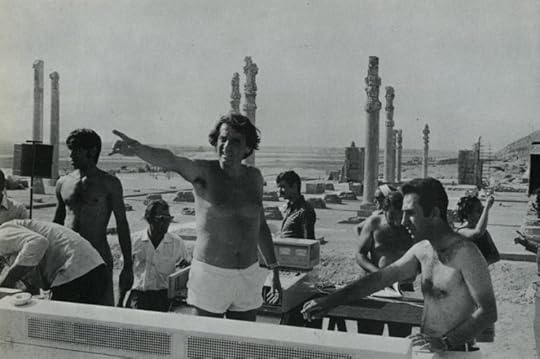
Xenakis and assistants prepare for the August 26, 1971 performance at Persepolis, Iran. Image sourced from Festival of Arts Shiraz Persepolis.

It probably didn't help that Xenakis was of Greek origin, as his use of torch-bearing schoolchildren descending down hillsides to the city ruins was interpreted as representing Greek/Macedonian Alexander the Great's (356 BC-323 BC) conquest and destruction of the ancient capital. Having it all accompanied by a soundtrack which most would consider as "noise" added further injury to the insult.


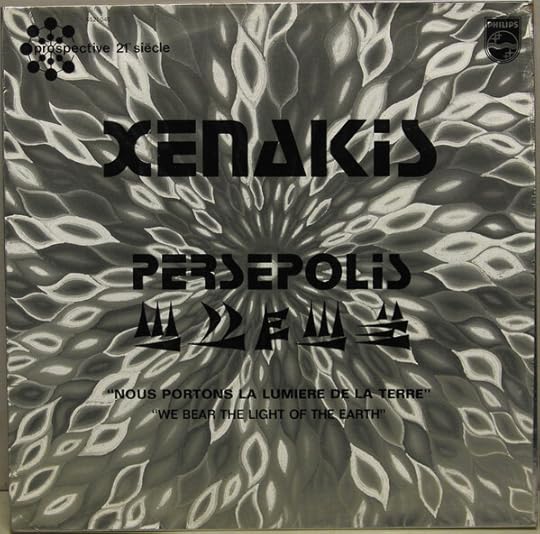
The album cover for the original release of Persepolis on vinyl LP by Philips 1972. The Old Persian cuneiform (𐎱𐎠𐎼𐏁𐎠) for Parša appears upside-down on the release cover. Parša is the Old Persian for Persepolis. Image sourced from Discogs.

Yardumian provides an excellent history of the life and career of Xenakis and the context of how the 2,500th year celebrations led to the eventual fall of the Shah of Iran.

This was another of my discoveries in the 33 1/3 Global series and I hope to investigate more of these books, although they are somewhat harder to find than the ones in the regular 33 1/3 pop music series. i.e. there are only a few of them at my local library for instance.

Soundtrack
There are several versions of Persepolis which have been released on LP or CD. The timings vary due to variable tape speeds. Based on the 55' timing, this version on YouTube is probably the original 1972 release on the Philips vinyl LP and you can listen to it here.

Trivia and Links
There was a documentary film Xenakis Persepolis made of the Persepolis performance by Pierre Andregui which is available to subscribers at Medici TV. You can see a glimpse of it for free here.

I have recently discovered that aside from 33 & 1/3's series on pop & rock music there is an entirely separate "Global" series which covers world music. Currently there are sub-series for Europe, Oceania, Japan, Brazil, South Asia and Africa. You can search through them at Bloomsbury Academic's website here.

The currently published selection for 33 1/3 Global Europe is available on a GR Listopia here.
Profile Image for Dennis Seese.
59 reviews
September 11, 2024
Excellent historical travelogue from Occupied Greece, to Postwar France and then finally to Pre-Revolutionary Iran told through the lens of the lives and tones of Iannis Xenakis. Other artistic figures of note in this story include: Le Corbusier, Pierre Schaeffer, Olivier Messiaen and others.
It examines Xenakis's roots in the Greek Resistance and his desire to apply physics and architectural theories into his musical compositions.
I can't recommend this highly enough for fans of avant-garde music, electroacoustic music, musique concrete and so on
The parts pertaining to the political climate in early 70's Iran and art's role in the Shah's attempt to modernize are fascinating.
Profile Image for Owen Hatherley.
Author 43 books558 followers
October 18, 2023
Very good short sketch on a particularly unusual and uncomfortable intersection of music/politics/history in the Shah's Iran, and Xenakis' complicity (or otherwise) in that regime's cultural 'soft power'.
Displaying 1 - 3 of 3 reviews

Can't find what you're looking for?

Get help and learn more about the design.