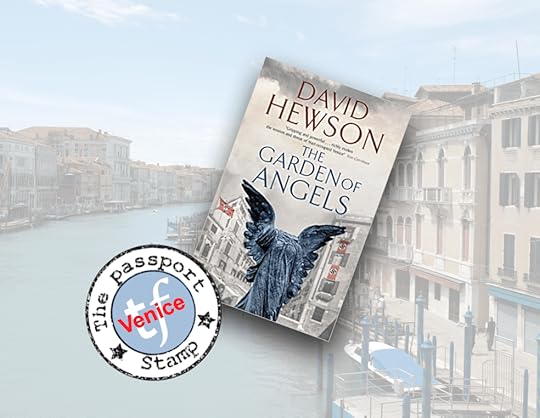
Palata Kolombina na Velikom kanalu u Veneciji dom je porodice Učelo, tri generacije muškaraca koji žive zajedno: petnaestogodišnjeg Nika, njegovog prezaposlenog, otuđenog oca i voljenog dede Paola.
Na samrtnoj postelji, nono Paolo daruje unuku neobičan poklon: rukopise u kojima su opisani njegovi doživljaji iz mladosti, za vreme naleta nacizma u Veneciji, 1943. godine. Ovaj čas istorije, kako ga naziva nono, priča je o herojstvu i brutalnosti prošlosti koje nikada ne treba zaboraviti, pripovest o ratu i iskušenju, tajna koju je čuvao samo za Nika. Zaintrigiran i uznemiren, Niko ne može da prestane da čita rukopise, pitajući se da li je ikada uopšte poznavao svoga dedu.
Rukopisi govore o mladom Paolu, koji posle smrti roditelja nastavlja da se bavi porodičnim tkačkim zanatom. Pod uticajem Jevrejina Alda Dijamantea, lekara, i oca Filipa Garconea, katoličkog sveštenika, donosi odluku koja mu menja život. Pristaje da u oronuloj porodičnoj kući zvanoj Anđeoski vrt sakrije dvoje mladih partizana Jevreja ‒ brata i sestru. Poznanstvo s doktorom i sveštenikom koji pomažu brojnim progonjenim ljudima budi u Paolu svest o užasima rata i nepravdi i dovodi ga u iskušenja. Da li da se „bori“ i rizikuje život, ili da obori glavu i radi što i svi ostali?
U ovom neobičnom romanu pred našim očima odmotava se priča o Veneciji četrdesetih i devedesetih godina dvadesetog veka, ali oživljava i savremena slika ovog grada.
DAVID HEWSON was born in Yorkshire in 1953. His books range from the Nic Costa series set in Italy to adaptations of The Killing in Copenhagen and the Pieter Vos series in Amsterdam. He's adapted Shakespeare for Audible and in 2018 won the Audie for best original work for Romeo and Juliet: A Novel, narrated by Richard Armitage. 2019 sees the release of a new, full-cast Audible drama set in New York, Last Seen Wearing, and a standalone novel set in the Faroe Islands, Devil's Fjord.
The Garden of Angels by David Hewson and narrated by Richard Armitage
Fifteen year old Nico, his father, and his grandfather reside in Palazzo Colombina, on Venice's Grand Canal. As Nico's grandfather, Nonno Paolo, is dying he presents Nico with five manuscripts of his life that he has been writing just for Nico's eyes. He wants Nico to understand the past and to understand himself. He sees something in Nico that he saw in himself and he wants Nico to learn from the story he has to tell. Paolo's story takes us back to 1943, when Venice was occupied by the Nazis and the war is on the doorsteps of the citizens. Eighteen year old Paolo's parents have been killed by a bombing raid and Paolo and his family's dearest employee have one last weaving job to complete.
Paolo's family is Italian and are considered newcomers to the area despite having lived there for so long. They have hidden away in their weaving business for years and eventually Paolo realizes that they have hidden away because of him, because he's different from other boys and that difference has been noticed by more than just his family. People stare and talk so his parents took Paolo out of school and taught him themselves while training him to continue the work of their business.
One day, Paolo makes a decision that changes his life even more than the war and his parents death has changed it. He agrees to hide a Jewish brother and sister who are wanted because they are Jewish and for their fight against the Nazis. Meeting these two, and the doctor and priest that are helping so many of the persecuted in the city, awakens in Paulo a heightened awareness of the war, the injustice, and his feelings towards individuals and himself, that he hadn't faced at this point.
The story that Paolo writes to his grandson is a bloody, treacherous nightmare of our past and after each of the five chapters we go back to Nico and his thoughts and reactions to the past events. He loves his Nonno Paola and wants to understand what he is trying to teach him but he's confused by so much of what he learns. The heroism of the past and also the brutality of the past should never be forgotten and that is one of the lessons that Paolo wants to impart to his grandson.
The narration of the story by Richard Armitage is fantastic, and along with the synopsis of the book, what drew me to this story. The brutality that is inflicted on those in Venice mirrors the rest of the world's horror during this time but what I remember is a doctor and a priest who put others before themselves. Paolo ever forgets these people and his housemates during that time and he wants his grandson to hold this story close to his heart, learn from it, and use it in his future.
Publication Jan 28th 2021
Thank you to W.F. Howes Ltd and NetGalley for this ARC.
"We reflect a complex world and, I don’t doubt, a complex heaven when we get there."
1999 in Italy, fifteen-year-old Nico gets a week’s suspension from school and his grandfather includes a history lesson punishment for him too. Nico's grandfather, Nonno Paolo is sick and hospitalized, he wrote a tale, his tale in 1943 in five parts, and every day he gives one piece to Nico to read, only for Nico!
"This is the untold story of your family. Our recent history. Mine mostly. No dark secret left unrevealed. No cruel deed. No betrayal. No … No blood spilt without it leaving a stain."
The story of young Paolo is so much engaging, fascinating, and terrifying that Nico, who hates history, is hooked.
Paolo's house had a cellar that could be used to hide two Jewish siblings on the run from the Germans. He had to act quickly, as the SS were hot on their trail. Despite the risk, Paolo chose to help them and kept them safe, after that his life was changed forever.
Paolo was telling the story of several different people. He was imagining the conversations they had when they weren't there. From the Jewish brother and sister's point of view, a priest, an old doctor, and even soldiers, the traitors.
"They'd kill you twice over even if you never did a thing. Jew and a homo."
OMG, this story was heartbreaking. I cannot believe how sad, yet beautiful, it was. It was about people who were devastated and broken by a war they had no desire to be in. I am so moved by the choices they had to make; it was truly heartbreaking. And the ending was out of words, unpredictable, yet so perfect.
I received the DRC from Netgalley (thank you Canongate) and besides reading my Kindle file, I also listened to the audiobook narrated by Richard Armitage, he is fantastic and reading so emotionally, I'm already searching for his other books.
WWII, Nazi-occupied Venice, Jews... ingredients that make excellent historical thriller... I'm following the work of this author for a long time... And I am happy that I finally found him a Serbian publisher and that now I'm his Serbian editor...
Posle mnogo godina pokušaja ovaj autor će napokon biti objavljen u Srbiji... Drugi svetski rat, Venecija pod nemačkom okupacijom, Jevreji, pokret otpora, kolaboracionisti... svi sastojci potrebni za odličan istorijski triler...
I’m always interested in historical fiction that takes me to a different locale. So while I feel I’ve burned out on WWII stories, I was interested in The Garden of Angels as it takes place in Venice. Hewson totally made me feel I was there. The book has such a great feel for the time and place. The book uses the two storyline approach. Nico is 15 years old when he’s suspended for watching his classmates attack a Jewish student. His dying grandfather gives him an old manuscript to read - the story of his Nonno Paulo living under Nazi rule in 1943 Venice. I would have preferred a straightforward story about the earlier time. The “present day” of 1999 was more didactic than engrossing. It also goes on longer than necessary and could have benefitted from a tighter editing. Hewson does a great job of keeping a high level of suspense and tension throughout the historic story. I desperately wanted to know who would survive. Richard Armitage is the narrator and does his normal good job.
Wowza but sad. Historical fiction at it's best. Starting in Venice during WW11.The family are Jews. Venice is dominated by the Nazi's. Centreed on 15 year old Nico and his grandfather. These two have a close relationship. In between is Nico's distant father. The grandfather is dying. During his last years he has written his life story in 5 volumes. He asks Nico to read them. But not to allow his father to see the volumes. Or for Nico' father to be told the story. The ending is stunning. Took me a few days to digest. Then I was able to write my book review. Unputdownable
I was drawn to this book partly by its subject matter but also by its setting. I’ve been lucky enough to visit Venice on a couple of occasions, although I can’t claim the intimate knowledge of the city the author clearly possesses. I’ll admit that, because of its unique location, it hadn’t occurred to me that Venice would have been occupied by the Nazis during the Second World War. Therefore, this was an aspect of the novel I found especially intriguing.
The story of the wartime experiences of Nico’s grandfather, Paolo Uccello, and his fellow Venetians is revealed in instalments to Nico, by way of a series of letters. A little confusingly Paolo’s recollections are related in the third person, as if he was an observer rather than a participant, and include scenes and conversations to which he was not a party. Leaving that aside, the story Paolo tells is one of fear, betrayal, collaboration and wartime atrocities but also of courage.
As Nico learns more about Paolo’s experiences, he wanders the streets of Venice visiting – and photographing – some of the locations mentioned by his grandfather, such as the building that housed the SS headquarters and the site of the Jewish ghetto. He is struck by the seeming unawareness of present day visitors to the terrible events that took place in those same places fifty years before. Seeing a group of children playing football at one site, he has to stop himself shouting ‘Don’t you know what happened here? Can’t you feel the traces of all that memory?’. As it happens, the Venetians who lived through that time, including the family’s housekeeper, seem equally unwilling to talk about what went on during the occupation. Nico’s wanderings through the city give him a growing sense of past and present eliding. ‘More and more I felt I was walking through two cities at the same time. The Venice I’d grown up in. The different, darker, violent city that Nonno Paolo had known when he wasn’t much older than me.’
I liked the way his grandfather’s story makes Nico reflect on how war can make people behave. ‘That was one of the lessons he was trying to teach me: evil wasn’t special. There was no need for extraordinary villains with scars, and wicked, dark glints in their eyes. It was ordinary, mundane, a part of the city, a lurking virus within us all.’ A good example in the book of the ‘ordinary monsters’ is the character Luca Alberti, a Venetian policeman who finds himself collaborating with the Nazis. There are plenty of other memorable characters too such as Catholic priest, Filippo Garzone, and Aldo Diamante, appointed by the Nazis as leader of the Jewish community in Venice, who becomes faced with an impossible dilemma.
The book displays the author’s impressive knowledge of Venice, especially the ‘off-the-beaten track’ areas rarely visited by tourists. I loved the imaginative ways Venice, ‘the city on the water’, was described, including as ‘a precious gilded prison’ and ‘the louche old lady of the lagoon’. Not only did I learn a lot about the history of Venice and Italian politics of the period but also about the process of weaving a kind of velvet known as soprarizzo using a Jacquard loom.
The Garden of Angels is both an intriguing wartime story and a great advertisement for the wonderful city of Venice. It’s a trip to put on your bucket list. In the meantime, why not visit in literary form by adding The Garden of Angels to your TBR pile.
Garden of Angels offers a three-timeline narrative: the story of the choices made by Paolo Uccello during the Nazi occupation of Venice; the written account of those choices that he shares while on his deathbed with his fifteen-year-old grandson Nico; and Nico's later reflections on his grandfather's story and his efforts to find a resolution of sorts in memories that are not his own.
The novel begins slowly then picks up speed after the halfway mark. The conclusion, at least for this reader, was unexpected. David Hewson uses Garden of Angels to explore themes of complicity and resistance. How do those who engage in resistance find the strength—or outrage—to take actions that appear to be right, but put their own lives at risk? Is there an honorable way to resist from the inside, to participate in the injustices with the goal of preventing some, but only some, of these from happening? Hewson also considers the fragility of historical memory: the events we willingly forget, but that then can recur precisely because of the decision to forget.
The characters here are interesting, most of them highly engaged with the world around them—and all of them making choices to act that lead to very different results. Young Paolo, who makes a quick decision to harbor two partisans, is the central figure, but readers also get to explore the outlooks of the partisans, of a Catholic priest and a secular Jew, and of ordinary people trying to survive honorably when honor is no longer truly possible.
There's a lot of WWII fiction out there right now. What makes Garden of Angels stand out are its multiplicities of both character and time. The narrative isn't a thread, but a densely woven fabric, which seems particularly appropriate given that the Uccello family have preserved the almost-lost art of weaving beautiful and costly Venetian velvets.
I received a free electronic review copy of this title from the publisher via NetGalley; the opinions are my own.
It took me a little while to gather my thoughts about this book because it was a HEAVY one, which I’m sure you can gather from the synopsis of it. I don’t know much about exactly what countries (other than the most commonly talked about ones) were taken over during WW2 but I never expected the city of Venice to be on that list. This book is an emotional wartime story about some of the worst years on this planet we call home. The ending is absolutely phenomenal that left it’s mark on me for days. This is definitely a book to read this autumn.
Thank you to Canongate for sending me a copy of this book.
Really, I had trouble finding words to suit. A mesmerising read. Set in Venice, partly during 1943 and the Nazi occupation and partly from the late 90’s on. Containing underlying commentary on the fierce independent character of the Venetian people, a look at those who chose to survive alongside the Nazis and those who chose to fight, the ordinary people, the Fascists (the Black Brigade), the Mussolini National Guard, and the Resistance fighters. We switch between a young weaver, Paolo Uccello, whose parents have been killed in an air raid, who agrees to aid two Jewish Resistance Fighters on the run. Then we come into the 90’s when it seems Venetians want to forget the past and the cost. A story in six amazing parts. A story that dwells in the unromantic aspects of Venice. In the beginning I’d wondered if I’d finish. Less than a chapter in I was hooked and stormed my way through the rest. What a tale it is, switching between the Venice of the past and into the recent present of 1999, where a young fifteen year old boy, Nico Uccello is in trouble at school. He’s been hanging out with a bad crowd. Their last action has had him suspended, for bullying a Jewish boy. His dying grandfather, Nonno Paolo, asks him to read a series of papers in five envelopes, one envelope at a time. A family history. Envelopes that he must read in order. If he wants to continue them he must return each missive before going on to the next. The contents are his grandfather’s memories of Venice under the boot of the Nazis and the Fascists. Nico is both is shocked and arrested by the story that unfolds. A story that’s fast being forgotten in the Venice of today. Nico’s Nonno explains to him, ‘There’s a reason I write about these things, not speak of them. You’ll come to appreciate it, I hope. These were unreal times and both of us lived quite unreal lives. Don’t judge me … don’t judge us by how things stand today.’ The letters and their contents deeply effect Nico, a story he runs from for many years—his world turned on its ear. Just as my understandings were in the final realizations. Exceptional reading!
A Severn House (Canongate Books) ARC via NetGalley Please note: Quotes taken from an advanced reading copy maybe subject to change
At the start of The Garden of Angels, fifteen-year-old Nico Uccello has been suspended from school for a week after watching bullies attack a Jewish classmate. He reluctantly goes to visit his ailing grandfather, Nonno Paolo in hospital, wishing he could be elsewhere instead. However, his thoughts of a day on the beach at the Lido, chasing girls or pursuing his photography hobby begin to be usurped by the letters his grandfather says are a story he has been saving for only him. These letters allow the novel's dual time frame to shift between 1999 and 1943 as Nico reads about the events that will determine the then eighteen-year-old Paolo's whole life. As Nico is transported to the uncertain, dangerous days of Mussolini's Italy and Nazi Occupation, David Hewson's intimate descriptions of the city are unsettlingly vivid. Venetians have perhaps been able to carry on more normally than other parts of the country so far but there is change in the air and the labyrinthine streets and waterways provide an atmospheric backdrop to the increasingly tense story. The young Paolo has recently been orphaned and is struggling to continue his family's weaving business. It's a chance moment that changes everything when he happens to witness a murdered Jewish woman being pulled from the canal. From here, his fate appears to be sealed as he is approached by the local priest, who has a request. When he agrees to shelter two wanted Partisans - Jewish brother and sister, Vanni and Mika Artom - the stage is set for dramatic revelations that change everything Nico thought he knew about his grandfather. Although The Garden of Angels is an affecting portrait of Venetian life under Occupation, it is also a tender character study and a coming-of-age tale that finds the young Paolo recognising his hermit-like existence is perhaps not just due to the Uccello family being considered outsiders. The tentative relationship that develops between Paolo and Vanni is achingly poignant, not least for the reaction it induces in Nico. As they work together on the old weaving looms, desperate to fulfil an important order, the beauty of the velvet they produce is soured by its meaning, and though Paolo is finally able to accept who he is, others are quick to remind him that it's not just Jews who are being rounded-up by the Nazis. Nico is far more forgiving of Mika, although her behaviour is more openly reckless and there is the suggestion that she thrives on the adrenaline and bloodshed, although whether that is entirely fair is debatable. One of the most interesting aspects of The Garden of Angels is its awareness of the human condition. There are few outwardly evil characters here; even Oberg, the city's Hauptscharführer, is a man you sense is not entirely at ease with his position. The friendship between local priest, Garzone and Jewish doctor, Diamante allows for a few moments of hope that humanity and understanding must prevail but still, the weight of history bears down on the two men who acknowledge their mistakes even as others may call them heroes. It's former police officer, Luca Alberti, who now openly collaborates with the Crucchi invaders who is perhaps the most intriguing character, however. Understandably viewed with contempt by many Venetians, as the novel progresses we begin to question whether his motivations are entirely self-serving or if he wasn't quite the villain that he will be remembered as. It's ultimately left to each reader to decide for themselves but he is a striking reminder that history is made by ordinary people who are rarely fully good or bad. Back in 1999, Nico realises that few people want to talk about the war, preferring to consign it to the past and the latter part of the book finds him attempting to come to terms with Paolo's shocking disclosures. Although the tension in the novel comes from the dramatic, melancholic wartime chapters, it's the conclusion which I found to be the most moving. Set years later, and with Brexit and the concurrent move towards right-wing totalitarianism across much of Europe casting an ominous shadow of racism and intolerance once more, Nico finally comprehends why Paolo gave him the letters. It moved me to tears and as much as I can and do recommend it for its superb sense of time and place, the excellent characterisation and taut, thrilling plot, it's the necessary reminder of what human beings are capable of which make The Garden of Angels such a compelling, memorable read. Very highly recommended.
The Garden of Angels is a thoroughly engrossing thriller set against the background of WW2 Venice. It is 1943 and the Germans have occupied the city, and are beginning to round up Jews for the long rail journey north to the camps. It is a harrowing time. The story is told, fifty six years after the events by Nonno Paolo – on his deathbed – to his grandson, fifteen year old Nico. Paolo has written it all down in chapters, and Nico is given a chapter a day to read for the following six days. They are to converse between instalments.
Back in 1943, two young Jewish partisans have arrived in Venice from Turin, and they need sheltering. They are hidden by Aldo Diamante, a Jewish elder and by Father Filippo Garzone, a Catholic priest, in the Giardino degli Angeli of the book’s title. It is the run down home of the Uccello family silk weaving business. Teenage Paulo Uccello now lives there by himself (his parents were both killed)– an ideal location for a secret hideout. He is promised minimal involvement in the goings on but, of course, it does not work out that way. The brother, Vanni, is quiet and sensitive – and happy to stay at home with Paolo. The sister, Mika, is keener on finding local patriots and working with them. Plans are being made to attack a German gathering and kill as many as possible.
Arrests and torture are plentiful. The story moves to a bloody conclusion before Allied troops arrive and escort the Germans out of town.
But, as I indicated at the beginning, there is a deeper parallel story to the thriller. The book is as much about the trials and tribulations of humans involved in the most difficult of circumstances. How would you, as a civilian, survive the terrors of occupation? Would you ‘fight’ and quite possibly be killed – or worse, be imprisoned and tortured? Or would you keep your head down and go with the flow? Would you inform on friends and family? Yes, some of the characters in the book (mainly the Germans, but an Italian or two as well) are pure evil – but many of the others, even some of the collaborators, are a real mix of good and bad. Luca Alberti is an Italian policeman who works with the Germans. Ostensibly bad (looking after himself at the expense of others, sometimes torturing them), but with some redeeming features. It is not all black and white.
Times, of course move on. Nico matures – lives for a while in England – and then eventually returns to Venice in the present day… to find the Giardino degli Angeli has established a new life as a trendy bar and restaurant. Seventy five years seems a long time ago. Quite another period in history.
The book is absolutely great in TripFiction terms. Venice in the 1940s, the 1990s, and today really comes to life. David clearly knows the city well.
Talk about red herrings there's a lot that goes on in this book, although it isn't hard to figure out what happens. This is about a young boy talking to his grandfather in the hospital about 2019 and his grandfathers writing about World War II, and his take on what happened. The boy always hating the character of one of the two people that Nonno Paolo Uccello was to save. David really describes Venice and all it's alley's and scruffy bars with a real passion. Just what you want to read about and WWII. He has a way with words that leaves you with wonder. Just read the book if you want to be suffused with was is fiction. I liked it so much as to give Hewson 5 stars.
4,5/5🌟I really enjoyed reading this book. I loved the background information the author provides you in this book and the style of reading he used. You read the letters Nonno Paolo entrusted to his grandson Nico. You learn a lot about World War 2 and specific occasions in 1943 in Italy. I also felt a lot of sympathy for the characters in this book. And then… the plot twist! I didn’t see that coming! I recommend this book for everyone who likes to read about the Second World War.
I was granted complimentary access to the eARC of The Garden of Angels by David Hewson through the publisher, Canongate Books - Severn House, via NetGalley is exchange for an honest review. Although I ended up requested and being granted access to the audiobook, I was sent a widget for the ebook in order to participate in the upcoming blog tour for this title with Rachel's Random Resources in March 2021. Thank you to all involved in giving me this opportunity! This has not swayed my opinion. My thoughts are my own and my review is honest.
The Garden of Angels is a story split between the present and the past. In the present, Nico Uccello has been suspended from school for a week for watching classmates attack a Jewish newcomer. When he confesses this to his dying grandfather, his grandfather gives him his own story, written down in parts, to read and keep secret until he is finished. In the past (grandfather Paolo's memoir), young Paolo lives in Nazi-occupied Italy and finds himself entangled in the underground Jewish resistance.
The former history student in me jumped at the chance to review this title! 20th Century wartime history was my focus, but I didn't get much from the Italian perspective in my studies. Even though this is fiction, it's clearly steeped in historical fact. That alone made this an enjoyable read to me. Add in the suspense aspect of not knowing how Paolo's story will resolve or what Nico will do with this new knowledge and I couldn't put it down!
The majority of this book set in the past reads like a novelized autobiography of the sort my history professors would have assigned to undergrads to understand the mindset of the people we were studying, like when we read Hilary's The First and the Last. The portions set in the present beautifully illustrate a teenage boy's breakthrough from complacently racist and passive to informed, righteous, and ready to stand up for the rights of others. I was particularly struck by the way the elders in his life responded when he started asking for other memories to go alongside his grandfather's and how not all of them were as willing. He didn't realize what sort of pain and fear he was asking them to uncover, and their sharp responses made him realize how little respect he was giving them and their past.
Overall the story this book tells is beautifully heartbreaking, or heartbreakingly beautiful. It has a thriller element, and though it isn't overly fast-paced, there are no dull moments. I would highly recommend this book to anyone who loves history, historical fiction, or heartfelt life lesson stories.
I liked this book more and more as I kept reading. The story was both a mystery that took place during the German occupation of Venice during World War II and a modern mystery about who Nico's grandfather, Nonno Paolo, really was and why he was sharing his story with 15-year-old Nico and no one else. The writing was awkward at times, but because Nonno wrote those pages and was not a writer, the author employed an unpolished style by design.
The book alternates between the present, where Nico's beloved Nonno is dying, and the past, when Nonno is a young man during the war years when the Germans are beginning to round up Jews and anyone who helps them. Nonno, an innocent, delicate weaver, has just lost his parents, and he gets talked into hiding two Jewish partisans for a few days. What follows are events that force Nonno to grow up quickly and to take a stand, despite fear and war atrocities.
This mystery and sometimes thriller is satisfying both in the past and present. One is left with an important question: If over time, historians sanitize war, what should humans remember to keep from repeating the same mistakes?
I tend to get more engrossed in Hewson's books as they go along, and this was no exception. I was first hooked by the family angle of the story, involving the dying grandfather sharing an important story with his teenage grandson, Nico, in a cliffhanger serial format: one chapter in one envelope, one night at a time. The story is to be Nico's alone, in response to his suspension for malign neglect toward a bullied classmate. The shattering story of Nico's grandfather's experiences as Mussolini rose to power in Italy and Italian Jews were purged from their native land also transforms Nico's life, as he sees how little he really understood his beloved Nonno Paolo and, by extension, himself. Richard Armitage's narration, as always, adds to the drama and connection with the story by his intelligent, entertaining voicing and interpretation. A meaningful story beyond the twists and turns.
Interesting, I liked learning about Venice in the war, story was good... I just feel other writers have done WWII better. Irene Nemirovsky and even Kristin Hannah (though with several historical inaccuracies in her case) presented a more balanced view of German soldiers, and I much prefer that. They were just uniformly sadistic in this one which feels unfair. Other writers have sought to remind us that they were human, some disagreeing with what was happening, unhappy to be away from their families, feeling sympathy for the occupied people. Maybe there was none of that in Venice. But I felt uncomfortable about it.
An intriguing dual timeline story where Nonno Paulo hands over his wartime story in the form of letters to grandson Nico. I thought it interesting how Paulo writes in the third person and in doing so makes Nico realise that even ordinary people can do horrific things. I hadn’t realised Venice was so involved in the Second World War- maybe it’s because it’s not usually one of the cities mentioned in the history books - but the historical detail brought it alive with the ghetto and the impact of the Nazis.
Nonno Paolo Uccello is in the hospital and 15 years old Nico, his grandson, went to visit him. He is not at the school because he was part of a bullying episode against a Jewish classmate.
Nico’s grandfather gets upset when he hears that Nico didn’t do anything to stop the bullying. Paolo gives then Nico five envelopes where he has written the story of his life. He pleads Nico to read it. Nico’s father doesn’t know the story written inside those envelopes. This is just for Nico to read.
Paolo sees in himself something of his old self. For this reason, he thinks Nico must learn his story, to understand his past which will make Nico understand himself.
Through the manuscript, Nico would learn of the 1943 Nazi occupation of Venice, of Partisans, of hatred, of violence, of living in war. Furthermore, he will discover aspects of Paolo’s life that he would never have guessed and which make him see his grandfather with new eyes.
In addition, Nonno Paolo’s story would change Nico, making him doubt who he really is, shaking him deep inside.
The manuscripts start the story when Paolo is 18 years old. He lives alone in his house because his parents died in an American air raid. His only company is dear Chiara who had worked with his parents in the family weaving company, creating a high-quality velvet.
Before his parents died, they had received a last order to do some banners for a mysterious man. And as money is quite scarce, Paolo decides to finish the banners with the help of Chiara.
However, his life unexpectedly changed. He is asked to hide a Jewish brother and sister. They are being persecuted for being Partisans and fighting against the Nazis.
THE WAR AND THE NAZIS
One can think that this story in “The Garden of Angels” has been told many times before: the Second World War, the Nazis’ invasion of a country, the hatred against the Jews, the violence, the indifference for the human life, etc., etc.
However, what this book narrates is much more than that, and that is what makes the novel so special.
We learn of the life of the people whose country has been invaded, of the inhabitants of Venice who suffered the occupation.
We read about their daily lives, and about all their sufferings, their anger, their pain, the fear that they have to experience day after day. Similarly, we hear about the hatred they felt for their invaders. This is the case of the character of Chiara, for example.
Additionally, we find out about the people who decide to help the invaders. These are the ones who decide first to save themselves and try to survive the cruelty around them. They choose to live, no matter what. And if surviving means helping the Germans, they would do it. This is the case of Alberti, a city policeman.
However, collaborating with the Nazis comes with a price to pay. Their fellow citizen see them as traitors and despise them.
THE MARTYRS: PARTISANS
Likewise, we also learn the story of another side of the war, of the people who try to resist and fight against the invaders. They risk everything they have, including their lives, to help and save their country from the Nazis.
That is the story of the Partisan brother and sister from Turin considered terrorists by both the Germans and the local Venetian police.
We find out about their anger and dissatisfaction as a consequence of seeing their country torn apart and their lives changed forever because of the war.
Additionally, we know about the Venetian Resistance. Even among them there are some people who put their personal safety before that of their friends, family and country.
OTHER MARTYRS: THE VENETIANS
In addition we learn about another type of people. These are the Venetians who decide to help the Partisans.
They also risk their lives, but in a different way. They don’t actively fight with their hands, but by hiding Partisans and not complying with the Nazi orders.
Nevertheless, they also receive the hatred of their fellow citizens. From their perspective, sometimes it is not so clear on which side they are. However, as we read in the pages of “The Garden of Angels” some of them even die trying to help those people who despise them.
This is the case of the priest Philippo Garzone and the old doctor of the city, Aldo Diamante. The Nazis asked this last one to write a list with the names of all the Jews of the city. However, his principles and his love for Italy and its citizens, did not allow him to complete the task, no matter which consequences that might bring…
FINAL THOUGHTS ABOUT “THE GARDEN OF ANGELS”
The last chapter of the book is one of the most beautiful texts I have read in the last years.
Time passes and Nico is now a grown-up man. He still tries to fully assimilate the story of Nonno Paolo and his family, and what this all means personally for him. His identity is a different one. He is not who he thought he was. His childhood has been a sort of lie.
Nico comes back to The Garden of Angels, the house where Paolo and his family had lived in Venice. Nowadays, it is a coffeeshop and a sort of museum, and he is invited there for the inauguration of the exhibition. They uncover a plaque remembering the people who had died there as martyrs for a free Italy.
And this is the thing which makes the last chapter so special. While they are uncovering the plaque, Nico realizes that the young people who attended the ceremony, only cared for the free coffee. They don’t care at all to remember the people who died there to recover the country where they live in now back from the hands of the Nazis. They don’t care if they had to pay with their lives so that they can now live in a free Italy. What an irony, right?
That is why, this book is so special, because it makes us remember that those martyrs cannot, should not be forgotten; that the atrocities of war cannot, should not be left behind.
When Nico tries to gather information about Alberti and his whereabouts, the old people he asked preferred not to say anything. It was better to forget the war and its atrocities in order to not opening old wounds. However, it is also understandable that after suffering so much, people simply want to forget.
That is why, Nonno Paolo put the manuscript with his life in Nico’s hands, to be kept and remembered, never forgotten. __________________________
Thanks to the publisher, W.F. Howes Ltd, the author David Hewson and NetGalley for providing me with a free copy of “The Garden of Angels” in exchange for an honest review.
Nico hat zuhause sturmfreie Bude; sein Vater ist auf Geschäftsreise und seine Mutter war vor kurzer Zeit in ihre Heimat England zurückgekehrt. Bei seinem Besuch des sterbenden Nonno Paolo vertraut der Senior eines Textilunternehmens seinem 15-jährigen Enkel seine Lebenserinnerungen an, die bewusst nur an ihm gerichtet sind. Nico soll die fünf Hefte nacheinander lesen, jeweils mit dem Nonno darüber sprechen und erst dann die Fortsetzung erhalten. Paolo Ucello war 1943/44 als 18-Jähriger im von den Nationalsozialisten besetzten Venedig in ähnlicher Situation wie Paolo. Seine Eltern waren auf einer Geschäftsreise einem Bombenangriff zum Opfer gefallen, und er blieb allein mit der Verantwortung für einen bröckelnden Palazzo und eine kriselnde Jacquard-Weberei am Canal Grande. Paolo ist noch nicht volljährig; er hatte seit seinem 12. Lebensjahr in der Firma gearbeitet, um zum Lebensunterhalt beizutragen. Die eingestaubte Weberei hatte sein Vater zuvor wieder in Betrieb genommen; ein geheimnisvoller lukrativer Auftrag aus Verona sollte die Geschäfte wieder florieren lassen. Paolos einziger Kontakt ist Chiara, die früher Textilarbeiterin im Unternehmen war und heute den Haushalt der Ucellos führt.
Als in der Lagune die Leiche der jüdischen Venezianerin Isabella gefunden wird, enthüllt ihr Tod das komplizierte Zusammentreffen einer katholischen Mehrheit, der bisher weltlich lebenden jüdischen Gemeinde, von Polizei, Besatzern – und wie Paolo bald erleben wird: der entschlossenen Widerstandsbewegung. Der Leichenfund hatte den abgelegenen Palazzo der Ucellos ins Rampenlicht gerückt; Paolo soll in der Folge die Geschwister Micaela und Giovanni Artom verstecken und nach außen den Schein aufrechterhalten, dass er weiter der einzige Bewohner ist. Das Anwesen erweist sich als raffiniert gewählter Schauplatz; denn auch wenn in der Stadt kaum etwas unbeobachtet bleibt, kann der hinter hohen Mauern verborgene alte Kasten von der Lagune aus ungesehen erreicht werden. Im äußerst spannenden Wettlauf um das eigene Überleben werden konkurrierende Grüppchen heran gezoomt: der Vorsitzende der kleinen jüdischen Gemeinde, der seine Mitglieder vor der Deportation bewahren will, der katholische Pater Filippo Garzone auf der Seite der Partisanen, der einheimische Polizist Luca Alberti, der zum Tod Isabella Finzis recherchiert als Kollaborateur, der niemanden verraten will, und die Besatzer wie Oberg, über die abschätzig geraunt wird, dass sie allein zum Prassen und Trinken nach Venedig gekommen sind. Während Alberti und der Pater einander als Gegenspieler gegenübertreten, Waffen transportiert werden und Paolo nach außen den Schein wahrt, wächst im Palazzo zwischen den beiden jungen Männern eine zarte Liebesgeschichte.
Mit routinierter Hand des Krimiautors verknüpft David Hewson in einer Rahmenhandlung der Gegenwart vor dem stimmungsvollen Hintergrund des winterlichen Venedig von 1943 ein komplex verwobenes Bündel von Handlungssträngen mit der Geschichte der Jacquard-Weberei und der überzeugenden Innensicht seiner Figuren. Das Glucksen der Kanäle im Nebel, die Spannung, ob Paolo den Schein wahren wird, die drückende Atmosphäre, in der handelnde Gruppen (Juden, Homosexuelle, Kollaborateure, Partisanen) einander wortlos erkennen, konnten mich konstant fesseln.. Die fiktive Geschichte vor realem historischem Hintergrund wirft die Frage auf, wer damals ein Held war und wer es wert ist, in Erinnerung zu bleiben. Erst als Erwachsener wird Nico im Rückblick erkennen, dass sein Nonno ihn zum Bewahrer dieser Erinnerungen vorgesehen hat. Vom morbiden Charme Venedigs (und dem zum Glück zeitlosen Cover-Foto) habe ich mich hier gern zum Grübeln darüber anregen lassen, wie David Hewsons Figuren jede auf ihre Art flüchten oder standhalten.
The Palazzo Colombian is home to the Uccello family: Paolo is dying, however, he has secrets he has waited his whole life to share
He entrusts his grandson Nico to read his ageing manuscripts, Nico finds himself transported back to 1943 when Venice was an occupied city under its Nazi overlords. As Nico reads on he soon wonders if he ever knew his beloved grandfather at all.
The Uccello family are renowned weavers, Paolos parents have both been killed during a bombing raid, with just one employee and no time they have one last job to complete. One day Paolo makes a decision which could change his life forever he agrees to hide a Jewish Brother and Sister who are being hunted by the Germans.
My Thoughts:
What follows is a story rich in narrative, deeply evocative, you can feel the tension and drama as it unfolds on the pages. The story is told from the viewpoint of 1943 and the present, a story which leave Nico desperate to know more but uncertain as to whether he should.
We read and learn about the life’s of the Venetians under the German occupancy and the struggles endured to stay alive even if that mean collaborating. The author has created characters which you can instantly engage with you can feel their pain and turmoil. There are times when the book is brutally stark in dealing with the realities and times of complete and unflinching tenderness.
As Paolo hides Vanni and Mika Artom, he comes to question himself and must face up to his inner feelings. As the story moves forward and the Jewish community fight and fear for their survival, those who are helping the Germans have to face their own realities..
David Hewson has created a powerful story which keeps the reader hooked as you are drawn into and read Paolos story in realtime with Nico. This is one of those books where you need to read every word and thanks to the writing one where you can feel yourself transported back to 1943.
The book is sprinkled with twists that will completely keep you guessing, the ending sublime.
It is clear as you read the story (and if you have read some of the authors previous books), his love and understanding for Venice and Italy shines throughout. A story that will stay with you for sometime
It is difficult to find the works and do justice to such a thought provoking read.
This is not your average thriller but a poignant reminder of the past and how decisions then can impact the life’s of future generations, but one i would definitely recommend you read.
I have long been a fan of the authors previous books and this rates highly.
My thanks to Canongate Books Severn House for an eARC via NetGalley of ‘The Garden of Angels’ by David Hewson and to W.F. Howes Ltd. for a review copy of its unabridged audiobook. It is narrated by Richard Armitage and has a running time of 13 hours, 22 minutes at 1x speed.
Hewson’s latest stand-alone novel is set in Venice. In the summer of 1999, fifteen-year-old Nico’s beloved grandfather, Paolo, is dying. The family are renowned Italian fabric weavers, the House of Uccello.
When Nico fails to act when a Jewish classmate is attacked by bullies, he is suspended for a week. During this period Nono Paolo presents Nico with a typed, yellowing manuscript, describing it as a history lesson. However, he cautions Nico to keep what he reads secret from his father.
This proved a powerful tale linked to the persecution of the Jewish community in Venice as well as the activities of the Venetian underground resistance. The narrative moves between 1999 and what happened to his grandfather in Nazi-occupied Venice in 1943. The last section shifts to 2019 as Nico returns to Venice and uncovers the final secrets of his family.
I have been an avid reader of Hewson’s novels for years and while this is different to his crime fiction, it still contains those qualities that I admire in his writing: close attention to detail in terms of settings and historical aspects, strong characterisations, and a compelling story.
In terms of the audiobook, Richard Armitage is my favourite male narrator and his performance and distinctive, rich voice brought this story and its characters vividly to life.
Overall, a powerful work of historical fiction that moved me deeply and highlighted aspects of WWII in Italy that I was previously unaware of. In his Author’s Note Hewson advises that although its characters are fictional, the novel took some inspiration from events following the German occupation of Venice.
The Garden of Angels, STAND ALONE.... David Hewson. Pre ordered iBook January 2021
Interesting storyline concept to write book 9 in a series back to the main character’s youth! But was this Nic Costa? Nico Uccello.....
At his beloved Nonno Paolo's deathbed, 15 year old Nico receives a section to read each time he visits his grandfather. Reading each section as he receives it, he discovers the past of his grandfather’s life during the occupation of Venice by the Germans in 1943 and the horrors revealed are really hard for a young teenager to grasp. The Uccello family, 3 generations of men focused on making elaborate velvet tapestries. A very loyal employee that helps the young Paolo, an orphan when his parents are killed and later the older Paolo and in turn young Nico. Nico finds the penultimate chapter very disturbing and he reads it just as his grandfather passes away. His father and mother come home for the burial but Nico resolves to leave Venice and make a life for himself elsewhere. His father supports him in this decision as the family business has been sold to a huge company and they are on the fringe and wealthy. Nico takes his eduction and then career in London and his father lives in Sicily. His father only requires Nico to come home a couple of decades later when the business is .... back in their hands and changing and wants Nico to help run it. Nico revisits memories of the past into the present and the future, finally reading the last segment of his grandfather’s notes.
There are some truly amazing characters in this storyline during the occupation storyline and some really tense moments. A pretty daunting story for a teenager to read and discover the truths of his family line. Most past and present lines are tied up quite well and it makes for a very engaging and interesting good read.
The Garden of Angels is an immersive thriller with a definite "destination fiction" element (Venice) beautifully written by David Hewson. Released 6th April by Severn House is 320 pages and is available in hardcover and ebook formats. It's worth noting that the ebook format has a handy interactive table of contents as well as interactive links and references throughout. I've really become enamored of ebooks with interactive formats lately. It makes it so easy to find info quickly with the search function.
This is such a beautifully written and crafted book. The interwoven timelines and juxtaposition of the (mostly) unchanging physical city contrasted with the sometimes desperate, short, muddled, and tragic lives of its inhabitants is powerfully metaphorical and effective. I loved that nearly all the characters were nuanced. Few of them were *truly* evil or good and the author does a very good job of portraying them believably.
The historical mystery elements are cleverly done and though the plot is slow at the beginning (it's a complex story, deeply told), it kept me engaged and never lost me. I was a teenager the last time I visited Venice and the author's intimate knowledge of the city historically and currently is impressive and filled me with a desire to visit again.
Five stars. This is one of my better reads for 2021 thus far. I would unhesitatingly recommend it to readers of historical fiction, mystery, and well written family saga.
Disclosure: I received an ARC at no cost from the author/publisher for review purposes.
At his beloved Nonno Paolo's deathbed, fifteen-year-old Nico receives a gift that will change his life forever: a yellowing manuscript which tells the haunting, twisty tale of what really happened to his grandfather in Nazi-occupied Venice in 1943. When a Jewish classmate is attacked by bullies, Nico just watches - earning him a week's suspension time to read the typed, yellowing manuscript from his frail Nonno Paolo. A history lesson, his grandfather says. A secret he must keep from his father. Nico is transported back to the Venice of 1943, an occupied city seething under its Nazi overlords, and to the defining moment of his grandfather's life: when Paolo's support for a murdered Jewish woman brings him into the sights of the city's underground resistance. Hooked and unsettled, Nico can't stop reading - but he soon wonders if he ever knew his beloved grandfather at all. The author is a must read for me & once again this very well written engrossing read didn’t disappoint. The descriptions of Venice are so real that I felt I was there & has given me the urge to travel there once I can - he also did the same for his descriptions of Rome in earlier books. I loved how Nico wandered about he city taking photos of the places his Grandfather mentioned & how he started to see his home city in a totally different light. Not always a comfortable read but an enthralling, intriguing one which I just devoured My honest review is for a special copy I voluntarily read