Living and Dying with Marcel Proust is the result of a lifetime's reading of, reflection on, and love for Proust's masterpiece, In Search of Lost Time.
Christopher Prendergast, one of the world's foremost Proust scholars, and general editor of the most recent translation of A la recherche du temps perdu, has produced a highly entertaining book that takes in such disparate Proustian obsessions as insomnia, food and digestion, colour, addiction, memory, breath and breathing, breasts, snobbism, music, and humor.
Living and Dying with Marcel Proust will surely become the companion for all future readers either about to reembark on Proust's three-million-word journey or setting out for the first time.
About twenty years ago, I read the first volume of In Search of Lost Time just to get a taste of it, not intending to read the whole cycle, as I was too fidgety to imagine spending half or more of a reading year on just one work. Bearing in mind a co-worker’s account of how he had been reading it for six months (in the original), I was at awe at his perseverance as well as sceptical about my own. My initial plan, as so often turned out nugatory. I was too hooked to leave it by one volume, and read them all. I was so intrigued I even read a biography of Proust (Ghislain de Diesbach, Proust) and a few related books about the experience of reading Proust (How Proust Can Change Your Life, Een liefde voor Proust: Op zoek naar de verloren tijd in 22 leeservaringen) - and made a small detour to Cabourg to throw a quick glance on the Grand Hotel too.
Since turning the last page no year has passed without the intention of getting back to the cycle again; only having managed to re-read one volume, since (‘Un amour de Swann’) and a few volumes of the gorgeous graphic novel adaptation from Stéphane Heuet), coming across reviews and discussions on the cycle regularly, the desire to re-read has only grown stronger. As it is the centenary year of Proust’s death, if in need for any further encouragement, the discovery of Christopher Prendergast’s book Living and Dying with Marcel Proust couldn’t have come more timely. It was the first time I read a book related to Proust that focussed more on the novel itself than on the life of its author, combining the pleasures of learning a bunch of new things with rediscovery.
Prendergast constructs his book around thematic and key entries to meander through the body of Proust’s cycle (Proust’s insomnia and asthma of which there are many echoes in the cycle; bread, Proust’s synesthetic perception and imagination, his intense connection with colour and the use of colour in the novel (focussing on the hues of pink), memory, breath, music, cheeks, breasts and milk, death). Via details as the hawthorns and the inevitable madeleine biscuit and closely in tune to Proust’s style he clarifies Proust’s narrative techniques like his way of progressing digressively – the Proustian Detour with a capital D – the essence of the novel as a Künstlerroman and the structure of the storytelling through metaphorical concepts as crossroads and stitching of threads which are at the heart of the novel, offering keys to understand the stylistic fabric of it. Prendergast amply draws from the novel and has a keen eye for alluring minutiae, for instance indicating the watch as a minor leitmotif, or ‘the key Proustian sound which is ‘the murmur’. Because of the well-chosen quotations to illustrate his observations it is easy to fall in love with and bask in Proust’s sentences again; just take this sentence which Prendergast quotes to illustrate Proust’s synaesthesia, of which he discerned literally thousands of examples in the novel:
When, before leaving the church, I kneeled in front of the altar, I suddenly smelled, as I stood up, a bitter-sweet scent of almonds, escaping from the hawthorns, and then I noticed, on the flowers, little yellower places under which I imagined that scent must be hidden, as the taste of a frangipani must be hidden under the burned parts, or that of Mlle Vinteuil’s cheeks under their freckles; Despite the silence and stillness of the hawthorns, this intermittent scent was like the murmur of an intense life with which the altar quivered like a country hedge visited by living antennae, of which I was reminded by the sight of certain stamens, almost russet-red, that seemed to have preserved the springtime virulence, the irritant power, of insects now metamorphosed into flowers.
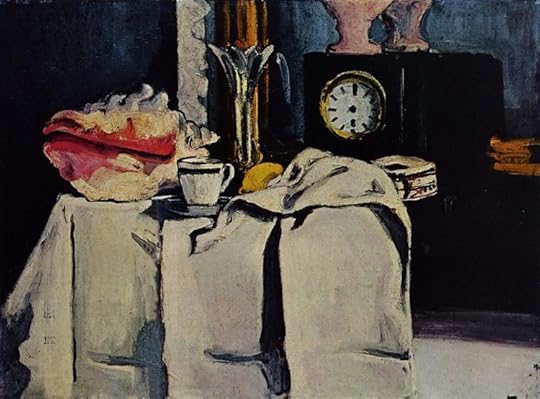
(Cézanne, The Black Marble Clock, 1870)
An anecdote which particularly amused me was that Proust, when asked in a survey for a newspaper on what sort of work he would have chosen if he wouldn’t be a writer, answered he would have liked to be a baker. It made me smile because I just read that the Flemish author Stijn Streuvels, born in the same year as Proust (1871) and known for his lyrical naturalism, actually trained and worked as a baker before becoming a writer. The baker that was lost in Proust brings Prendergast to highlight the import of bakery items (especially croissants) in the cycle and to some possibly shocking revelations (the madeleine in the novel drafts appeared first as a slice of toast! Instead of loving lime blossom tea, Proust was partial to café au lait!).
But when nothing subsists of a distant past, after the death of people, after the destruction of things alone, frailer but more enduring, more immaterial, more persistent, more faithful, smell and taste still remain for a long time, like souls, remembering, waiting, hoping, on the ruin of all the rest, bearing without giving way, on their almost impalpable droplet, the immense edifice of memory.
Prendergast points out that the world from the Recherche is death-haunted from start to finish. What will stay with me is the way he elucidates how subtle Proust weaves grieving into his cycle. While it was Roland Barthes’s Mourning Diary which reminded me of the moving passages in which Marcel addresses the loss of his grandmother, it was Prendergast who made me aware I had entirely forgotten – or perhaps skimmed over at the time of reading – the disappearance of Marcel’s mother from the novel – her death – by recapitulating scenes in Venice which had entirely slipped my mind. Likely, reading the same book at different stages of life makes one read it differently; one’s perspective on it changes and the same details might resonate quite differently (Prendergast’s recurrent highlighting of the ‘Bal des têtes’ sequence in the novel rekindled the memory that at the time of reading it, this phenomenal sequence helped me to see why my mother-in-law seemed to enjoy attending funerals so much).
Eloquent, evocative and entertaining, a delightful blend of enthralling anecdotes, facts and literary insights and reflections, Living and Dying with Marcel Proust aims for amateur Proustians rather than specialists. It is not a book to be read as an introduction to the Recherche as it reveals far too many essential plot elements and information on the fate of some of the characters that could spoil the reading pleasure of discovering them oneself. Probably readers who have not read the entire cycle yet better withhold from reading the book until the finale, as Prendergast’s reflections on the ingenious structure of the storytelling, the leitmotifs, the temporal shuffles which are a mix of recapitulations, disruptions and interpolations might resonate more when one has experienced the whole narrative arc.
Together with the lavishly illustrated Le Paris retrouvé de Marcel Proust which I finished a few weeks ago, Living and Dying with Marcel Proust seems an excellent and enriching companion piece to (re)-read when proceeding through the cycle again. even if Prendergast’s peculiar sense of humour and the rather pointless epilogue not entirely resonated with me. I hope that somewhere in the future there will be room to succumb to the voluminous Proust biography by Jean-Yves Tadié too.
In this interview, Prendergast tells more about the book (and a little on the Penguin translation of 2002, of which he was the general editor).
Thanks to NetGalley, the author and publisher Europa Compass for an ARC.
This is not a commentary on Proust or an academic monograph: the individual chapters range over key elements such as the senses, the colour pink, breasts, but they don't form an argument or thesis or come to a conclusion. Which is, of course, superbly fitting for a book which is deeply in dialogue with A la recherche, a novel without plot which circles back on itself endlessly.
I'd say this is a book for those who have read Proust all the way through at least once: it's too full of spoilers for anyone who hasn't yet but intends to read A la recherche. At times it can be frustratingly obtuse; at others gently humourous; again, enlightening (and I especially liked the chapter on colour, specifically the uses of pink throughout the seven volumes). Most of all, though, this is a book which invites, even urges, us to reread Proust and to take that journey all over again with Marcel.
Much like my reading experience of In Search of Lost Time (ISOLT), the idea of this book was much more intriguing than the book itself.
Professor Prendergast is a Proust scholar, the editor of the Penguin Classics English translations of ISOLT, translator and someone who views Proust as life-changing.
The first two chapters in this book about the therapeutic effect of Proust's work and the role of food were quite interesting. The rest of the book, less so. It ultimately felt too long-winded, too mundane and a bit forced. Again, very similar to my feelings as I progressed through reading ISOLT.
Texto algo disperso e com um escolha temática que achei particularmente desinteressante. Para terminar o #lerProust esperava algo mais enriquecedor. Bem na verdade posso sempre voltar a ler Citati.
My thanks to both NetGalley and the publisher Europa Editions for an advanced copy of this commentary on the works of Marcel Proust.
Over the 3 million words that make up the series In Search of Lost Time or as the French refer to the work La Recherche the author Marcel Proust discussed and reflected on many things, love, life, loss, memory, insomnia, food, music, being a snob, and the idea of humor. Some of these themes were covered in incredibly long sentences, some of them were thought about, and and discussed over the entirety of the works. Christopher Prendergast, editor of an earlier translation and a scholar of things Proust has in his book Living and Dying with Marcel Proust, writes of these ideas over the span of the whole book, with passages from both the books and the world around us.
The book begins with a brief introduction of our author, his love of Proust and his work on earlier translations and studies. From there we travel along with the author as he studies many of Proust obsessions using the work, and observations from Proust's life and others. The author dives deep into the work finding passages that might not seem to be a part of what he is discussing but suddenly the words seem perfect. His section on mourning and loss is especially well chosen, and the commentary alone is quite touching and maudlin.
The book is written in the style of Proust in that sometimes the reader is stunned by the amount of words that are appearing, but Prendergast is very skillful at bringing this all together. This is not a book for people who wish to know more about the books before starting them, or hoping for a Cliff Notes guide to get through a class. This is a book for people who enjoyed the novels and wish to know more as many plot points are revealed and the fate of characters are shared. This is book by a person who has spent a long time pondering, and studying a work and writing about it for others enjoyment.
Definitely for a fan of Proust. The work can sometimes seem daunting, but at the end you feel that a journey has been made and it was one of discovery. Also of appreciation for Mr. Prendergast and for the work that he so finely commented on.
Cambridge French language professor tells us about Proust and his use of the language going into special treatment of death, life, color, fragrance, etc., as shown in Remembrance on things past. Interesting and illuminating. . . . synesthesia . . . . transposed sensation. . . . p. 39 . . . immense edifice of memory. p. 42 Nietsche . . . There is more wisdom in your body than in your deepest philosophy. p. 43 Our love of life is not more than an old affair that we do not know how to discontinue. Its strength lies in its permanence. But death, which interrupts it, will cure us of our desire for immortality. p. 45 This lovely girl arouses in him a "longing for life" . . . p. 69 The world's most laborious sayer of nothing. . . p. 83 Just as an hour isn't only an hour but also a vessel containing all manner of unforeseeable sensory and psychological surprises. . . . p. 118 !!!! I was filled with life, if only for a few moments, by the elating power of solitude" --"connecting doors , long walled up, were opening again in my brain." p. 122 resolutely obtuse. . . . p. 127 Tha pile of paper on his left was still alive, like watches ticking on the wrists of dead soldiers. p. 132 !!!!!!! ( quote from Cocteau) . . . the geometry of a train of thought that stopped in the middle of nowhere. p. 136 !!!!! Finished, but incomplete. p. 148 The threshold crossed here is not into the hell of suffering , but into the joys of enlightenment and the embrace of vocation. p. 181 . . . summarized by Georges Poulet as " the presence, in the present, of another present, the past." P. 200 . . . he tried for a long time to discover my name from my face. p. 233
I keep putting off rereading Proust, by reading books tangentially connected, which is far less satisfying. This is a pretty ok overview of certain ideas that are woven through the narrative - colors, sounds, weaving itself, death- thats clearly written from a place of love for the material, with the occasional new insight. It says on the back blurb that those who haven't read A La Recherche could enjoy it, but I really really doubt this, as it requires a decent knowledge of the plot and main characters
Living and Dying with Marcel Proust by Christopher Prendergast is a wonderful dive into some of the themes and obsessions that run through In Search of Lost Time (À la recherche du temps perdu). This work fits nicely between the more academic analyses and the more popular ones.
I will initially question part of the book description, namely that this is a good book for those "just setting out for the first time" reading Proust. I think it is a great companion book for those who have read In Search of Lost Time but I am less certain that it would be all that helpful for a first time reader. My main reason is that Proust's masterpiece really needs to be experienced on one's own before trying to tie different parts of it together thematically. This is my opinion and I may well be wrong. But the first time I read all of In Search of Lost Time (though at the time, the mid-80s, it was translated as Remembrance of Things Past) I found myself getting lost in thought almost every time I put it down, so my connections were largely personal. I might not have those personal connections had I used a companion book that pointed out themes and ideas that run through it.
While most people have read at least one or two of the volumes, often taught as standalone novels even though they aren't, many people have shied away from reading the entire work. This is quite understandable, especially if it isn't being read as part of (or in at least one case I know of, the entirety of) a course. While my next comment might seem to contradict my previous one, I think reading Prendergast before deciding whether to read Proust might be beneficial.
Even with all of the scholarship I've read and used on À la recherche du temps perdu I think this short volume might be my favorite. For readers who have read through Proust several times this new book reminds you of things you have either forgotten or overlooked and, more importantly, it reminds you of why you return to it again and again. I don't know whether I will read it again, without intending to I have read it at some point during every decade from the 1980s through the 2010s. My reading habits now are quite different, but I do have most of the decade left to decide, and if anyone else writes another book of this caliber it will probably push me to reread it again.
I would highly recommend this to readers familiar with À la recherche du temps perdu but who might prefer to read about it now rather than reread it. This would also be a great book for someone about to embark on their second trip through the work, it will help remind you of where you'll be going while not beating any single topic to death. If you haven't read Proust and are considering it, this will offer some idea of the enjoyment one gets from it though it will give away some aspects of the book.
Reviewed from a copy made available by the publisher via NetGalley.
Superb reading for those who cannot leave Proust behind and constantly are seeking, sometimes with levels of irritation and futility, to wrestle further meanings from that purple prose. Prendergast knows he's on stony overexamined ground but he develops his essays on Proustian motifs - pink, parts of the body, gardens, death, croissants and madeleines - to gently guide the reader to a new understanding of the great and petty obsessive. Particularly edifying are the comparisons with Ruskin's world view and of course, of the Impressionists making images that reflected much of Proust's world and the horrid anti-semitism that plagued Proust throughout his life.
I read Swann's Way earlier this summer; I got a lot out of it, but I was leaning toward checking the Proust box and moving on for the time being, in regards to the rest of the series. This book, which I stumbled across in a bookstore while on vacation, changed my mind (with spoilers for this century-old series as part of the bargain, of course). It was like a lively English lesson and I know it will heighten my appreciation of the rest of the Recherche.
I read Marcel Proust's In Search of Lost time, a few decades ago and it was an amazing experience. I can't say I enjoyed the book, but every so often it would open up and reveal an outstanding passage that has lived with me for the rest of my life. I wish I had Prendergast's guide to help me through it as it shows depths to the book that I had not seen.
Living and Dying with Marcel Proust is a beautifully introspective journey into the profound ways literature intertwines with life and mortality. The book captures the timeless relevance of Proust's insights while inviting readers to reflect on their own fleeting moments. It's an engaging, meditative read that leaves you both thinking and feeling deeply.
Prendergast probably loves Proust more than me, but we love *very* different parts of Proust (i.e., give me all the social satire and humor and so on). Also, I just don't think you should write about Proust in 'Proustian' prose, because you're not going to be as good as him, and you'll put people off reading the real thing. For completist tragics only.
DNF. Probably didn't give this book a good chance. I was expecting a book about Proust's philosophy and this seemed to be a detailed explication of his famous novel. If I had stuck with it, it may have ended up being what I was looking for, but it just didn't hold my interest.
Given the title, I was hoping for something other than this overly academic review of Proust's In Search of Lost Time. However, the Epilogue regarding the film initiated in 1993 involving many readers of Proust's work is interesting.
If you're in the market for one meditation on Proust read Alain de Botton's How Proust Can Change Your Life. Prendergast makes it clear in his opening remarks that this is a collection of fragments straining for a higher purpose.
Really nice book. Has an academic flavor but is meant for general readers and fans of the Recherche. I’ve been meaning to reread Proust for years and this book has inspired me to get going with that project.
This book definitely inspired me to read more Proust, but while the begging was very engaging I felt that this book really dropped off by the end. I would suggest either dipping in and out of this book while reading Proust, or sit down and get it done in one sitting.