

What do you think?
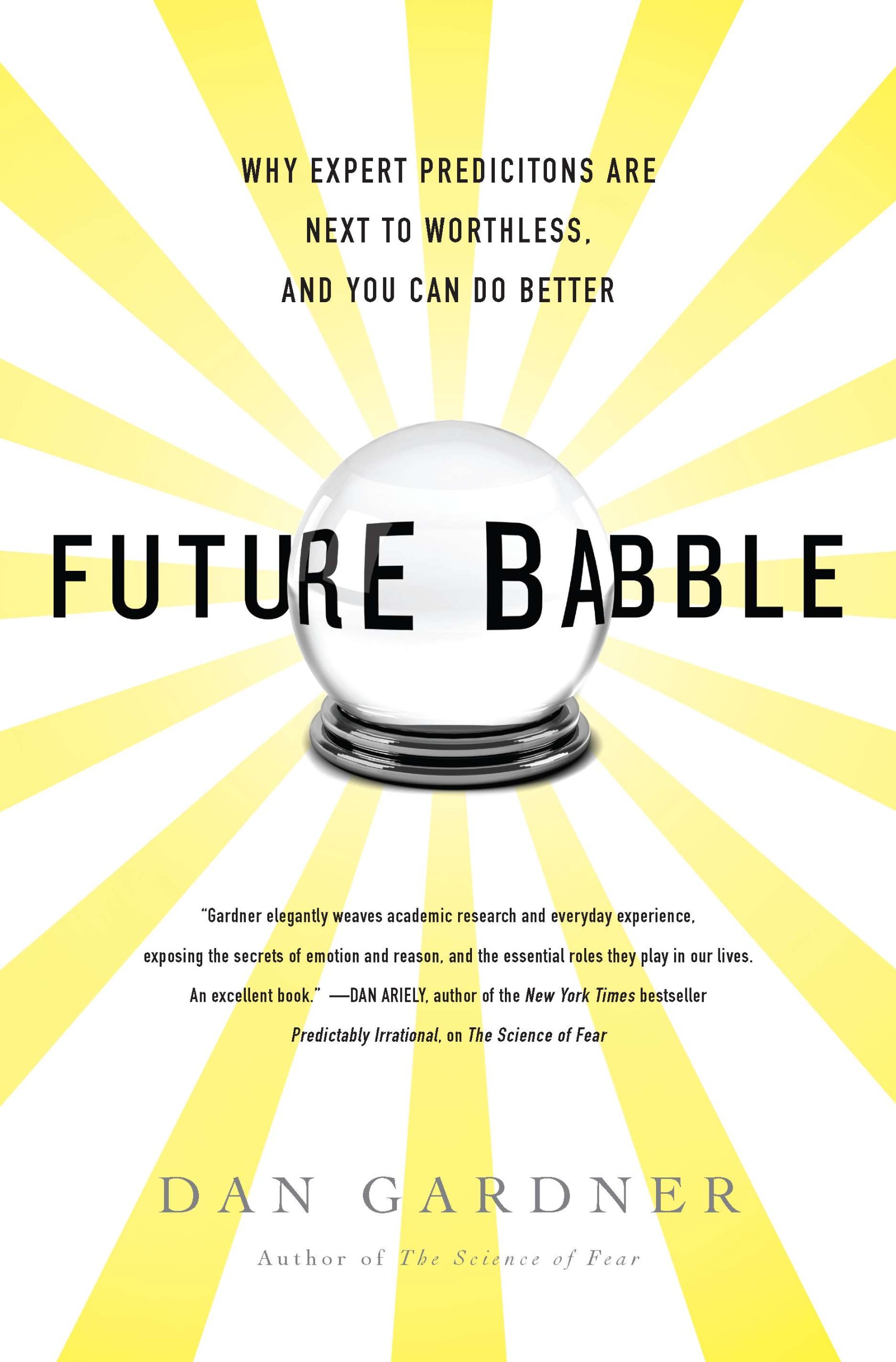
Future Babble: Why Expert Predictions Are Next to Worthless, and You Can Do Better
"Genuinely arresting . . . required reading for journalists, politicians, academics, and anyone who listens to them."
-Steven Pinker, author of "How the Mind Works"
We are awash in predictions. In newspapers, blogs, and books; on radio and television. Every day experts tell us how the economy will perform next year, if housing sales will grow or shrink, and who will win the next election. Predictions are offered about the climate, food, technology, and the world our grandchildren will inhabit. And we can't get enough of it.
Drawing on research in cognitive psychology, political science, and behavioral economics, award-winning journalist Dan Gardner explores our obsession with the future. He shows how famous pundits, "hedgehogs" who stick to one big idea no matter how circumstances change, become expert at explaining away predictions that are wrong while "foxes," who are more equivocal in their judgments, are simply more accurate.
Kindle Edition
First published January 1, 2010
About the author
Dan Gardner
21 books99 followersDan Gardner is a journalist, author, and lecturer.
Trained in law (LL.B., Osgoode Hall Law School, class of ’92) and history (M.A., York University, ’95), Dan first worked as a policy advisor to the Premier of Ontario. In 1997, he joined the Ottawa Citizen. In the years that followed, he travelled widely, researching long features about drugs, criminal justice, torture and other challenging issues. Later, he was a national affairs columnist until he left the newspaper in 2014. Dan’s writing at the Citizen won, or was nominated for, most major prizes in Canadian journalism, including the National Newspaper Award, the Michener Award, the Canadian Association of Journalists award, the Amnesty International Canada Media Award for reporting on human rights. In January, 2015, Dan became editor of Policy Options, Canada’s premier magazine of public policy, published by the Montreal-based Institute for Research in Public Policy.
In 2005, Dan attended a lecture by renowned psychologist Paul Slovic. It was a life-changing encounter. Fascinated by Slovic’s work, Dan immersed himself in the scientific literature. The result was a seminal book on risk perception, Risk: The Science and Politics of Fear. Published in 11 countries and 7 languages, leading researchers, including Slovic, praised the book’s scientific accuracy and lucid analysis of how psychology and social processes interact — causing us to fear what we should not and not fear what we should.
Dan’s second book, Future Babble, delved more deeply into psychology to explain why people continue to put so much stock in expert predictions despite the repeated — and sometimes catastrophic — failure of efforts to forecast the future. Again, Dan was delighted that his book garnered the praise of leading researchers, including Harvard’s Steven Pinker, who said it should be “required reading for journalists, politicians, academics, and those who listen to them.”
Both books resulted in invitations to give talks worldwide. Dan has lectured for Google, Siemens, Zurich Insurance, Khosla Ventures, and many more corporations and governments.
Next up: Superforecasting, co-written with Wharton psychologist Philip Tetlock, which examines the remarkable results of Tetlock’s latest research program. Superforecasting will be published in September, 2015, by Crown in the United States, Random House in the United Kingdom, and McClelland and Stewart in Canada. There will also be German, Spanish, Russian, Chinese, Japanese, Korean, Portuguese, Dutch and Finnish editions.
Trained in law (LL.B., Osgoode Hall Law School, class of ’92) and history (M.A., York University, ’95), Dan first worked as a policy advisor to the Premier of Ontario. In 1997, he joined the Ottawa Citizen. In the years that followed, he travelled widely, researching long features about drugs, criminal justice, torture and other challenging issues. Later, he was a national affairs columnist until he left the newspaper in 2014. Dan’s writing at the Citizen won, or was nominated for, most major prizes in Canadian journalism, including the National Newspaper Award, the Michener Award, the Canadian Association of Journalists award, the Amnesty International Canada Media Award for reporting on human rights. In January, 2015, Dan became editor of Policy Options, Canada’s premier magazine of public policy, published by the Montreal-based Institute for Research in Public Policy.
In 2005, Dan attended a lecture by renowned psychologist Paul Slovic. It was a life-changing encounter. Fascinated by Slovic’s work, Dan immersed himself in the scientific literature. The result was a seminal book on risk perception, Risk: The Science and Politics of Fear. Published in 11 countries and 7 languages, leading researchers, including Slovic, praised the book’s scientific accuracy and lucid analysis of how psychology and social processes interact — causing us to fear what we should not and not fear what we should.
Dan’s second book, Future Babble, delved more deeply into psychology to explain why people continue to put so much stock in expert predictions despite the repeated — and sometimes catastrophic — failure of efforts to forecast the future. Again, Dan was delighted that his book garnered the praise of leading researchers, including Harvard’s Steven Pinker, who said it should be “required reading for journalists, politicians, academics, and those who listen to them.”
Both books resulted in invitations to give talks worldwide. Dan has lectured for Google, Siemens, Zurich Insurance, Khosla Ventures, and many more corporations and governments.
Next up: Superforecasting, co-written with Wharton psychologist Philip Tetlock, which examines the remarkable results of Tetlock’s latest research program. Superforecasting will be published in September, 2015, by Crown in the United States, Random House in the United Kingdom, and McClelland and Stewart in Canada. There will also be German, Spanish, Russian, Chinese, Japanese, Korean, Portuguese, Dutch and Finnish editions.
Ratings & Reviews
Friends & Following
Create a free account to discover what your friends think of this book!
Community Reviews
Displaying 1 - 30 of 107 reviews

July 31, 2012
No, had to stop before this one even got started. I need to do something to control my blood pressure, and listening to idiots being smartarses isn't it. If you need to find out the meaning of hindsight bias, well, this is as good a book as any other. The guy 'demolishes' predictions made by experts and thus shows the need to be skeptical - if not actually cynical. The problem is that he predictions he chooses to demolish are all a bit bizarre. There is the right wing prediction that there would be weapons of mass destruction in Iraq - except that wasn't a prediction, that was a lie. There is a big difference there. There was the prediction that the US would be welcomed as liberators once in Iraq, and who would have predicted that wouldn't come to pass - to which the answer is, oh yeah, just about everyone. But the failed prediction that made my blood boil was that crazy leftwing one that Reagan's push to grossly accelerate the arms race pushed the world to the brink of nuclear war. Only someone completely blinded by their ideological preferences could argue that the mass stockpiling of nuclear weapons actually makes the world a safer place. That we got through those years without being destroyed in an endless fireball and nuclear winter is down to good luck. It is utterly clear that Reagan was unconvinced by the science of the utter devastation of such a war and was doing all he could to push brinkmanship. We are lucky the Soviet Union chose to implode - that was not the most likely outcome, nor the one they were being pressed into taking by Reagan's policies. To present the very real concerns we had in the 1980s of near immediate species suicide as a failed prediction is to completely misrepresent both the role of reasonable prediction and to misrepresent the very real dangers such weapons still present. It was bad enough with Reagan had his hand on the button, but would you choose to have Putin's hand there today? Or Iran's? Israel'? North Korea's? Pakistan's? India's? Excuse me for not feeling out of the woods yet, or of feeling terribly certain of any prediction that nuclear war ending in species extinction isn't still on the cards. If you want a reason to think the problems facing us aren't really problems at all as experts are always wrong, here is the book for you. Personally, I would rather act on the basis of the best available evidence in ways most likely to preserve our precious and all too delicate existence here on earth - even if that does mean being proven too conservative. The consequences of being proven too confident are too frightening to contemplate.

August 20, 2018
This was a good book and an engaging (but not too challenging) read. It is only suffering in my rating because I immediately followed it with Superforecasting: The Art and Science of Prediction, which was on the same topic (and Dan Gardner co-authored), which I thought was better.
Still, I learned things. Like that several countries (including South Korea) did nothing about Y2K. Hunh. This book gets a little more into the cognitive psychology, why we (as a society) still listen to people with a terrible track record - people prefer to be dazzled with BS, and confidence is more impressive than cautious precision. Or, as the intro to the Nine Inch Nails track puts it, "I don't want knowledge, I want certainty!"
Anyway, not bad, but I would recommend the other book.
Still, I learned things. Like that several countries (including South Korea) did nothing about Y2K. Hunh. This book gets a little more into the cognitive psychology, why we (as a society) still listen to people with a terrible track record - people prefer to be dazzled with BS, and confidence is more impressive than cautious precision. Or, as the intro to the Nine Inch Nails track puts it, "I don't want knowledge, I want certainty!"
Anyway, not bad, but I would recommend the other book.

February 16, 2011
This was okay, but read about a third or more of the way through it, and it was basically repeating the same idea over and over, can't imagine it adds anything more somewhere near the end. Ironically, I think the author makes statements way outside his expertise when he starts talking about how everything can be explained by Darwinian evolution and what life was like for primitive man - which can be generalized to such a degree that it becomes about as accurate as basing your theories of humanity on the horoscope.

May 22, 2014
I enjoyed in part because I hate the fact that people (everyone on cable news) make stupid predictions all the time and are never held to account for their massive BS. The first part of the book mostly discussed various major predictions and how they had failed, and this got boring pretty fast. The second part explored more why people make bad predictions and why they stick to them even when they're proved wrong (resolving cognitive dissonance), and this was much more interesting. Nothing groundbreaking here, but still worth a read if you're interested in that kind of stuff.

November 22, 2024
These are insights into human psychology that everybody should familiarize themselves with. Fortunately, many of the central points are included in many other books.
The only reason for not giving it a straight five stars is that it repeats itself too much. The message is convincingly conveyed within the first half of the book.
The only reason for not giving it a straight five stars is that it repeats itself too much. The message is convincingly conveyed within the first half of the book.

March 30, 2019
Dan reels off an exhaustive list of failed expert predictions throughout history. Some are egregiously inaccurate. This book is a more approachable "Black Swan". He also gives us the names of the experts to help us embody the targets of our mockery.
Throughout the book, Dan praises foxes and denounces hedgehogs (terms used to describe two types of thinkers). Foxes are malleable, fluid. They are able to live in uncertainty. They know they can be wrong. Hedgehogs live by a unifying theory of everything. They are unable to see their mistakes even in hindsight. They make arguments that are clear, simple, and wrong.
One of the most interesting bits in this book is the discussion on our profound aversion to uncertainty. People feel worse when something bad might occur rather than knowing for certain it will occur. Uncertainty spoils our illusion of control.
Hindsight should self correct our reliance on predictions, but it never does. Experts forget or excuse past failed predictions with regularity for various reasons. As a people, we crave certainty and are drawn to the experts who are most confident in their future predictions. Ironically, the most popular figures in media are the loudest voiced hedgehogs. And for this reason, they are often the most incorrect. Our desire for certainty is what fuels the talking heads to take hard positions.
Be like the fox. Be fluid. Have humility. Don't be certain about your predictions. Know that you can be wrong.
Throughout the book, Dan praises foxes and denounces hedgehogs (terms used to describe two types of thinkers). Foxes are malleable, fluid. They are able to live in uncertainty. They know they can be wrong. Hedgehogs live by a unifying theory of everything. They are unable to see their mistakes even in hindsight. They make arguments that are clear, simple, and wrong.
One of the most interesting bits in this book is the discussion on our profound aversion to uncertainty. People feel worse when something bad might occur rather than knowing for certain it will occur. Uncertainty spoils our illusion of control.
Hindsight should self correct our reliance on predictions, but it never does. Experts forget or excuse past failed predictions with regularity for various reasons. As a people, we crave certainty and are drawn to the experts who are most confident in their future predictions. Ironically, the most popular figures in media are the loudest voiced hedgehogs. And for this reason, they are often the most incorrect. Our desire for certainty is what fuels the talking heads to take hard positions.
Be like the fox. Be fluid. Have humility. Don't be certain about your predictions. Know that you can be wrong.

May 21, 2016
After having read "Superforecasting" by Tetlock & Gardner I wanted to delve deeper.
While I found this a wortwhile read there was a lot of repetition, if you're looking for a supplement and some expansion on "foxes & hedgehogs" then I suggest you give it a go.
Otherwise, most of it is already covered in "Superforecasting".
While I found this a wortwhile read there was a lot of repetition, if you're looking for a supplement and some expansion on "foxes & hedgehogs" then I suggest you give it a go.
Otherwise, most of it is already covered in "Superforecasting".
October 4, 2024
I thought I had my review on this book sorted out. "3-stars," I figured, "with the same kind of should-have-been-an-essay-not-a-whole-book that characterizes so much writing that falls back on evolutionary psychology." But, the last chapter offered some redemption, and so I'm adjusting to four stars.
In "Future Babble," Dan Gardner explores why expert predictions are so bad, and yet still so seductive. The core ideas are important if not terribly complex:
- We crave certainty over uncertainty, so we like to assert simple stories... and prefer hearing clear, strong, definitive predictions from experts rather than nuance and context.
- There are lots of cognitive phenomenon that double down on this, from avoiding dissonance to over-valuing predictive 'wins' and downplaying misses. These, again, both make it more likely for experts to make overly-bold, overly-confident predictions... and media to platform, and audiences to prefer, those who are bold over those who hedge towards accuracy.
- Our insatiable desire for predictions means that there will be a relentless, endless supply of them... so some people will be right just by chance. We then hold them up until the next accidental hit by someone new, and seamlessly pivot along to the latest and greatest all-knower we can herald.
So, these are all sensible ideas, and they're well worth hearing. But, for someone who already believed a lot of this, the book doesn't really push things much further, instead falling into fairly thin evolutionary biology explanations for our present state. That would be a much more interesting book, Gardner: how evolutionary biology replicates so many of the problems of prediction, and yet is held up as the ultimate explanation for everything!
The book also isn't helped by what feels like an overwhelming number of examples of false predictions. I mean, it's fun to hear folks predicting apocalypses that never happened, but it felt like we got more than we needed in every single chapter after the point was long made.
But then... then came the last chapter, which is where Gardner - in my view - hid the gold. Two parts of this, I think, really added value beyond the retrodding of all that had come before, again and again.
First, Gardner gives a nod to the all important question of whether predictions actually matter at all:
This is, to me, the whole game. The more we chase predictive power, the more and more diminished the returns, and the more and more we avoid the questions of politics, values, and implementation: what action will we take, who will pay for it, and do we all agree? Appeals for prediction are, in my opinion, all too often attempts to put off making those value decisions rather than simply recognize that nothing is certain and that making investments in avoiding risk is a value-based calculation, not a scientifically- and objectively-determined one.
The other value in the last chapter comes from Gardner's study of Alan Barnes and the Privy Council of Canada's unit attempting to predict geopolitical events. Rather than simply laughing at bad predictions, like so much of the book is dedicated to, this case begins to delve into the question of "how do we do this better?" The case is fascinating with valuable lessons about humility, aggregating sources and types of data, and being clear in uncertainties... but I wish that these sorts of cases took up more of the book rather than being a quick example with limited evaluation or longitudinal tracking in the concluding chapter.
Still, though, that final chapter, I think, delivers significant value. And, for those who might desire more intro to the topic overall, the book as a whole can be useful too. As such, 4 stars, with a caution to watch out of moments of over-reliance on evolutionary psychology.
In "Future Babble," Dan Gardner explores why expert predictions are so bad, and yet still so seductive. The core ideas are important if not terribly complex:
- We crave certainty over uncertainty, so we like to assert simple stories... and prefer hearing clear, strong, definitive predictions from experts rather than nuance and context.
- There are lots of cognitive phenomenon that double down on this, from avoiding dissonance to over-valuing predictive 'wins' and downplaying misses. These, again, both make it more likely for experts to make overly-bold, overly-confident predictions... and media to platform, and audiences to prefer, those who are bold over those who hedge towards accuracy.
- Our insatiable desire for predictions means that there will be a relentless, endless supply of them... so some people will be right just by chance. We then hold them up until the next accidental hit by someone new, and seamlessly pivot along to the latest and greatest all-knower we can herald.
So, these are all sensible ideas, and they're well worth hearing. But, for someone who already believed a lot of this, the book doesn't really push things much further, instead falling into fairly thin evolutionary biology explanations for our present state. That would be a much more interesting book, Gardner: how evolutionary biology replicates so many of the problems of prediction, and yet is held up as the ultimate explanation for everything!
The book also isn't helped by what feels like an overwhelming number of examples of false predictions. I mean, it's fun to hear folks predicting apocalypses that never happened, but it felt like we got more than we needed in every single chapter after the point was long made.
But then... then came the last chapter, which is where Gardner - in my view - hid the gold. Two parts of this, I think, really added value beyond the retrodding of all that had come before, again and again.
First, Gardner gives a nod to the all important question of whether predictions actually matter at all:
What all this means, very simply, is that accurate prediction often isn't needed in order to make good decisions. A rough sense of the possibilities and probabilities will often do. We can't predict earthquakes, but we do know where they are more or less likely and we make building codes less or more strict accordingly. That works. Similarly, it wasn't necessary to predict the 9/11 terrorist attack in order to know that having reinforced cockpit doors on jets is a good idea. In the 1990s, several incidents, including the stabbing of a Japan Airlines pilot but a deranged man, convinced many safety advocates and regulators that reinforced doors were a wise investment. They weren't in place on 9/11 because the airlines didn't want the extra cost and they successfully lobbied the politicians to block the proposal. It was politics, not unpredictability, that left planes vulnerable that fateful morning.
This is, to me, the whole game. The more we chase predictive power, the more and more diminished the returns, and the more and more we avoid the questions of politics, values, and implementation: what action will we take, who will pay for it, and do we all agree? Appeals for prediction are, in my opinion, all too often attempts to put off making those value decisions rather than simply recognize that nothing is certain and that making investments in avoiding risk is a value-based calculation, not a scientifically- and objectively-determined one.
The other value in the last chapter comes from Gardner's study of Alan Barnes and the Privy Council of Canada's unit attempting to predict geopolitical events. Rather than simply laughing at bad predictions, like so much of the book is dedicated to, this case begins to delve into the question of "how do we do this better?" The case is fascinating with valuable lessons about humility, aggregating sources and types of data, and being clear in uncertainties... but I wish that these sorts of cases took up more of the book rather than being a quick example with limited evaluation or longitudinal tracking in the concluding chapter.
Still, though, that final chapter, I think, delivers significant value. And, for those who might desire more intro to the topic overall, the book as a whole can be useful too. As such, 4 stars, with a caution to watch out of moments of over-reliance on evolutionary psychology.

June 21, 2017
Good: Convincingly showed how "expert prediction" is often wrong, and why. Called a lot of people out on their bad predictions, and their bad rationalizations for why they got them wrong.
Bad: Once the schadenfreude wore off Gardner just felt like the same kind of pompous expert he was mocking.
Ugly: In some ways this book was an eye opener for just how self-defeating modern sociology can be. The basic premise was this: 1) The world is super complex. 2) Our brains didn't evolve to understand and make predictions in this environment. Thus, most people simply have insurmountable biases (even a bias bias) which help them cope. But if Gardner is right (and most modern sociology books for that matter) and our minds aren't suited to this level of abstract and rationale thought, why should we believe them? Why believe these experts but not the experts they mock? Do I only believe Gardner because he seems so confident? Etc. I'm not saying he's wrong, just that when you say that our minds aren't suited to this sort of task, you end up undermining your entire argument.
Bad: Once the schadenfreude wore off Gardner just felt like the same kind of pompous expert he was mocking.
Ugly: In some ways this book was an eye opener for just how self-defeating modern sociology can be. The basic premise was this: 1) The world is super complex. 2) Our brains didn't evolve to understand and make predictions in this environment. Thus, most people simply have insurmountable biases (even a bias bias) which help them cope. But if Gardner is right (and most modern sociology books for that matter) and our minds aren't suited to this level of abstract and rationale thought, why should we believe them? Why believe these experts but not the experts they mock? Do I only believe Gardner because he seems so confident? Etc. I'm not saying he's wrong, just that when you say that our minds aren't suited to this sort of task, you end up undermining your entire argument.

March 10, 2018
Interesting and funny, this book delves into the world of expert predictions and human folly. It makes for an introspective view of the people I listen to in regards to current and future world events, and how I probably judge them more for their confidence and charm than their accuracy. Hindsight, confidence bias, memory; it all plays a part in how successful each expert and their adherents believe they are. Best quote: "Not one of them mentions that if they were as accurate as they are confident, they would be billionaires - and billionaires don't do talk shows."

September 3, 2025
Some good stories. But the general point that jackasses on TV/social media spouting opinions are often wrong is not shocking. Although the author brings up meteorology a lot, I feel like the opportunity was missed to distinguish between evidence-based predictions and eminence-based opinions. Astronomers can predict eclipses and such precisely, accurately and confidently far out into the future. All kinds of experts do make successful predictions. Thus the problem is not "experts" or "predictions," per se.
December 6, 2020
Offers important lessons to explain why we consistently fail at predictions, but continue to make them and listen to those who do. The most useful part of the book, alongside its dose of skepticism about anyone claiming to see the future, is its introduction of various heuristics we can use to overcome our in-built biases.

October 14, 2019
Interesting look at the problems with future forecasting and wrong predictions about the future. A bit heavy on the psychology angle, which doesn’t really apply at the aggregate in complex social systems.

January 29, 2020
If you're interested in forecasting, there's not much useful advice here. If you're not, all it says is"don't trust forecasts", which is too reductive. Either way, skip this and read superforecasting.
January 9, 2021
Argumentovano i detaljno napisana - jos jedna potvrda da je predvidjanje tesko pogotovu kad se radi o predvidjanju buducnosti.
Mozda je poglavlje o uspesnim metodima u predikciji moglo da bude i malo duze ...
Mozda je poglavlje o uspesnim metodima u predikciji moglo da bude i malo duze ...
This entire review has been hidden because of spoilers.

August 4, 2022
I've grown tired of books like this which could be easily summarized in a couple of pages. If you find the summary somewhere like Blinkist than go with that. Btw, there is nothing new being said here and it is also not being said in the form of a worthy story.

July 18, 2023
Interesting book with too many anecdotes and trivia too showcase the point that future is unpredictable.
Among that there were few nuggets of knowledge that are really appreciated. Last chapter is the best.
Among that there were few nuggets of knowledge that are really appreciated. Last chapter is the best.
February 20, 2017
Excellent - shows how all the predictions can be questioned :) and almost always are wrong

September 16, 2017
Great book, must read!

November 26, 2017
Excellent reading, if for no other reason than to remind me that I've been listening way too much to the babble of TV and YouTube pundits lately.
February 10, 2018
Must read for everyone.

May 28, 2019
A fantastic discussion of biases that different types of experts are prone to, and how to avoid them.

March 26, 2020
Don't listen to the experts

September 2, 2020
Illuminating and concise - along the lines of Dan Ariely
March 1, 2025
Incredibly arrogantly written

January 26, 2023
4 stars

November 14, 2012
Dan Gardner's Why Expert Predictions Fail - and Why We Believe Them Anyway is one of those books that points out the obvious that needed explanation, pointing to an issue--here, the tendency of futurologists of all kinds to make predictions which turn out false but whose opinions and methods are still valued--and explaining why this tendency exists.
The central problem Gardner deals with is this. I like to know about what will happen in the future, you like to know what will happen, we all want to know. Will the Earth be deterraformed by climate change and other environmental catastrophes? What fashions will be in vogue in Paris and Moscow and New York City next year? Will nuclear war raze the Northern Hemisphere? Are the French really going to outnumber the Germans by 2050? When will we send a manned mission to Mars? Using ostensibly scientific frameworks, any number of smart people have created systems which aim to explain the future: Arnold Toynbee created a theory of civilizations that claimed to describe the past and predicted the creation of a totalitarian world-state, for instance, and Paul Ehrlich predicted mass famines in the 1970s. Neither prediction came to pass, and any number of other predictions by other people (smart or not) have also failed to come true. Why?
Chaos theory, Gardner points out, makes predictions which go too far out into the future impossible. As the Depeche Mode song goes, "everything counts in small amounts." I zig, here, and the next mayoral election in Toronto goes one way; I zag, there, I get hit by a car and never get elected ward councillor. Accounting for all the variables involved is impossible at the best of time, while the simplified theories used by these futurologists are even less capable. Certain predictions can be made in certain broad contexts--Gardner cites the knowledge that, based on births and migration this year, we know how many people will be 30 years old in 30 years time, and we can speculate on their marital behaviour and fertility regimes--but that's it. This is not a new fact.
Why do we believe the people who claim to know what will happen? Put it down to our primate brains. We just aren't as perfectly rational as we'd like to think we are, with tendencies to overlook inconvenient facts. Toynbee had to hack his schema to account for the fact that Islamic civilization began--not ended--with a universal empire, while Ehrlich kept postponing his doomsday, saying that it will come. How did these gentlemen get away with this? They had tremendous charisma, with the population at large if not with people with enough knowledge to critique their theories, with excellent presentation skills and good connections and the certainty that, in a confusing world full of threats, they knew what would happen. And they themselves believed that they'd know, again discounting inconvenient facts, indeed becoming upset if people pointed out their contradictions.
All this is a serious problem for people. Acting on the basis of mistaken theories could cause catastrophe: Ehrlich's suggestion that food-exporting countries stop exporting food to countries "doomed to fail" like Egypt and India would have created horrors where none happened. It is possible, Gardner emphasizes, to learn ways to think critically about the future, particularly by adopting the practice of radical doubt. George Soros did a good job predicting the world financial crisis, but in numerous interviews Soros has emphasized the fact that he looks not for proof that he's right, but rather for proof that he's wrong. (These critical thinking skills would be useful in domains apart from predicting the future, too, but that falls somewhat outside the scope of Future Babble.)
Engagingly written, very well-sourced, and well-argued, I'd recommend Future Babble for anyone who's interested in what we think about the future and how we can do better.
The central problem Gardner deals with is this. I like to know about what will happen in the future, you like to know what will happen, we all want to know. Will the Earth be deterraformed by climate change and other environmental catastrophes? What fashions will be in vogue in Paris and Moscow and New York City next year? Will nuclear war raze the Northern Hemisphere? Are the French really going to outnumber the Germans by 2050? When will we send a manned mission to Mars? Using ostensibly scientific frameworks, any number of smart people have created systems which aim to explain the future: Arnold Toynbee created a theory of civilizations that claimed to describe the past and predicted the creation of a totalitarian world-state, for instance, and Paul Ehrlich predicted mass famines in the 1970s. Neither prediction came to pass, and any number of other predictions by other people (smart or not) have also failed to come true. Why?
Chaos theory, Gardner points out, makes predictions which go too far out into the future impossible. As the Depeche Mode song goes, "everything counts in small amounts." I zig, here, and the next mayoral election in Toronto goes one way; I zag, there, I get hit by a car and never get elected ward councillor. Accounting for all the variables involved is impossible at the best of time, while the simplified theories used by these futurologists are even less capable. Certain predictions can be made in certain broad contexts--Gardner cites the knowledge that, based on births and migration this year, we know how many people will be 30 years old in 30 years time, and we can speculate on their marital behaviour and fertility regimes--but that's it. This is not a new fact.
Why do we believe the people who claim to know what will happen? Put it down to our primate brains. We just aren't as perfectly rational as we'd like to think we are, with tendencies to overlook inconvenient facts. Toynbee had to hack his schema to account for the fact that Islamic civilization began--not ended--with a universal empire, while Ehrlich kept postponing his doomsday, saying that it will come. How did these gentlemen get away with this? They had tremendous charisma, with the population at large if not with people with enough knowledge to critique their theories, with excellent presentation skills and good connections and the certainty that, in a confusing world full of threats, they knew what would happen. And they themselves believed that they'd know, again discounting inconvenient facts, indeed becoming upset if people pointed out their contradictions.
All this is a serious problem for people. Acting on the basis of mistaken theories could cause catastrophe: Ehrlich's suggestion that food-exporting countries stop exporting food to countries "doomed to fail" like Egypt and India would have created horrors where none happened. It is possible, Gardner emphasizes, to learn ways to think critically about the future, particularly by adopting the practice of radical doubt. George Soros did a good job predicting the world financial crisis, but in numerous interviews Soros has emphasized the fact that he looks not for proof that he's right, but rather for proof that he's wrong. (These critical thinking skills would be useful in domains apart from predicting the future, too, but that falls somewhat outside the scope of Future Babble.)
Engagingly written, very well-sourced, and well-argued, I'd recommend Future Babble for anyone who's interested in what we think about the future and how we can do better.

November 19, 2010
One of the first things I've learned from this fascinating book is that the more you know, the less you know. You can not base the future on the past. The reason for this is that there are too many variables, the future is not linear. Too many things can cause hiccups in the reasoning. I learned that the economic and political experts who make forecasts for the future are rarely right, which leaves me to wonder if half of them predict something positive for the future, and the other half predict something negative, does that mean man would never progress? Nothing would ever happen? The section on randomness I thought was particularly interesting, I learned how the subconscious often overrides the conscious in making decision, but the conscious eventually gets there, it's just slower than the subconscious. In other words, the idea that is your first automatic thought is probably the right one, as in hunches or intuition. I've found that in my own life, if I am writing a letter, a story, or a comment to the newspaper, if I think about it after it's written, I start to overthink it and eventually go back to my original (if I haven't lost it, because that overthinking often messes up my clarity).
Foxes and Hedgehogs, Dan Gardner's names for the experts we place our faith on. The Foxes are the popular (right or wrong), confident, and probably entertaining; Hedgehogs, quieter, more careful and technical in their precision and declaration. Yet few predictions of the future based on the past and the present can come to pass. Hedged in wording that is not on a timeline or precise, but full of confidence and great presentation, the Foxes seem to do no wrong in their predictions, yet they are rarely right. When they are, because of their popularity, they are only remembered for their hits and their misses disappear in the human mindset. In Gardner's words, "Be simple, clear, and confident. Be extreme. Be a good storyteller. Think and talk like a hedgehog." The author has chosen a few experts from each type of thinking for his examples. In his findings, though, there appear to be too many examples of misses and too few hits, exactly his point. Surprisingly, they almost all think they were right. Somewhat like proofreading your own words, you see what you thought you wrote, they, too, see their own predictions the way they think they presented them.
What I enjoyed most about this book is the section on experiments performed to learn how people are influenced in their decisions of what or who to believe. A wide variety of these experiments will no doubt amaze the reader as to how the mind can be manipulated or simply change sides by what they perceive in the first examples. An unusual book for a mostly economic, environmental, and/or political evaluation of future predictions, but the second part of the title tells it all: Why Expert Predictions Fail - and Why We Believe Them Anyway. Based on no more information than what has been predicted by experts, I have decided, thanks to reading this book, I will no longer worry about the world in 2012.
Foxes and Hedgehogs, Dan Gardner's names for the experts we place our faith on. The Foxes are the popular (right or wrong), confident, and probably entertaining; Hedgehogs, quieter, more careful and technical in their precision and declaration. Yet few predictions of the future based on the past and the present can come to pass. Hedged in wording that is not on a timeline or precise, but full of confidence and great presentation, the Foxes seem to do no wrong in their predictions, yet they are rarely right. When they are, because of their popularity, they are only remembered for their hits and their misses disappear in the human mindset. In Gardner's words, "Be simple, clear, and confident. Be extreme. Be a good storyteller. Think and talk like a hedgehog." The author has chosen a few experts from each type of thinking for his examples. In his findings, though, there appear to be too many examples of misses and too few hits, exactly his point. Surprisingly, they almost all think they were right. Somewhat like proofreading your own words, you see what you thought you wrote, they, too, see their own predictions the way they think they presented them.
What I enjoyed most about this book is the section on experiments performed to learn how people are influenced in their decisions of what or who to believe. A wide variety of these experiments will no doubt amaze the reader as to how the mind can be manipulated or simply change sides by what they perceive in the first examples. An unusual book for a mostly economic, environmental, and/or political evaluation of future predictions, but the second part of the title tells it all: Why Expert Predictions Fail - and Why We Believe Them Anyway. Based on no more information than what has been predicted by experts, I have decided, thanks to reading this book, I will no longer worry about the world in 2012.

July 31, 2013
This is a book that could have been summed up in a 35 paragraph op-ed, let alone an entire novel. The first half of the book is dedicated to the inaccuracy of past predictions about the future (in a highly �I told you so� tone), invoking examples of oil price prediction, superstition (Y2K, 2012), military might, and geopolitics. The 2nd half of the book delves into the human psyche of why we are so attracted to future prediction, rather than introspection. A few scientific studies are cited that sum up how humans are more apt towards bad news (when was the last time you heard a celebrated prediction about future progress? More likely you remember Cassandra and the doomsday soothsayers) and lend credence towards confidence vs. accuracy. As most politicians know well, the public is more apt to believe an air of certainty rather than boring accuracy, have a very short memory for those predictions that are incorrect, and a very long memory for those shots in the dark that come true. It�s true the dictum that a know shit is less stressful than an unknown paradise. Citing various examples of futurists who have been correct, the author dispels their skill as �try enough times and you�ll eventually get it right�, which is not too far off considering that even a stopped clock is right twice a day. Future predictions are incredibly complex and non-linear, that it becomes nearly impossible, yet those who realize the profit to be made by making such predictions are those who take advantage (usually in the media). After indicting basically all types of future prediction, the author leaves little alternative conclusion than the implied beauty of experiencing the unknown in life. While I agree with this message, I do not agree with his attacks upon George Friedman and STRATFOR predictions. While it is true that Friedman/STRATFOR�s accuracy has been dubious at best, I find that this reads into his publications in completely the wrong manner. Rather than taking Friedman�s predictions as future soothsaying, I take it more from the perspective of a historian explaining what mistakes we have made in the past and how if we continue a future scenario might unfold. Friedman�s warnings likely will not come true, but serve as a real-life history lesson that would be remiss to forget about. In summary, this is an interesting book and quick read for those looking to kill an afternoon. My takeaway was more of an �I told you so� to not believe all the Cassandras out there without any suggestion for what it is that we should believe
Displaying 1 - 30 of 107 reviews