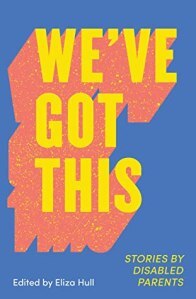
“being a disabled parent is a rebellious act”
“i don’t parent despite my disability; i parent as a proudly disabled person”
hopefully goes without saying at this point that i loved this, just like the rest of the series! hearing a diverse range of lived experiences will never not be invaluable <3 especially loved the final four stories
- really appreciated the diversity of disabilities and identities represented - first nations, queer, immigrants, CALD etc -
- didn’t realise that “more than 15 per cent of Australian households have a parent with disability” - a much greater percentage than i expected!! and makes the lack of representation in popular media even worse
- appreciated the repeated emphasis on strengths-based approaches and how not only is it possible to parent if you’re disabled, but being disabled can a) set you up well to parent (used to being creative, problem solving, patience etc) and b) have positive impacts on your children (empathy, patience etc)
- i will say, i am still looking for more nuance around the limitations of the social model (not at all disagreeing with this model - completely agree so much of disability is due to society - but its also not that black and white) and having children if you know you are passing on conditions with, for example, high chronic pain - these limitations of the social model are recognised in academia and i’ve studied them (at a basic undergrad level) but i find theres a lack of willingness to explore this nuance elsewhere - which i understand of course, but doesn’t make these conversations less necessary
- the interviews with intellectually disabled parents were particularly eye-opening - an area i didn’t know much about and we don’t often hear from people with intellectual disabilities. i found their experiences of interacting with the state, and the statistic that “60 per cent of parents with intellectual disability will have their kids taken by the state” shocking
- the fact that prohibited forced sterilisation of people with disability remains legal in australia was also shocking and something i want to look more into as it wasn’t discussed in here
- some other specific challenges disabled parents/people faced in this book that i think are important to highlight: challenges in adopting, family/domestic violence when your partner is your carer
- On the importance of addressing actual community needs: “We live in a world that values sympathy for people with disabilities and encourages us to donate to hospitals so they can cure disability. Meanwhile, people with disabilities are left behind, because those things that would make life liveable – a translator, a piece of software, a ramp – are not given priority.”
- “I think these attitudes exist because we’ve been writing about autism in the same way for eighty years. Textbook autism is very different to real-life autism. The current diagnostic criteria for autism describe distressed or traumatised autistic people: they don’t describe what an autistic person looks like when they’re well supported, accommodated and understood.”
- On double standards and different perspectives: all parents struggle, but different people will see that as being due to being disabled or due to being a parent. equally, empathy may change depending on which is perceived to be the ‘cause’.
- “Suddenly my confusion and slow functioning was acceptable because I was a New Mother. I was afforded a generosity I’d never encountered as a disabled adult…I was both grateful for the support I was receiving now and acutely aware of how few adjustments had been made for me previously as a disabled person.”
- “I quickly discovered that parents felt entitled to adjustments that were denied to disabled people….My fellow feminist parents expected that the circumstances of their life – in this case, having a child – should not exclude them from anything. So why did I accept being excluded because of my disability?”
- “Now I accept that depending on others is part of our human experience, and I relish how my experience teaches my children that relying on others is normal – and morally neutral. Giving and receiving help is not a scale to be balanced or declared equal, but a reciprocity that is shared. I want them to see that being part of a community is healthy, giving to others is empowering and that all people deserve dignity and care.”
- “In Australia, I was suddenly both more and less disabled. Less disabled because attitudes here seemed to have progressed. More disabled because society expected new mothers to perform the work of an entire village…Ableism does exist here; it just looks a little different. “
- the book ended beautifully with these words from Rebekah Taussig (highly recommend checking out her work, especially her new podcast!!):
“How interesting, to sit at the intersection between disability and parenting and feel the similarities wash over me again and again. Because not only are disability and parenting often imagined as two incompatible experiences, but parenthood is generally portrayed as a net gain and disability as an unequivocal loss. Even as both experiences are complicated and all-encompassing, isn’t it interesting to see them pulled apart and pushed into such opposing categories? Can you imagine if the overwhelming response to new parents was heartbreak, condolences and pity? Or if culturally we were able to recognise potential value in disability? Can you imagine if we responded to parenthood and disability with a resounding, ‘That could mean anything on earth to you! How do you feel today?’ Can you imagine if disabled people were seen as viable, competent parents? These experiences aren’t a one-to-one comparison, and they aren’t interchangeable. The experience of disability doesn’t mean you automatically understand parenting, or vice versa. Obviously not. But I think we will all benefit if we open our narratives surrounding each. Parenthood can tangle with grief and loss. Disability can include joy and abundance. And goddammit – disabled parents exist. We get to be both. We always get to be both.”