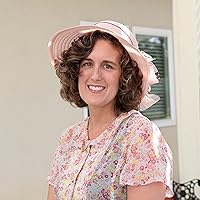
Kendra E. Ardnek is the self-proclaimed Arista of Fairy Tales. She makes her home in the hills of central Texas with her fellow author husband, who she found at a writer’s conference. When not writing, you can usually find her crocheting her own cloaks, valiantly attempting to read every retelling ever written, and pretending that owning toy dragons makes her a dragon trainer.
For one, I don't like Jane Austen to be retold, best to leave her stories as they are.
And for two, if I did like Jane Austen retold, this wouldn't be the book I'd have chosen to mix with "Beauty and the Beast." (Come on, gals, don't tell me you can't see it shiny bright as the sun who Jane's equivalent to Beast is! Hint: It isn't Henry boy.)
For third, I already sampled a Jane Austen + fairy tale retelling by this same author. It wasn't for me, for the above reasons and more.
This book is a whirlwind! An amnesiac heroine (who repeatedly forgets things in the past), a shape-shifting hero, a horrible curse to untangle, and a friends-to-lovers arc that I loved. Not to mention some found family elements too!
I like that a lot of what happened in Snowfield Palace got resolved in this book -- I'm so glad Ardnek didn't drag that out until the final book of the series, which is expected to launch this fall. Though I can see that some of this book's ending is setting things up for that final adventure, so everything is not fully resolved yet.
Once again, Ardnek cleverly twists a Jane Austen novel (Northanger Abbey) with a fairy tale ("Beauty and the Beast") and uses them to craft an entirely new story of her own.
I only removed one star because it is the least similar to the tales it is similar to. But, I like the little bits of details that are similar to the original B&B tale. Also gives a good conclusion to the dilemma started in the last book in the series, but also is understandable without having read prior books. I thoroughly enjoyed the book and highly recommend it.
I didn't really like Calla in the fourth book, but she really blossomed in this one. It was nice to see how her fears and struggles contributed to some of her somewhat brattiness in the previous book. I'm also very grateful that the Elinrose and Emmazel plotline was resolved in this book! I was nervous for Elinrose. And Hansel? He's an adorable love interest. I also noticed how much of Northanger Abbey was added into this book, and it was fun to see throwbacks to the novel, as well as touches of Beauty and the Beast. I continue to be impressed by the author's ability to combine two disparate titles into one. The plot was fascinating, especially since the main character kept forgetting important facts! It reminded me of 50 First Dates, but without the crudity. Such a cute and fun romance.
Thornrose Estate tells the story of a young girl, Calla, as she begins to learn about the truth of her past.
I think Calla has been one of the most relatable heroines in the series for me, with her avid love of reading and the fact that she would read all day if she was allowed to. I also really loved Hansel, who I believe was the most sensible character in the entire series and yet manages to balance between being fun and serious.
All in all, Thornrose Estate was a great read, and I can't wait for the final book in the series!
I have enjoyed each book in this series so far, and the overarching storyline has me hooked! I adore these characters, their flaws and their insecurities, their growth and their love for one another. And I think the fairytale/Jane Austen combination is very clever. I am glad to have a new comfort series to read over and over again (yes I can already tell I’ll be doing that ❤️) Ok, time to start the next one!
This is ABSOLUTELY my favorite Austen Fairy Tale. While I was a little uncertain at the start — Calla in the previous books was far from my favorite character — I quickly grew to love characters and story, and I think this is the strongest entry in the series.
For one thing, despite her history, Calla is such a relatable heroine. This may be a surprise to those who read Snowfield Palace, but once we see Calla out of Rina’s shadow . . . oh, I would so be friends with her! As with her Austen equivalent, she’s a bookworm and, dare I say, fangirl who takes refuge in her favorite stories and tends to view life in narrative terms, and it gives me life every time she reflects on the narrative appropriateness of particular occurrences. And I think her struggle — trying to navigate life away from home and family in a world where there always seems to be info she’s missing and working to figure out who she is in the face of who others are telling her she should be — is something that will resonate with most of us.
In addition, Hansel is an absolute delight of a love interest. Simultaneously the voice of reason in many circumstances and an absolute sweetheart with regard to his loved ones, including Calla, Hansel is the most sensible person in the entire book, and I love him for it. He’s his sister’s staunch defender, and he reaches out to help and support Calla when others leave her floundering, and he’s just generally wonderful. I only wish that we could’ve seen even more of him than we did, since he and Calla are so lovely together. I also loved his sister, Ela, who's struggling to balance her responsibilities with her hope that her mother will wake and return.
In addition to the heroes being excellent, the villains are eminently loathable. You know how, with regard to the Harry Potter fandom, fans tend to hate Umbridge so much more than Voldemort because Umbridge is a familiar villain, one of a type they’ve probably encountered themselves at some point? That’s what Kendra does here with the villains in Thornrose. We have the manipulators, the false friends who make it seem like they care for you but are only really using you for their own ends. (Can’t say who those are, but if you’ve read Snowfield, you probably have a good guess about one of them, and if you’ve read NA, you can guess the other.) And we also have the John/Gaston character in Johnston, a man whose pride makes Calla’s strengths into something he has to “forgive” and who’s more than happy to ignore her discomfort with his attentions if it means getting what he wants. And, let me tell you, it is so satisfying to see them get their due in the end.
Moving on from the characters, this book has so many mysteries to unravel — and it’s very satisfying to get some answers! If you’ve read Snowfield Palace, you know that Kendra left us all on quite the cliffhanger with many, many unanswered questions. Thornrose Estate finally gives us some answers, but sparingly, and Kendra weaves them in with other mysteries: why can’t Calla remember half her life — and why does she keep losing bits and pieces of more recent memory? Why do so many important people seem to have such an interest in her? And what the pumpernickel is going on with the Forest? Calla’s memory means she’s often just as uncertain as we are, but we know just enough more than she does to put pieces together, and the effect is just so good. It’s one of the main reasons I ended up devouring the second half of the book in one night.
Finally, Northanger Abbey and Beauty and the Beast are an excellent pairing. Kendra hasn’t missed once on her fairy tale and Austen combos! I will say that this is much more Northanger Abbey than it is Beauty and the Beast — while there are plenty of B&B elements, this doesn’t really read like a straight retelling of that fairy tale. The story does make up for this somewhat by giving us two in-world versions of B&B that Calla loves and uses as the chief basis for trying to figure out all the strangeness she’s stumbled into. That said, even if you look at it as just a Northanger Abbey retelling, Thornrose Estate is excellent.
The part of the book that follows Northanger Abbey is generally well-done, but Thornrose Estate doesn't follow the classic fairy tale as closely, even in spirit. I enjoyed the characters, and the plot was exciting, but due to the shortness of the book, there wasn't much development. Despite the importance of the events to the entire series, this is certainly the weakest of the novels. Nonetheless, I enjoyed it and am eager to read the final installment.
It was a fun read. I like what she did, intertwining a fairy tale (or two) and an Austen story. However, it would have benefitted from a bit more editing. I found myself wanting to reach for a red pen quite a few times. But then, I just read a book published by Barbour that I had the same response to.