

What do you think?

Ancient Lives
Cleopatra: Her History, Her Myth
A feminist reinterpretation of the myths surrounding Cleopatra casts new light on the Egyptian queen and her legacy
“A lucid and persuasive reinterpretation. Readers won’t see Cleopatra the same way again.”— Publishers Weekly
“Where Prose really her critiques of the cultural depictions of Cleopatra.”—Allison Arieff, San Francisco Chronicle
The siren passionately in love with Mark Antony, the seductress who allegedly rolled out of a carpet she had herself smuggled in to see Caesar, Cleopatra is a figure shrouded in myth. Beyond the legends immortalized by Plutarch, Shakespeare, George Bernard Shaw, and others, there are no journals or letters written by Cleopatra herself. All we have to tell her story are words written by others. What has it meant for our understanding of Cleopatra to have had her story told by writers who had a political agenda, authors who distrusted her motives, and historians who believed she was a liar?
Francine Prose delves into ancient Greek and Roman literary sources, as well as modern representations of Cleopatra in art, theater, and film, to challenge narratives driven by orientalism and misogyny and offer a new interpretation of Cleopatra’s history through the lens of our current era.
“A lucid and persuasive reinterpretation. Readers won’t see Cleopatra the same way again.”— Publishers Weekly
“Where Prose really her critiques of the cultural depictions of Cleopatra.”—Allison Arieff, San Francisco Chronicle
The siren passionately in love with Mark Antony, the seductress who allegedly rolled out of a carpet she had herself smuggled in to see Caesar, Cleopatra is a figure shrouded in myth. Beyond the legends immortalized by Plutarch, Shakespeare, George Bernard Shaw, and others, there are no journals or letters written by Cleopatra herself. All we have to tell her story are words written by others. What has it meant for our understanding of Cleopatra to have had her story told by writers who had a political agenda, authors who distrusted her motives, and historians who believed she was a liar?
Francine Prose delves into ancient Greek and Roman literary sources, as well as modern representations of Cleopatra in art, theater, and film, to challenge narratives driven by orientalism and misogyny and offer a new interpretation of Cleopatra’s history through the lens of our current era.
208 pages, Hardcover
Published November 8, 2022
About the author
Francine Prose
165 books912 followersFrancine Prose is the author of twenty works of fiction. Her novel A Changed Man won the Dayton Literary Peace Prize, and Blue Angel was a finalist for the National Book Award. Her most recent works of nonfiction include the highly acclaimed Anne Frank: The Book, The Life, The Afterlife, and the New York Times bestseller Reading Like a Writer. The recipient of numerous grants and honors, including a Guggenheim and a Fulbright, a Director's Fellow at the Dorothy and Lewis B. Cullman Center for Scholars and Writers at the New York Public Library, Prose is a former president of PEN American Center, and a member of the American Academy of Arts and Letters and the American Academy of Arts and Sciences. Her most recent book is Lovers at the Chameleon Club, Paris 1932. She lives in New York City.
Ratings & Reviews
Friends & Following
Create a free account to discover what your friends think of this book!
Community Reviews
Displaying 1 - 30 of 91 reviews
January 5, 2026
I have a soft spot for Cleopatra—and yes, I’ve been accused of having a bit of a crush on this 2,000-year-old queen. I plead guilty.
Frances Prose has written a concise, engaging, and refreshingly modern book on one of history’s most misunderstood figures. At under 225 pages, this biography never feels bloated or overworked. Instead, it offers a focused and thoughtful reexamination of Cleopatra that stands apart from many earlier treatments I’ve read.
What I appreciated most is Prose’s feminist perspective. She is unapologetically dismissive of the long tradition of objectifying Cleopatra—reducing her to seductress or spectacle rather than treating her as a capable ruler navigating an impossible political landscape. Prose reminds us that Cleopatra was not simply reacting to powerful men; she was actively shaping events in a brutal, male-dominated world.
As a classics professor at Bard College—and a colleague of James Romm—Prose brings scholarly credibility, but she writes with clarity and restraint. I came away with new insights into Cleopatra’s relationships with Caesar and Antony, especially her fierce commitment to securing the future of her children. Her hope that Caesarion might one day rule as a Roman emperor or Egyptian king was tragic and ultimately doomed—but Prose makes clear that Cleopatra pursued that goal with intelligence, resolve, and maternal devotion. She truly gave it her best shot.
An interesting side note: this book was used as a source in the making of the Netflix Cleopatra series, which speaks to its accessibility and modern framing.
That said, this is not a perfect book. Its brevity comes at a cost. At times it lacks depth, and I felt Prose leaned too heavily on Plutarch, a familiar and problematic source, without always balancing him with enough critical distance or alternative voices.
Still, if you’re interested in Cleopatra but don’t want to commit to a 400–500 page tome, this is an excellent choice. It’s smart, readable, and humane—and it left me admiring Cleopatra not as a myth or a caricature, but as a mother, ruler, and political survivor facing the end of a world.
Highly recommended for readers who want a thoughtful introduction—or a fresh reconsideration—of Egypt’s last queen.
https://substack.com/@lposse1
Frances Prose has written a concise, engaging, and refreshingly modern book on one of history’s most misunderstood figures. At under 225 pages, this biography never feels bloated or overworked. Instead, it offers a focused and thoughtful reexamination of Cleopatra that stands apart from many earlier treatments I’ve read.
What I appreciated most is Prose’s feminist perspective. She is unapologetically dismissive of the long tradition of objectifying Cleopatra—reducing her to seductress or spectacle rather than treating her as a capable ruler navigating an impossible political landscape. Prose reminds us that Cleopatra was not simply reacting to powerful men; she was actively shaping events in a brutal, male-dominated world.
As a classics professor at Bard College—and a colleague of James Romm—Prose brings scholarly credibility, but she writes with clarity and restraint. I came away with new insights into Cleopatra’s relationships with Caesar and Antony, especially her fierce commitment to securing the future of her children. Her hope that Caesarion might one day rule as a Roman emperor or Egyptian king was tragic and ultimately doomed—but Prose makes clear that Cleopatra pursued that goal with intelligence, resolve, and maternal devotion. She truly gave it her best shot.
An interesting side note: this book was used as a source in the making of the Netflix Cleopatra series, which speaks to its accessibility and modern framing.
That said, this is not a perfect book. Its brevity comes at a cost. At times it lacks depth, and I felt Prose leaned too heavily on Plutarch, a familiar and problematic source, without always balancing him with enough critical distance or alternative voices.
Still, if you’re interested in Cleopatra but don’t want to commit to a 400–500 page tome, this is an excellent choice. It’s smart, readable, and humane—and it left me admiring Cleopatra not as a myth or a caricature, but as a mother, ruler, and political survivor facing the end of a world.
Highly recommended for readers who want a thoughtful introduction—or a fresh reconsideration—of Egypt’s last queen.
https://substack.com/@lposse1
November 13, 2023
Dismissing Historical Misogyny & Hollywood Luridness
Review of the Yale University Press paperback (October 17, 2023) of the original Yale University Press hardcover (November 1, 2022).
She continues to fascinate us to this day. The final ruler of Egypt before its annexation to the Roman Empire is known to us as Cleopatra (c70 BCE - 30 BCE), but was actually Cleopatra VII of the Ptolemic Dynasty. She was a descendant of Ptolemy I (367 BCE to 282 BCE), one of Alexander the Great's Greek Macedonian generals who ruled Egypt as one of the several successor kings who carved up their conquered empire after the death of their leader.
Because of some gaps in the knowledge of her parental lineage, there is speculation that she may have been of mixed race. This has resulted in recent controversies such as the reaction to the Netflix documentary (2023) and the possible casting of the mixed race actor Zendaya in a rumoured future feature film.
Francine Prose gives a "feminist reinterpretation" of both the ancient historical accounts and the later Hollywood film depictions. All of these emphasize her as a diabolical temptress and seducer who led "noble" Romans such as Julius Caesar and Marc Antony astray. Those early accounts were written by Roman historians of course, often well after the actual events. These accounts often ignore the fact that she was the ruler of Egypt and sought to protect her children and the independence of Egypt for the future. She unfortunately allied herself with the losing forces who were either assassinated such as Caesar or committed suicide such as Antony. Cleopatra herself chose to commit suicide rather than be paraded through the streets of Rome by Octavian (later known as Emperor Augustus).
Sidenote: A lot of this reminded me of the blackening of the reputation of the last Plantagenet-Yorkist King Richard III in the later Tudor accounts such as Shakespeare's play. Recent history has sought to restore that reputation. Mystery fans should read Josephine Tey's The Daughter of Time (1951) for a fictional reexamination of the murder of the princes in the Tower of London.
Back to Cleopatra. In any case, Prose makes an interesting argument for reading those early accounts with a grain of salt and remembering who they were written by and for whom. Hollywood of course takes the most extreme stories and builds on them even further. So we have bizarre stories handed down such as Cleopatra being presented to Caesar after being rolled up in a rug and later committing suicide with the aid of an asp being smuggled in a basket of figs.
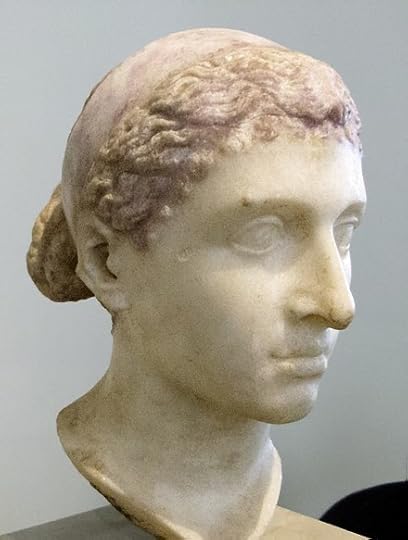
Bust of Cleopatra VII in the Altes Museum Berlin. Image sourced from Wikipedia where it is described as a Roman sculpture of Cleopatra wearing a royal diadem, mid-1st century BC (around the time of her visits to Rome in 46–44 BC). For an interesting video on What Did Cleopatra Look Like? based on extrapolating from this bust, see Trivia below.
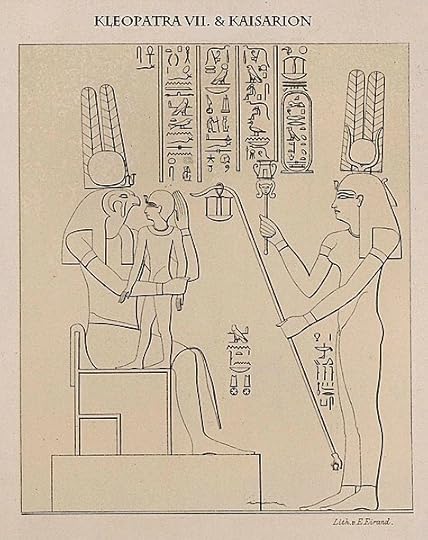
Cleopatra introduces her son Caesarion to the Egyptian falcon-headed god of war Montu. Image sourced from Wikimedia Commons.
I enjoyed this reinterpretation of the life of Cleopatra and look forward to reading more of the Ancient Lives series from Yale University Press. I had previously read Sarah Ruden's Vergil, The Poet's Life (2023).
Other Reviews
Francine Prose dispels the sexualized mythology surrounding a powerful ruler by Allison Arieff, Datebook SF Chronicle, October 31, 2022.
Trivia and Links
See a video of What Did Cleopatra Look Like? at the Royalty Now YouTube channel here.
Read an excerpt from the book at The Legend of Cleopatra at Yale University Press.
Cleopatra: Her History, Her Myth is part of Yale University Press's Ancient Lives series which currently includes: Marcus Aurelius: The Stoic Emperor (expected publication February 2024), Vergil: The Poet's Life (2023), Ramesses the Great: Egypt's King of Kings (2023), Julian: Rome’s Last Pagan Emperor (2023), Crassus: The First Tycoon (2022), and Demetrius: Sacker of Cities (2022).
Review of the Yale University Press paperback (October 17, 2023) of the original Yale University Press hardcover (November 1, 2022).
She continues to fascinate us to this day. The final ruler of Egypt before its annexation to the Roman Empire is known to us as Cleopatra (c70 BCE - 30 BCE), but was actually Cleopatra VII of the Ptolemic Dynasty. She was a descendant of Ptolemy I (367 BCE to 282 BCE), one of Alexander the Great's Greek Macedonian generals who ruled Egypt as one of the several successor kings who carved up their conquered empire after the death of their leader.
Because of some gaps in the knowledge of her parental lineage, there is speculation that she may have been of mixed race. This has resulted in recent controversies such as the reaction to the Netflix documentary (2023) and the possible casting of the mixed race actor Zendaya in a rumoured future feature film.
Francine Prose gives a "feminist reinterpretation" of both the ancient historical accounts and the later Hollywood film depictions. All of these emphasize her as a diabolical temptress and seducer who led "noble" Romans such as Julius Caesar and Marc Antony astray. Those early accounts were written by Roman historians of course, often well after the actual events. These accounts often ignore the fact that she was the ruler of Egypt and sought to protect her children and the independence of Egypt for the future. She unfortunately allied herself with the losing forces who were either assassinated such as Caesar or committed suicide such as Antony. Cleopatra herself chose to commit suicide rather than be paraded through the streets of Rome by Octavian (later known as Emperor Augustus).
Sidenote: A lot of this reminded me of the blackening of the reputation of the last Plantagenet-Yorkist King Richard III in the later Tudor accounts such as Shakespeare's play. Recent history has sought to restore that reputation. Mystery fans should read Josephine Tey's The Daughter of Time (1951) for a fictional reexamination of the murder of the princes in the Tower of London.
Back to Cleopatra. In any case, Prose makes an interesting argument for reading those early accounts with a grain of salt and remembering who they were written by and for whom. Hollywood of course takes the most extreme stories and builds on them even further. So we have bizarre stories handed down such as Cleopatra being presented to Caesar after being rolled up in a rug and later committing suicide with the aid of an asp being smuggled in a basket of figs.
Bust of Cleopatra VII in the Altes Museum Berlin. Image sourced from Wikipedia where it is described as a Roman sculpture of Cleopatra wearing a royal diadem, mid-1st century BC (around the time of her visits to Rome in 46–44 BC). For an interesting video on What Did Cleopatra Look Like? based on extrapolating from this bust, see Trivia below.
Cleopatra introduces her son Caesarion to the Egyptian falcon-headed god of war Montu. Image sourced from Wikimedia Commons.
I enjoyed this reinterpretation of the life of Cleopatra and look forward to reading more of the Ancient Lives series from Yale University Press. I had previously read Sarah Ruden's Vergil, The Poet's Life (2023).
Other Reviews
Francine Prose dispels the sexualized mythology surrounding a powerful ruler by Allison Arieff, Datebook SF Chronicle, October 31, 2022.
Trivia and Links
See a video of What Did Cleopatra Look Like? at the Royalty Now YouTube channel here.
Read an excerpt from the book at The Legend of Cleopatra at Yale University Press.
Cleopatra: Her History, Her Myth is part of Yale University Press's Ancient Lives series which currently includes: Marcus Aurelius: The Stoic Emperor (expected publication February 2024), Vergil: The Poet's Life (2023), Ramesses the Great: Egypt's King of Kings (2023), Julian: Rome’s Last Pagan Emperor (2023), Crassus: The First Tycoon (2022), and Demetrius: Sacker of Cities (2022).

August 23, 2022
Francine Prose tells the story of Cleopatra (VII Philopater, if you want to be specific), her entanglement with the Roman Empire, and how she has become distorted in cultural depictions after her death.
In a way, I am reading this book in preparation – I’ve got the reading of a retelling of Cleopatra’s life set in space (!) coming up, and I figured that I’d appreciate it more if I gave myself a better grounding of the historical subject matter first. Also, I’ve always found Cleopatra’s story fascinating, so it was no skin off my nose.
This is a pretty basic, straightforward history of Cleopatra’s life that does not engage in very much speculation, but presents the facts as they are given in ancient sources. F0r this reason, I think it would appeal best to those who don’t know much about Cleopatra and want to learn about her, but don’t want to read a doorstopper of a biography.
I think this book works best when it discusses the myths around Cleopatra and how she is depicted on stage and on screen, as the author discusses how she is portrayed in a number of mediums and sources
However, while Prose does question the veracity of these sources and engages critically with them, I felt that by the end of the book she was leaning pretty hard on Plutarch’s interpretation without gainsaying them much. I also wished Prose had gone a little further and gotten into the murkier parts of Cleopatra’s life, the things that aren’t so well-documented, to give the reader a broader picture of her. While we got Cleopatra’s story, I did not feel we got to know her.
Disclaimer: I received an ARC of this book from NetGalley. This is my honest and voluntary review.
In a way, I am reading this book in preparation – I’ve got the reading of a retelling of Cleopatra’s life set in space (!) coming up, and I figured that I’d appreciate it more if I gave myself a better grounding of the historical subject matter first. Also, I’ve always found Cleopatra’s story fascinating, so it was no skin off my nose.
This is a pretty basic, straightforward history of Cleopatra’s life that does not engage in very much speculation, but presents the facts as they are given in ancient sources. F0r this reason, I think it would appeal best to those who don’t know much about Cleopatra and want to learn about her, but don’t want to read a doorstopper of a biography.
I think this book works best when it discusses the myths around Cleopatra and how she is depicted on stage and on screen, as the author discusses how she is portrayed in a number of mediums and sources
However, while Prose does question the veracity of these sources and engages critically with them, I felt that by the end of the book she was leaning pretty hard on Plutarch’s interpretation without gainsaying them much. I also wished Prose had gone a little further and gotten into the murkier parts of Cleopatra’s life, the things that aren’t so well-documented, to give the reader a broader picture of her. While we got Cleopatra’s story, I did not feel we got to know her.
Disclaimer: I received an ARC of this book from NetGalley. This is my honest and voluntary review.

October 1, 2026
Please Meet Cleopatra
Finally, Cleopatra is presented as more than an obstacle to be overcome by imperial Roman expansion, or as a mere appendage of Julius Caesar or Mark Antony on the one hand, or as the oversexed enchantress responsible for the deaths of two great and noble Roman heroes on the other hand. Cleopatra gets the bad wrap and is often cast as the real-life version of the fictional Eve, the mythical Circe or the Shakespearean Lady Macbeth. This is to say that most often Cleopatra is defined by her relationships to her lovers rather than by her own record of leadership and accomplishment. She was “truly notable for next to nothing, except her ancestry and beauty” as Boccaccio slovenly put it. That is, the historical record is fixated on Cleopatra’s sex life rather than her public political life.
Plutarch does not give us a separate biography of Cleopatra. We only learn of her through him in his biographies of Julius Caesar and Mark Antony. This is part of the reason why she is shrouded in so much mystery. Add to this that much of what we do know about her has been told through biased Roman eyes. In Roman eyes she was the seducer and manipulator of Roman heroes. Her gender was used color every other aspect of her existence and her sexuality was used define her experience. The evidence of her achievements and the reality of her skills was invisible to Roman eyes. But the reality of a well-educated, highly intelligent, multilingual, brave and wise queen scared the hades out of the Romans. Turns out that it is dangerous for a woman be both desirable and intelligent, still true today in the MAGA U.S.A. She had the body and feelings of a woman as well as the brains and thoughts of a ruler.
Her mere existence as a strong and independent female leader was an afront to Rome no matter her actions, alliances or loyalties. If Caesar and Cleopatra were married, Cleopatra could have become regent of a combined Roman-Egyptian civilization through the accession of their son Caesarion if Caesar pre-deceased her which was likely. Nothing could be more galling to the Roman elite than to be governed by a woman and a foreign woman from the exotic east at that. Augustus lost no time in having Caesarion executed at age 17 for the crime of being Cleopatra’s son and for being a reminder of her. But of course, Cleopatra is blamed for everything, including the assassination of Julius Caesar and the way Mark Antony destroyed himself. Antony even garnered the pity of the Roman people for being enslaved by the Egyptian queen as if he had no agency of his own so strong was the bias against Cleopatra. The fact that Antony could not govern himself is somehow Cleopatra’s fault for far too many writers, ancient and modern. Same with the battle of Actium. If Cleopatra was culpable, we must believe that Antony, proconsul of the Roman Empire, member of the Triumvirate, and skilled battlefield general again had no more agency over his actions than a lovesick petulant child or a captive pathetic love-slave. She was accused of using magic spells. Antony’s self-pity was the spell he cast upon himself.
Cleopatra The Great or The Great Cleopatra
In addition to state craft, diplomacy, civil government, public works, commanding an army and a fleet in war, she had to manage the strains of three pregnancies (four children) and the physical demands of childbirth and still function as an effective leader of a difficult to govern country in an unstable world during volatile times. No ‘great’ man has had to do this. She initiated building projects in the long-established tradition of Egyptian pharaohs, expanded Egyptian territory, fended off Roman aggression for two decades, guarded Egyptian autonomy, commanded fleets and armies, and added considerably to the intellectual environment of Alexandria. Only magic or sorcery could explain her skills and leadership to the Romans. The Egypt of Cleopatra was multilingual and multicultural state with an ancient and vast bureaucracy. It took more than seduction and magic to govern in such an environment at a very volatile time.
For all this, what we are left with is Cleopatra as a mythical caricature of herself by her detractors and enemies rather than as a real person in the real world who was intelligent, skilled and competent, and not just in the arts of seduction. Cleopatra’s allure was found in her complete presence, physical and intellectual. In every era since she lived, she has been viewed through the social mores of the time and cultural lens of the writer. For this she is often portrayed as the cunning but evil seductress on the one hand, or as a vapid brainless teenage virgin on the other hand.
The Other Heroine
This is the loyal sister of Octavian and long-suffering wife Antony, Octavia, who did her level best to prevent war between her husband and her brother. She remained a loving wife to Antony and a devoted mother to their children. She kept the domestic home front in order as well as organizing supplies and support for Antony while he remained in the east with Cleopatra. As Francine Prose documents, the two principal women in the drama, Octavia and Cleopatra, were smarter and wiser than the corresponding men, Octavian and Antony. The two women were rational and pragmatic whereas the two men were absorbed by passion and pride.
Bonus Content
What I also like about this book is the review Francine Prose provides with respect to literary and artistic depictions of Cleopatra versus what we know to be true about her, starting from her life and death in the ancient world and proceeding into the Middle Ages, through Shakespeare, to the Renaissance, to the Enlightenment through to the books, films and plays of the modern era.
Finally, Cleopatra is presented as more than an obstacle to be overcome by imperial Roman expansion, or as a mere appendage of Julius Caesar or Mark Antony on the one hand, or as the oversexed enchantress responsible for the deaths of two great and noble Roman heroes on the other hand. Cleopatra gets the bad wrap and is often cast as the real-life version of the fictional Eve, the mythical Circe or the Shakespearean Lady Macbeth. This is to say that most often Cleopatra is defined by her relationships to her lovers rather than by her own record of leadership and accomplishment. She was “truly notable for next to nothing, except her ancestry and beauty” as Boccaccio slovenly put it. That is, the historical record is fixated on Cleopatra’s sex life rather than her public political life.
Plutarch does not give us a separate biography of Cleopatra. We only learn of her through him in his biographies of Julius Caesar and Mark Antony. This is part of the reason why she is shrouded in so much mystery. Add to this that much of what we do know about her has been told through biased Roman eyes. In Roman eyes she was the seducer and manipulator of Roman heroes. Her gender was used color every other aspect of her existence and her sexuality was used define her experience. The evidence of her achievements and the reality of her skills was invisible to Roman eyes. But the reality of a well-educated, highly intelligent, multilingual, brave and wise queen scared the hades out of the Romans. Turns out that it is dangerous for a woman be both desirable and intelligent, still true today in the MAGA U.S.A. She had the body and feelings of a woman as well as the brains and thoughts of a ruler.
Her mere existence as a strong and independent female leader was an afront to Rome no matter her actions, alliances or loyalties. If Caesar and Cleopatra were married, Cleopatra could have become regent of a combined Roman-Egyptian civilization through the accession of their son Caesarion if Caesar pre-deceased her which was likely. Nothing could be more galling to the Roman elite than to be governed by a woman and a foreign woman from the exotic east at that. Augustus lost no time in having Caesarion executed at age 17 for the crime of being Cleopatra’s son and for being a reminder of her. But of course, Cleopatra is blamed for everything, including the assassination of Julius Caesar and the way Mark Antony destroyed himself. Antony even garnered the pity of the Roman people for being enslaved by the Egyptian queen as if he had no agency of his own so strong was the bias against Cleopatra. The fact that Antony could not govern himself is somehow Cleopatra’s fault for far too many writers, ancient and modern. Same with the battle of Actium. If Cleopatra was culpable, we must believe that Antony, proconsul of the Roman Empire, member of the Triumvirate, and skilled battlefield general again had no more agency over his actions than a lovesick petulant child or a captive pathetic love-slave. She was accused of using magic spells. Antony’s self-pity was the spell he cast upon himself.
Cleopatra The Great or The Great Cleopatra
In addition to state craft, diplomacy, civil government, public works, commanding an army and a fleet in war, she had to manage the strains of three pregnancies (four children) and the physical demands of childbirth and still function as an effective leader of a difficult to govern country in an unstable world during volatile times. No ‘great’ man has had to do this. She initiated building projects in the long-established tradition of Egyptian pharaohs, expanded Egyptian territory, fended off Roman aggression for two decades, guarded Egyptian autonomy, commanded fleets and armies, and added considerably to the intellectual environment of Alexandria. Only magic or sorcery could explain her skills and leadership to the Romans. The Egypt of Cleopatra was multilingual and multicultural state with an ancient and vast bureaucracy. It took more than seduction and magic to govern in such an environment at a very volatile time.
For all this, what we are left with is Cleopatra as a mythical caricature of herself by her detractors and enemies rather than as a real person in the real world who was intelligent, skilled and competent, and not just in the arts of seduction. Cleopatra’s allure was found in her complete presence, physical and intellectual. In every era since she lived, she has been viewed through the social mores of the time and cultural lens of the writer. For this she is often portrayed as the cunning but evil seductress on the one hand, or as a vapid brainless teenage virgin on the other hand.
The Other Heroine
This is the loyal sister of Octavian and long-suffering wife Antony, Octavia, who did her level best to prevent war between her husband and her brother. She remained a loving wife to Antony and a devoted mother to their children. She kept the domestic home front in order as well as organizing supplies and support for Antony while he remained in the east with Cleopatra. As Francine Prose documents, the two principal women in the drama, Octavia and Cleopatra, were smarter and wiser than the corresponding men, Octavian and Antony. The two women were rational and pragmatic whereas the two men were absorbed by passion and pride.
Bonus Content
What I also like about this book is the review Francine Prose provides with respect to literary and artistic depictions of Cleopatra versus what we know to be true about her, starting from her life and death in the ancient world and proceeding into the Middle Ages, through Shakespeare, to the Renaissance, to the Enlightenment through to the books, films and plays of the modern era.

August 18, 2022
I don't know exactly what I expected of this book, but it was promising - a feminist reinterpretation of Cleopatra by a significant novelist. I think the main problem is that there is so little to reinterpret.
Prose makes the important point that Cleopatra the real person managed to rule her country for twenty years, at least as successfully as all her predecessors in the Ptolemy dynasty - this is not something that you'd know if you depended upon the movies or even Shakespeare for your information.
She also reminds us that the Ptolemies were Greek/Macedonian, not Egyptian, so Cleopatra's presentation as a dark exotic Middle Easterner has never been true. It may seem a little heavy handed to say that Rome approached Egypt just as imperialists of the modern age have approached countries belonging to brown people, but on the other hand it's clearly true.
Her analysis of Shakespeare's play is one of the best parts of the book. The summaries of the movies are less interesting and even rather annoying - yes this is part of the legend of Cleopatra, but they are bad movies!
The summary of the history of the Ptolemies before Cleopatra was confusing, mostly because every male was named Ptolemy. Where the book really lost me was in the last period of Cleopatra's life.. Despite the questions about reliability and sourcing in some of Plutarch's Life of Antony, once the war between Antony and Octavian begins she just narrates the story as Plutarch told it, no longer questioning what he could have known or whether it's accurate. As a result this smart and savvy queen who had military expertise and was able to successfully negotiate with Julius Caesar suddenly seems to have gone stupid. I think Prose should have continued her detailed approach here - are we really sure the Battle of Actium was fought at sea because Cleopatra said it should be? just for starters. This leaves us with the "woman ruined by love" narrative that she earlier criticized.
While this short book is useful for making clear what we really do and don't know about Cleopatra, there was not as much "there" there as I was hoping.
Prose makes the important point that Cleopatra the real person managed to rule her country for twenty years, at least as successfully as all her predecessors in the Ptolemy dynasty - this is not something that you'd know if you depended upon the movies or even Shakespeare for your information.
She also reminds us that the Ptolemies were Greek/Macedonian, not Egyptian, so Cleopatra's presentation as a dark exotic Middle Easterner has never been true. It may seem a little heavy handed to say that Rome approached Egypt just as imperialists of the modern age have approached countries belonging to brown people, but on the other hand it's clearly true.
Her analysis of Shakespeare's play is one of the best parts of the book. The summaries of the movies are less interesting and even rather annoying - yes this is part of the legend of Cleopatra, but they are bad movies!
The summary of the history of the Ptolemies before Cleopatra was confusing, mostly because every male was named Ptolemy. Where the book really lost me was in the last period of Cleopatra's life.. Despite the questions about reliability and sourcing in some of Plutarch's Life of Antony, once the war between Antony and Octavian begins she just narrates the story as Plutarch told it, no longer questioning what he could have known or whether it's accurate. As a result this smart and savvy queen who had military expertise and was able to successfully negotiate with Julius Caesar suddenly seems to have gone stupid. I think Prose should have continued her detailed approach here - are we really sure the Battle of Actium was fought at sea because Cleopatra said it should be? just for starters. This leaves us with the "woman ruined by love" narrative that she earlier criticized.
While this short book is useful for making clear what we really do and don't know about Cleopatra, there was not as much "there" there as I was hoping.

November 24, 2022
How much do we think we know about the ruler known as Cleopatra? Nearly everything we know comes from the media and writers that come from a time when she was judged by her looks and how women were expected to behave like. Roman women weren’t permitted to own property or businesses and largely were expected to dote on their husbands and children. Misogyny was apparent in everything women did so when Cleopatra rose to power, she was a problem that needed to be dealt with. She should’ve been applying makeup and having drinks with her ladies rather than planning a revolt to get her husband/brother off the throne. She was an anomaly that the Romans could do without.
The writing from Francine Prose was fantastical. You could be forgiven for thinking that this was a piece of fiction. It is seamless, with many layers to peel back and discover. Prose brought the original fascination of a foreign queen back into my vision. The legend of the Egyptian Queen was my first taster of what would become a blatant interest in everything ancient Egypt. She was everything she shouldn’t be – strong, resilient, maternal, and a strategist.
Cleopatra has been done a huge disservice for so many years through so many portrayals. But let’s not forget the fact that she managed to rule for twenty years during a time when it was dangerous for a woman to do so. She was the last Queen under Ptolemy’s rule. This is a piece of information that seems lost in all the translations of her rule, especially that god-awful Elizabeth Taylor film and Shakespeare’s’ play. Her heritage is falsely reported as being of Egyptian descent – her line of rulers was of Greek/Macedonian lineage. The research that Prose had dedicated to the book is there for all to see. She has for the first time allowed us to see the true Cleopatra and not just the seductress that Hollywood would have us see.
You can tell that this is an important character in history from the way Prose writes. She reminded me of a busy bar person trying to juggle all the different drink orders, trying as she might not to drop any bottles. She gives the first truly accurate retelling of one of the most important female Queen of a time gone by. A story that has finally done her justice. She cared not only about her own family but those of the Egyptians and her country’s standing in the years to come. Did she play games with the men in her life? You bet, but it was never mindless.
The writing from Francine Prose was fantastical. You could be forgiven for thinking that this was a piece of fiction. It is seamless, with many layers to peel back and discover. Prose brought the original fascination of a foreign queen back into my vision. The legend of the Egyptian Queen was my first taster of what would become a blatant interest in everything ancient Egypt. She was everything she shouldn’t be – strong, resilient, maternal, and a strategist.
Cleopatra has been done a huge disservice for so many years through so many portrayals. But let’s not forget the fact that she managed to rule for twenty years during a time when it was dangerous for a woman to do so. She was the last Queen under Ptolemy’s rule. This is a piece of information that seems lost in all the translations of her rule, especially that god-awful Elizabeth Taylor film and Shakespeare’s’ play. Her heritage is falsely reported as being of Egyptian descent – her line of rulers was of Greek/Macedonian lineage. The research that Prose had dedicated to the book is there for all to see. She has for the first time allowed us to see the true Cleopatra and not just the seductress that Hollywood would have us see.
You can tell that this is an important character in history from the way Prose writes. She reminded me of a busy bar person trying to juggle all the different drink orders, trying as she might not to drop any bottles. She gives the first truly accurate retelling of one of the most important female Queen of a time gone by. A story that has finally done her justice. She cared not only about her own family but those of the Egyptians and her country’s standing in the years to come. Did she play games with the men in her life? You bet, but it was never mindless.

October 30, 2022
The life and death of Cleopatra made her legendary.
The book "Cleopatra" reminded me why the woman behind myth and history all tangled together is so fascinating. The problem is that her story was told by men, her enemies, so how can we know what was true and what wasn't? Well, you can't dismiss the facts that Cleopatra was a pharaoh, she ruled Egypt and did anything she could to protect her kingdom and her children. She also had a love affair with Julius Caesar and Mark Anthony. These were powerful man that could help her, but unfortunately her relationships with them were her undoing. As the heir of Caesar, Octavian couldn't let the son of Cleopatra and Caesar roam free as a prince of Egypt, could he? He couldn't let Mark Anthony and Cleopatra rule independently from Rome, could he?
The author seemed to be very annoyed that nobody recognises what a great ruler Cleopatra was, what a great administrator and she even learned Egyptian (the first ruler from her dynasty who did it). Also she loved her children. That's all very well, but if that was all Cleopatra did in her life, not many people would enjoy reading about her. Or writing about her, or painting pictures of her... or making movies about her. The author is very critical of movies, book and paintings about Cleopatra. For her it is all exaggeration, sexualisation and cheap entertainment. After a while I was tired of the author criticising everything. The legend of Cleopatra inspired people and helped her to be remembered. Some of the paintings of her are beautiful pieces of art, even if the painter had no idea about Egyptian customs, how people dressed in her times and showed her half-naked. So, three stars.
I received "Cleopatra" from the publisher via NetGalley. I would like to thank the author and the publisher for providing me with the advance reader copy of the book.
The book "Cleopatra" reminded me why the woman behind myth and history all tangled together is so fascinating. The problem is that her story was told by men, her enemies, so how can we know what was true and what wasn't? Well, you can't dismiss the facts that Cleopatra was a pharaoh, she ruled Egypt and did anything she could to protect her kingdom and her children. She also had a love affair with Julius Caesar and Mark Anthony. These were powerful man that could help her, but unfortunately her relationships with them were her undoing. As the heir of Caesar, Octavian couldn't let the son of Cleopatra and Caesar roam free as a prince of Egypt, could he? He couldn't let Mark Anthony and Cleopatra rule independently from Rome, could he?
The author seemed to be very annoyed that nobody recognises what a great ruler Cleopatra was, what a great administrator and she even learned Egyptian (the first ruler from her dynasty who did it). Also she loved her children. That's all very well, but if that was all Cleopatra did in her life, not many people would enjoy reading about her. Or writing about her, or painting pictures of her... or making movies about her. The author is very critical of movies, book and paintings about Cleopatra. For her it is all exaggeration, sexualisation and cheap entertainment. After a while I was tired of the author criticising everything. The legend of Cleopatra inspired people and helped her to be remembered. Some of the paintings of her are beautiful pieces of art, even if the painter had no idea about Egyptian customs, how people dressed in her times and showed her half-naked. So, three stars.
I received "Cleopatra" from the publisher via NetGalley. I would like to thank the author and the publisher for providing me with the advance reader copy of the book.

April 10, 2023
This book was disappointing. It reads like a long undergrad paper by a kid who is trying not to paraphrase their sources while also depending entirely on a few paltry sources for all of their information. Francine Prose is not an ancient history scholar and she's trying hard not to paint a picture of the whole ancient Mediterranean and focus on Cleopatra, but we know so little about Cleopatra all Prose can say is that she's not trying to murder/fuck her children like the previous Ptolemies and she probably spent a lot of her time doing administrative tasks, being the empress of a huge country. Besides that, we've got the relationships with Caesar and Marc Antony, which were of a course strategic and not an exotic temptress beguiling a virile Roman with her inscrutable Oriental exoticism. This is part of the problem in this book that I am so frustrated by that took me way too long to read: Prose structures Cleopatra: The Book the same way she did her brilliant Anne Frank, which I thought this book was going to be as good as; Francine Prose tells a straight version of Cleopatra's life with occasional asides mentioning that what Plutarch is saying is nonsense and we'll never know what really happened, but occasionally she'll describe an Orientalist nineteenth century painting with Cleopatra covered in some iridescent gauze and explain why that definitely didn't happen, but it feels off when the occasional art critique is wedged into an ahistorical narrative. But the paintings are in color and Cleopatra's life is in black and white (borrowing from Dan Carlin's statement about how everyone in the ancient world before Herodotus was a boring writer) and if the cultural aftermath had been interspersed with the text, this book would have been better and more compelling. Theda Bara's Cleopatra is in black and white, but in the last chapter Prose presents herself as confused about why audiences in the first half of the last century would have wanted to see her boobs. Is Francine Prose of an age where she just second wave denies all compelling aspects of sexuality? Also, she's not a Shakespeare scholar either. There are cleverer ways to say, "This Shakespeare play is an eclectic mess and everyone dies in the end." Cleopatra: This Book shouldn't have been bad. Why was this bad? Francine Prose can do better. I tried selling her Anne Frank book at my garage sale and then I read it in a day and decided to keep it forever. Why wasn't this that?

March 28, 2025
You may know Cleopatra from her lurid portrayals and her passionate affairs with Roman figureheads Julius Caesar and Mark Anthony. A consummate actress on the Ancient stage. Thanks to Greek philosopher Plutarch and his intense bias towards her, some historians prefer to place particular emphasis on her amorous pursuits as opposed to her many political feats. After all she did dissolve a priceless pearl in a goblet of wine right?
Francine Prose really brings to light the sheer horror of the Romans at the unusual, explosive alliance between Mark Anthony and his 'siren' of a lover. A clunky, disatrous relationship in their eyes. One that could only amount to ruin. However, Cleopatra presided over a Millennia-old empire, nestled on the sinuous River Nile. She had great political acumen which was perceived as a rare thing for a woman of antiquity. Well, she lasted twenty years so suck it Plutarch!
Prose does well to remind us of this fact, which is why I was immediatly drawn to the feminist element of this book. Reworking but not rewriting some of the narrative around the Egyptian Queen and her scarcely documented life. Cleopatra dazzled, Cleopatra reigned supreme. Perhaps too hot to handle. Were the Romans simply threatened, thus deflecting onto a successful, foreign woman? Or were her actions so underhanded that they had every right to distrust her? I love the many questions that this book brought to the table.
History is written by the victor. Prose goes on to show us that with strength comes weakness. I do not doubt that Cleopatra had her foibles like any other, and under immense political pressure it is no wonder she came undone. She mindfully took risks and I admire her for doing so. Kudos to Prose for showing us the many layers of Cleopatra and her person and not covering up these weaknesses.
Francine Prose really brings to light the sheer horror of the Romans at the unusual, explosive alliance between Mark Anthony and his 'siren' of a lover. A clunky, disatrous relationship in their eyes. One that could only amount to ruin. However, Cleopatra presided over a Millennia-old empire, nestled on the sinuous River Nile. She had great political acumen which was perceived as a rare thing for a woman of antiquity. Well, she lasted twenty years so suck it Plutarch!
Prose does well to remind us of this fact, which is why I was immediatly drawn to the feminist element of this book. Reworking but not rewriting some of the narrative around the Egyptian Queen and her scarcely documented life. Cleopatra dazzled, Cleopatra reigned supreme. Perhaps too hot to handle. Were the Romans simply threatened, thus deflecting onto a successful, foreign woman? Or were her actions so underhanded that they had every right to distrust her? I love the many questions that this book brought to the table.
History is written by the victor. Prose goes on to show us that with strength comes weakness. I do not doubt that Cleopatra had her foibles like any other, and under immense political pressure it is no wonder she came undone. She mindfully took risks and I admire her for doing so. Kudos to Prose for showing us the many layers of Cleopatra and her person and not covering up these weaknesses.

April 30, 2024
if i had to recommend one book about cleopatra, i'd recommend the stacy schiff biography. but sometimes people like to know a normal amount of things and not 350 extremely detailed pages' worth, so for those people i would recommend this one! a really clear, coherent, accessible-but-detailed examination of 1. what we know about the cleopatra myth and 2. important moments in her pop culture portrayal (particularly the shakespeare play and the elizabeth taylor movie). some of this was a little simplistic, and i don't agree with all of prose's takes on the shakespeare play (prose has a fascination with octavia that i understand but i think saying octavia is more appealing to the audience than cleopatra is insane. woman is boring as hell), but i appreciate the refreshing bluntness of just calling a lot of cleopatra media racist instead of waffling around "it was the tImE pErIoD." a lot of good info in here; definitely worth picking up if you want to learn about cleopatra beyond the pop culture image!

January 5, 2023
I didn’t care for this book, but I already knew a decent amount of the history going in. While I learned some interesting things about Cleopatra, Anthony and Caesar here, this book overall didn’t add much. The author mostly made obvious thematic commentary and only laid out a pretty bare bones version of Cleopatra’s life. She also annoyingly would present information non-linearly, and a few times repeated a fact a second time later on in the book that diminished the impact of the fact. I feel like this book could have been an essay. If you want to read a thorough and engaging account about Cleopatra, I recommend the Stacy Schiff biography.

September 22, 2022
Thank you NetGalley for the advanced reader’s copy e-book. This book is set to publish on November 8th this year.
3.5 stars rounded down. This nonfiction book was more of a dissertation type piece on the thesis that much of what was written about Cleopatra and the films that portrayed her, were more myth than truth due to the male misogynistic voices that wrote the words and the scripts and directed the movies. She brings up a wealth of background, historical context, and facts to distinguish between myth and reality.
The reality is that if Cleopatra were a woman she would be praised for her military strategic intellect and power, not seen only for her lovers. History was written by men who objectified Cleopatra and villainified her because she was a woman.
“It is hard to think of a king or emperor whose prodigious achievements and accomplishments were so widely ignored even as he was ferociously reviled for having conducted two sequential and serious love affairs.”
This book was not organized the most logically, although I did learn a great deal of history and feminist interpretation. I appreciated the last half of the book more than the first half, because the first half read more like my AP world history textbook. It is a helpful read to become more exposed to that time period, culture, and powerful people. Overall, I think the author did justice to Cleopatra in hoping to portray her less through the lens of a seductive woman and more in line with her political achievements and ruling abilities. I appreciated that historical critique.
This is not a book for you if you have zero interest in history or feminism.
3.5 stars rounded down. This nonfiction book was more of a dissertation type piece on the thesis that much of what was written about Cleopatra and the films that portrayed her, were more myth than truth due to the male misogynistic voices that wrote the words and the scripts and directed the movies. She brings up a wealth of background, historical context, and facts to distinguish between myth and reality.
The reality is that if Cleopatra were a woman she would be praised for her military strategic intellect and power, not seen only for her lovers. History was written by men who objectified Cleopatra and villainified her because she was a woman.
“It is hard to think of a king or emperor whose prodigious achievements and accomplishments were so widely ignored even as he was ferociously reviled for having conducted two sequential and serious love affairs.”
This book was not organized the most logically, although I did learn a great deal of history and feminist interpretation. I appreciated the last half of the book more than the first half, because the first half read more like my AP world history textbook. It is a helpful read to become more exposed to that time period, culture, and powerful people. Overall, I think the author did justice to Cleopatra in hoping to portray her less through the lens of a seductive woman and more in line with her political achievements and ruling abilities. I appreciated that historical critique.
This is not a book for you if you have zero interest in history or feminism.
August 19, 2022
Cleopatra: Her History, Her Myth by Francine Prose is a "feminist reinterpretation" of her life and legacy. I felt like I was reading a script of a Discovery channel show. This is a great thing. I love to watch shows about Egypt and it was a treat to be able to have a chance to review this book. The type And alignment seemed off on the digital copy, but I'm sure this will be fixed upon publication. there are descriptions of artwork and how it can be interpreted in multiple ways. This is a very interesting read. Initially I wasn't sure that there would be anything new to write about Cleopatra, but I'm glad to have found some new perspective.
Thank you to NetGalley for the advanced digital copy to review.
Thank you to NetGalley for the advanced digital copy to review.

October 5, 2024
Pretty straightforward play by play of cleopatra’s life.

February 8, 2025
4.5 stars

August 5, 2022
A feminist reinterpretation of the myths surrounding Cleopatra casts new light on the Egyptian queen and her legacy
The siren passionately in love with Mark Antony, the seductress who allegedly rolled out of a carpet she had herself smuggled in to see Caesar, Cleopatra is a figure shrouded in myth. Beyond the legends immortalized by Plutarch, Shakespeare, George Bernard Shaw, and others, there are no journals or letters written by Cleopatra herself. All we have to tell her story are words written by others.
What has it meant for our understanding of Cleopatra to have had her story told by writers who had a political agenda, authors who distrusted her motives, and historians who believed she was a liar? Francine Prose delves into ancient Greek and Roman literary sources, as well as modern representations of Cleopatra in art, theater, and film. She challenges the common narratives driven by orientalism and misogyny and offers a new interpretation of Cleopatra’s history from the lens of our own era.
I couldn’t put it down really enjoyable read totally recommend
Thank You NetGalley and Yale University Press
I just reviewed Cleopatra by Francine Prose. #Cleopatra #NetGalley
I couldn’t put it down really enjoyable read totally recommend
Thank You NetGalley and Yale University Press
I just reviewed Cleopatra by Francine Prose. #Cleopatra #NetGalley

March 21, 2023
This is quick read that covers a lot of ground on the subject of Cleopatra, but upon finishing it, I had the sense that I knew less about the Egyptian leader than ever.
Francine Prose argues that Cleopatra has been the subject of many myths and mischaracterizations. And even as this book presents historical accounts, I found myself questioning every piece of information we have about her. After reading Shelf Life: Chronicles of a Cairo Bookseller by Nadia Wassef, I’m hyper aware of how Egyptian history has been primarily told by colonizers. And while Prose calls out instances of Orientialism, her work is written from the perspective of a Western feminist, which has its limitations.
Overall, this is a good overview of Cleopatra as a historical figure who successfully ruled Egypt for decades.
I received a digital advance reader copy of this book from NetGalley and Yale University Press in exchange for an honest review. I also listened to the audiobook.
Francine Prose argues that Cleopatra has been the subject of many myths and mischaracterizations. And even as this book presents historical accounts, I found myself questioning every piece of information we have about her. After reading Shelf Life: Chronicles of a Cairo Bookseller by Nadia Wassef, I’m hyper aware of how Egyptian history has been primarily told by colonizers. And while Prose calls out instances of Orientialism, her work is written from the perspective of a Western feminist, which has its limitations.
Overall, this is a good overview of Cleopatra as a historical figure who successfully ruled Egypt for decades.
I received a digital advance reader copy of this book from NetGalley and Yale University Press in exchange for an honest review. I also listened to the audiobook.

October 28, 2022
A great overview of what we know - or assume to know, rather - of Cleopatra's life and the myths and legends surrounding her. She was a fascinating and incredibly clever woman who used what she was able to in order to protect herself, her children and her country, and I am very glad I could learn some more about her and the history of Rome and Egypt in general.
Thank you to NetGalley for the free copy of the e-book!
Thank you to NetGalley for the free copy of the e-book!

April 7, 2025
Some literary and cultural analysis is excellent. Some of the interpretations, and even basic understanding, of Late Roman Republican history don't come out well in the wash. Julius Caesar is dubbed as emperor... I think in a bid to inflate the potential threat both Cleopatra and Caesarion to Rome at an earlier date (44B.C.).

August 31, 2022
A straightforward and concise history of Cleopatra. A good read for anyone who isn't familiar with Cleopatra looking to learn more about her. I would have enjoyed a little more character to the writing as opposed to strictly facts, but it was interesting nonetheless.

January 10, 2024
This was so interesting and informative to read. I’ve always loved cleopatra but like this was so insightful and amazing to read.

October 18, 2025
fell off at the end but generally a good book, had to read for an academic book review lol

October 30, 2022
Thank you to the publisher and NetGalley for providing this eARC.
In Cleopatra, Francine Prose provides a moderately detailed overview of the life of Cleopatra, leaning primarily on the writings of Plutarch to support her historical accounts. Later, Prose digs into portrayals of Cleopatra throughout history, often criticizing their exoticism and misrepresentation of the famous ancient queen.
I didn’t know much about Cleopatra going into this, so it was nice to get a general account of her life. Perhaps due to the lack of solid information on Cleopatra’s life — there appears to be more historical speculation than historical fact available — I ultimately didn’t feel like I learned quite enough to know or appreciate Cleopatra as a person. Rather, by the time Prose moved on fully to artistic reinterpretations of Cleopatra, I felt like I had simply learned the ways in which she was a chapter in two powerful Roman men’s lives. I think a lot of this has to do with Prose leaning so heavily on Plutarch, who the author even notes also framed Cleopatra simply as a chapter in Caesar and Mark Antony’s lives. Because of this, the large majority of the book mostly read like a book report, lacking the kind of critical feminist analysis that I hoped to find in this book.
The bulk of analysis instead lives in the last 20% of the book, centered primarily on the ways in which Cleopatra is represented and misrepresented in art. Prose points out the various ways in which she is exoticized and oversexualized, and even frames these choices in the context of their times. This was by far the more interesting part of the book since it did engage in a significant amount of critical analysis, and yet I do still wish it had gone farther. Because I didn’t feel like I was able to know Cleopatra the person well enough by the end of Prose’s overview of her history, I found it subsequently difficult to feel like I could parse out the real Cleopatra from Prose’s accounts of her misrepresentations on stage, in film, and in art. Instead, I felt like, even knowing nothing about Cleopatra’s life, I would have found these representations to be often shallow and too focused on Cleopatra as a sexual being than a full person, which really left me in the end wondering why I’d had to sit through the first 80% of the book just for these analyses.
I do think for readers interested in Cleopatra, Prose offers a successful introduction, however I still wish that her analysis had gone farther than it ultimately did.
In Cleopatra, Francine Prose provides a moderately detailed overview of the life of Cleopatra, leaning primarily on the writings of Plutarch to support her historical accounts. Later, Prose digs into portrayals of Cleopatra throughout history, often criticizing their exoticism and misrepresentation of the famous ancient queen.
I didn’t know much about Cleopatra going into this, so it was nice to get a general account of her life. Perhaps due to the lack of solid information on Cleopatra’s life — there appears to be more historical speculation than historical fact available — I ultimately didn’t feel like I learned quite enough to know or appreciate Cleopatra as a person. Rather, by the time Prose moved on fully to artistic reinterpretations of Cleopatra, I felt like I had simply learned the ways in which she was a chapter in two powerful Roman men’s lives. I think a lot of this has to do with Prose leaning so heavily on Plutarch, who the author even notes also framed Cleopatra simply as a chapter in Caesar and Mark Antony’s lives. Because of this, the large majority of the book mostly read like a book report, lacking the kind of critical feminist analysis that I hoped to find in this book.
The bulk of analysis instead lives in the last 20% of the book, centered primarily on the ways in which Cleopatra is represented and misrepresented in art. Prose points out the various ways in which she is exoticized and oversexualized, and even frames these choices in the context of their times. This was by far the more interesting part of the book since it did engage in a significant amount of critical analysis, and yet I do still wish it had gone farther. Because I didn’t feel like I was able to know Cleopatra the person well enough by the end of Prose’s overview of her history, I found it subsequently difficult to feel like I could parse out the real Cleopatra from Prose’s accounts of her misrepresentations on stage, in film, and in art. Instead, I felt like, even knowing nothing about Cleopatra’s life, I would have found these representations to be often shallow and too focused on Cleopatra as a sexual being than a full person, which really left me in the end wondering why I’d had to sit through the first 80% of the book just for these analyses.
I do think for readers interested in Cleopatra, Prose offers a successful introduction, however I still wish that her analysis had gone farther than it ultimately did.

November 7, 2022
In 'Cleopatra', Francine Prose very successfully provides a new way of looking at the ancient Egyptian Queen. For over 2000 years Cleopatra has been sexualised and villainised by many (usually male) historians, artists, directors and producers. Prose's work is a refreshing, feminist and reflective piece of work, which critiques the racist, misogynistic way that Cleopatra's story has often been narrated in the past.
She gives a large biography of Cleopatra's life, using multiple sources and questioning the sources biases and own perceptions of her. As it gives a full time line of events and background information on the political context of the time, it is a great resource for people that know nothing about Cleopatra or the world of ancient Egypt and Rome. It is detailed but never confusing.
The final few chapters focus on specific, well known portrayals of Cleopatra in media, From Shakespeare's Antony and Cleopatra, to Elizabeth Taylor's depiction in the 1963 film, Prose emphasises the problems with depicting Cleopatra in these manners in an informative and humerous way. This also makes it more relatable for the audience as we have reference points to look to. It is also helpful to be able to understand the implications of continued misrepresentations of Cleopatra today.
Overall this was an exellent book because Cleopatra is fleshed out and made real. She is far more nuanced than the static, portrayal we have been led to believe. She is not just a 'seductress' but a successful, powerful political leader in her own right, at a time when this was incredbily rare for women. I would particularly recommend it to anyone who is interested in learning more about women, especially if they are interested in questioning the narrative of what we have been told about certain women for thousands of years.
Thank you to Netgalley and Yale University Press for the ARC.
She gives a large biography of Cleopatra's life, using multiple sources and questioning the sources biases and own perceptions of her. As it gives a full time line of events and background information on the political context of the time, it is a great resource for people that know nothing about Cleopatra or the world of ancient Egypt and Rome. It is detailed but never confusing.
The final few chapters focus on specific, well known portrayals of Cleopatra in media, From Shakespeare's Antony and Cleopatra, to Elizabeth Taylor's depiction in the 1963 film, Prose emphasises the problems with depicting Cleopatra in these manners in an informative and humerous way. This also makes it more relatable for the audience as we have reference points to look to. It is also helpful to be able to understand the implications of continued misrepresentations of Cleopatra today.
Overall this was an exellent book because Cleopatra is fleshed out and made real. She is far more nuanced than the static, portrayal we have been led to believe. She is not just a 'seductress' but a successful, powerful political leader in her own right, at a time when this was incredbily rare for women. I would particularly recommend it to anyone who is interested in learning more about women, especially if they are interested in questioning the narrative of what we have been told about certain women for thousands of years.
Thank you to Netgalley and Yale University Press for the ARC.

October 27, 2022
I must admit when I started this book I expected something more like Madeline Miller’s book. An imaginary novel where Cleopatras was seen differently from the ruthless lascivious seductress. In truth, this is more a historical book, the author is very good in stating what is fact and what is fiction, but in the end you still get a completely new image of Cleopatras. She is shown as a very powerful woman, capable of leading a big country for 20 years and also a caring and thoughtful mother in a time when it was custom to kill siblings. I’m now obsessed with her figure and it kills me knowing we’ll never know her true story. It’s incredible how history written by men can be distorted not only for propaganda, but also because they were not accustomed to seeing powerful women. It their stories she ends up being almost magical, like a sort of evil Circe that can enchant men, only magic can explain why powerful men listen to her. I adored the insights the author gave about movies and books about Cleopatras, pointing out all the absurd things inserted just to maintain the seductress image. Of course she was not a saint, but she deserves to be respected for being a great woman.

December 8, 2022
I became super interested in Cleopatra's life from Girly Drinks and wanted to learn more about how she truly lived vs all the crap in the media. But this was a really basic book about her with not much speculation or discussion of theories. I heard the name Plutarch as much as Cleopatra while listening to this and I don't really care that much about his thoughts on Cleopatra I wanted a broader look. But overall was enjoyable and learned a bit!

June 19, 2026
This book was a short but informative social biography of Cleopatra. I appreciated the thorough summary of her life, including political and personal relationships. The last couple of chapters in the book relate to how Cleopatra has been portrayed in theater, art, and film. That was interesting and a nice expansion on her legacy.
Overall, a solid history for those interested in Cleopatra and this period. Nothing groundbreaking or terribly memorable.
Overall, a solid history for those interested in Cleopatra and this period. Nothing groundbreaking or terribly memorable.
December 16, 2023
Gelezen voor m’n lessen en was best prima. Feministisch maar niet een overkill aan te feministische interpretaties van de oudheid. Ik had wel wat meer klassieke bronnen willen zien maar goed. Volgens mij is de auteur geen classica.

Read
June 22, 2023Eh. It was fine


May 11, 2025
A good primer
Displaying 1 - 30 of 91 reviews