A portrait of one of the ancient world’s first political celebrities, who veered from failure to success and back again
“This colorful biography of Demetrius . . . explores his rich inner life and reveals an ancient world of violence and intrigue.”— New York Times Book Review
The life of Demetrius (337–283 BCE) serves as a through-line to the forty years following the death of Alexander the Great (323–282 BCE), a time of unparalleled turbulence and instability in the ancient world. With no monarch able to take Alexander’s place, his empire fragmented into five pieces.
Capitalizing on good looks, youth, and sexual prowess, Demetrius sought to weld those pieces together and recover the dream of a single world state, with a new Alexander—himself—at its head. He succeeded temporarily, but in crucial, colossal engagements—a massive invasion of Egypt, a siege of Rhodes that went on for a full year, and the Battle of Ipsus—he came up just short. He ended his career in a rash invasion of Asia and became the target of a desperate manhunt, only to be captured and destroyed by his own son-in-law.
James Romm tells the story of Demetrius the Besieger’s rise and spectacular fall but also explores his vibrant inner life and family relationships to depict a real, complex, and recognizable figure.
Demetrius followed in the footsteps of his father Antigonus One-Eye in the wars of the successors to Alexander the Great as the various generals battled for supremacy after the death of their leader. Demetrius' reputation is based on his construction of huge siege engines and warships, even though his military campaigns were often failures.
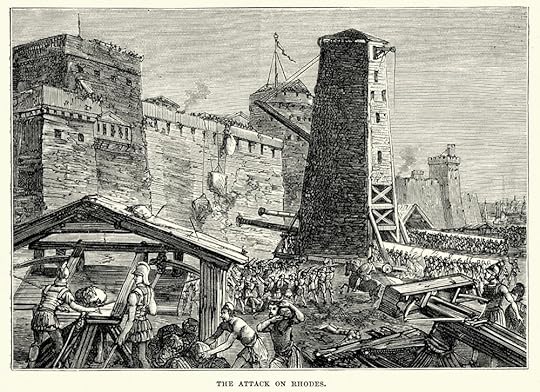
Lithograph of the Siege of Rhodes, English School, 19th Century. Source: See link under 'Helepolis' below.
The siege engine Helepolis (Greek: City Taker) was used in the siege of Rhodes and after the failure of that campaign, parts of it were used in the construction of the Colossus of Rhodes. Demetrius' flagship Hekkaidekērēs (Greek: The Sixteen) was considered the largest ever single-hulled warship built in the ancient world.
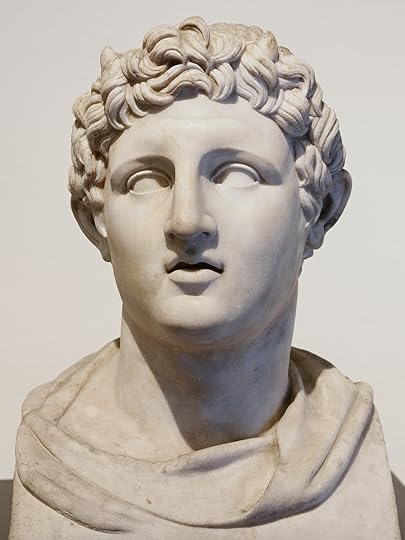
Bust of the divinised Demetrios Poliorketes wearing bull's horns. Roman copy from 1st century AD of a Greek original from 3rd century BC. Image sourced from Wikipedia.
Footnote * Ittimenos (Greek: Loser)
Although it seemed like a long catalogue of failed campaigns, I still enjoyed reading this further book in the Yale University Press' Ancient Lives series. I had previously read Vergil: The Poet's Life and Cleopatra: Her History, Her Myth.
Romm again proves to be a master storyteller. I'm convinced that the reason I don't like Greek historical fiction is because none of the fiction books are as interesting or as good as the nonfiction ones.
Demetrius is by turns a genius engineer and lothario rube and there is no way to predict how his life ends up based on how it begins.
Cassander and all Antipatrids (except daddy Antipater) suck.
This is a book about the life and times of Demetrius Poliorcetes “the Besieger”, son of Antigonus One-Eyed and one of the main heirs of the Diadochi.
A savior given divine honors by some and a creature of pure ambition, determination and sheer will, qualities that earned him the hatred of others. Demetrius led a very eventful and interesting life in a zigzag career that landed him at rock bottom at different times and propelled him to the heights of favor at others. He was a man of superb technological ingenuity and military engineering skill who supervised the creation of giant ships and machines of domination on both land and sea. It was this resourcefulness that earned him his most lasting epithet, a testament to a reputation built on battering at the walls of Salamis, Sidon, Rhodes, Messene, Thebes and plenty of other places.
Though this narrative is short and mainly focused on Demetrius it still offers some useful glimpses into the post-Alexandrian world order. We see a brand new world dominated by mass-Hellenized armies in the service of self-proclaimed kings, bound to their rulers by little more than the promise of plunder and success. This account also aptly testifies to a multipolar world in action, a world split five ways in which whenever one ruler seemed to be gaining in strength or ambition, the others banded together to counterweight him.
Whether it is writing about Thebes, Demosthenes or the fracturing of Alexander's kingdom, James Romm seems to have a pattern of focusing on tragic tales and tragic figures. And our Demetrius here is no different. I mean what's more tragic than aiming to attach Europe and Asia into a single entity only to end up partially responsible for your father's death and eventually ending your days in captivity? Yet again, in this book, like his other works, Romm manages to squeeze a captivating narrative out of the historical source material and bring an eventful era to life, painting its characters in the full colors of the human experience.
James Romm is the author of my favourite book of all time: Ghost on the Throne, so when I discovered he wrote a biography on the very intriguing character of Demetrius, I felt I needed to read this book. The events after Alexander the Great's death are thrilling and entertaining to read about, with a huge cast of very interesting and powerful players, each competing in the division of the spoils from Alexander's conquests.
Demetrius was one of these important characters, being the dashing, handsome and young son of the powerful Antigonus Monophthalmus (the One-Eyed). He fought together with his father first and later had to go at it alone. His life saw many failures, but also several successes and comebacks worthy of an epic play. According to Plutarch, Demetrius liked to quote a line from Aeschylus, addressing a personified Fortune: "You seem to both kindle my flame and blow it out." I feel there is no better line to describe his eventful life, fortune favoured him at different times, only to abandon him again, he had his comebacks but would eventually die in Seleucid captivity. He laid siege to so many cities (not always successful) that he became known as "The Besieger".
James Romm is a great writer who makes his work very approachable to the general reader. He is both entertaining and informative, sprinkling his book with many interesting anecdotes and quotations. However, I did feel that the first 40 pages or so were very chaotic and probably confusing to those who are not familiar with the Wars of the Diadochi. I know that you have to limit yourself in scope when writing a biography, but I felt that Romm could have done a better job in the beginning of the book. For the rest the book was really good and entertaining, I read it in only two days! That says a lot, four stars!
Demetrius, one of the Alexander wannabes of his time, spent his life trying to put the empire back together. In the course of this he developed a variety of siege engines and monster ships. Between wars, he indulged in excessive drink and sex. Not surprising that Plutarch paired his biography with that of Marcus Antonius.
Hellenistic Greece is not really my thing; I generally stick to Roman and classical Greek history. I picked this up because I liked the first book in the Ancient Lives series (Crassus). Romm writes in a lively style, skillfully elucidating the twists and turns of the Diadochoi through the life of Demetrius Poliorketes. He aims at general readers, but notes problems and gaps in our knowledge. The book is unobtrusively equipped with plenty of notes and bibliography for those who want to pursue specific topics in the sources or secondary literature.
As an opening point, I have to admit that I read the author's "Ghost on the Throne" about a decade ago, which deals with the political chaos following the demise of Alexander the Great, and it really didn't make that great of an impression on me. Possibly because I had yet to become a little better read about the period in question; a period that is inherently confusing.
That brings us to this book dealing with one of the contenders for overarching power in the era of the "Successors," and going from the general to the particular has served Romm well. It doesn't hurt that Demetrius, said sacker of cities, and his father Antigonus One-Eyed, are a particularly uproarious duo, in their quest to reunite all of Alexander's conquest under one throne. The reality being that despite the strategic central location of their territorial holdings, they could never quite make that advantage work for them.
However, in a certain sense, the Antigonids were some the most successful of these wannabe overlords. Yes, old-man Antigonus died in the battle at Ipsus, and Demetrius himself died a prisoner of Seleucus the First (though it was apparently a very comfortable house arrest), but the third in this line, Antigonus Gonatus (the "Knock-Knees?" (Romm can only shrug over that one)), made Antigonid control of Macedonia stick, and due to his family's program of political marriages was related to every other of the Successor families going forward.
Well-worth reading, after you've consumed a couple good books about Alexander.
Interesting persoective of the post alexander great turmoil and actually has some funny parts surprisingly, dragged on a little near the end but cool biography nonetheless
In Romm's short work on a lesser-known figure of the ancient world, Demetrius: Sacker of Cities is a well written history of the ups and downs of Demetrius I Poliorcetes' turbulent (and often opulent) life.
I was already familiar, at least as a history hobbyist, with the Wars of the Diadochi (the Wars of the Successors) over control of the Greek empire after the death of Alexander thanks to another book by James Romm, ‘Ghost on the Throne’ from 2011. I knew the five major players in the four-act drama of all-against-all, viz., Ptolemy in Egypt, Seleucus in East Asia, and Antigonus (one-Eyed) with Demetrius in West Asia, Cassander in Macedonia, and Lysimachus in Thrace. These were the five initial factions, not unlike the five families of the New York underworld. Demetrius I Poliocretes (aka The Besieger of Cities) was the son of Antigonus and thus a member of the next generation of would-be world conquerors and aspiring second-generation want-to-be Alexanders.
The First World War
This conflict spanned three continents and was effectively a world conflict in terms of the ancient world. This was a messy war in which Demetrius played the role of inveterate besieger, constantly charging at cities like Don Quixote tilting at windmills. As James Romm points out, Demetrius, and many of his fellow would-be world conquerors, were addicted to war and campaigning and preferred it to governing or reigning. These actors, these warlords, these would-be successors to Alexander’s empire fought each other on a continuous basis. These partitions notwithstanding, there was no effective ‘state’ as such in place. This working arrangement was more analogous to mafia turfs and warring gangs than to organized states or functioning governments. This was a history of people and personalities, not states and wars.
In-Between
This is a period of history that has always fascinated me, viz., the Hellenistic Age. This is the period beginning with the death of Alexander and ending with the death of Cleopatra. It begins with the end of the classical age but prior to the new world order of Rome. Greek dominance was becoming fragmented and stagnant, but Rome was not yet dominant. This was one of those rare periods of transition from one paradigm to another, an interregnum or a state of unsure in-betweeness, if I can put it that way. This period produced its own unique philosophy, art, and politics which I find both attractive and fascinating.
Counterfactuals
An obvious counterfactual embraces the death of Alexander. If Alexander did not die, it is likely that his empire would have held together under his leadership. But then what? Possibly the conquest of the west? This would have likely defeated Rome before it became powerful and thus prevented its eventual dominance. As such, perhaps Greek suppression of the Maccabees (radical Jewish cult) thus no Christianity and no Islam, all very desirable alternative outcomes in my opinion. The world could have avoided the three Abrahamic monsters. Perhaps Greek would have become the lingua franca in place of Latin in a Hellenistic world from the Atlantic Ocean in the west to the Punjab region of India in the east. No Jewish wars, No Christianization of Europe or the Americas, no Muslim conquest of the Middle East. It is also likely that Alexander would have conquered Arabia as well and I would have never been born to write this review – a good thing according to some Christians I know.
However, the counterfactual more relevant to this book is what would have happened if Antigonus and Demetrius won the battle of Ipsus in 301BC. This would have meant the defeat of Seleucus, Cassander, and Lysimachus. This would have given Antigonus and Demetrius a considerable force to then turn against Ptolemy in Egypt. A defeat of Ptolemy would have reunified Alexander’s empire under the still young and dashing Demetrius as the new Alexander.
Alcibiades rather than Alexander
Demetrius, putting together youth, dashing good looks, flowing hair, a faraway gaze and sexual prowess (important qualifications for leadership) was scheduled to be the new Alexander, but he was no Alexander, just an Alexander imitator. Alexander linked himself to the legend of Dionysus, and in imitation, the young and handsome Demetrius too had a turn at becoming the new Dionysus. But Demetrius stumbled, was stymied, and stalemated first in Egypt by Ptolemy, then in Rhodes, and again against Cassander in Thessaly and finally at the decisive battle of Ipsus in ways Alexander would not have been stopped. Alas, his failures were often a matter of hours and inches one way or the other. Demetrius was closer to being a new Alcibiades rather than a new Alexander. Plutarch paired Demetrius with Mark Antony in his ‘Parallel Lives’, not Alexander notably, because both squandered wealth, power and time in wine-soaked drinking binges, riotous behavior, and sex orgies, even if understandably with alluring and remarkable women, e.g., Antony with Cleopatra and Demetrius with Cratesipolis. Demetrius even tried to name a city after himself, but it didn’t stick. Both Antony and Demetrius became predatory, arrogant, and filled with a hubris that led to violence in pursuit of narcissistic ambitions. But then again, how else does one become be a god?
Liberty and Justice for All
This was a time when the Greeks started to embrace father and son savior gods and the deification of human beings. The once rational Athenians recognized Antigonus and Demetrius as their father and son Savior Gods in a leader cult along with Dionysus and Demeter – a new blurring and combining of terrestrial and celestial power - a portent of things to come in the ancient world still with us today. In much the same fashion American Christians worship Trump in a leader cult along with their Jesus as Savior Gods. American Christians do not understand that God cannot safeguard liberty and democracy because an all-powerful God is by definition an absolute ruler. The phrase from the U.S. Pledge of Allegiance “One nation under God, indivisible, with liberty and justice for all” is a prima facie contradiction, belief in an all-powerful God is inimical to human wellbeing. Current American politics is the result of this deep cultural contradiction and irreconcilable paradox. We live in a country craving cult leadership, not human liberty. At the least the Athenians had enough wits about them to occasionally through off their Savior Gods, not so with Christians, it pains me to say.
Good, but not one of Romm's best works. I think that is through no fault of his though. Personally, I found the boo to be too heavy in warfare, but that is Demetrius.
Demetrius, son of the one-eyed juggernaut Antigonus, began his career in the crumbling wake of Alexander the Great's demise, when the empire sprawled like a magnificent corpse no one quite knew how to divide.
At sixteen, Demetrius embarked on a secret voyage across the Aegean with his father, defying the new imperial boss, Perdiccas, and foreshadowing a lifetime of insubordination, theatrical entrances, and tactical exits. By his twenties, he accepted, under duress, a marriage to the thirty-something widow of Craterus, the very man his father had conspired to replace.
This bride, Phila, came with dowries in diplomacy and disillusionment, and Demetrius, ever the reluctant groom, responded with Euripidean puns and adolescent whining. When his father caught him in bed with a courtesan, Demetrius claimed fever; Antigonus dryly replied that he’d just met it walking out the door.
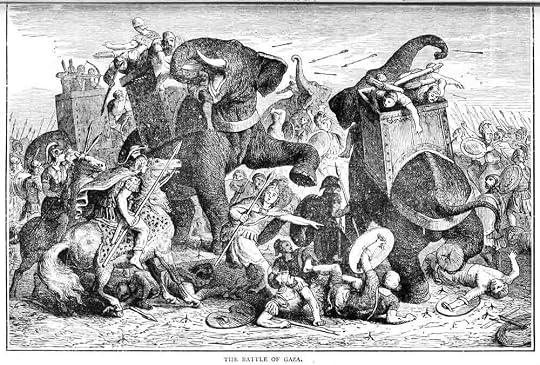
As Asia cracked under the weight of five men who each fancied themselves Alexander’s true heir, Demetrius auditioned for the part. He led armies, lost elephants, and field-tested spiked chains, turning his royal pachyderms into confused, wounded liabilities in his failed Gaza charge.
His experiments in siegecraft fared little better; his Nabataean campaign ended in humiliating retreat, his father's scolding, and a failed bid to extract asphalt from the Dead Sea. Yet in defeat, Demetrius sparkled - literally.
After being trounced by Ptolemy, he received back his personal effects (tent, silverware, pride) and graciously returned the favor after capturing Ptolemy’s general without a fight.
His victories were real, if occasionally accidental. After all, at Gabene, he stood beside his father as the elder Antigonus stole an entire army’s wealth by sneaking cavalry behind the dust cloud raised by elephants and seizing their baggage trains, leading to mutiny and the slow, quiet strangulation of Eumenes.
Then came Babylon. Demetrius marched in like a bold tourist and exited as a plundering invader, enriching himself but endearing the population to Seleucus, the crafty rival who would soon found a dynasty and a god-honored city.
Despite these setbacks, Demetrius kept swinging. In one brief Greek campaign, he threw an Athenian tyrant out the window and took to the stage in golden armor, announcing liberty while clearly enjoying the optics of conquest. He built siege towers taller than city walls, hoarded cities like medals, married and remarried with dynastic aim and carnal enthusiasm, and still found time to drop obscure literary puns on the battlefield.
Fathers built empires; sons hosted wine-fueled orgies in newly conquered capitals. And still, Athens named festivals after him.
The book details the hallucinations of a narcissist with a sword and an amphitheater subscription. Demetrius, half heartthrob, half hurricane, spends four decades pinballing across an empire too fragmented for one crown and too seductive for him to resist. “He never had peace, nor allowed any others to have it,” Romm writes, with what sounds like exhausted admiration.
Power is addictive, succession is bloodsport, and anyone following in Alexander’s footsteps should pack elephants, silver shields, a sarcastic father, and a funeral insurance policy.
One day when Demetrius ignored his father’s summons, claiming he had a fever, Antigonus went to the boy’s chambers and spotted a hetaera, a courtesan, furtively slipping away. As he entered his son’s room, Demetrius stuck to his story: “The fever has left me,” he declared. “Yes, I met it just now as it went out the door,” his father replied.
It is really really hard to come away from this book and not think – I could have just re-read Plutarch.
I accept that Romm sources more widely than Plutarch, applies more rigorous historiography, and is probably clearer with the narrative. Yet I really really find it hard to get away from regretting that I just didn’t read Plutarch.
Demetrius is an interesting character – not quite a freebooter as he had a semi-legitimate dynastical claim. He was also rarely totally bereft of a power base and therefore a player during the Successor Wars. However, Demetrius’ main noteworthiness is that he continued to exist for as long as he did, rather than any sustained (or possibly even momentary) periods of strategic success.
How much confidence did Demetrius inspire? He had failed to win in Egypt, at Rhodes, and most recently in Thessaly when facing Cassander.
I also feel Romm does not quite have the same energy as with Ghosts on the Throne - it’s a pretty straight man’s retelling, plus a little bit of titillation. The best stories sourced from… …Plutarch. I get the book is meant to be a precis of a moderately major character of the period, but Demetrius is probably better novelised – to really extract something from him, you probably need to go dramatic.
If you absolutely need your Diadochi fix from yet another shuffling round of sources that haven’t revealed anything new in the last century(? – more even?), sure, but realistically you should just read a general history (like Ghosts on the Throne!) and maybe an annotated copy of Plutarch. It is a good period to read about, just not via Demetrius.
I knew a little bit about how Alexander's empire was divided up among his generals after his death - Ptolemy in Egypt, Seleucus in Anatolia and the Middle East, and so on. I knew nothing of Demetrius. But I think that in my mind it had sorted itself out pretty quickly with a natural allocation of territories after a few skirmishes. It should have been no surprise to me that it was not that simple. There were many years of endless battles and jockeying for position among men whose lives were about fighting and conquest and who all saw themselves as being entitled to rule Alexander's empire in its entirety. Their troops loved their fighting, victories and plunder and so did the leaders. It was the only life that they knew. They couldn't happily rule in peace over a sizable chunk of the known world. Their ambitions drove them to want it all. Anyone who disbanded his army was prey for his rivals, and anyone who kept his army intact had to keep it fighting to control it. It must have been a hellish period for the people trying to live their lives in the vast regions around the Mediterranean and Middle East that were so long ravaged by these wars.
Demetrius was handsome and brave, skilled as a general, a leader and a diplomat, but he also had his setbacks. He couldn't sit still and consolidate his gains, and he was probably ultimately not so much as a civilian leader. In any case he had a serious addiction to war. He was like a gambler at the craps table who wins for a while, knowing full well that the only possible long run outcome is to go bust, but still continuing roll after roll after roll until the inevitable happens. Game over.
Demetrius, or Demetrius Poliorketes, or Demetrius the Besieger, has one of the most interesting histories of all the warlords who battled for European and Asian supremacy after the death of Alexander the Great in 323 B.C.
The bare outlines of his amorous affairs, military adventures and ultimate defeat hint at a hidden story of a fascinating individual in a turbulent time.
Sadly, James Romm adds almost nothing to that bare outline in his biography, which does an excellent job explicating the complex maneuvering of the Successors of Alexander as they intermarried, betrayed and otherwise engaged with their frenemies. Of course, it is hard to blame Romm, for history is written by the winners, and what histories of the Hellenistic Age (as the time is known) survive do not reveal much except the occasional lurid anecdote and military outcomes.
Still, as a sometime student of that period, I was hoping for more than a bland recital of alliances, battles and marriages -- but that was what I got. And for a reader less interested in the times, I fear that "Demetrius: Sacker of Cities" will be even less rewarding, though for some it may trigger a greater interest in a generally forgotten but surprisingly modern (globalization and the rise of women, to name just two) era.
Amazing storytelling brings the history and wars of Diadochoi to life. Hellenistic period deserves more books like this one. I can`t understand why the Hellenistic period, with such a rich array of adventures, intrigues, culture, sudden reversals of fortune, and so on, is so underrepresented in popular history books, historical fiction, or movies. It seems most people are far more interested in the classical Greek period, Greco-Persian wars, and then Rome as if nothing interesting happened in between. The Hellenistic period is intensely interesting and deserves Game of Thrones-like series and movies. In fact, quite often G.O.T., a fictional story, pales in comparison with real history, especially in the Hellenistic Period. While you won`t find dragons in history, I think war elephants are just as good!
Unfortunately, there are very few books on this character from antiquity. This books fills that gap. Having said that, this reviewer is careful to emphasize that this book is definitely not an opus on the subject, being only 224 pages. Despite being only that long, it touches upon the most important points and provides a relatively good biography that enables the reader to get a grip on this historical figure’s personality in only three or four hours of reading. On the negative side, the book is a bit dry but then again, considering it was written by an academic and was published by an academic press, this is to be expected. However, the positives far, far outweigh this relatively trivial weakness.
Here is the life story of a man who, as the junior part of a father-son team, attempted to reunite the empire of Alexander the Great. He had some successes and gained a bit of fame. After his father’s death, he continued the fight but failed, ending his days in prison, having founded a small dynasty that lived on until Rome brought it to an end. He had lots of cool toys, though.
The story of Demetrius doesn’t really stand out among the many contenders for supremacy after Alexander was gone, but what this book really seems to be about is filling in that chaotic stretch of history when a single great empire fragments into a collection of smaller empires that would eventually fall to the Romans and to the Parthians in the East.
An amazing read, the Yale Ancient Lives series again does not disappoint.
I have very little knowledge on the wars of the Successors and had never before heard of Demetrius. Now I have read this I am eager to read more upon the subject and learn even more about this time of nearly constant war, mistrust and uneasy alliances.
Structured in such a way that it reads amazingly, it made me want to not stop reading, not something I find I feel often. The actual Structure of the writing was something that made it easy to read but gave all the knowledge you would like.
Overall, a great instalment in a great series, I would whole heartedly recommend people read this book and series
This book is very thin, in both size and the depth to which it dives into the subject. More a string of facts with a few colloquial asides about how one development or another might have felt. It appears to be one of a series of Plutarch-like Lives. As such, it’s certainly interesting. However, it’s not satisfying for someone who wants the broader context of history such as material culture, philosophy and world view, archaeological record etc
Although the sub-title is misleading (let's be honest, Demetrius was ironically called "the Beseiger," so identifying him as a Sacker of Cities is quite the stretch. The one time he appeared to sack a city, it blew up in his face [figuratively, not literally]), this was an entertaining and interesting biography of a lesser known historical figure.
I knew Alexander left a mess when he died, but, wow, is that putting it mildly.
Pretty interesting given that I knew nothing about the subject. Romm is a good storyteller but I did find my attention drifting occasionally. Something about the pacing, unacknowledged gaps in the timeline. It inspired me to read Plutarch’s account, in part to see if Romm just “updated” the narrative Plutarch gives for modern minds.
A brilliant and entertaining biography of Demetrius - his dramatic life, complicated relationship and ambitious personality are highlighted here in a really accessible way! One of the better Diadoch biographies I have read.
A great introduction to a criminally overlooked era of history through the lives of one of that eras most fascinating characters, but anyone who's already knowledgeable on the topic probably won't learn much new with this book.
The Ancient Lives series has produced another great book. It tackles a fairly complicated subject and brings Demetrius into focus clearly while not losing the reader